Archive for Featured

Ryan Weathers Helps Padres Dodge Some Gloom

When the Padres stockpiled starting pitching and mapped out their season, they probably didn’t count on Ryan Weathers playing the stopper. Yet in a rotation with a former Cy Young winner, a four-time All-Star, and the author of the season’s first no-hitter, it was the 21-year-old southpaw — the majors’ youngest starting pitcher — who helped the Pad Squad turn the page on a 2-7 slide, a three-game losing streak, and some sobering injury news with 5.2 innings of one-hit shutout ball against the Dodgers at Chavez Ravine on Thursday night, part of a 3-2 win.

Making just the second start of his career, and matched up against Walker Buehler for the second time in six days, Weathers kept the Dodgers off balance with an effectively wild four-seam fastball/slider combo, mixing in the occasional sinker and changeup. While his low-spin four-seamer averaged a comparatively modest 93.7 mph and topped out at 95.9 mph, its exceptional horizontal movement helped him rack up 15 called strikes and four whiffs for a 41% CSW on that pitch, and an overall 33% CSW for the night.

Weathers threw 39 pitches in the first two innings, walking leadoff hitter Mookie Betts and plunking Max Muncy to start the second, but striking out Corey Seager, Sheldon Neuse, and Luke Raley along the way. The lone hit he gave up a sharp single to Buehler to start the third inning, but he got his pitch count in order by using just eight pitches to retire Betts, Seager, and Turner to begin his second time through the order, kicking off a run of 11 straight Dodgers he retired before departing in the sixth with a 2-0 lead. Read the rest of this entry »


Why Matt Carpenter’s Production Is Misleading (and Complicated)

There are two hitters I would like to introduce. The first, Player A, has been described in terms of the classic trio of statistics: average, on-base percentage, and slugging. The second, Player B, has been described in terms of modern metrics like Exit Velocity and Barrel rate. Take a look at their numbers and try to see who’s better:

Player A: .081/.205/.162

Player B: 95.4 mph Exit Velocity, 63.6% Hard-Hit rate, 27.3% Barrel rate

Not much of a competition, right? Without additional context, you probably chose Player B in a heartbeat. Player A’s appalling triple-slash makes him a DFA candidate. Player B, on the other hand, looks like a hitting genius! Those numbers and rates would place him well above the 95th percentile of all major leaguers. The twist, of course, is that these two hitters are in fact the same person: Matt Carpenter, veteran infielder for the St. Louis Cardinals.

Traditional and modern metrics do disagree at times, but the disparity between them is seldom this wide. Through 18 games, Carpenter’s efforts to clobber the ball have not translated into actual results, much to the chagrin of Cardinals fans. There’s having a stretch of bad luck, then there’s hitting below .100. Is there something else we’re missing? Read the rest of this entry »


Top 22 Prospects: Washington Nationals

Below is an analysis of the prospects in the farm system of the Washington Nationals. Scouting reports were compiled with information provided by industry sources as well as our own observations. As there was no minor league season in 2020, there are some instances where no new information was gleaned about a player. Players whose write-ups have not been meaningfully altered begin by telling you so. Each blurb ends with an indication of where the player played in 2020, which in turn likely informed the changes to their report if there were any. As always, we’ve leaned more heavily on sources from outside of a given org than those within for reasons of objectivity. Because outside scouts were not allowed at the alternate sites, we’ve primarily focused on data from there, and the context of that data, in our opinion, reduces how meaningful it is. Lastly, in an effort to more clearly indicate relievers’ anticipated roles, you’ll see two reliever designations, both on team lists and on The Board: MIRP, or multi-inning relief pitcher, and SIRP, or single-inning relief pitcher.

For more information on the 20-80 scouting scale by which all of our prospect content is governed, you can click here. For further explanation of Future Value’s merits and drawbacks, read Future Value.

All of the numbered prospects here also appear on The Board, a resource the site offers featuring sortable scouting information for every organization. It can be found here.

Read the rest of this entry »


The Strike Zone Is Imperfect, but Mostly Unchanged

The strike zone doesn’t exist. Not physically, at least; it’s a rough boundary that varies based on how each umpire looks at it and how each batter stands. Catchers influence the shape, too; smooth hands can turn balls to called strikes, while cross-ups tend to do the opposite.

This year, the zone seems particularly amorphous — maybe it’s just my imagination, but I feel like I can’t turn on a broadcast without hearing about an inconsistent zone. Of course, hearing isn’t believing, and there are botched calls every year. Just because there have been some memorable ones this year doesn’t necessarily mean the overall rate of missed calls has changed. Let’s find out if it has, or if it’s merely imaginations running wild with the backdrop of fan noise.

For a rough idea of ball/strike accuracy, I went to Statcast data. For every pitch, Statcast records a top and bottom of the strike zone, as well as where the pitch crossed the plate. Armed with that data as well as some constants like the size of a baseball and the width of home plate, I measured how far out of (or into) the strike zone each pitch of the 2021 season was when it crossed the plate.

This data isn’t perfect. The top and bottom of the strike zone are approximated, and the plate isn’t a two-dimensional object, despite the fact that our data on it is represented that way. We aren’t considering framing. But we have previous years of the same data, which is great news. We can use the previous years to form a baseline, then see if this year’s data represents a meaningful change. And because we have a huge chunk of data, we can at least hope that framing comes out in the wash. Read the rest of this entry »


Mookie Betts, Stephen Strasburg, and 2021’s Most Irreplaceable Players

Which players are most essential to their team’s postseason odds? While that list contains many of the best players in baseball, it’s not a strict ranking of the sport’s brightest stars. When looking at who is the most irreplaceable in the short-term, there are questions beyond just how good the player in question is. It becomes a matter of marginal utility. To a team already saddled with a doomed 2021 outlook, losing a star is unfortunate — obviously very much so for the player in question — but won’t really affect their chances of making the playoffs. The Colorado Rockies could build a time machine, kidnap Ted Williams, and stick a very confused Splendid Splinter in their lineup and it still wouldn’t change their near-term fate. And the same goes for teams at the opposite end of the spectrum — you can’t tip over your house with a leaf blower.

Of course, some teams are simply better equipped to deal with these kinds of nasty surprises than others, able to rely on enviable depth to weather absences. Two such nasty surprises have happened recently and illustrate the point well, albeit in opposite directions. Stephen Strasburg of the Washington Nationals was placed on the Injured List with shoulder inflammation after a mess of a start that saw him caught rubbing his shoulder on camera. (For more on the Strasburg injury, check out my colleague Jay Jaffe’s piece discussing what it means to Washington.) Another scare involved Mookie Betts, who took a hard, high-and-in offering from Rafael Montero directly on his forearm.

Luckily, Betts’ injury seems unlikely to sideline his for long — Dave Roberts says he expects him back later this week — but even if it had meant a longer absence, the Dodgers would have had little need to panic. Even in the worst-case scenario, where the team loses him for the rest of the season, it’s hard to derail this playoff train; the ZiPS projections have their playoff probability collapsing from 99.6% to…97.5%. A drop-off of two percentage points is a relatively minor one, smaller than the projection change if the White Sox lost Adam Eaton or the Astros had to suddenly replace Yuli Gurriel. Presumably, we have unanimous agreement that Betts is easily the most valuable player listed here.

The Nationals, on the other hand, are very reliant on their stars. Should they lose any of their key players — mainly Strasburg, Juan Soto, Trea Turner, Max Scherzer — it would nearly doom their October hopes. Soto joined Strasberg on the IL yesterday after suffering a strained left shoulder. Losing him for the duration would cause the club to miss the playoffs in 81% of the simulations in which the Nats would otherwise make it.

As steep as that sounds, from a quantitative standpoint, losing Soto isn’t the biggest possible loss in baseball in terms of playoff probability; ZiPS already sees the Nats having an uphill climb at 12.2%. The teams that have the most to lose are those with two key elements: a playoff fate that is very much undecided and and a lack of ready replacements elsewhere in the organization. So, as of Tuesday morning, here are baseball’s most irreplaceable players. The below changes in playoff odds assume a season-ending injury and the use of an in-house replacement. Just to illustrate how changeable this list is, only two of the top 10 are repeats from 2020.

ZiPS’ Most Irreplaceable Players, 2021
Rank Player Team Playoff Odds Before Playoff Odds After Difference
1 Mike Trout Los Angeles Angels 49.5% 14.0% -35.5%
2 Gerrit Cole New York Yankees 68.0% 38.5% -29.5%
3 Ronald Acuña Jr. Atlanta Braves 61.4% 33.1% -28.3%
4 Alex Bregman Houston Astros 52.0% 23.9% -28.1%
5 Jacob deGrom New York Mets 89.6% 64.6% -25.0%
6 Carlos Correa Houston Astros 52.0% 27.9% -24.1%
7 Luis Robert Chicago White Sox 69.2% 46.0% -23.2%
8 Byron Buxton Minnesota Twins 68.2% 45.5% -22.7%
9 Anthony Rendon Los Angeles Angels 49.5% 27.7% -21.8%
10 Freddie Freeman Atlanta Braves 61.4% 39.7% -21.7%

Mike Trout, Los Angeles Angels (-35.5%)

As the best player of his generation, Trout has a way of finishing at the top of lists, but his placement here is actually fairly unusual. He has sometimes missed this ranking completely, as the Angels have an impeccable record of building inadequate teams around their franchise player. But the AL West is open enough, and the Angels are good enough, that this is the year they really can’t afford to lose him. Trout going down would already be a huge loss even if the Angels had an extra league-average outfielder hanging around the roster. But with the likely in-house solution being to shuffle around the outfield, resulting in more playing for Juan Lagares and some combination of Scott Schebler and eventually Taylor Ward, that’s not the team’s situation.

Gerrit Cole, New York Yankees (-29.5%)

That Cole ranks so highly is not a slight on the quality of the Yankees’ starting pitching. They’re actually quite deep with interesting, talented arms who could step in if the worst should happen and they lose their ace. What is a problem is that after Cole, the Yankees have a lot of pitchers with spotty injury records. ZiPS already assumes that the team will have to turn to that depth multiple times before 2021’s final pitch is thrown. To lose the guy they want to set-and-forget at 200 innings would be a big blow. Complicating the picture is that while the Yankees are still the favorite, their slow start does matter and means that they’ve already lost a good chunk of their margin for error over the Rays, Blue Jays, and Red Sox in the division.

Ronald Acuña Jr., Atlanta Braves (-28.3%)

Acuña wasn’t the National League MVP in 2020, but he’s certainly the player I’d least like to lose if I owned the Atlanta Braves. All the projection systems love him for obvious reasons, but none more than ZiPS, which sees him as the only player in baseball to have non-laughable odds of becoming baseball’s first 50/50 club member. Drew Waters, Ender Inciarte, and Guillermo Heredia could replace the at-bats, but none of them have the recipe to replace the awesomesauce Acuña uses to feast on opposing pitchers.

Alex Bregman, Houston Astros (-28.1%)

Houston’s rotation depth over the last four years has descended from utopia to yikes and now the team’s offense is absolutely crucial to the Astros playing October baseball. The franchise’s offensive core may have originally been led by Jose Altuve and then Carlos Correa and George Springer, but Alex Bregman is now The Man, the hitter they can least afford to have missing from the lineup. ZiPS sees Aledmys Díaz and Abraham Toro as better-than-replacement talent, but Houston’s unlikely to run away with the division the way it has in some recent seasons, making every win crucial.

Jacob deGrom, New York Mets (-25.0%)

deGrom drops from first to fourth on the list, but that’s not due to any decline in his performance. Rather, with the Mets under new ownership, the team didn’t go into the season with five starting pitchers who looked good on paper and a roster that couldn’t withstand injuries to the rotation. This time around, the Mets actually have options. None of them could fully replace deGrom, mind you, but plenty could at least be respectable fifth starters on a good team.

Carlos Correa, Houston Astros (-24.1%)

Given Correa’s injury history, the fact that he ranks highly on a list like this should greatly concern the Astros. ZiPS sees Bregman as the clearly superior player but also sees the options after Correa as less enticing. Díaz isn’t a particularly good defensive shortstop, and Toro wouldn’t be an option at the position. Alex De Goti has interesting power but is a massive downgrade from Correa. Houston would likely have to explore a trade if misfortune befell Correa, but the team may have other needs, so that’s not a great scenario either.

Luis Robert, Chicago White Sox (-23.2%)

From a straight-up projection standpoint, Robert falls short of most of the names on this list. Just on the Sox, ZiPS thinks Lucas Giolito is a significantly more valuable player overall, at least when he’s not pitching in the morning. But if something should happen to Giolito, Chicago has spare arms to patch up the hole. If the team loses Robert, let’s just say ZiPS does not have a case of Leurymania or Engelalia. The race with the Twins is likely going to be a tight one and the Royals have shown surprising spunk. The White Sox could ill afford an injury to their center fielder.

Byron Buxton, Minnesota Twins (-22.7%)

Is this the year that Byron Buxton finally stays healthy and is awesome? In just nine games, he’s already collected an impressive 1.5 WAR! Buxton will fall off from his 15-WAR pace, of course, but a lot of the scenarios in which ZiPS sees Minnesota taking down Chicago involve a solid season from Buxton. Even if his offense regressed hard toward his career 93 wRC+, the team would struggle to replace his glove, which has remained a major plus even through his various injuries.

Anthony Rendon, Los Angeles Angels (-21.8%)

To nobody’s surprise, Rendon isn’t quite the player that Mike Trout is. But the Angels have real playoff hopes, and even with the team having better replacements for injured infielders than outfielders, it would struggle to replace Rendon. Franklin Barreto’s elbow is enough to just squeeze Rendon onto this list, where he’d otherwise finish 12th, with Gleyber Torres taking the 10-spot.

Freddie Freeman, Atlanta Braves (-21.7%)

I love Pablo Sandoval, but not as my starting first baseman. Nor would Austin Riley playing first (with Johan Camargo, Orlando Arcia, and Ehire Adrianza pitching in at third) remedy the situation. Freeman’s the best first baseman in baseball, and even if the position isn’t as important as it was 40 years ago, he’s a crucial part of the lineup.


Loss of Strasburg Is Just One of Nationals’ Rotation Problems

The Nationals can’t seem to buy a break. After the start of their season was delayed by a COVID-19 outbreak that sent nine players to the injured list, they’ve gone just 5-9, sliding into last place in the NL East and posting the league’s second-worst record and run differential (-22). A rotation that was supposed to be one of the majors’ best has instead been the worst, with Patrick Corbin looking for answers, Jon Lester set back multiple times, and Stephen Strasburg now sidelined due to shoulder inflammation.

As a unit, the Nationals’ rotation has the majors’ highest ERA (5.34), FIP (5.36), and home run rate (1.91 per nine), as well as the lowest WAR (-0.4). Those numbers look even worse without Max Scherzer: 7.80 ERA, 6.58 FIP, 2.7 HR/9, -0.7 WAR. Throw in lousy work by the bullpen (4.18 ERA, 4.64 FIP, -0.2 WAR) and a moribund offense that has scored just 3.64 runs per game (11th in the NL) while being shut out three times (tied for the major league high) and you have a recipe for yet another cold start by Washington.

Forced to wait five days by an outbreak that postponed their entire season-opening series against the Mets, the Nationals hit a high note in their first game of 2021, overcoming a rocky Scherzer start to come from behind and beat the Braves in their April 6 season opener on a walk-off RBI single by Juan Soto. From there, however, they proceeded to lose five straight to the Braves and Dodgers before rebounding to take two out of three from the Cardinals in St. Louis, and split a four-game series against Arizona.

An offense that has scored just 3.64 runs per game (11th in the NL) has been a concern, but the bigger one has been the ineffectiveness of both Strasburg and Corbin, the other two-thirds of a trio that propelled the team to its 2019 World Series win as well as the number five ranking among rotations in our preseason Positional Power Rankings. Read the rest of this entry »


Julio Urías, (Breaking Ball) Fusion Scientist

Julio Urías is only 24, but it feels like he’s been in the big leagues for a decade. Called to the majors at only 19 in the 2016 season, he’s been a part of the Dodgers’ future and present for a half-decade. When you start that young, much of your development happens at the major league level. In Urías’ case, that means all kinds of changes. Today, though, I want to focus on one: a curveball that has shape-shifted over time before arriving at a tremendously interesting final form.

When Urías came up, he threw a curve with two-plane break, something between a curve and a slurve. As you can see on our handy Pitch Type Splits, it featured 7.4 inches of horizontal break and only 2.9 inches of drop. In his next three seasons, all injury-affected, he turned the pitch into more of a classic curve — more drop than horizontal movement. 2020 saw a return to his original curveball shape. 2021? Well, it’s weird:

Curveball Movement by Year
Year H Mov (in) V Mov (in)
2016 -7.4 -2.9
2017 -4.2 -5.5
2018 -4.5 -5.7
2019 -4.2 -6.5
2020 -9.1 -4.1
2021 -8.6 -1.4

Is it a return to his old form? Is it an acceleration of his old form? Is it something else entirely? Let’s delve too deeply into some gifs and math and find out. Read the rest of this entry »


The Yankees Have Been Bronx Bummers So Far

The Yankees hit bottom this past weekend, not once but multiple times. Projected to be the AL’s best team, they’re instead the worst thus far, with a 5–10 record and a five-game losing streak. On Friday, they played so badly against the Rays that Yankee Stadium fans started hurling baseballs back onto the field, and afterwards, manager Aaron Boone dressed his players down in a closed-door meeting. In terms of outcomes, the stern lecture didn’t help, as the Yankees lost again on Saturday and Sunday, making it the first time they’ve been swept this year.

Friday night’s game saw the Yankees fall behind almost immediately, as opener Nick Nelson surrendered hits to the first three Rays he faced, capped by a two-run double by Brandon Lowe. He escaped without further damage, and Michael King entered to throw three shutout innings, but the Yankees managed just one hit in six innings against Rays starter Michael Wacha. When King departed, errors by Gio Urshela and Rougned Odor helped the Rays roll up four runs against Luis Cessa and then two against Lucas Luetge to pull ahead 8–0. The Yankees finally got on the board via a seventh-inning two-run homer by Giancarlo Stanton, but by the eighth, fans were disgusted enough to throw maybe a dozen baseballs on the field in the general vicinity of the Rays’ outfielders, halting play for a couple of minutes:

Read the rest of this entry »


Aaron Civale Has Overhauled Everything

If you take a quick glance at Aaron Civale’s 2021 numbers, nothing looks out of the ordinary. Yes, the 2.18 ERA signals a stellar start, but with strikeout and walk rates relatively in line with his career numbers, you wouldn’t suspect that Civale has undergone a host of changes to both his repertoire and his delivery. But look beyond the numbers to the guy on the field, and it’s clear that he’s undergone a rather obvious change in his process and approach, one that merits further analysis.

Coming into the season, Civale was mainly a sinkerballer, though that requires a rather liberal definition of the word “mainly.” Civale threw his sinker, cutter, and curveball to batters of both handedness, and supplemented those main offerings with a side of slider to righties and a side of changeups to lefties. That mix of speeds and movements put him in an interesting class of pitcher:

Five Frequent Offerings
Pitcher FIP WAR
Yu Darvish 2.23 3.0
Hyun-Jin Ryu 3.01 1.8
Max Scherzer 3.46 1.8
Aaron Civale 4.03 1.2
Kyle Freeland 4.65 1.0
Mike Fiers 4.94 0.6
Danny Duffy 4.75 0.6
Johnny Cueto 4.64 0.5
Adrian Houser 4.82 0.4
Jon Lester 5.14 0.2
Tyler Alexander 5.26 -0.1
Alex Young 5.57 -0.2
Tanner Roark 6.86 -0.6
Total 4.41 10.3
Pitchers with five pitches thrown at least 100 times, 2020

As you can see, Civale was one of 13 pitchers to throw five different pitches at least 100 times last season. This isn’t a group of particularly good or bad pitchers. In fact, combined, these 13 had a FIP- of exactly 100. And though Civale had a solid 2020 season, it’s not as if his 4.74 ERA, 4.03 FIP, and 22% strikeout rate scream ace.

What is interesting about Civale is that he has changed so dramatically year-over-year. Though he threw five different pitches fairly frequently, it is Civale’s sixth pitch — his four-seam fastball — that is in the spotlight so far this season. After throwing just 58 total four-seamers out of a total of 2,064 pitches over his first two seasons in the majors, Civale has already thrown 83 in his three starts this April. Still, that’s not the only change he has made (pun fully intended). Civale has ditched his traditional changeup in favor of a split-change and has all but stopped throwing his sinker. His yearly pitch type chart is extraordinary:

That’s not all. Civale also completely revamped his delivery, adopting a shorter arm action. It’s the same mechanical change Lucas Giolito made going into the 2019 season, greatly contributing to his development into a frontline starter. In a similar move, Civale went from being a long-windup, over-the-top pitcher last season to one who is now a side-stepping short-armer.

“That will be my windup for the year,” Civale told reporters, including Mandy Bell of MLB.com, this spring. “I did a lot of my work out of the stretch in the offseason. Changing my arm path, I didn’t want to add any rotation into my delivery that could alter that. Just decided to keep it simple. I didn’t do too much work on that windup, it’s just a little stutter-step. Not really shifting too much weight. A lot of the work I did to transition to the new arm path was out of the stretch. Less movement is less chance for error.”

Here’s 2020:

And now 2021:

Given how much Civale changed, the title of this article may actually be an understatement. One could argue that he is a completely different pitcher now. It’s hard to know exactly what results those changes will bring, and considering how different he has become, it’s interesting that his numbers are almost identical to last year’s thus far.

Still, it’s worth examining the early returns on an individual pitch level — even if the samples are minuscule — and comparing those to previous seasons. First, let’s look at the exchange of the sinker for the four-seam fastball, a rather common move by pitchers over the last few seasons as sinkers across the league continue to get crushed.

2020 Sinker vs. 2021 Four-Seamer
Pitch % of Total MPH wOBA xwOBA Whiff% CSW%
2020 Sinker 28.9% 91.8 .359 .358 11.3% 34.0%
2021 Four-Seam 29.6% 91.3 .293 .361 31.8% 25.3%

Admittedly, the number of both pitches he’s thrown is small. But, at least so far, what is interesting is that the pitches have generated rather similar quality of contact results. While Civale’s four-seamer has performed better from a wOBA standpoint, the two pitches have almost identical xwOBAs. Also striking is that Civale’s CSW% from his 2021 four-seam is lower than on his 2020 sinker, despite generating a whiff almost three times as often. Indeed, Civale already has 14 whiffs on his fastball this season, out of 44 total swings; last year, his sinker generated just 15 whiffs on 133 swings. That is a marketed improvement.

Additionally, while neither Civale’s fastball nor sinker will blow by hitters in the low-90s, the four-seamer’s movement profile is noteworthy. Kevin Goldstein recently wrote about the importance of fastball shape, and indeed, Civale’s pitch looks not-too-dissimilar from the 2016 Marco Estrada example he was highlighted. 2021 Civale is on the left, and 2016 Estrada is on the right:
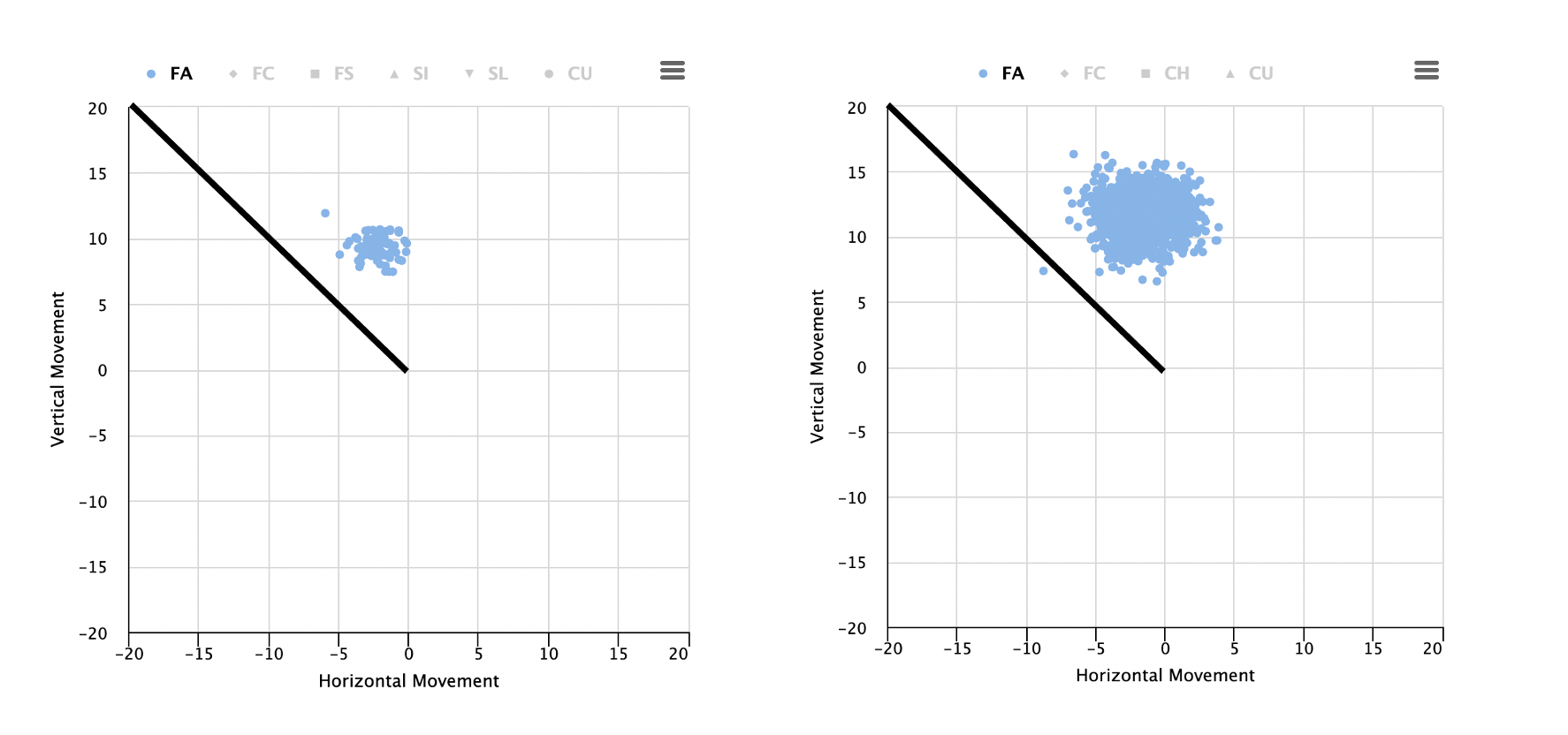
Of course, Civale doesn’t quite match Estada in the vertical movement department. But there’s clearly a similarity between the two in terms of raw, non-velocity-adjusted rise. Even after adjusting for velocity, however, Civale still generates about 5% more rise on his fastball than average, which definitely represents better pure stuff than his sinker, which generated 8% less sink than average. Indeed, as we would expect, there are signs that hitters will be popping him up. Civale is currently in the 75th percentile in average launch angle off of the four-seam fastball and has also been a big proponent of the lazy fly ball, ranking 16th in average exit velocity allowed on all air contact.

Then there’s the changeup, which — as Civale noted himself — is now a split-change. With the adjustment, it might have become his best pitch, or at least gives him a second strong offering in addition to the cutter. By our pitch values, Civale’s 2020 changeup was worth 1.6 runs above-average per 100 pitches. So far in 2021, his “split” has been worth 4.3 runs per 100. While we are again dealing with small sample caveats, here is what the quality of contact numbers look like year-over-year:

Changeup vs. Split-Change
Pitch % of Total MPH wOBA xwOBA Whiff% CSW%
2020 Changeup 9.2% 85.3 .155 .272 34.1% 31.8%
2021 Split-Change 18.2% 84.6 .146 .174 17.9% 19.6%

Again, we can’t yet draw firm conclusions from the wOBA and xwOBA data, though in the early going, it seems as if Civale has made what was a good pitch even better. Similar to the fastball/sinker chart, though, Civale is struggling in the CSW% department, with his former pitch performing much better than his new one so far. It very well could be noise, or it could still be him getting used to the new delivery; it’s worth noting that his overall CSW% is down six points from 2020 to ’21 as well. Nonetheless, to the naked eye, it definitely looks like he is getting more bite on the change; it’s dropping by about four more inches this year on average.

Here’s Civale’s 2020 change:

And here’s his 2021 split-change:

What do we make of all of this? It’s hard to know. There are so many moving parts, and it’s still early in the season, after all. But if you like pitcher reboots, you should definitely be paying attention to what Civale has done. I am not sure I have ever seen a pitcher change so much in just one offseason. I’m curious to see how it works out for him, and, really, I’m fascinated by his willingness to overhaul everything in an attempt to become a more effective player.



Sunday Notes: Cesar Valdez’s Powerful Paralyzing Perfect Pachydermous Percussion Pitch

Cesar Valdez’s name has graced this column a handful of times over the past year, most recently a month ago when I asked him about his powerful paralyzing perfect pachydermous percussion pitch. (No, the Baltimore Orioles reliever doesn’t actually call it that, but given that Bugs Bunny changeups make up the lion’s share of his deliveries, he arguably should). Since the start of last season, Valdez has thrown the mesmerizing offering an eye-popping 83.1% of the time.

The Red Sox have faced the 36-year-old slow-baller on three occasions so far in April, so I asked Boston hitting coach Tim Hyers what kind of advice he gives his charges when Valdez is on the bump.

“First, it is totally different in the batter’s box than it is watching video,” responded Hyers. “I can tell you that.The first time we faced him, the hitters were like, This is not your typical changeup.’ It’s almost like a unique curveball, because it gets to home plate and just dives. And at times it can dive both ways; it can break in, or break out. The guys have probably talked about him more than anybody else so far this season.

“It’s kind of an illusion,” continued Hyers. “You have to wait one tick longer in the contact point to get your swing off. It’s been helpful for us to face him [multiple times in a short time period], but it’s definitely very unique and challenging for hitters to face a guy like that.” Read the rest of this entry »