Archive for Featured

Dear MLB: Please Fix The Slide Replay

In one of the craziest, weirdest, most bizarre baseball games anyone has ever seen, the Cubs beat the Nationals 9-8 tonight, advancing to the NLCS. The game had everything you could think of and then some: catcher’s interference, RBI strikeouts that maybe shouldn’t have counted, Max Scherzer hitting a batter to force in a run, and Michael Taylor hitting a bomb on a pitch at his eyes. But, unfortunately, the lasting memory of this game might just be that MLB’s replay rule on slides into a base still sucks.

Read the rest of this entry »


2017 NLDS Game 5 Live Blog

5:07

Jeff Sullivan: Hello friends

5:07

Jeff Sullivan: Welcome to NLDS Game 5 Live Blog

5:09

Jeff Sullivan: Currently just trying to get my stream to actually work, so in the meantime, let’s entertain ourselves with some polls!

5:09

Jeff Sullivan:

Who do you think is going to win?

Cubs (70.2% | 165 votes)
Nationals (29.7% | 70 votes)

Total Votes: 235
5:09

Jeff Sullivan:

Who do you actually want to win?

Cubs (38.8% | 96 votes)
Nationals (61.1% | 151 votes)

Total Votes: 247
5:11

Jeff Sullivan: Well right now I’m being frustrated by my own technology so I hope you’re having fun!

Read the rest of this entry »


Let’s Watch Brett Gardner Work a 12-Pitch At-Bat

In the ninth inning of Game 5 on Wednesday night, Brett Gardner batted against Cody Allen for nine minutes. The Yankees were looking to add to a one-run lead, while the Indians were an out away from getting to give it one more try against the hardest-throwing pitcher in the world. Gardner batted with two runners on, and as his at-bat grew longer and longer, there was an increasing sense of urgency. Gardner batted for nine minutes after Todd Frazier had batted for five minutes, and it all meant that Aroldis Chapman was spending more time not throwing. More time cooling off. As Gardner saw pitch after pitch after pitch, insurance felt more and more critical. Chapman might come back out feeling too cold. You don’t want a pitcher sitting for half of an hour.

The last pitch was the twelfth pitch, and the twelfth pitch was fateful. Gardner lined a single into right, and since the count had been full, the runners were running. Aaron Hicks had no problem scoring from second, and to make matters worse for the Indians, an error allowed Frazier to also slide home. That last run was only salt in the wound; Hicks’ run felt like the killer. Although you can never know for sure, and although it was just last postseason that Chapman suffered a stunning blown save in the same ballpark, anything beyond a one-run margin felt insurmountable. For all intents and purposes, Brett Gardner ended the ALDS.

For Gardner, it was his longest plate appearance since 2014 — but for another 12-pitch at-bat he’d had in the fifth inning. For Allen, it was his longest plate appearance since 2012. It was the kind of at-bat that tempts you to read too much into it — to say things like, “there’s your proof that the Yankees don’t quit,” or “the Indians can never close anything out.” You shouldn’t give in. The at-bat didn’t mean anything larger. It was just an incredible at-bat, in a critical situation. And I’d like to go through it, pitch, by pitch, by pitch.

Read the rest of this entry »


2017 ALDS Game 5 Live Blog

8:04
Dave Cameron: Happy Game 5 Day everyone!

8:04
Dave Cameron: This should be a fun one.

8:04
Dave Cameron: And barring the most Nationals 9th inning ever, we’ll get another Game 5 tomorrow.

8:05
Dave Cameron:

I am rooting for

Cleveland (51.3% | 152 votes)
 
New York (48.6% | 144 votes)
 

Total Votes: 296
8:05
Dave Cameron:

I think

Cleveland will win (57.6% | 166 votes)
 
New York will win (42.3% | 122 votes)
 

Total Votes: 288
8:06
Dave Cameron:

CC Sabathia gets how many outs

Less than 3 (4.0% | 11 votes)
 
4-6 (12.8% | 35 votes)
 
7-9 (31.1% | 85 votes)
 
9-12 (29.3% | 80 votes)
 
12-15 (14.6% | 40 votes)
 
16+ (lol sure) (8.0% | 22 votes)
 

Total Votes: 273

Read the rest of this entry »


The Yankees Have Shown Us the Future

The Yankees gave us a glimpse of the future on Monday night, demonstrating how a game of ever-increasing extremes is only likely to continue trending in that direction.

No, this isn’t about bullpenning, a strategy that the club almost accidentally employed in the Wild Card game against Minnesota and that they ought to use again in Game 5 tonight. Rather, this is about fastball velocity.

The Yankees’ average fastball in Game 4 against Cleveland traveled at 98 mph. Ninety-eight! New York pitchers failed to throw a single fastball under 96 mph.

That’s kind of terrifying.

Read the rest of this entry »


The Dodgers Are Frightening Again

Kenta Maeda has helped resuscitate the bullpen after a tough September. (Photo: Arturo Pardavila III)

The Dodgers have had one of the weirdest seasons I’ve ever seen. Through August 25th, they were 91-36. And then, out of nowhere, they proceeded to lose 16 of 17, looking like one of the worst teams in baseball for almost three weeks. Their spot in the postseason was already secure, but their late-season collapse created an easy narrative that the Dodgers were headed for another playoff disappointment.

And when they drew the Diamondbacks — a club that had beaten them 11 of 19 times during the regular season, including six losses late in the year — in the first round, the narrative got even easier. The upstart team that wasn’t supposed to be here, the one that made the big left-field upgrade in July, would take down their division rival. The Dodgers might have been the better team in the first half of the year, but the Diamondbacks were ready to prove by way of their stronger finish that they were more equipped for October.

Well, so much for all that. Last night, the Dodgers completed a three-game sweep of the team that supposedly had their number. Once again, they look like the hottest team in baseball.

With these three victories, the Dodgers have now won nine of their last 10 — or 11 of their last 13, if that sounds more impressive to you. For the last two weeks, the Dodgers have again looked like the juggernaut that was in pursuit of the all-time win record at one point. And thanks to a few key changes, they look like a very scary NLCS or potential World Series opponent.

Yu Darvish Looks Fixed

When the Dodgers acquired Yu Darvish at the deadline, there were some legitimate concerns about his season to that point. His strikeout rate was trending down, and in July, he posted his worst monthly totals of his career. After a dominant debut in Dodger blue and a decent follow-up, his next four starts were even worse than the end of his Rangers run.

Over the course of four starts from August 16th through September 8th, opposing batters hit .346/.414/.679 against Darvish. That’s a .450 wOBA allowed; Mike Trout’s career wOBA is .412, for reference. Darvish’s walks were up, his strikeouts were down, and his home-run rate was through the roof. He looked nothing like the second ace for which the Dodgers were hoping.

But as quickly as he turned into a batting-practice machine, Darvish has snapped out of his slump, and last night was the culmination of a four-start run that has basically been the exact opposite of the stretch that preceded it.

In his final three starts of the regular season, Darvish allowed just two runs in 19.1 innings pitched, running a nifty 21/1 K/BB ratio in the process. He didn’t allow a single home run in any of those three starts after allowing at least one in each of his five previous starts.

Darvish did finally give up another home run last night — to Daniel Descalso of all people — but he was otherwise completely dominant, striking out seven of 18 batters. Though his night ended with a scary hit-by-pitch, he pushed his K/BB ratio over his last four starts up to 28/1. Opposing batters have hit .132/.163/.181 against Darvish over that stretch.

This Darvish looks like the guy the Dodgers thought they were acquiring. And having another dominant starter like Darvish makes this the scariest rotation left.

The Bullpen Got Sorted Out

One of the main reasons for their late-season losing streak was the inability to hold a lead, as nearly every pitcher tasked with getting the ball to Kenley Jansen failed. If you watched the Dodgers in September only, you’d think Dave Roberts would be forced again to use Kenley Jansen in the seventh inning throughout the playoffs, lacking trust in any of his middle relievers to bridge the gap after the starters were pulled.

This group, though, not only looks like they can be trusted; they actually look like a strength.

The big addition for October was Kenta Maeda’s move to the bullpen, since the team decided they’d be better off with him there than potentially just starting Game 4. And he couldn’t have looked better in the NLDS. In two outings, he faced six batters, retiring them on four strikeouts and two ground outs. A guy who averaged 91.5 mph with his fastball as a starter sat at 94 and topped out at 96 in his inning of relief, and his swing-and-miss slider rolled through the heart of the Diamondbacks order in his first outing.

This entire postseason, we’ve seen what good starters can do in shorter relief outings, and adding Maeda as a hard-throwing strikeout guy gives the team a quality bullpen option it didn’t have in the regular season. And paired with Brandon Morrow’s 100 mph fastball and an apparently fixed Tony Cingrani, the Dodgers now have three reliable middle relievers to get the ball to Jansen.

For all the talk of the dominance of the Yankee relievers this week, it’s actually LA’s relievers who’ve posted the lowest OPS allowed of any relief corps in the postseason so far, having held the Diamondbacks to just a .507 OPS in their 11.2 innings of work.

Pedro Baez might be on the roster, but the NLDS made it clear how Roberts is going to manage his bullpen when he has a lead. And with Morrow, Cingrani, Maeda, and Jansen, the Dodgers look like they have enough bullpen arms to keep it from being just the Kershaw and Jansen show again.

They’re Resting Up

The Dodgers won their division series last year, too, but to do it, they required 101 pitches from Clayton Kershaw in Game 1, 110 pitches on three days’ rest in Game 4, and then a memorable bullpen appearance in Game 5. Jansen’s totals are almost as absurd; he went 27 pitches in Game 1, 16 in Game 3, 13 in Game 4, and then 51 more pitches in Game 5, on his third consecutive day of work.

By the time the NLCS started, the Dodgers were running on fumes. They just couldn’t match a deeper Cubs team that had finished off the Giants in four games and got to rest before the showdown for the pennant. While no one can say definitively why Kershaw got lit up in the series clinching defeat in Game 6, it was unreasonable to expect Kershaw and Jansen to carry the team by themselves indefinitely. And if Kershaw just ran out of gas after handling a ridiculous workload, who could blame him?

That won’t be an issue this year. The first-round sweep means the Dodgers will get four days off before they play again, and Kershaw will have gone eight days between his Game 1 starts in the NLDS and NLCS. Jansen did pitch in all three games against Arizona, but he threw just 16, 18, and 16 pitches in those outings, and now he’ll get a nice break before being asked to take the mound again.

Alex Wood, Ross Stripling, and Pedro Baez didn’t even appear in the LDS, while Josh Fields faced two batters and threw all of eight pitches, so if the Dodgers run into a scenario where they have an early deficit in an NLCS game and just need to eat some innings while saving their best arms, they’ll have plenty of well-rested pitchers from which to choose.

For once, fatigue shouldn’t be an issue for the Dodgers in the NLCS. If either the Cubs or Nationals are going to get through them to advance to the World Series, they’re going to have to beat a fresh, rested group that is again firing on all cylinders.

As this weird season has shown, things can turn in a moment’s notice, and we should never assume that what just happened will continue going forward. But the idea that a big September slump showed that LA was going to be an easy elimination once the playoffs began? The Dodgers just put that idea in the ground, and once again, they look like the team to beat in the National League.


LDS Live Blog Extravaganza – 10/9/17

1:02
Paul Swydan: Hi everybody!

1:03
Paul Swydan:

Who is going to be eliminated today?

Red Sox (16.6% | 32 votes)
 
Yankees (6.2% | 12 votes)
 
Diamondbacks (13.5% | 26 votes)
 
All of them (19.7% | 38 votes)
 
Two of them (36.9% | 71 votes)
 
None of them! (6.7% | 13 votes)
 

Total Votes: 192
1:04
1908wasnextyear: Any way to guage whether a hitter’s splits or a pitcher’s splits are more important? Thinking of Edwards vs Harper … CJ is better against lefty hitters than any of the actual lefty pitchers in the Cubs pen — but Harper hits righties better. Whose splits matter more?

1:04
Paul Swydan: I’d be surprised if Edwards’ splits against lefties was indicative of his true talent level.

1:04
Brandon M: I LOVE BASEBALL

1:05
Paul Swydan: Me too, Brandon!

Read the rest of this entry »


The Case for Starting Chris Sale

Yesterday, the Red Sox offense finally woke up, rallying from an early deficit to score 10 unanswered runs, keeping their division series going for at least one more game. Thanks to the bats of Hanley Ramirez and Rafael Devers, David Price’s four brilliant innings of relief work weren’t wasted this time, and now the Sox live to fight another day.

That day is today, and with the season on the line again, John Farrell will hand the ball to Rick Porcello, saving Chris Sale for a potential Game 5 rematch with Justin Verlander. And the logic behind that decision is pretty straight forward.

The Red Sox have to win both of the next two games to move on to the ALCS. Chris Sale can only pitch in one of those two games. Since they have to win both, their odds of advancing don’t increase by simply changing the date of the game he pitches, and in fact, their odds might very well go down if they move him up. Sale has started on three days’ rest just once in his career, back in 2012, and he wasn’t very good in that outing. Pitchers generally perform worse on short rest, even the great ones. And over his last six starts, Sale has allowed 12 home runs, so his most recent performances have created a bit more concern than the Red Sox would like to have about their ace right now.

So, yeah, throwing Rick Porcello for a few innings on Monday and saving Sale until Wednesday makes plenty of sense. However, I think the way the series has played out has created a specific set of circumstances that could make Sale-on-short-rest the right call anyway.

The Weather

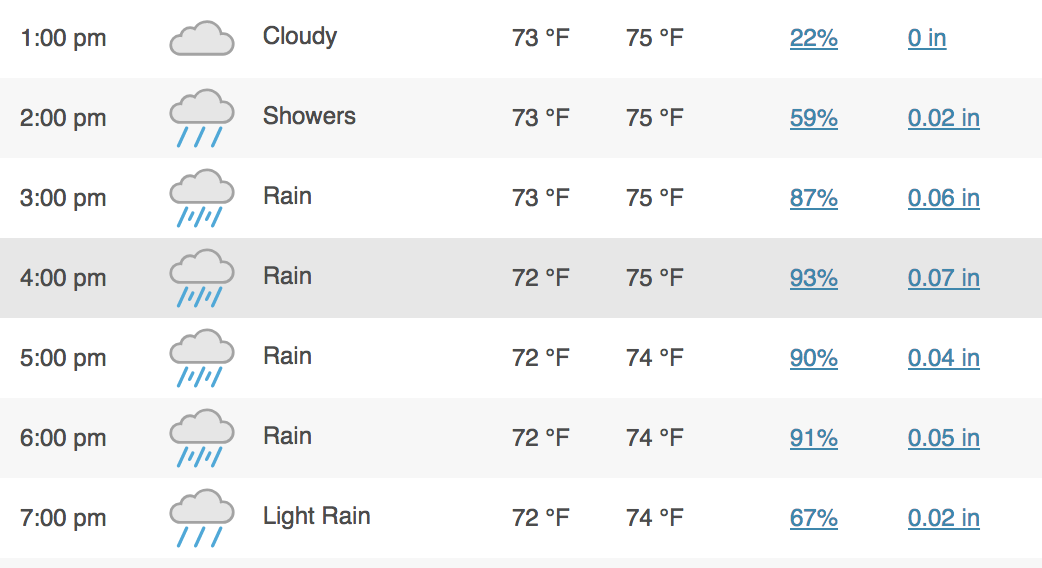
Any discussion about Game 4 strategy has to begin with the weather, because, well, this is the Weather Underground forecast for Fenway Park today, beginning at the scheduled time of first pitch.

It might not be raining when the game begins, but barring a significant change in the forecast, everyone should expect to get rained on at some point this afternoon. And the later the game goes, the more confident the meteorologists are that things will be falling out of the sky. There’s a pretty decent chance that Game 4 involves some kind of rain delay, or at least messy conditions while everyone tries to get this thing in the books before a delay is necessary.

Read the rest of this entry »


Sunday Notes: The Astros Changed Alex Bregman for the Good

Alex Bregman slashed .337/.409/.514 in three seasons at Louisiana State University, twice earning All-American honors. Displaying outstanding bat-to-ball skills, he fanned just 68 times in 786 collegiate at bats. The Houston Astros rewarded his efforts by selecting him second overall in the 2015 draft.

And then they asked him to change.

“A ton,” answered Bregman, when asked how much he’s evolved as a hitter since signing. “In college, I tried to hit the ball on the ground and low line drives. Up here, there aren’t a lot of hits on the ground with guys like Carlos Correa and Andrelton Simmons playing shortstop. Now I try to not hit ground balls.”

The ink had barely dried on his contract when he was told to alter his approach. Organizations typically let first-year players finish the season before suggesting changes, but Bregman was told “right away” that something else was expected. Before he could get his feet wet at the professional level, he had to “learn on the fly how to drive a baseball.”

He proved to be a quick study. Two short years later, in his first full big-league season, the 23-year-old infielder put up a .284/.352/.475 slash line, and his 63 extra-base hits included 19 home runs. He strikes out more often than he used to — “I never used to swing and miss, and now I do occasionally” — but it’s not as though he’s become all or nothing. His K-rate was a wholly acceptable 15.5%.

The adjustments he made were both mental and mechanical in nature. Read the rest of this entry »


The Best of FanGraphs: October 2-6

Each week, we publish north of 100 posts on our various blogs. With this post, we hope to highlight 10 to 15 of them. You can read more on it here. The links below are color coded — green for FanGraphs, brown for RotoGraphs, dark red for The Hardball Times and blue for Community Research.
Read the rest of this entry »

