Archive for History

The Worst Teams in Baseball History

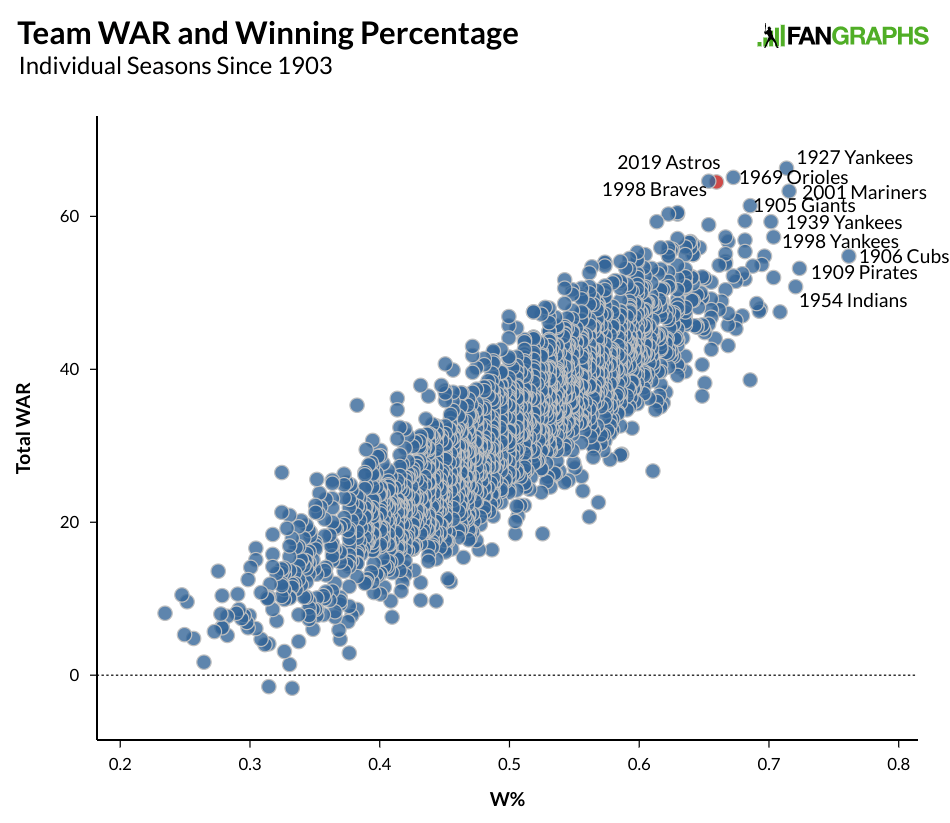
After the World Series ended and the Nationals emerged victorious, I wrote about how the Astros had put together one of the greatest regular seasons of all time and joined the (perhaps ignominious) list of great teams without a title. In doing so, I created the below graph, which shows team winning percentage and WAR, highlighting some of the greatest teams of all time:

At the time, I didn’t mention the teams at the very bottom-left of the graph. If the teams at the top-right are the greatest, then the teams in the bottom-left are the worst. In trying to find a single number to determine just how good or bad a team was, I created an IQ-like score for both winning percentage and team WAR, where 100 is average and every standard deviation away from the mean was worth 15 points. Then I took the average of the two scores for one final number. For reference, this year’s Astros team ended up at 136.5; more than 90% of all teams from 1903 through this season were between 75 and 125. Read the rest of this entry »


Andrelton Simmons Is Avoiding Strikeouts Like Tony Gwynn

Andrelton Simmons draws comparisons to Ozzie Smith for his defensive prowess. Both players are recognized as once-in-a-generation all-time greats at their positions, though Simmons has yet rival Smith’s Hall of Fame career.

Apart from the defensive skills, similarities have emerged between Smith and Simmons offensively, as well. Consider that, through the 2016 season, Simmons had taken roughly 2,500 plate appearances and put up a weak 85 wRC+. Compare that to Smith’s first seven seasons, through 1983, when he put up an even worse 74 wRC+ in more than 3,500 plate appearances.

Smith eventually turned his career around offensively, however, putting up a 103 wRC+ from 1984 through 1992 while producing 37 runs by means of the stolen base, a total which might even understate his total offensive value. Smith was bad on offense for quite some time, then he improved and was a good offensive player for a decent portion of his career. It’s possible we are seeing the same type of transformation from Simmons. The Angels shortstop put a 103 wRC+ last season at 27 years old; thus far this season, he’s doing considerably better, with a 143 wRC+ on the strength of his .331/.402/.466 batting line. Most remarkable about Simmons’ hitting numbers are the strikeouts — or lack thereof, rather — as Simmons has struck out in just 10 of his 200 plate appearances.

In 1998, Tony Gwynn stepped up to bat 505 times and struck out on just 18 occasions. The league-average strikeout rate of 17% at that point was nearly five times Gwynn’s 3.6% mark. Preston Wilson made his debut that season and struck out more times than Gwynn despite receiving only 60 plate appearances. Gwynn’s 3.6% strikeout rate isn’t the greatest of all-time. Joe Sewell struck out in under 1% of his plate appearances five times, while 68 players between 1919 and 1951 had qualified seasons with rates lower than 2%. There were 413 seasons during that time where a player’s strikeout rate was lower than Gwynn’s in that 1998 campaign. Gwynn himself even had four seasons with a lower strikeout rate than 1998, but when considering the overall context of strikeouts in the game, Gwynn’s 1998 season is probably the best of all-time. If Andrelton Simmons can keep this up, his season is going to be better.

Read the rest of this entry »


Jackie Robinson and the Integration Advantage

© Kirby Lee-USA TODAY Sports

Editor’s Note: This piece originally appeared at FanGraphs on April 17, 2018 to mark the 71st anniversary of Jackie Robinson breaking major league baseball’s color line.

Sunday was Jackie Robinson Day around the majors, commemorating the anniversary — the 71st, this year — of the fall of baseball’s color line via Robinson’s debut with the Brooklyn Dodgers. But just as Robinson’s immeasurable courage in confronting racism and the immense talent he showed while playing at the highest level deserve more than a single day for paying tribute, so too is it worth remembering the black players who bravely followed in his footsteps and ensured that baseball’s great experiment would not be a one-off. In the two decades following Robinson’s arrival, the influx of talent, first from the Negro Leagues and then the sandlots and high schools whose players previously could not have dreamt of such an opportunity, radically transformed the National League, in particular.

Led by president and general manager Branch Rickey, the Dodgers, of course, got the jump. During Robinson’s major-league career, which lasted from 1947 to 1956, the Dodgers won six pennants as well as their lone Brooklyn-era championship in 1955. In addition to becoming a pioneer of tremendous importance, Jackie himself was the game’s third-most valuable player over that span according to WAR (57.2), behind only Stan Musial and Ted Williams. While the Dodgers had a great supporting cast of white players such as Gil Hodges, Pee Wee Reese, and Duke Snider, those teams also got great work from two Negro Leagues graduates whom Rickey had signed before Robinson even reached the majors — namely Roy Campanella, who debuted in 1948 and went on to win three NL MVP awards, and Don Newcombe, who debuted in 1949, won Rookie of the Year honors that season, and would later win a Cy Young and an MVP award.

Though Rickey lost a power struggle to Walter O’Malley and was forced to sell his share of the team following the 1950 season, the Dodgers furthered their dominance over the NL in part by continuing to sign talented black players. Under Buzzie Bavasi as general manager and Fresco Thompson as director of minor-league operations, the organization added right-hander Joe Black (1952 NL Rookie of the Year), infielder Jim Gilliam (1953 NL Rookie of the Year), outfielder Sandy Amoros, second baseman Charlie Neal, catcher John Roseboro, shortstop Maury Wills (1962 NL MVP), and outfielders Tommy Davis and Willie Davis (no relation), among others.

Amoros, Black, and Gilliam would augment the Dodgers’ Robinson-era core, and the latter remained a vital lineup cog through the transitional phase that included the franchise’s 1957 move from Brooklyn to Los Angeles and their return to powerhouse status behind the one-two pitching punch of Sandy Koufax and Don Drysdale. Neal, Roseboro, and Wills would each spend at least half a decade in the minors and/or as understudies awaiting their shots before contributing to the team’s 1959 pennant and championship, with the latter two becoming more central alongside the two Davises as the team won championships in 1963 and 1965, and added one more pennant in 1966, Koufax’s final year. Tommy Davis, a left fielder, won back-to-back NL batting titles in 1962 and -63, while Willie Davis, a center fielder, was the position’s best defender this side of Willie Mays (his three errors in Game Two of the 1966 World Series to the contrary).

Read the rest of this entry »


Will King Felix Reach Cooperstown?

Felix Hernandez appears unburdened by his legacy in this freely available image.
(Photo: Keith Allison)

Felix Hernandez’s 2018 season got off to a rough start, as he was drilled on the right arm by a line drive in his February 26 appearance against the Cubs. The Mariners say he’ll miss just one Cactus League start, but on the heels of two subpar, injury-shortened seasons, M’s fans can be forgiven for curling up into the fetal position.

Hernandez took the hill just 16 times in 2017 due to shoulder bursitis and was lit up for a 4.36 ERA and career-worst 5.02 FIP; his 17 homers allowed in 86.2 innings was more than he served up in four of his eight 200-plus inning seasons. His 2016 campaign, which was shortened to 25 starts by a right calf strain, featured a less-than-inspiring 3.82 ERA and 4.63 FIP, as well. His recent decline probably owes something to eroding velocity. Via Pitch Info, his four-seamer has averaged around 91 mph in the past two years, down from a high of 96 in 2008 and 93.6 as recently as 2014. The story is similar for his sinker. He’s not missing as many bats as he used to, and his home-run rate is soaring along with those of just about every other pitcher in baseball. In short, he looks more peasant than king.

Read the rest of this entry »


Roy Halladay Isn’t Just a Borderline Hall of Famer

The late Roy Halladay will appear on next year’s ballot. (Photo: DGriebeling)

Among the players who’ll appear on next year’s Hall of Fame ballot, Mariano Rivera is likely to stand out as a no-doubter in his first try. He’s the all-time saves leader. He was dominant in the regular season and even more dominant in the playoffs. He’s regarded as the greatest reliever ever, and he did it all with just a single pitch.

Roy Halladay might not possess the same quantity of superlatives as Rivera, but he is worthy of enshrinement and there is little reason to delay his entry to the Hall past next year. Halladay’s untimely passing will likely bring a more somber tone to his candidacy. At this site, both Jeff Sullivan and Dave Cameron wrote touching tributes to Halladay’s career after his death. That said, Halladay needn’t benefit from sympathy or nostalgia to earn a place in the Hall. His case on the merits is very strong.

Based on the traditional measures alone, the argument for Halladay is decent, if not rock solid. Some notable facts:

So this is already a good start, but Halladay’s case goes well beyond these basic facts, too.

Halladay’s career was defined by greatness in an era dominated by hitters. Consider: since 1901, only 203 pitchers have reached 2,500 innings. Of those 203 pitchers, Halladay’s 3.38 career ERA ranks just 91st. But offense was hovering around record levels during much of his time as an active player. Relative to the era in which he pitched, Halladay’s actually prevented runs at a rate 24% better than average, and that mark actually ranks 15th since 1901. All 14 pitchers ahead of him by that measure are in the Hall of Fame except for Roger Clemens.

Read the rest of this entry »


Larry Walker’s Credentials Bear Repeating

On this year’s Hall of Fame ballot, four former players saw at least a 10-point increase in their voting share over the previous year. Vladimir Guerrero sailed into the Hall of Fame, Edgar Martinez solidified his status as a near-lock for next year, and Mike Mussina looks like a strong candidate for the 2020 class, if not the 2019 one.

Larry Walker, on the other hand, needs a lot of help. He received just 34.1% of the vote this year, leaving just two more cycles for him to reach the 75% threshold required for election. It’s not just that Walker needs some help to get elected: he wants it, too. And, most importantly, he deserves it.

Paul Swydan previously made a good case for Walker’s inclusion in the Hall, comparing him very favorably to Vladimir Guerrero. Here, though, I’d like to directly address a few points that still seem to cause confusion.

He Wasn’t Just Good Because of Coors Field

A lot of the arguments for Larry Walker’s inclusion in the Hall — including on sites like this one — are based on his very impressive 68.7 WAR. That figure ranks 66th all-time among position players and 39th since Jackie Robinson broke the color barrier. His WAR is sixth in that time among right fielders, just behind Reggie Jackson and ahead of every other right fielder you can think of except for a handful of all-time greats in Hank Aaron, Roberto Clemente, Al Kaline, and Frank Robinson

Walker doesn’t lack for impressive numbers by traditional measures. He has a lifetime .313 batting average, for instance, behind only Clemente, Vlad Guerrero, Tony Gwynn, Stan Musial, and Ted Williams among outfielders who’ve recorded at least 8,000 plate appearances over the last 70 years.

Walker also fares well by counting stats. He hit a lot of home runs, a ton of doubles, and stole over 200 bases. The list of players with more doubles, triples, homers, and stolen bases is a pretty small group, composed of just Aaron, Carlos Beltran, Barry Bonds, Andre Dawson, and Willie Mays. He won an MVP award in 1997, receiving more than three-quarters of the first-place votes from the writers. He also has seven Gold Gloves, five All-Star appearances, three Silver Sluggers. He earned at least one vote for MVP in eight different seasons.

There are those who might dismiss Walker’s accomplishments out of hand simply because of Denver’s thin mountain air. It’s certainly true that, with regard to the counting stats, some mental adjustment is necessary. As for estimates of his overall value, though, such considerations are irrelevant: WAR already penalizes Walker for whatever benefits he received from playing half his games at Coors Field.

Read the rest of this entry »


Projecting the Hall of Fame Ballot Through 2023

A lot of people are disappointed that Edgar Martinez hasn’t been elected to the Hall of Fame yet — and, by extension, that he wasn’t elected during this most recent round of voting. But there’s good news on this front: Martinez’s chances of making the Hall of Fame have never been better.

Martinez debuted on the ballot eight years ago, garnering 36.2% of the vote. Five years after first becoming eligible for the ballot, though, his case had gained little headway. In fact, by 2014 and -15, he’d actually backslid a little, appearing on just 25.2% and 27.0% of ballots, respectively, in those two seasons. At that point, it appeared as though he had little chance of making the Hall of Fame.

In 2016, Martinez benefit from a healthy bump (to 43%) and then another big bump (to 59%) the next year. And while that improved his overall chances of earning admission, the probability that it would occur this year remained low. Consider: over the last 50 elections, only Ralph Kiner has been elected in one year after receiving less than below 60% of the vote the year before. Martinez will almost surely make it next season after a strong 70% showing this year.

Read the rest of this entry »


A Look Ahead to the 2019 Hall of Fame Ballot

The late Roy Halladay will appear on next year’s ballot. (Photo: DGriebeling)

Congratulations to Vladimir Guerrero, Trevor Hoffman, Chipper Jones, and Jim Thome. That quartet of fine players all received word yesterday that they’d earned a place in baseball’s Hall of Fame, each receiving more than 75% of the BBWAA’s vote.

If you think the day after one year’s results are announced is too early to start thinking about the next year’s ballot, that’s fair. If you believe next year’s ballot is fair game, however, come with me as I consider what might happen next January.

First, a point regarding the sheer number of candidates. No players on this year’s ballot were in their 10th and final year of voting, so nobody was removed due to time constraints. That means that every player who was not elected this year and who also received at least 5% of the vote will be on next year’s ballot. Four players were inducted this year, though. Last year, it was three. The size of those two classes alone helps clear out the logjam of eligible candidates a bit.

Read the rest of this entry »


Four Deserving Hall of Famers, Omar Vizquel New to Ballot

As I noted in my post at the end of last week regarding Hall of Fame holdovers, the ballot is a bit of a mess right now. There are already seven players who’ve received at least 45% of the vote — generally a pretty good gauge of worthiness when it comes to the Hall — plus a handful of others (Larry Walker, in particular) who are lower on the ballot but deserve induction, as well.

Joining that group of deserving candidates this offseason is a collection of four additional players who merit a place in the Hall — as well as Omar Vizquel, who is getting a lot of votes in the early going. This year’s entries include one no-doubter (Chipper Jones), another who’s deserving and likely to earn induction on the strength of his offensive contributions (Jim Thome), and two more players who merit selection but whose case rests largely on defensive contributions (Andruw Jones and Scott Rolen).

Before we get to the contenders, let’s take a brief look at the players who’ve earned spots on the ballot with solid careers but lack much of a case for the Hall.

Read the rest of this entry »


A Manny Machado Trade Would Be Historic

Manny Machado possesses a rare combination of youth and talent. (Photo: Keith Allison)

The Orioles have seemingly come to their senses about their place on the win curve and, as such, are open to trading Manny Machado. On the other hand, it’s been nearly a week since that news broke, and we haven’t heard many concrete trade offers out for Baltimore’s All-Star infielder. Perhaps the news was overblown. Perhaps not. One thing we can say with certainty is that, if Machado were traded, it would be fairly historic.

Read the rest of this entry »