Archive for Q&As

Justin Turner Talks Hitting

Justin Turner jumpstarted his career following a swing change prior to the 2014 season. The Los Angeles Dodgers third baseman has spoken on the subject several times, with no shortage of stories chronicling his journeyman-to-slugger evolution.

That doesn’t mean that Turner doesn’t have more to say about hitting. He still has plenty to share on the intricacies of his craft, both philosophically and as they pertain to his own experience. When it comes to a good thing, there’s always room for more.

The conversation that follows took place this past Sunday.

———

David Laurila: Do you see hitting as more or an art, or more of a science?

Justin Turner: “Honestly, I think it’s both. When you’re talking about the mechanics of the swing, and the position you’re trying to get in, there is definitely science involved. You need to understand how your body works — or, if you’re working with someone else, understanding how their body works — in order to get into the best position to have consistent success.

“Then, when you’re in the box, you have that cat-and-mouse game with the pitcher you’re going to face three or four times. How is he going to attack you? How is he going to approach you? That’s more of the art of hitting.”

Laurila: Doing what feels natural isn’t always going to be optimal. Is that accurate?

Turner: “Usually, what’s natural is what’s comfortable. You definitely want to feel comfortable in the box, but sometimes when you get into bad habits, comfortable isn’t always the right answer. I think there’s a time for feeling uncomfortable, to get yourself out of some unwanted habits you have. If that makes sense.”

Laurila: Can you elaborate? Read the rest of this entry »

Evan Longoria Talks Hitting

Evan Longoria has been a good player for a long time. Since debuting with the Tampa Bay Rays in 2008, the 33-year-old third baseman has bashed 289 home runs, been awarded three Gold Gloves, and garnered MVP votes in six separate seasons. A three-time All-Star, he’s been worth 50.4 WAR.

The extent to which his best days are behind him is difficult to determine. Longoria hasn’t been as productive since joining the San Francisco Giants prior to last season, but he’s showing signs of a revival. Going into the All-Star break, he was 10 for his last 25, with a pair of doubles and five home runs.

Longoria sat down to talk hitting prior to a recent game at Petco Park.

———

David Laurila: A number of hitters have told me they go up to the plate hunting fastballs. Does that describe your approach, as well?

Evan Longoria: “It starts there. I think if you look around the league, the top pitchers have an ability to locate a fastball. Commanding the zone early with a fastball is a big reason they’re successful, so as a hitter it makes sense to stay on that.

“On a very basic level, my approach is … over the course of my career, I’ve had a lot of success hitting the ball from gap to gap. That’s kind of where I start, but then it changes every day based on a few, if not a bunch of, factors. The starting pitcher that day has a lot to do with it. Sometimes it’s the way I’m feeling, both physically and mentally. Where the defense is positioned … sometimes, if you’re feeling really good, you pick your spot to try to beat the shift, or hit a hole.

“Velocity has a lot to do with it, too. Against guys who are in the upper 90s, you really have to look for one pitch; you have to stay on the fastball even more. Against guys with a little less velocity, you can kind of sit on those in-between speeds and make adjustments from there.”

Laurila: Regardless of how good you’re feeling at the plate, controlling where you hit the ball is easier said than done. Read the rest of this entry »


Fernando Tatis Jr. Talks Hitting

Fernando Tatís Jr is arguably the most-exciting young player in the game. He’s certainly gotten off to a rousing start. Through his first 55 games with the San Diego Padres, the 20-year-old shortstop is slashing .327/.393/.620, with 14 home runs, a 162 wRC+, and 13 stolen bases. Twice he’s scored on a sacrifice fly that was caught by the second baseman. Defensively, his range and his arm have both elicited oohs and aahs from what is becoming an increasingly-invigorated Padres fanbase.

The conversation that follows is focused entirely on the young man’s approach to hitting. He’s learned his lessons well — primarily from his father, former big-league infielder Fernando Tatis — but at the same time, his M.O. at the plate is straightforward. Tatis likes to keep things simple, and that’s unlikely to change anytime soon. Given the numbers he’s been putting up, why should it?

———

David Laurila: Is hitting simple, or is it complicated?

Fernando Tatis: “It’s complicated if you want it to be. I think if you take it as simple as possible, you can be more consistent every day. People make it complicated when they start doing a lot of stuff — when you start doing a lot of stuff to your mind; when you think you’re doing this, you’re doing that. For me, a big thing is to remember that I’m playing baseball. I’m just a kid playing in a park. Yes, I have to make adjustments sometimes, but as simple as I can be at the plate is way better.”

Laurila: Are you basically hunting fastballs?

Tatis: “I’m always looking fastballs. I don’t want it to sound like hitting is that easy. Don’t get me wrong. Hitting is not easy. But again, as simple as I can make it is way better.”

Laurila: How do you go about recognizing breaking pitches? Is it mostly a matter of reps?

Tatis: “More reps will be better for you, but for me, recognizing breaking balls is … a big part is when you’re looking for his fastball, you forget about everything down. If you see spin up, those are the good ones to hit. The ones down are going to be hard.” Read the rest of this entry »


Paul DeJong Talks Hitting

Paul DeJong will represent the St. Louis Cardinals in next week’s All-Star Game. He’ll do so with solid, albeit unspectacular, offensive numbers. The 25-year-old shortstop is slashing .260/.344/.455, with 13 home runs and a 110 wRC+. Thanks in part to plus defense, he leads the Redbirds with 2.9 WAR.

Two years ago, in an interview that ran here at FanGraphs, DeJong discussed the mental side of hitting. This past weekend, the Illinois State University graduate — his degree is in biology — sat down for a far-wider-ranging conversation about his craft.

———

David Laurila: How would you describe your hitting approach?

Paul DeJong: “My general approach is to hit something hard through the middle. I’m usually looking for a fastball that I can hit gap-to-gap; not pull, not oppo, but kind of through the middle. That gives me the best chance of adjusting to different speeds and different locations. I’m able to open up, or if I’m late, I still have time to keep it fair.”

Laurila: Something I’ve been asking players about is the idea of an A-swing, and whether hitters have multiple swings.

DeJong: “Hitters absolutely have multiple swings. For instance, if you get fooled on a breaking ball, you’re kind of adjusting your body. But for me, it’s more about keeping my hands back. If you do that, you can drift forward with your body — you’ll be off balance out front — but if your hands are still back, you’re able to deliver the barrel, still put the ball in play hard.”

Laurila: What about on fastballs riding high in the zone? Read the rest of this entry »


A Conversation With Brendan McKay

Brendan McKay continued his fantastic season this past Saturday. Making his big-league debut with the Tampa Bay Rays, the 23-year-old left-hander retired 18 of the 20 Texas Rangers batters he faced. And his work on the farm had been every bit as dominating. In 66.2 innings between Double-A Montgomery and Triple-A Durham, McKay compiled a 1.22 ERA and allowed just 38 hits.

And then there’s the offensive side of the equation. As you know, McKay can swing the bat. Aspiring to be the major’s next Shohei Ohtani — sans the Tommy John surgery — the former Golden Spikes winner as a two-way player at the University of Louisville was 11 for his last 33, with three home runs, at the time of his call-up.

What is his approach on each side of the ball, and does he truly expect to be able to play both ways at baseball’s highest level? I addressed those questions with the 2017 first-round pick a few days before he arrived in The Show.

———

Laurila: Nuts and bolts first question: What is your approach on the mound?

McKay: “I’m a pitcher who likes to get ahead — just like every other pitcher — and force the action, rather than letting the hitter have any control over the at-bat. That’s basically it.”

Laurila: Are you looking to induce contact, or are you out there trying to miss bats? Read the rest of this entry »


Cavan Biggio Talks Hitting

Cavan Biggio has turned yet another corner this season. One year after blasting 26 home runs in Double-A New Hampshire, the 2016 fifth-round pick has ridden a torrid start at Triple-A Buffalo to a spot in the Toronto Blue Jays lineup. And while he remains an unfinished product, the early returns have been promising. Since debuting on May 24, the son of Hall of Famer Craig Biggio has a 114 wRC+, and he’s gone deep five times.

What type of hitter is the 24-year-old infielder? Part of that answer can found within our Blue Jays Top Prospects writeup, which dropped prior to spring training. A more recent, and much more comprehensive look, went up just one week ago, courtesy of my colleague Devan Fink.

And then there is Biggio’s own take. The young Blue Jays basher broke down his mechanics, as well as his power-and-patience approach, in a wide-ranging conversation that took place last weekend.

———

David Laurila: What is your hitting philosophy?

Cavan Biggio: “My goal is to get a pitch I can square up, and drive. Hitting the ball hard is my No. 1 goal. If I don’t get the pitch I want in the first couple of strikes, I’m going to take. Once I get to two strikes, I’m going to battle and just try to get on base.”

Laurila: Are you basically looking fastball middle?

Biggio: I’d say I’m pretty traditional in trying to hunt the heater. I look for a heater in the middle thirds: middle-in, middle, and middle-away. Those are the parts of the strike zone where I can do the most damage. I’ve also gotten better at recognizing offspeed while looking for the fastball, so if it’s a mistake— if it’s a hung breaking ball — hopefully I’m able to hold off a little bit, put a good swing on it, and barrel it up. So I’m basically trying to hit the heater, but if a guy makes a mistake with a breaking ball, I’m ready for that as well.”

Laurila: What is the key to recognizing an off-speed pitch, particularly one you can handle? Read the rest of this entry »


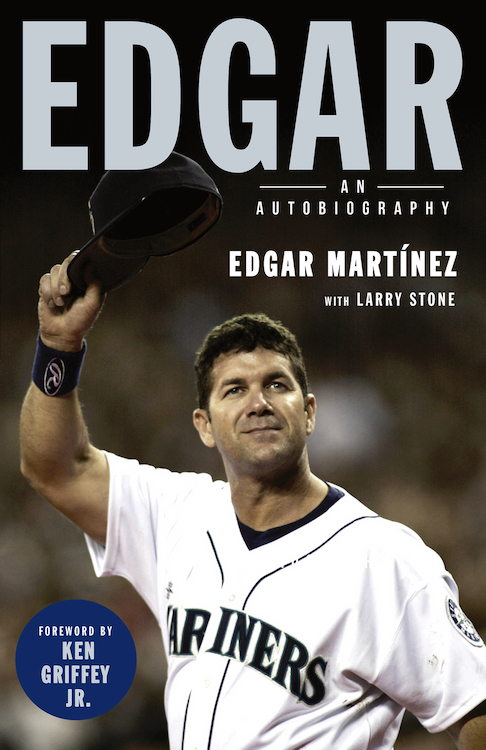
Edgar: An Autobiography is Yet Another Hit for Martinez

Edgar Martinez’s story — at least as recounted in Edgar: An Autobiography, written with veteran Seattle sports scribe Larry Stone and published by Triumph Books earlier this month — reads like something of a fairy tale. Born in New York City in 1963, he moved to Puerto Rico when his parents split, and was raised in the Maguayo neighborhood of Dorado by his maternal grandparents, whom he chose to stay with at age 11, even after his parents reconciled and returned to New York. Though his love for the game was kindled by the heroics of Roberto Clemente in the 1971 World Series, and his development stoked by his relationship with cousin Carmelo Martinez, who spent nine years in the majors (1983-91), he didn’t sign a professional contract until just before his 20th birthday; putting aside $4-an-hour work on an assembly line, he received just a $4,000 bonus from the Mariners. Despite hitting a homerless .173 in his first professional season (1983), and battling an eye condition called strabismus, in which his right eye drifted out of alignment, the Mariners stuck with him.

While Martinez debuted in the majors in 1987, he spent three seasons trying to surmount the Mariners’ internal competition at third base, wound up shuttling back and forth to Triple-A Calgary, and didn’t secure a full-time job until 1990, his age-27 season. Though he won a batting title in 1992, a slew of injuries — shoulder, hamstring, wrist — threatened to derail his career until the Mariners convinced him to become a full-time designated hitter. Once he did, he became one of the AL’s most dominant players; from 1995-2001, he hit .329/.446/.574 for a 162 wRC+ (third in the majors) and 39.9 WAR (seventh, less than one win behind teammate Ken Griffey Jr.).

His heroics not only helped the Mariners reach the playoffs for the first time in 1995 (a year in which he also won his second batting title), but he became a one-man wrecking crew in that year’s Division Series against the Yankees, capping his .571/.667/1.000 performance with a series-winning double in Game 5 that basically saved baseball in Seattle. Remaining with the team for the duration of his career, which lasted through 2004 and included three other postseason appearances, further endeared him to a city that watched Griffey and fellow Mariners Randy Johnson and Alex Rodriguez depart for greener pastures. When he retired, Major League Baseball renamed its annual award for the best designated hitter in his honor. Earlier this year, in his 10th and final cycle of eligibility, he was elected to the Hall of Fame, that after more than tripling his support from just four years earlier.

Martinez’s arc seems so improbable, and yet it’s all true. Over the course of Edgar’s 352 pages, Martinez candidly details the highlights and lowlights of his career, the big decisions, unlikely events, and tactics that helped him surmount so many obstacles. Stone provides testimony from his former managers, coaches, and teammates in the form of sidebars that offer additional perspectives and enhance the narrative.

Read the rest of this entry »


A Conversation with Phil “The Vulture” Regan

The New York Mets made an out-of-the-box move yesterday, hiring 82-year-old Phil Regan as their interim pitching coach. The former big-league hurler, and longtime coach, takes over for Dave Eiland, who along with understudy Chuck Hernandez, was relieved of his duties in the throes of what has been an underachieving season.

As you should be aware, Regan’s nickname is “The Vulture.” It was given to him by Sandy Koufax, in a year that Regan went 14-1 out of the Dodgers bullpen with 21 saves and a 1.62 ERA. Prior to that 1966 season, he’d pitched primarily as a starter for the Detroit Tigers, the team he grew up rooting for in rural Michigan. Overall, Regan appeared in 551 games, for four teams, from 1960-1972.

The excerpted interview that follows was conducted approximately five or six years ago and was intended for inclusion in a book project — conversations with Detroit Tigers players of yesteryear — that has remained on the back burner. Given the timeliness of Regan’s hiring, I am choosing to share highlights from the interview here.

———

David Laurila: You were born in 1937, and grew up in southwest Michigan rooting for the Tigers.

Phil Regan: “Yes, I grew up in a town called Wayland. My earliest recollection of the Tigers was listening to Harry Heilmann call games on the radio. I recall players like George Kell, Johnny Lipon, Hoot Evers, Johnny Groth, and Vic Wertz. But my favorite of all was Hal Newhouser. He always seemed to be the one who pitched on Sundays, often against Bob Feller. He was my hero.

“During the week, I’d rush home from school, turn on the radio, and listen to Harry Heilmann and then, later on, Van Patrick. In those days we didn’t have a lot of television, but we always had the games on the radio. Of course, being from Michigan, I grew up wanting to play for the Tigers.”

Laurila: You ended up signing with them after graduating from high school.

Regan: “I did. As a kid, I never really got to play many games of baseball, because I lived out on a little farm, near a little town. Mostly I threw against a barn, with my brother, and stuff like that. But I had a good arm, and after graduating I was invited to Tiger Stadium to work out. They offered me a contract, but I decided that I wanted to go to Western Michigan [University]. After a year at Western, I decided to sign with the Tigers. From there I went into their minor league system.”

Laurila: How much did you sign for? Read the rest of this entry »


Tyson Ross Talks Sliders, Cutters, and Pitch Design

Tyson Ross has had an uneven career since being selected in the second round of the 2008 draft by the Oakland Athletics. Along with his original organization, he’s pitched for the San Diego Padres, Texas Rangers, St. Louis Cardinals, and now the Detroit Tigers. Injuries have been an issue. Currently on the 60-day Injured List with ulnar nerve neuritis, the 32-year-old right-hander previously underwent Thoracic Outlet Syndrome surgery in 2016.

When healthy, he’s been a quality big-league pitcher. Ross was an All-Star with the Padres in 2014, and the following year he led the National League in games started. His ERA over that two-season stretch was 3.03, while his K/9 was a robust 9.4. A mid-90s fastball played in a big role in that success, but it’s never been his best pitch. Ross has — when at full strength — one of the game’s best sliders.

Ross talked about his signature pitch, as well the cutter his college coach didn’t know he threw, and what he’s learned since purchasing a Rapsodo, when the Tigers visited Fenway Park in late April.

———

David Laurila: You’re known for your slider. What is the history behind it?

Tyson Ross: “It’s always been my go-to pitch. I went to college at Cal-Berkeley and threw a ton of sliders when I was there. But I originally learned the pitch when I was 11 years old. I was in All Stars, playing third base, and we ended up needing an emergency pitcher. I could get on the mound and throw strikes with a fastball, but I needed a second pitch. My buddy’s dad said, ‘Hey, grip it like this and throw it like a fastball.’ The second or third one broke. He didn’t actually call it a slider — he just called it a breaking ball — but it felt good in my hand, and I’ve been throwing it the same way ever since.”

Laurila: Is there anything unique about it?

Ross: “Nothing special. It just works the way it does, for whatever reason.” Read the rest of this entry »


Joey Gallo Talks Hitting

Joey Gallo is a unique hitter having an outstanding season. Though temporarily sidelined with an oblique injury, he’s slashing .276/.421/.653, with 17 home runs in 214 plate appearances and a 170 wRC+. And when he’s not bopping, he’s usually fanning or walking. The 25-year-old Texas Rangers slugger has the second-highest walk rate, and the second-highest strikeout rate, among qualified major league batters. The antithesis of a singles hitter, Gallo is all about Three True Outcomes.

Gallo sat down for an in-depth discussion of the art and science of hitting earlier this week.

———

David Laurila: Straightforward question to start: What is your hitting approach?

Joey Gallo: “I feel that I have a pretty in-depth thought process at the plate. I always have an approach. I think a lot of people assume I just go up there kind of ‘beer-league-softball,’ and try to crush everything I see. But I have a plan of what I want to do against a certain guy; the pitches I want to look for; who is behind the plate, umpire-wise; who is calling the pitches, catcher-wise; what the environment is; what the situation is. There’s a lot that goes into hitting. It’s not just me trying to put the ball into the seats.”

Laurila: Nuance aside, are you generally hunting fastballs middle, and adjusting from there?

Gallo: “I don’t want to give away exactly what I’m thinking at the plate. Obviously, you’re taught to look fastball and adjust to off-speed, but there are situations where you change that approach and look for different stuff. It changes at-bat to at-bat. Sometimes you’re looking off-speed. Sometimes you’re looking for a certain location. You’re not always just looking fastball, because the guys are so good in this league that you can’t always have exactly the same approach.”

Laurila: Have you made changes this year with either your approach or your mechanics?

Gallo: “I’m trying to stay through the ball a lot more now. That’s something we’ve worked on: I try to stay as short and compact as I can. One thing we talked about when Luis Ortiz was hired [as hitting coach] was that I don’t need to generate any more power. All I have to do is touch the ball; all I have to do is put the barrel to the ball. So we worked on simplifying my swing, throughout the offseason and in spring training. I had too much movement for a big guy. Now I’m just thinking about getting my foot down and putting the barrel to the ball.”

Laurila: Is there any compromise with the shortening up? All hitters have their timing mechanisms. Read the rest of this entry »