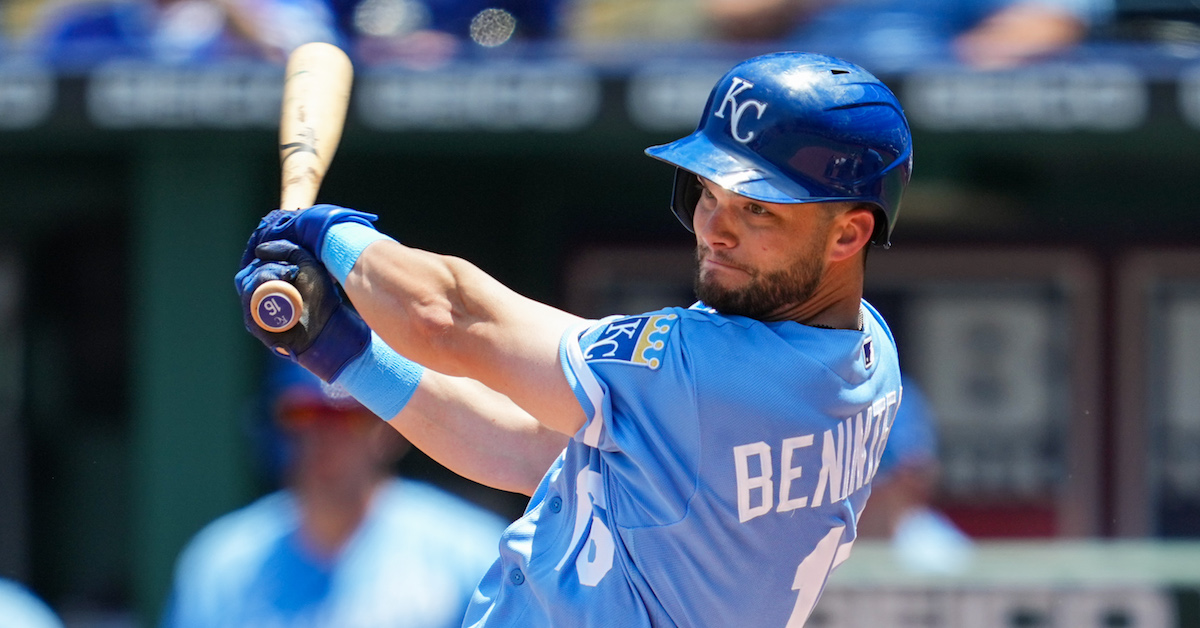
The New York Yankees added outfield help on Wednesday night, closing a deal with the Kansas City Royals to acquire outfielder Andrew Benintendi in return for three lower-level pitching prospects. Coming off his first career All-Star appearance, Benintendi is having what is easily his best season since 2018, fortunate timing for him given that he’ll hit free agency for the first time this fall. In 93 games for the Royals, Benintendi has hit .320/.387/.398 for a career-best 126 wRC+, and his 2 WAR already makes 2022 his second-best full season.
It would be hard to argue that much has gone wrong for the Bronx Bombers in 2022 — even after a month of .500 ball, the Yankees remain on a 108-win pace. But I doubt anyone would claim that Joey Gallo’s annus horribilis is what they had in mind when they sent four prospects to the Rangers for him and Joely Rodríguez almost exactly a year ago. Over his time in New York, Gallo has hit .160/.293/.371, good for an 89 wRC+ and 0.9 WAR. While that’s a pretty robust line for a .160 average, secondary skills can only go so far. There was an argument to be made that Gallo’s lousy stint at the end of 2021 was a BABIP-related blip, but this year, his approach at the plate has completely fallen apart. Always a brutally poor contact hitter, Gallo has to be selective to survive, and in what might be him reacting to his poor August/September last year, he’s been aggressive at the plate in a bad way. How bad? He’s been about 80% more likely to swing at an out-of-zone pitch than he was in 2021 — not a great approach when you miss as often as Gallo does. Even his exit velocity numbers have dropped off the charts. Gallo’s not officially gone yet, but I’d be astonished if he’s Benintendi’s teammate for more than a few days. Read the rest of this entry »
While still focusing upon teams that meet the loose definition of contenders (a .500 record or Playoff Odds of at least 10%), and that have gotten about 0.6 WAR or less thus far — which prorates to 1.0 WAR over a full season — this year I have incorporated our Depth Charts’ rest-of-season WAR projections into the equation for an additional perspective. Sometimes that may suggest that the team will clear the bar by a significant margin, but even so, I’ve included them here because the team’s performance at that spot is worth a look.
As noted previously, some of these situations are more dire than others, particularly when taken in the context of the rest of their roster. I don’t expect every team to go out and track down an upgrade before the August 2 deadline, and in this batch in particular, I don’t get the sense that any of these teams have these positions atop their shopping lists. With catchers, framing and the less-quantifiable aspects of knowing a pitching staff make it easier for teams to talk themselves out of changing things up unless an injury situation has compromised their depth.
All statistics in this article are through July 26, though team won-loss records and Playoff Odds are through July 27.
2022 Replacement-Level Killers: Catcher
Team
AVG
OBP
SLG
wRC+
Bat
BsR
Fld
WAR
ROS WAR
Tot WAR
Cardinals
.195
.251
.252
47
-22.2
-3.5
-1.8
-0.8
0.7
-0.1
Astros
.166
.235
.312
57
-17.2
-2.3
-4.0
-0.5
0.6
0.1
Guardians
.176
.267
.267
55
-17.4
-2.7
2.7
0.1
0.8
0.9
Mets
.199
.245
.266
50
-20.3
-3.7
6.4
0.2
0.9
1.1
Red Sox
.251
.307
.373
89
-5.0
-8.6
-1.9
0.4
1.1
1.5
Rays
.205
.226
.346
63
-15.2
-0.6
0.9
0.4
1.3
1.7
Statistics through July 26. ROS = Rest-of-season WAR, via our Depth Charts.
Cardinals
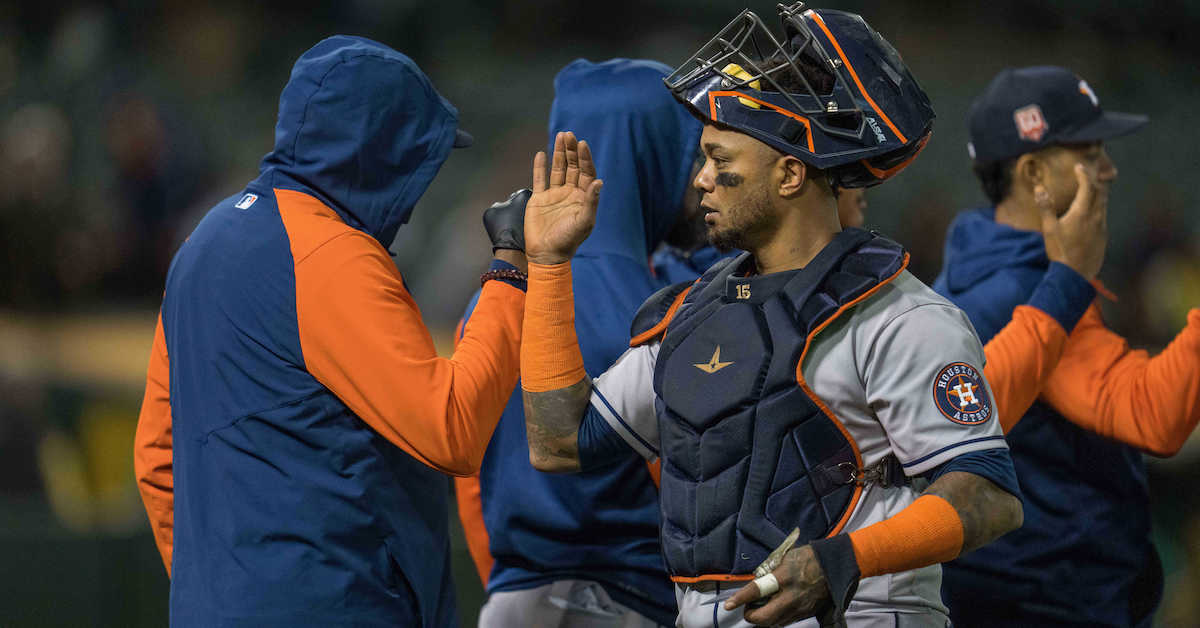
Yadier Molina may be a future Hall of Famer, but his final major league season hasn’t gone smoothly. The 39-year-old backstop reported late to spring training due to personal reasons, then hit just .213/.225/.294 (46 wRC+) in 138 plate appearances before landing on the injured list with right knee inflammation in mid-June. With the team’s permission, he soon returned to his native Puerto Rico, a move that did not escape the notice of his teammates, who value his presence and leadership even when he’s not able to play up to his previous standards. Molina finally began a rehab assignment on Monday.
In Molina’s absence, the Cardinals have started Andrew Knizner behind the plate 51 times, and he’s reminded them that even by the standards of backup catchers, he leaves something to be desired. The 27-year-old has hit .199/.291/.248 (64 wRC+) and is 5.5 runs below average in our framing metric; his WARs have now been in the red for all four of his major league seasons, with a total of -1.7 in just 443 PA. Baseball Prospectus’ comprehensive defensive metrics put him 5.2 runs below average for his framing, blocking, and throwing as well. His backup, Austin Romine, owns a 47 wRC+ while catching for four teams over the past three seasons; his most notable accomplishment as a Cardinal is in joining Paul Goldschmidt and Nolan Arenado among the ranks of unvaccinated players who were unable to travel to Canada for this week’s two-game series against the Blue Jays.
Back in June, St. Louis gave a look to Molina’s heir apparent, Iván Herrera, who entered the season at no. 75 on our Top 100 Prospects list and has hit .295/.385/.432 at Triple-A. The 22-year-old Panamanian has a plus arm and potentially a plus hit tool as well as average raw power; his framing is below average and his receiving average. He was called up to replace Romine for the Toronto series but did not play.
With the trade market not offering a lot of obvious solutions (an intradivision trade for Willson Contreras probably isn’t an option), the Cardinals, who have gone just 24–26 in June and July but are still entrenched in the second Wild Card spot, would probably be better off pairing Molina with Herrera than Knizner or Romine. One possible option is Oakland’s Sean Murphy, who will be arbitration eligible for the first time this winter and who placed 37th on our Trade Value list; he could pair with Herrera for the next year or two and still be dealt while having club control remaining. Read the rest of this entry »
Trevor Story is an accomplished hitter. The 29-year-old Boston Red Sox infielder was a stalwart in the middle of the Colorado Rockies’ lineup prior to this season and has 173 home runs and a 110 wRC+ over six-plus MLB campaigns. Twice a National League All-Star, Story blasted 37 home runs in 2018, and he followed that up with 35 more in 2019.
His first go-round in the Junior Circuit has been of the up-and-down variety. Signed to a six-year, $140 million free-agent deal by Boston in March, Story has 15 long balls to his credit, but just a .221/.289/.423 slash line. Currently on the injured list with a hand contusion, the Irving, Texas native is expected to return to the Red Sox lineup in the near future.
Story discussed his evolution as a hitter earlier this week.
———
David Laurila:Nolan Arenado and Daniel Murphy, players with different approaches to their craft, were among the earliest interviews for my Talks Hitting series. [Links here and here.] Which of your former Rockies teammates are you most similar to that regard?
Trevor Story: “It would be Nolan. He was a mentor to me my first few years, and we still talk the game a lot. Nolan pretty much taught me how to pull the ball the right way. But knowing yourself as a hitter… just like Murph did. Murph knew himself, and he knew that he was going to be thinking the other way or thinking up the middle. There are obviously different schools of thinking, and I would say I’m closer to Nolan, trying to get the ball in the air pull-side.”
Laurila: What about in terms of analytics? When I spoke to them, Arenado was all about keeping things as simple as possible, while Murphy was very in-depth and detailed. Have you delved into analytics much over the years? Read the rest of this entry »
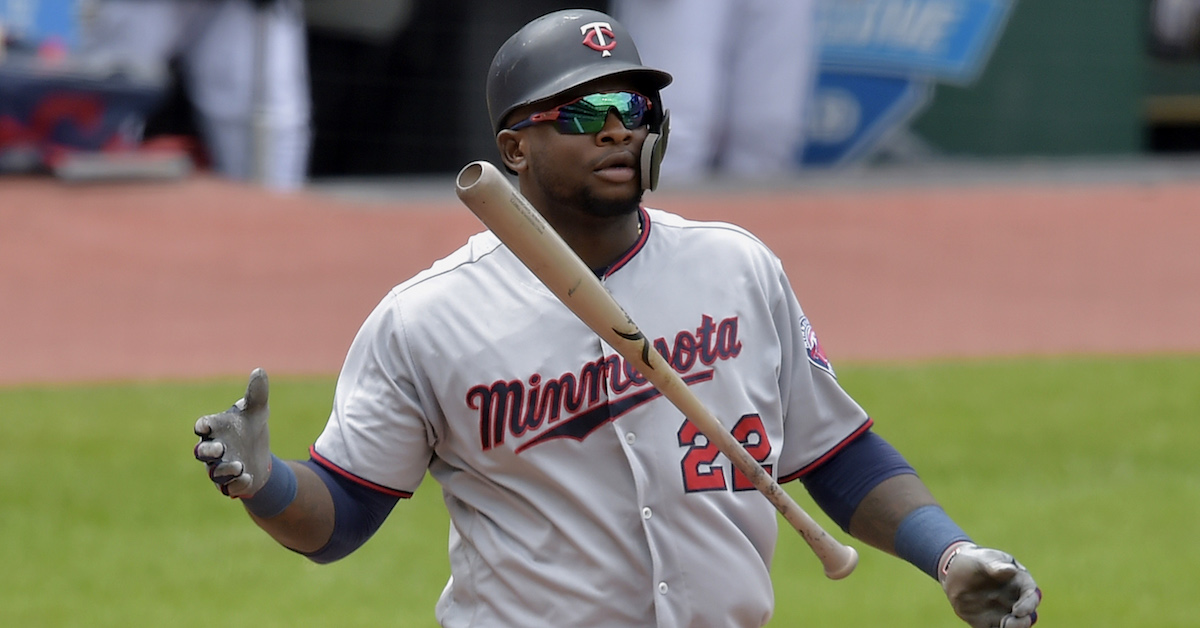
Again, the focus of this series remains on teams that meet the loose definition of contenders (a .500 record or Playoff Odds of at least 10%), and that have gotten about 0.6 WAR or less thus far, which prorates to 1.0 WAR over a full season. With most contenders reasonably well-situated at third base, I’ve loosened the criteria a bit for reasons that will become clear. As noted previously, some of these situations are more dire than others, particularly when taken in the context of the rest of their roster. I don’t expect every team on these lists to upgrade before the August 2 deadline, and I’m less concerned with the solutions – many of which have more moving parts involved than a single trade — than the problems.
2022 Replacement-Level Killers: Third Base
Team
AVG
OBP
SLG
wRC+
Bat
BsR
Fld
WAR
ROS WAR
Tot WAR
Twins
.265
.312
.436
110
4.5
-5.3
-7.7
0.6
1.2
1.8
Phillies
.266
.306
.382
90
-4.5
0.0
-3.0
0.8
1.1
1.9
Statistics through July 26. ROS = Rest-of-season WAR, via our Depth Charts.
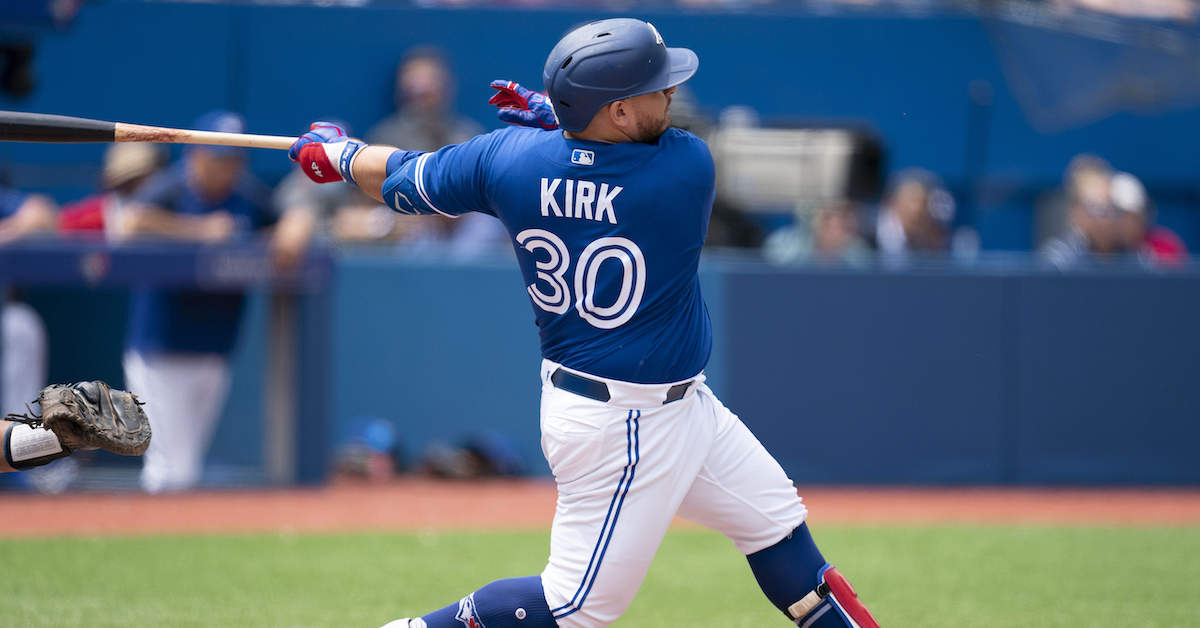
Good swing decisions are a core component of the Toronto Blue Jays’ organizational hitting philosophy. That doesn’t make the American League East club unique — every team wants its hitters to be disciplined at the plate — but the degree to which they accentuate attacking the right pitches is noteworthy. From the lowest levels of the minors all the way up to the big leagues, swing decisions are not only a focus, they’re assigned grades.
Hunter Mense has played a key role in the practice. Now doing double-duty as the big league assistant hitting coach, the 37-year-old former Florida Marlins farmhand has been Toronto’s minor league hitting coordinator since 2019.
Mense discussed the organization’s efforts to develop disciplined hitters when the Blue Jays visited Fenway Park last week.
———
David Laurila: What can you tell me about the Blue Jays’ organizational hitting philosophy?
Hunter Mense: “A lot of it has really just filtered over from 2019 and continued to build. Nothing has drastically changed. But I will say this: The things that have changed, probably — what I’ve seen up here — are some of the more important things that play in the big leagues. It’s us doing a better job of that, and learning how to develop it more in the minor leagues.”
The Toronto Blue Jays have two of the best pitchers in baseball this season. Kevin Gausman possesses a 3.00 ERA and a 1.99 FIP to go with 116 strikeouts in 99 innings. Alek Manoah boasts a 2.24 ERA and a 3.34 FIP with 110 strikeouts in 120.2 innings. The latter pitched a scoreless inning in last week’s All-Star Game; the former, who surprisingly was not named to the squad, has arguably out-performed his teammate.
Each of the two garnered wins over the weekend. On Friday, Gausman ran his hard-luck record to 7–7, fanning 10 batters over five innings in Toronto’s 28–5 rout of the Red Sox at Fenway Park. On Saturday, Manoah allowed one run over six innings, striking out seven Boston batters along the way, to raise his record to 11–4.
On Sunday, I asked the right-handers about each other. In short, why is the other one of the best pitchers in baseball?
“I would say his character,” Manoah said of Gausman. “His character, his competitiveness, the way he goes about his work every day. He’s had his teeth punched out before, and he’s found ways to get back to the top. So I think his resilience is big. There’s also his ability to adjust from pitch to pitch, from lineup to lineup. He’s very strategic. Read the rest of this entry »
In what has been a relatively quiet July so far on the trade front, the Mets made two minor trades over the weekend, both with the Pirates. First, they picked up designated hitter Daniel Vogelbach in return for reliever Colin Holderman. In a separate transaction, Pittsburgh also sent catcher Michael Perez to Queens in return for the team’s favorite kind of player: cash.
As a power-and-walks hitter without much defensive value, Vogelbach was not a favorite of prospect-watchers, but the internet at least partially fell in love with him due to his Rubens-esque proportions. While his major league career hasn’t exactly resulted in any Large Adult MVP memes, he’s established himself in the big leagues as a power-hitting DH, albeit one with a fairly limited role. You don’t want him in a game against a left-handed pitcher, and ideally, you don’t want him standing in the field with a glove, either. If you need a part-time DH who can also come off the bench and ruin a right-handed reliever’s evening, though, then Vogelbach is your man. His .228/.338/.430 triple-slash in Pittsburgh is hardly eye-popping, but in 2022, that’s enough to get you a perfectly serviceable wRC+ of 118.
As a Met, Vogelbach’s line should look even better than that, as he’s joined a team that has less of a reason to let him face lefties. With an extremely thin roster, the Pirates started him 14 times against left-handed starters, about 40% of the time. They had no lefty-masher on hand to serve as a complement to Vogelbach, and when he wasn’t starting, they regularly turned to Yoshi Tsutsugo, another left-handed hitter, or used the position to rest other players. The Mets, on the other hand, are quite content to use J.D. Davis against lefties — he’s started all 35 games against them — and appear to have finally decided that his best position is DH. If Dominic Smith had been hitting at all, a trade like this would not have been necessary, but with a .560 OPS this year after last year’s .667, the team is basically at wits’ end when it comes to getting consistent production out of him. I’d actually be surprised if Smith is on the roster after the deadline, and at this point, a divorce may be best for both parties. Read the rest of this entry »
The trade deadline is nearly here and once again, team behavior will be affected by 40-man roster dynamics. Teams with an especially high number of currently-rostered players under contract for 2023 and prospects who need to be added to the 40-man in the offseason have what is often called a 40-man “crunch,” “overage,” or need to “churn.” This means the team has incentive to clear its overflow of players by either packaging several to acquire just one in return, or by trading for something the club can keep — international pool space, comp picks, or, more typically, younger players whose 40-man clocks are further from midnight — rather than do nothing and later lose some of those players to waivers or in the Rule 5 Draft. Teams can take care of this issue with transactions between the end of the season and the 40-man roster deadline in November, but a contending team with a crunch has more incentive to do something before the trade deadline so the results of those deals can bolster the club’s ability to reach the postseason.
In an effort to see whose depth might influence trade behavior, I assess teams’ 40-man futures every year. This exercise is done by using the RosterResource Depth Chart pages to examine current 40-man situations, subtracting pending free agents using the Team Payroll tab, and then weighing the December 2022 Rule 5 eligible prospects (or players who became eligible in past seasons and are having a strong year) to see which clubs have the biggest crunch coming. I then make an educated guess about which of those orgs might behave differently in the trade market as a result.
Some quick rules about 40-man rosters. Almost none of them contain exactly 40 players in-season because teams can add a player to the 40 to replace one who is on the 60-day injured list. In the offseason, teams don’t get extra spots for injured players and have to get down to 40 precisely, so if they want to keep some of their injury fill-ins, they have to cut someone else from the 40-man to make room. Read the rest of this entry »
Hunter Mense had some talented teammates during his relatively brief playing career. None were more talented than a teenager who went by one of his middle names. Now the assistant hitting coach for the Toronto Blue Jays, Mense played alongside Giancarlo Cruz Michael Stanton during their time together as Florida Marlins farmhands.
“I knew him as Mike,” Mense said of the the 2022 All-Star Game MVP, who began going by his given first name after reaching the big leagues. “I remember reading about, and him telling me that he could have played D1 basketball or D1 football. He looked more like a D1 football player than he’s ever looked like a baseball player.”
It goes without saying that the Brobdingnagian superstar is a stupendously good baseball player. According to Mense, who doubles as Toronto’s minor-league hitting coordinator, Stanton’s work ethic was off the charts. Wanting to improve defensively, the 6-foot-6, 245-pound outfielder would often “drag a coach out to the field” and have him hit balls in his dirction before batting practice.