Archive for Yankees

Aaron Judge Might Need Another Adjustment

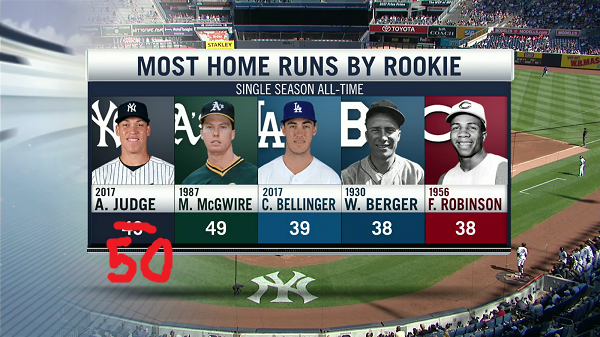
The notion that Aaron Judge would have to eventually make an adjustment this season isn’t all that surprising. What comes with being the largest, most physically intimidating player in the game is also the largest strike zone, the largest area within which pitchers and opposing game-planners can work.

And the counter-offensive to Judge’s remarkable first half has perhaps begun. Even after his home run Monday, Judge had recorded just a .170/.339/.360 slash line in the second half entering play on Tuesday.

Consider some facts regarding Judge and the fastball.

Read the rest of this entry »


Aroldis Chapman Doesn’t Look Right

Sunday night, Rafael Devers went yard against Aroldis Chapman, even though Chapman’s fastball was recorded at nearly 103 miles per hour. It’s the fastest pitch hit out in the pitch-tracking era, which has spanned nearly a decade, and that linked article was almost obligatory. Had to write something up. Devers tagged Chapman, even though it seemed like Chapman had his best stuff.

To a certain extent, you can’t blame Chapman for what happened. He threw a lefty-on-lefty fastball, with two strikes, kind of up and in at over 100 miles per hour. That pitch should basically never go for a homer. I’m still not sure how it happened. But, ignore the homer for a moment. Pretend it was a double, or a single. Or even an out! Whatever you like. Devers made contact. Solid contact, at that. The contact is what’s strange, and there are signs of a problematic trend, here.

Let’s examine Chapman’s career, shall we? I’ve prepared three rolling-average plots, each using samples of 30 games. This first one shows the development of Chapman’s average fastball.

You could argue there’s a recent down tick, but Chapman is still regularly reaching triple digits. His fastball is fast. Still a Chapman fastball. Like we all saw with the at-bat against Devers, Chapman can still run it up there about as hard as he ever has. So, based on the velocity, Chapman seems okay. Shifting to pitch location, we can see a trend from the past year and a half or so.

Chapman has been aggressive with pitching in the zone. He’s thrown two-thirds of his pitches for strikes, and this year in particular, he’s regularly gotten ahead with the first pitches of plate appearances. And, of course, with such an unhittable fastball, why mess around? Chapman had a terrific 2016, in which he came right after his opponents. This year, he’s done much of the same. But-

That plot shows contact rate. Chapman’s present contact rate is far higher than it’s been since earlier in 2013. All of a sudden — it’s not so much that Chapman is hittable, but he’s a great deal more hittable than he’s been. Look at this table of the biggest contact-rate declines from last year, with a minimum of 30 innings:

Top 10 Contact Declines
Pitcher 2016 Contact% 2017 Contact% Change
Aroldis Chapman 65.4% 75.2% 9.8%
Seung Hwan Oh 65.6% 74.4% 8.8%
Matt Cain 80.4% 89.1% 8.7%
Dustin McGowan 69.5% 78.0% 8.5%
Junichi Tazawa 73.5% 82.0% 8.5%
Luke Gregerson 57.9% 65.7% 7.8%
Mychal Givens 70.0% 77.5% 7.5%
Daniel Coulombe 70.5% 77.9% 7.4%
Kelvin Herrera 70.3% 77.3% 7.0%
Cole Hamels 74.6% 81.5% 6.9%
Minimum 30 innings pitched in each season.

Chapman has a contact rate of 75.2%. The league-average reliever has a contact rate of 75.4%. No pitcher’s contact rate has dropped by more, and although Chapman is still mostly okay, and although this could be a blip, he was on the disabled list for a month, with a rotator-cuff problem. His contact rate has only risen since he came back. The velocity is there, and maybe that’s the most important thing, but you do have to wonder. Chapman’s been one of the most dominant relievers anyone’s ever seen. Real cracks appear to be forming.

Related to this, consider Chapman’s year-to-year ranks among all relievers in Win Probability Added:

  • 2011: 24th
  • 2012: 8th
  • 2013: 44th
  • 2014: 15th
  • 2015: 16th
  • 2016: 7th
  • 2017: 337th

I don’t know what the issue is. It wouldn’t be a surprise at all if it were linked to the injury. In that case, it would be nice to have an explanation. But even then, explanation isn’t resolution. Aroldis Chapman is allowing roughly league-average contact. He’s in the first year of the largest contract a reliever has ever signed.


Let’s Watch Rafael Devers Take Aroldis Chapman Deep

The most improbable home run I’ve ever watched in real time was hit last November. You know the one — it was the one hit by Rajai Davis, against Aroldis Chapman, with Davis choked halfway up the barrel. I’m sure that, mathematically, there have been home runs of a lesser likelihood, but that Davis blast just felt impossible. It didn’t feel real until the ball cleared the fence. I still can’t believe it happened, and the Indians still lost the game a couple innings later. I don’t care. I recall the Davis home run more clearly than anything else.

In truth, in my book, any home run against Chapman counts as improbable. I don’t know how he ever gets touched. And yet, Davis, at least, was batting right-handed. He had the platoon advantage. And the pitch he lined out to left field clocked in at a hair over 97 miles per hour. Fast, but not *outrageously* so. There are plenty of pitchers out there who can throw 97. Sometimes they give up dingers. The Davis home run, realistically, never should’ve happened, but I can bring myself to get it. I can understand the mechanism.

When Davis took his hopeful swing, Rafael Devers was, I don’t know, somewhere. Probably, he was watching. But no matter what he was doing, he was doing it having recently turned 20 years old. He was a good baseball prospect, but he was one who hadn’t yet encountered Double-A competition. I’m not sure how close Devers felt like he was. Yet Sunday night, you could say that Devers arrived.

Read the rest of this entry »


Updated Top-10 Prospect Lists: AL East

Below are the updated summer top-10 prospect lists for the orgs in the American League East. I have notes beneath the top 10s explaining why some of these prospects have moved up or down. For detailed scouting information on individual players, check out the player’s profile page which may include tool grades and/or links to Daily Prospect Notes posts in which they’ve appeared this season. For detailed info on players drafted or signed this year, check out our sortable boards.

Baltimore Orioles (Preseason List)

1. Chance Sisco, C
2. D.L. Hall, LHP
3. Ryan Mountcastle, OF
4. Austin Hays
5. Cedric Mullins, OF
6. Cody Sedlock, RHP
7. Keegan Akin, LHP
8. Hunter Harvey, RHP
9. Jomar Reyes, 3B
10. Anthony Santander, OF/1B

Read the rest of this entry »


Masahiro Tanaka’s Daylight Problem

Is there anyone having a weirder season than Masahiro Tanaka? Dude is in the top fifteen when it comes to strikeouts minus walks, and yet he’s got an ERA over five. He’s been better recently! And he’s done it by… refusing to throw fastballs. Despite this wrinkle, he’s still giving up nearly two home runs per game. We haven’t even gotten to the weird day/night splits, but they’re part of the story, too. Weird.

Read the rest of this entry »


Ranking the Prospects Traded During Deadline Season

Among the prospects traded in July, Eloy Jimenez stands out. (Photo: Arturo Pardavila III)

Below is a ranking of the prospects traded this month, tiered by our Future Value scale. A reminder that there’s lots of room for argument as to how these players line up, especially within the same FV tier. If you need further explanation about FV, bang it here and here. Full writeups of the prospects are linked next to their names. If the player didn’t receive an entire post, I’ve got a brief scouting report included below. Enjoy.
Read the rest of this entry »


Belated Trade Analysis: White Sox Acquire Blake Rutherford & Co.

Several trades occurred while I was on vacation. I’m profiling the prospects involved in those deals in a belated nature. This post analyzes the prospects involved swap between the White Sox and Yankees, centered around the Yankees new bullpen weapons and prospect Blake Rutherford. A reminder of those involved.

Yankees get

White Sox get

Read the rest of this entry »


With Sonny Gray, the Yankees Are World Series-Ready

The A’s were never going to hold. There was simply too much for them to lose. Sure, the rumors flew around, but they never made sense, as the A’s aren’t stupid. The A’s were never going to hold, and the Yankees were always the obvious match. They stood to gain the most in the short-term, and they stood to gain the most in the long-term. An agreement felt virtually inevitable, and while there were tugs on either side, there’s nothing like a deadline to push negotiators toward a decision. As time ran out, the A’s and the Yankees finally came together, as one would’ve figured they would.

Yankees get:

  • Sonny Gray
  • $1.5 million in international bonus money

A’s get:

The Yankees get to sell it as a move for a good starting pitcher in which they didn’t have to give up their absolute top-tier prospects. The A’s get to sell it as a move for three talented young players, each of whom could make a big-league splash. Neither interpretation would be incorrect — that’s how the spin goes when you’re dealing with a system as deep as New York’s. The A’s did well to get what they did, and there’s something to dream on with all of these players, yet the bigger takeaway for now is that the Yankees have taken another step forward. Their transition period is complete, and they’re now ready to try for a title.

Read the rest of this entry »


Scouting Dustin Fowler, James Kaprielian and Jorge Mateo

After months of scouring the market for another starting pitcher and weeks of industry chatter suggesting it would likely, eventually, be Sonny Gray, the Yankees have acquired the righty shortly before the trade deadline. It came at a fairly steep price. Below is analysis of the prospects sent to Oakland in the deal.

Yankees get

  • RHP Sonny Gray
  • International bonus slot

Athletics get

Read the rest of this entry »


Projecting Dustin Fowler and Jorge Mateo

The Yankees traded for Sonny Gray. Below are the projections for the prospects the Athletics received in exchange for Gray’s services. Although he is a major part of this trade, I do not have a projection for James Kaprielian, who has thrown just 29 innings as a professional and zero since April 2016. WAR figures account for the player’s first six major-league seasons. KATOH denotes the stats-only version of the projection system, while KATOH+ denotes the methodology that includes a player’s prospect rankings.

Dustin Fowler, OF (Profile)

KATOH: 9.0 WAR (28th)

KATOH+: 8.8 WAR (18th)

Read the rest of this entry »