
Davey Lopes (1945–2026): Speedster, Student, and Mentor
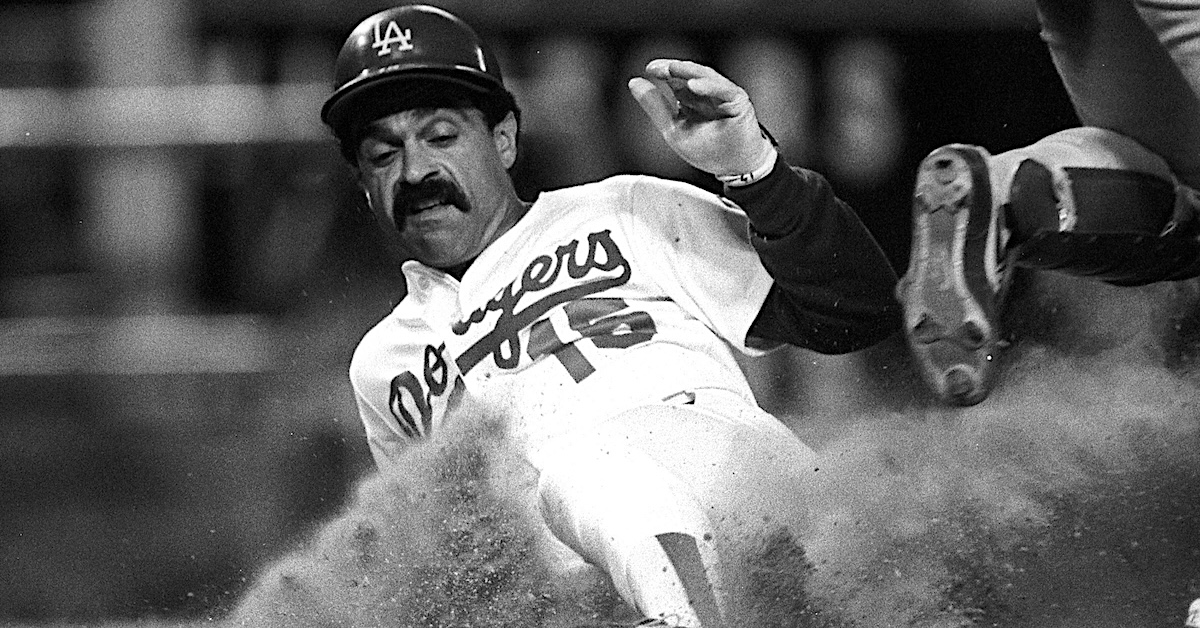
Davey Lopes was my first favorite ballplayer. In retrospect, I’m not sure how my eight-year-old self settled upon Lopes in a star-laden lineup featuring power hitters Dusty Baker, Ron Cey, Steve Garvey, and Reggie Smith, who the year before (1977) had become the first quartet of teammates to homer 30 times apiece in a season. I have a much better grasp of how Bill James helped my teenage self appreciate Lopes for his combination of high on-base and stolen base rates with mid-range power, but James wasn’t communicating those ideas via mass-market paperbacks circa 1978. Perhaps it was Lopes’ position atop the lineup I memorized while learning to decode box scores (my theory) or the Topps baseball card set that began my collection. Maybe it was simply his instantly recognizable, bushy mustache (my friends’ theory), but one way or another, even before later heroes such as Fernando Valenzuela and Jim Bouton, Lopes was my guy.
The news that Lopes passed away on April 8 at age 80 due to Alzheimer’s and Parkinson’s diseases — a brutal double bill — reached me while I was traveling in Austria with my own 84-year-old parents and additional family as we tracked down the Vienna addresses of my long-deceased paternal grandparents. I had no shortage of thoughts regarding mortality, and yet the hits kept coming. Lopes wasn’t even the most recent former All-Star-second-baseman-turned-manager to pass away, as Phil Garner, his National League rival and then predecessor in managing the Brewers, died of pancreatic cancer on April 11. So it goes.
Though he didn’t debut until well past his 27th birthday, Lopes spent 16 seasons in the majors (1972-87), the first 10 with the Dodgers, whom he helped to four pennants and a championship while making four All-Star teams, winning a Gold Glove, and becoming team captain. From 1973–81, he manned the keystone in the longest running infield in major league history, along with Garvey at first base, Cey at third, and Bill Russell at shortstop — a unit that formed the foundation of those pennant-winning teams under managers Walter Alston and Tommy Lasorda. “He was the catalyst of the engine. It was 700 horsepower with the four of us, and the equation was his ability to get on base,” Garvey told CBS LA in the wake of Lopes’ death.
Lopes was best known as an elite base thief, leading the NL in stolen bases in 1975 and ’76 and setting a major league record with 38 consecutive successful steals in the former season, during which he swiped 77 bases in 89 attempts. Mentored by Maury Wills, who returned the stolen base to prominence by stealing 104 bases en route to the NL MVP award in 1962, Lopes developed what many regarded as the game’s best eye for reading pitchers’ moves to the plate. He described basestealing as “psychological warfare” and drew endless amounts of pickoff throws, each one presenting another opportunity to study a pitcher’s tendencies. “Davey Lopes was the most serious player I covered in any sport,” former Dodgers beat reporter Chris Mortenson told author Jason Turbow for They Bled Blue, a 2019 book about Los Angeles’ championship-winning 1981 team.
Lopes stole 40 or more bases in a season seven times; in six of those, he was caught 12 times or fewer. In 1985, his age-40 season, he stole 47 bases for the Cubs — 10 more than any other player that age or older — while being caught just four times. His career total of 557 stolen bases ranks 26th all time, while his 83% success rate ranks third among players with at least 500 attempts since 1920:
| Player | Years | SB | CS | SB Att | SB% |
|---|---|---|---|---|---|
| Tim Raines | 1979–2002 | 808 | 146 | 954 | 84.7% |
| Willie Wilson | 1976–1994 | 668 | 134 | 802 | 83.3% |
| Davey Lopes | 1972–1987 | 557 | 114 | 671 | 83.0% |
| Jimmy Rollins | 2000–2016 | 470 | 105 | 575 | 81.7% |
| Carl Crawford | 2002–2016 | 480 | 109 | 589 | 81.5% |
| Ichiro Suzuki | 2001–2019 | 509 | 117 | 626 | 81.3% |
| Joe Morgan | 1963–1984 | 689 | 162 | 851 | 81.0% |
| Vince Coleman | 1985–1997 | 752 | 177 | 929 | 80.9% |
| Rickey Henderson | 1979–2003 | 1406 | 335 | 1741 | 80.8% |
| Roberto Alomar | 1988–2004 | 474 | 114 | 588 | 80.6% |
| José Reyes | 2003–2018 | 517 | 127 | 644 | 80.3% |
| Johnny Damon | 1995–2012 | 408 | 103 | 511 | 79.8% |
| Ozzie Smith | 1978–1996 | 580 | 148 | 728 | 79.7% |
| Kenny Lofton | 1991–2007 | 622 | 160 | 782 | 79.5% |
| Paul Molitor | 1978–1998 | 504 | 131 | 635 | 79.4% |
| Rajai Davis | 2006–2019 | 415 | 108 | 523 | 79.3% |
| Luis Aparicio | 1956–1973 | 506 | 136 | 642 | 78.8% |
| Marquis Grissom | 1989–2005 | 429 | 116 | 545 | 78.7% |
| Barry Bonds | 1986–2007 | 514 | 141 | 655 | 78.5% |
| Tommy Harper | 1962–1976 | 408 | 116 | 524 | 77.9% |
Incomplete data before 1920 prevents us from positioning early stolen base kings such as Ty Cobb, Max Carey, and Eddie Collins within this context, and Lopes’ rate slips to ninth if you lower the bar to 300 attempts, but the point is that he dealt in volume and efficiency. By Baseball Reference’s baserunning runs measure — which also accounts for extra bases taken — he’s fifth among that post-1920 set at 83 runs above average, while FanGraphs’ numbers place him 18th at 68.4 runs above average, fewer than 10 runs out of eighth place.
For his career, Lopes hit .263/.349/.388 (107 OPS+) with 1,671 hits, 155 homers, 42.4 bWAR, and 36.3 JAWS, numbers that by themselves don’t rate serious consideration for the Hall of Fame (he received just two votes in his lone BBWAA ballot appearance in 1993), but his contributions hardly stopped there. Indeed, he was the first-base-coach analogue of Johnny Sain, the well-traveled and much-revered former All-Star who carved an outsized niche as an iconoclastic pitching coach. Lopes spent 27 seasons on staff for the Rangers, Orioles, Padres, Nationals, Phillies, and Dodgers, interrupted by two seasons and change as the manager of the Brewers (2000–02); in all, he spent 49 seasons in professional baseball. He was particularly successful in Philadelphia, where he coached four straight division winners, including one with a record-setting stolen base success rate (87.9% in 2007), one that won a World Series (2008), and another that won an NL pennant (2009). After that run, Dodgers general manager Ned Colletti recruited him to return to L.A. “Davey Lopes transformed coaching at first base,” Colletti told the Los Angeles Times after Lopes’ death. “His situational awareness and intricacy of coaching first base was the best I have ever watched. He changed a coaching position and how it was executed — base running, secondary leads, pitch tipping, cutting your steps from first to third.”
Jayson Werth, who stole 60 bases in 68 attempts during Lopes’ four year with the Phillies, said, “I might go as far as to say he’s the best [first base coach] in the history of baseball. Now that isn’t very well researched, of course. But the way he transfers knowledge to players is amazing.”
David Earl Lopes was born on May 3, 1945 in East Providence, Rhode Island, and grew up in South Providence. His father, a native of Cape Verde, died when he was two years old, and a stepfather came and went, leaving his mother, Mary Rose Sylvia, to raise 10 children on her salary as a domestic worker. Lopes once described his childhood surroundings to Los Angeles Times columnist Jim Murray as “roaches, rats, poor living conditions, drugs as prevalent as candy, tenement houses with six to a room, welfare, food stamps.”
“If it hadn’t been for sports, there’s no telling what I’d be or where I’d be,” Lopes told the Los Angeles Times’ Ross Newhan in 1973. “All I had to do was step off the porch to a choice of all the things you associate with a ghetto… drugs, vice, stealing.” He admitted to shoplifting clothes, baseballs, and bats as a youth, but at least sports gave him “something to do… a way to take out my frustrations.” He began playing Little League in Providence’s Fox Point neighborhood, and used the same glove until he reached high school. At La Salle Academy, he earned all-state honors in both baseball and basketball, the latter despite maxing out at a listed 5-foot-9 and 170 pounds in the majors.
Between his size, his grim surroundings, and the Northeast’s short playing season, Lopes didn’t draw the attention of scouts or harbor dreams of playing professionally after graduating in 1963. However, he caught the eye of Hope High School coach Michael Sarkesian, a rival who would become a mentor to him. When Sarkesian became the athletic director at Iowa Wesleyan University, he brought in Lopes on a baseball scholarship; he earned NAIA All-American honors there, and when Sarkesian moved to Washburn University in Topeka, Kansas, Lopes went along and played both basketball and baseball, hitting .380 and slugging .793 with nine homers in 1967. “Whatever I missed by not really having a father, Sarkesian provided,” Lopes told Newhan. “He could relate to my problems, my environment. The drive, the determination not to give in to the ghetto, to make something of my life, stems from my relations with him.”
The Giants selected Lopes in the eighth round of the June 1967 amateur draft, but he opted to return to Washburn to continue his education. The Dodgers then chose him in the second round of the January 1968 draft, a now-bygone secondary phase for previous draftees who hadn’t signed. He was at the leading edge of what emerged as the greatest draft haul in the sport’s history. The team additionally chose and signed pitcher Geoff Zahn in the sixth round of that phase, then, in the primary June draft, added infielder Bobby Valentine (first round), first baseman Bill Buckner (second round), outfielders Tom Paciorek (fifth round) and Joe Ferguson (eighth round), and pitcher Doyle Alexander (ninth round). In the secondary phase of the June draft, the Dodgers selected Garvey (first round) and Cey (third round). All would go on to substantial major league careers save for Valentine (whose career was derailed injuries), totaling 23 All-Star appearances and 234.8 bWAR among them, according to MLB.com’s Jim Callis.
While Lopes signed for a $10,000 bonus, he didn’t attend spring training in Vero Beach in either 1968 or ’69. With the team’s blessing, he finished his classwork before reporting to A-level Daytona Beach in both years, further slowing his progress at a point when he was already among the league’s oldest players, but allowing him to earn his bachelor’s degree in elementary education. During spring training in 1970, Lopes caught the eye of Lasorda, then Triple-A Spokane’s manager, when he legged out a triple on what should have been a gap double. Lasorda decided he wanted the speedster at Spokane, later saying, “He had literally run into my life.”
Lopes exclusively played the outfield in A-ball, but at Spokane, where he joined several fellow 1968 picks, Lasorda asked him to learn second base. Lopes balked and threatened to quit, only to have the manager call his bluff. “Maybe they’ll let you play outfield on the thread factory team,” Lasorda told Lopes, who began infield lessons under coach Monty Basgall. “Davey had terrible hands — terrible — and he couldn’t make the double play,” recalled Basgall in 1977. He was more impressed by Lopes’ range, strong arm, and the speed with which he learned the position once he set his mind to it.
Basgall additionally tutored Garvey, a former third baseman, and Russell, a former outfielder, at learning new positions, exemplifying an organizational principle that Branch Rickey termed “coconut snatching.” If the Dodgers believed a player could hit major league pitching, they moved him around the diamond to find a positional fit, bearing the defensive consequences.
Lopes hit .262/.339/.382 but stole just 11 bases in 100 games in 1970, though the powerhouse Spokane team went 94-52 and won the Pacific Coast League championship. He improved to .306/.383/.433 with six home runs and 36 stolen bases for Spokane in 1971 while playing 58 games in the outfield and 41 at second base, up from three the year before, and began to shed his shyness. “It took two years [at Spokane],” observed Lasorda, “but he finally got to the point where he felt he belonged.”
The Dodgers transferred their Triple-A affiliate from Spokane to Albuquerque after the 1971 season, and Lopes, now entering his age-27 season, went along. He hit .317/.411/.476 with 11 homers and 48 steals in 104 games in the high-altitude, high-offense environment (the Dukes scored 6.09 runs per game) while playing 96 games at second, 13 in the outfield, and even two at shortstop. In late September, after helping the Dukes win the PCL championship, he joined the Dodgers, who were en route to an 85-70 record and a third-place finish in the NL West. The team had cycled through a succession of second basemen, with Jim Lefebvre, Valentine, Lee Lacy, and Billy Grabarkewitz all spending uninterrupted-but-largely-undistinguished stretches as regulars. After Lacy’s season ended due to a knee injury, Lopes debuted on September 22, 1972, batting leadoff and going 0-for-5 in an 11-inning, 1-0 win against the Giants; also in the lineup for the first time that year was the 24-year-old Cey, who took over at third base. Lopes drew three walks in five plate appearances the next day, notching his first steal after a first-inning walk against Ron Bryant. On September 24, he collected his first two hits with singles off the Giants’ Jim Barr, and he remained atop the lineup for the rest of the season, batting .214/.327/.310 with four stolen bases in 49 plate appearances.
Despite Lopes’ strong spring in 1973, Lacy reclaimed the second base job. Lopes batted just four times during the team’s first 16 games, but with Lacy starting slowly, the two swapped spots, as Lopes joined a starting infield that included Buckner at first base, Russell at shortstop, and Cey at third. Lopes was so hot in the early going that his batting average crested at .388 after a 4-for-7 game against the Braves on May 19. Meanwhile, Garvey, who had struggled with throwing as a third baseman in 1971–72, tried out left field before winding up on the bench. In the second game of a June 23 doubleheader against the Reds, Alston wrote Garvey in as the first baseman and moved Buckner — who had suggested the position switch, recalling the teammates’ time at Albuquerque in 1969 — to left field. It was the debut of the Longest Running Infield, though it took Alston a couple of weeks to fully commit to a unit that spent eight and a half seasons together. Lopes hit .275/.352/.351 (100 OPS+) with 36 steals in 52 attempts, as well as six homers — the first a two-run shot off the Giants’ Barr on May 13 — and 3.5 WAR. He finished sixth in the NL Rookie of the Year voting. The Dodgers went 95-66 but finished 3 1/2 games behind the Reds.
In 1974, Lopes improved to .266/.350/.383 (109 OPS+) with 10 homers and 59 steals (in 77 attempts), half the total of Lou Brock in his record-setting season. On August 20, Lopes homered three times and went 5-for-6 in an 18-8 blowout against the Cubs at Wrigley Field; four days later, he tied a 70-year-old NL record with five steals in a game against the Cardinals. With Garvey hitting his way into the NL All-Star lineup and then winning the league’s MVP award, and big seasons from center fielder Jimmy Wynn, starters Andy Messersmith and Don Sutton, and rubber-armed reliever Mike Marshall, the Dodgers won 102 games, making the playoffs for the first time since 1966. They proceeded to beat the Pirates three games to one in the best-of-five National League Championship Series, with Lopes getting on base nine times and stealing three bags, but fell to the defending champion A’s in a five-game World Series, where Lopes went just 2-for-18.
From 1975–79, Lopes hit a combined .267/.359/.401 while averaging 14 home runs, 55 stolen bases (and just eight times caught), and 4.6 WAR. The first of those seasons was his best in terms of WAR (5.3), fueled by 77 steals, 91 walks, and 108 runs scored; he even spent a few weeks filling in at center field (with Lacy at second) when Alston juggled the lineup while Buckner was injured. From June 10 through August 24, Lopes stole 38 straight bases without being caught, breaking Carey’s mark of 36 straight from 1922–23; the Expos’ Gary Carter threw him out in the 12th inning of a game after Lopes had already stolen safely three times. “He’s the best there is at stealing,” said Reds catcher Johnny Bench, who caught Lopes just twice in 10 stolen base attempts in 1975. “Lopes not only has the knowledge and speed, but also the quick acceleration. He has everything.”
Alas, the Dodgers could not catch Bench and the Big Red Machine in either 1975 or ’76, as the team finished a distant second in the NL West both times. Despite being limited to 117 games due to injuries in 1976, Lopes stole a league-leading 63 bases in 73 attempts, but his season was otherwise a subpar one offensively, as he managed just four homers and a 94 OPS+. He began to emerge as a team leader, at one point admonishing Baker, who’d arrived in a trade from the Braves, for overthrowing the cutoff man. “We don’t play that way,” Lopes told the newcomer, who protested that the play had been close. When Lopes reiterated his stance, “I looked up and the whole team was coming over to back up Davey,” recalled Baker.
Though Lopes stole “only” 47 bases in 59 attempts in 1977 — the Dodgers’ first season under Lasorda, with Alston having retired after 24 seasons at the helm — he rebounded to set new highs with 11 homers and a 110 OPS+. Driven by the four 30-homer sluggers and a deep rotation led by Sutton and Tommy John, the Dodgers built a 10-game lead in the NL West by the first week of May, and took the division with a 98-64 record. They beat the Phillies in a four-game NLCS, with Lopes helping to fuel a three-run ninth-inning rally in Game 3 while exemplifying how speed put pressure on the opposing defense. He drove in the tying run by legging out a deflected infield single off Gene Garber, then scored the go-ahead run after an error on a pickoff play and a Russell single. Though he hit a two-run homer off the Yankees’ Ron Guidry in Game 4 of the World Series, he went just 4-for-24 as the Dodgers fell in six games.
The Dodgers named Lopes team captain in 1978, after Lasorda told owner Peter O’Malley that he’d already been functioning in the role in an unofficial capacity. He made his first All-Star team at age 33 and showed more power than ever, homering 17 times while batting .278/.355/.421 (118 OPS+), stealing 45 bases in 49 attempts, and winning his only Gold Glove. He caught fire in the postseason, batting .341/.370/.750 with five homers and 12 RBI in another four-game NLCS win over the Phillies and six-game World Series loss to the Yankees. He homered and collected three hits in each of the first two games of the NLCS, driving in three of the Dodgers’ four runs in Game 2 with a solo homer, an RBI single, and an RBI triple.
Unfortunately, that hot streak was tinged with sadness. On September 15, longtime Dodgers player-turned-coach Jim Gilliam suffered a massive cerebral hemorrhage and slipped into a coma. He died on October 8, the day after the NLCS ended. After Lopes homered twice and drove in five runs in the World Series opener, he dedicated his performance to Gilliam, whom he called “a father, friend, and locker room inspiration.” The Yankees, however, apparently misinterpreted his pointing at the sky in tribute to Gilliam during his second trip around the bases as a “we’re number one” gesture, stoking their ire. While the Dodgers took the first two games, they lost the last four, though Lopes scored four of the team’s eight runs in those losses.
In January 1979, Lopes signed a five-year extension through the 1984 season, worth somewhere in the neighborhood of $2 million. That year, he was voted into the NL All-Star lineup for the first of three straight times, ending Morgan’s run of seven consecutive starts. Not only did Lopes set new highs with 97 walks, 109 runs, and a 128 OPS+ (.265/.372/.464), but his 28 homers — including a walk-off grand slam against the Cubs on September 2 — tied Garvey and Cey for the team lead. Even so, the Dodgers finished 79-83 as their pitching collapsed.
They returned to contention in 1980, losing out on a playoff spot due to a Game 163 tiebreaker loss to the Astros, but the next year, they won the “first half” NL West title before a seven-week players’ strike. While fans still anointed Lopes to All-Star status, age caught up with him and his offense waned. He hit just .251/.321/.344 (87 OPS+) with 10 homers in 1980, and a dismal .206/.289/.285 (66 OPS+) with five homers in ’81, during which he played just 58 games due to ankle and groin injuries; he did go 20-for-22 in steals that season. In August 1981, when Lopes’ groin strain sidelined him, the Dodgers called up 21-year-old Steve Sax straight from Double-A San Antonio for a glimpse of their future. Mixing in youngsters like slugger Pedro Guerrero and rookie pitching sensation Valenzuela, the Dodgers won five straight elimination games against the Astros in the Division Series and the Expos in the NLCS before beating the Yankees in a six-game World Series. Lopes hit just .233/.324/.267 in the postseason and set a World Series record with six errors, though he also set a postseason record with 10 stolen bases (without being caught), and looked much more like his younger self while scoring five runs in the final four games of the World Series. “They can do anything they want with us now,” said Lopes after the Dodgers won their first championship since 1965. “I’ve got the ring. They can’t take that away from me.”
That championship was the swan song for the Longest Running Infield. On February 8, 1982, Lopes was traded to the A’s after he and agent Tony Attanasio negotiated a $150,000 buyout of his no-trade clause. The Dodgers, who acquired 19-year-old infielder Lance Hudson in the deal, included cash to help defray the $1.3 million remaining on Lopes’ contract.
Part of the draw in accepting the trade was Oakland manager Billy Martin’s love of the running game, though there was some question as to whether Lopes would hit second behind leadoff man Henderson, who had already led the AL in steals twice in three seasons. The A’s went just 68-94 under Martin (who got the axe), but Henderson broke Brock’s single-season record with a whopping 130 steals. Lopes, generally batting sixth or seventh, managed 28 himself but just a 90 OPS+. He rebounded in 1983 (17 homers, 22 steals, 116 OPS+, 2.8 WAR), after which Bill James, in his annual Baseball Abstract, called him “a great percentage player, a multi-dimensional player [who] could loosely be described as a National League Amos Otis or a lower-class Joe Morgan.”
Unfortunately for Lopes, the A’s signed the 40-year-old Morgan, an Oakland native, as a free agent ahead of the 1984 season; Lopes moved into a utility role that included more time in the outfield than the infield. He fared well in that capacity, and on August 31, was traded to the Cubs, reuniting him with Cey on a team bound for its first postseason appearance since 1945 — though he played sparingly. In the NLCS, the Cubs lost to a Padres team led by Garvey, who won series MVP honors, with old Yankees nemeses Graig Nettles and Rich Gossage also in key roles.
Before filing for free agency, Lopes agreed to return to the Cubs on a two-year deal worth just under $1 million, covering his age-40 and age-41 seasons. “Although I didn’t get to play much, I could see all the positive things being done,” he said upon re-signing. Now almost exclusively an outfielder, he put together an impressive campaign in 1985, hitting .284/.383/.444 (122 OPS+) with 11 homers, 47 steals in just 51 attempts, and 1.8 WAR. He was effective, if not as aggressive, in 1986, stealing 22 bases in 59 games before being traded to the playoff-bound Astros on July 21. With Houston, he again played sparingly both in the regular season and in a losing cause against the Mets the NLCS.
In the spring of 1987, Lopes served as a baserunning instructor for the Astros under manager Hal Lanier, a preview of his career as a coach. Age and injuries limited him to just 56 plate appearances, and after the season he retired. He began his career as a first base coach on Valentine’s Rangers staff in 1988, and after a four-year run there, he joined the Orioles, for whom he spent three years (1992–94) on the staff of another former Dodgers teammate, Johnny Oates. After that, he spent five seasons (1995–99) under manager Bruce Bochy in San Diego, helping the Padres win the NL West in both 1996 and ’98, with a pennant (but a World Series loss to the Yankees) in the latter season.
During this time, Lopes interviewed for several managerial openings but always came up short. With commissioner Bud Selig directing teams to consider minority candidates for managerial jobs, Lopes finally landed one in the fall of 1999, as the Brewers (then guided by Wendy Selig-Prieb, the commissioner’s daughter) chose him over Willie Randolph. It was not a plum position, as Milwaukee was coming off six consecutive sub-.500 seasons under Garner and was about to lose significant revenue because construction delays prevented the team from moving into Miller Park for the 2000 season. With the game’s eighth-lowest Opening Day payroll ($35.8 million) and a dearth of talent, the undermanned team went 73-89 in 2000, and then — after a 38-34 start — just 68-94 in 2001, Miller Park’s inaugural season.
Amid a second-half skid, on July 29, 2001, with the Brewers down 12-5 against the Padres, Henderson — by that point San Diego’s 42-year-old leadoff hitter — stole second base with a seven-run lead. Though the play was later ruled defensive indifference, Lopes took umbrage at what he felt was a violation of the unwritten rules, threatening Henderson with retribution. “I just told him to stay in the game because he was going on his ass. We were going to drill him, flat out,” Lopes said afterwards. Bochy removed Henderson before that could happen; Lopes drew a two-game suspension, and was further chastened when the Elias Sports Bureau counted seven times that he himself stole while up at least seven runs. Oops.
When the Brewers started the 2002 season 3-12, Lopes mercifully was fired. He returned to the Padres (with no hard feelings, apparently) from 2003–05 before spending ’06 with the Nationals and then joining the Phillies. Led by Rollins (41-for-47), Shane Victorino (37-for-41), and Michael Bourn (18-for-19), the team stole 138 bases while being caught just 19 times, for an 87.9% success rate, the highest in major league history to that point. By the end of his run, the championship-winning 2008 team (84.5%) ranked second and the ’10 team fourth (83.7%), though with the 2023 introduction of the pitch clock, disengagement rule, and bigger bases, a whole host of teams has matched or surpassed those rates. The 2007 Phillies now rank third, behind the 2025 and ’23 Mets (89.1% and 88.7%, respectively), while the ’08 team was bumped all the way down to 16th.
Lopes, who survived a bout of prostate cancer in 2008, moved on to the Dodgers (2011–15) and back to the Nationals (2016–17), coaching past his 72nd birthday. While in Washington, he helped develop Trea Turner into another high-percentage base thief who would later win stolen base titles in 2018 and ’21 and go 30-for-30 in ’23. “He’d look at me [at first base] and say, ‘Why are you still standing here?’” Turner told the Philadelphia Inquirer in 2023. “He was old-school… Not a lot of numbers or anything. Just pure confidence… having him in my ear and saying, ‘Just trust it and go,’ was kind of a change of pace.”
In recent years, as his health challenges increased, Lopes moved back to Rhode Island. South Providence dedicated a recreation center in his name in 1988, but Lopes still bore scars from the lack of recognition he received for coming from “the wrong side of the tracks.” Within baseball, however, his legacy as a player, coach, mentor, and student of the game is forever safe.
Brooklyn-based Jay Jaffe is a senior writer for FanGraphs, the author of The Cooperstown Casebook (Thomas Dunne Books, 2017) and the creator of the JAWS (Jaffe WAR Score) metric for Hall of Fame analysis. He founded the Futility Infielder website (2001), was a columnist for Baseball Prospectus (2005-2012) and a contributing writer for Sports Illustrated (2012-2018). He has been a recurring guest on MLB Network and a member of the BBWAA since 2011, and a Hall of Fame voter since 2021. Follow him on BlueSky @jayjaffe.bsky.social.
Somewhat related but how is Reggie Smith not in the hall of fame?
Smith was every bit the equal of Votto and Utley. He was an OBP machine when OBP was still discounted. If those two modern guys get in, a future veteran’s committee should look hard at Smith.