
Fitting Jarren Duran Into the Red Sox Outfield Puzzle
Jarren Duran enjoyed a breakout season in 2024, making the AL All-Star team, receiving down-ballot support in the MVP voting, and leading the league in several key categories while ranking fifth with 6.8 WAR. Though he remained an above-average player last year, his season didn’t go quite so well, and as the 2026 campaign dawns, his role is among the many questions the Red Sox face this spring.
At a time when the Red Sox are trying to figure out their primary infield alignment — Will newly acquired Caleb Durbin play second or third? Will Marcelo Mayer man the other spot from the start, or begin the year in the minors after an injury-shortened rookie season? — they’re also sorting through their outfield options. The situation is more or less the same as it’s been since last June, when Roman Anthony, the no. 2 prospect on our preseason Top 100 Prospects list, was called up to squeeze into an outfield capably manned by Duran, Ceddanne Rafaela, and Wilyer Abreu, with platoon assistance for the last of those from Rob Refsnyder. The trade deadline came and went without either Abreu or Duran being moved despite numerous rumors, and injuries to Abreu, Refsnyder and then Anthony (who suffered a season-ending oblique strain in early September) simplified manager Alex Cora’s juggling, though not for the betterment of the team. Boston won 89 games and claimed a Wild Card spot, but without Anthony and enough healthy starting pitchers, the Red Sox were bounced out of the first round by the Yankees.
Refsnyder departed for the Mariners in free agency, but the other four outfielders are back and healthy. The Red Sox also have an expensive platoon designated hitter, Masataka Yoshida, further crowding the picture, and last year’s Opening Day second baseman Kristian Campbell — who entered the 2025 season seventh on our Top 100 and inked an eight-year, $60 million extension just a week into his big league career — is working out in center field, as well. Having too many good players isn’t a bad problem to have, but it can become one when questions about playing time, contract statuses, and trade rumors get relentless.
Which brings us back to Duran, who’s 29 and has two more years of arbitration eligibility remaining. As noted, he’s coming off a good-not-great campaign, having slipped from .285/.342/.492 (131 wRC+) with 21 home runs and 34 stolen bases in 2024 to .256/.332/.442 (111 wRC+) with 16 homers and 24 steals in ’25. His 3.9 WAR still led the team’s position players last season, but his performance didn’t turn heads as it did the year before.
“I’m always disappointed in myself,” Duran said last week when asked about how he viewed last season in contrast to his great 2024. He may not have meant it as such, but the harsh self-assessment offered an uncomfortable reminder of his previous mental health struggles and his tendency to be overly hard on himself. “I always feel like I don’t do the best that I can do. I feel like I let the fans down sometimes, or my teammates. It’s a new year, so you just have to flush it and go out there and do my thing.”
Looking more closely at 2025, Duran was particularly inconsistent from month to month, with a red-hot July papering over some subpar stretches, including three months in which he finished with a wRC+ in the 87–91 range.
| Monthly | G | PA | HR | AVG | OBP | SLG | wRC+ |
|---|---|---|---|---|---|---|---|
| Mar/Apr | 31 | 149 | 2 | .279 | .336 | .426 | 108 |
| May | 28 | 128 | 2 | .258 | .297 | .400 | 87 |
| June | 26 | 114 | 2 | .210 | .301 | .400 | 91 |
| July | 23 | 95 | 5 | .317 | .411 | .683 | 193 |
| August | 26 | 111 | 3 | .239 | .360 | .402 | 112 |
| Sept/Oct | 23 | 99 | 2 | .233 | .303 | .389 | 89 |
Here’s how his production looked in rolling graph form:
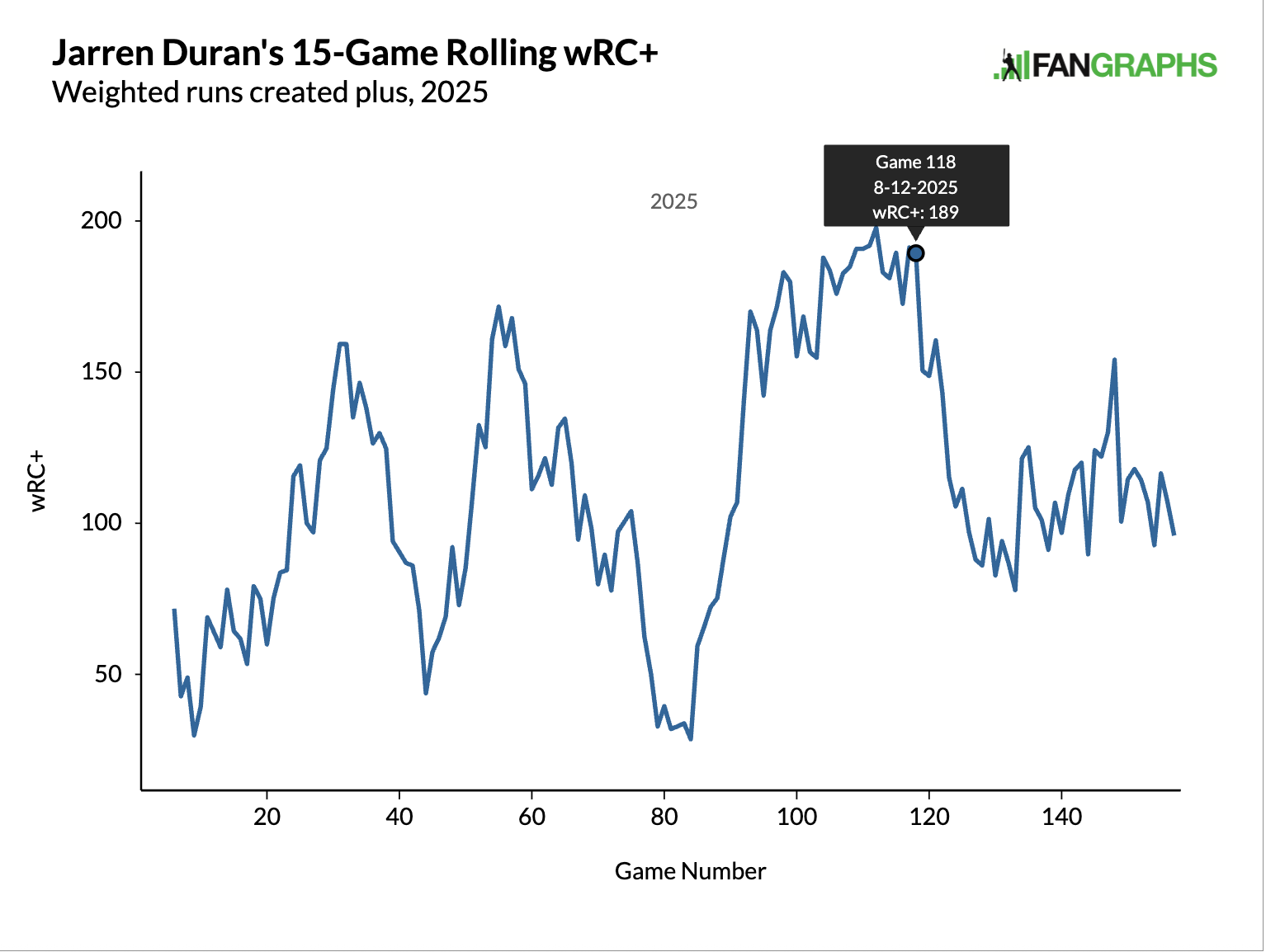
That sizable peak stretch ran from July 9 to August 12, but Duran didn’t approach that level thereafter. All told, he hit for just a 103 wRC+ in the first half, compared to a 124 wRC+ in the second, albeit with his midsummer power surge dissipating to the point where he had a lower slugging percentage over the final two months (.396) than the first two (.414).
Duran’s fall-off wasn’t due to injuries; he played in 157 games, down from 160 the year before, but aside from a scratch in a February Grapefruit League game due to calf soreness, I couldn’t find any report of even a minor ailment. Yet, of the players with at least 600 plate appearances in both 2024 and ’25, he lost more value than all but one:
| Player | Team | 2024 WAR | 2025 WAR | Dif |
|---|---|---|---|---|
| Gunnar Henderson | BAL | 7.9 | 4.8 | -3.1 |
| Jarren Duran | BOS | 6.8 | 3.9 | -2.9 |
| Salvador Perez | KCR | 3.3 | 0.5 | -2.8 |
| Brent Rooker | OAK/ATH | 5.1 | 2.4 | -2.7 |
| Juan Soto | NYY/NYM | 8.3 | 5.8 | -2.5 |
| Bobby Witt Jr. | KCR | 10.5 | 8.0 | -2.5 |
| Elly De La Cruz | CIN | 6.6 | 4.3 | -2.2 |
| William Contreras | MIL | 5.5 | 3.6 | -1.8 |
| Jose Altuve | HOU | 3.9 | 2.1 | -1.7 |
| Shohei Ohtani | LAD | 8.9 | 7.5* | -1.5 |
| Francisco Lindor | NYM | 7.7 | 6.3 | -1.5 |
Some of Duran’s decline was due to his offense — which I’ll dive into below — but some owed to his defense, not only in terms of lesser metrics, but also positioning. In 2024, he spent 57% of his innings in center field, but in ’25, that share dropped to 14.4%, with nearly all of the balance in left field. While he was a Gold Glove finalist in center in 2024, the Red Sox believe they have an even better man for the middle pasture in the 25-year-old Rafaela. In 2024, when Trevor Story was sidelined by a shoulder injury, the Red Sox used Rafaela at shortstop for 82 games, making room for Duran in center, but Rafaela dialed back to 24 games in the infield last year (all at second, after Campbell was demoted to Triple-A Worcester) and ended up winning a Gold Glove. Bumped to left field, Duran went from excellent metrics at two positions to a rather mixed bag:
| Season | Position | Innings | DRS | FRV |
|---|---|---|---|---|
| 2024 | LF | 611 | 6 | 3 |
| 2025 | LF | 1149 | 11 | 0 |
| 2024 | CF | 810 1/3 | 17 | 9 |
| 2025 | CF | 194 | -2 | 2 |
Based on Statcast’s components under the hood, Duran’s arm improved from 2 runs above average to 4 above average, but that was more than offset by his decline in range, from 9 runs above average to 2 below. The DRS components show a decline in the value of his throwing (from 9 runs to 6), but an even bigger decline in range (from 23 runs to 9). We’re talking about two sets of partial-season samples while calling Fenway Park — with an outfield that’s anything but cookie-cutter — home, so none of this need be taken as gospel, but suffice it to say Duran wasn’t as good as he’d been before.
“Playing left is tough,” Duran said last week. “Weird angles. Especially playing at Fenway. It’s the hardest left field in the big leagues. I’ll just continue to play out there, get reps and shag during BP. That is going to help me. We all know repetition is going to help me get better.”
Turning back to Duran’s offense, a big part of his decline was his struggle against left-handed pitching:
| vs. LHP | PA | AVG | OBP | SLG | BB% | K% | wRC+ |
|---|---|---|---|---|---|---|---|
| 2023 | 49 | .289 | .327 | .422 | 6.1% | 30.6% | 100 |
| 2024 | 230 | .255 | .319 | .346 | 7.4% | 24.3% | 88 |
| 2025 | 209 | .211 | .260 | .340 | 4.8% | 27.3% | 61 |
| vs. RHP | PA | AVG | OBP | SLG | BB% | K% | wRC+ |
| 2023 | 313 | .296 | .349 | .491 | 6.7% | 24.0% | 125 |
| 2024 | 505 | .298 | .352 | .557 | 7.3% | 20.6% | 150 |
| 2025 | 487 | .277 | .363 | .488 | 10.3% | 23.0% | 133 |
In 2023, his first season with more than 58 major league games, Duran hit for a 122 wRC+ overall while largely being protected from lefties; he started just seven times against southpaws and took 13.5% of his plate appearances against them, managing a league-average performance in that small sample. Upgraded to full-time duty in 2024, he hit well enough against lefties to justify his spot in the lineup given the caliber of his defense, but last year, he stopped walking against lefties, struck out more, and didn’t offset that with enough power or enough defense to be particularly helpful.
As in 2024, Duran scuffled against fastballs and breaking pitches from lefties. Less obvious — as in, not something you’d pick up from the platoon splits — is that he suddenly struggled against breaking stuff from righties, as well.
| vs. LHP | Type | % | PA | AVG | xBA | SLG | xSLG | wOBA | xwOBA | EV | Whiff% |
|---|---|---|---|---|---|---|---|---|---|---|---|
| 2024 | Breaking | 35.9% | 95 | .220 | .215 | .275 | .307 | .235 | .250 | 86.8 | 37.5% |
| 2025 | Breaking | 41.5% | 89 | .184 | .191 | .333 | .344 | .221 | .236 | 90.8 | 37.9% |
| 2024 | Fastball | 62.0% | 128 | .273 | .270 | .373 | .423 | .329 | .348 | 89.3 | 20.3% |
| 2025 | Fastball | 55.8% | 115 | .240 | .260 | .356 | .402 | .296 | .323 | 91.2 | 27.2% |
| 2024 | Offspeed | 2.1% | 7 | .429 | .333 | .857 | .659 | .545 | .420 | 91.6 | 22.2% |
| 2025 | Offspeed | 2.7% | 5 | .000 | .154 | .000 | .175 | .181 | .287 | 70.3 | 18.2% |
| vs. RHP | Type | % | PA | AVG | xBA | SLG | xSLG | wOBA | xwOBA | EV | Whiff% |
| 2024 | Breaking | 24.2% | 134 | .278 | .251 | .587 | .514 | .376 | .340 | 90.3 | 28.0% |
| 2025 | Breaking | 23.5% | 108 | .223 | .206 | .351 | .268 | .296 | .267 | 90.5 | 33.0% |
| 2024 | Fastball | 58.8% | 271 | .328 | .288 | .586 | .514 | .414 | .374 | 92.1 | 21.4% |
| 2025 | Fastball | 55.7% | 264 | .290 | .283 | .534 | .497 | .401 | .395 | 93.3 | 22.2% |
| 2024 | Offspeed | 17.0% | 99 | .247 | .274 | .441 | .396 | .315 | .316 | 88.9 | 25.1% |
| 2025 | Offspeed | 20.8% | 114 | .297 | .249 | .514 | .425 | .352 | .297 | 90.7 | 38.2% |
I generally prefer to analyze individual pitch types — separating four-seamers from sinkers, curveballs from sliders, and so on — but these aggregations clarified some trends. Lefties fed Duran more breaking balls, against which he’s been particularly prone to whiffing, but he also came up empty much more often against fastballs from same-siders; his production against both classes fell relative to 2024. Against righties, he absolutely collapsed against breaking balls, dropping 236 points in slugging percentage and somehow even more than that in xSLG while also whiffing more often.
All of this led to Duran’s strikeout rate increasing from 21.8% to 24.3%. Looking at his track record going back to 2021, when he first debuted (he played 91 major league games between that year and the next), it’s his 2024 rate that’s out of line; his career mark is 24.5%. A deeper dig into the data supports the conclusion that last year he tried to hit for more power, whether consciously or not. He swung harder, used his fast swing more often, swung and missed more often, intercepted the ball further in front of the plate when he made contact, and had similar squared-up and blast rates as in 2024. Though he hit the ball harder — and to his pull side, in the air — when he did make contact, it ended up making him a less productive player. Here’s the bat-tracking, pull rate, and swinging-strike comparison:
| Season | Avg Sw Spd | Fast% | SqUp% | Blast% | vs. Front | Pull% | Pull Air% | SwStr% |
|---|---|---|---|---|---|---|---|---|
| 2024 | 73.6 | 36.2% | 23.2% | 13.7% | 0.0 | 29.9% | 10.3% | 10.5% |
| 2025 | 74.8 | 47.5% | 23.4% | 14.2% | 3.2 | 35.4% | 15.2% | 12.4% |
And here’s the contact data:
| Season | BBE | EV | maxEV | LA | Brl% | HardHit% | AVG | xBA | SLG | xSLG | wOBA | xwOBA |
|---|---|---|---|---|---|---|---|---|---|---|---|---|
| 2024 | 515 | 90.8 | 113.9 | 9.5 | 9.3% | 43.9% | .285 | .267 | .492 | .456 | .357 | .340 |
| 2025 | 455 | 91.8 | 117.7 | 12.0 | 9.7% | 46.8% | .256 | .248 | .442 | .410 | .335 | .326 |
Duran’s average and maximum exit velocities, launch angle, barrel and hard-hit rates all set career highs; for that matter, so did his pull rate, fly ball rate (25.1%), and pulled air rate. Yet the whole was less than the sum of its parts.
A big reason for that is Fenway Park itself. Thanks to the Green Monster, no ballpark rewards lefties going to the opposite field more often. Over the past five seasons, lefties going oppo in Fenway have hit .403 and slugged .641, the highest marks of any permanent ballpark (counting Sacramento’s Sutter Health Park and Tampa’s George Steinbrenner Field but not the special-event parks, such as the one for the London Series). Lefties pulling the ball in Fenway hit .332 and slugged .624, not only lower than when they went oppo, but also rates that respectively rank 28th and 30th out of 32 ballparks.
Long story short, Duran got away from what made him successful in 2024, and what worked especially well in Fenway. Now he has the dual challenges of recovering his lost production and carving out time in an outfield, and on a roster, where he’s the only principal player not signed beyond 2026. Anthony, Rafaela, and Campbell are on long-term extensions, and even Yoshida — who was limited to 55 games and an 88 wRC+ last year after undergoing offseason labrum repair in his right shoulder — is signed through 2027, at $18 million per year. Abreu, now 26 years old and poised to be arbitration-eligible for the first time, hit .247/.317/.469 (110 wRC+) in 115 games while pairing with Refsnyder in a platoon; though he missed 45 games due to oblique and calf strains, Abreu won his second consecutive Gold Glove. With Boston making noise about Abreu facing more lefties in 2026 and offering him an extension (which he rebuffed), the team appears more committed to him — the younger and less expensive player — than to Duran.
Thus, the thinking is that with Rafaela in center and Abreu in right on a more or less full-time basis, Duran and Anthony will share left field and DH duties, which seems like a waste of a good glove either way. “Well, I would be the fastest DH in the league, so that’s a start,” Duran quipped while adding, “Wherever [Cora] and the front office need me, I’m going to do my best job.” Duran could also lose time against lefties, though his most natural platoon partner in a DH capacity, lefty-masher Romy Gonzalez, won’t be ready for Opening Day due to a shoulder injury.
It all adds up to a puzzle for Cora to fit together, and an unenviable situation for Duran. We’ll see if he makes the most of it.
Brooklyn-based Jay Jaffe is a senior writer for FanGraphs, the author of The Cooperstown Casebook (Thomas Dunne Books, 2017) and the creator of the JAWS (Jaffe WAR Score) metric for Hall of Fame analysis. He founded the Futility Infielder website (2001), was a columnist for Baseball Prospectus (2005-2012) and a contributing writer for Sports Illustrated (2012-2018). He has been a recurring guest on MLB Network and a member of the BBWAA since 2011, and a Hall of Fame voter since 2021. Follow him on BlueSky @jayjaffe.bsky.social.
I really don’t think this is a big deal.
First, aside from Brock Holt, Jarren Duran is probably the best defender the Red Sox have had in left field in the statcast era. It is super hard to play left field there. Even in 2025 he had 0 FRV in left field, which is a huge accomplishment.
Sure, maybe Roman Anthony or Wilyer Abreu would be even better there, but that’s not a guarantee.
Second, there were 2044 PAs that Red Sox outfielders took in, roughly consistent with the 650-700 PAs-per position situation that most positions have. The only one of those outfielders who also had more than 600 PAs last year at any position was Duran.
Despite all of the stuff about moving Rafaela around to get him in the lineup more, he only had 587 PAs. Anthony was called up midseason but he was also hurt. They’re saying that they want to get Abreu more PAs against left-handed pitching–a horrible idea that may not last past May–but even if it doesn’t, he was also hurt for part of last year. And they lost Refsnyder who gave them 117 PAs last year.
If everyone isn’t healthy, it’s super easy. You have four outfielders and one of them is hurt? No problems there.
If everyone is healthy, that’s even better. You can give Rafaela some time off against pitchers (usually RHP) where Yoshida matches up well and Rafaela doesn’t by sliding Duran or Anthony into center field.
You can give Abreu or Duran a break against tough lefties, subbing in for Abreu by sliding Anthony to RF and playing Romy Gonzalez at DH (when he’s healthy), Durbin (playing Monasterio in his spot), or even Yoshida if for some reason he matches up well.
And the rest of the time you can let Duran or Anthony take a day off of fielding by DHing, or entirely to keep them fresh throughout the year.
Even if literally everyone stayed healthy throughout the entire year, how reasonable is it to expect that everyone is going to get 675 PAs?
Rafaela has never topped 600 PAs in a season, and Abreu has never topped 450. Even if you think Rafaela gets to 600 this year and Abreu gets to 550 (the latter of which I think is a real stretch), that’s 200 PAs right there.
It seems likely that Anthony would probably need at least 100 PAs off the full season grind from fielding anyway, so if you stick him at DH for 50 PAs and give him another 50 PAs of rest to keep him fresh you’re up to 300 PAs where there is already now conflict.
Duran’s been an ironman, but you could easily do the same thing for him, giving you another 100 where there is no conflict (up to 400). Plus he doesn’t have a great record against left handed pitching either, you could easily sit him another 75 PAs (up to 475 freed up now) so that he gets the same 550 PAs against lefties that Abreu gets.
That leaves only 200 PAs where there is a potential situation where they are wasting a good glove by sticking him at DH.
And again, this is all in a situation where nobody gets hurt and where Abreu gets to 550 PAs despite his career 62 wRC+ against lefties (85 last year).
It’s going to be okay.
I think this is right – there’s enough playing time for everyone and redundancy if one of the outfielders is injured.
Even if everyone stays healthy, it must help to get the occasional day off to rest.
I agree with everything you said. The one issue is Yoshida is really redundant. I don’t know who would be better than him that they could just slot in as a RHP, though.
Maybe he’s just so much of a sunk cost that it’s not worth litigating anymore, but the presence of Yoshida is the factor that leads me to think that the Red Sox didn’t have a plan here and are just hoping it works itself out. If the scenario they wanted is one where they have a guy making almost $20 million riding the bench (instead of paying his entire deal down in a trade or just releasing him), I have some serious questions about their process.
They have a plan, but it’s timing-critical. There’s no way to offload Yoshida without him establishing a baseline of value, unless they’re willing to eat a bunch of salary and even then, they’d have to convince another team to carry him on their roster. And that might take some surplus value better allocated elsewhere. It’s a bit tricky and things need to align right and that will take time.
It’s rather have Castellanos or Grichuk than Yoshida, whose only role is “backup platoon DH.”
I’m still not entirely convinced that OAA/Statcast is correctly handling the Green Monster for LFs/CFs. I’ve found some cases where a catch probability of something greater than zero percent on balls that hit 15+ feet up the wall. As far as I know, there isn’t any way to systemically search for plays and get the catch percentage — you can find your way there from individual players’ pages.
You will be unsurprised to learn that Fenway has the top 6 seasons of BA – xBA (and I think all but one of them is in the top 30) in the Statcast era for LF specifically. I don’t expect xBA to capture the Monster — it’s a LA/EV model, after all — but I would expect catch probability to zero out balls that are literally unreachable.
I am completely convinced that no system can properly quantify LF defense in Fenway. Your comment reinforces what I have seen and read in my years of watching everyone from Ted and Yaz to Manny stand in front of The Green Monster. I have waited 75 years to see a left fielder in Fenway go back more than 25 feet on a fly ball and I don’t expect to see it happen in 2026, or 2036 for that matter. The throw to the plate is so short that scoring from 2nd is rare, even for the fastest men. It wouldn’t make much difference whether it is Dewey Evans, the best arm I have watched, or Johnny Damon, as weak an arm as I can recall, out there, very few are going to attempt to score. The position is unique and will continue to defy all attempts to accurately measure it.
My mental picture of Duran when he’s going well is him reaching out and banging doubles off the Monster. So I’m glad to see the numbers back that up.
My real question is whether the Red Sox can find a home for Yoshida. His contract is a sunk cost at this point and he’s probably not among the Sox’s top 4 players for the outfield/DH spot assuming everyone stays healthy through the spring. But I do think he’d be an upgrade for several teams’ DH/OF/bench bat situation: Twins? Rangers? Tigers? Pirates? Guardians? Angels? Royals? I think the question is whether Sox can eat enough money to get a decent lottery ticket in return. I suspect something will happen before opening day, unless someone gets hurt.
Does “the bench” count as a home?
I don’t think most of those teams would want to even roster Yoshida, much less trade for him. I almost all of them have guys who are similar to him already but with less cash committed to them (Joc Pederson, Jorge Soler, Kerry Carpenter, Trevor Larnach, Rhys Hoskins), and the Royals are going to have Perez DH a lot.
They would have to pay his deal down to minimum salary and take a token amount of cash back to get anyone to take him. For reference, Jesse Winker is a pretty good comparison for Yoshida. He’s unsigned.
The only team that I can think of that would actually be interested in him on the merits is the Astros, and they’d need to unload Christian Walker to make it work. Maybe the Padres or White Sox, but the Red Sox would have to eat the whole deal.
As a Nats fan, I was very excited by a commenter suggestion earlier this winter that the Nats take him along with a prospect or two. Pretty good fit as the team needs prospects and has no credible 1B/DH – if only the ownership would spend the money.
The White Sox bought David Sandlin and a few players to be named later for $16M. Sandlin’s an FV45 but it sounds like the White Sox value him at more of an FV45+ level.
Yoshida is owed $39M, and I don’t think the Red Sox are too excited about trading away guys who are at an FV50 level or higher. So they would eat some of that money. They could eat most of that by taking back Keibert Ruiz who they would probably then DFA.
They probably also would prioritize trading guys who are on the 40-man already or will be next offseason. And who are superfluous.
But they’ve done a really good job of trading away guys like that. Password, Brandon Clarke, Richard Fitts, and Luis Perales (the last one was traded to the Nationals). The only guys left like that are Kristian Campbell and Mikey Romero, and Romero isn’t going anywhere because they desperately need infield depth.
So Kristian Campbell and Masataka Yoshida for Keibert Ruiz?
I’m in.
Alternatively, there could be a Ruiz for Yoshida swap, with additional prospects coming to the Nats. This would save the Sox $12 million AAV against the CBT for 2026-27. The total dollars owed is less than $2 million over the length of the contract. Even if Ruiz can’t beat out Wong, cutting him would get the Sox further away from the 2d luxury tax threshold the next couple of years while their big commitments cycle off. That’s got to be worth something to the Sox, and it would let the Nats play Ford and Millas (or eventually Lomavita). Yoshida can dh for two years while Lile Crew and Wood show whether that’s the OF going forward.
My first thought was the Rockies. Yoshida is sort of a poor man’s Luis Arraez – no strikeouts or walks + lots of balls in play. I really want to see that profile in Coors Field.
The Tigers *really* don’t need a poor man’s Kerry Carpenter, when they have the full fat version at home.
Adding to the chorus of “Yoshida wouldn’t fit on my team,” the Pirates have Ozuna at DH and a hugely left-handed lineup. They don’t really need another platoony left-handed bat with a bad glove.
I was hoping the Red Sox would use the offseason to get Duran trained up on 1B, following the Cody Bellinger model. Casas and Gonzalez are always hurt. If Contreras needs a day off (or a short time on the IL), it will probably be IKF or Wong playing 1B. I would rather play Duran at 1B and Yoshida at DH if that becomes necessary.
Its weird that the red sox will have plenty of guys who can play a mediocre shortstop (Story, Durbin, Rafaela, IKF), and a legit SS prospect probably starting the year in AAA (Mayer). Yet the 1B depth looks really thin.
If Contreras has to go on the DL I think they will call up Casas.
Assuming he is healthy. Which is not a guarantee.
What they really need in place of Yoshida is a guy who can back up both first base and the corner outfield. Kind of like the guy Mark Canha was in 2023 or 2024.
But isn’t this what Mo was more or less suggesting? Training/giving reps at 1st to Duran so he can .. you know … back up first and the outfield?
Isn’t the obvious answer here to jettison Yoshida? At his best he’s a 1 WAR platoon -DH. That’s not worth a roster spot. Designate him to get him off the 40-man, and pay him to go back to Japan.
But who goes into that roster spot that’s significantly better?
Any unsigned lefty masher is a better roster fit than Yoshida.
A fungible relief arm? A mediocre bat who can carry a glove somewhere? A noodle-bat middle infielder with a good glove who adds one more layer of insurance against Rafaela being asked to play 2B?
Yoshida is a hot 3-4 weeks away from completely changing the narrative about him. If the Red Sox are just going to dump him and eat the cost, I wouldn’t expect it to happen until Memorial Day.
Poor Duran is so disrespected. Imagine leading the hitters on your team in WAR for two straight years and being 14th in all of baseball over that time all while being the heart and soul of your team and there’s questions over whether they can find a spot for you in the lineup? Hopefully this is not how the Red Sox are actually thinking about this. I mean, how is this conversation going. I know you are in your prime and have been our best player but we’re not sure if we can find a spot for you because we’ve got this guy that’s been terrible, can’t play the field and is projected for 0.3 WAR but we’ve already committed to him for $36M so we’ve got to find a spot for him.
I still think this is not a big deal if you just park Yoshida on the bench until there’s an injury.
But it does matter a little bit, and the only reason why this matters at all is because Duran, Abreu, and Yoshida are all best set up to be used in a platoon. From 2023-2025, Yoshida’s got an 80 wRC+ against them in MLB, Duran is at something like 78, and Abreu is at 62.
Because they’re busy demonstrating how the sunk cost fallacy works with Yoshida they lost Refsnyder and didn’t replace him with any other right-handed outfield types. Or anyone who can hit and they can trust to play any position on defense. Which means that now they are guaranteed to have at least one guy in the outfield who can’t hit left handed pitching well each time they face Max Fried, Carlos Rodon, etc.
It’s not a big deal. Just a little deal.
I just don’t understand when it’s ever a good idea to start Yoshida. If he could hit lefties it would be a completely different story. Unfortunately for him, both Abreu and Duran hit righties well, plus they can play the field. If they split starts against lefties and are already sitting say 15% of the time, I don’t think you can ask either of them to sit against a righty as well. I’m guessing the Sox are hoping that Yoshida has a stellar spring and someone is willing to take him and $30M for a ham sandwich.
The obvious answer is that it makes sense to play him when someone else is hurt. But there’s another answer too.
The player who would sit is Rafaela. He’s really good but he probably needs a day off at some point anyway and Duran is CF capable.
I am sure the Red Sox have models that tell them which types of pitchers that hitters like Rafaela are most likely to have trouble with. It’s better to give him a break against those guys than at random.
That’s still probably only 150-175 PAs though. The main role he will play is that he DHs when one of the four outfielders is hurt.
Very well said. I commented below before reading your comment and could be subject to plagiarism because I made virtually the same argument. The Red Sox unwillingness to accept the fact that Yoshida does not have a place on the team is ridiculous. This is a franchise that has paid Liam Hendricks $20M for less than nothing, Lucas Giolito $38M for one year of mediocre pitching and has yet to get one inning from Patrick Sandoval for over $18M. Your other comment about giving another team Yoshida and $30M for a ham sandwich is too much. I would settle for a bagel.
Trade him to the Cards, haha!
I suspect Monasterios becomes the RHH off the bench.
Jarren Duran brings so much to the table that he is the most indispensable position player on the Red Sox roster. He is the heart and soul of the team while playing a dynamic game that ignites the offense, often turning routine singles into doubles and has led the AL in triples the last two years. MLB-TV recently called him the Most Baseball-y player in the game. Even in a slightly down year, he was 6th in extra base hits in the AL with 70. His play in LF is the best since Yaz. Mere numbers do not come close to measuring his value. This the player the Red Sox should be looking to lock up well past his present control.
The Red Sox have control over Duran through him turning 32. That’s the exact amount I’d want. So much of his game is built on speed that if it continues to regress he’s going to be the 2-3 win guy in an outfield with better and younger players. I think there’s another gear in terms of game power, given his 70-grade raw power, but until he unlocks that the Red Sox should be content with the 3 years remaining.
I love Duran but are we talking about the same player? He doesn’t have anything close to 70 grade raw power. Also, he’s projected to be a 2-3 WAR player now. Hopefully he can beat that but if he’s only a 2-3 WAR player 3 years from now, the Sox will be very happy with that.
I feel like Preller gets his guy and makes a trade for Duran before OD.