
Five Things I Liked (Or Didn’t Like) This Week, April 11
Welcome to another edition of Five Things I Liked (Or Didn’t Like) In Baseball This Week. I was at a wedding this past weekend, a generally fun event for a baseball writer. That’s because strangers ask me what I do, and then I get to say, “I’m a baseball writer.” That plays a lot better than, “I work in accounting/finance/tech,” no offense to any of you in those fine fields. But this weekend, someone inquired deeper. “Oh, like sabermetric stuff?” “Yeah! Kind of. Also I make GIFs of dumb and/or weird plays. And bunts, lots of bunts.” Yes, it’s a strange job being a baseball writer, but also a delightful one, and this week delivered whimsy and awe in equal amounts. So unlike guests milling around at a wedding, let’s get straight to the point – after the customary nod to Zach Lowe of The Ringer for the inspiration for this article format.
1. Not Reaching Home
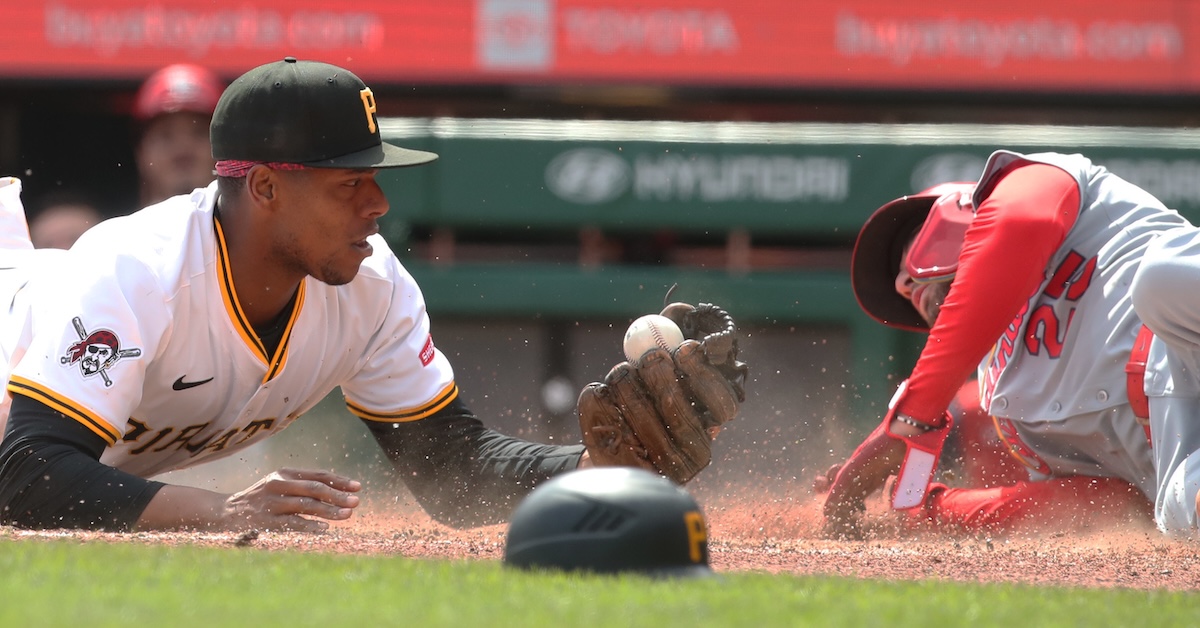
The third time a runner was tagged out at the plate in Wednesday’s Cardinals-Pirates clash came at a pivotal moment. Locked in a scoreless tie in the bottom of the 11th, Pittsburgh finally looked like it would break through when Joey Bart singled to right. But, well:
That was a good throw by Lars Nootbaar and a clean catch by Pedro Pagés, and that combination turned a close play into a gimme. I mean, how often are you going to be safe when the catcher already has the ball in his glove and you’re here:
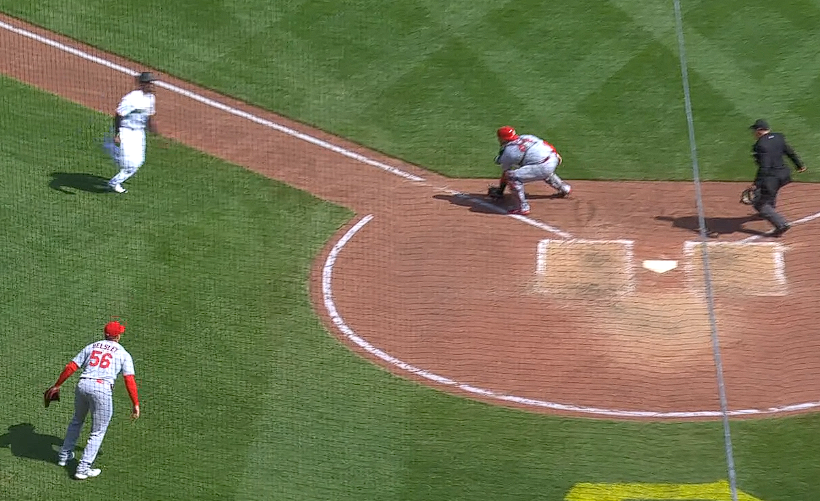
Hey, doesn’t Alexander Canario’s position seem strange to you? It sure did to me – and was noted by both announcing crews during the replay. I don’t think he would have been safe anyway, but he definitely added a few feet to his route:
Plays like that happen from time to time in baseball. I don’t think sending Canario was the obvious choice, but it was defensible. Ending the game then and there, with one of the best strikeout pitchers in baseball on the mound, is enticing. And really, you can’t plan on the throw being that good. Nootbaar, who has a strong arm, just dropped in a laser beam:
So that one? Pretty reasonable. But the second time someone got tagged out at the plate in this game? That one was a doozy. The Cardinals inserted one of their fastest players, Michael Siani, as the automatic runner in the top of the 10th inning. Pagés lashed a single to shallow left field to lead off the frame. Let’s just say it didn’t end well for St. Louis:
I didn’t spit out my drink when I was watching, but that’s only because I didn’t have a drink. Seriously, here’s where Siani was when Bart secured the ball in his glove:
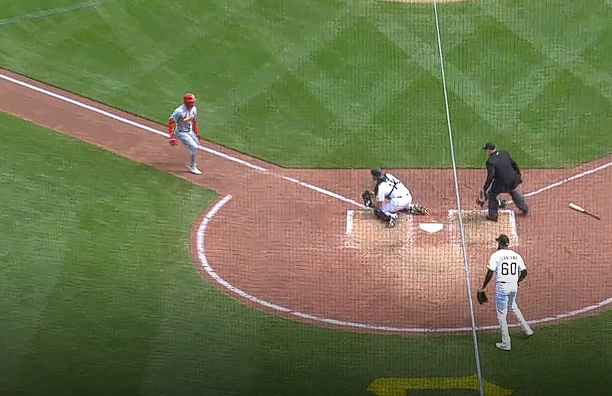
Again, probably not gonna be safe on that one, and this was a meaningfully worse decision than the Canario play. There were no outs, and the run wouldn’t have ended the game; you’re always trying to score two runs in extra innings as the away team, which makes sending a runner here less valuable even if it works out. And how likely was it to work out? Not very! Here’s when Tommy Pham had the ball in his glove in left:
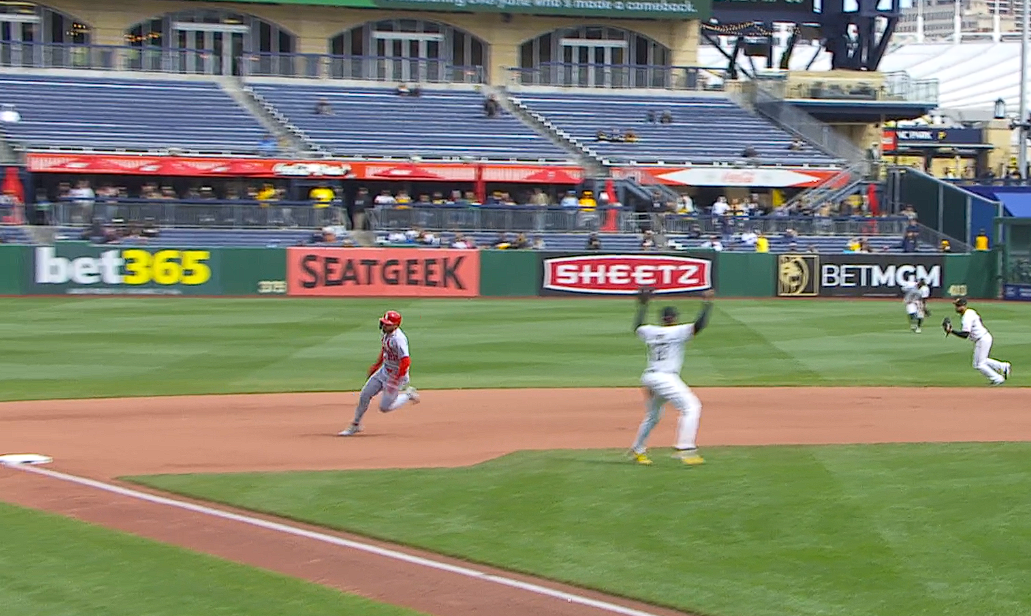
You’d want the runner to be safe about 90% of the time to send him in that spot, and again, did you see where Siani was when Pham retrieved the ball? I don’t care if Usain Bolt was rounding third; the math just doesn’t add up when the fielder is so close and in possession of the ball so early. Siani would have been out with even an average throw, but Pham’s was excellent:
Here’s the kicker: That wasn’t the worst out that a Cardinal made at home plate in this game. No, that’d be the first time a runner got tagged out at home in this game. There was no throw necessary for this one:
Honestly, I’m not even mad, just in disbelief. Was that poor baserunning by Thomas Saggese? Indubitably. If he continued into the pile-up of Bart and Endy Rodríguez, he would have scored for sure, because lying in the basepath after you’ve “made an attempt to field a ball and missed,” to quote the rulebook, is no defense against obstruction. Saggese had the right of way as soon as the ball clanked off Rodríguez’s glove. Even if he didn’t want to step on anyone, he could’ve veered into the foul side of the basepath, which was wide open. But Saggese didn’t do either of those things; he slowed nearly to a stop and then turned into traffic:
You can see him watching Ke’Bryan Hayes and trying to figure out how to squeeze through to home plate. But that’s not good baserunning; good baserunning is taking your path and continuing into the fallen fielders for an automatic run via obstruction, or at the very least, deviating from your path to avoid the fielder closest to the ball. Instead, Saggese looked like me in a grocery store aisle – “excuse me, sorry, would you mind if I – oh, never mind, I’ll wait…”
Don’t lose sight of how good Hayes was here, though. One of the best defenders in all of baseball lived up to his reputation. He kept his eyes on the play the entire time even though he wasn’t directly involved, and I love how he played the ball after it came free. He didn’t dive for it, because the momentum of doing so would’ve taken him out of the play. He also understood that if he’d slowed down, Saggese would have done so as well, because of where he was standing — and Hayes never lost sight of the runner. When he scooped up the ball, he already had both feet planted, and he lunged to cover the plate immediately afterward. He kept his cool while everyone else lost theirs – and ended up saving the game in a 2-1 Pirates victory in 13 innings.
2. Saving Your Closer
Speaking of pitchers duels, the Mariners and Astros went into the ninth inning Tuesday night locked in a 1-1 tie. Seattle closer Andrés Muñoz was warming in the bullpen, but manager Dan Wilson eschewed him in favor of Carlos Vargas, a middle reliever who entered with only 11 1/3 innings in his major league career and a 4.98 FIP in Triple-A in 2024.
I loved it! I wrote about the correct time to save your closer when the zombie runner was first introduced, and this tactic makes perfect sense to me. Muñoz’s great skill is missing bats; he has a career 34.3% strikeout rate. Strikeouts are just the same as any old out with the bases empty, but with a runner aboard, particularly if the runner isn’t on first, strikeouts go up in relative value by quite a bit. Retiring a batter with no chance of advancement is a big deal, and never bigger than when there’s a runner on second with no outs or a runner on third with one out, two positions that come up quite frequently in extras.
Even a bad pitcher will throw a scoreless inning more often than not if a runner doesn’t start the inning in scoring position. That made the ninth a better time to use Vargas – and he did exactly what Wilson had hoped, retiring the side in order. That preserved Muñoz for the 10th inning, and that’s precisely how things worked out after Seattle’s hitters didn’t score in the bottom of the ninth. Muñoz came in and blew away the first batter he saw, then worked through the rest of the inning without allowing a run. Just like Wilson drew it up.
On the other side of the field, manager Joe Espada and the Astros used their own extra innings plan. Closer Josh Hader came out to pitch the bottom of the ninth and took care of business, with two strikeouts in a perfect inning. But Espada wasn’t making a mistake by not saving his closer – he knew his closer could pitch multiple innings. Hader came back out for the 10th and looked as good as ever, notching two more strikeouts en route to another clean frame.
The two methods were a good reminder that there’s never just one way to do things in baseball. You can tinker around with your existing players, trying to squeeze out an extra few percentage points of win probability – or you can just use one of the best relievers in the game for multiple innings and avoid answering the question at all. Houston won 2-1 in 12, but both teams expertly used their bullpen in their own specific way.
3. Valiant Efforts
That game was so good that I couldn’t limit it to just one item. I mentioned that Muñoz pitched a scoreless 10th, but he was only able to do so thanks to a heroic play from Ryan Bliss. With two outs, Jose Altuve stroked a grounder that briefly looked like it would be a routine out. Then it hit second base:
Oh my goodness, what a play. Look at him transition from getting low to field a grounder into leaping to snag a carom:
I would say that you should try making this move at home to understand how much coordination it requires, but you’d probably hurt yourself. By the time Bliss realized that he needed to go high to grab the ball, his left foot was barely on the ground. That meant he had to gather all his weight on his right leg and make a one-footed sideways jump to have a play on the ball. Even then, it was at the very edge of his catch radius, which made for a tough play. The reverse angle shows how little time he had to decide what to do:
That’s just spectacular, and it saved the game. The baserunner would have scored if Bliss didn’t keep the ball in the infield, and the Mariners weren’t likely to score against Hader in the bottom half. Sure, that play didn’t result in an out, but it was one of the best defensive highlights I saw all week anyway.
The Mariners weren’t done showing off their defensive skills, though. Houston threatened again immediately, loading the bases with one out in the top of the 11th inning. Then Dylan Moore briefly entered the matrix:
Uh, what?! We’re gonna have to see that one again:
Just your average glove deflection, barehanded scoop, plant on the bag and side-arm throw off balance to hit your first baseman on the fly with no margin for error. Oh yeah, and all of that off the wrong foot thanks to where the play occurred. That grounder was an absolute missile, 108 mph off the bat, and it’s no surprise that it handcuffed Moore. But instead of giving up on it or taking a single out, he kept his eyes on the prize. I mean that literally. Watch him keep his head down and secure the ball even as he starts to dream of a double play:
I have no notes – that was perfect. Neither of those gems ended up mattering, because the Mariners couldn’t score and the Astros eventually broke through. But that doesn’t make either play less spectacular. Watch some Mariners games if you get a chance. The runs might be hard to come by, but the highlights aren’t.
4. Full Layouts
Derek Hill is the platonic ideal of a journeyman outfielder. He can play all three positions, though he’s a natural center fielder. He can flat out fly, both on the basepaths and in the field. Can he hit? Not really! But between pinch running, getting in as a defensive replacement, and filling in for the starters when they get their occasional days off, Hill could be a serviceable fourth or fifth outfielder for many teams, a classic fringey option – which explains why he played for the Rangers, Giants, and Marlins in 2024 after a series of waiver claims.
This year, he’s in a center field timeshare with Dane Myers in Miami. He’s off to the best offensive start of his career, although that’s damning with faint praise: He’s striking out more than a third of the time and barely walking, but a .429 BABIP has propelled him to a 126 wRC+ through 30 plate appearances. But this item isn’t about his long-term place on the Marlins. It’s about the skills that keep landing him major league jobs despite his career .280 OBP. Skills like this:
Oh. My. Goodness. It’s a shame that the FAA has gone through so many layoffs this year, because if they had the bandwidth, I assume they would have asked Hill for a flight plan and tail number when he took off there.
Hill was playing Tyrone Taylor extremely shallow, and also shaded to right. How shallow? He was 290 feet from home plate when Taylor made contact. Average center field depth is 322 feet; the Marlins have played their center fielders at 316 feet on average this year. So Hill was about as far away from the ball as is feasible, and to make matters worse, the ball was tailing away and headed for the warning track. This is a play that most outfielders wouldn’t even attempt; you have a much better chance of playing a carom than making the catch and holding onto the ball.
Even the elements were working against Hill. The start time of this game got moved because of unseasonable cold; it was in the low 40s, with strong winds producing gusts above 40 mph. That’s both bad weather for tracking a ball in flight and tough weather for diving onto a hard-packed dirt surface. This angle made me wince in pain even as I nodded in appreciation:
I’m not sure what else to say about this one, so I’ll just leave it to Ronny Henriquez, who got bailed out on a ball that he surely never expected to come anywhere near a fielder’s glove:
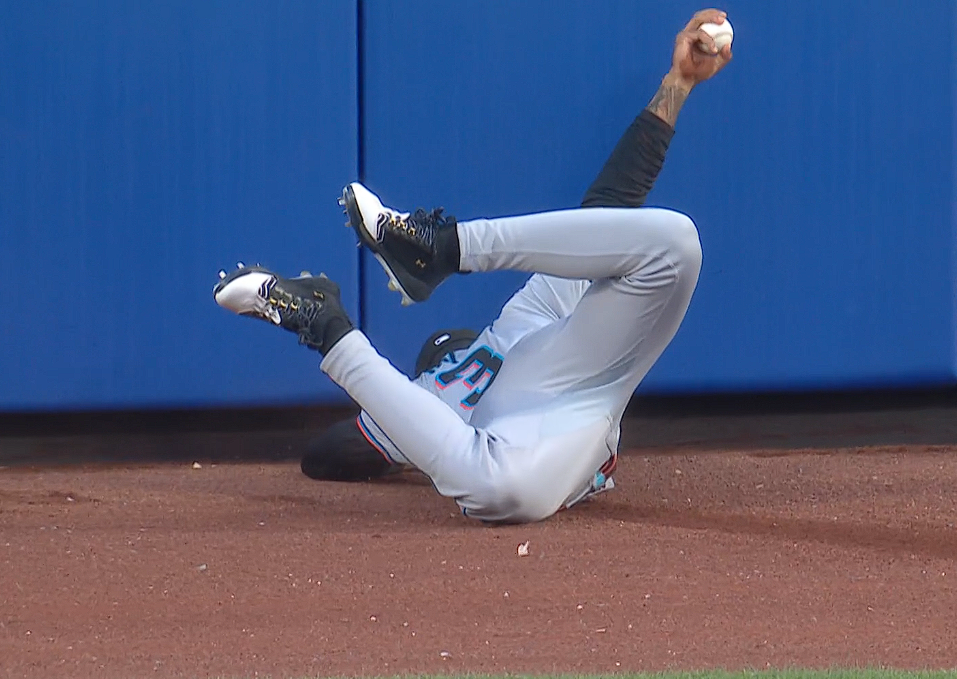
And fine, with this spectacular image of Hill letting everyone know that he caught it:
5. Grand Openings and Grand Closings
This wasn’t the first or last week of the year, but there were still some momentous beginnings and endings. First, J.C. Escarra got his first major league hit in his first major league start:
Calling Escarra, who turns 30 in 13 days, a Cinderella story doesn’t do him justice. After flaming out as a 15th-round pick, he spent two years bouncing through Indy ball and the Mexican League; if you’ve played for the Gastonia Honey Hunters and also the Algodoneros de Union Laguna, you must really love the game of baseball. Escarra could have quit; he was driving for Uber and substitute teaching to make ends meet. But he didn’t, and after he latched on with the Yankees in 2024, he put together a solid season across two levels of the minors.
When the Yankees traded Jose Trevino to the Reds in December and then exited free agency without securing a veteran backup catcher, Escarra’s road to the majors opened up. He seized the opportunity, and he’s living out his major league dream. Look at how happy he was after recording that double:
Also happy: Mike Yastrzemski, though for a completely different reason. Yaz has a journeyman story of his own, though it’s not quite as dramatic as Escarra’s. But now he’s ensconced in right field as a platoon bat for the Giants. He’s a great fit for Oracle Park, with the instincts and range to cover Triples Alley and a lefty power stroke built to pepper the right field wall. On Wednesday, he capped a furious comeback with one of the rare delights of San Francisco baseball, a splash walk-off:
Plenty of stadiums have their own quirky home run options. You could hit it off the apple in Queens, off the warehouse in San Diego, or into the pool in Phoenix. You could launch one over the Monster at Fenway or into Big Mac Land at Busch. But splash hits into McCovey Cove are my personal favorite, and not just because I live here now. The kayakers and gawkers, combined with the memories of seeing Barry Bonds treat it like his own personal water hazard, have always delighted me. The combination of the enormous wall and reachable-but-still-challenging distance makes for great optics, too: If you hit a splash home run, it’s almost always a no doubter, which means that every splash hit comes with the celebration that accompanies a clear home run. Yastrzemski knew that ball was gone right off the bat, even before the fans understood how hard he’d hit it:
What a way to end a game. And what a way to start a career for Escarra. More of both, please.
Ben is a writer at FanGraphs. He can be found on Bluesky @benclemens.
I watched the whole Bucs/Cards game on Wednesday and there were multiple “WHAT THE F*CK” moments for sure
I agree 100%. I expect that from the Pirates. The Cardinals definitely aren’t the same organization.
And you could argue that none of those plays at the plate on Wednesday were as hilarious/brutal as the what happened in the White Sox/Guardians game!
I’m a dyed-in-the-wool, partisan Red Sox hack, but since this article was defense and baserunning oriented, I wanted to shout out Wilyer Abreu for throwing a 90+ MPH pill to get Lars Nootbaar out at 3B on Sunday Night Baseball. It was truly Ichiro-esque.
This is such a fun one Ben! Love it
Amen–fantastic work, Ben!
I’m in complete agreement about saving one’s high-K reliever for extras if possible. One caveat: Observationally at least, it feels like flame-throwing RPs are often worse at holding runners than the ones who rely on craft and guile. Also, the zombie runner is frequently a speedster, either due to a light-hitting batter making the last out or insertion of a pinch runner. In certain circumstances, I could see why a manager might choose to deploy his relievers in a way that avoided an auto-steal of third in the 10th.
Oh, and that throw by Dylan Moore was insane.
Love the Friday 5 things. Have a question on the infield pop up in front of home plate. Can you explain why with 2 fielders without the baseball laying in the runners base path (without the ball secured)that surely impeded the runner wasn’t obstruction called on the defense.
same question
The runner has to actually contact the defenders that are in his way. That’s why Ben said, “good baserunning is taking your path and continuing into the fallen fielders for an automatic run via obstruction”.
And up until the ball was dropped, the fielders were in the act of fielding the ball, so they had “right-of-way”, so to speak. The egregious mistake is not running into the dogpile, but as Ben mentions, not running to the outside of the line instead of inside. By running to the inside, you are 1) closer to the play 2) opening yourself up to possible interference if run into Hayes as he’s trying to get to the ball.
Two other things I’ll note:
1) I can’t hate on Saggese all that much because I doubt that situation has ever come up for him (or, frankly, most players/fans/announcers). The fact that he was rounding third and coming into that meant that he had to make a decision quickly on a play where, to be honest, I think many players would have checked out on, while already at full speed.
2) Hayes played that about as perfectly as possible. The route he took to get to the ball was slightly into Saggese’s path, opening a possible interference or at worst, slowing him down just a bit, and as Ben pointed out, calmly collecting the ball instead of just diving on it or rushing and dropping it/kicking it.
The Cardinals are absolutely behind the curve these days. That they’re already 0-4 in extra innings (!) is less about luck than about terrible managing and decision making. Marmol typically uses Helsley to start the 9th inning of a tie game, and refuses to let him (or any other reliever except Matz) get more than three outs even with low pitch counts, increasing the odds that one of the random relievers won’t have it that day.
And the highlighted “send” call was all kinds of wrong, as noted: not just because the runner was almost assured of being out but because you want multiple runs in that scenario, so to risk losing 1st and 3rd with nobody out on a terrible send call should be grounds for termination.
That game screamed “two teams not all that interested in winning,” a brand of baseball that as a White Sox fan I’m all too familiar with.
Ryan Bliss did that with a torn biceps muscle!
Yeah, that video clip / memory is going to have to keep Bliss fans happy (blissed?) for a while, since you’re not getting another one for a while. Maybe not this season.
The Saggese play at the plate was the wrong call. It was obstruction. The fact that there was no contact is irrelevant. When one fielder in the act of fielding a ball is in the runner’s path, it’s not obstruction. But in this case a second fielder was involved and that makes it obstruction. The umpires blew it. The run should have scored. Check out Lindsay Imber at Close Call Sports on Youtube.
The fact that a second fielder is involved irrelevant if they’re both making a play on the ball and collide. Her analysis fails in that when it comes to obstruction from fielders attempting to make a play on the ball a collision completely negates the rule of the single protected fielder. The call is entirely up to the umpire to decide whether both players were making a play on the ball. So it’s not as cut and dry as she makes it out to be.
Thanks for your take.
Specifically, rule 6.01(a)(10) states that in a situation of determining interference (of a runner) that “provided that if two or more fielders attempt to field a batted ball, and the runner comes in contact with one or more of them, the umpire shall determine which fielder is entitled to the benefit of this rule [calling a runner out for interference], and shall not declare the runner out for coming in contact with a fielder other than the one the umpire determines to be entitled to field such a ball”. I added a clarification in [].
It’s less clear how it applies to obstruction — there’s a lot less language around obstruction in general in the rule book. I think it’s a fair interpretation to say that if one or more fielders can be considered as “making a play” for purposes of interference, the same would be applicable for obstruction.
Also, the comment for 6.01(h) — the obstruction rule — includes this line: “It is entirely up to the judgment of the umpire as to whether a fielder is in the act of fielding a ball.” The example considered in that comment about no longer fielding a ball making the fielder liable for obstruction seems to suggest that this play could have been considered obstruction, but I also think that it is fair judgement of the umpire to rule that the fielders were still in the act of fielding the ball at very least until the ball hits the ground. If one of those players had rolled over and attempted to pick up the dropped ball, it’s more clear that no obstruction occurs.
The provisions of 6.01(i) — the so-called “Buster Posey rule” — do suggest that a runner needs to avoid an avoidable collision at the plate. Whether this play qualifies for that rule is debatable — I think it’s vague enough that either interpretation is viable — but it is an interesting wrinkle to consider.
(Not an umpire or a lawyer; just a rules nerd.)
I thought for sure when discussing the Marlins outfield defense in the Mets series we would get to marvel at the Dane Myers catch to end the game! With that one in particular, I don’t think he got a good jump on the ball at all and still was able to make up the ground
Derek Hill’s journeyman status is relevant to that unbelievable catch in another way, too, which is that it was probably inadvisable to attempt it, since the Marlins were already getting clobbered. But as the article points out, he’s in a fight for individual playing time and so he has to show that kind of hustle regardless of the game situation, even at the risk of getting hurt. If he were an everyday starter for a good team you’d probably want him to think twice before laying out like that — even if it deprives the fans of a holy-shit moment that doesn’t really affect the outcome.
Yeah, if Aaron Judge tries that nonsense, Yankee fans would be screaming bloody murder.
That pop fly had literally everything. Two guys running into each other because a pitcher coming off the mound can’t even catch anything (which there has got to be times they allow them to try, like this) catcher entirely losing the ball, umpire inexplicably standing on the plate during a live ball. Then my favorite part was the runner…what was he doing? Why did he slow down? Why did he take that route?
I think the umpire’s positioning makes sense in the context of attempting to ascertain whether either of the fielders held on to the ball.
Neither Jackson Chourio nor Jacob Wilson has walked, as of the time of this post (morning on April 12). The difference is that Chourio is gonna hit like 35 homers this year and Wilson is gonna only have like 35 strikeouts.
Amazingly, neither one is #1 in Swing %. Chourio is 2nd, Wilson is 4th. Hunter Goodman is #1 by a lot.
It sure doesn’t seem likely that they can continue to run wRC+’s of 151 and 171 much longer without walking, so let’s enjoy it while it lasts.
“It’s a shame that the FAA has gone through so many layoffs this year, because if they had the bandwidth, I assume they would have asked Hill for a flight plan and tail number when he took off there.” Well said – turns out firing important people is not a way to run anything