
Five Things I Liked (Or Didn’t Like) This Week, May 30
Hello, and welcome to another edition of Five Things I Liked (Or Didn’t Like) This Week. Memorial Day marks the point at which we’re a third of the way through the season, a great time to take stock of how preseason story lines have fared in the light of the regular season day. The Orioles might be bad. The Phillies and Tigers might be great. The Rockies might be the worst team of all time. Aaron Judge might be an alien. We’ve learned a lot so far – but none of those things affect the day-to-day experience of watching baseball. That’s what I like about it so much – you can turn on a random game, completely ignore any of those overarching narratives, and still see something delightful. So this week, let’s celebrate the little things that don’t necessarily win games but do consistently bring a smile to my face. With my customary nod to Zach Lowe of The Ringer for his basketball column that inspired this one, let’s dive in.
1. Determination
I’ve always been fascinated by Nick Allen, who blends elite shortstop defense with a completely powerless approach to offense. That combination got him traded to the Braves this winter to play a utility infielder role, but he outplayed Orlando Arcia in spring training to claim the starting job, and he’s been running with it. Not on offense – his 68 wRC+ is both mortifying and a career high – but on defense, he’s never been better.
Allen’s defense is many things, but most importantly to me, it’s kinetic. He doesn’t give up on plays. He’s always moving. He’ll throw from any platform, any arm angle, jump or twist or slide to get more force behind it. He’s graceful around second base, but it’s a nervous kind of grace, a ballet dancer after four shots of espresso. And if something gets in his way, he’ll just run through it:
That’s definitely not how you draw up a double play at home. Ozzie Albies just got tunnel vision; this is the shortstop’s ball all the way. Allen could field it with his momentum heading the right direction and then either take it to second himself, or flip it to Albies for a conventional turn. But Albies misjudged Allen’s position and went for the ball himself, even though he was in no position to turn two from there:
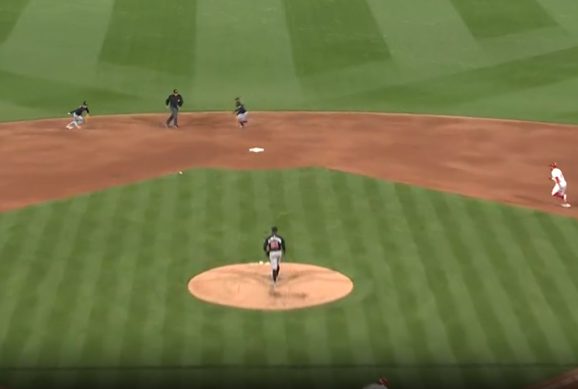
That probably should have held Allen to a single out. Though Albies tried to pull up at the last second, he clipped Allen’s torso and left leg in the collision, spinning him out towards right field from his initial direct line to second base. But this is part of Allen’s genius. Body torquing like a top, runner bearing down, momentum nonexistent, he just chugged through it. He put his head down, recalibrated his steps to hit second cleanly, and fired a fallaway throw to first with just enough on it:
This isn’t something you practice. You could go your whole career at shortstop without having to avoid your own second baseman, well on your side of the bag, before turning a double play. No one would fault him for taking the out at second and leaving it at that. But Allen isn’t the type to settle for one out. This is just who he is: an instinctual, phenomenally coordinated defender. It might not always look like art, but who cares? Allen is playing shortstop about as well as anyone in the majors right now. Let’s get one more angle of this one just to emphasize it:
2. The Var-Show
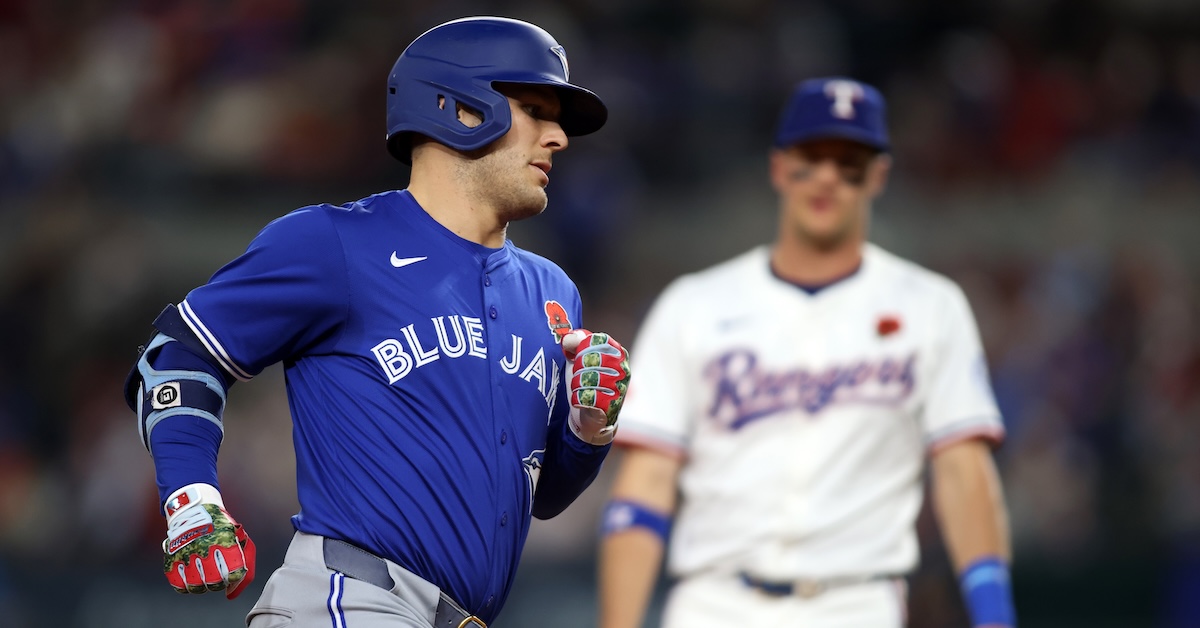
On Monday night, Daulton Varsho beat Jacob deGrom and the Rangers all by himself. He started things off with a bang, a laser to right field to put the Jays up 1-0:
That’s part of Varsho’s game. He has 25-homer power, and even though he missed a month to start this year, he’s already hit eight dingers in 100-ish plate appearances. He laced a ground rule double that led to another Jays run in the fourth inning; more of the same skill. Now, is Varsho striking out a third of the time this year? Indisputably. Is he walking? No, basically never. His carrying tool on offense is power, and it better be, because he’ll never be a high on-base guy. He does have one trick he can break out when the Jays need a baserunner, though. Varsho might be the best bunter in baseball, and when he faced lefty specialist Hoby Milner, he didn’t waste time, dropping this beauty down on the first pitch (thanks to my friend Blake Murphy for pointing this one out, as I’d already switched games and would have missed it otherwise):
Varsho has blazing speed, so he doesn’t need much of an opening to attack, and he laid the ball down perfectly. As soon as the pitcher couldn’t get there, the play was over; Varsho is fast enough that a single moment of hesitation will make him safe. The Jays hung on to win this one 2-1, and the next day, Varsho added the third type of highlight he’s best known for:
It’s nice to be Superman. I can’t add a lot of nuance to that play. Being really fast and taking really good routes? That’s how you play good defense. But I do have a new obsession, courtesy of this excellent series, and I’m hoping that you can help me track it if you watch the Jays play.
My favorite piece of hockey jargon is the Gordie Howe hat trick. A regular hat trick – three goals – is a time-honored hockey statistic, but the Gordie Howe hat trick is a little different: a goal, an assist, and a fight (hockey used to be wild). In baseball, the cycle is roughly as time-honored as the hockey hat trick, so I propose a Daulton Varsho cycle: a home run, a bunt single, and an excellent defensive play.
Varsho himself has only accomplished this feat once in the majors. On September 4, 2022, he homered and then bunted for a hit after tracking down a Tyrone Taylor drive into the gap:
Luckily, it’s not a huge problem that Varsho hasn’t accomplished his namesake feat very often. As my colleague Michael Baumann told me, Howe himself only had three Gordie Howe hat tricks in his career. But I hope Varsho can do it at least one more time, in the home of hockey, and secure his place in weird sports feat lore. And I hope that the Pete Crow-Armstrongs, Jacob Youngs, and Luke Raleys of the world follow suit – pull this off enough times, and you might even get it named after you.
3. Jorge Mateo’s Versatility
I might have a bias when it comes to slick-fielding shortstops who can’t hit. Jorge Mateo bears a superficial resemblance to Nick Allen, at least statistically. He’s above average at one of the hardest defensive positions on the field, but he has a career 77 wRC+ because he doesn’t walk, he strikes out too much, and he doesn’t hit for power. But that suits the Orioles just fine, because they don’t need a starting infielder; they already have Gunnar Henderson, Jordan Westburg, and Jackson Holliday.
What they do need is a versatile backup who can fill in almost anywhere and play good defense. Mateo has been doing that since Henderson claimed his natural position in the second half of 2023. Last year, Mateo played 450 innings at second base while backing up shortstop, and he even mixed in a few games of center field. This season, he’s already played second, short, third, left, and center. And while his outfield defense doesn’t grade out all that well so far, you can’t fault his effort:
Dylan Carlson was playing that ball cautiously, sneaking a glance at the wall and setting up directly in front of it in case he had a play. Then Mateo burst onto the scene out of nowhere. You could almost hear him yelling “LEEEROY JENKINS!” as he tracked the ball, realized he’d be jumping into the wall awkwardly to get his glove on it, and then just went for it anyway:
You can’t teach that effort. Honestly, you shouldn’t teach that effort: It’s a great way to get hurt, and that’s a ridiculously difficult catch for any outfielder, let alone a utility infielder with 100 career innings in center. But that’s what Mateo brings to the Orioles. He definitely isn’t their best player. In an ideal world, he’d only play two or three times a week. But when he does play, he’ll stand anywhere and go full bore to help the team, even if it means tumbling head first into the bullpen. In the long grind of the major league season, backups like him are essential.
Sportsmanship note: Carlson did his best to help brace Mateo’s fall, as you can see in the above clip. Very nice of him! The Red Sox relievers came over to check on him, too, and helpfully pointed him to a more conventional way to exit the bullpen after he made it back to his feet:
4. The Full Jordan Walker Experience
I went to my first Busch Stadium game in years last weekend, and I got treated to a gem. The Cardinals won 6-5 thanks to a tie-breaking, eighth-inning single off the bat of Jordan Walker, one of his three RBI on the day:
Walker was named Player of the Game (I don’t know who chooses this, I just heard it on the radio) for his efforts. A burly right fielder with extra-base power is Walker’s ideal form. But this game wasn’t just that. It also featured another part of Walker that Cardinals fans have grown accustomed to in recent years: his baby-giraffe-learning-to-walk moments in the field. The reason the Diamondbacks had the lead in the first place was this Josh Naylor “triple” from the previous inning:
I’m not going to sugarcoat it for you: that’s a bad play. Statcast pegs that one at a 90% catch probability. Walker only had to cover 25 feet, and he had three seconds of hang time to do it. But his first step was back and to his right when it should have been straight in, giving him almost no chance at making the catch. Then he compounded the error by making a long-shot dive that let the ball skip right past him. This position? You never want to be in this position:
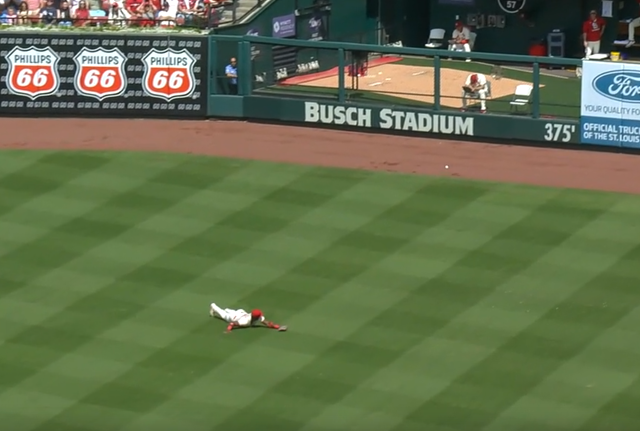
I don’t think Walker will ever fully put these defensive lapses behind him; he’s a fish out of water in right, a lifelong third baseman who moved off the position because of Nolan Arenado’s presence in St. Louis. Honestly, though, I’m into it. I love outfielders who make every catch an adventure, guys who are out there because they hit well and DH is taken. Don’t tell me you didn’t enjoy Jose Canseco taking one off the melon for a home run. Raul Ibanez? Loved watching him clobber homers in one half-inning and trip over his own feet in the next.
Major leaguers are so dang good these days that this archetype of player is less prevalent, or so it seems to me. Lourdes Gurriel Jr. looked like he might be one of these guys, but he steadily improved his defense and is probably above average in left these days. Nick Castellanos won’t be around forever. The recently optioned JJ Bleday looks overmatched because he’s miscast in center, not because he couldn’t handle a corner position. How am I supposed to enjoy the full range of baseball if I don’t get the occasional fielding miscue as part of the deal?
Unfortunately, Walker isn’t holding up the offensive end of the bargain right now. He’s hitting .215/.270/.310, bringing his career wRC+ down to a desultory 95. That won’t cut it as a bat-first corner outfielder. It would barely cut it as a glove-first corner outfielder, in fact. I’m hoping Walker will pick things up at the plate, though. We know he’s capable of it. He was a top prospect for a reason, and it certainly wasn’t his defense. So Jordan, please, start hitting. The Cardinals could use your bat, and we could all use the delightful experience of watching a major leaguer stumble around a bit, just like we would, while still clearly belonging thanks to his prowess at the plate.
5. Zombie Survival
Writing about extra innings strategy this week brought out a lot of opinions about the evils of the zombie runner, but I couldn’t disagree more. I think that the zombie runner is delightful, not dreary, and that the strategy and urgency it brings to the game is just what we need more of when it comes to extra innings baseball. I think I can use a game from last week to explain why.
The Mets and Dodgers played a barn-burner in the rain on Friday night. An hour and a half delay in the third inning chased both starters, leading to a parade of rarely used relievers handling multiple innings at a time. The Dodgers took a three-run lead into the ninth, but the Mets stormed back to tie it in the bottom half of the inning. We were going extras.
Here’s the first reason that zombie runners are great in the regular season: Did anyone actually want this game to last longer? I’m all for playoff tension, but on a Friday night in May, it’s fair to say that these two teams were evenly matched and dying to finish this one off quickly. The zombie runner makes that more likely – not inevitable, as you’ll see shortly, but more likely. That’s the main reason the rule is in place, and I sympathize with it. I was tired watching this game on TV; I can only imagine what it was like to have been a fan in the stands, or worse still, a player.
That’s an important player health concern, but since fans watch most games from the comfort of the couch, they probably don’t care about that one much. More importantly, you get action right away with the zombie runner. When Edwin Díaz came in for the 10th, Mookie Betts was on second and Freddie Freeman was batting. You might wait innings to get that kind of chance under the regular rules of baseball, but we got it right from the start. Then Díaz hit Freeman and walked Will Smith to load the bases, and we got to see defensive decisions, too. The New York infield played way in with no one out and got Betts at the plate on a force play, then dropped to double play depth and wriggled out of the jam when Francisco Lindor turned two. One half inning, tons of excitement.
The Mets couldn’t break through in the bottom half even with the top of their lineup batting, and the Dodgers didn’t get anything done in the top of the 11th. That led to another decision point: Pete Alonso was the zombie runner, but he runs like an actual zombie, not ideal in a tie game. Carlos Mendoza brought in José Azocar to pinch-run. I think I like this decision, but it’s a tough one. Alonso is much better than Azocar at the plate, and by a much larger margin than Azocar exceeds Alonso as a baserunner. If that spot in the lineup came up again, the Mets would sorely feel Alonso’s absence. And how often is a pinch-runner the difference between an out and a run? But the Mets had a runner in scoring position, and the rules make extra innings games end quickly. Mendoza took the risk and tried to win it right then. I love that decision, and I love that he has to make it – less likely in a game where Alonso doesn’t start the inning on base.
Almost immediately, Dave Roberts made a win-now move of his own. With Anthony Banda on the mound and one out, Roberts intentionally walked Tyrone Taylor to pitch to Francisco Alvarez. That’s weird! Walk a righty to face a righty, and bring the top of the opposing lineup up sooner? It doesn’t sound great. But Roberts wasn’t playing for what would happen later; he was playing to not allow any runs in this inning. Alvarez is easy to double up, so Roberts created the conditions for that to happen. Sure, it was a small boost to the Dodgers’ chances, but that’s what I like about extra innings: Teams have more chances to play for small boosts. Alvarez struck out, the Dodgers escaped, and we played another inning.
After another intentional walk in the top of the 12th – Freeman against a righty, man on third, two outs, righty on deck – Roberts truly pulled out all the stops. He saw that Alonso wasn’t in the lineup anymore and thought “Hey, why face the good hitters?” He walked Lindor to lead off the inning. After a sacrifice bunt from Starling Marte, he walked Juan Soto. That meant Luis Torrens, hitting in Alonso’s spot, had the biggest at-bat of the game, and he grounded into a double play to end the threat. You can’t tell me that strategy isn’t fun.
The game finally ended in the 13th when the Dodgers strung together enough hits to put two runs on the board. Sure, not every extra innings game under the new rules will go 13. Most don’t. But when games go 13 innings these days, those extra innings are a thrill a minute. It’s 4-on-4 overtime in hockey or a shootout in soccer: You have to keep your eyes on the TV, because the game is purposefully and perpetually in a high-offense state.
You don’t have to love that. There are plenty of good reasons not to like it, even. These are questions of taste, and reasonable minds can disagree. But I’m baffled by the segment of fans who don’t like it because they wish baseball was just like it was “back in their day” – nine innings from every starter, a baseball in the ribs if you so much as think about celebrating, plenty of singles, and guys “playing the game the right way.” Pretty much every professional sports league in the world has come up with regular season rule alterations to ensure games end in a reasonable time, and baseball’s is great. Bunts! Plays at the plate! Defensive gambles and risky strategies! This is what I want more of in my baseball, not less, and some of it even lines up with the preferences of those traditionalists. I love the new extra innings rule, and I hope it never changes.
Ben is a writer at FanGraphs. He can be found on Bluesky @benclemens.
I am strongly pro-ghost runner and I find myself constantly surprised by how much people hate it
It’s such an unsatisfying way to end a game because most of the time the winning team barely did anything to earn it.
The thing about soccer shootouts is, they don’t use them in the regular season! Because it doesn’t tell you anything about which team played better!
I strongly disagree with “barely did anything to earn it”
Comparing to soccer shootouts:
Regular Season MLB games would end in a tie after 9,
and Playoff games would end in a Home Run Derby after 11.
No thank you.
In any ghost runner game where the winning team “barely did anything to earn it,” they stopped the losing team from scoring with a runner on second and no outs.
It is I, a person who feels, however irrationally, that winning because you hit two consecutive “move em overs” isn’t strategy as much as appalling AND a person who is done after the 12th inning because I have a job and kids and so much cleaning left to do (i contain multitudes)
I don’t like extra innings in the regular season (I love them in the playoffs).
But I don’t like soccer shootouts and I don’t like the ghost runner. At all.
You get a lot of games where it’s like “11 innings, final score 9-4” and you’re like, was that really necessary?
You get games that are super tense and instead of the tension building in extras like you would in a regular inning you get games where your guy on second scores in two batters and all the air is let out of the stadium.
I think baseball needs to embrace the tie. No special rules. Go to 12 innings, if nobody wins it in 12, it’s a tie.
But now that the ghost runner happens we’re stuck with it until the people who came up with it retire.
Allowing games to end in a tie is the answer. I find it unnecessary to artificially create “excitement” by automatically putting a runner on second. If it’s tied after 9, let’s play one more inning then call it a tie (during the regular season).
Call me a form of traditionalist, but I find the idea of letting MLB games end in ties really distressing. One of baseball’s great charms is that every game ends with a winner and a loser. (Virtually every game, if you want to hung up on the aberrant suspended game that’s never completed.)
Agreed. I’m confused about what problem they’re even trying to solve here. “Those eighteen inning games can ruin a pitching staff!” You mean those games that occur once every three seasons?
I love the Manfred Man as well. 10 or 11 inning games would be fine without the runner, but the olden days had some pretty bad baseball by the 12th inning or so – one team’s #6 reliever facing off against a bunch defensive replacements and pinch runners.
The entire week after a really long game would be bad as well – an exhausted bullpen and starters asked to go deeper into games than they should.
The ghost runner clearly changes the strategy at the end of games, but I think it leads to better baseball than the old system. Playing to a tie doesn’t seem any better to me.
I say keep the ghost runner!
You say “bad baseball,” I say “multi-game roster-strategy challenges.” Apart from the serendipitous beauty of the out-of-nowhere 7-hour endurance competition — what other entertainment product can unexpectedly force you to cancel a night’s plans and figure out how you’re even going to manage to eat or sleep? — this kind of stuff is what I miss about extra innings.
I’m a sicko, I secretly wanted every game I attended to last 20 innings, and I hate the Manfred Man. It might not be a beautiful set of reasons, but I stand fully behind them.
I absolutely hate it. I don’t like putting runners who didn’t earn it by their play getting on base. And it doesn’t speed up the game.
80% of games were ending by the 12th inning prior to the ghost runner. There just wasn’t a need for this for the majority of the games. If you wanted it for the 13th to argue it would speed up games, sure, but it’s truly unnecessary for the 10th and 11th inning.
Put me in the category of liking the extra runner. I wouldn’t want to go back.
I think my favorite part of Jordan Walker’s defense this season is that despite not passing the eye test, he’s grading out as basically an average RF.
I also hope he figures out how to hit. He hits the ball so had, but just can’t capitalize on it because off the support skills.
Jordan Walker might hit the ball harder than any .095 ISO hitter ever. Here are his Statcast numbers for 2025, minimum 150 PAs, out of 203 hitters. You can see how things are going by looking at his declining ordinal rank as you get further away from potential and closer to expected stats .
Max EV: 10th
EV: 32nd
Hard Hit %: 66th
xBACON: 125th
xISO: 144th
These are all largely independent of his (checks number again) 202nd spot in whiffs and 201st spot in Contact % (out of 203). It’s pretty clear that what he is doing is not working, because it’s not like he’s had that many unlucky bounces. But his xwOBA is .280. And his launch angle and barrel % aren’t so bad.
He needs to find someone who can teach him to put the bat on the ball enough just to let his natural power do the rest, and who is willing to play him everyday at either first or third base because how long has he had to learn to play the outfield now?
I think the 1st part of your comment is spot on about someone needing to help him make contact more, but I don’t agree on the position. This is a horrific play shown, but generally he looks like an average RF and OAA and DRS think that as well, although admittedly both take a year to stabilize. He generally looks much more confident and like he belongs out there.
Where he does not look confident is in the batters box. He swings at way too many pitches outside the zone and the contact rate needs to improve. Walker did just turn 23 so I still think there is hope for him, but he needs a good amount of coaching to get there.
fwiw, the first three years of the ONeil Cruz experience were a mixed bagat best and now he might be putting it together in the “What if he hit the ball more often?” category. I think Walker can be a better defensive CFer if not the same kind of hitter.
This. I came to post most of these same things. Jordan Walker has been average in RF. He’s also probably made more “great plays” than “baby giraffe plays.” He’s fine in right field.
He was actually hitting the ball really well for a couple of weeks before injuring his wrist.
He’s still very, very young. I think he’s going to make a decent player one day.
I would say Walker generally looks better. He has lapses at time, but he actually makes some above average plays out there as well with his speed. Will he ever be better than average with the glove? Most likely not, but he has significantly improved.
That is largely due to the fact that Walker faced a grand total of 34 defensive opportunities with success rate between 5% and 95% this season.
Austin Hedges has not had a single season with wRC+ over 50(!) since 2019.
Yet, three weeks ago in May 6th, Hedges boasted wRC+ 104 across 42 PAs.
Of course, Hedges only needed an extra 19 PAs to return to his usual wRC+ 44.
Bottom line: defensive stats for corner outfielders at the end of May is as noisy as wRC+ for regular hitters in mid April.
If you love Jordan Walker’s defense, can I interest you in some Jasson Dominguez? The “great” thing about Dominguez is that sometimes, he’ll let his athleticism take over and he’ll make an actual good play. The rest of the time, he plays outfield with analysis paralysis. He tries so hard not to screw up that he screws up.
Sounds like the Oneil Cruz special! Cruz to my look has gotten more comfortable in CF, and the metrics seem to bear them out–he’s at -6 DRS/0 OAA, on April 17 when Davy Andrews wrote an article about how bad he’d been in CF he was at -8 DRS/-2 OAA, so seems like he’s been +2 since then. Still will occasionally just huck one though.
Big fan of the Varsho Cycle. Hope to see many more of those.
And I very much want to see more runners on 2nd with 0 outs late in close tight games.
Using the rule, extra-inning games appear to require less time, but not that much less time. From numbers I could obtain from the web, the average amount of time saved using the ghost runner rule is a bit more than 10 minutes, which is less time than it takes to traverse the line at the ballpark to purchase a hot dog. My guess is that the reason they keep it is to reduce the number of pitches and pitchers used by each team.
IMO, the rule is arbitrary, just like the height of the mound, the distance between bases, the size of the bases, the number of called balls for a walk, or the coefficient of restitution of the baseballs. The fun part is devising a strategy to win given the rule.
Every recent major rule change – from the universal DH to the pitch clock to the zombie runner to the stealing-related suite – has been fantastic. The game is evolving positively. Come at me.
Nice to see Varsho keep our boy Burger in the ring for this week with a failed defense of a perfect bunt, but also managed to help suppress Marcus Semien’s BABIP to ever more sorrowful levels.
I don’t watch regular season extra innings games since the zombie runner became a rule. It’s just no longer baseball. And I’m not some old man yelling at clouds, most of the other rule changes were welcome to me. I don’t miss pitchers hitting and barely notice the pitch clock, but put a runner on second for free and I’m out.
That does seem like an old man yelling at clouds.
In fairness to Gordie Howe, he wouldn’t have gotten too many Gordie Howe Hat Tricks, because even in his 50s, not many people were stupid enough to challenge him to a fight!
The Varsho Hat Trick is fun, hope we see more!
Just here to say I hate the zombie runner and it can’t go away soon enough. I HATE the “action” in extras because it’s arbitrary – they didn’t earn the runner or the run. If we like this so much why not do it every inning? I just don’t get it and want it gone ASAP.
No joke, as soon as I saw the first angle of the Mateo catch I thought “LEROOOOY JENKINS” before reading the paragraph under it
“aulton Varsho beat Jacob deGrom and the Rangers all by himself. ”
A 1 WAR game then?
I really dislike when people say this.
RE “Zombie runners” or “Manfred man”
Don’t like those phrasings either.
But the rule is good, I think. Intellectually, I don’t really like it. But when I watch a game that I’m invested in, it’s high alert pretty much every moment after that 54th out.
Why would a team have to accrue 1 WAR to win a game? That would just assume every opponent is replacement level.
With great and terrible plays, a new stat, and a controversial perspective at the end, I thought this was one of the best articles in the whole series.
It did make me wonder if the comment section for these articles might be more likely to focus on things #1 and #5 than the middle things, but maybe that’s because I wanted to read more comments about #2 rather than because the serial position effect actually applies here…
Anyway, I loved #2 so much that I stopped reading for a while and only later came back for #’s 3-5. My take: Unless early 2025 turns out to be a fluke, the “Daulton Varsho cycle” may end up being known as “a PCA”.
I like the ghost runner so much I think they should incorporate it into essentially every inning.
1st inning: nobody on
2nd inning: man on first
3rd inning: man on second
4th inning: man on third
5th inning: men on 1st and 2nd
6th inning: men on 1st and 3rd
7th inning: men on 2nd and 3rd
8th inning: bases loaded!
9th inning: nobody on
10th inning: man on 1st
11th inning (and beyond): man on 2nd
Imagine the high leverage relievers you want for the 8th inning!
Just give me one inning of real baseball in extra innings. I fucking despise losing because my closer gives up a ground out, a fly out, and a strikeout, while their closer gives up a strikeout, a ground out, and fly out. That’s not strategy, tension, or somebody outperforming somebody else. It’s what Baseruns was created to clean up.