
Goodbye, Mr. Baseball. It’s Ben Rice Knowing You.
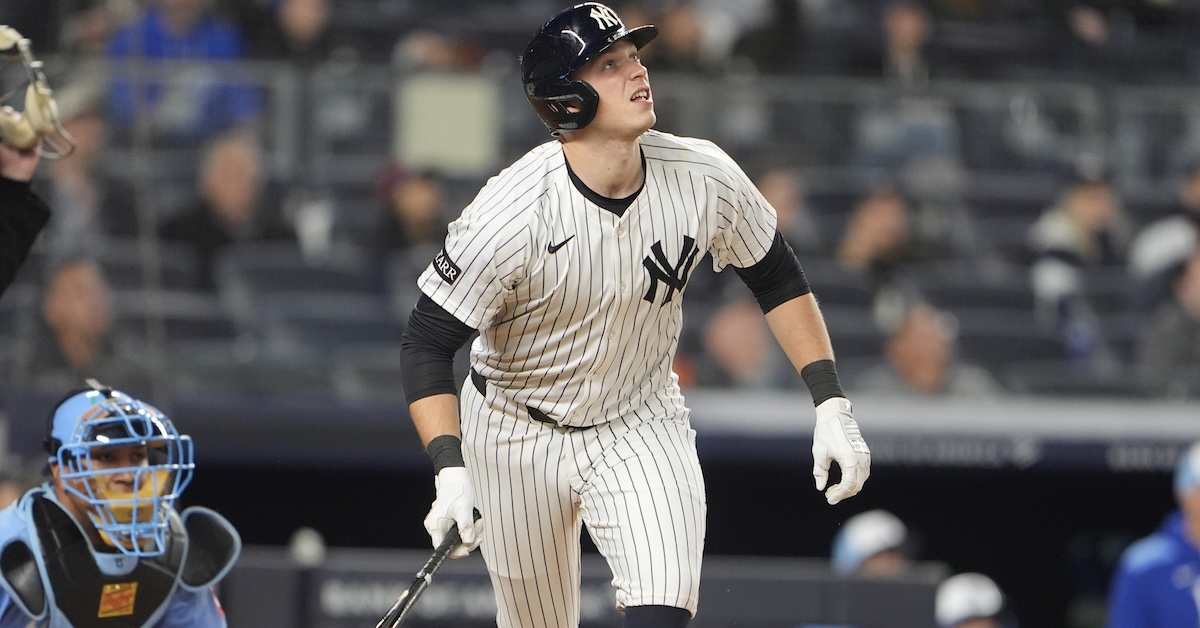
When the Yankees lost Gerrit Cole and Luis Gil before the season started, I thought they were screwed. Turns out, at least so far, that New York’s stripiest sports team is right where it ended last year: First place in the AL East. That’s because the Yankees, as of this writing, lead the league in home runs, OBP, SLG, and (by a pretty big margin) wRC+. It helps that the rest of the AL East (especially the Orioles) has started slow, but the best defense is a good offense and all that.
And it’s not just Aaron Judge, who is 20% of the way through an offensive campaign that makes Babe Ruth look like Rey Ordonez. Judge can only bat four of five times a game; even he can’t do it alone. But even with Giancarlo Stanton hurt and Austin Wells and Jasson Domínguez offering only token offensive contributions, Judge has had the running buddy he needs. It’s… Ben Rice, believe it or not.
Once a sports team has been around as long as the Yankees have, and won as long as the Yankees have, patterns will start to emerge among star players across the history of the club. Think of the Lakers’ centers throughout history: Mikan, Wilt, Kareem, Shaq. Or Manchester United’s pretty-boy wingers: George Best, David Beckham, Cristiano Ronaldo.
Since I’ve already mentioned Ruth and Judge, you might think that the Yankees’ version of this historical successorship is the home run-hitting right fielder. Sprinkle in a little Roger Maris here, a little Reggie Jackson there.
All that’s well and good, but the truest Yankee is the 25-year-old rookie first baseman/DH who rakes for somewhere between six and 18 months and is never heard from again. Rice was not only a 22-year-old college catcher when the Yankees took him in the 12th round in 2021, but he’d also only played 30 games total in three years at Dartmouth, as the Ivy League not only canceled most of the 2020 baseball season, but all the 2021 schedule as well.
Rice hit his way gradually through the minors over parts of four seasons, but he never developed into a big league-quality defensive catcher. Eric Longenhagen could only place Rice 29th on the Yankees’ prospect list in his final year of eligibility.
The summary: “I was hoping to juice Rice more than this at the onset of the process for this list, but I left my film study of his defense feeling extremely bearish about his ability to stay behind the plate. There is still big time lefty bat speed here, enough to make Rice interesting as a bat-only prospect.”
So when Rice popped his head into a major league clubhouse in the middle of last year, I took notice of the fact that the Yankees had a left-handed-hitting rookie catcher/DH other than Wells. Beyond that, I filed Rice into the same mental cubbyhole previously occupied by Mike Ford, Greg Bird, Tyler Austin, Shelley Duncan, Kevin Maas… I’m counting George Selkirk too because he probably would’ve played some first base if Lou Gehrig hadn’t been on a historic ironman streak.
Some of Rice’s numbers were pretty solid in his rookie year: Seven home runs in 50 games is 20-plus homer power over a full season, and an 11.2% strikeout rate, a 27.0% walk rate, and a .178 ISO are fine. By no means is that first-division starter production, but a first baseman or DH who puts up those numbers will usually find a roster spot somewhere.
Unfortunately, those secondary numbers are all totally independent of batting average, and Rice hit .171. That won’t fly. It would not have shocked me if a 73 wRC+ in 50 games had closed the door on Rice’s Yankees career for good. We’d see him in three years hitting .200 with 25 home runs playing every day for the Pirates or something, but 25-year-old 12th-rounders with a 35+ FV don’t get that much rope with good teams.
Through Monday’s games, Rice was putting up similar walk and strikeout numbers — 11.4% and 25.2%, respectively — but everything else was a night-and-day difference from last year. Rice already has more home runs (eight) in 123 plate appearances than he produced in 178 plate appearances last year. The other less-truthful outcomes have fallen into place as well: Rice is hitting .255/.358/.557. That’s an improvement of 84 points of batting average, 94 points of OBP, and 208 points of slugging percentage.
Rice’s 160 wRC+ is not only good enough to claim a starting spot on any team in the league, it’s commensurate with a top-10 MVP finish, even for a DH.
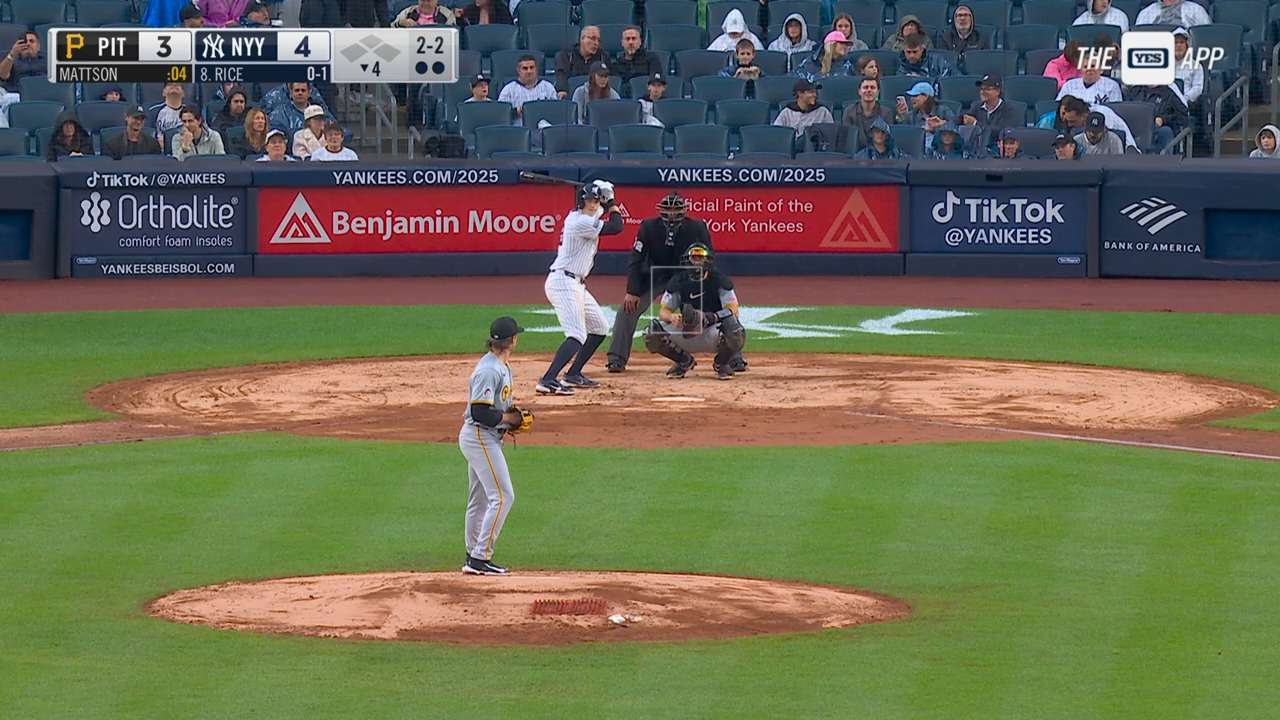
This early in the season, it’s frequently a struggle to identify which changes in a player’s game are real and which are a small-sample mirage. But not always. This is Rice’s stance at the end of 2024.
And this is his stance now.
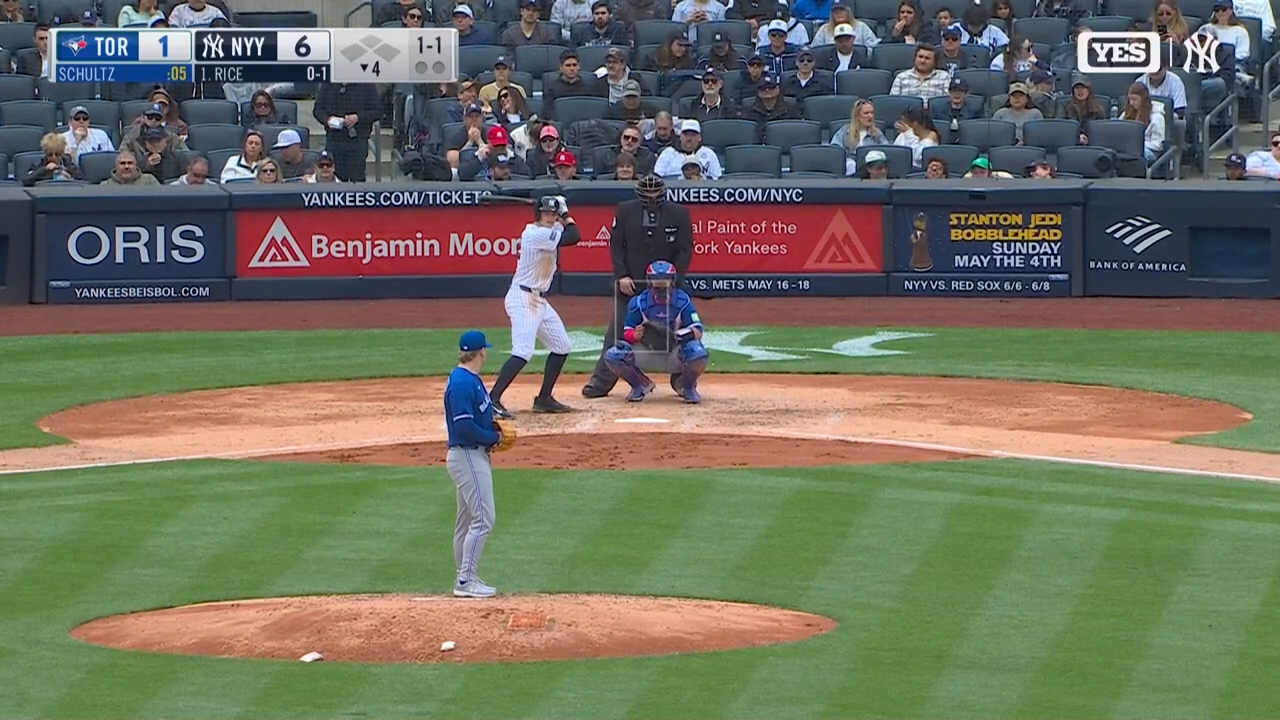
Rice always had an open stance, which led to all sorts of desirable attributes as a hitter: That high walk rate, for one, and plus bat speed, for another. Rice has long tended to pull the ball, and to hit it in the air, and crucially, to do both at the same time. That’s how you get home runs.
Some hitters, having suffered as Rice did as a rookie, might have gone back to the lab and tried to come up with something new. Not Rice, who decided that more is better. An eight-degree open stance is now a 27-degree open stance, according to Baseball Savant.
Now, I’m from the 1990s, so when I see a guy come to the plate standing sideways with his legs splayed out like Tim Commerford on the bass guitar, my mind goes to Tony Batista.
I’ve written before about how my childhood admiration for Derek Jeter made me a disciple of the church of the closed batting stance. So obviously I harbored an intense dislike for Batista, whose posture in the batter’s box seemed entirely risible to me. And because I was wondering why in the heck anyone would debase himself by hitting like that, I always remembered Batista’s explanation: It helped him see the ball better.
Seeing as how Rice plays for the Yankees, and this is a highly noticeable change in technique, he’s been asked about the new stance before. His explanation: “[I] felt like it gave me a little bit more of an ability to see the baseball.”
Truly, there is nothing new under the sun.
Anyway, let’s see if Ivy League Tony Batista is actually seeing the ball better.
| Season | wRC+ | BB% | K% | Swing% | O-Swing% | Z-Swing% |
|---|---|---|---|---|---|---|
| 2024 Triple-A | 175 | 18.1 | 18.8 | 40.7 | 20.6 | 62.3 |
| 2024 MLB | 73 | 11.2 | 27.0 | 26.0 | 19.9 | 71.9 |
| 2025 MLB | 160 | 11.4 | 25.2 | 42.7 | 23.1 | 61.0 |
Rice crushed high-minors pitching last year, hitting a combined .273/.400/.567 in 79 games across Double-A and Triple-A. Older power hitters with good bat speed are going to do that, and when a prospect like Rice comes to the majors, question no. 1 is usually: How is he going to adapt to pitchers who can spin the ball, command the ball, and do both at the same time?
Even the most demanding evaluator would give a rookie some grace while he figures things out. But Rice wasn’t chasing wildly outside the zone last year. He wasn’t striking out at a ridiculous rate; in fact, he was making more contact, especially within the strike zone, than he did in the minors.
Rice had two big problems last year. First is what looks to me like apocalyptically bad batted-ball luck. In 178 plate appearances as a rookie, Rice posted a .186 BABIP, and a .269 wOBA against an xwOBA of .340. Even notwithstanding the stance change, Rice fixed a lot of his problems by making nice with the malevolent spirit whose grave he walked over every morning on the way to the park last year.
Problem no. 2: As a rookie, Rice swung at more than 70% of the pitches he saw within the strike zone. Out of context, that’s not wacky aggressive or anything; plenty of really good hitters live in the high 70s in Z-Swing%. But in the minors, Rice was in the low 60s. In other words, he went from the bottom quartile for Z-Swing% to the top quartile, and I think it messed him up a little.
In Little League, you get taught to defend the strike zone. In the pros, you have to get your money’s worth out of each swing. Runs are scored, games and championships are won, and million-dollar contracts are earned not just by making contact, but by making hard contact. Which is not what you’ll get if you’re playing tennis with every backdoor sinker that comes near the plate.
Last year, Rice’s average swing speed was 71.4 mph, which was 243rd out of 503 hitters who took 100 or more swings. This year, it’s 74.6 mph, which is 30th out of 230 hitters who qualified for Baseball Savant’s leaderboard. Or, if you want some more useful context, it’s one spot ahead of Bryce Harper, one of the poster boys for selective aggression.
Here’s how Rice did on pitches in the strike zone last year, compared to this year.
| Year | BA | OBP | SLG | wOBA | xwOBA | Whiff% | Bat Speed | Swing% |
|---|---|---|---|---|---|---|---|---|
| 2024 | .190 | .185 | .405 | .245 | .331 | 17.6 | 71.7 | 72.9 |
| 2025 | .321 | .321 | .705 | .438 | .444 | 16.4 | 74.8 | 62.4 |
Rice put on a little weight over the offseason, so some of the increased bat speed is probably attributable to added strength. But he’s made enormous gains in terms of identifying his pitch and letting it rip.
It’s a welcome development for the Yankees. Rice has started 28 games this year, 23 of them in the first three spots in the batting order. Rice has scored 22 runs this year, of which 13 have either come on his own home run or on an RBI provided by Judge. As the season has gone on, and manager Aaron Boone has put more faith in the resurgent Trent Grisham (speaking of wild comeback stories), Rice has started hitting behind Judge, who’s moved up to second in the order.
Last year, Judge drove in 144 runs, the highest total in a major league season since 2008. That was the result not only of his own ridiculous power output, but of hitting behind a left-handed two-hole hitter with a .419 OBP. Even before Yankee pitchers started blowing out their arms two or three at a time, it was reasonable to wonder how the Yankees would get on if Judge didn’t have Juan Soto to drive in anymore.
I am by no means saying that Rice is on Soto’s level now, or that he could get on Soto’s level in the future. There is no replacing Soto.
But Rice has filled more of that hole than anyone would’ve expected after last season. He’s not a superstar hiding in plain sight, but he’s carried enough of the load that Judge can handle the rest.
Michael is a writer at FanGraphs. Previously, he was a staff writer at The Ringer and D1Baseball, and his work has appeared at Grantland, Baseball Prospectus, The Atlantic, ESPN.com, and various ill-remembered Phillies blogs. Follow him on Twitter, if you must, @MichaelBaumann.
I know this is pulling a stat from another site, but it’s interesting that Rice’s SEAGER was in the 88th percentile last year and only 45th this year. A lot of the positives seem to come from hitting the ball much harder as the article says.
Say what you will about Rey Ordonez’s bat, 4 dWAR seasons don’t just come along every decade you know
Probably the second best defensive shortstop I’ve witnessed in my 38 years as a baseball fan behind Ozzie.
It may be blasphemy, but I think Ordonez was as good as, or better than, Ozzie. He just couldn’t hit enough to be a starter for long enough.
Not blasphemy at all. Rey Ordoñez made plays that I’ve never seen before. Routinely. I’d put Ozzie and Rey at 1 and 1a, and then Omar Vizquel at 2.
I have a hard time seeing him topping Andrelton Simmons, but I also didn’t get to see Ordonez very much in his heyday. Andrelton was special, he made at least one impactful play on defense every single night it seemed like. He was a master at creating outs when he had no business doing so.
There doesn’t seem to be a generational type shortstop defender these days. That archetype of player is my favorite to watch.
Showing my age, but Belanger and Ozzie remain the two best I’ve seen, although peak Ordonez was a defensive wizard in his own right. The issue is that 4 dWAR you mentioned was never replicated. Belanger had a 4.9 dWAR and averaged nearly 4 dWAR over a six year reign of terror. I say terror since I wasn’t an O’s fan and trying to get a ball through the infield manned by Brooks, Belanger and Grich was ridiculous. I was too young to realize that infield was not normal!
I haven’t read the article yet, but the headline is Pulitzer-worthy.
Headline of the year IMO. I occasionally complain about the failed puns but this one was worth at least ten of the groaners and head-scratchers.
Really? To me this was an absolute groaner.
Sure. But the good kind of groan, not the bad kind.
The best headline I can remember here for a long time.
It was John Sterling-esque from the written side.
I always thought his underlying numbers in 2024 were pretty similar to Pete Alonso’s (wait, Alonso has gone off even more than Rice this year. Weird). Given that, I figured there was a pretty good chance the production would come. Of course, I’ve also seen plenty of those disappearing 1B over the years, so I can’t claim to have been really that confident.
Glad to see Grisham get a mention. He’s been really good since coming to the Yankees; he’s just been overlooked because his 2024 numbers were dragged down by his first two months, when his primary job was to accumulate rust on the bench.
Yeah is Grisham doing something different? He’s hitting better than Rice with worse projections. He’s very useful if he gets to 100 wRC, and he’s at like 180 now.
I don’t have interesting approach-level insights, but he’s hitting less ground balls and pulling more often. That’s especially good in Yankee Stadium. I’m not positive how he’s hitting the ball harder now, but I just read that he’s swinging at the first pitch more.
He’s up to 28.7% this year, relative to 21.9% for his career!
That follow thru from a hr a couple days ago was absolutely amazing. Like 1940s esque
he still seems to suck a lot vs breaking stuff, and it’s a problem in the long run. but production wise it just shows that no matter what you do in the rest of the at bats, as long as you can pull the damn ball in the air and maximize production on that, you’ll be very productive. also interesting that he’s simply swinging faster this year by quite a bit.
“… and an 11.2% strikeout rate, a 27.0% walk rate, and a .178 ISO are fine.”
Yeah those are switched
If Rice can closely approximate Soto’s overall batting impact moving forward, it’ll be a huge help to their lineup. I think Soto is probably a 150ish wRC+ bat moving forward, while Rice is most likely a shade below that. The difference is Soto is going to be OBP heavy, while Rice is going to be power heavy. Soto has the better EVs he just doesn’t pull the ball enough. Rice’s isolated power this year would be a career high for Soto (in a non covid season). Even better than last year, where he hit in Yankee Stadium.
So I’m glad that you have concluded that Ben Rice is “only” Albert Pujols (145 career OPS+).
At least you’re not setting your expectations ridiculously high or anything…
Well, I didn’t say for his whole career. Pujols went through like 10 years of decline phase.
But I think a 135-140 wRC+ for Rice is reasonable. He actually pulls the ball in the air and has a top 20ish wOBA and xWOBA. He’s not a bum who’s getting babip luck.
I’m a big Rice fan but a 135-140 wRC+ is absolutely not “reasonable” for a guy who was mostly a non-prospect (he was old for every level he was at in the minors) and scuffled at his 1st taste of the majors last year. ZiPS projects only 16 guys to put up a 135+ wRC+ the rest of the season. The BAT X says 15 guys. Rice dropping in and being one of the top 15 hitters in baseball is not “reasonable”. I’m not saying he won’t because what he is doing so far is totally legit and not some fluky .500 BABIP or whatever, but it would be incredible if he puts up a 135 wRC+ the rest of the way.
It’s reasonable. And it would be incredible. All of the underlying data says this is real. ZiPS projects 126 wRC+, OOPSY projects 130 wRC+ going forward.
Yes, and no hitter has ever had a hot month at the start of their career, then regressed when pitchers inevitably adjust and start pitching them differently.
How can a Yankees fan, of all people, who witnessed Kevin Maas and Shane Spencer, not grasp this?
Ben Rice is not going to “settle in” between 135-140 OPS. You’re basically “conceding” that he’s not a first ballot HoF’er now, he’s only a run of the mill HoF’er.
A 135-140 wRC+ from 25-30 really isn’t “run of the mill Hall of Fame” territory for a 1B.
That’s the Matt Olson/Ryan Howard/Max Muncy/Adam Dunn/Pete Alonso range.
The data didn’t support Maas and certainly not Shane Spencer. I drafted Rice in my auction league because he seemed to be a decent breakout candidate. In that sense, I viewed him as the opposite of a Shane Spencer type. He’s someone who underperformed his numbers last year. That aside, I agree with your sentiment. Fast starts often fade. I doubt he’s a 160 wRC+, but I can see him maintaining in the 120 range with his skillset.
Difficult for you to say the data didn’t support Maas, when it was 35 years ago, so quite frankly we didn’t have nearly the same “data” to go on.In addition, Rice has already started to cool off. .185/.279/.444 over the last 16 games, with 4 BB and 17 K’s.Pitchers have started to adjust, and now we see if Rice can adapt to it. It’s way too soon to be talking about him in the same breath of even guys like Alonso/Olson/Howard, etc.
Pujols put up a 164 wRC+ through age-32.
I feel like you’re completely missing the spirit of my comment.
Ben Rice is “only” a 145 OPS+ bat, as if that’s a massive concession.
Every comment you’ve made on this article makes it seem like you think FanGraphs members are dumb dumbs who can’t follow arithmetic.
Shit; you’re entirely missing the importance of how WordPress comment threads work.
I mean, Jesus Christ, mate – literally everyone can see you moving your goalposts, right now.
There’s nowhere to hide!
Were you hoping that you could claim a 1B putting up a 135 wRC+ through their 20s would make them a HoF candidate without any pushback, on the basis that none of us know how numbers or leaderboards work?
If <insert player here> can closely approximate Soto’s overall batting impact moving forward, it’ll be a huge help to <insert team here>’s lineup.
Soto isn’t Judge. Or Ohtani. Or Yordan. He’s like a 150 wRC+ true talent guy. Which is great obviously but guys do that every year. Or come close enough. Rice’s metrics are great and he actually pulls the ball, something Soto doesn’t do enough.
Eh? Soto has a career 157 wRC+, and from 2020 to last year, it was 164. He’s much more likely to be a 160 than a 150.
Yes. Soto won’t be the only player every year who posts a 150-160 wRC+, but he’s one of the very few who we can reasonable project can do it every year for a decade. That’s why he got paid $800MM+ by Cohen.
Rice is going to be a fine hitter. Wouldn’t shock me if he has some 140 seasons. I also don’t think prospect status is an end all. Look at Yankees current 1st baseman for example. But also cmon, what are we saying here. He’s an above average bat, possibly even an above average dh 1st type bat
The pearl clutching at the concept that Rice could be Matt Olson during his control years cracks me up.
How dare you forget MLB’s 2020 home run leader Luke Voit! From when he got traded to the Yankees at the 2018 trade deadline through the end of 2020 he hit 57 home runs and had a 145 wRC+ (both 15th in MLB) in 213 games. And he was so bad defensively that despite having the highest wRC+ among primary first basemen over that stretch, his WAR/162 still only ranked 9th among them at 3.33.
Shane Spencer, too. Baumann’s on to something there.
The Yankees black magic on guys of this type is not bound by eras. They will find a way to make you an all-star for exactly one and one-third of a season. No more, no less.
Greg MF Bird
Bird had the talent. He was undone by injuries to his feet and the shoulder surgery.
He also fits my own (least) favorite recent Yankees trend: the guy they plug into the open hole on the diamond and rakes (or shoves) for 6 to 18 months, then crumbles into dust from a series of injuries while the medical staff bumbles around.
There have been weirdly a lot of these guys in recent Yankee history. They’d make fantastic sell-high trade candidates, you’d think.
Would they just go on to become good players? Josh Donaldson was injury-prone and good for years for other teams. Then he goes to the Yankees, one injury, and poof! dust. Who’s a guy they actually traded away on a good note early on? JR Murphy? Yeah, that worked out exactly like you said.
The answer is “Every pitcher like Chase Hampton”
Jesus Montero?
Mm! That’s a good one, even though I prefer to think that the Mariners ruined him (the ice cream sandwich story helps).
Ugh. Both these guys got traded for super talented players whose time with the Yankees was marred by repeated injuries. Does selling high amount to little more than rearranging deck chairs?
I did a double-take on last year’s K and BB rates. Strike that, reverse it.
11.2% K and 27% BB is more than just okay, huh
Alex Call has a 9% K rate and a 18% walk rate over 89 PAs with a .348 BA and he is just a 4th outfielder on a losing team.
Feels like he should play a touch more
The outstanding headlines will continue to be posted until morale improves
Why wasn’t he more well-regarded as a prospect? He’s crushed every level he’s been at. Hits the ball hard, walks a lot, doesn’t strike out too much. I feel like this profile should have popped in prospect rankings but he peaked at a 35+.
The ghosts of every bat only minor leaguer haunt prospect writers. Sometimes on long drives between affiliates Keith Law will swear he saw Ian Stewart’s face flash across his rear view mirror.
Honestly though how many were given the time to figure it out? So many are called up then expected to hit immediately and if they don’t so long. Maybe it’s from..watching the Red Sox for as long as I have but over the last decade their philosophy has been to give young players a ton of runway. Look at Jarren Duran it’s hard to stress how poorly his first season went and many wrote him off then bam something clicks after enough exposure. Look at their call ups over the last decade even ones that turned into professional potatoes were given a long look, Bobby Dalbac comes to mind.
Casas is an example of a bat first prospect that was given a lot of time in his rookie year to figure it out and eventually he did. Obviously the last few seasons have not gone well.
Drafted in the 12th round and as a catcher, barely even played in college due to covid, and was already 22 by the time he played in his first minor league season. Not exactly even on the prospect radar with that profile. He had long odds to make it, especially once it was clear that he wasn’t going to be a catcher, and he struggled against LHP during his MiLB career (that’ll ding you as a bat-only 1B/DH type prospect for sure and he still does have a significant split in the Majors).
He also needed some time to get there, and also made key adjustments going into 2023. Just a good player development success story for the Yanks. Probably just a spot of the prospect evaluators not having all the same info as the team.
This. He was always old for his level in the minors and seemed like a platoon DH/1B. He might still be that, though he would still be very valuable if he can continue to mash righties even with a little regression.
But what is the track record for that kind of minor league profile? I think it’s rather low probability to be more than a 1-2 WAR player.
Did we read the same Athletic article?
He was a rando Ivy League kid whom none of their friends had bothered to check.
I think the Ivy League part matters. Not saying there isn’t a lot of pay for play in Ivy League admissions, but you also have to imagine that someone who is likely well above average intelligence can figure stuff out easier than other players. It also doesn’t hurt that he likely has smart people around him, too.
Oh, he’s a BB&N kid – instant his parents signed the check, the worst Uni he could go to was Trinity Hartford.
Elite headline and sub headline combo.
The article title is going to raise the hackles of those punsters over at Razzball.
Trying to decide whether the title or the sub headline are better. Both are awesome. . . .
hope this article ages well considering his 30, 15 and 7 game numbers are all trending south. League is figuring him out, now to see if he can make the adjustments.
The HWAT