
Historically Speaking, Game 4 Was Absolutely Bananas
Watching Game 4 of the World Series, you may not have felt as exhausted as Brett Phillips did when the plane celebration ran out of fuel, but you probably came pretty close. Baseball is at its best when it’s full of unresolved tension, and until that moment of catharsis when the Rays highlight-reel celebration ensued, there were a good six or seven innings of nonstop pressure Saturday night.
Looking at the win probability graph for Game 4 illustrates the rollercoaster everyone rode:
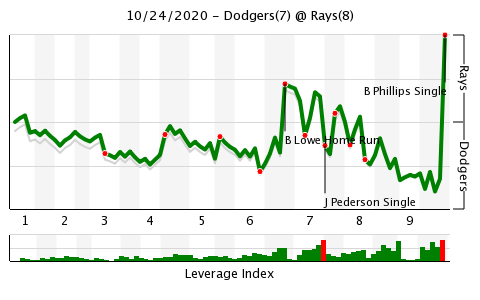
The sheer number of peaks and dips is scary. The outcome was mostly in doubt for the final two-thirds of the game and the arrow of fate couldn’t decide where it was going. For a much less suspenseful game, let’s look at an earlier Dodgers tilt this postseason, the Game 3 NLCS laugher against the Braves that started with an 11-run first inning:
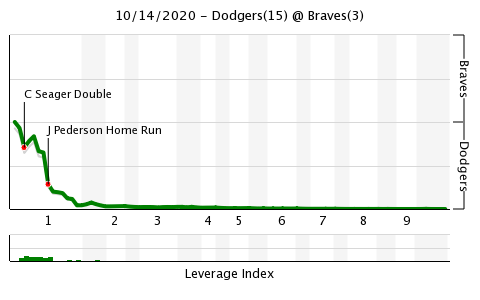
Given how little suspense there was, that might as well have been a graph of fan interest. While the Dodgers were rightly pleased to bank such an easy win, watching eight-and-a-half innings of baseball that’s all but certainly decided isn’t the most compelling viewer experience. I was still watching the game, but at that point, I was paying more attention to the Paladin I was leveling in World of WarCraft!
So how does Game 4 fit into baseball history? To answer this question, I took every win probability change for all 125,000 plays in postseason history in postseason history and tracked them on a game-by-game basis. I then crunched the numbers to determine which games had the most change in expected outcome per event and thus to see how all 1,668 games ranked in terms of volatility. If you thought you were watching a special game, you were right; the uncertainty in Game 4 was definitely meaningful on a historic level:
| Game | Total Probability Change | Plays | Probability Delta per Play |
|---|---|---|---|
| 2020 World Series Game 4, Dodgers at Rays | 6.13 | 86 | 7.12% |
| 1995 NLDS Game 1, Braves at Rockies | 5.81 | 82 | 7.09% |
| 1995 ALDS Game 1, Red Sox at Indians | 7.50 | 107 | 7.01% |
| 1980 ALCS Game 3, Royals at Yankees | 5.96 | 90 | 6.62% |
| 2011 World Series Game 6, Rangers at Cardinals | 7.17 | 109 | 6.58% |
| 1995 ALDS Game 2, Mariners at Yankees | 7.77 | 122 | 6.37% |
| 1912 World Series Game 2, Giants at Red Sox | 5.92 | 93 | 6.37% |
| 1986 ALCS Game 5, Red Sox at Angels | 5.86 | 94 | 6.23% |
| 2000 World Series Game 1, Mets at Yankees | 6.25 | 101 | 6.19% |
| 1924 World Series Game 7, Giants at Senators | 6.11 | 99 | 6.17% |
| 2017 World Series Game 5, Dodgers at Astros | 6.22 | 101 | 6.16% |
| 2004 ALCS Game 5, Yankees at Red Sox | 7.75 | 126 | 6.15% |
| 1995 ALDS Game 5, Yankees at Mariners | 5.94 | 97 | 6.12% |
| 2020 ALWC Game 2, Yankees at Indians | 5.68 | 93 | 6.11% |
| 1910 World Series Game 4, Athletics at Cubs | 4.88 | 80 | 6.10% |
| 1972 ALCS Game 1, Tigers at Athletics | 5.17 | 85 | 6.08% |
| 2009 NLDS Game 4, Phillies at Rockies | 5.22 | 86 | 6.07% |
| 1980 World Series Game 5, Phillies at Royals | 4.67 | 78 | 5.99% |
| 2001 World Series Game 4, Diamondbacks at Yankees | 4.61 | 77 | 5.99% |
| 1999 NLCS Game 5, Braves at Mets | 7.50 | 126 | 5.95% |
For games prior to 2002, I used the probabilities from stathead.com.
1. 2020 World Series Game 4, Dodgers at Rays
You really should remember this one without a description, but if you’re going through your own personal Groundhog Day-scenario and have repeated October 23 10,000 times, check out the piece written by my colleague Ben Clemens, who recapped the game. I’m still exhausted thinking about this game. Sadly, this isn’t even the only game in the top 20 to feature a Kenley Jansen loss.
2. 1995 NLDS Game 1, Braves at Rockies
Chipper Jones went on to play 93 postseason games in his Hall of Fame career. This was the first, and one of two career multi-home run games he had in the playoffs. And both his homers were significant ones, with the first bringing the Braves back to within a run in the top of the sixth inning, and the second, a two-out blast in the ninth off Rockies reliever Curt Leskanic, enough to give the Braves the win as Mark Wohlers was still good at this point.
3. 1995 ALDS Game 1, Red Sox at Indians
The second of three 1995 postseason games to make the top 20! Roger Clemens got into trouble in the sixth against the heart of the Cleveland order, but future Red Sox reliever Julian Tavarez allowed a solo blast to Luis Alicea in the eighth that tied the game. Tim Naehring hit a hard liner for a homer in the 11th, but Rick Aguilera blew the save in the bottom of the inning and it remained tied until Tony Peña (the original one) hit a walk-off shot against Zane Smith in the 13th. The call of the walk-off is a fun one as Bob Costas seemed unaware of what was going on in the game until the moment he heard Peña connect. Including the regular season, this win pushed the Indians to 14-0 in extra-inning games, a streak they continued until ALCS Game 3 against the Mariners.
4. 1980 ALCS Game 3, Royals at Yankees
This one was back in the dreadful days when the championship series was best-of-five, which didn’t change until 1985. The Royals swept the Yankees, but it didn’t come easily, with the two teams combining for only six runs on 20 hits. After a Reggie Jackson double in the sixth, Paul Splittorff was pulled, with the intention of Dan Quisenberry getting the 3 2/3 inning save (he threw at least three innings 10 times during the regular season). Frank White threw away the grounder on a play to third that George Brett was slow to recover from and a Rick Cerone single scored Oscar Gamble from third to give the Yankees a 3-1 lead.
George Brett’s three-run homer turned out to be the difference, but Quiz had another scare when he loaded the bases with a triple and two walks in the eighth. He managed to hold them scoreless.
5. 2011 World Series Game 6, Rangers at Cardinals
This game probably needs little introduction, what with it being The David Freese Game and all. Freese’s triple in the ninth, with the Rangers one strike from winning the World Series, drove in Albert Pujols and Lance Berkman, while his home run off Mark Lowe in the bottom of the 11th was the finishing blow.
6. 1995 ALDS Game 2, Mariners at Yankees
With a 4-3 lead, the Mariners decided to roll with Norm Charlton with lefties Wade Boggs and Paul O’Neill due up in the inning. Charlton successfully got Boggs and Bernie Williams out, but O’Neill’s homer tied the game. Charlton got to stay in the game and largely atoned for the dinger, throwing three scoreless innings. The Yankees held back Mariano Rivera in a tie game, instead using John Wetteland. The result? Ken Griffey Jr. hit a homer to give the Mariners the lead in the 12th. But Jeff Nelson and Tim Belcher lost that lead in the bottom of the inning.
This time, the Yankees did bring in Mo and he dueled with Belcher for a few frames before Jim Leyritz hit the walk-off shot in the bottom of the 15th.
7. 1912 World Series Game 2, Giants at Red Sox
You could argue that this game is actually baseball’s most suspenseful because we still don’t have a winner 108 years later! It was a marathon by the standards of the day at two hours and 38 minutes, long enough that it had to be called a 6-6 tie in the 11th due to darkness. Much of that sentence sounds very odd today. Poor Christy Mathewson threw 11 innings and watched his defense give up six runs on five errors, with not even a W in the scorecard to show for it.
Of course there’s no game footage.
8. 1986 ALCS Game 5, Red Sox at Angels
Angels manager Gene Mauch allowed starter Mike Witt to attempt to finish a complete game to push past the Red Sox, but a two-run homer by Don Baylor made things interesting. Gary Lucas plunked Rich Gedman and then, one strike from finishing off the Sox, Donnie Moore gave up two-run homer to Dave Henderson, giving Boston a 6-5 lead. The Angels scored a run off Bob Stanley and Joe Sambito, but left Moore out there for the 10th and 11th, something you’d never see a manager do today. Moore hit Baylor in the 12th, and allowed two more singles. Still left out on the mound, Henderson came in and hit a sac fly to give the Red Sox the lead they never lost. Only for the final out did Mauch turn to rookie Chuck Finley, who had a 3.29 FIP in 25 relief appearances in his rookie season that year.
9. 2000 World Series Game 1, Mets at Yankees
The Yankees won the Subway Series in five games, but with every game decided by two runs or fewer, it was a lot closer than the final result would make one think. None of the games were closer than this Al Leiter vs. Andy Pettitte pitchers’ duel, a scoreless affair until the Yankees took the lead with a David Justice double in the bottom of the sixth; singles by Bubba Trammell and Edgardo Alfonzo took it back in the seventh. Glendon Rusch survived the 10th and 11th, stranding four runners, but Turk Wendell was less fortunate, allowing a bases-loaded walk-off single to Jose Vizcaino in the 12th.
10. 1924 World Series Game 7, Giants at Senators
Who said the Tampa Bay Rays invented the opener? For Game 7 of the 1924 Fall Classic, second baseman/manager Bucky Harris started Curly Ogden in his first (and only) career playoff appearance. Why? Because the Giants used platoons. By opening with the righty Ogden, the idea was to hopefully get New York to commit to playing as many lefties as possible for the scheduled starter George Mogridge. It partially worked — the Giants started a struggling Bill Terry against Ogden — but the game remained close throughout. Walter Johnson threw four scoreless innings to complete the game and was even allowed to hit for himself with a runner on in the bottom of the 12th. Earl McNeely hit a walk-off double against Jack Bentley.
Dishonorable Mention: 2019 NLDS Game 5, Cardinals at Braves
The Dodgers-Braves NLCS game I mentioned earlier was only the second least-volatile game in postseason history. For the all-time lagger, look no further than last year’s NLDS Game 5 between the Braves and Cardinals, in which the Cardinals scored 10 in the first en route to an easy 13-1 victory. Mike Foltynewicz was hit so hard that game that he lost 4 mph off his fastball! Okay, maybe not.
Dan Szymborski is a senior writer for FanGraphs and the developer of the ZiPS projection system. He was a writer for ESPN.com from 2010-2018, a regular guest on a number of radio shows and podcasts, and a voting BBWAA member. He also maintains a terrible Twitter account at @DSzymborski.
I’m pretty surprised that game 7 of 1960 WS wasnt near the top. Lots of scoring/lead changes and a walkoff too. Nevertheless Game 4 was awesome to watch.
Game 7 in 1960 was 26th at 5.91% swing per play.
No wonder I felt like I’d watched this game before (2017 G5). 2017 G2 is probably pretty far up the list, too, if I had to guess.
The game I was expecting to see was game 7 of the 2016 World Series. Also thought there’d be something from 1986. So many dramatic moments througout both Championship Series and the World Series.
BTW, great article, loved this a LOT!
That game was nuts but the lead changes started very late so there were less of them in total. The games on this list all got stupid in the 5th or 6th and some still went extras
True. The other big difference – at least between the Rays/Dodgers game and the Cleveland/Cubs game – is that the former had a walk-off hit, whereas the latter didn’t. That walk off alone produced an 81% swing in win probability (no play in the Cleveland/Cubs game was above 39%). Now imagine some alternative reality where Michael Martinez homers off Mike Montgomery in the bottom of the 10th…
This is true, and not just a walkoff but one from a losing position. Those are very rare: this was the first walkoff from a losing score position since Kirk Gibson. It creates a much larger WP swing than you can otherwise see. Even the famous Freese game involved a tie and then later the walkoff hit
Actually Joe Carter in the ’93 WS was the most recent to do it. Others to do it in the WS are Dane Iorg (’85) and Cookie Lavagetto (’47).
Its interesting that the Carter HR doesn’t show up on the list of highest win probability swings in WS history. I think this is because there were not yet 2 outs, so the Jays’ run expectancy for the inning was still quite high (there was 1 out, so the Carter play was worth 66% win probability, whereas the Gibson HR was 87 and the Phillips play was 81; that extra out makes a big difference).
The entire inning was about an 80% win probability swing, but Molitor and Henderson took up some of that by reaching base.
I remember watching that game on TV and honestly the HR didn’t feel that dramatic. With the way Mitch Williams was pitching, it almost seemed inevitable that the Blue Jays would come back and win the game. Felt like a how, not an if.
So here’s what I would like to see for the follow up article: How many other games in this specific World Series (and playoffs, if you have to add more) do you need before you get to the total excitement of this game? Because I feel like this game was like the level of excitement you would get across three games (so, games 1-3?) but condensed into one.
This series has sort of had a different kind of excitement that is more tension as you’ve had some close games but outside of game 4 there has not been a lead change so it will rate poorly on this scale.
For example last night was a very tense game but the win probability chart is pretty boring as there were only 5 baserunners after the crazy Rays 4th inning and that was the only situation where the win probability inverted back to the Rays. The Dodgers immediately went up from 50% in the top of the 1st and maintained that lead the whole game.
You can find some LCS games like NLCS 7 that have some of this but the world series has involved very few actual lead changes, just the tension of games being within reach for the losing team in some cases.
The lack of lead changes is kind of remarkable.
I don’t know how to calculate your “probability delta per play,” but game 2 of the 2005 WS probably ranks up there too. It was a back-and-forth affair with both the White Sox and Astros holding a couple of leads early, then had weirdness and drama late with Konerko’s grand slam with two outs in the seventh (after the maybe phantom HBP on Jermaine Dye) taking the White Sox from 2 down to 2 up with 6 outs to get. Then the Astros tied it with 2 outs in the top of the ninth on a Jose Vizcaino single, and it ended with Scott Podsednik hitting a walk-off HR with one out in the bottom of the ninth after hitting zero regular season HR in 568PA during the regular season.
Game 2 2005 was 28th.
Game 7 2016 was 67th.
Both very high in the rankings with 1668 games (I didn’t do last night’s game)
2017 G2? I remember the night of it was one of the craziest WS games in history but it gets forgotten because game 5 was worse
Found an old tweet from Craig Edwards which notes the following:
“There have been two games in World Series history with 5 plays where win probability changed at least 25%
Game 2, 2017
Game 5, 2017”
Yeah kill me
That WS is so sad to remember: 2 of the most insane games in WS history, Dodgers lost both. 2 Yu Darvish implosions. Dodgers lost both. 3 ordinary, competitive baseball games: Dodgers won all 3.
This series has a lot of parallels, but only one crazy, insane game.
I’m a Cleveland fan. So if you’re looking for some sympathy, sorry!
🙂 🙂 🙂
I mean hey we are still in the same boat until at least tomorrow. Then it might be different.
The way I see it, Cleveland fans and Dodger fans have a certain amount of solidarity in understanding how much it sucks to narrowly miss out on a title. We’ve been fortunate enough to get further chances, but we still don’t have anything more to show for it just yet.
Sorry, I was born in ’69 so I’ve seen the Dodgers win two titles already, something that I haven’t seen Cleveland do.
It seems to me that extra-inning games (at least before this year) should be given some kind of bump-up when it comes to suspense. Every pitch in the bottom of an extra inning (including the bottom of the ninth if the game is tied, as this one) has a win-probability change of up to .5 (rarely even greater) riding on it, unless the visiting team scored in the top of the inning. That’s true even if the pitch results in an out. Is there a simple change in your metric to take that into account?
What you’re describing is what’s called leverage, not actual win probability. Leverage is the potential change in win probability swing that can occur. Win probability is then actual swing that occurs.
2 of the top 13 in the same 5 game series! (1995 Mariners v Yankees). Game 4 was no snoozer either. Amazing to think that was 25 years ago.
You also have 3 of the top 6 (and 4 of the top 13) coming from the 95 Division Series. Weird.
BTW, a small typo in the text. Says that 3 of the top 20 are from 1995. But it’s 4.
Is… Turk Wendell wearing a NECKLACE OF BONES
Only WS game I’ve ever been to was game 1 in 2000, and it was so cold by the end but I knew it was something special.
Fun piece, Dan! A whole lot of memories coming back from games I’d half-forgotten.
One small correction: when you say about 1995 ALDS Game Two, “The Yankees held back Mariano Rivera in a tie game, instead using John Wetteland,” it implies that Mo was the closer. But Wetteland was the closer on the ’95 and ’96 Yankees, and Mo was the long man. Rivera would often pitch both the 7th and 8th, giving way to Wetteland in the 9th.
So Showalter was actually using his closer in a tie game, unlike what he did three games later, when he kept both Wetteland and Mo on the bench in favor of Jack McDowell… and of course his famous non-use of Zach Britton 21 years later.