
Hold That Tiger: Kevin McGonigle Gets a Record-Setting Extension
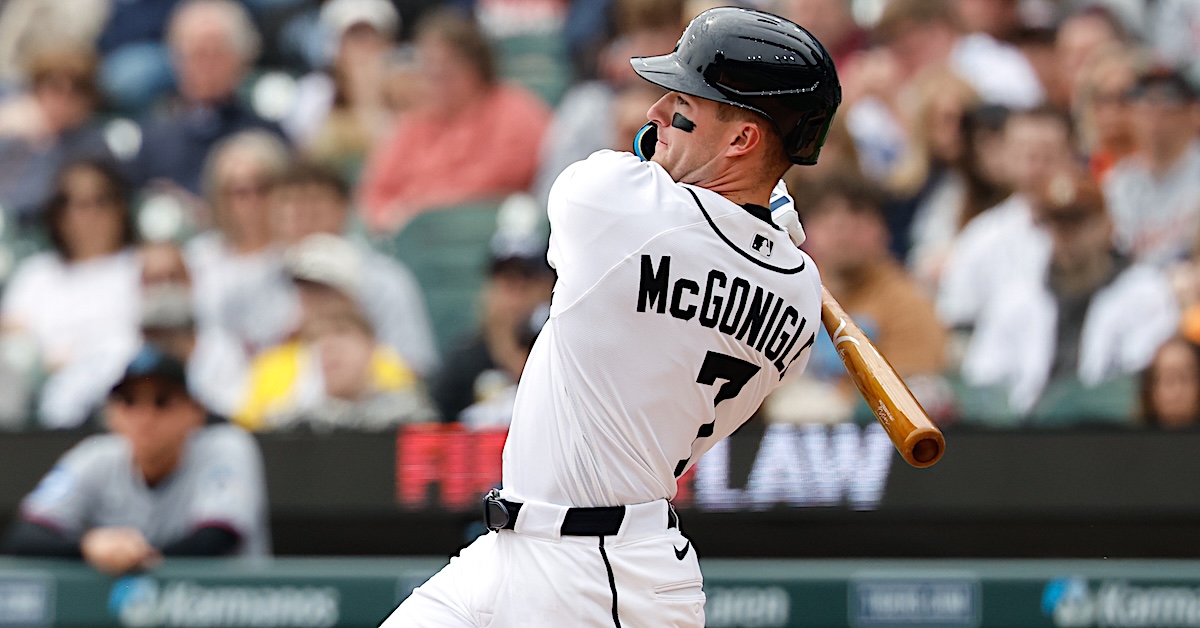
Konnor Griffin isn’t the only rookie infielder to land a nine-figure extension within his first few weeks in the majors. On Wednesday, the Tigers reached an agreement with Kevin McGonigle — who made the jump from Double-A into Detroit’s Opening Day lineup and has been the team’s top hitter thus far — on an eight-year, $150 million extension for the 2027–34 seasons. The contract slightly surpasses the value of Griffin’s deal, making it the largest guarantee to a player with fewer than 100 days of major league service time, even before its other bells and whistles are considered.
According to MLB.com, McGonigle will receive a signing bonus of $14 million, $8 million of which is payable within 30 days and the rest in 2028. He’ll then earn $1 million next season, $7 million in 2028 (when he would have qualified for Super-Two status), $16 million in ’29, $21 million in ’30, $22 million in ’31, and then $23 million annually from ’32–34, which would have been his first three years of free-agent eligibility. Escalator clauses can increase the values of the deal by an additional $10 million, with higher salaries for those last three seasons of $25 million (2032), $26 million (2033), and $28 million (2034).
Those escalators are based on MVP voting and other honors, and can be triggered starting this season, per ESPN. McGonigle could get boosts of $2 million for winning an MVP award, $1 million for finishing second through fifth in MVP voting, and $500,000 for finishing sixth through 10th; he’ll also get $500,000 for making the All-MLB first or second team, $250,000 for making an All-Star team, and $250,000 for winning a Silver Slugger award. His contract has no options or opt-out clauses, but additionally includes a $5 million assignment bonus for every time he’s traded to another organization under the life of the contract.
By comparison, Griffin’s nine-year, $140 million contract covers this season, so it also runs through 2034. It includes a $12 million signing bonus, $10 million in escalator clauses, and limited no-trade protection. The deals of both McGonigle and Griffin fall short of the $210 million extension Julio Rodríguez signed in 2022, the largest for a player with less than one year of service time, but as MLB Trade Rumors pointed out, by the time Rodríguez inked that deal, he’d made his first All-Star team and was well on his way to winning AL Rookie of the Year. In the McGonigle/Griffin comparison, it’s worth noting that while the latter’s deal is uncharted territory for the Pirates, the Tigers are no strangers to writing big checks, though the deals for Miguel Cabrera, Justin Verlander, and Prince Fielder — the three largest in team history ahead of McGonigle — went to much more established players.
The Tigers drafted McGonigle out of Monsignor Bonner and Archbishop Prendergast High School in Drexel Hill, Pennsylvania with the 37th pick in 2023, a Competitive Balance A pick. He rocketed through the minors even while battling injuries, not playing more than 60 games at a single stop in a season. Last year, in six games at A-level Lakeland (on a rehab assignment following a month lost to a right ankle sprain), 36 at High-A West Michigan, and 46 at Double-A Erie, he hit a combined .305/.408/.583 (182 wRC+) with 19 homers and 10 steals while showing off what our prospect team suggested might be the best hit tool in all of the minors; he struck out in just 11.6% of his plate appearances while walking in 14.9%. He capped that stellar season by hitting an ungodly .362/.500/.710 in the Arizona Fall League.
The 21-year-old McGonigle placed fifth in our preseason Top 100 Prospects list as a 60-FV lefty-swinging prospect, with our prospect team describing him as “[s]hort-levered with plus bat speed, elite hand-eye coordination, and a great approach… the total package at the plate.” The only real knock on him is a questionable future at shortstop, as he’s stretched there defensively. The 5-foot-9 — he lost an inch in the official ABS measurements — 187-pounder is a bit light when it comes to his arm strength and range, and he lacks some projection on the defensive side due to his stocky frame. So far, he’s split time with Javier Báez at shortstop (11 games, eight starts), and Colt Keith and Zach McKinstry at third (10 games, nine starts). While he has 28 games of minor league experience at second base, he has yet to play the position in the majors, but with Gleyber Torres signed only through this season, that’s a long-term possibility, as well. Regardless of where McGonigle plays, the scouting reports and statistical profile both suggest a middle-of-the-order presence and a foundational player for an organization.
Given his lack of upper-level experience, McGonigle was hardly a lock to make the Tigers out of spring training, but he showed he was ready for the majors both at the plate and in the field, and so he broke camp with the big club. On Opening Day, he raked a two-run double on the first pitch he saw from the Padres’ Nick Pivetta, added another double off Pivetta in his next plate appearance, and ended up going 4-for-5. As colleague Michael Baumann pointed out, that made him the 25th player to record four hits in his major league debut.
The next day, McGonigle collected a go-ahead two-run single off San Diego’s Wandy Peralta in the eighth inning. He hit his first homer, off the Marlins’ Sandy Alcantara, this past Sunday as part of a 3-for-4 day with a walk.
McGonigle isn’t hitting .800 anymore, but his .313/.421/.484 (162 wRC+) line reflects exceptional strike zone judgment (23.8% chase rate) and minimal swing-and-miss (87.9% contact rate, 5.0% swinging strike rate). Again, he’s walking more often than he’s striking out (rates of 15.8% and 13.2%, respectively). His 88.2-mph average exit velocity, 9.3% barrel rate, and 37% hard-hit rate thus far are less impressive, but his actual stats match up with his expected stats (.296 xBA, .546 xSLG) well enough to suggest he’s on the right track.
“We do this for a living — we study young hitters and their adjustment period to the big leagues,” said president of baseball operations Scott Harris at the press conference to announce McGonigle’s contract. “Some of the best players in baseball right now really struggled for their first 150 plate appearances, and clearly, he hasn’t. It speaks to the quality of the skill set, the talent and the human being. I can’t remember being as impressed with anyone through the first — what is it? — 17 games.”
In his brief time in the majors, McGonigle’s plate discipline and contact rate have given his ZiPS projection a bit of extra zip, according to colleague Dan Szymborski. It’s a pretty darn good-looking projection, with a sustained peak above five wins per year:
| Year | BA | OBP | SLG | AB | R | H | 2B | 3B | HR | RBI | BB | SO | SB | OPS+ | WAR |
|---|---|---|---|---|---|---|---|---|---|---|---|---|---|---|---|
| 2027 | .267 | .354 | .470 | 528 | 89 | 141 | 37 | 5 | 20 | 85 | 70 | 73 | 9 | 128 | 4.3 |
| 2028 | .272 | .361 | .480 | 552 | 97 | 150 | 39 | 5 | 22 | 92 | 75 | 73 | 9 | 132 | 5.0 |
| 2029 | .271 | .362 | .483 | 561 | 101 | 152 | 39 | 4 | 24 | 94 | 78 | 72 | 9 | 134 | 5.2 |
| 2030 | .272 | .365 | .485 | 559 | 102 | 152 | 39 | 4 | 24 | 95 | 80 | 69 | 9 | 135 | 5.4 |
| 2031 | .270 | .363 | .479 | 559 | 102 | 151 | 39 | 3 | 24 | 95 | 80 | 68 | 8 | 133 | 5.3 |
| 2032 | .269 | .363 | .477 | 558 | 103 | 150 | 38 | 3 | 24 | 94 | 81 | 67 | 8 | 132 | 5.3 |
| 2033 | .269 | .363 | .477 | 558 | 102 | 150 | 38 | 3 | 24 | 95 | 81 | 67 | 7 | 132 | 5.3 |
| 2034 | .272 | .366 | .482 | 558 | 102 | 152 | 39 | 3 | 24 | 95 | 81 | 67 | 7 | 135 | 5.4 |
The ZiPS contract suggestion for that is eight years and $192 million, even given the arbitration discounts. By comparison, the system projected eight years and $142 million for Griffin, though since his extension does cover 2026, that’s not apples-to-apples; as Szymborski noted in his coverage of Griffin’s extension, his ninth year (also 2034) projects to be worth another $40 million, so again, the two are very close — roughly a difference of one run per year — over that timespan. “Griffin and McGonigle are literally just about the best prospect projections since Mike Trout,” Szymborksi told me while providing the numbers. “It’s hard for ZiPS to be this nice.” He then sent along another table of the top single-season projections for hitters 22 and under to place the numbers for McGonigle and Griffin in perspective:
| Name | Year | Age | BA | OBP | SLG | HR | OPS+ | WAR |
|---|---|---|---|---|---|---|---|---|
| Mike Trout | 2012 | 20 | .267 | .338 | .414 | 15 | 106 | 4.5 |
| Gunnar Henderson | 2023 | 22 | .259 | .354 | .458 | 24 | 123 | 4.0 |
| Corey Seager | 2016 | 22 | .266 | .311 | .447 | 20 | 111 | 3.9 |
| Corbin Carroll | 2023 | 22 | .253 | .341 | .428 | 16 | 110 | 3.9 |
| Konnor Griffin | 2026 | 20 | .256 | .325 | .397 | 15 | 101 | 3.4 |
| Kevin McGonigle (ZiPS DC) | 2026 | 21 | .249 | .329 | .438 | 18 | 113 | 3.4 |
| Julio Rodríguez | 2022 | 21 | .282 | .341 | .465 | 16 | 123 | 3.3 |
| Gregory Polanco | 2014 | 22 | .261 | .309 | .392 | 11 | 96 | 3.2 |
| Anthony Volpe | 2023 | 22 | .234 | .318 | .407 | 17 | 100 | 3.1 |
| Adam Jones | 2008 | 22 | .286 | .342 | .498 | 24 | 114 | 3.1 |
| Bobby Witt Jr. | 2022 | 22 | .268 | .323 | .454 | 21 | 108 | 3.0 |
| Jurickson Profar | 2013 | 20 | .263 | .331 | .414 | 13 | 95 | 3.0 |
| Byron Buxton | 2016 | 22 | .266 | .310 | .405 | 9 | 95 | 2.9 |
| Riley Greene | 2022 | 21 | .268 | .335 | .465 | 23 | 117 | 2.9 |
| Kevin McGonigle | 2026 | 21 | .249 | .329 | .438 | 13 | 113 | 2.8 |
| Carter Jensen | 2026 | 22 | .248 | .322 | .411 | 18 | 103 | 2.8 |
| Daric Barton | 2008 | 22 | .280 | .369 | .440 | 11 | 119 | 2.8 |
| Spencer Torkelson | 2022 | 22 | .249 | .334 | .489 | 28 | 122 | 2.8 |
| Ronald Acuña Jr. | 2018 | 20 | .269 | .321 | .452 | 21 | 107 | 2.8 |
| Xander Bogaerts | 2014 | 21 | .267 | .331 | .429 | 16 | 105 | 2.8 |
| B.J. Upton | 2006 | 21 | .275 | .354 | .422 | 14 | 101 | 2.7 |
The two highlighted lines for McGonigle reflect his raw projection for 406 plate appearances (an amount suppressed by his playing just 88 games last year and 74 in 2024 due to a fractured right hamate) and then a Depth Charts adjustment to 546 plate appearances. The other projections, including those of Griffin (who played 122 games last year), are raw ones, without playing time adjustments.
Not every player above panned out to the same degree — a few of those names read like cautionary tales, including those of teammate Torkelson (sigh) — but it’s worth noting that McGonigle’s 2027 projection for 4.3 WAR at age 22 would rank just below Trout, and the same is true for Griffin. Ahem.
Anyway, that’s a lot to get excited about. Less exciting thus far has been the Detroit offense. The Tigers are off to just a 9-9 start while averaging a middling 4.11 runs per game (eighth in the AL) and batting a combined .237/.322/.365; both their slugging percentage and 99 wRC+ also rank eighth in the league, while their on-base percentage is sixth. The lack of power is disconcerting, but some of that might owe to cooler early-season temperatures; the major league-wide slugging percentage of .383 is down one point from last year through the first three weeks of the season, though that mark rose 20 points, to .404, by season’s end. Of more concern is the fact that aside from McGonigle, just three other Tigers regulars have a wRC+ of 100 or better, namely Dillon Dingler (148), Keith (121), and Báez (116), with Torres, Torkelson, Greene, and Kerry Carpenter all in the 90s, and part-timers McKinstry, Matt Vierling, and the now-injured Parker Meadows notably worse in smaller samples.
Still, thanks to a pitching staff allowing a league-low 3.44 runs per game, the Tigers are just 1 1/2 games behind the Twins (11-8) and half a game behind the Guardians (10-8). It’s a bit early to start fretting, and in the big picture, the team now has one of its cornerstones in place for a long time.
Brooklyn-based Jay Jaffe is a senior writer for FanGraphs, the author of The Cooperstown Casebook (Thomas Dunne Books, 2017) and the creator of the JAWS (Jaffe WAR Score) metric for Hall of Fame analysis. He founded the Futility Infielder website (2001), was a columnist for Baseball Prospectus (2005-2012) and a contributing writer for Sports Illustrated (2012-2018). He has been a recurring guest on MLB Network and a member of the BBWAA since 2011, and a Hall of Fame voter since 2021. Follow him on BlueSky @jayjaffe.bsky.social.
Coming into the 2014 season, Mookie Betts was a well regarded second base prospect due to his high average and low strikeout rate. Even though I had him ranked 39th on my top 100 list that year, in hindsight I still underestimated just how special his skill set was in terms of combining elite contact quality with elite contact frequency. The best hitters in the game are usually plus-plus in one of those areas and plus or above average in the other, but being plus-plus in both is incredibly rare.
Kevin McGonigle is the first prospect I’ve seen since Betts who has that combination. I have him making numerous All-Star games, winning multiple batting titles, and grabbing at least one MVP award. Committing $150 million to a 21 year old with only 890 professional plate appearances would normally feel risky, but here it feels like a bargain.
Nobody has been on the Mookie Betts bandwagon since his days at Greenville and Salem more than I have been and I agree with your assessment of McGonigle wholeheartedly. To handle today’s pitching the way he has done is so rare that it shocks the senses. The other highly-touted young players have struggled to find their footing, Holliday, Mayer, Basallo, Jensen and others to a lesser degree. I am also looking closely at J.J. Wetherholt and like his power potential.
Ah, I was salivating (and raging with jealousy!) over Mookie at MinorLeagueBall!
Fully agree that McGonigle gives the same vibe – was baffled when he didn’t get a 65.
Think I called his low-end “Howie Kendrick with more pop and less chase” preseason, haha
Man, I miss Sickels and minorleagueball
I think the FG comment section is the gathering spot for people who thought Mookie Betts was going to be at least an average regular and had a good chance of being an all-star.
8 all star games, 4 All-MLB First Team, one MVP award, and 62.8 fWAR later…
I did not see Mookie in the NY-Penn League but caught him for two series in the season of 2013. Early in Greenville and later in Salem, then three games in 2014 at my home park in New Britain. I was already 110%+ on his bandwagon then he hit one over the scoreboard, at least 425′, and it was clear that he had a chance to be great which he has since proven in every way possible. I prefer bWAR (75.2) which gives him his due for the Gold Glove defense he has shown all over the field. I wish there was away to dig up my comments, under a different pseudonym, on Baseball Prospectus from the days before I found Fangraphs. McGonigle is exciting but he has a long way to go before we can call him a first ballot Hall of Fame player.
He might be the highest floor hitting prospect I’ve seen since I started following prospects more closely. Never have I been more sure that a guy would be able to be at least be league-average at the plate than with McGonigle.
The power will determine how good he can ultimately, but since he’s so young, it’s a good bet he’ll figure that out.
Yeah I remember thinking in the preseason “how does this prospect fail except getting hurt?” And I couldn’t answer it.
I guess Gavin Lux also looked similarly. But he kind of had a perfect storm of issues. Power grade was mismeasured, defense greatly overrated, hit tool was much weaker and covered up by offensive environment…
You have to have to be wrong about so many things when you have a prospect at that level. He wasn’t going to be the top prospect with Konnor Griffin hanging around, but I had a super hard time seeing him as worse than #3, with him and Jesus Made being a coin flip.
Lux also struck out much more at every level. McGonigle simply never really struck out, ever, even as a teenager against players much older than him, which really stuck out to me.
But even Lux, with all his struggles, has a career 99 wRC+ in the bigs, so I guess we could say he has indeed been roughly average at the plate over his entry contract. Just nothing more, and he hasn’t been the defender he was thought to be.
If Lux hit the ball as hard as he was expected to, the defense would be less of an issue…but yeah, the main thing with McGonigle is that he’s a freaky SEAGER monster.
I think we’re a little better now at projecting future power with bat speed and EV metrics. McGonigle looks like he has more raw currently than Lux in his prime years, and he strikes out about half as much. He also looks like he’ll walk more than he strikes out, which makes the floor very high.
Yeah, I just wouldn’t call Lux a gamble in any way like Royce Lewis, Jo Adell, Eloy Jimenez, Amed Rosario, or Samuel Basallo. Most of whom probably shouldn’t have been 65s anyway.
There were only two guys in the Eric / Kiley / Brendan era at FG where everyone was just flat out wrong about a super elite position player prospect: Lux and Victor Robles. Everyone was just wrong about the tools.
(Maybe Jackson Holliday joins them, but he’s still got time.)
Yeah, with Holliday we’re really starting to get in the danger zone. He’s still young and got time, but even ZiPs has moved from projecting him as a star to more in the above-average range.
I don’t know what’s in the water in Baltimore right now because Adley Rutschman has regressed pretty hard as well after looking like a potential HOFer to start out. Part of that is likely injuries and catching-related wear and tear, but not all of it. Basallo has struggled early but I agree he should never have been that high to begin with.
Gunnar Henderson is really the only one of these 65+ FV Baltimore hitters in recent years to hit the ground running and maintain that. Such is prospect evaluation, I guess.
Also the other Jackson is mashing. I wouldn’t take the bat out of his hands right now
I never understood why Jackson Holliday was that highly rated to begin with. You can look back at past comments to see that I was always down on him despite being an Orioles fan. I got into an argument with Keith Law in February of 2024 when he made the preposterous statement that “Holliday is a better defender than Gunnar Henderson at short,” as it was already obvious to me by that point that Holliday couldn’t possibly stick at shortstop and that he probably wouldn’t even be a good fielder at second. He was also hopeless against left-handed pitching and couldn’t pull good fastballs.
I did miss on Robles, though. I expected him to be a lot better both offensively and defensively.
Benintendi erasure!
His only season as a plus starter came when he knew which pitches were coming.
Yer a wizard, Kevin
It’s a shame Skubal is almost done in Detroit, because it’d be fun to have a few years where the 2 best pitchers in MLB were with Pittsburgh & Detroit, and the same was true for the 2 best young SS.
He doesn’t have to be. The Ilitch family of all people absolutely could extend him. It wasn’t too long ago another man with that name ran the Tigers and extended both the best hitter and best pitcher in the league.
I concur. I don’t think the Tigers are out on Skubal. Cohen can go beyond what anyone else can pay if he wants to do that, but if that doesn’t happen then Detroit will be in the running.
Not that Max Clark is “The Answer”, but he has to be an improvement over what they have in CF. On the other hand, Baez at 116 wRC+ can’t be expected to continue. They could still use an upgrade at RF/1B/DH. Murakami could have been that. Now maybe Ivan Herrera? What’s Josue Briceño up to?
Briceno is recovering from wrist surgery
The season barely started they aren’t going to rush the development of their top prospects in a panic move to maybe squeeze out an extra 1 WAR if things go right. Clark will come up in the second half of the season if he is ready
Of course, that was before da war!
I was trying to come up with a comp for McGonigle after I saw the news, and the only thing I can think of is a fun-sized version of Joe Mauer who got taught to play the infield and was decent at it.
This guy’s ability to control the strike zone is real special, and he makes consistent hard contact. Don’t see a ton of home runs in that stadium but he’s going to make the pitcher either walk him or give him a pitch that he can hit 95+ MPH close to half the time. Going to be a lot of liners in his future.
Hits the ball in the air more than Mauer so I have to imagine he’s going to top 20 homers more than once in his career, and get to double digit homers more than twice in his first six seasons. Tigers fans should be thrilled that he will be around for a while.
If he can pull flyballs, that’s the Mookie Betts and Jose Ramirez blueprint for having game power play up way more than raw. So far, it looks like pulling in the air a good rate, instead of spraying doubles to the oppo gap like Mauer.
He is certainly capable of it. I just don’t think I would feel comfortable predicting that anyone would.
He is also going to have a tough time doing that in his home park.
Here I was, thinking that the guy who put up six approximately full seasons with a wRC+ of 130 or more and adding another 5-10 home runs to his total every year was being too optimistic…
Lofty, lofty comparison but what about like Barry Larkin, Scott Rolen, Lenny Dykstra, or even Xander Bogaerts? Davenport comps has Dykstra and Rolen on the list (though those are hitter comps).
Rolen played SS in high school but moved to 3B when he turned pro (and that worked out pretty well), so not perfect there.
Larkin was a SS and even though he won 3 gold gloves (and this was an era where you really had to a good hitter to win a gold glove), I’d say he was much more known for hit bat. He didn’t have a ton of power but put up some decent ISO seasons for his time, really great walk and strikeout rates.
Dykstra much lighter of a power hitter but same sorta plate discipline, though an outfielder.
Bogaerts had questions on if he’d have to move to 3B (thankfully he was blocked by Middlebrooks/Panda/Shaw lol) but stick at SS and I would say had dangerous enough power ultimately, even if you felt there was more in there when he was coming up.
Below I mentioned this already, but the guy I had always had as a comp for him was Chase Utley. Same (likely) position, same handedness, same size. Didn’t have any opinion about his defense at second, just that it was his likely home.
His actual production will look different because he plays in Detroit and not Philadelphia, but I think he’s going to be the same caliber of hitter as Chase Utley.
Other guys who one might consider are Lou Whitaker or Brendan Donovan, but I think he’s almost certainly going to be a better hitter than both.
If you’re willing to consider different handedness then you could go with Roberto Alomar or Craig Biggio.
If you’re willing to consider different positions but same handedness, I think Mauer is the guy I would go with. But you could make a case for John Olerud or Keith Hernandez. Guys who were seen as not really having “enough power” for their positions but who had a respectable amount for a middle infielder and who raked anyway.
This is basically an entire list of guys who are either Hall of Famers or Hall of Very Good (and Brendan Donovan). I don’t really think that saying “barring injury, he’s probably going to be Hall of Very Good” is much of a leap. He’s a special hitter.
Was about to say, Mauer doesn’t have his power!
Howie Kendrick with pop and a plan was my comp
If you go with position, handedness, and offensive profile the only comp that is anything like him is Chase Utley.
But I am increasingly thinking that is *low* on the hit tool. And Chase Utley hit .332 one year (against less ridiculous pitching than what we see now, but still).
I don’t know if he’ll be plus defensively at second base or not but this is a special bat. Like a guy who hits 150 wRC+ or higher in a good year.
Yup!
Kid’s fucking freaky – wonder if he gets along with his dad?
(I don’t either!)
I think if you’re looking for a cuckoo bananas offensive ceiling comp then it’s probably George Brett, right?
I thought about him. Brett had more power than I remembered; the era he played in was not homer friendly at all, so Brett’s power numbers are unimpressive by today’s standards. But it was very impressive for the era and his home stadium.
I don’t think McGonigle has that kind of power but then again if we are already calling it a cuckoo comp why not?
McGonigle is hard to find comps for because it looks like he’s going to walk at least as much as he strikes out, which is already a rare profile, and he’ll do so with average to slightly above average power. Brett is a good cuckoo comp for that. Utley struck out a bit too much and walked a bit too little, so his profile is I think a lighter hit tool, but with better power.
Nice to see them get ahead of this for once.
I attended the last spring game in Lakeland and sat behind third base. McGonigle played third that day. He had three plays on which he had to make two throws to first, the other was a double play he started. The first throw to first was a short hop, the other was low to the glove side of Torkleson. Both were routine plays. He definitely does not have the arm for third full time.
The DP showed great quickness though so I think he is more of a fit at second if he shakes out of shortstop. If I were managing I’d play him exclusively at short until he showed he couldn’t handle it.
It as a shame about Torkelson, he just doesn’t hit enough to be a championship caliber first baseman. He has Dean Palmer level power but can’t hit it in the air enough. If you’re only going to hit .230 you’d better hit 40-50 bombs a year. He hits too many G5’s and G6’s to get his average or HR where they need to be. This year he’s mostly hit 6th or 7th. Which tells you Hinch is starting to agree. If he’s gonna be good he better get at it as he’s in his age 26 season.
Agree on the 3B comments. He’s looked really good there coming in to make plays where the throw is shorter, but he has look worse going back/towards the line.
The consistency at third definitely needs work, but the arm seems playable there. On the opening AB of yesterday’s game against the Royals, he ranged into the grass in foul territory to field a chopper from Maikel Garcia and then gunned it to Torkelson at chest level to get the runner. That’s about as long of a throw as you’re going to be asked to make at the position and he got it there with plenty of zip. Not saying he’ll be plus at the position (at least not yet), but from what I’ve seen so far the arm strength is better than I expected from the scouting report.
Projecting for 6 straight years of hitting 24 HRs would make Khris Davis proud.
ZiPS is projecting ~45.5 WAR through McGonigle’s age 30 season (I assumed a 4.3 WAR season in 2026 to arrive at this in conjunction with the table above). That compares favorably to many Hall of Famers. As Dan noted – an aggressive projection, indeed!
In the Fangraph’s Bold Predictions (https://blogs.fangraphs.com/excuse-me-our-bold-predictions-for-the-2026-season/), I made the following prediction:
Bold prediction- Kevin McGonigle goes .320/.410/.530 & is a 6 WAR player his rookie year & is a total red ass that immediately becomes beloved in Detroit & hated by opposing teams fans.
That’s higher than I thought, probably in the 90th percentile of my expectations could be this year & It’s early. However, the skills I see from him match what jdbolick has in his post- great plate discipline, swing decisions & contact ability.
Maybe won’t hit 24 HR’s, but, I could see 40 2B, 12 3B, 15 HR annually for him while hitting over .300 every year.
Given how often he has been pulling fly balls (30th out of 270 qualified hitters) in his early career, and his future 60 raw power grade, I’d think that > 20 home runs yearly is a safe bet. He has posted max EVs in spring training & in the minors higher than what he’s done so far in his 18 game MLB sample (109.5 MPH).
I’m now thoroughly convinced that the owners think the time to free agency is likely to go down in the next CBA.
How would he be super-2 in 2028? He will have exactly 2 years of service time. He would have been pre-arb in 2028.
That is what I was thinking too. There isn’t some performance based acceleration into super 2 status that I’ve missed, is there?
Is the year of control that gets cut for a RoY placement an arb year or pre-arb?
I’ve not been this thrilled to see a Tiger rookie play since Fidrych. McGonigle just has a special feel about him, like he was destined to be here. Absolute nails and I never get the feeling he’s in over his head despite skipping Toledo. I’m not old enough to have seen Gehringer (my grandfather said he was the best second baseman he ever saw) but he reminds me a ton of Dick McAuliffe with better bat-to-ball skills. You never know about injuries but Kevin McGonigle has the opportunity to be a fan favorite in Detroit for the next nine seasons.
How many players early in their rookie year have been projected for a Hall of Fame career right off the bat?
Acuna was like that. I think there was a whole article written about how much age matters for Hall of Fame cases, with Acuna as a case study.
(Looks like injuries are going to get in the way though.)
Based on that, I would guess there are 5 players who projected that way based on their minor league record, age, and what they did immediately in MLB: Harper, Trout, Acuna, Soto, and Jason Heyward.
(All outfielders, interesting)
Interesting that they are all relatively modern players. Presumably Fangraphs could retroactively apply their projections to older players as well to see who would have been predicted for HOF as well?
But yeah, that’s a hell of a group (I gave up trying to figure out Jason Heyward long ago).
Those are all modern players because those are the guys who I remembered! But you’re right, the age 18-20 phenoms didn’t show up much between 1960 and 2010.
If you wanted to go back further I would add Griffey and A-Rod for sure, although there’s a chance A-Rod was juicing already then.
And further back you’d have guys like Vada Pinson, Frank Robinson and Mickey Mantle, although at that point we’re talking about foundational guys in the training set.
Basically, the moment the MLB draft was instituted in the 1960s we stopped seeing age 18-20 phenoms. This is probably because there was a misalignment between the high draft picks (who were mostly high school guys) and the players who performed well (who were mostly college guys), which then led more guys to go to college.
Since 1960 I’d add Cesar Cedeno and Dwight Gooden as guys who probably had awesome projections at 20/21 yrs old. There are probably more but yeah, it’s rare.
I realized your first point about 10 minutes after I typed it. Now I’m even more curious to see actual projections!
Griffin as well