
How Much Would You Pay Ranger Suárez?
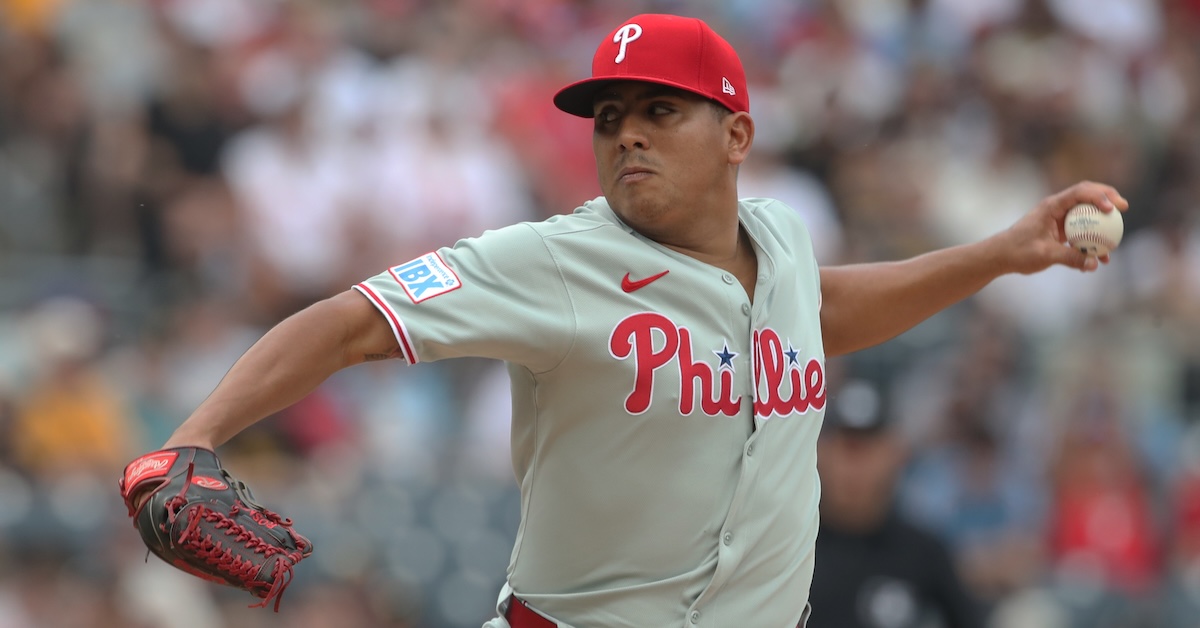
On Tuesday night, Ranger Suárez aced his toughest test of the season. Taking on a red-hot Astros team (they’ve posted a 135 wRC+ over the last 14 days) that demolishes lefties (they’re first in wRC+ vs. left-handed pitchers), Suárez hardly broke a sweat. He tossed 7.1 scoreless innings, allowing just three hits, before Cooper Hummel parked his 99th pitch of the game into the right field seats.
The start may have ended on a sour note, but Tuesday’s performance was the cherry on top of an unbelievably sweet run for the 29-year-old southpaw. In his last nine starts, Suárez has allowed eight earned runs. That’s good for a 1.17 ERA over nearly a third of an entire season.
But for some reason, I’m never quite ready to believe. Maybe it’s because his primary fastball sits below 91 mph, or the absence of gaudy strikeout rates, or the lack of a single pitch that grades out as even average by Stuff+ or PitchingBot. Mostly, I think it’s because I perceive Suárez as a fundamentally streaky pitcher. He’s certainly on a run at the moment, and he’s gone on these runs before. During his breakout 2021 campaign, he compiled a 1.24 ERA in his final eight starts of the season. And there were the first three months of 2024: a 1.85 ERA over a 99 inning span.
I’ve written these stretches off as part of the deal with a pitcher who relies so heavily on his excellent command. When it’s dialed in, Suárez is untouchable. When it’s off a tad, he can look suspiciously replacement-level. But after this latest stretch, I’ve started to wonder if the “streaky pitcher” framing sells Suàrez short. Over a significant sample, he’s pitching like one of the 20 or so best pitchers in the sport. Is he more than just a guy who mixes hot streaks with mediocre performance?
The question is more than just academic. This is Suàrez’s final season before free agency. Between Dylan Cease and Framber Valdez, there are two starting pitchers clearly at the top of this winter’s market. But if Suárez can keep this up, he may be the best of the rest. Would it surprise you to hear that, since the start of 2024, Suárez ranks 16th in pitcher WAR, ahead of Logan Gilbert, Michael King, and Hunter Greene?
It certainly surprised me. But handing out a nine-figure contract to Suárez requires a belief in skills that are less undeniable (more deniable?) than, say, Cease’s heater or Framber’s power sinker. From a shape perspective, Suárez’s primary pitch is pretty similar to that Framber sinker, but perhaps without the power modifier — Suárez’s sinker moves 3.5 mph slower on average. Clearly, Suárez isn’t relying on velocity. So how does he do it?
In short: He induces weak contact by wielding a deep mix with pinpoint command:
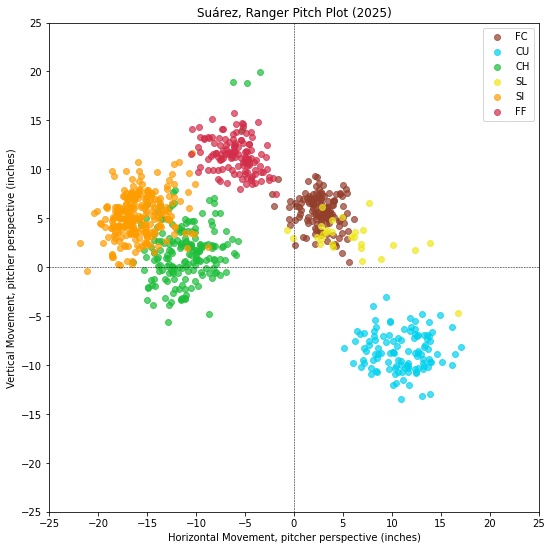
Between Nick Martinez, Spencer Schwellenbach, and Max Fried, these sorts of pitchers have been a fascination of mine. But Suárez is also a bit different. Unlike Schwellenbach and Fried, Suárez is working with below-average velocity. And unlike Martinez, he lacks a carry fastball to throw at the top of the zone. To succeed, he must work the outer edges and the shadow zone below the knees. At the moment, he’s walking that tightrope with precision.
The bedrock of Suàrez’s approach is the interplay of his sinker and cutter. Because he tortures lefty hitters, opponents tend to stack their lineups with righties, as the Astros did on Tuesday — he’s only faced 31 left-handed hitters the entire season.
Opposite-handed sinkers are generally considered suboptimal, but Suárez is staying off barrels with that pitch while racking up a ton of called strikes. That owes to his primary target being on the outer edge; he concentrates a plurality of his sinkers on the low-outside corner, far from where anyone could conceivably punish the pitch:
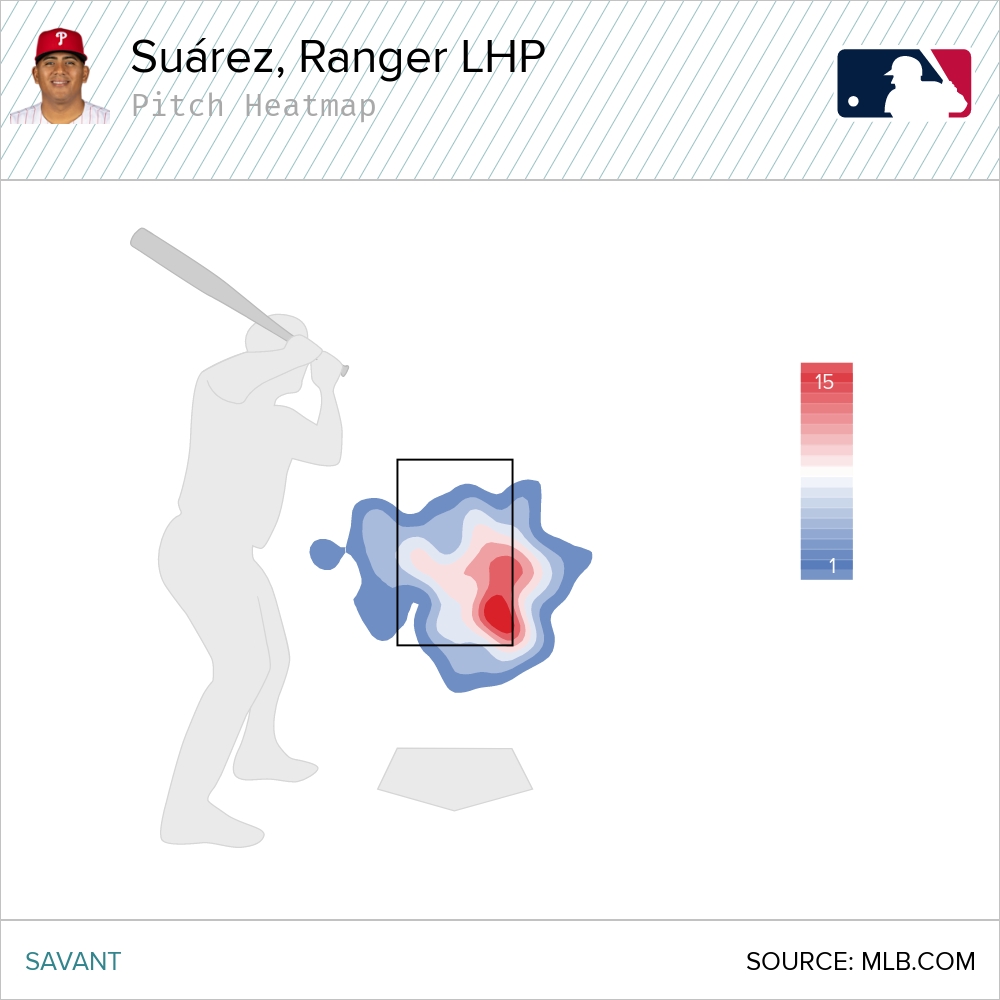
Primed with the expectation of these wide sinkers, Suárez busts the cutter inside with extreme effectiveness. These pitches tunnel very effectively together, traveling along the same trajectory before splitting off in separate directions. When Suárez manages to get the pitch in on the hands of a right-handed hitter, they’re essentially helpless — among pitchers with at least 100 cutters thrown this season, Suárez ranks first overall in exit velocity allowed. It’s a weak contact machine:
These two pitches allow Suárez to get ahead in early counts and generate weak contact when he falls behind. But when he gains an edge, he pivots to his two out pitches.
The curveball is eye-catching, drooping into the strike zone at 74 mph with two-plane movement. There’s nothing else in Suárez’s profile that moves remotely like this, and it can catch hitters off guard, though the pitch hasn’t been quite as successful this season as it’s been in past years. Even with questionable effectiveness in a vacuum, the pitch enhances his overall arsenal. (More on this later.) The curveball moves 17 mph slower and drops 14 inches more than the sinker, making it trickier for hitters to lock in on a particular movement pattern.
But it’s the changeup that has emerged as Suárez’s best pitch. He’s throwing it more than ever this season, and the increase in usage has coincided with a subtle shape change. As recently as three years ago, Suárez’s changeup moved exactly like his sinker, with a seven tick gap between the two pitches. These days, the velo differential is more like 10 mph, and the pitch is now cutting relative to the sinker.
This sort of sinker-changeup movement relationship is pretty uncommon. I looked at every pitcher with at least 100 sinkers and 100 changeups thrown, and noted the gap between the horizontal movement of each pitch. Suárez gets nearly five inches of “cut” relative to his sinker, fourth-most among all pitchers in baseball. A couple of those are kick changes, thrown with significant depth relative to the sinker. Suárez’s changeup, by comparison, gets the same amount of drop as the sinker:
| Pitcher | Changeup Cut (inches) |
|---|---|
| Logan Webb | 7.5 |
| Cade Povich | 7.4 |
| Jack Kochanowicz | 6.6 |
| Logan Allen | 4.9 |
| Ranger Suárez | 4.8 |
| Kyle Hendricks | 3.9 |
| Charlie Morton | 3.8 |
| Aaron Nola | 2.7 |
| Mike Vasil | 2.5 |
| Emerson Hancock | 2.4 |
The result? Some really ugly swings. Nobody is squaring this pitch up. Hitters are whiffing 35.9% of the time and managing just a .245 xwOBA on contact.
Like Martinez, Schwellenbach, and Fried, Suárez is more than the sum of his parts. All of these pitches in tandem — the four aforementioned offerings, plus an occasional four-seamer — produce an absolutely chaotic look for hitters, as this plot from Stephen Sutton-Brown of Baseball Prospectus shows:
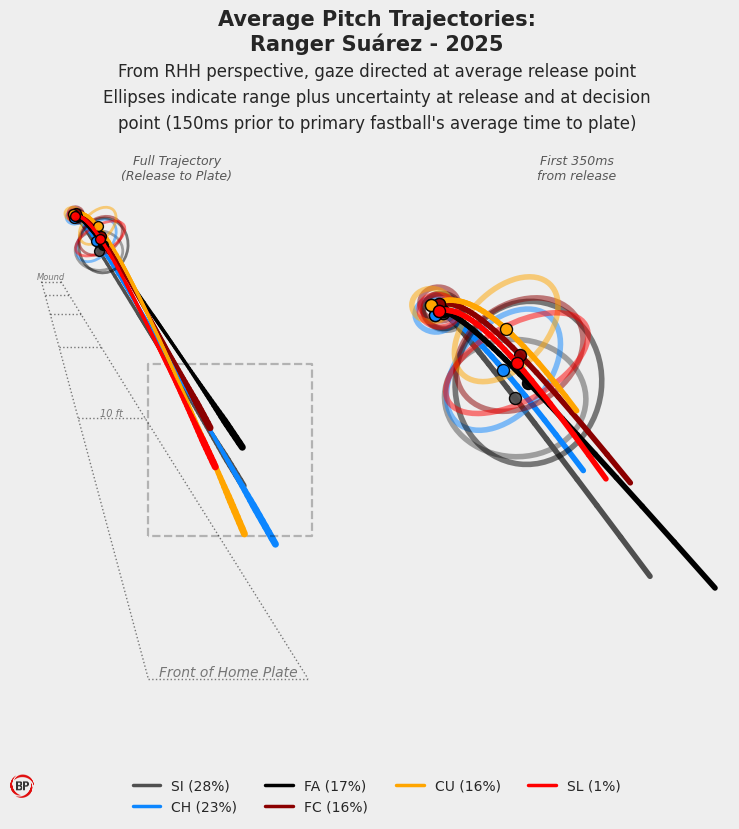
Because Suárez throws so many pitches moving on similar trajectories with roughly equal frequency, hitters have no choice but to guess. As the plot below shows, Suárez ranks as one of the best tunnelers in the league by Stephen’s arsenal metrics:
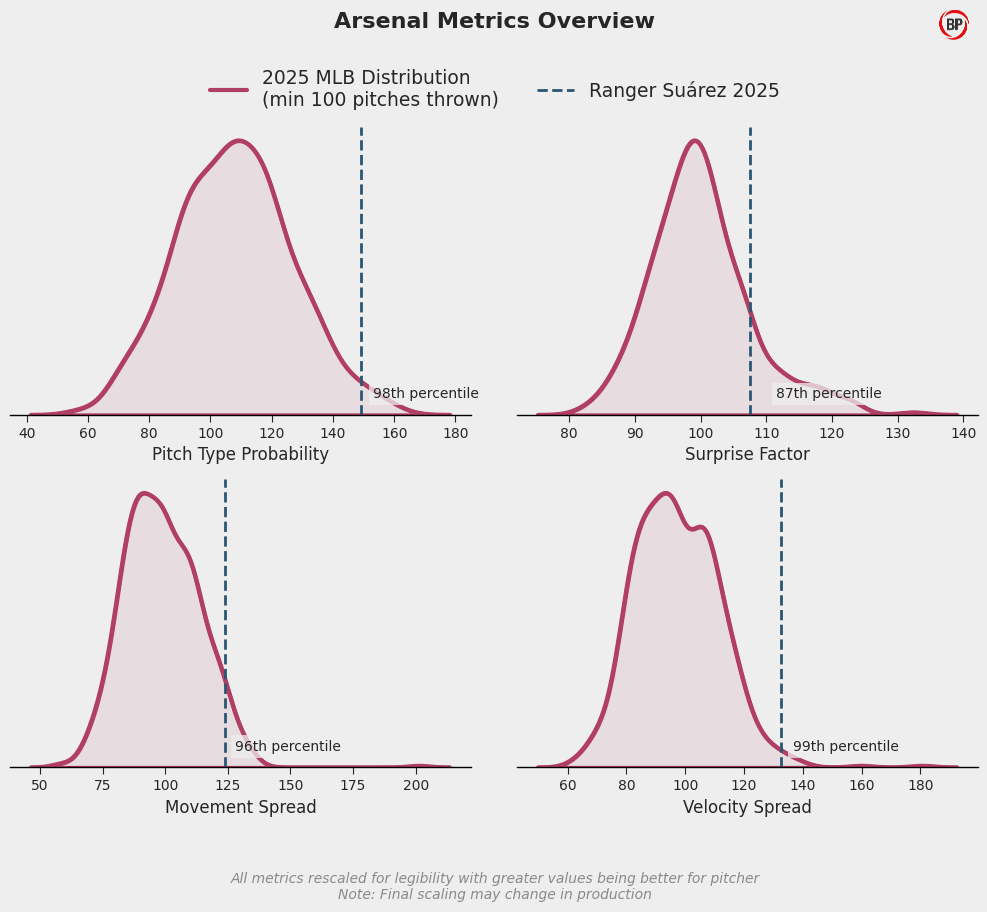
He ties it all together with pinpoint command. Perhaps that’s clear from the location plots, but the models are here to support that narrative. Suárez’s Location+ numbers this season are off the charts, ranking second among all pitchers with at least 50 innings pitched. BotCMD concurs, giving him a 61 command grade on the 20-80 scale.
It may only matter on the margins, but Suárez also fields his position with more panache than any pitcher, save for maybe Brusdar Graterol. Look at how casually he scoops up this Agustín Ramírez grounder even after initially booting it:
He’s never worried!
The Phillies booth could only laugh after this one:
If you could lock in Suárez’s performance from the last year and a half — a 3.05 ERA and 3.21 FIP — over the length of his next four seasons, he’d easily merit a nine-figure free agent deal. Will teams have enough faith in this deep mix/command profile to make that big bet? It’s a scary proposition. I felt pretty confident Nick Martinez could repeat his 2024 performance but, so far, it hasn’t been pretty. Martinez is running a 4.40 FIP. What’s to stop Suárez’s performance from backing up like Martinez’s did? And what happens if his sinker velo dips from 91 mph to 90 mph, or even 89 mph?
It’s hard to say. But when Suárez is one of these runs, it’s hard not to get swept up in what could be.
Michael Rosen is a transportation researcher and the author of pitchplots.substack.com. He can be found on Twitter at @bymichaelrosen.
Suarez is good, playoff-caliber pitcher and there are only so many of those. So I would pay a fair amount for him, but more like a 3+ win starter than whatever he is doing now. This run he is on is due to homer prevention below his career norms and I wouldn’t bet on that continuing.
I think he probably is the #3 pitcher in this class behind Cease and Valdez, but I would put Valdez in the same bucket as Suarez and not Cease. I am a huge Framber Valdez fan and Dylan Cease is having a rough year but Cease is a better bet going forward because of the K’s.
I thought Michael King might have had an argument to be #1 but with the injury there are some questions coming back about his durability. Senga and Merrill Kelly are the other two who I would pay for.
The Ranger we’re seeing now isn’t far off the Ranger we saw last year before he went on the IL with a hurt back. The HR rate was higher last year @ 10.6% vs the current 6.7% but the K-BB of 18.5 was actually even better than his current 16.5. He’s never crossed the 155 IP mark though.
Cease drives me nuts. His LOB rate has been low for 3 years because his command from the stretch is poor. I’d have him work from the stretch exclusively this offseason to get his front side dialed in. Dude looks nearly unhittable from the windup and then looks like a slightly below average pitcher from the stretch.
Can’t pay full price for King given the current injury issues.
I think Senga can’t opt out because of the ip he’s missed last and this year?
Whoops, I guess he is not available!
Senga can’t opt out because he didn’t reach the inning requirement to be able to do it.
This is my favorite Phillie and it’s going to kill me if he’s in another uniform next year. I went to a random IronPigs game way back when (I’m an Allentown native and got seats right behind home plate) and fell in love with him. Poise, perfect balance/ repeatability, great command.
Don’t undersell the defense either (not that you did, but don’t). Against the Astros, he made three outs that very few other pitchers would have gotten: a lineout double play, and another lineout. He got 22 outs where another pitcher might have gotten 19. He’s so dependable up the middle that you can shift your middle infielders toward the 5.5 and 3.5 holes. Plus he works fast and works to weak contact, which keeps everybody engaged.
He’ll always have command and there’s no reason he can’t pitch another ten years, a la Jaime Moyer, Livan Hernandez. I’d sign him in the heartbeat.
Todays market,4yr,24m per,opt out after 1yr.
I enjoyed this piece. The skepticism at the beginning of the article is the consensus in the fantasy baseball world; Suarez has essentially been free in all my fantasy baseball drafts since his debut. However, we’re almost 700 innings into his career and his 3.29 ERA isn’t far from the estimators, suggesting that there is more to pitching than what most analysts focus on: whiffs, stuff and CSW. Glad to see the breakdown that explains why Suarez has been able to keep runs off the board despite the lack of respect he gets from the sabermetric people.
For this I usually like using xERA for to identify pitchers that induce soft contact, because it’s defence-independent (important for someone like Suarez who plays in front of a questionable defense). But I think xERA structurally underestimates ground ball pitchers. Framber Valdez, Ranger Suarez, Max Fried, and Paul Skenes don’t have a ton in common except they induce a ton of ground balls and they have a habit of beating their xERA, sometimes by quite a bit.
The ingredients of a good pitcher are (1) striking out a lot of batters, (2) not walking batters, (3) making the batter put the ball into the dirt. I would argue it’s roughly in that order, but you could switch them around a bit if you wanted. And it’s extremely difficult to make a living doing consistently doing the other things that lead to good outcomes (e.g., making the batter hit a popup, inducing soft contact, etc). I mean, Marco Estrada was probably the best guy in the league at getting popups for a couple of years and it was good until it wasn’t.
Over full seasons Framber is really the only one of that group that crushes his xERA.
Who also has the highest ground ball rate! By a lot!
A bit of an exaggeration, but in terms of style, is Ranger this generation’s Maddux? He was certainly worth it.
You definitely already know the answer to that. Every generation has a bunch of crafty lefties, some of whom are very good, but the absolute ceiling for all of them is “this generation’s Mark Buehrle” and even the good ones are usually in the ballpark of “this generation’s Jaime Garcia.”
*Note: This the “crafty lefty” is a subset of lefties that are crafty, since the “crafty lefty” implies middling velocity or stuff, a la Dallas Keuchel (or Jaime Garcia). It does not include someone like David Price or Clayton Kershaw, who in addition to being crafty also has excellent stuff.
Buehrle(who would get my vote for HOF) was an insanely good fielder and was probably the best all time at controlling the running game. He also had stuff good enough to throw both a no-no and a perfecto. Buehrle gave you 200 innings every year and was just consistently darn good. It’s a very high bar for any crafty lefty to meet.
Not every generation has a Maddux, and most have not deserved one.
Comparison to Nick Martinez feels very strange given that 2024 was the first season he recorded 2+ WAR and he was 33 years old.
Since 2021, Ranger Suarez is 10th by ra9-war, and 19th by fwar.
That is a pretty long track record as pitchers go nowadays.
Interestingly, Suarez never pitched enough in a season to qualify for ERA title, yet is 43rd in innings pitched during the last 4 1/2 seasons. (He converted from a reliever to a starter in August of 2021)
Which brings me to the hill I’m willing to die on: MLB really needs to figure out a way to either incentivize starting pitchers to go deeper relax the qualifying innings threshold.
Can’t incentive what you can’t prevent — arm injuries. I think the big breakthrough will have to occur in the sports medicine/biomechanical sphere for pitchers to become more durable.
Qualifying innings threshold is definitely too high in my opinion. It’s not realistic.
Ranger Suarez is very good. I’d say he’s the Chooch of pitchers. Pay that man his money!
Reminds me of Hyun-jin Ryu. Only with no real history of arm injuries. Disrupts timing, locates exceptionally, fields extremely well. And a lot of fun to watch. A true pitcher in an era of max effort guys.
This is a great comp. Wish I could upvote it 10 times.
Great article. Thanks !
Maybe the stats are not picking it up, but Ranger’s pitches seem to have really great movement. I don’t know which ones, I just know this from watching him a few times on TV.