
How to Neutralize a Rookie Sensation
Yordan Alvarez is the favorite to win the AL Rookie of the Year Award. He completely demolished opposing pitching this year, first in Triple-A (170 wRC+), then in the majors (178 wRC+) after being called up in early June. Between the two levels, he launched 50 home runs while showing elite plate discipline. But this October, he’s been a non-factor for the Astros.
He showed some life against the Rays, going 6-for-19 with three doubles in that five game series. But against the Yankees, he’s been completely shut down. He collected his first hit of the Championship Series last night, a broken bat single off Chad Green. He’s reached base just three other times against Yankees pitching, drawing two walks and reaching on an error. Overall, he’s slashing just .206/.270/.294 in nine postseason games.
What’s even more concerning is his elevated strikeout rate. He struck out just over a quarter of the time he came to the plate during the regular season. That’s jumped up to 37.8% in the postseason. During the regular season, Alvarez never had a nine-game stretch as poor as this one.
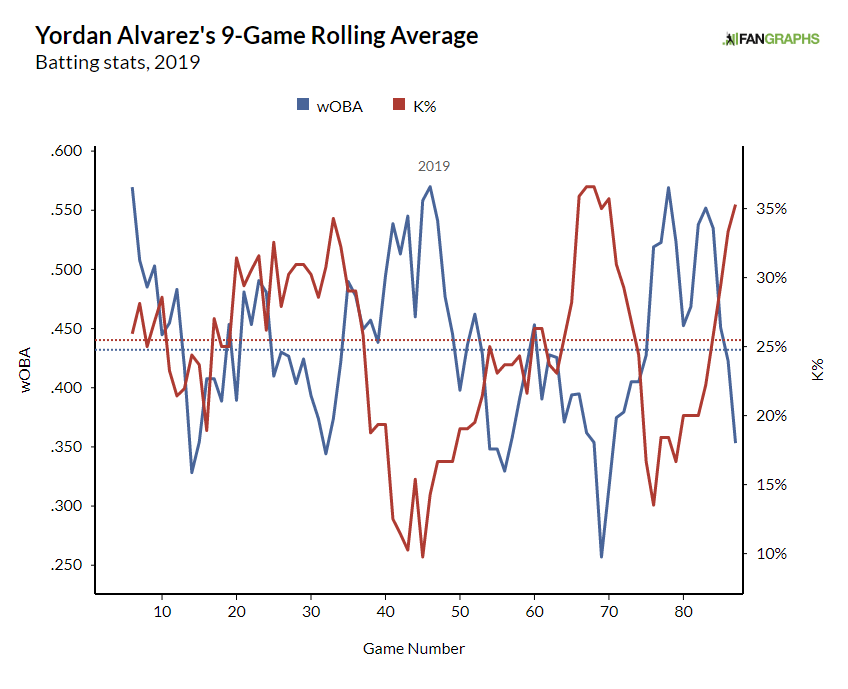
There was a nine-game stretch ending on September 6 during which he posted a strikeout rate of 36.6%. But he also launched three home runs over that span, something he hasn’t been able to do during the postseason. Obviously small sample caveats apply here, but it appears as though both the Rays and the Yankees have found similar approaches to neutralizing the 22-year-old rookie.
During the regular season, Alvarez saw a fastball 58.8% of the time, no matter the pitcher’s handedness. He posted an excellent .454 wOBA off all types of fastballs but that’s dropped to .174 in October. The pitch quality he’s facing in the playoffs is certainly higher — the average fastball velocity he’s seen in the postseason is three miles per hour faster than in the regular season — but he was able to handle hard fastballs just fine before. He had a .379 wOBA against fastballs thrown harder than 95 mph in the regular season.
He’s also seen an increase in the number of fastballs thrown against him, up to 64.8% in the postseason. And it looks like both the Rays and Yankees have a common approach with their heaters.
In the GIF above, Luis Severino busts Alvarez up and in with a 95 mph fastball. Alvarez can’t get his powerful arms extended and pops up harmlessly to left. In a September article examining his outstanding year, Ben Clemens wrote about Alvarez’s ability to pull the ball with power:
“Here’s a random, tossed-off statistic for you. When Alvarez pulls the ball in the air, he bats .868 with a 2.421 slugging percentage. … Your mind will logically go to small sample sizes and regression here, and that’s not unreasonable. Consider this, though: Alvarez’s xwOBA is a robust .963 on these balls, second only to Joey Gallo. He hits them, on average, 100.3 mph, good for sixth in the league. He’s barreling up nearly half of them, 43.2%. In other words, Alvarez might be getting marginally lucky when he pulls the ball in the air, but for the most part he’s hitting the ball too hard to need luck.”
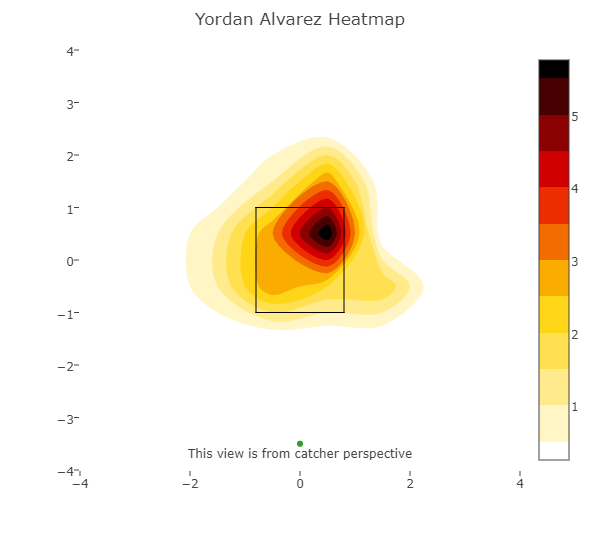
Most of those pulled fly balls and line drives during the regular season came off pitches in the middle of the plate or down and in where he can drop the barrel of his bat or get his arms extended. By pitching him up and in, the Rays and Yankees have prevented Alvarez from taking advantage of his greatest strength. He’s only pulled four batted balls in the air during the playoffs, three line drives and a lazy fly ball.
Along with struggling to catch up with the heat, he’s seen plenty of left-handed pitchers during the playoffs. Of the 20 (!) different pitchers he’s faced in the postseason, nine of them have held the platoon advantage. But he never really showed much of a platoon split during the regular season — a .422 wOBA against lefties vs. a .437 wOBA against righties. He’s been abysmal against left-handers in October, going 2-for-12 against them with 8 strikeouts. They’re pairing their fastballs up and in with breaking balls low and away and he’s flailing away at them.
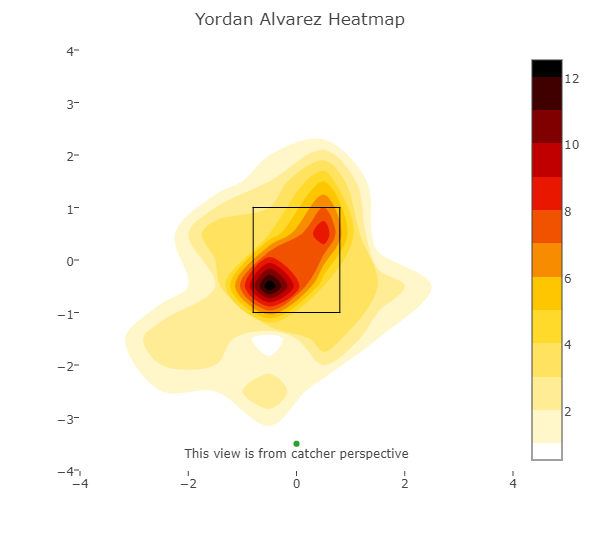
His overall whiff rate is up eight points in the postseason, from 38.5% to 46.4%. He isn’t seeing a huge increase in the number of breaking balls from left-handers, but he simply isn’t making contact when he does get a bendy pitch. His swinging strike rate against breaking balls has increased from 15.6% in the regular season to 23.7% in the playoffs.
Alvarez’s struggles have forced Astros manager A.J. Hinch to move him down a spot in the lineup, from fifth to sixth. With James Paxton on the mound for the Yankees tonight, he’ll probably see more of the same: hard fastballs up and in, breaking balls low and away. Slumping in the postseason is never ideal and it’ll be challenging to break out of it tonight. But the Astros will continue to put their rookie sensation out there, hoping he’ll start showing off his massive power sooner rather than next year.
Jake Mailhot is a contributor to FanGraphs. A long-suffering Mariners fan, he also writes about them for Lookout Landing. Follow him on BlueSky @jakemailhot.
Interesting — and challenging — that the first time in his MLB career that Alvarez is forced to make adjustments is in such a high pressure situation. It gets no easier against the Nationals.
Success didn’t always come easy in the minors for him. He always bounced right back, so i think that is a positive indicator.
Interesting. This kind of reminds of when Mike Trout was struggling on fastballs up and in a couple (a few?) years ago and teams went all in on that. Then he totally just started mashing those, too, cause he’s Trout. Will be interested to see how well Yordan adjusts.
A narrative of adjustment is one way to describe it. The other is that the best players in the game are the best in the game. I feel like “adjustments” are things that parasites profit from as they claim expertise. Player development is what I prefer to call it. Players are different year over year… that’s just the way it is. Maybe they are just better – everyone certainly has a physical peak and a mental one – I think people have a hand-eye peak as well. A few cycles of roids are an adjustment as well.
Isn’t “hard in, soft away” one of the oldest pitching maxims in the book? If it was really that simple to solve Alvarez, wouldn’t someone have figured it out before now?
My guess is that this is some combination of SSS noise, first-playoffs anxiety making him chase pitches he knows aren’t his, and possibly fatigue. I saw somewhere that he has had ~700 PAs this season between the regular season and playoffs, which is almost three times his previous career high.
I’m not disputing the statistical analysis , just not sure what conclusions to draw from it. Thanks, Jake.
I think it’s partly this also. He had 400 PA in 2017, and actually a little less last year. So not three times as many this year, but almost double.
Ding ding ding. I could not agree more. Struggles and breakouts are creative wrinting prompts as well. No disrespect intended Jake – I am just saying that you take a great player and there are predictable articles that will come on both ends of the production. Some are going to attempt to quantify or explain the jump in production (Josh Bell stuff from half 1 2019 lol) and the other half looks like this or playoff Kershaw stuff.
I mean, 95mph+ fastballs up and in work on pretty much everyone, don’t they? Have to give the pitchers a lot of credit for executing so well.
And it’s the playoffs, so no one’s getting any ABs off scrubs here.
It seemed like a lot of the borderline calls have gone against him so far and hurt him a lot in the Yankee series. Sadly for him, I don’t think he’ll get much better luck vs Scherzer & Stras.
I don’t buy that YA isn’t getting himself out. He is just struggling. I watch baseball and I don’t see pitchers executing very often. Take that terribly executed pitch in the GIF from Severino. That is belt high FB on the inner half when he was ahead in the count – YA just missed it, he wasn’t exploited. I would bet you that he isn’t bad against pitches that are belt high. Much of a player’s ability to hit a pitch up comes from the bat angle. A flat bat means you are going to be able to hit pitches up generally and YA checks that box. That looked like a healthy hack to me – throw that 3 times and one will end up in the seats – YouTube will even interupt the game with an ad campaign as it probably goes 450 ft. I have watched that swing ten times now and I think it is a beaut. Timing was on and everything looked great but he missed it by a cm or two at the most. For what it is worth, one of YA’s defining traits as a prospect was that he could crush balls the other way. He isn’t a dead pull hitter even though he is good at it. He is the one guy in that lineup that has prompted pitching changes the most – nobody has had a tougher assignment than him. As a big fan I am not seeing anything to be concerned about this postseason with YA. I certainly don’t think people are getting him out by some elaborate planning. That has not held true through 2 WS games at all. I am obviously cheating here as I have more data than you, but you were right coming in game 6 for sure as that represented his absolute low point – he even got pinch hit for in that game and did look lost. I just found out today that there were articles detailing YAs demise so my timing is weird on this. I just want to point out that I don’t think there is any magic going on, just ebbs and flows of the game. When he doesn’t win the triple crown next year it won’t be because the league figured him out. Hes good. He is one of the few young stars in the game that looks like he wants to improve and he really has a great approach – I can’t say the same for most young stars. Most are busy celebrating how great they are, but I don’t get that impression from YA. He looks like he is trying to get better at hitting as opposed to showing what he can do. Who knows? Maybe once he is a household name that will change because he should be by the end of next year.