
In Appreciation of Blake Snell
Maybe you’ve heard — Blake Snell pitched a nifty five-plus innings two nights ago. The decision to pull him or leave him in has been hashed, rehashed, diced, A-Rod’ed, and generally poked and prodded like a murder victim in an episode of CSI. If you want my opinion on it, I would have kept Snell in, though I don’t think that was in any way the determining factor in the game.
That’s not why I’m writing today, though. Any honest analysis of that decision is going to come down to a minuscule edge. Use one good pitcher, or use another good pitcher? It doesn’t matter much — the players on the field determine the game, not the manager, even if you think the decision was clearly one way or the other. Instead, let’s appreciate not what Blake Snell could have done if he stayed in, but what he did do when he was in the game.
Snell threw 73 pitches on Tuesday night. He generated a whopping 16 swinging strikes, a 21.9% swinging strike rate. That was his second-highest mark of the year, behind a September 29 start against the Blue Jays. That might not sound impressive, but the Dodgers are, well, the Dodgers. No other starter this year topped a 20% swinging strike rate against them; they simply aren’t the kind of team that swings and misses.
Against Snell, they were. He did it with every pitch. His fastball was explosive, avoiding bat after bat in the zone:
The Dodgers swung at 15 of Snell’s fastballs and came up empty on eight. One other pitcher all year, regular season and postseason combined, enticed 15 or more swings at fastballs and got a higher whiff rate — Julio Urías in Game 4 of the World Series, believe it or not.
Snell’s curveball and slider also baffled the Los Angeles lineup. The raw numbers aren’t quite the outliers that his fastball created, because breaking pitches induce more whiffs, but they were still overpowering: four whiffs on his slider and three on his fastball, good for 26.7% and 20% swinging strike rates, respectively. You want a visual? You probably want a visual. Here’s the slider turning Cody Bellinger into a pile of jelly:
Gross, right? That’s what happens when you have to think about the soul-stealing fastball, and it’s not as though picking up on a curveball is easy either:
The Dodgers were simply overmatched on their swings. Bellinger looked roughly the same whether he was swinging at a Snell heater or a bee:
If that’s all there was to say about Snell’s start, it would be impressive. On the biggest possible stage, against a fearsome opponent, Snell was as unhittable as anyone had been all year. That undersells his sheer dominance, though. Called strikes help a pitcher’s cause just as much as whiffs, and Snell excelled there as well. When he wasn’t blowing the Dodgers away, he was freezing them in place on his way to 13 called strikes. That 18% called strike rate would have been his fifth-best of the year.
You’ve already seen the whiffs, but the called strikes showed a precision Snell has rarely achieved in his major league career. He dotted the corners, hitting the edges of the zone when he needed a strike. He was particularly lethal on the outside corner to righties, where he caught them looking seven times. Four of those came on his changeup, which he located exactly where he wanted it: on the outside part of the plate and away, where they could either live with the umpire’s call or take a feeble swing:
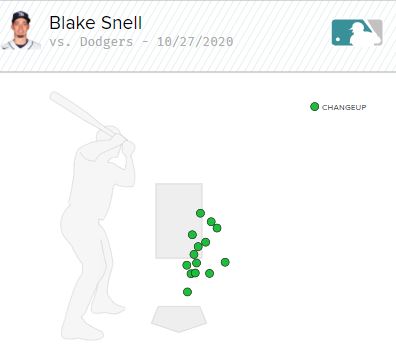
Combine the called and swinging strikes, and you get a statistic called CSW%. Snell checked in at 40% Tuesday night — in other words, 40% of his pitches he threw ended up as strikes. Not fouls, which can differ in type from the 400 foot just-missed-it blast to a jam shot down the third base line, but strikes — pure, unfiltered strikes.
As you can probably guess from my extended and breathless description, 40% is excellent. It’s Snell’s best mark of the season, for one. It’s in the top 2% of all starts this year; the best mark was Lucas Giolito’s 47.5% in his August 25 no-hitter. It’s also the best mark against the Dodgers all year, narrowly ahead of Zac Gallen’s July 31 gem.
Whiffs and called strikes aren’t all there is in baseball. Sometimes, despite your best efforts as a pitcher, the other team hits the ball. Snell faced 18 batters and struck nine out, which means he allowed nine balls in play.
Of those nine, one was hit more than 95 mph, the “hard-hit” cutoff. Chris Taylor laced a line drive into left at 105.4 mph, a clean single that was one of the two hits the Dodgers managed all night. The others were some mixture of medium-hit line drives and truly poor contact. The only other hit against Snell was this Austin Barnes single in the sixth, another clean single that came nowhere near threatening extra bases:
Two singles is a meager offensive output, but it’s pretty much all the Dodgers deserved. They couldn’t do anything with Snell’s pitches; Mookie Betts, one of the great contact hitters of our era, managed a single foul ball when he offered at Snell’s pitches. His other three swings got only air.
To be clear, none of this means that Snell was going to keep up this level of performance the rest of the game. Research employing various methods has found no evidence that a pitcher who cruised the first two times through the order was any better the third time through. There’s some evidence that things might be slightly different in the playoffs, as Tom Tango wrote yesterday, but again, who cares? There’s a world where Snell shoved for another three innings and the Rays won. There’s a world where he got Game 2’ed — he was cruising through four no-hit innings then, but gave up a walk, then a homer, then another walk, then a single, and all of the sudden the game went from over to contested.
Those worlds didn’t happen, and I don’t care about them. I care about this one, where Blake Snell was downright magnificent. For 5.1 tremendous innings, he looked like a man playing a video game on easy mode. The curves were nasty, the fastballs hellacious, and the Dodgers stood a better chance of making contact with an insect than with the baseball. That’s Snell as he was on Tuesday. Anything else is just conjecture.
Ben is a writer at FanGraphs. He can be found on Bluesky @benclemens.
I was just blown away by what he was doing. That stuff looked incredibly nasty.
I question whether Blake Snell is really consistent enough to be that league ace everyone thought he was back in 2018–he was good, but he benefitted a lot from the Rays magical defense back then (and still does). But holy hell did he turn it on for that game. It was just strikeout city. Between that and Kershaw’s gems, there was some really great pitching going on this series.
Yeah you could really believe those teams had top 3 pitching staffs in MLB in that series, and the Rays really did a herculean effort to keep it under control as long as they did. It felt like you could really tell that the Rays offense was the one unit that wasn’t elite – Rays P vs Dodgers O was a real strength vs strength matchup, but Rays O vs Dodgers P was just too unbalanced over the balance of the series.
I’m not sure if this came up in the other article about Snell (I haven’t read it yet), but there was a great twitter analysis I saw that is kind of boggling:
https://twitter.com/ckurcon/status/1321483776141205506
If you dont want to click, the summary is that in starts as similar as possible to Snell’s over the last 4 seasons (at least 9Ks, 2 or less baserunners thru 5) over the last season, which is 202 games by exclusively elite pitchers (Verlander, Scherzer, etc), they allowed a 0.56 ERA through the first 5 innings, and then allowed a 3.86 ERA in exactly the 6th inning. A foible of that kind of outing is that it creates a situation similar to the first inning of a game: The top of the order is guaranteed to bat with a full set of outs to work with, becuase there’s been so few baserunners. Consequently, you get pretty high offense.
It’s kind of boggling to think that it’s a statistical reality in MLB that the greatest pitchers in the game, in no hitter/perfect game type scenarios, are still more likely to allow a run than an elite reliever the 3rd time through the lineup. It’s the kind of thing that seems like it shouldn’t be true, and that we shouldn’t want to be true. But it is.
I am reminded of how everyone was pointing back to the 19 Nats in nostalgia for those long starter outings, but it kind of ignores how the 19 Nats had a bullpen so awful that that was an optimal strategy for them. I’d be interested in analyzing whether it’s possible that moving all series to the model used this year – the no-offdays setup – would actually help, because it taxed the bullpens so deeply between the lack of rest and the forced use of weaker starting pitchers in some games, that it kind of made getting length from your best pitchers valuable in the LDS and LCS rounds.
In the regular season, you can only operate like the Rays if you have a bullpen like the Rays, and most teams don’t, so they need to ask starters for length sometimes. In the postseason, with offdays, you can avoid that. It’s interesting to think about how much the Rays’ bullpen was taxed by those two earlier series, and to what degree that influenced both Anderson and Fairbanks allowing a good number of runs and baserunners to the Dodgers. How much better would those guys have been with rest days in the previous rounds? I bet the answer is ‘some’.
Didn’t see it in the sources linked, but I would consider pitch count very heavily in this decision. I really have to imagine that K-BB% and pitch count would yield a more intuitive unerstanding of the third-time penalty or mitigation thereof.
The MGL post gets into it in reverse, just not explicitly. Essentially, once you factor in the third time penalty, there isn’t any particular better performance vs the penalty for pitchers who had a low pitch count when compared to pitchers with a high pitch count.
And there’s a follow up tweet on the Connor Kurcon thread in which he says:
—
mean (and median) pitch count after 5 IP = 76 pitches
“Snells” with a lower count = 3.69 ERA
“Snells” with a higher count = 4.12 ERA
so not a huge difference?
—
But I actually don’t think this is evidence in favor of removing Snell, if you think it’s accurately capturing the state of things. If you give Snell the mean 6th inning ERA (3.86), that measures out to 0.43 runs given up *in the 6th inning* on average.
Now, he’s facing the top of the order with a man on. Not good. But he already has an out. Good. And the previous two hitters did not hit the ball with any authority. Also good. But he wasn’t getting strikes anymore. Not good. And of course it’s a better lineup than the average “Snell” lineup from over the course of the last four seasons. More not good.
So it’s a mixed bag of supporting circumstances.
But the point is he needed to get two outs, which means the runs he’d be expected to give up is closer to 0.3 than 0.43 (edges a bit higher because there’s a man on). If he pitched exactly as expected, he would on average come out of the inning with a lead twice as often as not. (More than twice as often, really, since he can’t give up less than 0 runs, but he can give up more than 1; so there will be disproportionately more instances of 0 runs than of 1+ runs to arrive at the 0.43 average per 6th inning.)
And, as has been repeated so much by this point, what you’re comparing him to is not his own earlier performance (which as this piece details was amazing); what you’re comparing him to is what to expect from the bullpen. If the Rays’ bullpen was necessarily going to start with Anderson—who over the last two rounds had been just plain awful, no other way to put it—then Snell is a better bet. Anderson gave up about a run per inning over the last two rounds. That’s a painfully small sample size, so you can’t extrapolate too cleanly there. But I think there’s good reason to think Snell at about 0.3 or whatever is going to be better than Anderson, who’s probably worth somewhere between 0.2 and 1 run per inning, based on a mix of his regular season and playoff performance.
* * *
But on some level all that is beside the point. Until he was removed, Snell was as good as I’ve ever seen a pitcher be in the World Series. Just spectacular work.
Hey you also broke this out, I just used it in my own reply!
I think this is a really good analysis, and what’s really kind of troubling about it is that one of the lessons is that the most elite pitchers in MLB, when they’re throwing borderline no-hit/perfect game type scenarios, are still more likely to allow a run on the 3rd time through than an elite reliever. That’s not a reality we really want to accept, and its probably not one that’s a net good for baseball. In the regular season, few teams can operate like that, but in the postseason the options are much more available for most teams.
IMO, the key to Snell’s performance was the lack of walks. That has been one of his bugaboos. I would have been more concerned if he had walked Barnes vs giving up a single. That would have been a red flag for me. Using that bit of data trumps the other analytics as to whether or not I would have taken him out. Then again, I stayed at a Holiday Inn Express. 🙂
It is significant that Snell’s velocity was dipping rapidly: his last 10 fastballs had gone from 98MPH to 94 on the ball that resulted in the single to Barnes.
That’s a pretty big decline, and a significant reason to think that he’s going to have a harder time maintaining his dominating performance when he no longer has the pitches he’d had earlier.
In the 4th Seagar was the first to face Snell. Snell threw him three 95 mph fastballs. He then dialed it up to 96-97 the rest of the 4th. In the 5th he was 95-97. No doubt he lost a little off his FB, who doesn’t after throwing 60+ pitches. Quite often a pitcher will need more than the normal allotment of warm up pitches between innings to ramp up his speed as the game progresses. Had he thrown more FBs at 94 or lower I’d be in total agreement with you, but we’ll never know if he was gassed. I’ll go with my eyes and he was still dealing.
I guess all of the comments from Dodger hitters after the game who were relieved they didn’t have to face him again meant nothing.
I think a thing to consider is that the psychology can be misleading. I have no doubt the Dodger hitters felt better in that situation, just like the Nats hitters felt better last year.
There’s not actually a guarantee that that comfort translates to performance. Or, for that matter, that they wouldn’t have also found success against Snell. That’s exactly what happened in Game 2, except Snell had a couple extra walks: he allowed no hits, struck out 9, through the first 18 batters, and then gave up 2 walks, a single and a home run to batters 19-22. I don’t imagine the Dodger hitters felt good about facing Snell that time, either, but they were successful anyway.
And fwiw what you said is not true; there’s no trend of guys starting slower and gaining velocity in later innings. By and large, they just lose the velocity as they fatigue.
I think the only guy I remember who started at lower FB velo and increased as the game went on is a younger Verlander.
Agree with your last comment. I guess I wasn’t clear in what I was trying to say. I was referring to pitchers getting in their warm-up pitches before they start an inning. They are not throwing quite game speed when they warm up. It’s possible that the first pitch (FB) of the sixth inning he was not quite ramped up. Speculating there but certainly possible. We’ll never know.
All calculations aside, there’s something downright rude about pulling someone performing at that level. Like standing up and blowing a vuvuzela during a concerto.
Right. If the starter doesn’t go deeper into the game, does it really matter how great they performed early on? If the starter can’t go 7 or 8 when they are pitching great, there is an issue.
I mean yes because 5 scoreless innings is very, very valuable when you are in an elimination game.
The problem with the Snell situation is that it’s almost certainly factually true that an elite reliever (and Anderson is an elite reliever, though he did not seem right in the playoffs and I am surprised the Rays still viewed him that way) really is less likely to allow a run than a dominant starter the 3rd time through the lineup. The benefit to the hitter is large. And that is really bad for a lot of aesthetic and general entertainment from baseball reasons, and consequently it should lead us to look for ways to make it prohibitively difficult to do that sort of thing consistently, such as setting up the playoffs to be too demanding in terms of scheduling and with too few relievers available for a team to not value getting extra length out of it’s starters. A no-offdays format like this with only 13 pitchers, for example, would really start to create situations where having your ace go extra IP is extremely valuable because your bullpen just can’t absorb that many innings effectively.
Isn’t how dominant this start was a little overstated by comparing it to regular season performances? In the regular season, Snell at that low pitch count and with that success, wouldn’t have been pulled from the game. Other pitchers who pitched as well as Snell might have been left in and then not maintained that level of excellence. So other great pitching performances this year would also include at bats during the third time through the order. I’d be interested in how dominant this performance was compared to everyone else’s first 18 at bats.
Fwiw, in the analysis of starts similar to Snells, about 10% of the pitchers didn’t come out for the 6th inning (21 of 202). Further, Snell -never- pitches deep into games: he hasn’t completed the 6th inning since the middle of the summer of 2019. The Rays rarely let him pitch past 18 batters, and when they do it is in situations like WS Game 2, where they have a substantial lead (and they don’t let him go much further: he only faced more than 21 batters twice this season).
This is the Rays MO: they do do it in the regular season. It’s not a playoff thing, and it’s not even a Snell thing – they did the exact same thing to Morton, who threw only 66 pitches over 6 IP in ALCS Game 7 and was removed anyway. This is just how they operate in close games, because the math does favor it, even in the most extreme great performances.
As you can see in one of the replies above, there was an analysis done of starts as similar as possible to Snell’s. They took starts where, through 5 IP, the pitcher had allowed no more than 1 run, struck out 9, and walked 1 or less batters. They found 202 games over the last 4 years, all started by elite pitchers (many better than Snell, like Verlander and Scherzer). In aggregate, the pitchers in those starts had a 0.62 ERA in the first 5 innings.
They allowed a 3.86 ERA in the 6th inning. That’s not just worse than they had been performing, but considering the names of the pitchers involved (Verlander, deGrom, Cole, Kershaw, Buehler, Bauer, etc), it’s significantly worse than their full season lines as well. “Dealing” is just not predictive, as much as we feel like it should be when we’re watching a game. The times-through-the-order advantage at the 3rd time is just very, very large, and it’s not based on anything with the pitcher. It’s not a fatigue thing or anything like that, it is a batter familiarity thing, picking up the ball better, understanding how the pitches are moving today, etc.
Now, it’s a real problem in some degree that this IS a statistical reality. It means that a guy with no-hit stuff through 5 is still like, very likely to allow runs on the 3rd time through the order (that’s why so many no hit bids are lost in the 7th or 8th, since that’s the 3rd time through the heart of the order in a nohitter, depending on how many walks were issued). I don’t think we like the idea of baseball working that way. But it DOES work that way, so if we want to incentivize teams to leave starters in longer, we need to find a way to make the rules incentivize that. The easiest is probably limiting the number of relievers on a roster, as that would create an additional benefit to SP length eating innings in the way that we normally associate it. Modern teams have so many arms and exchange so many guys on the back end of their roster that they have no real challenges keeping their pen relatively rested without having starters going 6 or 7 innings, but if we cut down on the number of pitchers available we’d make those extra starter innings more valuable even if the starter’s performance level is going to degrade.
Huzzah!