
Inside Pete Alonso There Are Two Swings
It’s never fun being the subject of a story that people call a saga. So when the Pete Alonso free agency saga transpired over the winter, I wondered whether he’d get off to a sluggish start as a result. Signing for less money than your agent told you you’d make, later than you expected to sign, and with a team offering you a smaller contract than they had the year before? It’s enough to make spring training a bit less of a ramp-up period and a bit more of a time for taking out frustration. If Alonso had started slow this season, I wouldn’t have raised an eyebrow.
Turns out, Pete Alonso isn’t like me. Instead of sulking a little and coasting into the regular season, he’s come out like a man possessed. Through Tuesday’s action (17 games), he’s hitting an outrageous .356/.466/.729, the kind of batting line that doesn’t really make any sense and doesn’t need to. Suffice it to say, he’s not going to stay this hot unless he’s secretly Lou Gehrig, a development that would raise more questions than it answered. So we don’t need to ask whether this form is real – we can instead focus on what Alonso is doing the same and differently, and then go from there.
What is Alonso best at? That’s right, hitting the ball in the air with authority. That’s always been his calling card and it’s no different this year. Want a simple way of stating that? He leads the majors with 13 barrels, one ahead of Aaron Judge. That’s the kind of power you’d expect from a first baseman who averages 38 homers per 600 plate appearances (2020 makes “per year” stats pretty annoying). Even last season, Alonso’s worst in the bigs, he finished 13th in the majors in barrels. He plays a lot and he hits the ball very hard; those are things we’ve always known about Alonso.
So from one perspective, the most important thing about Alonso’s hot start is that he’s doing the thing he does best as well as he ever has. This power barrage is hardly unprecedented. His 23.8% HR/FB ratio this year is barely higher than his career mark of 22.1%. And truly, watching Alonso hit the ball, you’d be hard-pressed to see any difference. Here he is detonating a hittable fastball:
That highlight could be from any of the past seven years. It’s just what he does. Only Judge and Kyle Schwarber have cranked more home runs against fastballs since Alonso debuted, and only Judge has more homers overall. As far as I’m concerned, the most interesting thing about Alonso’s power spree is that it doesn’t represent a new level at all. That’s good news nonetheless, because he signed for less than expected this winter in part due to fears that he’d no longer be able to reach those heights. But this power spike is right in line with what he’s done all along:
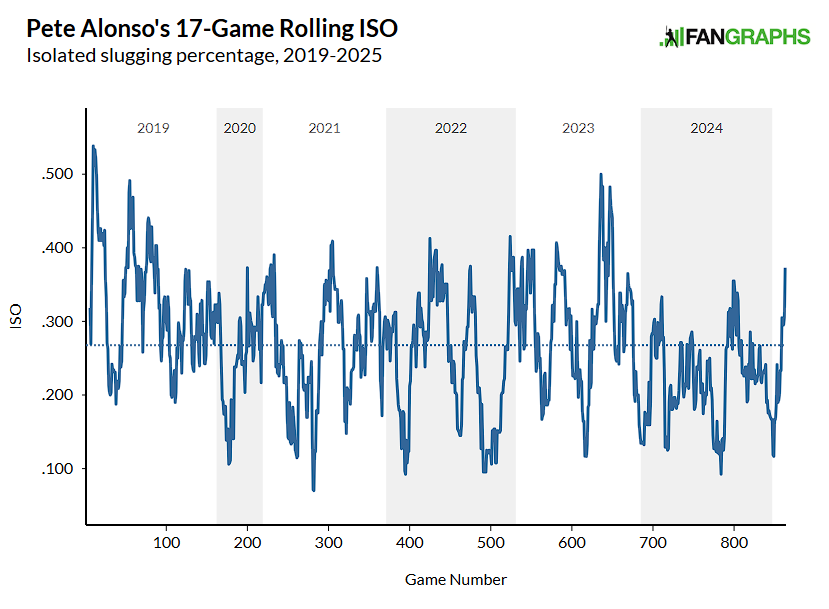
Alonso has actually had power binges meaningfully hotter than his current form, and that current form is “lead the major leagues in barrels for a three-week stretch.” Do not question his ability to mash. It’s intrinsic, like Luis Arraez’s contact skills or Juan Soto’s batting eye. The rest of his game is where Alonso has historically either sank or swam. When he’s striking out too much and hitting pop ups instead of line drives, he’s only okay. When he’s taking walks and keeping his batted balls at dangerous launch angles, he’s unstoppable. And so despite that unremarkable (for Alonso) isolated power, his 2025 start is among the best 17-game stretches of his career when it comes to overall offensive production:
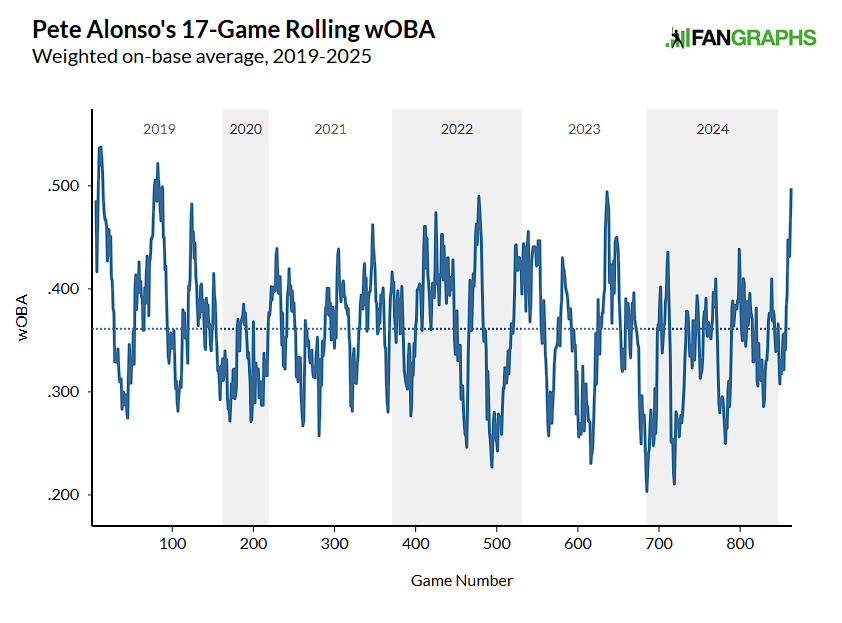
That’s the story here. Alonso goes on baseball-crushing sprees all the time, but he rarely combines them with excellence in the rest of his offensive profile the way he has to start this season. The simple reason for that? He’s walking more (15.1%) than he’s striking out (13.7%), a remarkable change for a player who came into the season with a career 9.9% walk rate and 22.8% strikeout rate.
To some extent, the underlying numbers suggest that this is real. Early in his career, Alonso had a swing-first approach. From 2019 through 2022, he swung at 49% of the pitches he saw. In the past two seasons, he dialed it back, down to 42%. That’s an enormous change, down from the 62nd percentile to the 13th. This year, he’s attacking the heart of the plate almost as much as he did at his aggressive peak, but chasing less than he did even in recent years. He’s combined the best of both worlds, in other words.
The change in chase rate is most noticeable with two strikes. Sure, it’s a small sample – 68 pitches outside the zone in two-strike counts – but this is exactly what you like to see:
| Year | Two-Strike Chase% |
|---|---|
| 2019 | 44.9% |
| 2020 | 43.8% |
| 2021 | 43.0% |
| 2022 | 45.0% |
| 2023 | 39.9% |
| 2024 | 39.5% |
| 2025 | 30.9% |
Want to strike out less? Swing at putaway pitches less frequently. And in case you were worried that Alonso has accomplished this trick by simply leaving the bat on his shoulder with two strikes, that’s not the case:
| Year | Zone Swing% |
|---|---|
| 2019 | 87.5% |
| 2020 | 89.4% |
| 2021 | 88.9% |
| 2022 | 89.9% |
| 2023 | 88.2% |
| 2024 | 87.7% |
| 2025 | 88.7% |
Ah, but there is something different about Alonso’s swing behavior this year other than “don’t swing at bad pitches.” Take a look at the distribution of his swing speeds starting in the second half of 2023:
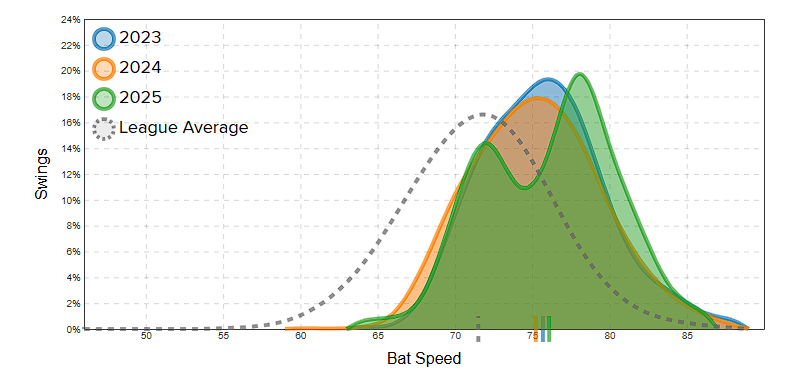
In terms of overall average, Alonso has barely budged from the last two years. He’s averaging 76.1 mph this year, up from 75.7 mph and 75.2 mph in the past two years. But now he has two distinct swings, which you can think of as a homer cut and a contact cut.
Now, you’d expect the slower swings to disproportionately show up in two-strike counts, but that isn’t what’s happened at all:
| Year | <72mph | 72-76 | >76mph |
|---|---|---|---|
| 2023 | 24.9% | 33.9% | 41.3% |
| 2024 | 27.6% | 40.0% | 32.4% |
| 2025 | 24.6% | 16.4% | 59.0% |
Admittedly, I picked the 72 and 76 mph cutoffs based on his swing distribution. But Alonso isn’t giving up on power in two-strike counts. If anything, he’s attacking more when he gets a pitch he thinks he can hit. He’s taking as many defensive swings as ever, though, cutting out the middle of the distribution. Given what we know about the relationship between exit velocity and production, this is a great decision to make. Very hard swings are disproportionately useful, and you’d definitely prefer half defensive swings and half Super Saiyans to having everything in the middle.
Another important distinction: You should take your most aggressive swings at the pitches you’re most likely to drive. That’d be fastballs in the strike zone, basically. Sticking with that 76 mph swing cutoff – Statcast uses 75 mph league-wide, but I’m looking for fast swings for Alonso in particular – you can see that he’s doing exactly that:
| Year | FB Fast Swing% |
|---|---|
| 2023 | 23.8% |
| 2024 | 42.8% |
| 2025 | 61.7% |
It’s almost like there are two Alonsos now. Sometimes, he grips it and rips it. When he does, he’s barreling the ball up 28.1% of the time that he makes contact. These fast swings are absolutely lethal, and they always have been; the only difference this year is that he’s taking them more often and whiffing less frequently. On the other hand, his slow swing is for when he’s fooled or otherwise trying to stay alive. It doesn’t perform particularly well, and you wouldn’t expect it to. But you can think of it as “emergency hacks” – sure, you don’t want to take one of these swings, but the alternative is worse.
With the caveat that this is all still early in the season, you can see the results in his putaway percentage. That’s the rate at which pitchers convert two-strike pitches into strikeouts. For a batter, lower is better, and Alonso is doing better than he ever has against every type of pitch:
| Year | Fastball | Breaking | Offspeed |
|---|---|---|---|
| 2019 | 19.9% | 24.4% | 28.0% |
| 2020 | 18.0% | 28.0% | 33.3% |
| 2021 | 18.0% | 28.0% | 14.6% |
| 2022 | 16.2% | 22.5% | 10.3% |
| 2023 | 17.4% | 23.6% | 22.2% |
| 2024 | 19.4% | 23.5% | 18.8% |
| 2025 | 8.5% | 7.3% | 11.1% |
Why has that gone down? Well, those slow swings aren’t great for cranking the ball out of the ballpark, but they’re just fine when it comes to fouling off tough pitches. When Alonso chases, he’s making foul contact much more frequently and coming up totally empty far less often:
| Year | Foul% | Whiff% |
|---|---|---|
| 2019 | 35.7% | 41.7% |
| 2020 | 25.5% | 52.2% |
| 2021 | 34.9% | 41.2% |
| 2022 | 32.6% | 38.1% |
| 2023 | 29.9% | 43.1% |
| 2024 | 26.6% | 48.1% |
| 2025 | 45.5% | 29.5% |
At some point, I can’t keep throwing more statistics at you. You’ll just have to believe what they’re saying in concert: Pete Alonso got a lot better at avoiding strikeouts. And he did it while taking his “A” swing at fastballs more often, which helps to explain the combination of fewer strikeouts despite his characteristic massive power.
Alonso has had past episodes of swinging out of his shoes, posting huge fast swing rates. But generally speaking, they’ve corresponded with broad increases in his swing speed. Going back to the start of swing speed data in the second half of 2023, Alonso has posted fast swing rates around his current level in six different brief periods. In those six, however, his slow swing percentage sunk like a stone. He had more fast swings because every one of his swings was faster.
You can think of two different processes generating swing speed. There’s overall strength and quickness, which changes the level of every swing. Alonso’s slow swings are faster than Steven Kwan’s fast swings, in general, because Alonso generates more acceleration than Kwan, regardless of intent. The second process is idiosyncratic – purposefully swinging all out or holding back on one swing in particular.
The previous times that Alonso reached this level of fast swing rate, he was just at a higher overall swing speed level. In those episodes, his average swing speed eclipsed 77 mph every time; he had more fast swings because of a level change. This time, his fast swing rate has gone up without his overall swing speed spiking. The thing that’s changed is his intent as much as his level.
I’m very excited about Alonso’s start. Think of it this way: Alonso has been a very consistent player from the day he debuted. He hits the ball hard and in the air, and he makes a lot of contact for someone who swings so hard. You can beat some sluggers in the zone. Not so with Alonso, who boasts an above-average contact rate. You’d have to go down to Soto, 50 homers behind Alonso since the start of 2019, to find a slugger who makes contact more frequently.
The worry with Alonso was that he’s always had these skills but never developed another gear. That made aging scarier, or at least it felt that way to me: When he hit for less power in 2024, you could see the future unfolding in a similar manner, with the same dingers-or-bust approach but with the volume turned down. The 122 wRC+ he posted in 2023 and 2024 combined just isn’t that special for a first baseman, and that was at age 28 and 29. How might his 30s unfold?
Well so far, his 30s are unfolding with an old(ish) dog learning new tricks. The power is still there, to be sure. Again, did you read the part about him leading the league in barrels? But now he’s showing greater selectivity at the plate and taking something off of his swing when he needs to stay alive in the at-bat. He’s accomplished that trick while taking his best swing more frequently. I’m not here to tell you that he’s going to keep doing this. But my long-term evaluation of Alonso has improved markedly this year. I just didn’t think he had this in him, because he’d never shown any evidence of it. Now, though, he’s mixing power and adaptability. When the power streak fades, he’ll still have his new approach to fall back on. That’s about as good of news as you can hope for over 17 games.
Note: Statistics current through games of April 15.
Ben is a writer at FanGraphs. He can be found on Bluesky @benclemens.
I know this is a gross oversimplification, but I truly think going oppo against an outer half Airbender in the playoffs last year unlocked something for Pete mentally.
I really thought he was in steep decline after the past two years and its only eighteen games but he’s never looked better his barrel rate pa is nearly double what is was during his monster rookie year! He’s walking more than striking out( and rarely striking out), and his approach has never looked better as he’s fouling off tough pitches and not chasing like he has in the past. He’s averaging more pitches per plate appearances too. I believe Steve Gelbs mentioned that Pete hired a hitting coach over the offseason and boy has it paid off. The common refrain by Mets fans last year was that he was feeling the pressure of his contract year, but I thought it was the continuation of a decline, but he said his mechanics were out of wack all year until the playoffs. He won’t put up a wRC+ in the 200’s but if he stays with his approach I don’t see why he can’t put up a 150+ wRC+ this year.
It is kind of crazy how much Aaron Judge and Pete Alonso have been on weirdly similar trajectories. Record setting rookie seasons, but never quite living up to that level again through their 20s. Aaron Judge went from feared slugger to “best hitter on the planet” in his age 30 season (2022); Pete Alonso appears to also be levelling up in his age 30 season.
The other thing Alonso appears to have done is “scooch up a bit” — namely, he’s setting up a full inch closer to the pitcher, a bit closer to the plate (0.8 inch), and brought his legs closer together by 2+ inches. It seems like that might to be to line his bat up better so that he’s putting the barrel on the ball more.
This was interesting to read and loved the statistics breakdown! I laughed at “at some point I have to stop throwing statistics at you and you have to believe me” – I believed you BECAUSE of your statistics, not in spite of them 😅
Wow. Excellent article.
LFGM, but I have to say I’m on Team Null Hypothesis here. As you point out, he’s had stretches like this before. I’ll enjoy it as long as it lasts but I don’t expect this year to be more than a modest improvement over last.
I was looking at Alonso’s plate discipline data a few days ago and noticed his first pitch strike percentage (47.4%) was crazy low. It seems, unsurprisingly, that his wOBA and First pitch strike rate have an inverse relationship. I wonder how much that has been a factor as well for him. I do think the A and B swing development is helping a ton, especially with the K%, as his career K% is still 18.3% through 1-0 counts
I spent the winter typing as fast as I could that Pete Alonso must complete his career as a Met and defending him against many, most of whom don’t watch him play regularly, who do not recognize his excellent hands and defensive skill at handling bad throws. I have very little use for defensive metrics in general but I absolutely loath the 1st base penalty. It is great to see him play this well and hope that future negotiations keep him in a Mets uniform for as long as he plays.
I agree there’s something weird going on with his defensive metrics. I essentially never watch a play in the field and think “gosh, if only we had a better defensive first baseman out there.” He’s solid.
I guess not as rangy as some?
The team mentioned that they had identified something like this as a point of improvement in March.
This is a great analysis. the other person who did this, long ago, after a conversation with his new manager, was Frank Howard. Look at the difference in his walk rate and other patience metrics from 1968 to 1969/70. Yes, by 1971, age had caught up to him, but those two years were glorious, MVP worthy.
The manager?
Ted Williams
The other day when his batting line was briefly comparable to Peak Babe Ruth I took a look at all of these process stats and came to the conclusion that, yeah, this isn’t fluky, he’s just actually been raging hot so far, there’s no red flags under the hood. It’s fascinating.
He said last year that he was working on changing his approach, and that he went through a period of just being too passive overall, but then started putting it all together down the stretch. And now this.
Which like, it makes sense that there’s another level there for him to unlock. After 2019 I certainly thought he had the potential to grow, to combine his ludicrous power with getting better as a hitter. But he never really did that. …..until maybe he did??
One other thing that I don’t think I’ve heard anyone really mention is about his mechanics. Last year I started noticing that his hands were flying all over the place during his swing: the very first move they made was to dive out over the plate, and then he’d pull them back in. His balance was poor, it looked like he was constantly overswinging, and it resulted in a lot of 5-3 groundouts. This year, even what I take to be the “fast” swings that you’re talking about here don’t look like he’s putting that much wild effort into them. They’re smoother, quieter, his hands are staying put at the beginning of his swing and are therefore in better position to explode through the ball. The swing against Williams’s changeup in the postseason last year was the same: just a smooth little swing, but hey it turns out he’s really strong.
Though I wasn’t necessarily expecting this, nor do I expect him to hit .300 with more BBs than Ks all year, I did NOT think Pete’s skills were declining, because I just didn’t see any evidence of decline under the hood of his surface stats in 2023 and 2024. His issues seemed to be more about process. Over the winter, I made the argument that he should go fastball-hunting, even if requires sacrificing a bit of contact, in part because he makes more contact than the typical slugger. It seems he’s doing just that—except he hasn’t sacrificed any contact. That might regress, because his O-Contact% is WAY higher than normal, and his results on those swings are really strong. However, it’s not only that his chase rate has decreased; it’s also that the pitches he does chase are not way out of the zone—i.e. his chases are “better.” (For example—small sample alert, of course, he’s only swung at one out of 32 pitches thrown in the “waste” zone.) Meanwhile, his swing rate on pitches in the “heart” zone has gone up about 10% from the last two years.
This is great analysis thank you!
I definitely didn’t think he had an especially bad year in 2023, it was just that half the line drives he hit were right at people. Seriously, his batted ball stats that year are ABSURDLY unlucky.
Last year he was genuinely bad for most of the season. But he’s said that he was working on changing his approach, and that his mechanics were off. So it may have just been a transition year, not a decline!