
Padres Add Profar
Monday evening during a squall of non-tender news, the San Diego Padres continued to sculpt their 40-man roster during what is likely to be a very active offseason, this time swapping power-hitting “catching” prospect Austin Allen and a player to be named for famous non-tender candidate Jurickson Profar in a deal with Oakland.
From a roster construction standpoint, the deal makes an awful lot of sense for both teams. The Padres had four catchers on their 40-man and were suddenly shallow in the middle infield after they traded Luis Urias to Milwaukee last week. Profar wasn’t as productive as he had been the season before, and Oakland has a tight budget imposed by ownership as well as two young and enigmatic-but-talented infielders coming up in Jorge Mateo and Franklin Barreto. The club also needed catching reinforcement behind oft-injured prodigy Sean Murphy.
Profar, who agreed to a one-year, $5.7-million deal with San Diego after the trade, is now the favorite to be the Padres’ everyday second baseman next year. While his surface-level 2019 production (.218/.301/.410) was down from the previous year (.254/.335/.458), his peripherals (9% walk rate, 14% strikeout rate) were identical, he golfed out 20 homers again (mostly left-handed, though Profar is a better hitter from the right side), and he offers some amount of defensive versatility (2B/LF last year, all over the place the year before), though he’s not a great glove anywhere. As Craig Edwards noted on Twitter, Profar had a horrendous April before he righted the ship and was a slightly above-average offensive performer for the rest of the year.

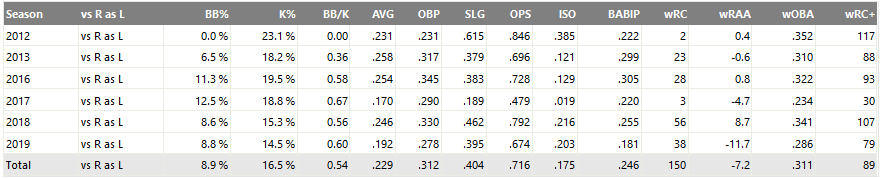
For a couple of years now, there have been industry rumblings about Profar’s makeup and effort level dipping, which I find understandable if true considering the way he was handled by Texas. He’s now been traded twice in two years, his run times are sluggish (on par with Josh Bell’s), and he had a .218 BABIP last year, which is perhaps a weak collection of supporting evidence. It’s possible a return to the loving arms of A.J. Preller and Jayce Tingler, both of whom played a role in Profar’s development with Texas, will reawaken something in him if indeed he has been sour. But if not, or if my team sources have been seeing something that’s not there, Profar is still a suitable role player because of his offensive ability.
His departure from Oakland means some combination of Chad Pinder, Barreto, Sheldon Neuse, and Mateo will man second base for the Athletics next year. None of them is a traditional fit there. Mateo is mistake-prone, and the other three aren’t typical infield athletes, but Oakland hasn’t shown any inclination to try Barreto or Mateo in center field, where I think their physical tools fit most traditionally. That foursome is talented enough that one of them should ascend in a relevant way, and I think Barreto is an approach improvement away from doing it, and therefore most likely, but his approach has totally undercut his physical talent to this point.
Allen, who turns 26 in January, is a big, immobile defender with power. Some of his issues might be rendered moot by the eventual use of an electronic strike zone, but for now Allen’s reps need to be limited the way Evan Gattis’ were when he was seeing regular playing time, pairing him with pitchers who work in such a way that Allen’s problems are masked. With 26-man rosters coming, his presence as a third catcher, late-inning lefty bench bat, late-inning catcher when the A’s trail, or occasional DH sub for Khris Davis against righties all make him immediately rosterable. He profiles as a bit player who does this sort of thing rather than an everyday catcher or first baseman.
Eric Longenhagen is from Catasauqua, PA and currently lives in Tempe, AZ. He spent four years working for the Phillies Triple-A affiliate, two with Baseball Info Solutions and two contributing to prospect coverage at ESPN.com. Previous work can also be found at Sports On Earth, CrashburnAlley and Prospect Insider.
The Padres have got to have Dave Cameron stuck in an office in the basement with the old file cabinets and unused promotional items.
I’m hoping for a Ball Four-esque tell-all novel from him describing the puzzling decision making processes of a semi-quant front office.
Like it for padres
One thing to mention is profar battled yips all year. Never seen anything like it, he just couldn’t throw to first unless it was overhand. Fix that and it’s a steal for the padres, but if not he’s hard to roster
Profar for $6m has to be a better deal than Khris for triple that for multiple years.
I don’t follow this comment: “Some of his issues might be rendered moot by the eventual use of an electronic strike zone…”
What does Eric mean here? (This is an honest question – what issues would be moot if an electronic zone was implemented?)
I haven’t looked at his numbers, but the implication would be that his framing is so bad that he is taking strikes away from his pitchers. This isn’t uncommon with catchers with poor technique. If they have a lot of glove and/or body movement after the pitch and can’t stick the location, they can make a strike look like a ball (especially the ones right on the edges of the zone, which are actually the best pitches). But if there was an electronic zone, the computer would read that those pitches were strikes regardless of the poor framing shenanigans going on behind the plate.
I imagine Austin Allen is considered to be below average at framing pitches. If there’s an electronic strike zone, framing won’t matter.
Ah, right. That make sense. When I read that bit about the electric strike zone, I was only thinking in terms of Austin’s offensive game for some reason (even though what you’re saying makes perfect sense, especially given the preceding sentence). Thanks!
So they traded away a guy with a ton of upside for a bad 5th starter, then signed a mediocre player for a year who has had one solid season to replace him. Small market teams have to be better than this to do well and I would like the Padres to do well.
I don’t think the team that keeps giving out eye-popping free agent contracts should be thought of as small market anymore.