Archive for InstaGraphs

World Series Game 3: Mets 9, Royals 3

It’s almost as though every angle and storyline has been covered already. There are 377 assigned seats in the Citi Field press box (including auxiliary seating), and plenty more media members offering perspectives from afar. The World Series doesn’t lack ink, electronic or otherwise.

But this is baseball. There’s always something more to write, because you never know what you’re going to see.

What happened on the first pitch of tonight’s game was presaged yesterday. Asked about how he might combat Alcides Escobar’s recent – and scarily good – first-pitch success, the Mets starter said he “had a few tricks up his sleeve that was going to pull out.”

On Halloween Eve, Escobar stepped into the box and was immediately treated to a 98-mph fastball that sent him sprawling. A few pitches later, the Royals lead-off hitter went down swinging.

At which point things started to go downhill for Thor. Ben Zobrist doubled over Yoenis Cespedes‘ head in center field and he eventually came around to score when the Mets couldn’t turn a 3-6-3 double play. Syndergaard getting tangled up with Lucas Duda near the bag didn’t cost the out – Wilmer Flores‘ throw was off line – but the play had snafu written all over it.

An inning later, Syndergaard gave up four hits and a pair of runs, one of them scoring on a pitch that skipped to the backstop. Were it not for an overturned safe call at third base – the baserunning boo-boo belonged to Alex Gordon — the damage could have been worse.

Yordano Ventura started off even shakier. Curtis Granderson led off the bottom of the first with a single and David Wright followed with a blast over the left-center field fence. It was the first for the Mets captain this postseason, and the 16th for the team. Home run #17 came in the third inning when The Grandy Man went yard after a Syndergaard single. With his base knock, the righty with the long, blonde locks became the eighth pitcher in Mets history to get a hit in the World Series.

In the top of the fifth, Kansas City’s Raul Mondesi became the first player in history to make his major league debut in the World Series. Pinch hitting for Ventura, he went down meekly against Syndergaard’s heat.

On Thursday, Zobrist told reporters that certain teams will “do some stuff” to get into the emotional Ventura’s head. In the bottom of the fifth, they did stuff to chase him from the game. Duda started the frame with a shift-beating grounder. Travis d’Arnaud then rang a two-bagger. Michael Conforto, mired in an 0-for-20 slump – “very good at bats and nothing to show for it,” according to Terry Collins – then plated New York’s fifth run with a something-to-show-for-it infield hit. Ventura, who failed to cover first on the right-side chopper, was bound for the showers.

Unlike his flame-throwing counterpart, Syndergaard refused to turn into a pumpkin. Instead, he turned into a middle-innings beast. Beginning with the last out of the second, he set down 12 straight, six by way of the K.

Escobar told me yesterday that he “really wants to win a Gold Glove.” In the sixth inning, Flores showed that he’s pretty good too. With the bases drunk, the slick-fielding shortstop ranged up the middle to throw out Alex Rios, just nipping him at first. The under-the-radar play essentially quash Kansas City’s chances.

A four-run bottom of the sixth sealed the deal. It was meltdown city for the visitors, epitomized by a Franklin Morales brain cramp. The lefty fielded a fist-and-third comebacker, whirled, whirled again… and held the ball. He might well have spun himself into the ground, because by inning’s end, the score stood 9-3.

It ended that way. Any hopes the Royals had of putting the Mets in a 3-0 hole were long gone. Tomorrow night is Steven Matz versus Chris Young – it’s also Halloween – and New York is very much alive.

Thanks for Being Awesome, Grantland

ESPN announced today that they are suspending operations — in other words, closing down — Grantland, the site that was originally built around Bill Simmons but grew into a place with some of the best sportswriting on the planet. Their baseball coverage was phenomenal, as Jonah Keri (hired away from FanGraphs when they decided to bring in a full-time baseball writer) and Ben Lindbergh regularly put out the kind of in-depth, intelligent-but-still-approachable writing about the sport that made me jealous of their abilities.

So, as a celebration of their work, here are some of the best baseball pieces I read at Grantland over the last few years. This is just off the top of my head (and a few of FG authors who kicked in suggestions while I was writing this), so I’m certainly going to be missing a good number of great pieces, but feel free to add your own favorites in the comments below.

The Art of Pitch Framing — Lindbergh’s seminal piece on the topic.

Grand Theft Baseball — Keri’s terrific piece on stealing bases with Coco Crisp.

Rocked — An oral history of the 1989 World Series earthquake.

The Tragedy of Derek Jeter’s Defense — Lindbergh on The Captain’s glovework.

Ty Cobb as Detroit — Anna Clark on the Tigers legend.

The Website MLB Couldn’t Buy — The story of Twins.com.

Before Beane — Lindbergh on the early days of analytics in baseball.

The Year of Living Less Dangerously — Lindbergh on MLB’s changing home plate collision rule.

The Curious Case of Mark Buehrle — Rany Jazayerli on the guy who gets outs throwing 83.

Eephus Influence — Keri on the most fun pitch in baseball.

Just so much great work was published over there, because Grantland hired really talented people and gave them the ability to do creative interesting stories. I’ll miss Grantland as a one-stop place for this kind of writing, but with writers this good, I’m sure we’ll keep seeing great work from them at other places in the not too distant future.


Job Posting: Toronto Blue Jays Baseball Operations Analytics Intern

Position: Toronto Blue Jays Baseball Operations Analytics Intern

Location: Toronto

Description:
A Baseball Operations Analytics Intern is primarily responsible for assisting with day-to-day tasks within Baseball Operations. Responsibilities vary dependent on the baseball calendar and internal sub-department needs (Amateur Scouting, Player Development, Pro Scouting and Baseball Information), with a heavy focus on analytics and research.

Why Rogers?
As a proud Canadian company, we’re dedicated to making things easier for our customers. We’re driven to make our communities and our country stronger and more successful by providing Canadian’s with advanced networks, powerhouse media brands, and technologically-advanced communications services. We’ve been embracing and leading change for over 50-years, and we’ll continue to seek out new opportunities to bring our customers simple solutions for today and tomorrow.

Why Rogers? Because we believe the best is yet to come.

Responsibilities:

  • Assist the Baseball Operations department with projects as directed.
  • Staying current on publically available baseball research.
  • Maintain critical scouting/statistical databases and monitoring the import of data feeds.
  • Assist with the preparation for the Rule 4 Draft.
  • Provide support for Baseball Operations meetings and player transaction decisions.
  • Support Minor League Operations/Player Development with their daily operations.
  • Contribute to analysis of Major and Minor League Players.
  • Assist with the testing of Baseball Operations software systems.

Qualifications:

  • Strong baseball knowledge.
  • Proficient in Microsoft Office (Excel, PowerPoint, Word).
  • Experience using SQL and statistical software such as R.
  • Familiar with current baseball research and analytics.
  • Professional attitude and work ethic with strong interpersonal skills.
  • Bachelor’s degree in a relevant field is a plus.
  • Demonstrated analytic skills and knowledge of a scripting language are a plus.
  • Baseball playing or scouting experience are a plus.
  • Previous work with professional or local sports organization is a plus.

Compensation:
This position is compensated.

To Apply:
If interested, apply here.


The Royals Run Prevention Deserves More Praise

After two games, the runaway narrative of the 2015 World Series is the success of the Royals contact offense; they just keep swinging at and hitting everything in sight, even against pitchers who are used to blowing opponents away. From the fifth inning on last night, most of Fox’s broadcast consisted of heaping praise on the Royals “relentless” offense, and pleading with baseball to build line-ups more like this one.

The Royals line-up is fun to watch, and it is nice to see a team put the ball in play as often as the Royals do, but I’d like to point out the following set of facts. Note that we’re using R/PA instead of R/G in the runs column to account for the extra inning contests that make per plate appearance a better denominator than per game.

Royals Offense and Defense
KC Offense BA OBP SLG R/PA
Regular Season 0.269 0.322 0.412 0.12
Postseason 0.269 0.327 0.440 0.15
World Series 0.253 0.323 0.398 0.12
KC Opponents BA OBP SLG R/PA
Regular Season 0.249 0.314 0.396 0.10
Postseason 0.220 0.299 0.368 0.11
World Series 0.165 0.230 0.203 0.06

During the postseason, the Royals offense has hit a little bit better than they did during the regular season, which is a remarkable achievement given the quality of pitching they’ve faced. October is a low run-scoring environment, so for them to basically sustain their regular season levels of hitting is a notable achievement.

But look at what the Royals pitchers and defenders have done to opposing offenses, especially in this series. The Mets have a .433 OPS after the first two games in Kansas City. They’ve scored five runs in 23 innings. They have one extra one base hit. Even the rallies they have managed were based on walks and bloopers, as the Royals pitching staff has rarely had to work out of jams.

The contact-hitting-versus-dominating-pitching narrative is an easy one, especially when Jacob deGrom and Matt Harvey combine for four strikeouts between them. But the Royals are up 2-0 more because of their run prevention, which has been remarkably good in the first two games. If the Royals were striking out left and right, they’d probably still be up 2-0, given how effectively KC has shut down New York’s offense.

There’s nothing wrong with giving credit to the Royals hitters; guys like Alcides Escobar really are having remarkable Octobers. But let’s not overlook the job the Royals run prevention unit is doing; they’re the ones really dominating the Mets so far.


Job Posting: Houston Astros Baseball Research and Development Analyst

Position: Houston Astros, Analyst, Baseball Research and Development

Location: Houston

Description:
The Houston Astros are seeking an Analyst for the team’s Baseball Research and Development group. The Analyst will work closely with the Director of R&D and the analytics team to conduct research and develop methods that encourage the effective understanding and application of information throughout Baseball Operations. If you are passionate about understanding the game of baseball, enjoy the challenge of solving a diverse array of problems and want to work in a collaborative team environment where your contribution will make a difference, this is the position for you.

Responsibilities:

  • Research, develop and test mathematical, statistical and predictive models to support Baseball Operations in player evaluation, roster construction and game tactics.
  • Conduct research to improve the organization’s understanding of the game of baseball.
  • Prepare and explore a variety of baseball data sets and construct workflows to utilize this data.
  • Communicate closely with front office, coaching and scouting personnel in the gathering and application of baseball information.
  • Build information systems to support Baseball Operations efforts to improve player health and performance.
  • Evaluate and lead implementation of advanced technologies.

Qualifications:

  • Bachelor’s degree or higher in statistics, engineering, applied math, physics, quantitative social sciences, computer science, operations research or similar field.
  • Strong analytical and problem-solving skills.
  • Strong interpersonal and communication skills (written and verbal).
  • Proficiency with SQL and relational databases.
  • Ability to communicate technical ideas to non-technical audiences using data visualization.
  • Experience with baseball data and understanding of sabermetric concepts.
  • Experience with statistical software, programming languages and machine learning techniques is strongly preferred.

Compensation:
This position is compensated.

To Apply:
If interested, apply here.


Alex Anthopoulos Leaves Blue Jays

Well, this is a bit surprising.

The Blue Jays have been publicly looking for a baseball guy to replace Paul Beeston as team president for over a year, beginning with their awkward courtship of Kenny Williams and Dan Duquette last winter. They finally found their replacement in August, when they brought Mark Shapiro over from Cleveland to take the job, though the announcement at the time suggested that Shapiro would focus mostly on the business side of the organization, leaving the baseball operations department in Anthopoulos’ hands. After the team won the AL East on the backs of his many acquisitions over the last year, the general assumption was that he’d done enough to earn autonomy as the guy putting together the team’s roster.

But perhaps we should have seen this coming, given that the organization was clearly looking for a former GM to take their presidents role, rather than focusing solely on someone with a business background. They made a point of hiring a baseball guy to be Anthopoulos’ new boss, and it’s probably difficult to assume that you’re going to be allowed to make decisions if your boss was hired in large part because he’d done your job before.

So now a great 2015 Blue Jays season ends with a stain, as the team will have to undergo changes in the baseball operations department as well. Shapiro’s lengthy tenure in Cleveland helped produce many front office members around the game and the team’s position should help attract quality candidates; I’d suggest this might be the kind of job that could get Ben Cherington to reconsider taking a year off from working in baseball, for instance.

But this is an awkward cap to put on a great year in Toronto. Anthopoulos absolutely did trade away huge chunks of the team’s farm system, but in acquiring guys like Josh Donaldson, Troy Tulowitzki, Devon Travis, and Russell Martin, he made moves that set the team up to win not just in 2015, but beyond as well. And focusing solely on the cost of the acquisitions without balancing that against the obvious rewards of reinvigorating a city that hadn’t seen playoff baseball in 20 years seems short-sighted at best.

The Blue Jays will probably be fine without Anthopoulos, but the Jays are going to have to do some pretty nifty PR to not squander the significant excitement for the franchise they just spent so much time generating. And while there aren’t any other GM jobs open at the moment, it seems pretty likely that Anthopoulos will find a job in the not too distant future, and probably one where he’s allowed to call his own shots, rather than reporting to a GM-turned-president who doesn’t share his same philosophies.


Mets-Royals Team Comparison Dashboard

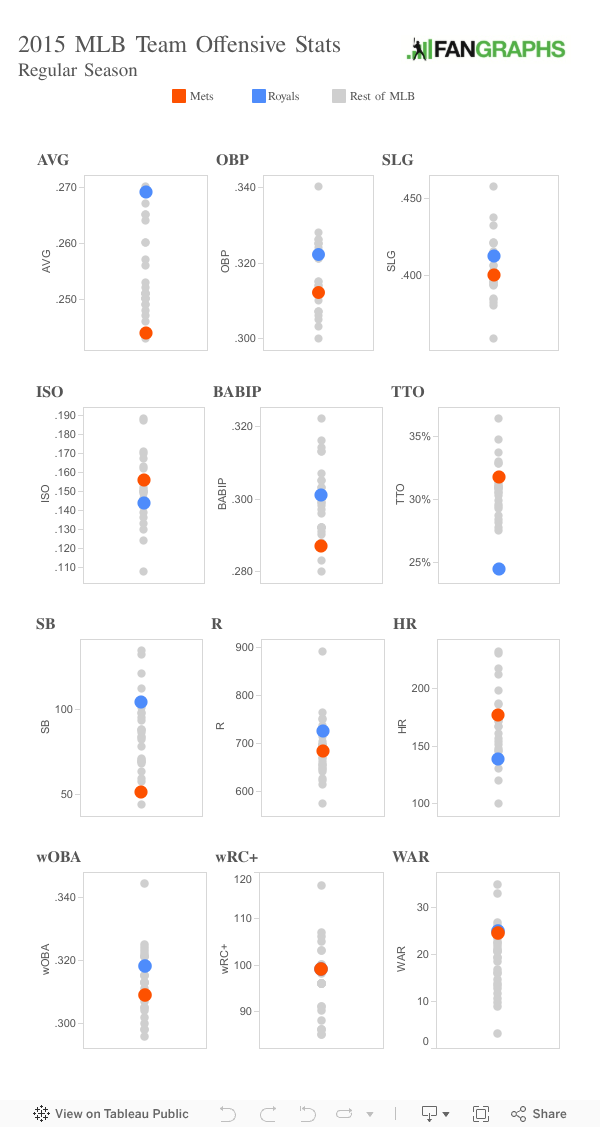
Building off of Eno’s comparison between the Mets and Royals, I built a quick dashboard that shows team offensive and pitching stats for all 30 teams, calling out the two World Series participants. This is just a visual representation of some of the most popular stats on our leaderboards. There are a few interesting extremes such as the three true outcomes (TTO), which Eno looked at yesterday, and batting average.

These plots are box plots without the boxes, so the location of the dot on the y-axis represents the team’s stat in that particular category. A dot’s size and color are just for call out purposes. They are also interactive so you can explore where other teams fall.

Read the rest of this entry »


Win Probability Added Leaders Through the LCS

Recently, after the completion of the various divisional series, I compiled win probability added (WPA) for the current postseason. In this post, I’ve updated that data to include all three rounds of the postseason thus far through Game 6 of the ALCS. Since WPA is accrued, many of the players at the top will have a higher WPA because they’ve played more games.

Batters

Batter WPA Through LCS

Read the rest of this entry »


What’s Behind David Price’s Postseason Struggles?

David Price can’t pitch in the postseason, maybe you’ve heard. It’s a decent 56.2 inning sample at this point, but it’s just a little bit more than a month’s worth of work. He’s had six worse months in his career.

Still, to be fair to the hand-wringing, if he had a month with a 4.10 FIP, we’d be talking about it here as well. So let’s try to look at why David Price has struggled in the postseason. Because his regular and post-season strikeouts minus walks are almost identical, it’s obviously about the home runs. His home run rate in the postseason is 77% higher than it is in the regular season!

And there’s a little something to this. A combination of a couple little things — one in his control, one not — may have lead to more home runs in the postseason than he’s seen in the regular season.

Read the rest of this entry »


Job Postings: Los Angeles Angels of Anaheim Baseball Operations

Just to be clear, there are two separate positions here.

Position: Los Angeles Angels of Anaheim, Director, Quantitative Analysis

Location: Anaheim

Description:
This position is responsible for developing and overseeing the research and analytics initiative within Baseball Operations, reporting to the General Manager and Assistant General Manager. Angels Baseball is an equal opportunity employer.

Responsibilities:

  • Direct and develop Quantitative Analysis staff by identifying strong candidates, supervising projects, and providing constructive feedback.
  • Perform advanced quantitative analysis on baseball datasets to improve Baseball Operations decision-making, including predictive modeling and the development of an internal player projection system.
  • Effectively present analysis through the use of written reports, tables, and data visualization methods to disseminate insights to other members of the Baseball Operations staff and aid in decision-making.
  • Identify new techniques, models, and algorithms for application to internal processes.
  • Meet with vendors and make recommendations for investment in new data and technology resources to enhance Baseball Operations decision-making.
  • Contribute to general baseball decision-making and generate ideas for player acquisition, in-game strategy, and roster construction.
  • Manage components of Baseball Operations budget related to Quantitative Analysis department.
  • Other projects as directed by General Manager and Assistant General Manager.

Qualifications:

  • Advanced degree or equivalent experience in statistics, mathematics, computer science, or a related field.
  • Demonstrated ability to effectively communicate complex concepts to colleagues possessing a diverse set of backgrounds and with varying experience with quantitative methods.
  • Minimum of five years work experience in mathematical, statistical, and predictive modeling.
  • Demonstrated expertise with baseball datasets and sabermetric analysis.
  • Demonstrated ability in problem-solving and project management and a desire and ability to act as a mentor to members of the analytics staff.
  • Demonstrated expertise with R, STATA, SPSS, SAS, or similar statistical computing software.
  • Demonstrated expertise in relational database development and administration with Microsoft SQL Server, MySQL, or other database systems.
  • Knowledge and demonstrated ability with computer programming and machine learning techniques.

Compensation:
This position is compensated.

To Apply:
Please submit your resume and cover letter here.

Position: Los Angeles Angels of Anaheim, Baseball Information Analyst

Location: Anaheim

Description:
The Los Angeles Angels are seeking a Data Scientist for the team’s Baseball Analytics group. The Baseball Information Analyst will work closely with the Director, Quantitative Analysis and our analytics team to research, develop, and test mathematical, statistical, and predictive models that support Baseball Operations. Angels Baseball is an equal opportunity employer.

Responsibilities:

  • Research, design, and test predictive and statistical models to enhance Baseball Operations decision-making.
  • Provide guidance for and aid in the development of junior members of the analytics staff.
  • Work with Systems Architect to design and build decision-support tools and support the development of baseball systems.
  • Effectively present analysis through the use of written reports, tables, and data visualization methods to disseminate insights to other members of the Baseball Operations staff and aid in decision-making.
  • Other projects and related duties as directed by Director, Quantitative Analysis.

Qualifications:

  • Advanced degree or equivalent experience in statistics, mathematics, computer science, or a related field.
  • Demonstrated ability to effectively communicate complex concepts to colleagues possessing a diverse set of backgrounds and with varying experience with quantitative methods.
  • Excellent analytical and problem-solving skills.
  • Experience with baseball datasets and sabermetric analysis.
  • Demonstrated expertise with R, STATA, SPSS, SAS, or similar statistical computing software.
  • Proficiency with Microsoft SQL Server, MySQL, or other relational database systems.
  • Experience with computer programming and machine learning techniques.

Compensation:
This position is compensated.

To Apply:
Please submit your resume and cover letter here.