
Jacob deGrom, Command God

In the introduction to their 2023 Saberseminar presentation, Scott Powers and Vicente Iglesias hit on a fundamental truth about pitching: The variable that bests predicts the outcome of a pitch is the location where it crosses the plate. For a case study, look no further than this tweet from MLB.com’s David Adler about Yoshinobu Yamamoto’s splitters.
Hitters have swung 74 times at Yoshinobu Yamamoto's splitter this season …
38 of those swings are whiffs (51%)
Another 17 are foul balls
That leaves 19 balls in play
18 of those 19 are ground balls (95%)
Only 1 of Yamamoto's splitters has been hit in the air pic.twitter.com/ggLR1qHYZW
You Aren't a FanGraphs MemberIt looks like you aren't yet a FanGraphs Member (or aren't logged in). We aren't mad, just disappointed. We get it. You want to read this article. But before we let you get back to it, we'd like to point out a few of the good reasons why you should become a Member. 1. Ad Free viewing! We won't bug you with this ad, or any other. 2. Unlimited articles! Non-Members only get to read 10 free articles a month. Members never get cut off. 3. Dark mode and Classic mode! 4. Custom player page dashboards! Choose the player cards you want, in the order you want them. 5. One-click data exports! Export our projections and leaderboards for your personal projects. 6. Remove the photos on the home page! (Honestly, this doesn't sound so great to us, but some people wanted it, and we like to give our Members what they want.) 7. Even more Steamer projections! We have handedness, percentile, and context neutral projections available for Members only. 8. Get FanGraphs Walk-Off, a customized year end review! Find out exactly how you used FanGraphs this year, and how that compares to other Members. Don't be a victim of FOMO. 9. A weekly mailbag column, exclusively for Members. 10. Help support FanGraphs and our entire staff! Our Members provide us with critical resources to improve the site and deliver new features! We hope you'll consider a Membership today, for yourself or as a gift! And we realize this has been an awfully long sales pitch, so we've also removed all the other ads in this article. We didn't want to overdo it. In case you didn't read all that, here's the short version. Membership includes:✓Ad-free browsing✓Unlimited FanGraphs & RotoGraphs articles✓Historical & platoon projections✓Leaderboard & player-page stat heatmaps✓One-click data exports✓Customizable player-page dashboards✓Dark & Classic site modes✓Weekly Members-only mailbag✓FanGraphs Walk-Off, your year in review✓Optional homepage photo removal✓Gift articles to non-Members✓Full postseason coverage— David Adler (@_dadler) April 22, 2025
If Yamamoto buries his splitter arm side, he’s probably getting a whiff. If it’s on the edge of the zone, it’s likely a foul ball. If it catches plate, it’s getting put in play. The location dictates the outcome.
Given this truth, pitchers who command the ball best ought to dominate. But there’s a catch. As Powers and Iglesias noted, the location is also the variable with the least predictive reliability. If you see a pitcher throw a fastball 98 mph, you can be pretty sure he is going to do it again. A dotted backdoor slider, on the other hand, does not guarantee an entire game of dotted backdoor sliders. Command is both the most important and the least reliable quality for a pitcher.
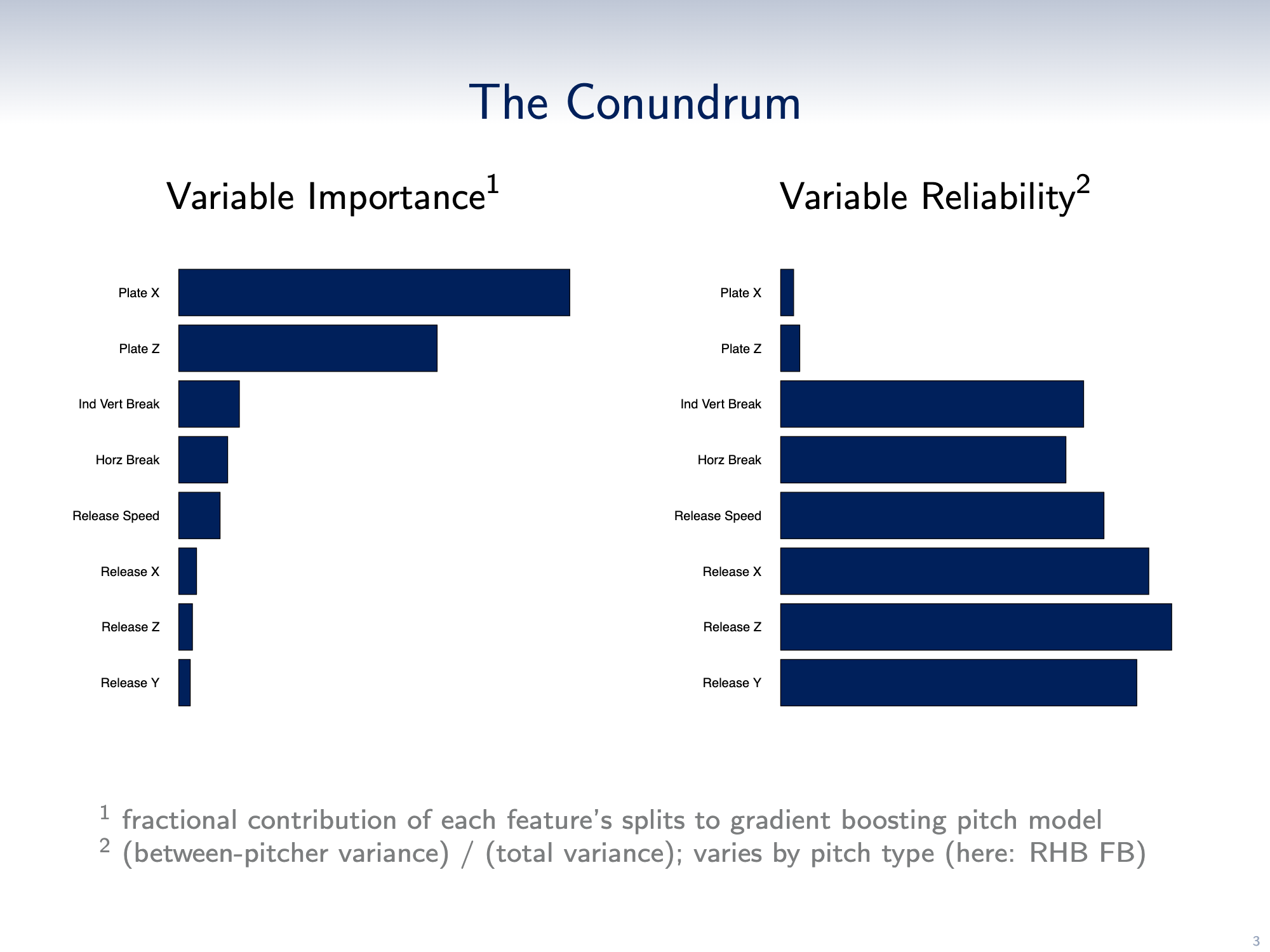
Nobody can nail the corners with every pitch. But pitchers can at least minimize the variance of their locations, finding relative reliability within the chaos of command. And in 2025, there is perhaps nobody more reliable than Jacob deGrom.
deGrom’s flat attack angle fastball and firm slider have (justifiably) built his reputation as a stuff monster. Even after easing up on the gas pedal this season, deGrom is still a darling in the eyes of the models. His overall Stuff+ is in the 80th percentile for starters with at least 30 innings pitched, fueled by his depth-y 89-mph slider. PitchingBot likes deGrom even more, ranking him in the top 10 among those pitchers. Over at Baseball Prospectus, the StuffPro model believes deGrom wields four pitches — his curveball and changeup, in addition to the heater and slider — that all grade out as plus.
But stuff is no longer deGrom’s carrying tool. Possibly as a function of his decision to throw slower, possibly as a positive outcome of aging, deGrom’s standout skill these days is his command.
deGrom’s unbelievable precision came to my attention while writing about Hunter Gaddis for a piece that was published on Monday. As part of my effort to discern whether Gaddis owed his early-season success to slider command (the verdict: inconclusive), I created a version of the Kirby Index for sliders to see where he landed. That metric measured the variance in release angles and release points and distilled those figures into a single score that captured command ability. Originally, it was designed for fastballs, which tend to be thrown to all parts of the strike zone. It perhaps works even better for sliders, which generally are thrown to fewer targets. Gaddis’ rank among his fellow pitchers was nothing remarkable, but deGrom’s name sitting at the very top caught my attention.
| Player Name | VRA Pctl | HRA Pctl | Vert. Release Pctl | Horiz. Release Pctl | Kirby Index |
|---|---|---|---|---|---|
| Jacob deGrom | 99th | 97th | 91st | 79th | 0.94 |
| Merrill Kelly | 97th | 77th | 78th | 97th | 0.89 |
| Zac Gallen | 97th | 82nd | 92nd | 39th | 0.84 |
| Taijuan Walker | 90th | 66th | 92nd | 76th | 0.82 |
| Zack Littell | 87th | 96th | 88th | 17th | 0.80 |
| Jack Flaherty | 94th | 92nd | 3rd | 78th | 0.76 |
| Reese Olson | 93rd | 56th | 49th | 93rd | 0.76 |
| Scott Blewett | 73rd | 61st | 95th | 83rd | 0.75 |
| Corbin Burnes | 92nd | 90th | 3rd | 82nd | 0.75 |
| Bryce Elder | 81st | 99th | 59th | 28th | 0.75 |
As I wrote earlier this year, a more straightforward implementation of the Kirby Index would be to just measure the variance of the actual pitch locations. For this story, I calculated the standard deviation of the vertical and horizontal locations of a given pitcher’s sliders; once again, deGrom found himself at the top of the pack. Look at how much distance there is between him and the next closest pitcher:
| Player Name | Horizontal Location (St Dev) | Vertical Location (St Dev) | Overall (St Dev) |
|---|---|---|---|
| Jacob deGrom | 0.525 | 0.498 | 0.724 |
| Merrill Kelly | 0.595 | 0.586 | 0.835 |
| Zac Gallen | 0.616 | 0.565 | 0.836 |
| Corbin Burnes | 0.556 | 0.671 | 0.871 |
| Jack Flaherty | 0.575 | 0.659 | 0.874 |
| Bryce Elder | 0.514 | 0.713 | 0.879 |
| Zack Littell | 0.574 | 0.719 | 0.920 |
| Luarbert Arias | 0.543 | 0.755 | 0.930 |
| Enyel De Los Santos | 0.732 | 0.619 | 0.959 |
| Dylan Lee | 0.493 | 0.827 | 0.962 |
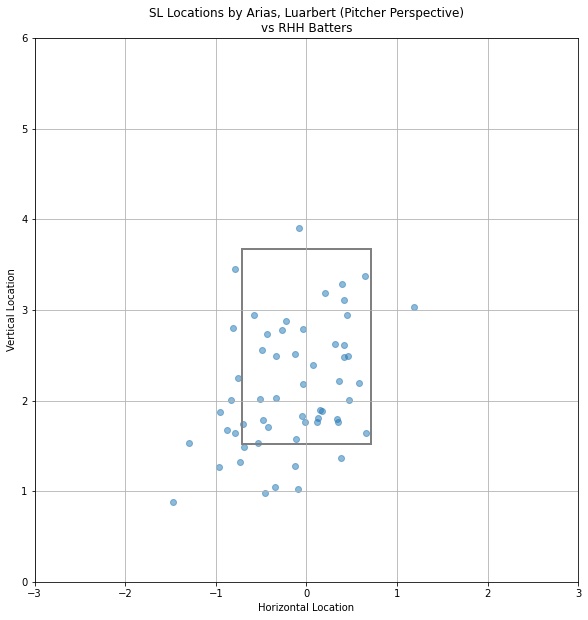
Random tangent here, but you have to admire Luarbert Arias for refusing to throw his junky 82-mph slider anywhere but inside the strike zone.
Anyway, measuring location densities, ultimately, could just point at pitchers who fill up the strike zone; the real test of command is a pitcher’s ability to hit his actual target. To that end, Driveline Baseball provided me with a sample of their proprietary miss distance data. Using Inside Edge tracking data, Driveline measures the distance from the intended target to the actual location of the pitch.
No surprise — deGrom’s slider miss distance ranked first among all pitchers. The league-average miss distance for sliders is about 12.5 inches; this year, deGrom is missing his target by under nine inches, nearly three standard deviations below the average. Any way you slice it, deGrom is commanding his slider like no one else in the sport.
The outcomes have been unassailable. So far, deGrom’s slider has returned a run value of -3.2 per 100 pitches thrown, the best mark for any slider thrown by a starting pitcher. Not only is he getting a bunch of swing and miss — a 38.1% whiff rate, as of this writing — it’s also grabbing a ton of called strikes. When batters do manage to put it in play, they can’t do much with it. The average launch angle on the pitch is just 2°; the xwOBA is a meek .227.
The harmless outcomes on balls in play are a function of deGrom’s targets. To right-handed hitters, he targets the classic low-away corner, breaking off the plate. Note the bimodal distribution on the heatmap — there’s a large concentration of sliders he’ll throw in the zone for strikes, and then another cluster right below the zone that generate chase.
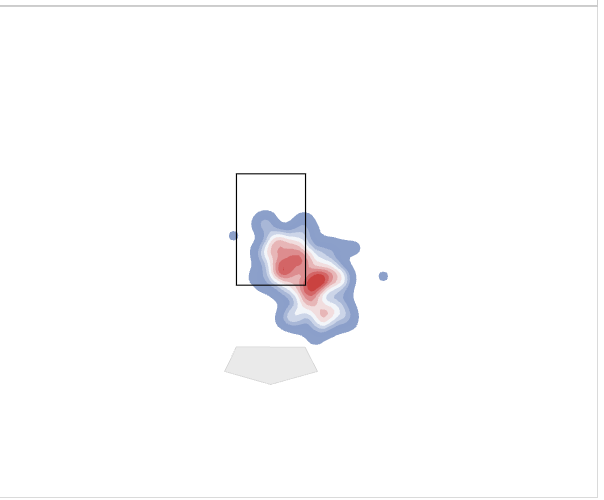
These intentions can be seen in the filtered heatmap clusters. When deGrom throws sliders to righties in zero-strike counts, he tends to be in the zone:
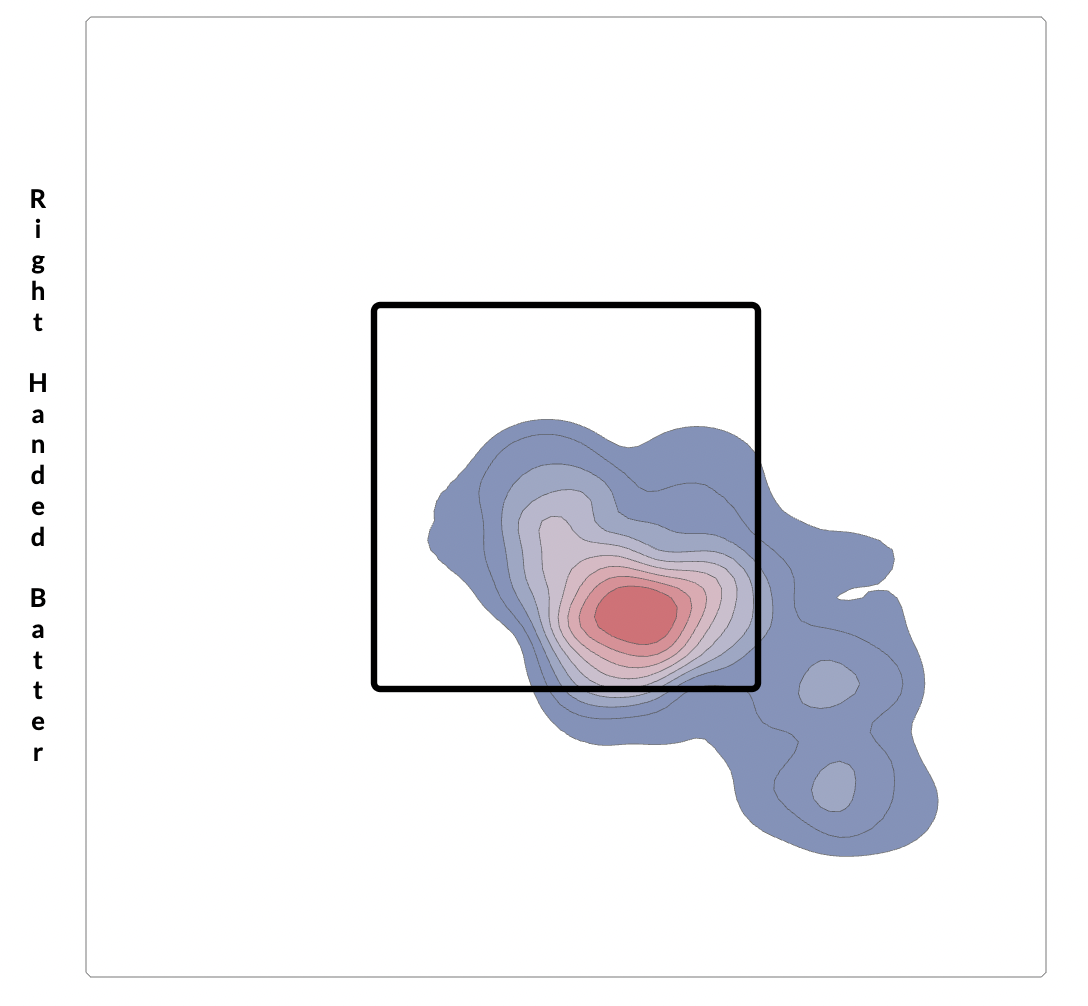
In two-strike counts, he chases the swing and miss:
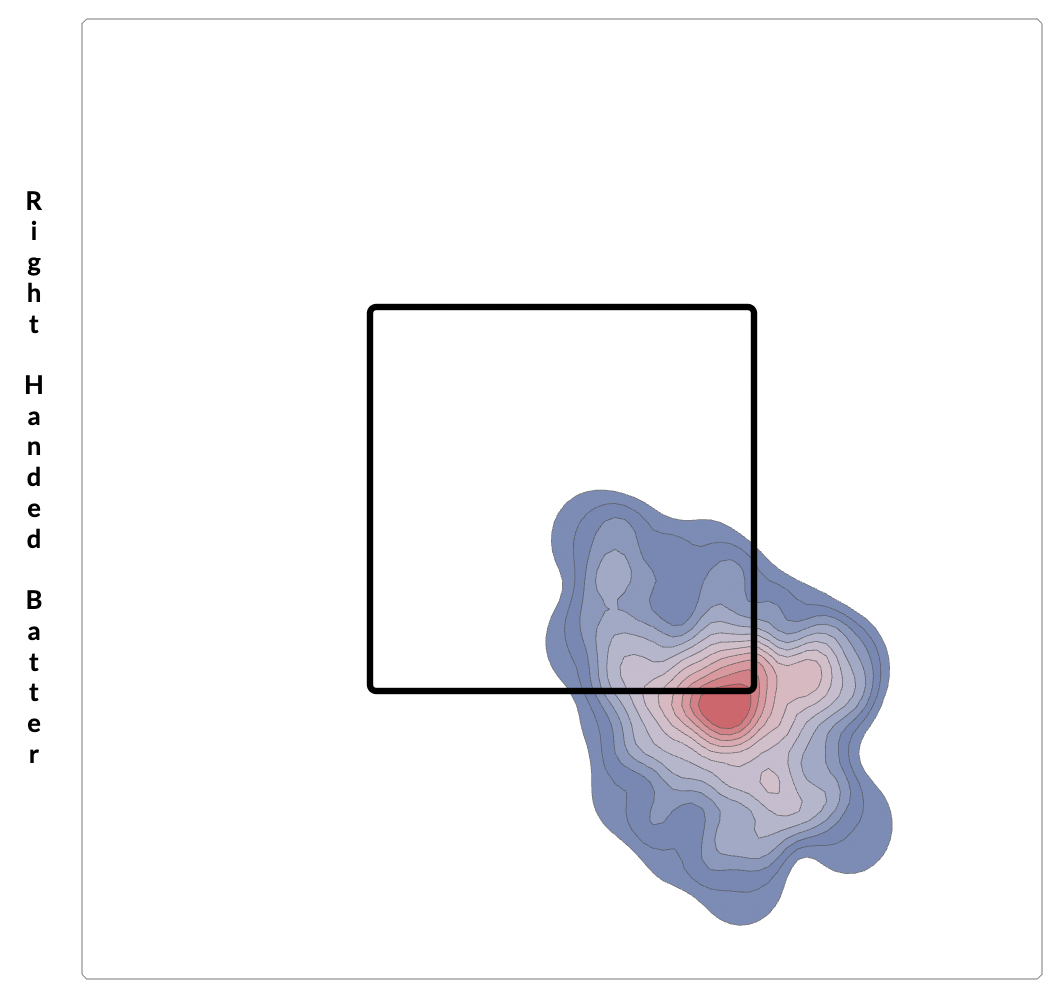
To lefties, deGrom shows a similar bimodal distribution, but the pattern appears reversed. In early counts, he’s aiming just below the zone; in late counts, he’s looking for called strikes. This sequence to Athletics rookie Nick Kurtz, which featured four sliders, gives a sense of the approach. On 1-0 and 2-0, deGrom tries to bait a chase, but the big lefty resists.
Down 3-0, deGrom fires a middle-middle heater in an auto-take scenario, then returns to the slider in a 3-1 count. Here, deGrom dials in his robotic precision, dotting the lower edge of the strike zone to bring the count full.
On 3-2, he goes there again. Kurtz takes it and pays the price. Though the superimposed strike zone on the broadcast says this pitch is just low, my sense is he deserves that call; if he’s consistently landing pitches within inches of his intended target, you sort of just have to hand it to him.
deGrom isn’t just painting with the slider. I calculated the Kirby Index for four-seam fastballs thrown to righties in 2025; incredibly, he also sits in first place on that list.
| Player Name | VRA Pctl | HRA Pctl | Vert. Release Pctl | Horiz. Release Pctl | Kirby Index |
|---|---|---|---|---|---|
| Jacob deGrom | 92nd | 73rd | 96th | 94th | 0.88 |
| Bailey Ober | 91st | 99th | 56th | 72nd | 0.85 |
| Bryan King | 95th | 63rd | 89th | 81st | 0.83 |
| Spencer Schwellenbach | 90th | 95th | 44th | 88th | 0.83 |
| Trevor Williams | 99th | 56th | 57th | 92nd | 0.80 |
| Aaron Nola | 83rd | 91st | 59th | 68th | 0.79 |
| Joe Ross | 96th | 90th | 43rd | 50th | 0.79 |
| Ryan Gusto | 70th | 89th | 76th | 72nd | 0.77 |
| Colin Rea | 86th | 83rd | 60th | 52nd | 0.76 |
| Elvin Rodriguez | 76th | 78th | 79th | 55th | 0.74 |
| Kyle Freeland | 88th | 94th | 18th | 63rd | 0.74 |
| A.J. Puk | 90th | 54th | 51st | 91st | 0.74 |
As nice as it would be to think that deGrom can be just as good even after dropping two ticks off the fastball, it just isn’t true. Absent improvement elsewhere, losing stuff will bring him back to Earth. But deGrom is far from stagnant. In 2019 — his last full big league season, amid the most dominant phase of his career — his fastball command measured as below average by miss distance. Six years later, it’s hard to argue his command is anything but 80-grade. And as long as the elbow cooperates, it will help him defy gravity.
Michael Rosen is a transportation researcher and the author of pitchplots.substack.com. He can be found on Twitter at @bymichaelrosen.
Countdown to injury. 3:2;1
C’mon man, don’t rain on the parade. I know it’s tempting to do this for guys like him and Trout, but….
He’s intentionally throwing slower. Earlier in the year he was throwing slower than now, more like 96, but then he realized how much better his fastball performs at 97-98 so he has added a bit of velocity back. These are all conscious decisions, so I feel like at least for one year he’s a decent bet for a strong season w the TJ honeymoon phase.
Probably off the juice now
Competing with yourself for the worst comment?
I must have owned you in the past
Username checks out
Explain
It’s clearly sarcastic.
Plan on catching some perch with that bait?
What bridge do you live under?
Watching deGrom pitch for his entire career has really been a treat. Now, imagine that if fate had gone in a different direction, and Jacob was born in say the Netherlands or Belgium for example, we never would have had the opportunity to see him play baseball, and he never would have known that he could have been one of the best ever at this. Just a random somewhat unrelated thought to throw in here.
Fellow rotation member Patrick Corbin was bitten by a spider earlier this season. He went out and crushed his start against the Angels, 5.1 innings with 1 run.
deGrom made a meme using a newspaper/Daily-Bugle headline calling Corbin out as Slider-Man.
Coming from deGrom, a titanic compliment.
Lowest ERAs since Robinson broke the color barrier in 1947:
1) Clayton Kershaw 2.50
2) Jacob deGrom 2.52
3) Whitey Ford 2.75
4) Sandy Koufax 2.76
5) Jim Palmer 2.80
6) Tom Seaver 2.86
11) Bob Gibson 2.91
Adjusted for era, there’s also #1 and #2 all time in ERA+. These are two legitimate living legends and yet they still feel underrated
Good list but a bit of a cherry pick. Pedro is sitting at 154 ERA+ with double the innings of Jacob. It’s a big, big difference. Pedro’s 291 ERA+ in 2000 is almost beyond comprehension. Oh and for that top 10, Pedro is sitting at 2.93, just behind Bob. No one is underrating Kersh or deGrom, but we saw this act already 20 odd years ago. I would love to see DeGrom get another Cy, maybe crawl to 125 wins and 60+ WAR and see what the HOF voters do with that. I like peak candidates so for me he’d be an easy yes.
Not to take anything away from DeGrom, but he has 1410 innings pitched. From 1997-2003, Pedro had 1408 innings pitched with a 2.20 ERA–in the era of the home run chase!
Also Brandon Webb is in the top 10 for ERA- for post-1947 starters and is within 100 IP of DeGrom at the moment. Somehow his career seems much shorter.
If DeGrom made it to 60 WAR he’d be a HoFer for sure–he’s only at 43ish (either variety) so that’d be like 3 or 4 more excellent seasons. For me, if he pulls off two more 4-win seasons I’d vote for him.
I watched Jacob deGrom in 2019. If the measurement of ‘miss distance’ is accurate, I would suggest that deGrom was throwing his fastball where he wanted to but not where his catcher was setting up the target.
Tbh the idea that deGrom had below-average fastball command in 2019 is the sort of thing that makes me question the validity of the metric
I would also question the validity of the metric, but it’s also very possible that when your stuff is that good it doesn’t matter where you locate it
Right but like, I watched deGrom in 2019 and that’s just not what he was doing
Is it possible that the lack of repeatability in location is the reason location is so important in determining outcome?
The conjecture is something like, if a pitcher had perfect control, then each pitch would have very little uncertainty and hitters would have less variation to deal with, making a pitch easier to hit. The wildly different outcomes from what the pitcher hopes is the same effort keeps the batter from ever being able to really anticipate the final pitch location.
Clearly deGrom’s command makes him better, not worse, but he’s still missing by nearly 9 inches. If Yamamoto always could throw the best location of his splitter, no one would swing because It’s going to be a ball. The question is there a point at which too much command would make you worse?
Why? Just control it to go to different locations.
You’re positing an extremely dumb Yamamoto that never figures this out and never starts dotting the bottom of the zone instead of throwing below the zone; that just isn’t realistic. The better your command, the better you are, unless your coaches are deliberately sabotaging you or something.
This, though, is super interesting. The actual question I would ask is something like, “Once we have already selected for MLB pitchers, the graph shows that the rarer something is, the more valuable it is; is that because that is the true value of those things and it happens to reverse-match rarity, or is it an artifact of the data and some kind of selection bias?” We don’t see anyone with 80 command but 20 stuff since Jaime Moyer retired, and even he was probably closer to like, 30+ than 20 stuff. If there were suddenly a ton of extra junkballers and a lack of prospect types that throw smoke, I would bet that the trend would even out.
I’m sure this is “old school, boomer” type of thinking, but right now, deGrom is averaging 5.375 IP/start. I have a difficult time describing that as “dominant.” Over a full year, it projects to about 32 starts, 172 IP, and 3.2-.3.5 WAR. He’s ~65th in MLB in FIP.
It’s above-average; good, even. I just don’t think that qualifies as “dominant” in today’s game. Having seen deGrom from 2018-2021, I don’t think it’s dominant by deGrom’s standards.
I think you’re 100% right that calling deGrom dominant is not accurate. It’s got nothing to do with his innings to me, since Mariano Rivera and Trevor Hoffman were dominant pitching just one inning. But his xFIP and SIERA average out to about 3.25, which, as an ERA, would have tied him for 15th last year amongst qualified starters. To me dominant means either one of very top guys, or maybe even just the #1 guy if he’s that much better than everyone else (peak Maddux, peak Pedro, etc). A dominant pitcher should dominate the game; that’s the meaning of the word. Right now deGrom is going out there and giving you five and a half innings of good pitching. He isn’t winning any games by himself anymore.
I don’t think that’s “boomer” thinking–you’re referencing FIP-based WAR!
I don’t know if this is right or not (I can’t recall any reporting or studies on this one way or another), but is it possible that FIP-based WAR systematically undervalues guys (like 2025 deGrom) with 80-grade command (likely because they’re better than the model would expect at inducing poor/soft contact by absolutely dotting it)?
If so, that might make ’25 him closer to dominant, with his current ERA in the high-2s being more reflective of his true talent than his current FIP in the high-3s. Although YMMV on whether that’s dominant or not (and also, again, I’m uncertain as to whether there’s any reason to believe that claim).
Yesterday he decided to start striking guys out and hit 100, so you can see it is still there. Even the 100 didn’t look like his max effort, compared to what he was doing a couple years ago via follow thru, etc. Just sayin’
In 2021, Jake was doing this, while also being the hardest-throwing starter in the game, essentially only throwing his fastball and slider, and throwing almost everything glove-side. It was gloriously ridiculous. (Come home, Jake.)