
José Ramírez Is on Quite a Run
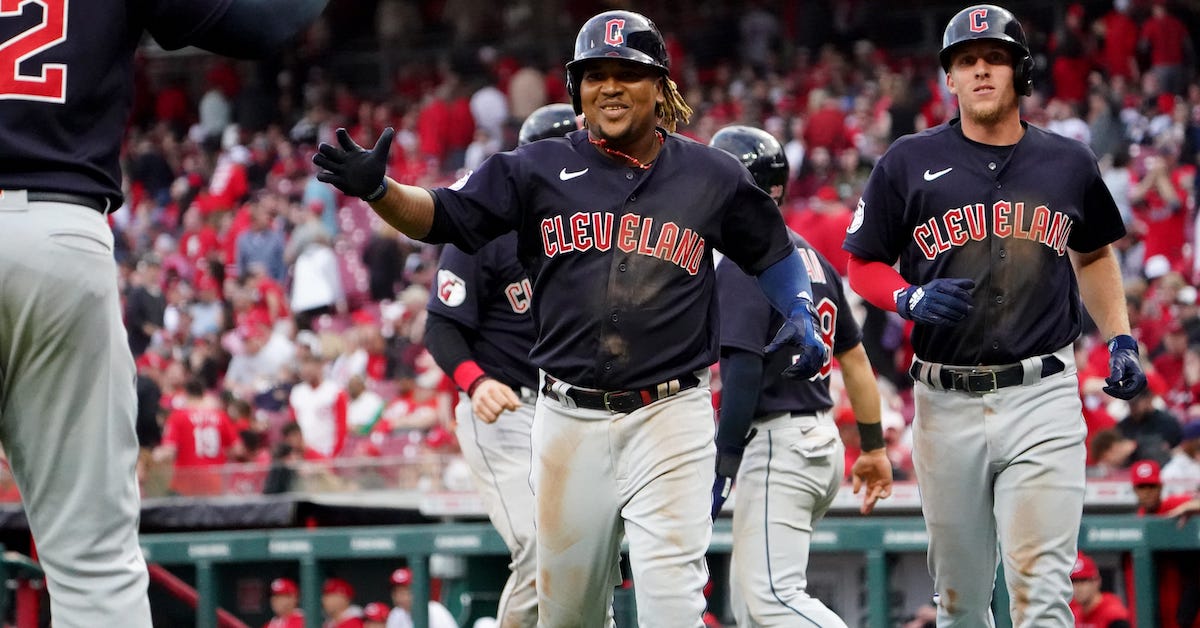
Matt Olson isn’t the only recent recipient of a contract extension who’s off to a ridiculously hot start. The Guardians’ José Ramírez is putting up even more eye-opening numbers than Olson, and he added to those with a grand slam and an RBI double against the White Sox during a Wednesday doubleheader, driving his season total to 20 — in 11 games!
I generally don’t care about RBI totals much, particularly since I’m more than a decade removed from my days of playing fantasy baseball. You might not care much about them, either, having grown to appreciate the modern-day cornucopia of statistics that do a better job of measuring batter skill. But hey, we’re just two weeks into the season, and with none of the stats under discussion having stabilized, it’s a good time just to appreciate extremes of performance while connecting them to more solid truths. Ramírez’s incredible hot streak provides us a good opportunity to appreciate the player before us (and I promise you, I won’t spend the entire piece rambling about ribbies).
And so here we are. In Wednesday’s opener, the Guardians piled 10 runs on White Sox starter Dallas Keuchel, one in the first and then nine in the second, during which the Chicago lefty failed to retire any of the 11 batters he faced. A pair of errors by shortstop Tim Anderson didn’t help, and neither did manager Tony La Russa’s apparent desire to avoid going to his bullpen so early. Ramírez, the sixth batter of the inning, unloaded on a center-cut cutter that turned a 3–0 game into a 7–0 one:
Man, that ball got outta here in a hurry, which will happen when you hit one with an exit velocity of 111.6 mph. It was Ramírez’s fourth homer of the season, and his second grand slam; he hit his first one off the Reds’ Daniel Duarte in the ninth inning of an April 12 game, that while batting left-handed:
Beyond the slam, Ramírez didn’t get another hit in the first game, an 11–1 rout. He went 1-for-3 with an RBI double and a walk in the nightcap, a 2–1 win by Cleveland.
Twenty RBIs in a team’s first 11 games is not a record, but it put Ramírez in a seven-way tie for second with some notable company:
| Rk | Player | Team | Year | RBI |
|---|---|---|---|---|
| 1 | Manny Ramirez | CLE | 1999 | 22 |
| 2T | Lou Gehrig* | NYY | 1927 | 20 |
| Babe Ruth* | NYY | 1932 | 20 | |
| Bobby Doerr* | BOS | 1941 | 20 | |
| Willie Mays* | SFG | 1964 | 20 | |
| Brant Alyea | MIN | 1970 | 20 | |
| Larry Walker* | COL | 1999 | 20 | |
| José Ramírez | CLE | 2022 | 20 | |
| 8T | 14 Players, incl. Cody Bellinger | LAD | 2019 | 19 |
That’s five Hall of Famers plus an obscure journeyman, a group that includes Gehrig in the year in which he set a short-lived season record for RBIs, with 173; Hack Wilson drove in 191 just three years later, and Gehrig himself would set the still-standing AL record with 185 in 1931. Of the 14 players tied with 19 RBIs, six of those are Hall of Famers as well, namely Jimmie Foxx (1940), Al Simmons (1929), Reggie Jackson (1974), Edgar Martinez (2000), Brooks Robinson (1966), and Ted Williams (1950), with Scott Rolen (2004) heading in that direction. Aside from Alyea — who after 1970 would drive in just 18 more runs — these were mostly elite hitters on a tear at a time that their teammates were getting on base.
In case you’re wondering, Ramírez fleetingly held a share of the record through his team’s first 10 games — in other words, after Wednesday’s opener — tied with Manny, Chris Davis (2013), John Buck (also 2013) and Gehrig at 19, but he fell behind by picking up only one RBI in the nightcap. As for the record over any 11-game span, Ramírez doesn’t even chart. Three players are tied with 29 (!): Mel Ott (1929), Foxx (1933, in two overlapping streaks), and Davis (2012–13), with the last hitting 11 homers in that span.
Big RBI totals don’t happen without the help of one’s teammates, and in Ramírez’s case, the Guardians have scored a major league-high 5.64 runs per game. Ramírez has hit third in every game, batting behind two players getting on base at unsustainable clips in Myles Straw (.318/.434/.409, 160 wRC+) and Steven Kwan (.387/.524/.548, 222 wRC+). Even so, his 28 PA with men on base is merely tied for 14th in the majors, and likewise with his 17 PA with men in scoring position is tied for 10th. He leads the majors in RBIs because he’s come through the most often in those opportunities, going 11-for-23 with two walks, a sacrifice fly, and a 1.217 SLG with men on base, and 8-for-13 with two walks, the sac fly, and a 1.615 SLG with runners in scoring position; nobody has more hits in either context.
Ramírez’s overall .429/.479/.881 slash line is similarly unreal. His batting average and 295 wRC+ lead the majors, and his slugging percentage and 1.1 WAR both lead the AL. Meanwhile, his on-base percentage is second in the league behind Kwan, and his four homers are tied for second, trailing only Vladimir Guerrero Jr. (who has five). What’s more, he’s struck out only twice in his 48 plate appearances, which is tied with the Mariners’ J.P. Crawford for the majors’ second-lowest strikeout rate behind the Royals’ Nicky Lopez (3.0% in 33 PA). Even for a player who had the majors’ 11th-lowest strikeout rate last year (13.7%), that’s impressive.
On Wednesday, I noted Olson’s power-contact combination, specifically that last year he was one of 13 players to combine a slugging percentage of at least .500 with a strikeout rate of 20% or lower. Ramírez not only did that last year — with the lowest strikeout rate among the group — but also has done it four times in the last six years, tied with Nolan Arenado and Mookie Betts for the majors’ second-highest total behind only Freddie Freeman. Here’s last year’s baker’s dozen, again:
| Player | Team | PA | SLG | K% |
|---|---|---|---|---|
| José Ramírez | CLE | 636 | .538 | 13.7% |
| Juan Soto | WSN | 654 | .534 | 14.2% |
| Freddie Freeman | ATL | 695 | .503 | 15.4% |
| Vladimir Guerrero Jr. | TOR | 698 | .601 | 15.8% |
| Kyle Tucker | HOU | 567 | .557 | 15.9% |
| Matt Olson | OAK | 673 | .540 | 16.8% |
| Trea Turner | WSN/LAD | 646 | .536 | 17.0% |
| Jorge Polanco | MIN | 644 | .503 | 18.3% |
| Bryan Reynolds | PIT | 646 | .522 | 18.4% |
| Cedric Mullins | BAL | 675 | .518 | 18.5% |
| Brandon Crawford | SFG | 549 | .522 | 19.1% |
| Pete Alonso | NYM | 637 | .519 | 19.9% |
| Paul Goldschmidt | STL | 679 | .514 | 20.0% |
In connection with this year’s ridiculously low strikeout rate, Ramírez has just a 4.2% swinging-strike rate, which can’t match Kwan’s 0.5% but is the sixth-lowest among qualifiers. Cleveland has been especially good in this area, as Amed Rosario (4.3%) and Straw (4.4%) are also in among the 10 lowest. Rosario has hit for just a 67 wRC+, but the other two have been very productive, as noted above. Cleveland’s 8.9% swinging-strike rate is the majors’ lowest, which doesn’t guarantee success — the second-lowest team, the Pirates, is scoring just 3.75 runs per game — but is probably worth keeping an eye on.
While Ramírez’s 89.4 mph average exit velocity and 41.5% hard-hit rate aren’t particularly notable either in their own right or relative to last season, this year’s 17.1% barrel rate is nearly three times his career rate (6.5%) and six points above last year’s previous career high. Combine that with his contact-centric approach (which includes only an 8.2% walk rate), and you have a player who’s right near the top of Statcast’s alternate barrels leaderboard, barrel rate per plate appearance (instead of per batted ball event):
| Rk. | Player | Team | BBE | EV | Hard-Hit% | Brls/BBE % | Brls/PA % |
|---|---|---|---|---|---|---|---|
| 1 | Giancarlo Stanton | NYY | 30 | 97.1 | 50.0 | 26.7 | 16.3 |
| 2 | José Ramírez | CLE | 41 | 89.4 | 41.5 | 17.1 | 14.6 |
| 3 | Aaron Judge | NYY | 30 | 93.6 | 56.7 | 23.3 | 14.0 |
| 4 | Marcell Ozuna | ATL | 48 | 93.4 | 60.4 | 16.7 | 13.8 |
| 5 | C.J. Cron | COL | 36 | 90.8 | 52.8 | 19.4 | 13.5 |
| 6 | Jeremy Peña | HOU | 30 | 93.2 | 50.0 | 20.0 | 13.3 |
| 7 | Eugenio Suárez | SEA | 26 | 85.0 | 26.9 | 23.1 | 13.3 |
| 8 | Seiya Suzuki | CHC | 21 | 93.3 | 47.6 | 28.6 | 13.0 |
| 9 | Pete Alonso | NYM | 39 | 89.3 | 46.2 | 17.9 | 12.3 |
| 10 | Vladimir Guerrero Jr. | TOR | 29 | 92.0 | 48.3 | 20.7 | 12.2 |
Just to be clear, that’s a 5-foot-9 player standing tall while flanked by the 6-foot-6 Stanton and 6-foot-7 Judge.
For as hard as he’s hitting the ball right now, Ramírez has had similar stretches. Statcast doesn’t track barrel rates on a rolling basis the way it does exit velocity or hard-hit rate, but expected slugging percentage seems like a decent proxy, since the definition of a barreled ball is a combination of exit velo and launch angle that leads to a minimum xAVG of .500 and xSLG of 1.500. Ramírez, who has a .750 xSLG this year, has a .725 mark over his last 50 PA:
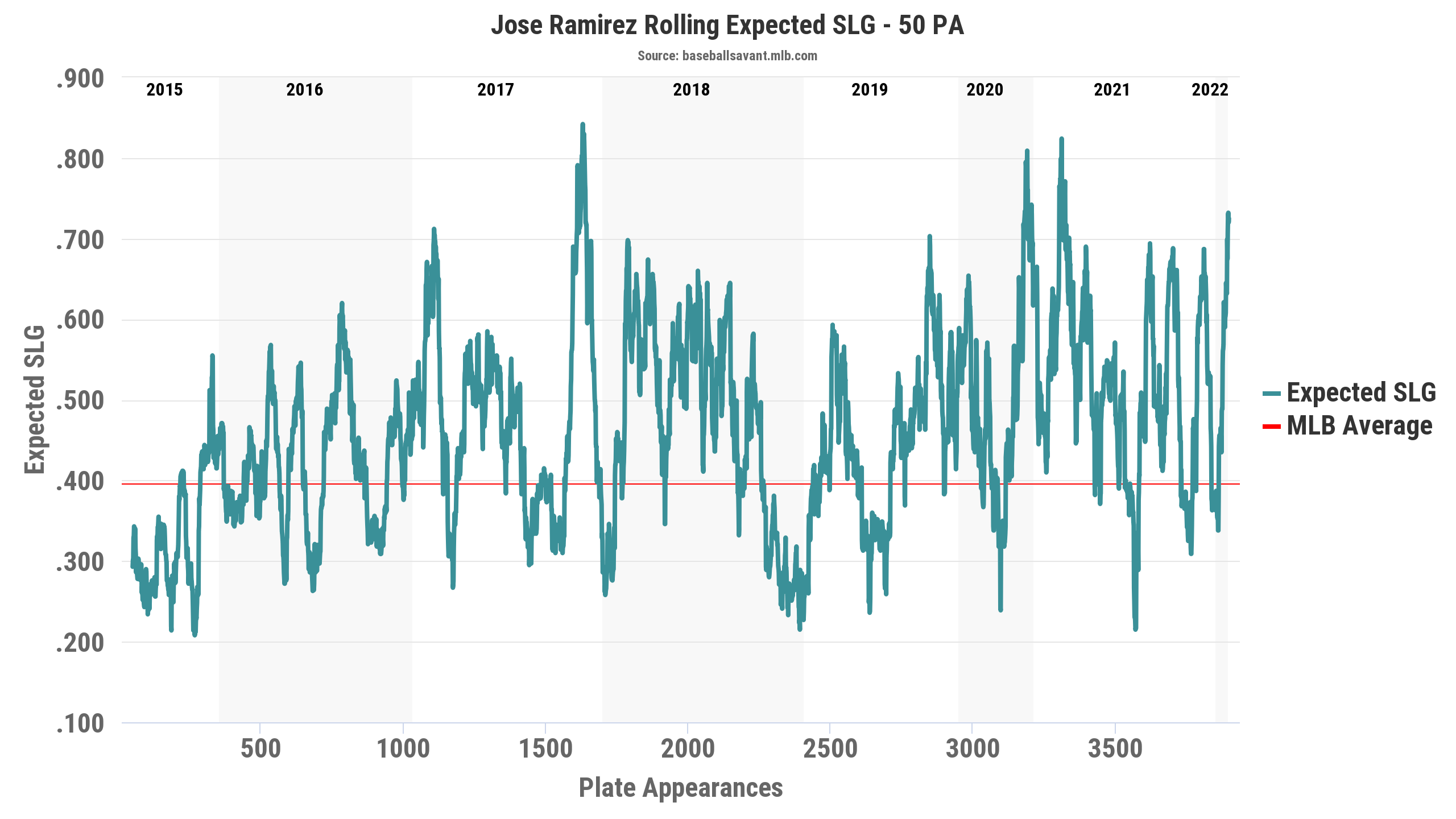
He’s had a few hotter stretches in that regard, one early last year (.768 xSLG as of April 30), one in late 2020 (.809 xSLG as of September 24), and one in late ’17 (.830 xSLG as of September 20). Not coincidentally, both of those were part of seasons in which he ranked among the game’s heavyweights in terms of wRC+ and WAR.
Since the question is inevitable (it comes up in my chats with some frequency, at least): yes, the 29-year-old third baseman is building himself a case for Cooperstown, particularly with three seasons of at least 6.7 bWAR. Even so, Ramírez’s 35.2/33.1/34.1 career/peak/JAWS line leaves a lot of work to be done, which is hardly atypical at his age, but he’ll need to continue playing at an All-Star level. Within his peak score, he has low-hanging fruit in the form of seasons of 3.1, 2.5, and 1.5 WAR. With, say, a trio of five-win seasons (including this one) over the next three years — which is more or less in line with the ZiPS projection Dan Szymborski ran on the occasion of his five-year, $124 million extension — he’d boost that to 49.4/41.0/45.2. Add the remaining 11.8 WAR for which he’s projected through the end of the deal (2028, his age-35 season), and that’s 61.2/41.0/51.1, which would currently rank 18th among third basemen but is still shy of the standards (68.4/43.0/55.7) and competing for attention with current contemporaries Evan Longoria (57.5/41.9/49.7), Josh Donaldson (44.4/41.7/43.1), Arenado (45.4/40.3/42.9), and Manny Machado (46.7/38.8/42.8), all of whom figure to continue building their own cases.
None of those other third basemen is coming off as strong a season as Ramírez, though, and none of them is off to as hot a start in 2022, or projects to be a top-three player this year. He won’t sustain his extreme numbers, but Ramírez is playing at or close to his peak right now, and that’s worth appreciating.
Brooklyn-based Jay Jaffe is a senior writer for FanGraphs, the author of The Cooperstown Casebook (Thomas Dunne Books, 2017) and the creator of the JAWS (Jaffe WAR Score) metric for Hall of Fame analysis. He founded the Futility Infielder website (2001), was a columnist for Baseball Prospectus (2005-2012) and a contributing writer for Sports Illustrated (2012-2018). He has been a recurring guest on MLB Network and a member of the BBWAA since 2011, and a Hall of Fame voter since 2021. Follow him on BlueSky @jayjaffe.bsky.social.
That wasn’t a cutter that Keuchel threw him, it was a “home run pitch, bro.” Jose is the 🐐🐐🐐
Who the heck is this Brant Alyea?! Interesting career stats, this article has prompted me to take a look at his story sometime..
Definitely a name I’ve never heard of before! Looks like he was mostly a weak-side platoon bat, getting 57.5% of his PAs against lefties.
I well remember that incredible opening week or so that Brant Alyea had. He made the cover of The Sporting News that week, if I recall correctly. TSN was the bible for baseball fans back then.
Hard not to love Jose! When it came to his recent extension, he basically told his agent “Do whatever it takes to get a deal done”. He’s incredibly appreciative of Cleveland giving him the opportunity to play MLB and wants to spend his whole career there (and if possible, go into the HOF as a Guardian). A definite breath of fresh air. I’m certainly in favor of players maximizing their earning potential when they can. But at the same time, it’s great to see someone who recognizes that there are other things in life that are also important.
There was a point in time when I thought Ramirez was toast as far as his HOF chances. He had a 529 PA stretch from Late 2018 to mid 2019 where he put up a 81 wRC+. I’m stoked to see that he’s turned that around and is back on a convincing HOF trajectory.
I think HoF voters will be somewhat more lenient on low WAR totals from 2021.
I also sometimes forget how good peak Manny Ramirez was.
Peak Manny had, batting in front of him, Kenny Lofton, Omar Vizquel and Robbie Alomar hitting in front of him.
Their OBP in front of him in 1999?
Lofton: 0.405
Vizquel: 0.397
Alomar: 0.422
They were so good that Alomar actually drove in Lofton more than Ramirez (33 to 26).
You can get lost on Baseball Reference looking at that offense…
Ramirez hit cleanup the entire year…except for Opening Day (he hit 5th, behind Thome). Hargrove fixed that the next day.
Oh…and the three (Lofton, Vizquel and Alomar) combined for 104 SBs.
True. Manny having a career 154 OPS+ doesn’t hurt with the RBI totals either.
Jose has averaged 5.95 WAR/600 since the beginning of 2016.
That’s quite a peak. If he keeps it up another 3-4 years, I think he’s in.
For comparison, Harper has averaged 4.72/600 even if we start right at his monster 2015 season.
If anyone was as puzzled as I was by what “two overlapping streaks” meant in reference to a single-season 11-game streak, Jimmie Foxx drove in 31 runs over 12 consecutive games on August 2-15, 1933. He drove in 2 runs each in the first and last of those games, so he drove in 29 in 11, no matter whether you include the August 2 game or the August 15 one.
So, two overlapping streaks of 29 rbis in 11 games.
So nice to read this comment section and not have to wade through the “he’d look good in x uniform” comments. Thanks for the post, Jay!
He’s not one of the very best switch hitters (yet?), but he might be the most consistent from both sides.
Rose, Mantle, and Chipper were each considerably better from one side of the plate.
Carlos Beltran was very consistent from both sides and edges out Ramirez for now, though Ramirez might be the better hitter by the team his career is finished.
I just looked again, and Ramirez is already a better career hitter than Beltran even without taking into account that Beltran’s era had much better offense.
We haven’t seen Ramirez’s decline phase yet, but he could become the third or fourth best switch hitter (depending on where you value Rose).
Ramirez might not even be the best switch hitter right now – that’d be Wander Franco.