
Meatball Punchout Bonanza
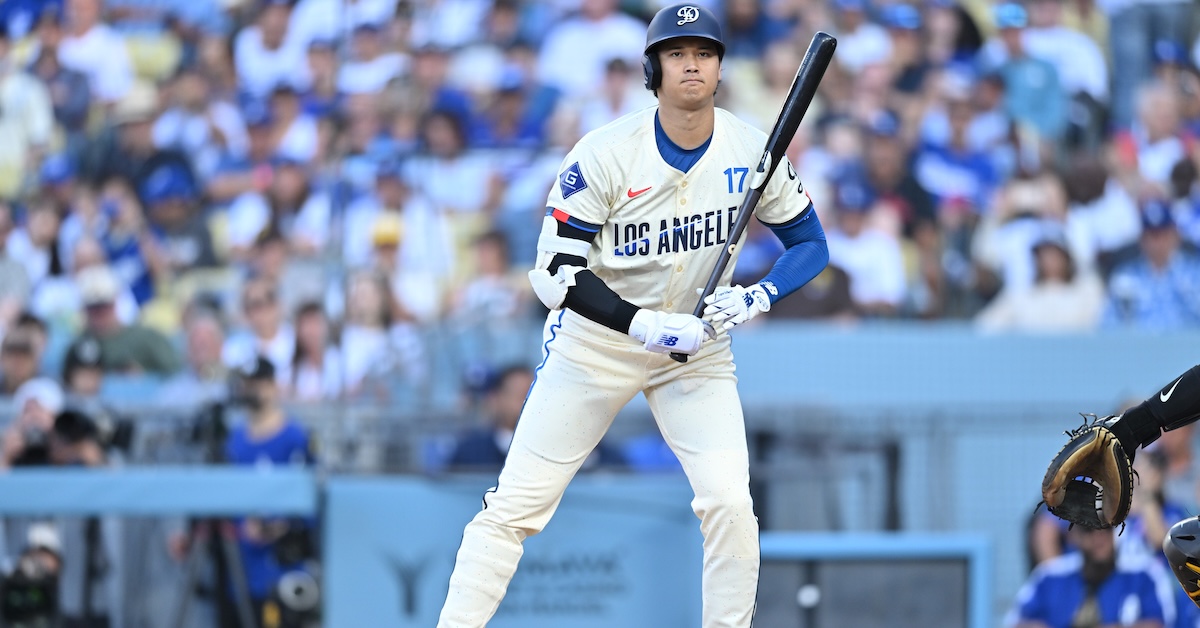
Yesterday, I dove into the wonderful world of Nick Pivetta’s middle-middle magic. It’s pretty crazy to think about. Pitches down the middle shouldn’t lead to a huge batch of called strikeouts, and yet opposing hitters can’t help themselves when Pivetta is on the mound. This two-strike dominance is fueling Pivetta’s best season as a professional. Obviously it is – all those free strikeouts can’t be bad.
When I see such an unexpected and excellent tactic, my mind naturally goes to the exact opposite of it. If Pivetta is getting ahead by doing this, surely some hitter must be getting victimized by having it done to them. If there are standouts in acquiring called strikeouts, surely there are players particularly susceptible to them. So let’s look at the list of the hitters with the most called strikeouts on middle-middle pitches, hereafter “meatball punchouts” with a hat tip to editor Matt Martell:
| Player | Meatball Punchouts |
|---|---|
| Gavin Lux | 21 |
| Oneil Cruz | 20 |
| Elly De La Cruz | 20 |
| Shohei Ohtani | 19 |
| Seiya Suzuki | 18 |
| James Wood | 18 |
| Ben Rice | 18 |
| Taylor Ward | 16 |
| Mike Trout | 16 |
| Ke’Bryan Hayes | 15 |
Wait, what? These are mostly good hitters! The anti-Pivetta being Gavin Lux is one thing – Lux is having a solid but not spectacular season. But Shohei Ohtani? Elly De La Cruz? The hitters who are worst at the thing Pivetta is best at are mostly great. Let’s look at it a different way:
| Player | Meatball Punchouts | wRC+ |
|---|---|---|
| Gavin Lux | 21 | 107 |
| Oneil Cruz | 20 | 92 |
| Elly De La Cruz | 20 | 117 |
| Shohei Ohtani | 19 | 173 |
| Seiya Suzuki | 18 | 124 |
| James Wood | 18 | 128 |
| Ben Rice | 18 | 126 |
| Taylor Ward | 16 | 121 |
| Mike Trout | 16 | 125 |
| Ke’Bryan Hayes | 15 | 63 |
Yeah, OK, whatever Ke’Bryan Hayes is doing isn’t working. Look at the rest of them, though! A nine-man lineup of the top nine on this list would be the best offense in baseball, with an average 123 wRC+. Hell, a 10-man lineup with Hayes included would still be the best lineup in baseball, with a 118 wRC+. By contrast, here are Pivetta and company along with some performance metrics:
| Player | Meatball Punchouts | ERA | FIP | SIERA |
|---|---|---|---|---|
| Nick Pivetta | 22 | 2.81 | 3.27 | 3.59 |
| Tanner Bibee | 18 | 4.62 | 4.50 | 4.13 |
| Yusei Kikuchi | 17 | 3.52 | 4.08 | 4.17 |
| Paul Skenes | 17 | 2.16 | 2.45 | 3.16 |
| Zac Gallen | 17 | 5.28 | 4.7 | 4.28 |
| Garrett Crochet | 17 | 2.43 | 2.59 | 2.94 |
| MacKenzie Gore | 16 | 4.04 | 3.50 | 3.52 |
| Hunter Brown | 16 | 2.36 | 2.91 | 3.28 |
| Shane Baz | 16 | 5.22 | 4.78 | 3.94 |
| Ranger Suárez | 15 | 3.25 | 3.23 | 3.77 |
Sure, there are a few clunkers, but that group has admirable run prevention numbers overall. Even if you had to run a 10-man rotation and use all of them, their average ERA works out to one of the top five staffs in baseball.
Squeeze this into your head: The batters who take pitches down the middle for strike three most often would, in aggregate, be the best offense in baseball. The pitchers who get those meatball punchouts most often would be one of the best rotations in baseball. This marker – lots of called strikeouts on smashable pitches – somehow works in opposite directions depending on which side of the ball you’re examining.
What gives? To explain that to you, I’ll first point to an old study of mine. The pitchers who draw the most swings and misses down the middle of the plate are amazing, just as you’d expect. The hitters who swing and miss most frequently on pitches over the heart of the plate? They’re also amazing! It’s the same weird phenomenon that I found here, only for swings instead of takes.
The reason that both of these counterintuitive effects exist comes down to contact quality. Since the start of the 2021 season, Aaron Judge is the best hitter when he puts a middle-middle pitch into play, with a .673 wOBA. Miguel Rojas is the worst hitter on those same batted balls, with a .308 wOBA. That’s an enormous spread, obviously. Think about who Rojas is and who Judge is, though, and you’ll have no problem understanding why.
Over the same time frame, Carlos Rodón has been the best pitcher in the majors at limiting damage on middle-middle contact, allowing a .356 wOBA. Patrick Corbin has been the worst, allowing a .456 wOBA. The gap between these two pitchers is only a third as wide as the gap between the two extreme ends of the hitting spectrum. In other words, hitters have a lot more to say about contact quality than pitchers do.
The identity of the batter at the plate matters far more to a pitcher than his own skill when it comes to limiting loud contact. You know this to be true implicitly; your best pitcher against Judge feels scarier than your worst pitcher against Amed Rosario, the last guy on the Yankee bench. Understanding this unravels the whole riddle.
Take a look at the 10 hitters we started this article with again. They’re a powerful group (again, except for Hayes). They take a lot of called strikeouts because they’re pursuing a strategy that lets them do what they do best – send the ball into orbit – most often. Expanding the zone as a power hitter is your worst nightmare. The more bad pitches you swing at, the more bad pitches you put in play, and the more pitchers can avoid the zone without walking you. Chases sap power and OBP at once, in other words. Taking strike three right down the middle is very bad too, of course, but if you trade one called strike three for four tough takes (or whatever ratio), you’re coming out way ahead. If taking the occasional easy pitch allows you to take many more tough pitches, the trade-off is acceptable.
Taking a called strike three isn’t hurting these guys as much as you’d think. Pivetta and company excel in two-strike counts, and overall, our group of 10 hitters does too. Sure, Oneil Cruz has been downright atrocious in two-strike counts, but even taking his woes into account, these hitters combine for above-average production with two strikes, meatball punchouts and all:
| Player | Meatball Punchouts | Two-Strike Run Value |
|---|---|---|
| Gavin Lux | 21 | 1 |
| Oneil Cruz | 20 | -15 |
| Elly De La Cruz | 20 | -2 |
| Shohei Ohtani | 19 | 16 |
| Seiya Suzuki | 18 | 9 |
| James Wood | 18 | -2 |
| Ben Rice | 18 | 12 |
| Taylor Ward | 16 | 0 |
| Mike Trout | 16 | 2 |
| Ke’Bryan Hayes | 15 | -2 |
Think of it this way: Ohtani has seen 141 middle-middle pitches in two-strike counts. Sure, he’s taken 19 strikeouts. He’s also socked 11 homers, two doubles, and four triples on those pitches. Those middle-middle strikeouts aren’t hurting him that much; his results on contact are so dang good that his overall production on two-strike meatballs is high even as he gives up a few freebies. Meanwhile, he’s seen 378 pitches outside the zone with two strikes, and he’s swung at 133 of them. He’d love to cut down on those swings. He sees more bad pitches than good ones and performs well on the good ones even as he takes a few for strikeouts. Why would he change this equilibrium, exactly?
That’s the delight of this counterintuitive finding. Power hitters can afford to be patient, even in two-strike counts, because they’re capable of producing runs with a single swing of the bat; convert 10 meatballs into one homer, and life is good even if one of them turns into a strikeout. Pitchers, meanwhile, don’t exert a ton of control over how far the ball is going to go; the best thing they can do is get a strike, whether called or swinging.
Now, would the approach of our most-meatball-punchoutable hitters work for everyone? Definitely not. Take that approach when you can’t punish pitchers for their in-zone insolence, and you’re just costing yourself strikeouts for no gain. Fail to lay off pitches in the dirt anyway, and you’re not getting anything for your patience; might as well hack away at the easy ones if you’re going to hack away at the hard ones.
There’s a selection effect here, of course – hitters who take a ton of called strikeouts and also don’t hit for power generally don’t stick in the major leagues. You have to bat a lot to lead the league in called strikeouts down the middle, and the worse you are, the less likely you are to bat a lot. I’d be remiss if I didn’t mention this potential shortcoming of the study.
Even taking that into account, though, this weird dichotomy between the Pivettas and Ohtanis of the world helps explain why strikeouts have continued to climb throughout baseball’s history. For pitchers, a relative lack of control over contact quality encourages strikeout-seeking behavior. For hitters, strikeouts are a reasonable sacrifice in pursuit of damage. Some of the best hitters in baseball strike out a lot because they’re trying to sock homers. As long as batters keep hitting for enough power to offset the strikeouts, they’re going to stick to what they’re doing. Thus, we get the current state of the world, where meatball punchouts are an indication of good pitching – and of good hitting.
Ben is a writer at FanGraphs. He can be found on Bluesky @benclemens.
How can you not be romantic about baseball statistics?
The reason is because the guys who take a ton of meatballs are not always facing the guys who throw a lot of meatballs. If you limited it to those two classes of players facing off against each other it’s a zero sum game. But if not, the meatball pitchers can befuddle the “non TTO sluggers” and the TTO sluggers can wreck the “non meatball pitchers.”
Well, it depends what you’re measuring. This article was measuring strikeouts for pitchers and approximately run value for hitters, which are not zero-sum with each other.
It’s also very possible that these “meatball pitchers,” the good ones at least, are still better than average against the meatball sluggers, yet still worse against those sluggers than they are against worse hitters.
I’m not sure if there’s a differential effect here, meaning that throwing meatballs is particularly effective relative to one class of hitter than another. This article creates the suggestion that it is, by noting that the big sluggers actually take more called middle-middle strikeouts, but in fact points out that they are not worse that expected overall on those pitches despite that.
If you want to have some real fun try and figure out who of that top 9 hitter lineup you would play at 3B (or who you would, hilariously, bench in favor of playing Hayes at third instead)
That part will work out because Trout will be hurt.
But I would be a little anxious about making Ben Rice my everyday catcher instead of my everyday first baseman (which would also mean one of Suzuki, Ward, or Wood would have to play first). I don’t suppose Will Smith or Adley Rutschman is 11 on that list?
Suzuki actually came up to the Hiroshima Carp as an infielder and played mainly 3B and SS his first season. We don’t have advanced metrics there, but his .907 career fielding percentage at 3rd over 73 games is roughly in line with Devers’ abysmal 2020 season defensively.
So yeah… maybe not Seiya.
That’s interesting because that could make him a candidate for first base if his range declines further. Not right now probably because he wants to stay an outfielder, but if he signs a big contract after he is a FA that could be where he ends up.
Probably Lux and regret it.
You can actually make a lineup using positions that guys have played at the major league level:
P- Ohtani
C- Ward/Rice
1B- Rice/Ward
2B- Lux
3B- De La Cruz
SS- Cruz
LF- Wood
CF- Trout
RF- Suzuki
Now obviously this would be a pretty disastrous level of defense, but I feel like it would definitely be manageable if you had a 123 wRC+ to go along with it
Another quality ‘bution. Thanks, Ben!
How in the world is Wyatt Langford not on this list?
I would say the same about Henry Davis. Even though he doesn’t qualify on # of PAs, have to think he’s in top 5 of missing meatballs. And Cruz is simply lost.
I think a lot of it can be explained by hitters guessing.
Better hitters guess better I’d venture. Remember Miguel Cabrera taking a pitch right down the middle to make last out of the World Series? That’s not because he is reacting. Tbf maybe vs Romo reacting would be possible, but I’d venture very few guys, maybe Arraez, maybe Hoerner type are reacting, and guys who react usually hit like the guys I mentioned…not hard.
Good hitters do not guess. Full stop. It might look like a guess from an outside perspective, but what is happening is that the hitter is either correctly identifying the incoming pitch, or not. They make their decisions based on what they think the pitch is, not on what it actually is. To an outsider, that might look like a guess.
For as bad an announcer as Joe Morgan was, this is something he taught me. Dude was an incredible hitter, and his explanation of this has stuck with me for years.
The thing I find most fascinating is that when I compare this to the February 2003 article about swinging at meatballs and missing, the list of “very good” players that shows up on all the lists has a lot of new names, and that was just 3 seasons ago. Excellence in baseball is fleeting for all but the most talented of players.
Very true.
If I’m reading it right, Trout is the only name on both lists.
Is this related to the recent usage trend of throwing high sliders on purpose? It strikes me that the easiest way to end up with more middle-middle takes is for the league to be throwing more middle-middle changes of speed/shape.
Might be, honestly. I think Pivetta’s ‘I’ll throw everything to every spot’ approach is definitely a big driver for him, it’s less clear if it’s a big driver for pitchers as a whole.
That’s Ke’Bryan “114 wRC+ on the Reds” Hayes to you, pal.
Let me just say that no one is going to be more excited if Hayes hits in Cincy than I am (I mean, excluding Hayes and people who know Hayes, of course). I have a chronic inability to correctly judge his talent; I’m just always a buyer of him taking a step forward. And maybe this time he will!
Would be very Pirates for him to immediately become a 5 WAR player because Cincinnati told to him “move your hands back a little” or something.
This will 100% happen. Just like Cole thrived immediately upon going to Houston, Musgrove unleashed hell upon arrival to San Diego, Jose Bautista became Babe Ruth the minute he was traded to Toronto (for a backup catcher, mind you). Sigh.
Hahaha. You forgot Tyler Glasnow. And… I’m sorry…
Lol, as a fellow long-suffering member of the Ke’Bryan Hayes fan club, that makes two of us.
Just responding to the lede, I’m guessing it takes some serious confidence in your strike zone discipline to take a pitch down the middle. Then, factor in all the various filters and selection biases that go into creating an MLB player, and you probably have your answer as to why a hitter taking meatballs is a sign of excellence. Repeat the exercise on a men’s league field, and you probably get a different result (though I definitely lead my team in meatballs taken, and I’m a good hitter).
I’ll read later, I promise 🙂
These batters are mostly good! (Or they play(ed) for the Pirates, who have made taking a called strike 3 down the middle after swinging at two in the dirt an art form).
Beautifully enumerated point!
Would be interesting to see not just total number of meatball pitches, but on a rate per total called strikes + total swings? Or even by total pitches. Counting stats will reward players who get more ABs and see more pitches, like Ohtani, who is tied for the league lead in total PAs.