
Miami Marlins Top 53 Prospects
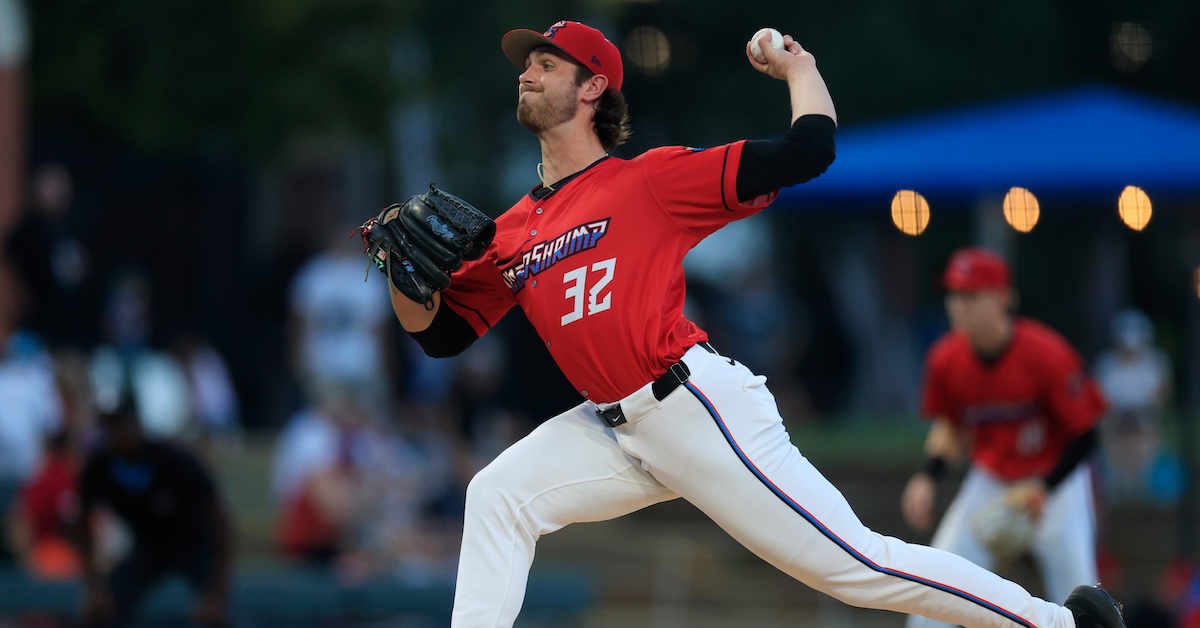
Below is an analysis of the prospects in the farm system of the Miami Marlins. Scouting reports were compiled with information provided by industry sources as well as my own observations. This is the sixth year we’re delineating between two anticipated relief roles, the abbreviations for which you’ll see in the “position” column below: MIRP for multi-inning relief pitchers, and SIRP for single-inning relief pitchers. The ETAs listed generally correspond to the year a player has to be added to the 40-man roster to avoid being made eligible for the Rule 5 draft. Manual adjustments are made where they seem appropriate, but we use that as a rule of thumb.
A quick overview of what FV (Future Value) means can be found here. A much deeper overview can be found here.
All of the ranked prospects below also appear on The Board, a resource the site offers featuring sortable scouting information for every organization. It has more details (and updated TrackMan data from various sources) than this article and integrates every team’s list so readers can compare prospects across farm systems. It can be found here.
| Rk | Name | Age | Highest Level | Position | ETA | FV |
|---|---|---|---|---|---|---|
| 1 | Thomas White | 21.7 | AAA | SP | 2027 | 60 |
| 2 | Joe Mack | 23.5 | MLB | C | 2026 | 50 |
| 3 | Aiva Arquette | 22.7 | AA | SS | 2028 | 50 |
| 4 | Karson Milbrandt | 22.2 | AAA | SP | 2027 | 50 |
| 5 | Robby Snelling | 22.5 | MLB | SP | 2026 | 50 |
| 6 | Luis Arana | 18.2 | A | 2B | 2028 | 45+ |
| 7 | Keyner Benitez | 20.1 | A | SP | 2027 | 45+ |
| 8 | Owen Caissie | 23.9 | MLB | RF | 2026 | 45 |
| 9 | Yohanfer Santana | 20.7 | R | SP | 2029 | 45 |
| 10 | Kevin Defrank | 17.9 | R | SP | 2031 | 45 |
| 11 | Dillon Lewis | 23.0 | AA | CF | 2028 | 45 |
| 12 | Eiver Mosquera | 19.8 | A | SP | 2031 | 40+ |
| 13 | Starlyn Caba | 20.5 | A+ | SS | 2028 | 40+ |
| 14 | Noble Meyer | 21.4 | A+ | SP | 2027 | 40+ |
| 15 | Josh Ekness | 24.4 | MLB | SIRP | 2026 | 40+ |
| 16 | Edgardo De Leon | 19.3 | A | 3B | 2030 | 40+ |
| 17 | Andrew Salas | 18.3 | A | SS | 2031 | 40+ |
| 18 | Dax Fulton | 24.7 | MLB | SP | 2026 | 40+ |
| 19 | Kemp Alderman | 23.8 | AAA | LF | 2026 | 40+ |
| 20 | Manuel Genao | 20.6 | AAA | SIRP | 2029 | 40+ |
| 21 | Cristian Hernández | 22.5 | AA | SS | 2028 | 40+ |
| 22 | Luis Cova | 19.4 | A | CF | 2030 | 40 |
| 23 | Adrian Pena | 18.1 | R | SP | 2031 | 40 |
| 24 | Brendan Jones | 24.1 | AA | CF | 2028 | 40 |
| 25 | Juan Matheus | 22.1 | AA | 3B | 2028 | 40 |
| 26 | Cam Cannarella | 22.8 | AA | CF | 2028 | 40 |
| 27 | Jared Serna | 24.0 | AAA | SS | 2026 | 40 |
| 28 | Chris Arroyo | 21.6 | A | RF | 2029 | 40 |
| 29 | William Kempner | 25.0 | MLB | SIRP | 2026 | 40 |
| 30 | Brandon White | 26.6 | AAA | SP | 2027 | 40 |
| 31 | Maximo Acosta | 23.6 | MLB | SS | 2026 | 40 |
| 32 | Liomar Martinez | 21.0 | A+ | SIRP | 2027 | 40 |
| 33 | Nate Payne | 20.8 | A+ | SP | 2029 | 40 |
| 34 | Deyvison De Los Santos | 23.0 | MLB | 1B | 2026 | 35+ |
| 35 | Josh White | 25.6 | MLB | MIRP | 2026 | 35+ |
| 36 | Ryan Ignoffo | 25.9 | AA | C | 2026 | 35+ |
| 37 | José Castro | 19.6 | R | RF | 2031 | 35+ |
| 38 | Victor Ortega | 22.4 | A | C | 2027 | 35+ |
| 39 | Johnny Olmstead | 25.9 | AAA | SS | 2026 | 35+ |
| 40 | Fenwick Trimble | 1.8 | AA | LF | 2028 | 35+ |
| 41 | Andrew Pintar | 25.2 | AAA | CF | 2027 | 35+ |
| 42 | Brandon Compton | 22.6 | A+ | LF | 2029 | 35+ |
| 43 | Andres Valor | 20.6 | A | CF | 2028 | 35+ |
| 44 | Eliazar Dishmey | 21.6 | AA | MIRP | 2028 | 35+ |
| 45 | Pedro Montero | 18.9 | R | SP | 2031 | 35+ |
| 46 | Joey Volini | 23.5 | A+ | SP | 2027 | 35+ |
| 47 | Dameivi Tineo | 22.9 | A+ | SIRP | 2029 | 35+ |
| 48 | Walin Castillo | 21.5 | A | SIRP | 2029 | 35+ |
| 49 | Grant Shepardson | 20.7 | A | SP | 2029 | 35+ |
| 50 | Santiago Solarte | 17.6 | R | 3B | 2032 | 35+ |
| 51 | Jacob Miller | 22.9 | AA | MIRP | 2027 | 35+ |
| 52 | Matt Pushard | 28.6 | MLB | SIRP | 2025 | 35+ |
| 53 | Garret Forrester | 24.6 | AAA | C | 2027 | 35+ |
Other Prospects of Note
Grouped by type and listed in order of preference within each category.
Upper-Level Bench Bats
Gage Miller, INF
Payton Green, INF
Matthew Etzel, OF
Ethan O’Donnell, OF
Brian Navarreto, C
A third-rounder in 2024, Miller didn’t hit much last year but has found his stroke this season. He’s added a drifty leg kick and appears to be swinging harder. He’s also hitting the ball harder and performing better, but it’s still 40 impact, and he’s no longer making a ton of contact. Green can stand on the left side and does enough well to play a depth role, but he lacks a carrying tool for more. Etzel is a corner bat who’s held his own at Triple-A. He’s a readymade depth outfielder. O’Donnell is a lefty-hitting outfielder drafted out of Virginia in 2023. He’s already risen to Triple-A, but has been in the honorable mention section of our lists throughout his career because of the huge hole in his swing against fastballs up and away from him. Navarreto has had a couple cups of coffee. He’s a glove-first emergency depth option behind the plate.
Newbies
Esmil Valencia, OF
Jake Clemente, RHP
Drew Faurot, 2B
Max Williams, OF
Dylan Jasso, INF
This group has all joined the org in the last year or so. Valencia was part of the return for Jesús Sánchez at the deadline last year. A finger injury has limited him to just 25 games in 2026 and seems to have had a dampening effect on his power and overall production. He has an ugly swing, with a huge bail out reminiscent of a Little Leaguer afraid of the ball. He can juice a ball down and in, but he hasn’t done so very often throughout his career, and the pitching is only going to get more capable of exploiting the holes in his swing. He has fans, inside the organization and out, but I’m skeptical he can hit. Clemente was Miami’s seventh-rounder last year. In a length role, he’s working with a mid-90s carrying fastball and a couple secondaries, highlighted by his north-south slider. He’s been wild, but he could have two 55s in short stints and has a middle relief ceiling if the strikes tick up in the bullpen.
Everybody loses a little pop when they trade metal for wood, but the gap between Faurot’s power data at Florida State and the pros is almost laughable. Williams, another draftee from Florida State selected one round earlier, also saw a significant dip in his measurable power numbers in pro ball last summer. He’s missed the entire season with a torn labrum. Jasso is the fourth player from the Ryan Weathers deal. He’s a corner infielder who could have an average glove at third and average power at maturity. Good fastballs loom as a major test.
Famous Names
Jacob Berry, INF
Dillon Head, OF
Carter Johnson, INF
PJ Morlando, OF
Berry was one of the most divisive first-round selections in recent memory. He’s maintained the good approach he’s had since his LSU days, but he hasn’t grown into the power that his backers assumed would translate from college. That said, Berry has turned himself into a versatile defender and is having his best pro season to date. The sum of the parts is enough to play some kind of up-down role. A first-round pick back in 2023, Head’s a good athlete and a plus runner. He’s missed a lot of time with injuries since draft day, and both his feel to hit and positional skills in center remain raw. Johnson signed for $2.8 million in 2024 as a second-rounder. He was a somewhat controversial selection, as some evaluators saw a slower-twitch guy without explosive bat speed. He’s a player who needs to hit, and it’s thus concerning that he’s batting .246 with a 26.7% strikeout rate in his third spin through Low-A. Morlando has battled a ton of injuries since entering pro ball and doesn’t have the same power or hit tool he once flashed as an amateur. He’s struggling in his second stint at Low-A, and even though he was drafted out of high school two years ago, he’s already 21.
Tweeners
Jesus Hernandez, INF
Carlos Sanchez, C
Emaarion Boyd, OF
Colby Shade, OF
Ian Lewis Jr., INF
Hernandez has made starts at four positions as a pro. He takes a big swing for a smaller guy, and he’s nonetheless a hit tool flier with a knack for making decent contact. Were he a better fit at short, he’d be on the main section; he has a chance to hit his way into some kind of utility role. Sanchez is an undersized catcher. He’s hitting for power, but I have concerns about his swing, and his size isn’t a good match for his position. Boyd can run and plays a decent center field. You’d like to see more contact or more power before thinking about a place on the main section of this list; he’s young enough to think it’s possible. Shade looks great in center and has been an elite base stealer at the lower levels, good end-of-roster skills that may not be enough to compensate for a light bat. Lewis is a speedster who can run into a ball once in a while. He’d be a better roster fit if he played a premium position.
Reliever Nightclub
Nigel Belgrave, RHP
Janero Miller, LHP
Jack Ralston, RHP
Will Schomberg, RHP
Colby Martin, RHP
Juan Reynoso, RHP
Jack Sellinger, LHP
Carson Laws, RHP
Belgrave is a low-to-mid-90s-and-a-slider reliever. It’s a pretty good hook, a low-80s sweeper with long break that flashes plus. He’s never been a great strike-thrower, though, and while his stuff doesn’t look terribly different this year, he isn’t missing many bats with it. We’ll tuck him down here until he gets right. Miller was a very exciting two-way athlete with big league potential as both a pitcher and an outfielder. He was seen often in the U.S. (usually at tournaments in Florida) as an amateur, and signed with the Marlins for just shy of $1 million in January of 2023. He hit and pitched in his first pro season, then only hit in his second (he K’d around 40% both years), and has pitched exclusively since. He’s only made one appearance on the Florida complex this year, and his velo was down a tick. He’s raw for obvious reasons, but at his best, he pairs mid-90s velo with a slider that flashes above average.
Ralston is a 28-year-old minor league vet. He works straight over the top and with an arm stroke that makes me shoulder hurt. His fastball and slider are pedestrian (though he’ll touch 95), but his split is at least plus with devastating late sink. He throws it half the time, and the whole package is just funky enough to work. Schomberg is a low-slot, spin-to-win righty. He’s spent most of his career in a length role; we’ll see if he throws meaningfully harder in shorter stints. Martin touches triple digits and flashes a plus north-south slider. He needs to throw more strikes to reach the main section of this list. Reynoso is working out of the High-A bullpen. He’s a high-slot, low-release righty who touches the upper 90s and has a couple sharp breaking balls. He might be too wild to profile. Sellinger is a Double-A lefty who turns 27 later this year. While he can touch 95, he leans on his slider, which has an elite spin rate. He doesn’t always execute the pitch and his control has been just fair throughout his career, but 3,000 rpms is 3,000 rpms. He’ll have teams checking in on him until he hangs ’em up. Laws is primarily a fastball-slider pitcher. He’s been hit hard, but he’s throwing in the mid-90s, the stuff looks okay in a vacuum, and if he picks up a few ticks in short stints, there may be something here.
Complex Follows
Evan Da Souza, RHP
Hamlet Garcia, RHP
Abraham Hernandez, LHP
Ronny Muñoz, INF
Jose Paulino, RHP
Angel Brachi, INF
Kifraidy Encarnacion, LHP
Almen Tolentino, C
Johan Machado, INF
Da Souza touches the mid-90s and flashes a good curve. He’s still 16, so he’s eons away, but he has the size, arm strength, and athleticism of a big leaguer, and he’s off to a good start in his pro career, with nine punchouts and no runs allowed in his first two starts. To rank, or not to rank, that is the question with so many of these DSL pitchers with strong and erratic arms. In Garcia’s case, he touches 97 and has feel for spin, enough so that he’s a priority follow on the complex. Hernandez is a lefty who matches that rough description. After missing most of the last calendar year, he just returned from the 60 day IL in the last week. He was another of those six-figure international signees. Muñoz was one of Miami’s top signings in the 2026 international class. He’s a power-over-hit left side infield prospect who is putting up big exit velos for his age, but also swinging and missing a lot. If he ends up needing to move to third base, the strikeouts will be a bigger problem.
Paulino is a barrel-chested righty with upper-90s velo and a tight slider. He’s not especially projectable, and he’s walking more than a batter per inning in the FCL. Brachi came over to Miami from the Rays last winter in exchange for Victor Mesa Jr. He’s a utility infield prospect with contact skills, plus wheels, and a knack for getting hit by pitches; it’s happened 31 times in his brief career thus far. Encarnacion is a 20-year-old southpaw on the complex. He’s physically projectable, touches 100, and flashes a plus slider. That’s great, but he’s also walked 35 guys in 17.2 professional innings, and at some point you have to hit the barn. Tolentino is a slow-burn catching prospect. He hit well in the DSL in 2025 but is striking out a lot on the Florida complex, and he’s got a long way to go as a receiver. The risk on both sides makes him more of a flier prospect than one of the org’s top catchers. Machado is a lean utility prospect who’s repeating the DSL. He has the speed and athleticism to stay at short, and has main section upside if he fills out enough to develop even 40 power.
Length Arms
Aiden May, RHP
Patrick Monteverde, LHP
Julio Mendez, LHP
May was a compensatory pick who signed for $900,000 in the 2024 draft. He’s a sinker-slider-change length arm. The change, and to a lesser extent the slider, miss bats, but the overall package is underwhelming, and it’s fair to wonder if there’s an out pitch for better hitters. Monteverde briefly debuted last year. An upper-80s fastball limits the utility of otherwise shapely stuff. He could spot start. Mendez has been loitering in Low-A for awhile, where he’s starting to miss quite a few bats. He doesn’t have big secondaries, but he’s a lefty with viable arm strength and the pitchability to potentially work some kind of length role.
System Overview
There are a lot of players here. Both in the trade and international markets, Peter Bendix and Co. have prioritized acquiring a high volume of interesting players in lieu of one top talent. That strategy was readily apparent throughout my evaluation here, as well over 100 names were considered for the list. The Marlins want depth and they sure have it.
Remarkably, they’ve built one of the deepest farm systems in baseball while drafting pretty poorly, at least in the early rounds. Their top pick in the 2022 draft, Jacob Berry, is not on the main section of this list, and neither are their only seven-figure guys from 2024, PJ Morlando and Carter Johnson. With another top 10 selection last year and the sixth-highest bonus pool in the draft, Miami was able to dole out eight bonuses of $500,000 or more, but Aiva Arquette is the only one of the group I’m particularly enthused about. They haven’t whiffed on every early rounder — Joe Mack and Thomas White were large-bonus guys — and it’s certainly possible that I’ve botched the eval on some of these players. But for a team that generally drafts high, and one that won’t spend in free agency, reliably hitting big in those spots is crucial for their chances of contending for a playoff spot, and they haven’t executed often enough in recent years.
The Marlins have a couple of interesting pitching tendencies worth touching on. Let’s start in Latin America, where Miami tends to spend big on arms in a way that bucks the general trend. Most teams are wary of this demographic, as the bonus pool is a finite resource, and these kids are just so far away from the big leagues, both in time and physicality, that the attrition rate tends to be high. Some teams don’t invest much at all in pitching internationally, but the Marlins take a different tack, and tend to sign at least a few six-figure pitchers per class. It’s obviously a risky play, but I kind of like it. There’s value in zigging while everyone else zags, and it’s not like there aren’t any high-upside arms loitering about: Kevin Defrank, Manuel Genao, Keyner Benitez, Eiver Mosquera, Adrian Pena all have arm strength and an ability to spin the ball. They won’t all stay healthy or throw strikes, but if even one or two of them does, they offer the kind of star upside on the mound that the Marlins won’t ever acquire in a trade or on the open market.
Miami has an unusually high number of pitchers who throw really good curveballs. This tends to be a harder pitch to develop than the slider, but the team’s acquisition and pitching group seems to have found the secret recipe. This list features several pitchers with good feel for spin throwing a hard curve without any hump, and I’m pretty sure that Liomar Martinez is the only pitcher I’ve projected an 80 curve on all year.
On a less upbeat note, we have to talk about the injuries. It’s almost hard to find a pitcher on this list who isn’t out with, or returning from, a major arm injury. Every club sees their fair share of hurlers succumb to a UCL tear, but in Miami, it’s practically a rite of passage. The Marlins target velocity, they have a lot of pitchers who work with a high degree of effort, and they throw a ton of breaking balls, so it’s not shocking that there are some casualties here. But even by the standards of modern development, this feels like a lot of major injuries, and on the org’s end, it’s perhaps worth taking a hard look at their processes to see if there’s a way to reduce that number. Were I an amateur pitching prospect, a glance at the list of injured pitchers here would have me a little worried.
At the end of the day, though, this is a good system. There’s depth and upside, bats and arms, power, hit tools, and good defenders galore. The Marlins’ self-imposed financial limitations make it hard for the org to win, but at the very least there’s enough talent here to keep the lights on and stay competitive for a while.
Brendan covers prospects and the minor leagues for FanGraphs. Previously he worked as a Pro Scout for the Pittsburgh Pirates.
Brendan really crushed this. Much more accurate/updated outlooks than the Marlins lists from the last couple of years
Great job with this and so close to the finish line! My main gripe would be that I just can’t get behind putting a 60 on a pitcher with a current shoulder injury that will cause him to miss the rest of the season and who has barely pitched this year because of another injury (admittedly not arm related).
Truky blown away by Starlyn Caba’s unique “.255/.104/.440” slash line and “1836%” walk rate
They said it couldn’t be done, lol! Looks like .401 and 18.6% were intended.
I can’t imagine how much work they put into these lists. A few typos are gonna happen.
Truky!!
I still like White plenty and the stuff is nasty, maybe he will go the snell/glasnow route of the stuff being so good the command only matters a little. But he’s still a 55 fv for me.
I kind of thought he was on the border before all the injuries so I would round down now. The stuff is awesome enough that you don’t want to give up on him at all, it’s a Blake Snell or Jesus Luzardo starter kit. But he also looks a bit like Jay Groome and AJ Puk.
Fantastic write-up. But why exactly are the Marlins unable to spend more? New stadium, 9th largest US metro, and lots of wealth there especially post-2020 migration. They are one of the prime examples to point to whenever an owner is asking for a new stadium subsidy. I love baseball but we gotta stop giving taxpayer money out for stadiums. What did Miami get for covering 80% of the cost of the new ballpark?
Not that the point of public financing of stadiums should be allowing the team to spend more on players, anyway. Such a farce
They probably could spend more but not by much because they alienated their fanbase so badly no one wants to see them play.
Brendan, what has become of the Mesa bros?
Not Brendan, but Victor Mesa Jr, who turned out to be the better of the two, is in the big leagues with the Rays. Victor Victor Mesa appears to have washed out of the Marlins system in 2023.
This is without Caissie and with mack, without mack they drop to 224. This is probably farm grades I disagree with most so far, lot of the lower levels grades feel overly optimistic.
MIL: 287.5
MIA: 252
WSH: 242
LAD: 242
SEA: 241
DET: 236
SFG: 234.5
STL: 227
BOS: 212.5
MIN: 204
Pitt: 199
CHWS: 197
Tex: 192.5
TOR: 179.5
CLE: 172
BAL: 169
NYM: 167.5
AZ: 167
Col: 154.5
A’s: 145
NYY: 142.5
KCR: 139
CHC: 138
CIN: 123.5
LAA: 121
PHI: 116.5
ATL: 114.5
SDP: 68.5
HOU: 60
In addition to an 80 grade name, Fenwick Trimble is definitely advanced for age 1.8
Fangraphs is having a bit of fun with us. Fenwick Trimble is actually a character in the Dickens novel about the group of Londoners visiting America. In the story, he’s the player/manager for the Hartford Dark Blues.
Last bit about the injury rate in the system is interesting. It’s usually the Dodgers getting dinged for their injury rates.
It’s the teams with Rays-style pitching labs. Some of it is the sorts of guys they look for and some of it is what they are teaching.
This is the most thought anyone has put into the Marlins franchise in multiple seasons
You’re going to be moving Caba up pretty quickly, so you might as well wrap your head around that. Something seems to have clicked recently – since mid May he’s put up a .293/.453/.537 line over his last 12 games. If he stays healthy, with his glovework I’d expect the Marlins to be pushing him to AA soon to see if his progress at the plate sticks. If it does – he’ll be back into the MLB top 100 pretty quick.