
Michael Harris II Is On Fire
At the All-Star break, Michael Harris II was heading for his worst season as a professional. His solid defensive skills couldn’t make up for his woeful 47 wRC+, a .210/.234/.317 batting line that had neither on-base skills nor power. Between a league-low walk rate and only six homers, Harris had “accumulated” -0.8 WAR, a shockingly low number for the Braves standout. Only two Rockies, Brenton Doyle and Michael Toglia, had worse numbers.
Since the All-Star break, Michael Harris II has been one of the best hitters in baseball. In a mere 30 games, he’s racked up 2.2 WAR thanks almost entirely to his offensive prowess. He’s hitting a bruising .398/.413/.732, good for a 217 wRC+. That power outage? Forgotten. Harris has more home runs since the break (nine) than before it. Only two players in baseball – Nick Kurtz and Shea Langeliers – have a better wRC+ over that time span, or more WAR.
It can be hard to hold two opposing ideas in your head, particularly when those two ideas are “Michael Harris can’t hit” and “Michael Harris is one of the best hitters in baseball.” One purposefully silly way of saying it: Harris has accumulated 158% of his 2025 WAR in the second half of the season. Another wild thing about this ridiculous tear: Between when I filed this piece on Monday afternoon and when it was published on Tuesday, Harris went 4-for-4 with a home run and gained 16 points of wRC+ and 0.3 WAR. For the rest of this article, the numbers I use are updated through the end of play on Sunday.
It’s unquestionably true that almost anything can happen for 100 plate appearances, but this is stretching the limits of “almost anything.” You don’t run a 200 wRC+ for a month on accident. You don’t run a 47 wRC+ for half a season on accident either. I had to investigate.
The greatest weakness in Harris’ game happens to be one that I’ve spent a bunch of time thinking about, in a broad sense, this year: He chases a ton of pitches. When he broke onto the scene in 2022 by winning Rookie of the Year, he walked only 4.8% of the time and posted a 137 wRC+ anyway. When he backed that season with 3.9 WAR in 2023, he walked only 4.6% of the time and still managed a 116 wRC+. In each of those years, he chased nearly as much as anyone in baseball as part of a swing-happy approach. It might have kept his walks down, but you can understand why Harris wanted to swing so much; when he made contact, good things were happening.
By 2024, the trade-off didn’t seem to be working as much. He still walked only 4.9% of the time and still chased around 40% of pitches outside the strike zone, but the excellent results on contact fell off a bit; less power, lower BABIP, and a below-average offensive line for the first time in his career. That brings us to this year: more chase, fewer walks, and a power collapse leading to unplayable offense at the break:
| Year | BB% | K% | Chase% | wOBACON | wRC+ |
|---|---|---|---|---|---|
| 2022 | 4.8% | 24.3% | 39.1% | .468 | 137 |
| 2023 | 4.6% | 18.7% | 38.4% | .405 | 116 |
| 2024 | 4.9% | 20.0% | 39.4% | .368 | 99 |
| 2025 H1 | 2.7% | 20.9% | 42.2% | .285 | 47 |
It’s an easy story to tell in your head. Harris’ swing-first tendencies lead to worse swings and declining damage on contact, but he leans into the slump by swinging even more to try to pull out of it. More swings means worse swings, worse swings means worse contact, and the two effects keep feeding on each other in a vicious downward spiral. So Harris dialed back his aggression to career norms and started to succeed again, right? Wrong:
| Year | BB% | K% | Chase% | wOBACON | wRC+ |
|---|---|---|---|---|---|
| 2022 | 4.8% | 24.3% | 39.1% | .468 | 137 |
| 2023 | 4.6% | 18.7% | 38.4% | .405 | 116 |
| 2024 | 4.9% | 20.0% | 39.4% | .368 | 99 |
| 2025 H1 | 2.7% | 20.9% | 42.2% | .285 | 47 |
| 2025 H2 | 2.5% | 15.6% | 44.0% | .541 | 201 |
Oh, so he’s just getting lucky with some batted balls falling, flattering his wOBACON, right? Wrong again:
| Year | wOBACON | xwOBACON | Barrel% | Hard Hit% | GB/FB | EV90 |
|---|---|---|---|---|---|---|
| 2022 | .468 | .422 | 10.1% | 45.3% | 2.07 | 108.4 |
| 2023 | .405 | .421 | 10.0% | 48.5% | 1.54 | 108.2 |
| 2024 | .368 | .410 | 10.0% | 47.0% | 1.65 | 108.6 |
| 2025 H1 | .285 | .354 | 6.1% | 39.6% | 1.69 | 108.2 |
| 2025 H2 | .541 | .502 | 13.1% | 51.5% | 1.22 | 109.6 |
Yes, he’s beating his expected stats by a smidgen, but that’s not the big story here. He’s hitting the ball much harder and getting it in the air more often, leading to meaningfully more valuable batted balls. Sure, this is small sample theater, but the movie playing in that theater is a summer blockbuster, full of huge explosions and crowd-pleasing action.
What has Harris changed? It’s actually fairly simple – he’s attacking in good attacking situations more often. We think of all swings for a given player as roughly equal, but that isn’t the case. Where the ball crosses home plate is incredibly important. When a batter swings at a pitch that’s three inches outside, the odds of success even on contact are low. When they swing at one right down the middle, the chance of contact goes up, but the increase in expected production on contact is far more important.
Separate the hitting zone up into four concentric quadrants: heart of the plate, shadow of the plate, chase zone, and waste pitch zone. Swings that make contact in the heart zone produce a .403 wOBA and .611 SLG. That’s a dead ringer for what Manny Machado and Vladimir Guerrero Jr. have done on contact this year. Swing at a meatball, and good things happen.
It gets progressively worse as you swing at pitches farther from the center of the plate. In the shadow zone, the edges of the strike zone and the area just outside that, contact produces a .327 wOBA. In the chase zone, we’re down to a .255 wOBA. By the time you get to the waste zone, pitches that rarely draw swings, contact produces a mere .250 wOBA and .301 SLG. That’s the kind of batting line that often gets you DFA’d. Heart of the plate contact? You’re a star. Way off the plate contact? Good luck on the waiver wire. It’s not quite as simple as that, but where you swing matters more for how much damage you do than it may first appear.
Harris has turned things around thanks to a straightforward plan: Attack the best pitches to hit more frequently. Here’s a smattering of times and locations where it’s good to swing, along with Harris’ swing decisions split up by halves:
| Count/Zone | First Half | Second Half |
|---|---|---|
| 0-0, Heart | 47.9% | 67.5% |
| Balls>Strikes, Heart | 75.9% | 84.0% |
| Balls=Strikes, Heart | 60.4% | 78.0% |
| Ball<Strikes, Heart | 90.0% | 96.3% |
That last item, more strikes than balls and pitches over the heart of the plate, isn’t particularly meaningful. Everyone swings a lot in that situation; swing rates go up because hitters have to defend the plate when they’re behind, and a pitch right down the middle in a tough count is begging for a healthy hack. Harris has seen 27 such pitches since the break and swung at 26 of them. The league swing rate in that situation is massive, too. The key changes are that when he sees heart-zone pitches early in the count and when he is ahead, Harris is swinging far more frequently.
That change has worked perfectly. In the first half of the season, around 45% of his batted balls came off of pitches thrown over the heart of the plate. He’s up near 60% in the second half. He’s making more in-zone contact overall, too. If you want your batted ball numbers to look good and you’re going to swing a lot, you absolutely can’t pass up the opportunity to take a hack at a meatball. Harris is doing much better at that. Is it really as simple as swinging at more good pitches?
Sadly, it’s not. Yes, he’s finding more pitches to hit. He’s also clobbering those pitches to a degree that is surely unsustainable. Since the break, he’s running a .600 wOBA (and .600 xwOBA) when he makes contact with a pitch down the middle. Awesome! Probably not going to continue even on those drivable pitches, though. He has approached that level before when he’s hot, and this seems very much like another hot streak. Here’s his rolling wOBACON on pitches over the heart of the plate for his entire major league career:
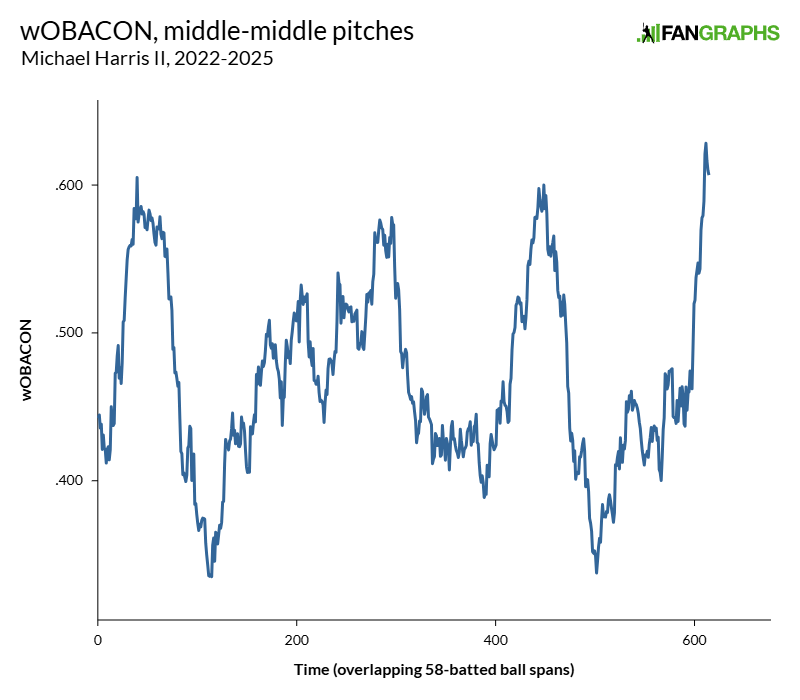
In other words, he’s done this before, but never for all that long. It’s probably a good bet that he’ll end up back in the middle of the range before too long. Sure, finding more hittable pitches will improve your contact quality, but that’s not enough to turn someone from a true-talent 47 wRC+ hitter into a true-talent 201 wRC+ hitter. Nothing is enough to make that transformation, in fact. For one thing, with the possible exception of Aaron Judge, no one is a true-talent 201 wRC+ hitter. It’s more accurate to say that because so much of Harris’ offensive output consists of balls in play – he barely walks, and he’s so aggressive early in the count that he doesn’t strike out much either – fluctuations in batted ball quality have an outsize effect on his overall batting line.
Take Bizarro MH2, for example: Pete Crow-Armstrong. Like Harris, he’s an aggressive swinger looking to do damage early. Like Harris, he doesn’t walk much and doesn’t have a huge strikeout problem. In the first half of the season, he had a near-.500 wOBA and xwOBA on center-cut contact, en route to a 132 wRC+. For the first half of August, he suddenly couldn’t hit: -52 wRC+, .115 BABIP, .024, ISO, no walks at all. He broke out of that with a scorching hot series over the weekend in which he batted .625 with an .833 BABIP, but he’s still performing meaningfully worse in the second half than the first despite a similar approach.
This made me wonder: Do hitters who chase more often experience more volatile overall results? MH2 and PCA would certainly make you think that. Or what about Ceddanne Rafaela (115 first-half wRC+, 36 second-half wRC+)? Julio Rodríguez (109 first-half wRC+, 153 second-half wRC+)? This could be random variation, of course, but where there’s smoke, there is sometimes fire, so I devised a simple test to find out.
I took the 2024 season and sliced it in half at the 81-game mark. For every hitter with 200 plate appearances in each half, I noted the difference between their first- and second-half performance as well as their chase rate. From there, I tried to correlate chase rate and wRC+ variation. The only problem is that I couldn’t find any.
Oh, you want more specifics? There was a .001 r-squared between chase rate and the absolute value of wRC+ change. There was a .002 r-squared between total swing rate and the absolute value of wRC+ change. The 25% of batters who chased most often had an average change of 27.3 points of wRC+ from one half of the season to the next. The 25% of batters who chased least? They had an average change of 27.1 points of wRC+ between halves. In other words, there’s no evidence that a swing-happy approach makes your output meaningfully more volatile.
Why is this? My theory is that there are two countervailing effects. Batted ball results are inherently extremely random; this we know. Naturally, then, if more of your output is made up of those, each individual event is going to be more random and variable, particularly in small samples. But that “in small samples” is kind of the key. Players who rarely strike out or walk have more batted balls. The law of large numbers comes into play here; it’s easier to have an outlier BABIP or wOBACON if you put 25 balls in play than if you put 100 in play. The contact-happy hitters might have more balls in play, more chances for the BABIP gods to decree fortunate or unfortunate outcomes – but pray to those gods enough, and their blessings will converge on the mean.
What does this mean for Harris in particular? It means that you shouldn’t read too much into half a season of even awful performance. The actual outputs, the results on contact? They’re wildly noisy, but the constituent parts of Harris’ 2025 season are going to end up looking a lot like his previous years. Similar swing decisions, similar chase rates, similar walk and strikeout numbers. Honestly, his batting line is probably going to end up looking a lot like his previous years, just with a very strange path to getting there; he has a career 109 wRC+, and we’re projecting him to hit at about that level for the remainder of the year, finishing with a 92 wRC+ and around 20 homers. Standard stats, wild path.
Figuring out what will happen next is hard! You might think that a hitter who is one of the worst everyday regulars in baseball for months will keep doing that. You might think that the sweet-hitting Rookie of the Year from 2022 will keep hitting. You might think that someone with a 200 wRC+ for a whole freaking month must be a great hitter. All of these things are mostly true. And yet none of them are completely true, because baseball is always complex and never predictable.
Will Harris’ newfound in-zone aggression keep working? Sure, when he’s going well, it’ll often be because he’s jumping on great pitches to hit early. But sometimes he’ll go poorly, and the opposite will happen. You can’t be as aggressive as Harris is on pitches in the zone without plenty of flailing swings, and getting behind in the count is particularly likely for free swingers like him. On the other hand, that free swinging unlocks some awesome results; the best time to hit is often early in the count — before pitchers can break out their lab-honed secondaries in strikeout situations — and Harris does that quite frequently.
The only real constant is change. I looked into Michael Harris II expecting to find some universal truth of aggressive hitters. Instead, I found chaos and impermanence, similar approaches feeding different outcomes. I think that’s just how baseball is; if you try to fit it to a strict blueprint, you’ll be disappointed. Sometimes you just have to look at a guy going from completely lost to utterly unstoppable and say, “OK, fine, that’s just the breaks of the game.”
Ben is a writer at FanGraphs. He can be found on Bluesky @benclemens.
It’s important to consider that Harris’ struggles were driven by a teamwide shift in offensively philosophy, something that he and Ozzie Albies struggled with in particular. Harris was less aggressively early because he was positioned back in the box and trying to get “a better look” at pitches with the idea of becoming more selective and drawing more walks. Both he and Albies absolutely could not implement this, vis-a-vis someone like Matt Olson, who had few problems, or someone like Marcell Ozuna, who took it to an extreme degree and basically just fished for walks even when his hip make it hard for him to drive the ball.
A combination of enforced passivity and then trying to “battle” once behind in the count obliterated Harris’ contact quality.
It’s somewhat annoying that it took Harris so long to simply go back to trying to kill the ball early in the count, but at least he’s there now.
Kudos, Ben! Some great lines in this piece (the theater one in particular got me good!)
One thing you didn’t touch on is that MHII has tweaked his stance a bit and seems to have had a meaningful drop in his GB rate. It’ll be interesting to see if that sticks, because he hits the ball so hard and so often that it’s a shame it’s on the ground half of the time. If he can get that down to even close to league average ~42%, his swing-happy ways would be MUCH more productive.
I hope to see this article in a balloon when FanGraphs turns 25
If anyone wonders what “seeing the ball well” looks like…MH2 is seeing the ball well right now.
I love that phrase, it’s one of my favorites. People think it’s such a huge understatement but it’s really not. Whenever Bryce Harper went on one of his huge tears I would say “he’s seeing the ball well” and people would look at me like it was an understatement, and maybe it was but those sorts of heaters are exactly what “seeing the ball well” looks like.
One of those things where you have to have played a bat and ball sport, even slow-pitch, to get.
Yep, ball goes from looking like a beach ball to looking like a golf ball. Been there many times playing ball throughout the years.
Can anyone forward this to Snitker? He probably won’t understand most of it, but for the rest of the season, maybe he won’t pinch run for the hottest hitter on the planet after his 4th hit of the night. Took the bat out of his hands as the tying run just to give him an extra 15 minutes of rest before the game ended.
Snitker deserves all sorts of scorn, but for the manager that rests his regular players less than anyone else in MLB to give a player a slight rest down eight runs after having already pitched Luke Williams, complaining just seems ridiculous. I mean, Snitker hit Harris clean up today! Of all things to rage at him about, these just seems like post hoc nonsense.
It is a weird guy to pinch run for. Not like White isn’t faster, but pinch running for a + speed guy just seems pretty silly
Harris did the same thing (though less extreme) in 2024, performing great in the second half after a less than stellar start. Same thing in 2023. His second half has been better every year of his career.
Perhaps a coincidence, or maybe something more to look into for a follow up article?
the rolling WOBACON graph captures this pretty well, I think, as does Ben’s conclusion: MH2 is gonna give you some extremes and you never know which one you’re gonna get and when
that said, i’d pay good money to whomever could figure out how to 1st half j-rod to resembled 2nd half j-rod
Jackson Chourio and Julio Rodriguez have shown this tendency too. I think there is a class of toolsy outfielders with hit tool problems where it sometimes takes a while for them to get out of their own way.
I think this is correct. Those types seem to need an in-season adjustment period, whereas players with a better eye and contact skills can be hot out of the box.
And the hope is that at some point they will figure out how to do it right off the bat before they are robbed of their incredible physical gifts.
But it is also true that it seems like this version of Michael Harris was especially bad. Chourio and Julio both started off their first MLB season looking that terrible but not since then, they’ve been more disappointing than “taken out of the lineup” bad.
Man, this is one of the better articles I’ve read on Fangraphs. Very well done, thank you for writing it.
He changed his stance
He’s holding his hands way higher than he was before. Seems weird to write this article without seemingly actually watching him hit.
Other analysts have pointed this out as a major contributing factor.
Fool me once, shame on you. Fool me twice…you can’t get fooled again!
Harris is still an average to below-average hitter whose plate discipline has not changed in a significant way unless you torture the data. He’s still swinging at 44% of pitches outside of the zone in the 2nd half (Statcast data), 3rd highest in the league.
He’s definitely on a heater post-ASB but here’s the full list of pitchers that he’s had extra-base hits against during that time: Slade Cecconi, Will Warren, Yoendrys Gomez, Tyler Zuber, Jon Gray, Reed Garrett, George Soriano, Trevor Megill, Jacob Latz, Kumar Rocker, Seth Lugo, Shawn Armstrong, Brent Suter, Grant Anderson, Kolby Allard, Ryan Gusto, Cole Winn, Cal Quantrill, Ryan Helsley.
Not exactly murderer’s row.
He happens to be running into some cookies for the past few weeks. Nothing we haven’t seen before.
Idk what that list of pitchers is meant to prove. It’s got good relievers, bad relievers, average-y starters, and bad starters.
As Harris showed in past seasons:
1) Chase rate isn’t a problem if your contact on chasing is unintuitively and semi-uniquely effective; and
2) You can still hit incredibly well if you just make good contact before a chase can get you into trouble, because most pitchers won’t eschew the zone in its entirety just because you happen to chase a lot.
With respect to the first point, when Harris first came up, he was falling over the plate but able to reach pitches well off the plate away, and punish them. He had a high chase rate, but had a weirdly high contact quality on non-strikes as a result, so it was fine.
With respect to the second point, we’re seeing this play out in the latter half of this year, i.e., the last few weeks. It doesn’t matter if your chase rate sucks if you just crush the 0-0 or 0-1 pitch. The homer he hit off Shane Smith last night in a 3-1 count is a rarity for him during the heater, he’s been spanking the ball early in the count and even behind in the count. Being able to wait out or beat pitcher’s pitches isn’t a prerequisite to being a good MLB hitter.
Why did I get downvoted? He’s 2 for 20 and slashing .100/.100/.250 since this article went to press.
I don’t think your empirical test is appropriate for answering the question. While some guys’ volatility might break down nicely at 81 games exactly, other guys’ volatility might be patterned in a different way. I’d suggest using a variance measure, maybe standev month-to-month wRC+ or something, and then see if that correlates with chasing/hacking.
I’m an opposing team and we have all this data. We are thinking that maybe we won’t give Michael anything right down the middle on the first pitch. I know it’s harder then it looks, but maybe a change-up or slider that falls out of the zone and see if he chases first pitch? With a guy swinging at balls over 40% of the time, I am not giving him anything early in the count to drive. Or am I missing something?
Harris started his tear in July. By August, it was probably clear to most teams that he was feeling it (in a good way). From August-on, he’s seen 76 first pitches, of which eight have been right down the middle, 24 have been in the “heart” and middle either vertically or horizontally, and another three have been in the corner of the heart zone.
Assuming he’s gonna crush them, 24/76 or 27/76 is a pretty good ratio for a chance to do massive damage, especially considering that even if he whiffs on a pitch out of the zone at first, he still gets another hack.
The ratio for 0-1 is pretty similar, he’s just seen a lot fewer 0-1 pitches in this run.
It seems inevitable that some team will try the “don’t throw him strikes” approach at some point. Until then I don’t think the nonexistent walk rate matters.
He has a better hitting line on the season than Mookie Betts. For a fan of a team that has stunk all year, this has made the last month of baseball watching at least a little bit better!