
More for Gore: Rangers Snag Top-Line Starter in Bulk Deal
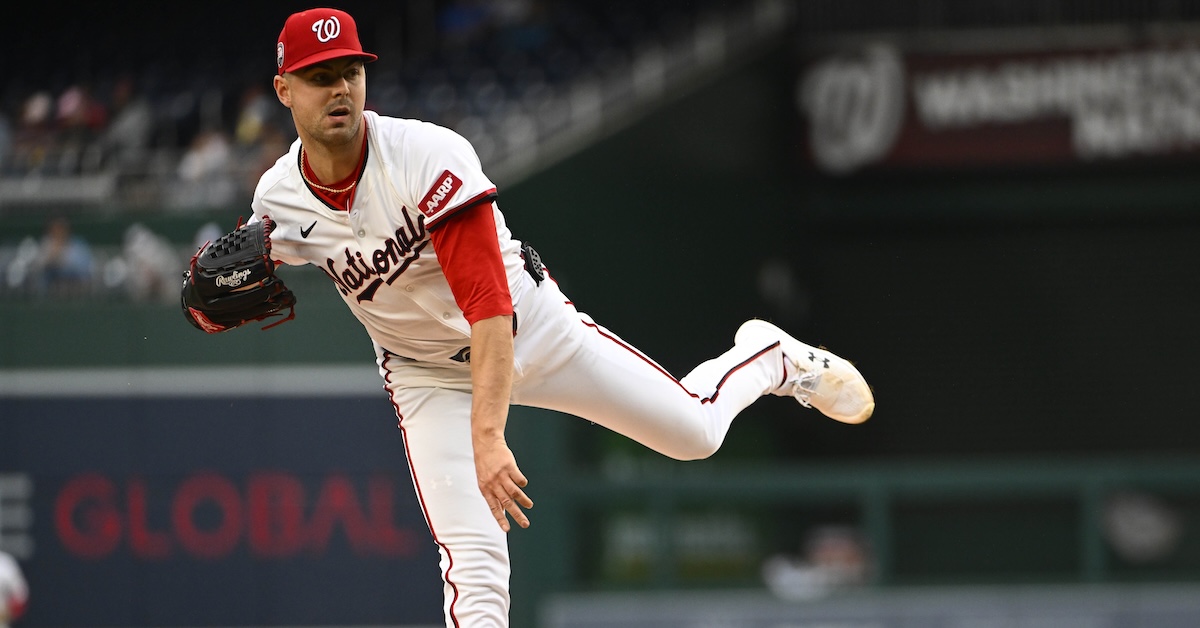
When the market is hot, it seems like it’ll never cool down. Forget the fact that we’re late into free agency and yet too early in the year for contract extensions. The last few marquee free agents to sign are starting to do so – hi, Cody – and that seems to have opened the floodgates for a series of trades. You’ve heard about all the noise the Mets have gotten up to, no doubt. They aren’t the only ones. The Rangers have jumped in on the action in a big way. On Thursday, they acquired MacKenzie Gore from the Nationals in exchange for prospects Gavin Fien, Devin Fitz-Gerald, Alejandro Rosario, Abimelec Ortiz, and Yeremy Cabrera, as Jon Heyman of the New York Post first reported.
In some ways, this trade has been a long time coming. Gore has been on the trade block for most of his major league career. First, he got sent from San Diego to Washington in the first Juan Soto trade. Almost immediately upon his arrival in the nation’s capital, however, he turned into a trade chip. The Nats were pretty obviously far away from competing, and Gore is the kind of arm that lots of teams dream about placing at the top of their rotation.
By 2024, Gore’s third year in the big leagues, the trade rumors were at full volume. Gore exploded out of the gate, with 98 strikeouts over 80 innings in his first 15 starts. He was a deadline target for many teams – but he slumped hard down the stretch, with a 4.48 ERA and 4.16 FIP the rest of the way, and no trade ever came to fruition. The Nats looked around that winter, didn’t move him, and then again held on after Gore came out of the gates hot, making his first All-Star appearance on the back of a 3.02 ERA (2.96 FIP) in the first half. He stayed put at the deadline – and once again slumped hard down the stretch.
That brings us to the present. Trading Gore always made sense, and the new Nationals front office finally did it. He still has two years of team control remaining, and the price for controllable starters has never been higher. His service time status lines up very well with the situation in Arlington. The Rangers have a roster that is built to contend now. Their lineup has five different hitters in their 30s (baseball-age wise, Jake Burger doesn’t celebrate his 30th until April), and only two who are 25 or younger. The rotation is led by Jacob deGrom and Nathan Eovaldi, two heroes of the 2010s who are in the twilight of their respective careers.
The lineup and the top of the starting rotation paint a clear picture: Get rings or die trying. The problem with that? The next three starters in the rotation didn’t come even close to fitting that bill. Jack Leiter and Kumar Rocker are both post-hype sleepers with a ton of uncertainty around them. Leiter is up right now, and Rocker is down, but I wouldn’t want to count on either of them as my third starter. Jacob Latz, a swingman who made eight starts in 2025, is getting stretched out as a starter. Cody Bradford, who had internal brace surgery to repair his UCL last spring, will figure into the equation somewhere as well. Does that sounds like a rock-solid playoff rotation to you? Yeah, I thought not.
Adding Gore to that puzzle changes things meaningfully. With a strong top three, fielding two spots becomes notably easier. If you’re looking at four mid-level pitchers to fill three rotation spots, there’s almost no margin for error. If you’re using those same four to fill out the no. 4 and no. 5 starter roles instead, you might just be able to make it work. The pre-trade Rangers roster looked dangerously understaffed. One or two injuries, and some very marginal pitchers would be covering important innings. Now, there’s at least some margin for error.
This improvement banks on Gore pitching like he does in the first half for a full season. It hasn’t happened often – in his career, he’s more than a run’s worth of ERA and FIP worse in the second half – but I have no trouble at all convincing myself that it could work. His vertical arm slot and explosive fastball pair well with a big 12-6 curve, and a tight slider completes the up-and-down-the-zone attack. There’s no worry about him being susceptible to platooned lineups despite the lack of a real changeup. In his career, he has reverse splits; his fastball/curveball combination diverges by roughly 40 vertical inches, and neither has a profile that’s friendly to opposite-handed hitters, so he just spams those two pitches against righties to great success.
Against lefties, Gore throws his fastball and slider a combined 86% of the time. I’m shocked that he hasn’t worked on something with more horizontal movement to further bedevil lefties, but the truth is that his pitch mix hasn’t been the problem. He has the tools to attack everyone. His issue has been with maintaining them. Here’s a split of Gore’s first- and second-half pitch model grades in each of the past three years:
| Year | 1st Stuff | 2nd Stuff | 1st Command | 2nd Command | 1st Overall | 2nd Overall |
|---|---|---|---|---|---|---|
| 2023 | 59 | 54 | 48 | 47 | 54 | 49 |
| 2024 | 64 | 58 | 51 | 50 | 57 | 50 |
| 2025 | 59 | 55 | 51 | 42 | 55 | 43 |
| Average | 61 | 56 | 50 | 46 | 55 | 47 |
Solve this problem, and the Rangers will have won this trade handily. I don’t know how to solve it, obviously. I don’t think you can just keep telling Gore it’s early June and call it a day. But you don’t trade for the guy if you don’t have some plan for this, because the pattern is fairly clear at this point. He’s wearing down in the second half, throwing worse stuff with worse command. That’s the difference between a top 30 pitcher in baseball and a mid-rotation starter.
I don’t think that Texas has any special ability to fix this issue, but that’s not to say that they have no chance of figuring something out. Sometimes a new team is all a player needs to break out of a rut. Sometimes a random offseason tweak or adjustment takes hold. Sometimes variance just happens in the good direction instead of the bad one. Sometimes there wasn’t even a real problem, and the perceived “pattern” itself was just variance in the first place. If you told me Gore was better in the second half than the first in 2026, I’d be only mildly surprised. The only constant in baseball is change.
Regardless of that seasonality of performance, though, Gore fits the Rangers’ window like a glove. There’s no tomorrow, and so Gore’s two years of remaining team control are just right. Any more, and they probably couldn’t afford to trade for him. But that second year means that they won’t face this same bind next year if they want to try to get one more year of contention out of their veteran core. If they change their minds and embark on a rebuild instead, Gore would become a valuable trade chip immediately.
The players the Rangers sent out to get the deal done are so numerous that they’re getting their own article by Eric Longenhagen. At a high level, though, the Nats asked for quantity over quality. In future value terms, we’re talking about a 45+, a 45, a 40+, a 40, and a 35+, give or take, a nice sampler platter without a clear headliner. Our prospect team likes Fitz-Gerald best, but even then, it’s a bet on growth and variance, not a can’t-miss profile. We don’t project any of the five to reach the majors in the upcoming season, with Ortiz the only possible exception.
The Nationals surely don’t care about that. They finished last in the NL East last year, and their big offseason move has been trading their only good pitcher. They’re targeting 2027, or 2028, or 20xy, with x and y carefully left undefined. This return is the equivalent of saying, “We know we’re bad, and we need to bulk up our farm system.” My general view is that bad teams should try to build deep and broad farm systems to best use the playing time and developmental window that their current major league deficit affords them.
Without any clear top prospects heading to D.C. in this trade, my simplistic surplus value model has the Rangers coming out “ahead” on the deal. But I don’t think that’s quite right. Fien was a first-round pick just last year. Rosario’s upside is enormous. Fitz-Gerald drew Jed Lowrie comps from Eric. (He did, to be fair, qualify that with “if things break right.”) Each of the five prospects has real major league upside, and with the timeline the Nats are working on, each will get plenty of chances to develop. I’m rounding up on the package as a result; it’s kind of a best-of deal, where one of them spiking a high-end outcome would make up for the rest of them flaming out entirely.
That doesn’t mean I dislike the deal for Texas, though. My read on this situation is that this trade was one of multiple options the Rangers were pursuing, probably along with one for Freddy Peralta, who fits their window even better than Gore, before the Mets sent two of their top prospects to Milwaukee for him. With two potential trade targets, the Rangers could bargain and take their time. When one came off the table, though, their roster forced their hand. This team clearly needed a third starter, and it doesn’t seem like Texas was interested in Framber Valdez, the best remaining free agent. It had to be a trade, then, and Gore was an obvious move. I’d speculate that the Nats stuck to their price and the Rangers begrudgingly met it while carefully avoiding trading away potential 2026 contributors.
That’s a boring conclusion, I know. I’m sorry! I wish I could say that someone ripped someone else’s face off in this deal, or that it was the underpay of the century, or that the Nats are redefining the way trades work. None of that is true, though. This is a reasonable deal for a very good pitcher with very real durability concerns. I’m sure that the Nationals brass is happy to depart the Gore roller coaster ride with plenty of prospects as a parting gift. I’m sure that the Rangers think they added an ace without sacrificing anything they’ll miss this year. That’s about as good as it gets for a five-for-one trade.
Ben is a writer at FanGraphs. He can be found on Bluesky @benclemens.
A very fair trade indeed. Gore has been on and off very good but no gust and Nats get good upside for two years they aren’t competitive even with Gore. 2029 looking good though