
Orioles Throw Good Money After Baz
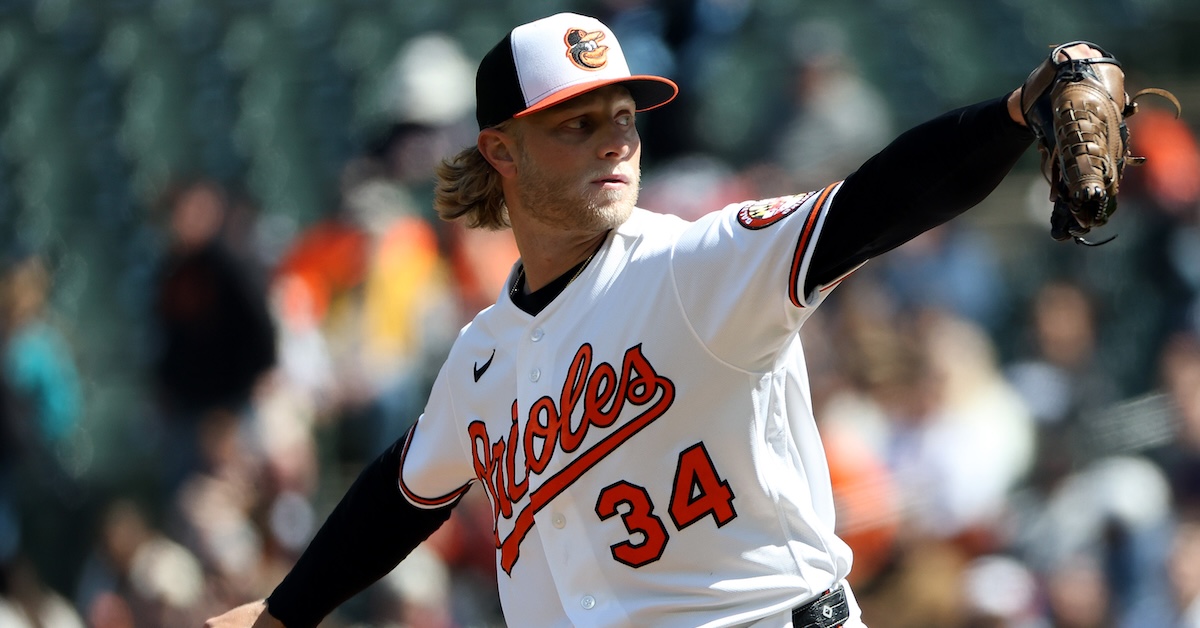
Don’t believe in love at first sight? The Orioles do. Back in December, Baltimore traded a draft pick and four prospects — including two top-40 picks from their 2025 draft class — to Tampa Bay for right-handed pitcher Shane Baz. And on Friday, roughly 48 hours before Baz threw his first competitive pitch in orange and black, they signed him to a five-year, $68 million contract extension that will keep him in Maryland through 2030. It’s the richest contract the Orioles have ever given to a pitcher.
Baz did OK in his first Orioles start, by the way. The Twins scored four runs in 5 1/3 innings, and Baz allowed at least one hard-hit batted ball (i.e. 95 mph exit velo) on each of the four pitch types he threw. That included his changeup, which he only broke out four times and which only generated one swing.
All four of those runs came in a second inning that wasn’t great, but probably would’ve been a little less ugly with better defense. Trevor Larnach hit an RBI single that not one but two Baltimore infielders could’ve made a play on, and then Tristan Gray hit a bases-clearing double past Tyler O’Neill, who chose that moment to attempt some sort of somersaulting maneuver:
But even with that one awful inning, Baz was solid enough. He touched 99 mph with his fastball, struck out four without walking anyone, and allowed just one batted ball — Gray’s double — with an exit velo of more than 100 mph. Some good news, some bad news, in other words.
The point of this whole post is obviously to analyze Baz specifically, and whether he’s likely to either over- or under-perform this deal, but there are some interesting narrative threads to unspool here first.
Although the Orioles managed to avoid selling from their absolute top tier of prospects, they gave up quite a bit in volume to acquire Baz.
Now, on the one hand, this is a 26-year-old who just made 31 starts and finished 22nd in the American League in innings pitched. He was not only cheap, but under team control through 2028, and was recently acclaimed as having no. 1 starter potential. Between the peak of Baz’s prospect shine and the day he was traded, he missed 23 months while recovering from Tommy John surgery. In 45 starts since his return, he had a 23.8% strikeout rate, an 8.8% walk rate, an ERA of 4.29, and a FIP of 4.27. Home runs had been an issue, ballooning to 1.41 dingers per nine innings in 2025.
Overall, Baz was a 2.0-WAR pitcher in 2025, which feels like a happy compromise: Some of the surface numbers were ugly, but overall, he was fine.
One of the weirdest stories of the past 30 years has been Baltimore’s inability to develop even “fine” starting pitchers. In the Wild Card era, the Orioles have had just 23 pitchers make 50 or more starts in their colors; every other team has at least 25, and the Pirates — hardly the picture of stability over the past three decades — have had 36 pitchers make 50 or more starts.
Dig into the results and you can see why the Orioles have changed out their pitchers so often. Let’s lower the threshold to 40 starts: Two-thirds of Orioles pitchers with 40 or more starts for the team posted an ERA- of 100 or higher. Only five — Kyle Bradish, Erik Bedard, John Means, Jimmy Key, and Mike Mussina — have an ERA- under 90.
Have a gander at this table:
| Name | W | L | GS | IP | K% | BB% | ERA | FIP | ERA- | WAR |
|---|---|---|---|---|---|---|---|---|---|---|
| Sidney Ponson | 73 | 84 | 212 | 1353 1/3 | 14.0% | 7.8% | 4.85 | 4.61 | 107 | 16.5 |
| Erik Bedard | 40 | 34 | 111 | 653 1/3 | 22.7% | 9.0% | 3.84 | 3.60 | 85 | 15.4 |
| Kevin Gausman | 35 | 49 | 127 | 728 2/3 | 21.1% | 7.0% | 4.24 | 4.23 | 100 | 10.4 |
| Wei-Yin Chen | 46 | 32 | 117 | 706 2/3 | 18.5% | 5.8% | 3.72 | 4.14 | 92 | 9.4 |
| Chris Tillman | 74 | 60 | 205 | 1137 1/3 | 17.3% | 8.9% | 4.57 | 4.72 | 109 | 9.2 |
| Daniel Cabrera | 48 | 59 | 146 | 840 1/3 | 17.2% | 12.6% | 5.06 | 4.82 | 112 | 8.0 |
| Dean Kremer | 41 | 38 | 123 | 658 | 20.3% | 7.8% | 4.27 | 4.36 | 104 | 7.7 |
| Kyle Bradish | 19 | 15 | 67 | 357 2/3 | 25.8% | 7.8% | 3.47 | 3.50 | 87 | 7.1 |
| Dylan Bundy | 36 | 44 | 103 | 574 2/3 | 23.2% | 7.9% | 4.79 | 4.82 | 108 | 6.8 |
| John Means | 21 | 26 | 73 | 390 | 20.2% | 4.8% | 3.65 | 4.59 | 81 | 6.7 |
| Grayson Rodriguez | 20 | 8 | 43 | 238 2/3 | 25.7% | 7.8% | 4.11 | 3.80 | 100 | 3.9 |
| Miguel González | 39 | 33 | 95 | 565 1/3 | 17.0% | 7.7% | 3.85 | 4.73 | 95 | 3.5 |
| Brian Matusz | 21 | 33 | 68 | 354 2/3 | 17.6% | 8.7% | 5.51 | 4.82 | 129 | 2.9 |
| Brad Bergesen | 17 | 24 | 59 | 352 1/3 | 11.8% | 6.7% | 4.60 | 4.73 | 106 | 2.7 |
| Zack Britton | 18 | 17 | 46 | 250 | 15.0% | 10.1% | 4.86 | 4.25 | 116 | 2.5 |
| Jake Arrieta | 20 | 25 | 63 | 344 2/3 | 16.8% | 10.2% | 5.41 | 4.74 | 129 | 2.4 |
| Tyler Wells | 16 | 16 | 50 | 249 1/3 | 21.4% | 6.5% | 4.11 | 4.82 | 103 | 1.8 |
There are a few good pitchers here, and a couple honest-to-goodness developmental triumphs. I don’t think Bradish is, like, an ace, but he’s a good no. 2 or no. 3, and getting that out of a former fourth-round pick acquired as trade bulk is a big win. So is getting anything like regular contributions from a Rule 5 guy (Wells).
But there are also more than a few pitchers who have struggled to actualize until they either moved to the bullpen (Britton, Matusz) or were traded (Arrieta, Gausman).
All that time, the Orioles have been willing to let go of what good starters they’ve had. They just traded Rodriguez this offseason, and let Corbin Burnes walk as a free agent the one before.
So, yeah, even if Baz is only a mid-rotation starter going forward, he’s valuable enough not only to trade for, but to keep. He settles into a Baltimore rotation behind Bradish and Trevor Rogers — who, believe it or not, the Orioles might have actually fixed — and ahead of veterans Chris Bassitt and Zach Eflin. That’s not a terrible group, one through five.
But as good as Bradish and Rogers have been, they haven’t gotten paid yet. Bassitt and Eflin are the kind of veteran innings-eaters the Orioles had habitually over-indexed on. (The Orioles’ innings leaderboard over the past 30 years is heavy on Bruce Chen and Bruce Chen-like individuals.)
Baz’s $68 million contract is, as I’ve said, the richest the Orioles have ever handed to a pitcher. It’s also worth $1 million more than the guarantees in Samuel Basallo’s pre-arbitration extension, which makes it the fifth-heaviest deal in franchise history.
Which is kind of wild, because $68 million is not that much in this day and age. Drive two hours northeast from Baltimore on I-95 (a journey that, incidentally, costs about $68 million in tolls — thanks for nothing, Delaware) and you’ll find the Phillies, who have eight players currently on contracts worth more than Baz’s, plus a ninth (J.T. Realmuto) who just re-signed after playing out a nine-figure deal, and a 10th (Nick Castellanos) who’s still cashing checks from the team even though he got released this spring.
OK, the Phillies are a big-market team whose owner is trying to turn his tobacco money into a World Series before the Grim Reaper’s breath gets too hot on his neck. Bad example. Let’s go the other way on I-95, to Washington. The Nationals have only existed since 2005, and have been in rebuild and/or tank mode for most of that time. They’ve also either traded or let walk Juan Soto, Bryce Harper, Trea Turner, Anthony Rendon, and Max Scherzer, only to see those five players sign long-term contracts worth a combined $1.77 billion.
And yet the Nationals have signed five contracts worth at least $126 million (including Stephen Strasburg twice). That’s almost twice as much as the Orioles guaranteed Basallo and Baz.
I hope this, along with Pete Alonso’s market-beating deal, signals a new commitment to maintaining a competitive core under new-ish owner David Rubenstein. (Not nearly as much as Gunnar Henderson’s agent hopes this is the case, I presume.)
OK, now let’s talk about the nuts and bolts. I buried what would usually be the lede in a story like this because this is a pretty reasonable, straightforward contract. Five years, overwriting 2026 and buying out two free agent seasons, with extremely modest bonuses ($50,000 for each All-Star appearance or Cy Young win) and no options in either direction.
Baz got a $4.1 million signing bonus as a first-round pick of the Pirates, but that was all the way back in 2017. He had never made more than $1.45 million in any of his previous major league seasons, and was due to make $3.5 million in 2026. He was already three-car garage rich, but now his kids are going to be three-car garage rich too.
The structure of the contract is interesting as well, because it’s heavily backloaded. That’s got the same practical effect of a deferral — money later is worth less than money now — which could be useful to an owner like Rubenstein, as compared to a less cash-poor owner like Steve Cohen or the money-printing Hydra that owns the Dodgers. A lot of extensions spread the value of a contract out, but Baz’s pays him less now and more later: $21.8 million in 2029 and $25.8 million in 2030, which would’ve been his first two free agent seasons.
In addition to the cashflow benefits — the Orioles got Baz on the Wimpy-from-Popeye payment plan — this allows the Orioles to maintain a consistent $13.6 million CBT value for Baz. This year, the Orioles’ CBT hit for Baz is $11.8 million higher than his actual salary, and who gives a damn? The Orioles are $27 million from the lowest tax threshold. But by 2030, they’ll be paying Baz $12.2 million more than his tax hit.
All of this assumes that the next collective bargaining agreement maintains something like the status quo. There’s a possibility that a work stoppage could result in radical change, leaving us with either perpetual indentured servitude for all ballplayers, or the Social Democratic Worker’s Baseball League. (Slogan: Let It Eat the Rich.) I’m assuming that neither of those edge cases comes to pass, not just because that’s the likely outcome, but because Baz’s contract is easier to analyze in that context.
It’s an open question how well Baz will ultimately perform over the next five years. Last year, he added 1.4 mph to his average four-seamer velocity, compared to 2024, at the cost of some of the rise and run that made it an effective pitch in 2024. The results were more or less the same.
Baz also reversed the usage of his knuckle-curve and slider in 2025, relegating the latter from his primary breaking ball to a show-me pitch to be used against righties only. And just as well, because it got creamed. So did his cutter, which was new for 2025, though that pitch probably helped keep opponents off Baz’s heater. For 2026, Baz is at least tinkering with a sinker, which he threw eight times to right-handed hitters in spring training, but did not unholster against the Twins.
Ultimately, Baz is at a watershed moment in his career. He’s a 26-year-old with an upper-90s fastball and a truly evil knuckle-curve, and enough room for improvement to entice any GM. At the same time, one of the better player development teams in baseball decided to sell after a mediocre season. He’s missed almost two full big league seasons due to injury, but he also made 31 starts and qualified for the ERA title last year. He can be disastrously hittable or tantalizingly brilliant, which averages out to, well, something average.
So it’s fitting that this contract looks pretty reasonable. Baz leaves some maximum earning potential on the table in exchange for security, while retaining the possibility to ring the bell for big bucks down the line if he turns into the second coming of, well, Mussina. The Orioles make a big commitment — if only by their standards — to a pitcher who has been OK, but still has room to improve. And if he does, the contract structure will favor them down the line.
When it comes to building a playoff-quality rotation, that’s the cost of doing business. It’s good to see the Orioles are willing to pay it.
Michael is a writer at FanGraphs. Previously, he was a staff writer at The Ringer and D1Baseball, and his work has appeared at Grantland, Baseball Prospectus, The Atlantic, ESPN.com, and various ill-remembered Phillies blogs. Follow him on Twitter, if you must, @MichaelBaumann.
I really like this deal for the Orioles. Baz is one of these guys who’s perceived as “injury-prone” when he really isn’t. He had a drawn-out elbow injury that eventually led to Tommy John, which every pitcher gets at some point or another, and that’s it. I don’t think he has a notably higher risk of injury than anyone else.
This deal is totally fair even if you think he pitches at his 2025 level (but with better results from not having to pitch at Steinbrenner Field) for the next five years, and there’s valid reason to believe he improves and makes it a complete steal.
Baz should be happy about this as well, given all he’s been through.
I agree completely. If he’s an average pitcher earning less than the QO (basically what he did last year), that’s a good deal. I think he has some more upside as well.
Top-tier article title.
Early favorite so far this season.
I wasn’t crazy about trading G-Rod, but letting Corbin Burnes walk might turn out to be a good move.