Debates about All-Star selections are generally pretty fleeting. The selections are announced, there’s maybe a week’s worth of complaints, then the game, then the sport is overwhelmed by the trade deadline and ensuing pennant races. That said, one of the complaints that pops up is that every team gets an All-Star and more deserving players are left home while less-deserving players on bad teams are selected for the game. This year, Salvador Perez might be one such selection. Perhaps Yan Gomes might have been more worthy. It isn’t just teams needing to send at least one player that can result in potentially deserving candidates failing to make the squad. The nature of the game itself, pitting the American League against the National League, brings about a similar issue.
Take Mitch Moreland, for example. Moreland has a 134 wRC+ and a solid 1.5 WAR in 269 plate appearances on the season. He’s arguably the best first baseman in the American League this year and therefore deserving of his place at the All-Star Game. On the other side of the coin, here are the top qualified first basemen in baseball this season ranked by WAR.
Best First Basemen of the First Half
Freddie Freeman is having a great year, with Paul Goldschmidt, Brandon Belt, Jesus Aguilar, Matt Carpenter, and Joey Votto all relatively close. We could remove Carpenter given that he’s started more games at third base, but it doesn’t change the overriding theme of National League superiority at first base. Of those top five players, just two have been named to the All-Star Game. Jose Abreu is a good player having a bad year and was voted in the by the fans. Moreland isn’t even on this list because he hasn’t qualified for the batting title because he was splitting time with Hanley Ramirez early on and gets some days off against lefties.
The only AL player on the list above is Matt Olson. The A’s first baseman has a 117 wRC+, which is solid, but it is lower than the average of all NL first basemen this season. The list of first basemen in the AL only includes two players (three if you count Niko Goodrum) on pace for above-average seasons.
As a whole, first basemen are having their worst season in the American League in more than 50 seasons.
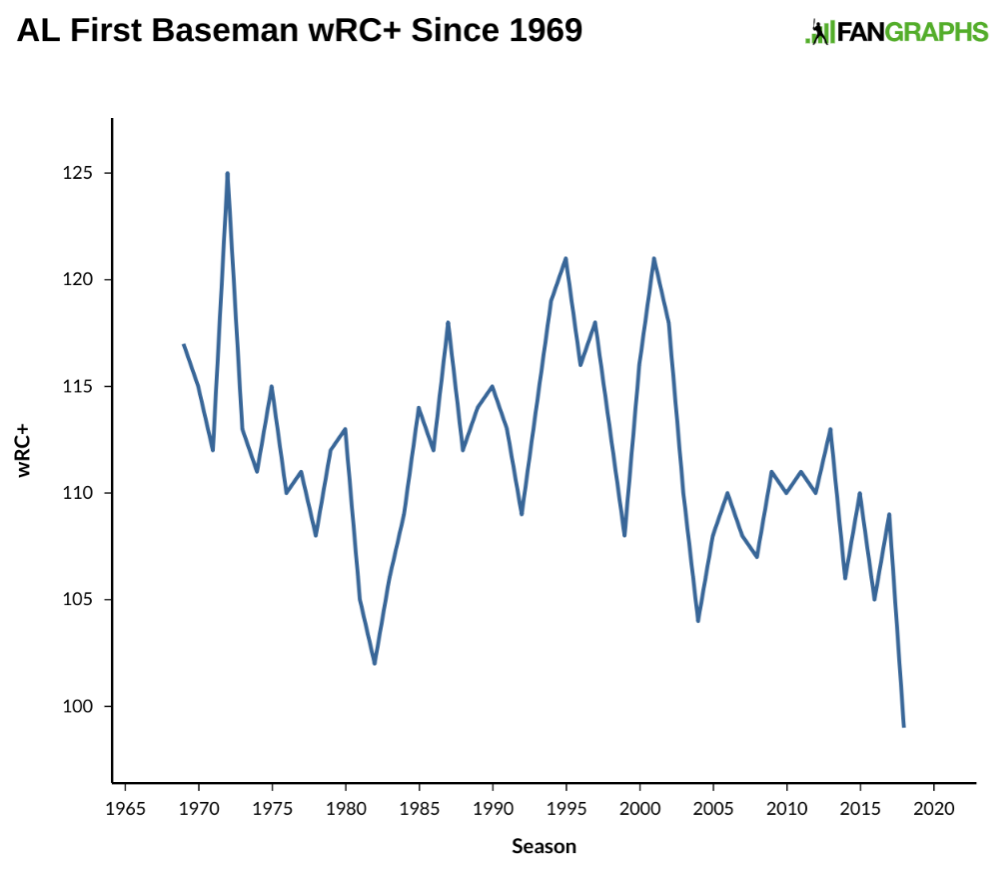
The 99 wRC+ for AL first basemen is perfectly acceptable as an average offensive player, but because first base is generally the easiest position to play on the diamond, the standards are generally higher for the bat. American League first basemen haven’t finished a season below average at the plate since 1957, and the only other time it has happened in the last 100 years was in the 1948 season. As the graph above shows, they are generally comfortably above average, with only the 1982 season getting close. As the season wears on, first basemen should start performing a bit better than they have, but right now they are nowhere close to the top of the pecking order by position.
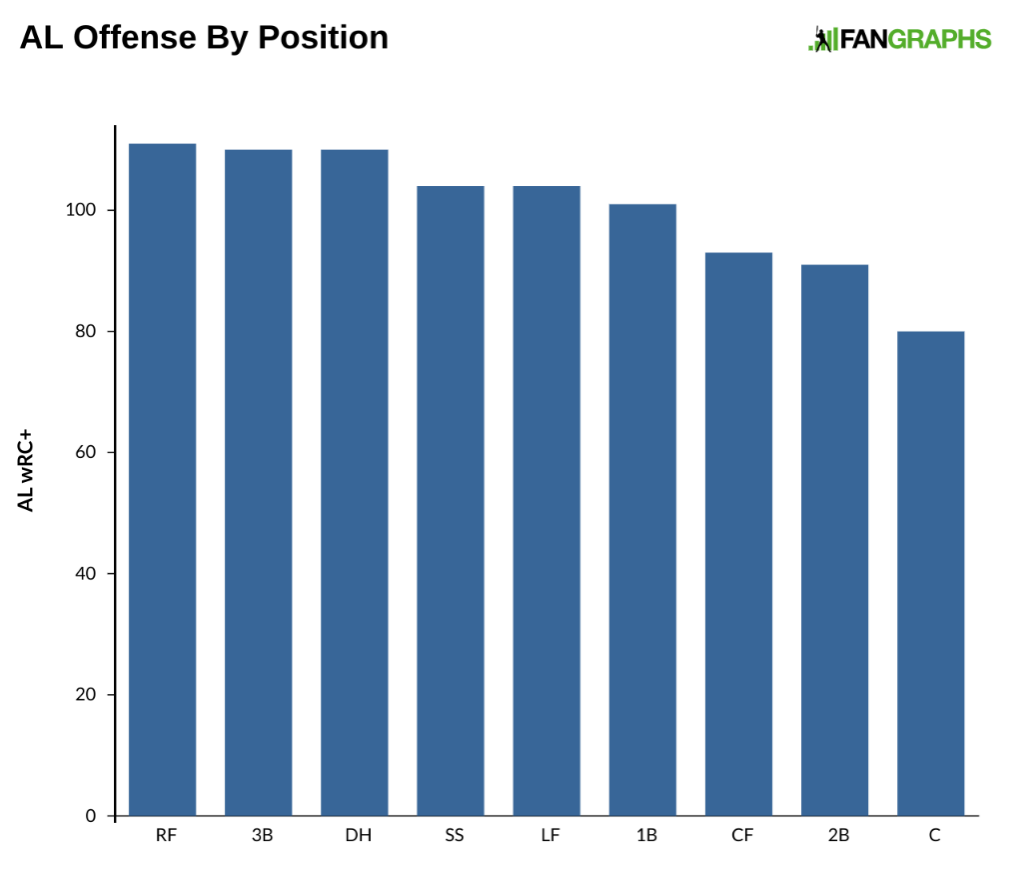
First basemen are actually in the bottom half of the league. The caliber of shortstop play is tremendous and third basemen are doing great as well, but first basemen really shouldn’t be this bad. It’s clearly not an MLB-wide issue, as their NL brethren are having no such problem carrying up the average enough to be pretty close to historical norms. It might be fun to lay the blame on Chris Davis, but first basemen would still be only slightly above average on the season without Davis’ contributions, if you want to call them that.
I checked among the designated hitters to see if the league was missing some good ex-first basemen that might be skewing the results, but all the top DHs this season — J.D. Martinez, Nelson Cruz, Shin-Soo Choo, Giancarlo Stanton, and Khris Davis — are converted outfielders. The converted first basemen are either barely above average (Edwin Encarnacion) or well-below (Albert Pujols, Logan Morrison). A quick look at last year’s AL first basemen shows some drain over to the NL, but mostly these are just poor performances from good players mixed in with a bunch of players not expected to do all that well.
Hosmer and Santana are now in the NL, though Hosmer isn’t playing all that well. Smoak is having a decent season, but the rest of the players are not, nor are they expected to do well the rest of the year. A quick look at our projections will tell you, it isn’t just first-half performance that seems to indicate the balance of power is in the NL, as our best estimate of talent says the same thing.
First Baseman Projected wOBA
| Name |
Team |
PA |
wOBA |
| Joey Votto |
Reds |
288 |
.395 |
| Freddie Freeman |
Braves |
293 |
.392 |
| Paul Goldschmidt |
D-backs |
288 |
.386 |
| Anthony Rizzo |
Cubs |
294 |
.375 |
| Brandon Belt |
Giants |
242 |
.363 |
| Matt Carpenter |
Cardinals |
284 |
.362 |
| Eric Thames |
Brewers |
241 |
.361 |
| Carlos Santana |
Phillies |
282 |
.360 |
| Cody Bellinger |
Dodgers |
268 |
.357 |
| Steve Pearce |
Red Sox |
76 |
.353 |
| Jose Abreu |
White Sox |
283 |
.351 |
| Justin Smoak |
Blue Jays |
290 |
.347 |
| Matt Olson |
Athletics |
279 |
.345 |
| Jose Martinez |
Cardinals |
284 |
.345 |
| Matt Adams |
Nationals |
80 |
.343 |
| Yonder Alonso |
Indians |
290 |
.343 |
| Joey Gallo |
Rangers |
266 |
.342 |
| Jesus Aguilar |
Brewers |
241 |
.342 |
| Justin Bour |
Marlins |
259 |
.341 |
| Mitch Moreland |
Red Sox |
239 |
.338 |
Blue=NL, Red=AL
American League first basemen aren’t always going to be this bad, but they have been so far this season. This is just a weird time in the cycle for the position, probably not helped by the lack of competition for playoff spots in the league compared to the NL. Many might be up in arms over Jesus Aguilar or Brandon Belt not making the All-Star team. It isn’t that they aren’t deserving of a spot as one of the top-60 or so players in baseball, or one of the top six players at their position. They just happen to play in the wrong league.

