And on the 99th day of the owners’ lockout, shortly after the umpteenth deadline set by commissioner Rob Manfred, Major League Baseball and the Major League Baseball Players Association finally reached a deal on a new Collective Bargaining agreement, just in time to preserve a 162-game schedule. Players will report to camps by March 13 (except for those with visa issues); arbitration figures will be exchanged on March 22, with hearings taking place during the season; Opening Day is set for April 7; the regular season will be extended by three days to absorb one of the two previously canceled series, with nine-inning doubleheaders and off days used as a means of absorbing the other; and players will receive full pay and service time. We’re a long, long ways from all being right with the world, or even within the baseball industry, but yes, there will be a 2022 major league season.
BREAKING: Major League Baseball and the MLB Players Association have reached a tentative agreement on a new labor deal, sources tell ESPN. While it still needs to be ratified by both parties, that is expected to be a formality, and when it is:
Two days of close-but-no-cigarnegotiations had the two sides drawing closer on core economic issues, but MLB’s insistence upon pairing the creation of an international draft with the ending of the qualifying offer system (aka direct draft pick compensation) set things back on Wednesday. Manfred responded by postponing (but notably not officially cancelling) another week of games, and the league stopped short of delivering a full counterproposal in the late afternoon, instead presenting the union with three options. Via ESPN’s Jesse Rogers:
[1] “Sign the CBA, including eliminating draft pick compensation [the qualifying offer system], and take some time to examine the international draft. If the union won’t implement within a couple years (by ’24?), the league can re-open the CBA.
[2] “Do the entire package without the draft which means without draft pick compensation.”
[3] “Take the original deal. League gets the international draft and draft pick compensation is eliminated.”
The union rejected the premise but made a counterproposal to remove the qualifying offer this year, contingent upon the two sides studying the parameters of the international draft further and setting a deadline to reach agreement or return to the status quo of qualifying offer and no draft. The union proposed November 15 for the date, but mere minutes after my morning update went live, The Athletic’s Evan Drellich reported that the two sides had agreed to a July 25 deadline instead. After a bit more back and forth on the numbers, the proposal was put to a vote, but while the union’s executive subcommittee unanimously voted against the proposal (8–0), the 30 team representatives who round out its executive board voted 26–4 in favor of it, with the Mets, Yankees, Astros and Cardinals dissenting. The owners ratified the agreement shortly after 6 pm ET by a unanimous 30–0 vote, and the lockout officially lifted just after 7 pm ET.
As for the details, not all of them are immediately clear, nor have all of them been fully reported. Here’s what we know so far. Read the rest of this entry »
While the discourse surrounding the details of a new CBA has largely focused on economic issues, Sunday offered a glimpse into its potential impact on the playing field. In their proposal that day, the MLBPA agreed to grant the commissioner the ability to implement a pitch clock, larger bases, and restrictions on the shift for the 2023 season with less offseason notice than previously allowed (45 days compared to a year), per Evan Drellich of The Athletic.
Though no element of the new CBA has been finalized, it does seem likely that the league will be free to experiment with rule changes, given little incentive on the players’ part to resist them when broader matters are at stake. Already, there’s been speculation about how they’ll impact the game, with much of it concerning the demise of the infield shift. On the fantasy side, articles have popped up analyzing which hitters would benefit. On the social media side, there have been memes — lots of them.
On the FanGraphs side — well, let’s give it a shot! It’s a few days overdue, but late is better than never. There’s no guarantee that the commissioner will outlaw infield shifts, but if he does, what happens? Will the game be nudged in the right direction, or will its supposed problems worsen instead? What do we want out of a plan to ban the shift, anyways?
A huge part of it isn’t related to any numbers, but rather aesthetics. Consider how baseball is both a symmetrical and stationary game. It’s true that team sports designate positions to players corresponding to offensive or defensive roles, but in most cases, they come with the freedom to mingle and roam about. In soccer, varying formations are regarded as tradition, not experimentation. In football, there are seemingly endless amounts of routes and passes for teams to implement. In hockey, they play hockey.
Baseball is different. For decades, fielders have remained loyal to their assigned districts, moving only to respond to an incoming ball; even then, they take caution so as not to disrupt an adjacent teammate. Fans, players, and coaches have long understood this. The shift, in this context, is an incongruity that evokes a feeling of discomfort. When a hitter sends a ball through a gap created by an infield shift, we tend to focus on the aberration (the shift) rather than the outcome (a base hit). Likewise, when a line drive is snared by a second baseman in right field, the same out appears unnatural. It’s no wonder numerous fans want the shift gone. It’s also no wonder that they attribute this disruption of baseball’s law and order to a myriad of issues. Read the rest of this entry »
At least from the outside, on Wednesday it appeared possible that after another marathon session of negotiations the owners’ self-imposed lockout might end in time to meet commissioner Rob Manfred’s umpteenth deadline and squeeze in a full 162-game season. The dollar figures from proposals by the league and the union pertaining to the new collective bargaining agreement’s core economic issues had converged into “split the difference” territory. Yet since Tuesday night, it had become apparent that the path to a deal suddenly hinged upon the union agreeing to the implementation of an international draft, in exchange for which the qualifying offer system (a.k.a draft pick compensation) would be eliminated. Long sought by the league, and long reviled by the players, the international draft was suddenly of vital importance for one side and simply too complex for the other to agree to under the pressure of deadlines and ultimatums. And so, around 6:30 pm ET on Wednesday, Manfred snatched defeat from the jaws of victory by announcing the postponement of Opening Day to at least April 14.
Manfred didn’t actually use the phrase “officially canceled,” as he did on March 1, nor did he hold a press conference. This time, he said via a statement, “Because of the logistical realities of the calendar, another two series are being removed from the schedule, meaning that Opening Day is postponed until April 14th.” Given what transpired in the days leading up to this week’s artificially-imposed and then delayed deadline, it’s clear not only that the schedule still has a bit of wiggle room via potential doubleheaders (likely with seven-inning games) and juggled off-days, but that the league understands that it can’t unilaterally dictate the length of the season. The ramifications for shortening the slate with regards to salaries, incentives, and service time will require another layer of negotiations, guaranteeing more headaches — particularly with the union having indicated that anything less than pay and service time based on 162 games could mean withholding approval an expanded playoff format for 2022.
As noted in my coverage on Wednesday, the now-familiar pattern — MLB leaking details of its proposal to the media in the dead of night, in time for the next day’s news cycle but before the players, wary of being pressured into accepting an agreement in the wee hours, could consult their executive board and respond — had the potential to create unfounded optimism about a deal. The international draft, which on Wednesday morning USA Today’s Bob Nightengale called “the last big remaining obstacle to reach a labor deal today” proved to be no small hurdle, either. Read the rest of this entry »
Robert Van Scoyoc has diligently built a reputation as one of the best hitting coaches in the game. Hired by the Los Angeles Dodgers in November 2018 after first having served as a consultant (with a year spent as a hitting strategist with the Arizona Diamondbacks in between), the 36-year-old Santa Clarita, California native is respected both for his communication skills and his nuanced understanding of the craft. Well-versed in technology and modern-day concepts while still being an adherent of proven old-school practices, he honed his knowledge base working alongside longtime hitting instructor Craig Wallenbrock.
In the latest installment of our Talks Hitting series, Van Scoyoc addressed several philosophies and principles, including the importance of angles and the relationship between process and outcome.
———
David Laurila: Since coming to pro ball, the two titles you’ve held are “hitting strategist” and “hitting coach.” What’s the difference?
Robert Van Scoyoc: “In Arizona, the strategist role was more broad. I was involved in multiple departments, along with doing some of the major league advancing work. Being the hitting coach, my responsibilities are just with the major league team. That being said, we have a very collaborative organization where all three hitting coaches — me, Brant Brown, and Aaron Bates — are all working with [player development], and will even talk with amateur scouting and some of the guys watching our players. So my day-to-day responsibilities are with the major league staff, obviously, but with us being very collaborative, I’m involved with many different parts.”
After another 24 hours of intense negotiations, MLB’s lockout of the players remains in effect. Just like the last time negotiations ticked past a league-imposed deadline, MLB announced that they had canceled a week (two series) of games, postponing Opening Day until April 14. That brings the total number of weeks canceled to two and series to four, with the possibility of more to come should the two sides not reach a compromise in their negotiation of a new collective bargaining agreement.
It’s unclear whether these games will remain canceled, or whether some newly structured season will change the schedule. After all, the league canceled a week of games last week, then spent most of this week saying they would un-cancel them and play a full 162 if the two sides reached a deal by their new deadline. Plus, the length of the season, and the salaries and service time that go with it, is itself a matter of bargaining. But let’s take the league at their word and assume that we’re now looking at a 150-game season. Read the rest of this entry »
DEPARTMENT: Baseball Operations: Research & Development – Baseball Systems REPORTS TO: Architect, Baseball Systems
Location:Chicago, IL
Description:
The Chicago Cubs Baseball Systems Department is seeking to fill a Baseball Systems Software Engineer position. This role will focus on the development and maintenance of the Chicago Cubs baseball information system data warehouse, including creating web interfaces and web tools for the user interface; assisting in mobile application development; building automated ETL processes which feed it; maintaining back-end databases; and troubleshooting data source issues as needed. This role will collaborate with software engineers and data analysts in their use of the Cubs’ data warehouse and coordinate plans for database growth, while also reviewing and recommending new technologies for use by Baseball Operations department. Read the rest of this entry »
Here we are again. Just two years after a global pandemic led to the cancellation of part of spring training and a delayed Opening Day, the lockout has resulted in the loss of more baseball.
This time around, there are no PPP loans to help soften the blow. FanGraphs is in slightly better financial shape than we were in 2020 due to all of our Member support, but that doesn’t change the fact that the lockout is already starting to put the site at risk. Lost revenue is lost revenue, and the longer this goes on, the worse shape we’ll be in. It took us all of last year to climb out of the financial hole the pandemic put us in, and now we’re being dragged back into that uncertainty. Read the rest of this entry »
Remember back on March 1, when Rob Manfred canceled Major League Baseball’s March 31 Opening Day and the first week of games? And the week before that, when a league spokesperson threatened that canceled games would not be rescheduled, saying, “A deadline is a deadline. Missed games are missed games. Salary will not be paid for those games”? Apparently that wasn’t the real deadline to fit a full 162-game season into the calendar. No — and we’ll pause here so as to be heard over the sound of goalposts being dragged — that deadline was apparently Tuesday, and it’s been extended yet again. After lawyers for the league and the union huddled on Monday, MLB offered its latest formal proposal, and the two sides went back and forth for over 17 hours on Tuesday before pausing around 2:30 AM ET on Wednesday morning so that the union could speak to its board and respond with a counterproposal.
The two sides have converged on monetary issues, but significant gaps remain both there and on other matters, most notably the international draft. It’s possible that a deal could come Wednesday… or that the whole thing could fall apart, with more finger-pointing, and Manfred announcing the cancellation of more games.
Before digging into the details, it’s worth noting again that the length of the season and the ramifications that carries for salaries, incentives, and service time isn’t something that Major League Baseball can decide unilaterally. It’s subject to negotiation, which was why the passage of the March 1 deadline felt so significant, as any attempt to shorten the season would add another layer of complexity to the already contentious proceedings. Complicating matters — or calling the league’s bluff, depending upon how one looks at it — the union has indicated that anything less than pay and service time based on 162 games could mean that they won’t approve an expanded playoff format for 2022. Read the rest of this entry »
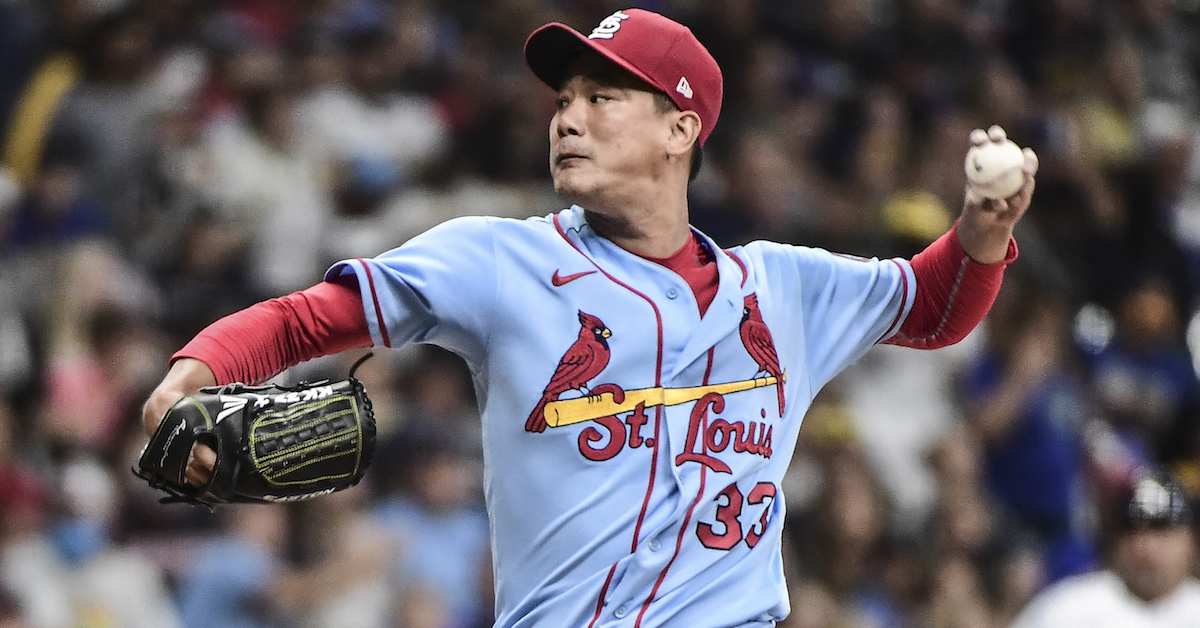
With no clear end in sight to the owner’s lockout, free agent Kwang Hyun Kim 김광현 has decided to return to Korea for the 2022 season. On Monday, Jeeho Yoo of Yonhap Newsreported that Kim has signed a four-year deal with the SSG Landers (previously the SK Wyverns). The deal is worth 15.1 billion won ($12.3 million dollars) and breaks the record for largest KBO contract that was previously held by Dae-Ho Lee 이대호 and Sung-bum Na 나성범. In a statement released by the Landers, Kim said, “I was able to challenge myself in the majors because of support from fans here. I decided I wanted to give back to them once I returned to the KBO. The Landers recognized my value with the biggest contract ever in the KBO — I didn’t have to think long and hard about the reunion.”
Kim returns to his old team in Incheon, a squad that has missed the playoffs both years since he made the jump to the major leagues after the 2019 season: They placed ninth in the 10 team league in 2020 but came up half a game short of qualifying for the Wild Card game in 2021. Kim solidifies a starting rotation that also includes former major league pitchers Iván Nova and Wilmer Font. Font led the Landers pitching staff with a 3.46 ERA and a 3.25 FIP, but the four pitchers in the rotation behind him all had ERAs and FIPs over five. With Kim back in the fold, the Landers are likely one of the preseason favorites heading into the regular season.
I asked former FanGraphs contributor Sung Min Kim for some additional context on Kwang Hyun Kim’s return to the KBO.
“Landers are now in a very good position, especially with their pitching staff. Not only do they get one of the better KBO pitchers back in their rotation, but they also bet highly on Wilmer Font, who pitched very well with them in ’21, and Iván Nova, and they also have two solid Korean-born starters in Jong Hoon Park and Seung Won Moon set to return mid-season from injuries. Those five pitchers would make up the best rotation in all of KBO, and make them instant pennant favorites for 2022. They will certainly be a very fun team to watch.”
Kim’s time in America was anything but easy. A club legend while playing for the Wyverns from 2007-19, he made the transition to the US prior to the 2020 season. Unfortunately, his introduction to the major leagues was interrupted by a global pandemic. The next season was a little more normal, but his two-year deal with the Cardinals expired at the end of 2021 and the 33-year-old again found himself in strange circumstances, with the owner’s lockout disrupting his foray into MLB free agency.
While pitching for St. Louis, Kim’s role was as settled as the circumstances around him these past two years. He began the 2020 season as the Cardinals closer, notching his first professional save in his first major league appearance. A COVID outbreak on the team forced him into the starting rotation soon after, and he made seven starts during the remainder of the abbreviated regular season with an additional start in the Cardinals Wild Card series against the Padres. He allowed just nine total runs to score against him in those eight regular season appearances, good for a 1.62 ERA.
Last year, two separate stints on the injured list limited Kim to 21 starts and six relief appearances. The second of those trips to the IL came in mid-August after the Cardinals had acquired J.A. Happ and Jon Lester to bolster their rotation for the stretch run. Kim returned after two weeks on the sidelines but had lost his spot in the rotation by then. He made two more starts through the end of the season but was mostly relegated to mop up duty in the bullpen over the last month of the season.
All told, he made 28 starts during his time with the Cardinals and seven additional relief appearances. He compiled 1.8 WAR with an excellent 2.97 ERA that outpaced a more middling 4.34 FIP. He never racked up big strikeout totals, instead relying on good command and a solid ability to limit hard contact. Just 25.6% of the plate appearances against him ended with a hard hit batted ball, right in line with the league average over the last two seasons. He allowed a 6.3% barrel rate during his time in the majors and just a .348 expected wOBA on contact.
On the pitcher’s decision to return to Korea, Sung Min Kim had this to say:
“I think he was always inclined to stay in the US and try to prolong his career in the US by signing with another team. He’s had a desire to challenge himself in the majors for a long while, even before he signed with the Cardinals. With his age and the decreased velocity he showed during his two seasons in St. Louis, I wasn’t sure what the market looked like for him, especially given that he was relegated to a bullpen role later in 2021. I think, with the lockout taking awhile, him missing his family being back in Korea, and definitely having a clearer role guaranteed back in KBO, it was very hard to say no to a lucrative deal to come back.”
Kim’s departure from the US creates an even bigger hole in the depleted free agent starting pitching market. Twelve of the 18 starters listed on our top 50 free agents list signed new deals prior to the lockout. That leaves very few options for teams looking to bolster their rotations once the offseason resumes. Kim was ranked 35th on that list of top free agents, ahead of Zack Greinke, Michael Pineda, and Yusei Kikuchi. Though he probably wasn’t likely to land a significant payday from an MLB club, he could have been a solid back-of-the-rotation option for a contending team that needs a bit more depth in their rotation. Those teams that might have been interested in Kim’s services are now limited to looking at starters like Pineda, Kikuchi, Tyler Anderson, and Garrett Richards.
This may also be the first instance of the ongoing owner’s lockout influencing a player to leave the US to find other opportunities abroad. Obviously, Kim returning to his home country to play for the same team he starred for previously is a unique circumstance, but the fact that there was no clear end to his free agent limbo in America had to have entered into his decision-making process when opting to return to Korea. Kim chose to leave behind the uncertainty of MLB for a record-setting KBO deal.
If negotiations between MLB and the Players Association continue to drag on, jeopardizing more and more of the regular season, it wouldn’t be surprising to see players consider signing with international leagues to give them some guarantee of earnings and playing time. Bryce Harper already joked about playing in Japan and Taiwan on his Instagram account:
It’s not hard to imagine a situation where MLB players start to seriously consider their options abroad if progress towards a new CBA deal hasn’t been made. Opening day in Korea is set for April 2, while the Nippon Professional Baseball season begins on March 25. That gives players an increasingly narrow window to make a decision. Established stars like Harper probably won’t be making the jump to Asia this year, but for players still mired in free agency or on the fringe of a major league roster and ineligible to play in minor leagues, a guaranteed paycheck and playing time in a foreign league could become increasingly enticing.
There’s a lot of power in Alec Bohm’s swing. He’s capable of getting completely twisted up, arms fully bent, on a pitch he has no business swinging at, and yet he can still get the barrel on the ball with enough power to blast it off the centerfield wall. Here, see for yourself:
It takes quick hands and great bat-to-ball skills to square up 93 mph that far in on your hands. It should be no surprise that the man behind that swing produced an 89th-percentile average exit velocity and 90th-percentile hard-hit rate in 2021. Yet good results rarely followed suit for Bohm, as the highly anticipated follow-up to his 138 wRC+ in his rookie campaign landed with a dud. The 6’5” third baseman proved unable to tap into his power, with only seven homers and a lowly .095 ISO — 15th percentile in the majors, well off the league average of .165 (though even during his stellar rookie season, he only got up to .145). His elite hard-hit rate wasn’t enough to keep his offense from cratering; he finished with a 75 wRC+ and was even demoted late in the season.
Bohm clearly has power potential, but after just 11 homers in his first 597 plate appearances, why hasn’t it surfaced? At first glance, it looks like a simple diagnosis: he hits the ball on the ground too often, and his ability to hit the ball hard is being diminished by a poor launch angle. That is certainly a good place to start given his 52.7% groundball rate last season, which ranked in the eighth percentile league-wide. Thriving with a groundball rate that high is not unheard of, but in order to do so, you really have to damage the fly balls you hit. It’s the Juan Soto model for success; he has an identical 52.7% grounder rate, but 24.4% of his fly balls leave the yard because he simply crushes them (average exit velocity: 96.2 mph). Bohm’s fly balls, meanwhile, are only leaving the park 11.3% of the time. Read the rest of this entry »