
Six-Player Deal Sends Caleb Durbin From Brewers To Red Sox
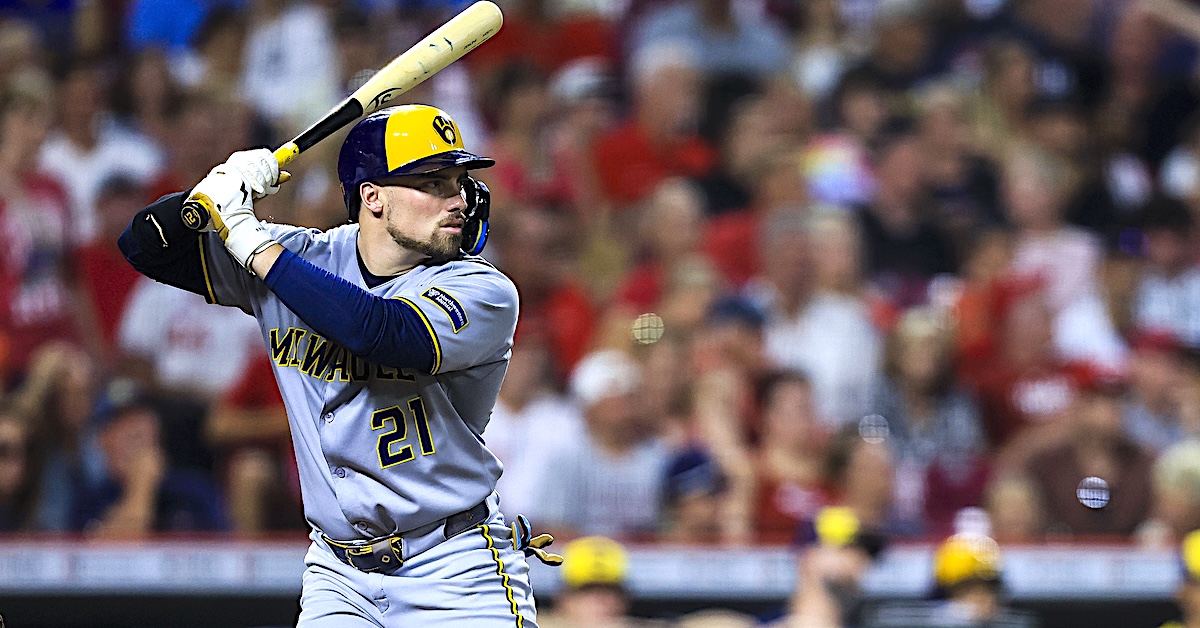
Clearly, none of those people who argues that the day after Super Bowl Sunday should be national holiday is in charge of the Brewers or the Red Sox. Things got complicated very early this week, as Milwaukee and Boston announced a six-player trade on Monday morning.
The Brewers received infielder David Hamilton and left-handed pitchers Kyle Harrison and Shane Drohan. The Red Sox received infielders Caleb Durbin, Andruw Monasterio, and Anthony Seigler, along with Milwaukee’s competitive balance Round B draft pick. The headliner of the deal is Durbin, who will slot in as Boston’s everyday second or third baseman. When you factor in that Boston also traded for Willson Contreras, signed Isiah Kiner-Falefa, and claimed Tsung-Che Cheng off waivers, the Red Sox have now added more than an entire infield this offseason. Don’t worry; their infield situation is still plenty complicated. Harrison headlines the package going to Milwaukee. The Brewers get the chance to work their magic on two young pitchers, and they get to add to their collection of speedy, scrappy, undersized infielders.
It was an odd trade in some ways. All six players were on 40-man rosters already. The Red Sox got the comp pick (as of now, the 67th pick in the draft) even though they were also getting the biggest name, a player who will go straight from Milwaukee’s starting lineup into their own. The left-handed Hamilton has a few more tools than the right-handed Monasterio, but the two are at least comparable; it’s likely that the handedness of the two players affected Boston’s willingness to part with him. You could argue that the Brewers gave up more than the Red Sox, but that they needed what they got much more. The Red Sox have one of the deepest rotations in the league, so Harrison is going from a team that would have struggled to find room for him to a team that will likely need him to hold down a rotation spot from day one.
Let’s start with Durbin, who ranked just 21st on our Brewers org list in May, then went on to break out and finish third in the National League Rookie of the Year voting. The Yankees sent the brawny, 5-foot-7 Durbin to Milwaukee in the Devin Williams trade. He put up 2.6 WAR over 136 games, which works out to just under 3.1 WAR over a full season. His offensive profile follows a familiar pattern: bottom of the scale in terms of bat speed and exit velocity, top of the scale in terms of contact rate and strikeout avoidance. Thanks to a predilection for pulling the ball in the air, Durbin popped 11 home runs in 2025. That makes him sound like a perfect fit for Fenway Park (a fact chief baseball officer Craig Breslow noted during a Zoom call with reporters on Monday), but Statcast estimates that he would have hit just five home runs there last year.
Durbin certainly earned his rookie success. He played great defense and ran the bases well, and advanced metrics like xwOBA and DRC+ indicate that he deserved his production at the plate. Still, it’s probably a bit much to expect him to repeat the 105 wRC+ he put up in 2025 without any regression. It seems more reasonable to put up closer to two wins, serving as a well-rounded store brand replacement for Alex Bregman. Durbin doesn’t have quite the same plate discipline, and he’s likely to bang more balls into the Green Monster and fewer over it, but he’s still got five years of team control. Breslow said on Monday the team hasn’t decided whether Durbin will play second or third base.
It would be easy to spend a whole article slogging through the Boston infield situation, but I’ll try to lay it out as simply as possible. At first base, the Red Sox traded for slugger Willson Contreras, but they also have slugger Triston Casas, who may or may not be ready on Opening Day after rupturing his patellar tendon in 2025. At shortstop, they have Trevor Story, who projects to put up a bit over two wins in the final year of his contract, but has had just one healthy season in the past four years. The 23-year-old Marcelo Mayer would seem to be the shortstop of the future, but he struggled in his debut in 2025, and he’s had trouble staying healthy since the Red Sox drafted him in 2021. The simplest configuration has Casas at DH, Contreras at first, Story at short, and Mayer and Durbin at second and third (or vice versa).
Complicating all this is that the team also got Monsterio, signed Kiner-Falefa, claimed Cheng, still has Romy Gonzalez coming off a breakout 2025 season in which he put up a 123 wRC+, and also has an outfield crunch that could at least theoretically still see Kristian Campbell end up as an infielder. Monasterio has spent at least some time as Milwaukee’s starting third baseman in each of the last three seasons, and in 2025, he looked like an average hitter at the plate, but it’s hard to imagine him getting too much playing time in Boston. These are all good problems to have, and we haven’t even gotten to the deeper names like Nate Eaton and Nick Sogard (both of whom got significant playing time in the postseason), and of course, Seigler. RosterResource projects Durbin to start at second, with Mayer and Gonzalez platooning at third, though manager Alex Cora said during Fenway Fest in January that he hopes to get Mayer more at-bats against left-handed pitching.
All of this is still a downgrade from having Rafael Devers or Bregman. We’re not positive who will play where because none of the players we’re talking about is an undeniable star. Considering their resources and position in the win curve, the Red Sox probably should be consolidating their depth into a star player rather than trading one away and letting the other walk in free agency. Still, that’s a lot of depth.
At lot would have to go right for this to be a very good infield. At least three of the following things would have to happen: 1) Durbin would repeat his rookie success, 2) Story would stay healthy and continue his good BABIP luck, 3) Mayer would stay healthy and figure things out at the big league level for the first time, 4) Gonzalez would repeat his breakout campaign. Getting three of those four seems pretty unlikely, but having all this depth makes the floor very solid. The team will have replacements for anyone who gets injured. If Mayer fails to hit lefties (assuming he gets the chance), Gonzalez can step in. If Gonzalez steps back, the team can count on solid defense from Monasterio and Kiner-Falefa. Likewise, if Durbin’s offense steps back, the rest of his game should keep him at least around replacement level. And if all else fails, Campbell (or even Ceddanne Rafaela, again) can jump back into the infield. Maybe you’ve noticed that I haven’t dived into the balance of right-handed batters and left-handed batters here. That’s because I don’t want to. We’ve talked about this infield enough and you can’t make me do it.
Fiiiiine, I guess my editor can make me do it. Curse you, Matt! After well over a year of hand-wringing about the overwhelming left-handedness of the lineup, it should be fairly balanced. Right now, RosterResource projects it to feature four lefties and five righties against right-handed pitchers. However, positionally, most of the infielders (including both catchers) expected to make the Opening Day roster are righties and most of the outfielders bat left-handed. There are also two switch-hitters in the mix, though both are likely to begin the year in Triple-A. One of them is Anthony Seigler, whom we’ll get to now.
Seigler was the Yankees’ first-round pick in the 2018 draft, an exciting switch-hitting, switch-pitching(!), two-way prospect who in 2019 ranked eighth in the organization. He signed as a catcher and infielder, but he’s struggled with injuries and underperformed at the plate. Then in 2024, he put up a 122 wRC+ with 12 home runs in Double-A. He became a six-year minor league free agent after the season, and the Brewers signed him to a minor league deal with a non-roster invite. He put up a 143 wRC+ in Triple-A in 2025, but struggled in his first taste of the big leagues.
He is now 26, and the rest of the paragraph is just my paraphrasing the notes Eric Longenhagen sent me on Seigler after the trade. Seigler is much better hitting from the left side. He possesses plus-plus plate discipline and plus bat speed, along with the ability to lift the ball. However, Eric doubts that Seigler’s swing will play at the major league level, which is to say that he’ll strike out a whole lot. Eric doesn’t consider Seigler an option as a catcher. As a second or third baseman, he has nice actions and feel for his position, but he has below-average range and throwing accuracy. Stop me if you’ve heard this before, but Eric considers him a nice depth player. “The measured power is impressive,” Eric told me, “and so is his approach,” but he’s going to strike out a lot and provide substandard defense.
I apologize to any Brewers fan who had to wade through all that just to get to their portion of the trade. Kyle Harrison is the main piece of the return, but let’s stay in the infield and start with David Hamilton, who certainly sounds like a Brewers guy, at least to a point. He’s a 5-foot-11 middle infielder with speed, defense, and not much power. He’s 28 years old, but he’s got just two years of service time, so he won’t be a free agent until 2030. He first debuted in 2023, and appeared in more than 90 games in each of the last two seasons, stealing 33 bases in 2024 and 22 bases in 2025. His defense grades out pretty well, too. However, he stops sounding so much like a Brewers guy when you talk about his offensive profile. Hamilton doesn’t have great contact ability. He put up a 94 wRC+ and 1.6 WAR in 2024 thanks to a .316 BABIP, but the batted ball luck disappeared in 2025, and his wRC+ fell to a bleak 60.
Maybe Milwaukee is planning on adding another infielder, but Hamilton only has one minor league option, so it certainly seems like he’s going to start the season on the 26-man roster. It’s hard to imagine the team just plugging him and his 83 wRC+ ZiPS projection into the starting third base spot. RosterResource has Hamilton in a bench role, with Joey Ortiz shifting over to third and Jett Williams starting at shortstop. That’s a whole lot to ask of the 22-year-old Williams, who was acquired in the Freddy Peralta trade earlier this offseason. He excelled in Double-A last year, but he’s never played in the majors.
All this puts this infield in a precarious position. The Brewers sold high on Durbin, but if Williams isn’t ready, they’ll need to depend on Hamilton in a major way. In doing so, they are taking the opposite approach of the Red Sox in their infield. Boston is stockpiling depth, while the Brewers appear to be handing the keys to a 22-year-old rookie and relying on a 28-year-old with 1.5 career WAR to fill in the gaps. They’ve certainly hit big on this formula in the past in the form of Durbin, Ortiz, and Brice Turang, but as usual, they’re walking a fine line.
Now that we’ve dispensed with the infield, we can get to Harrison. The left-hander came to Boston in the Devers trade, so let’s all spare a moment for Maddie Landis of Talk Sox, who on Monday morning published an article titled “The Rafael Devers Trade Tree Is Rotting” just 79 minutes before ESPN’s Jeff Passan broke the news that made it both perfectly timed and instantly obsolete. The 20-year-old Jose Bello is the only remaining part of the Devers return still in the Boston system. Breslow really wanted out of that contract.
The Giants drafted Harrison in the third round of the 2020 draft, and he found early success, running a 3.19 ERA in Low-A in 2021, then a 2.71 ERA and 3.20 ERA across two levels in 2022. He made his major league debut in 2023, and he now has 42 career appearances and 37 starts under his belt, with 194 2/3 innings pitched, a 4.39 ERA, and a 4.44 FIP. He’s mostly run decent strikeout rates and iffy walk rates while struggling to limit hard contact. His fastball has generally been around or below the league average in terms of velocity. None of that makes him sound like the centerpiece of a deal for Devers or Durbin, but as Harrison told David Laurila, he was a different pitcher once he got to Boston last year.
In Boston, he raised his release point and his arm angle slightly. His four-seam fastball added half an inch of rise and more than an inch of arm-side run. His slow, bendy slurve added even more horizontal movement, and the Red Sox encouraged him to try throwing the pitch inside to righties looking for whiffs, instead of just using it as a backdoor pitch intended for called strikes and weak contact. Lastly, after experimenting with a splitter, Harrison switched from a one-seam changeup to a kick change, which once again added more movement. Just as important, he added two new pitches, a cutter and a sinker reserved for left-handed batters. He was no longer a three-pitch pitcher, and he went from throwing the four-seamer 43% of the time all the way down to 16%.
These are huge differences. It’s essentially three new pitches, along with completely different usages for the other two. The sample size is small, too. Harrison made 18 starts in the minors (six with the Giants and 12 with the Red Sox), so we’re talking about just three major league appearances in Boston with this new repertoire. Harrison is only 24, and we shouldn’t assume that the Brewers are just going to roll with these changes. They’ve been turning pitchers into the best versions of themselves for years now, and clearly, the paint is far from dry on Harrison’s profile as a pitcher.
Harrison will certainly get his chance to make it all work. He moves from an overflowing Boston starting pitching situation to a Brewers rotation that looks a bit threadbare without Peralta. (Full disclosure: On the advice of my wife, I deleted a pasta-themed version of the previous sentence that compared the Red Sox rotation to an overstuffed ravioli that explodes the moment you drop it into boiling water, so I’ll just tell you that the Boston rotation ranks first on our Depth Charts even without Harrison, while the Milwaukee staff ranks 16th.) The Brewers have Brandon Woodruff, Jacob Misiorowski, and Quinn Priester (who in early 2025 was also traded from Boston to Milwaukee) in the front of their rotation, so Harrison should slot in toward the back.
Last we come to the 27-year-old lefty Drohan, whom the Red Sox drafted out of Florida State in the fifth round in 2020. He ranked 41st on their top prospects list last year. Everything you read from here on out was written by Eric Longehagen, who put a future value of 40+ on Drohan:
Drohan has transformed in many ways since he was drafted, as both his delivery (a much shorter arm action) and repertoire have changed multiple times. His prospect value peaked in mid-2023 when he climbed to Triple-A as a starter and threw 125 innings as a wild, changeup-oriented swingman prospect. The White Sox used a Rule 5 pick on him in 2023, but he needed nerve decompression surgery before the 2024 season and was DFA’d and returned to the Red Sox during his rehab. He was put on the IL again in August 2024 with shoulder inflammation.
Because of the timing of Craig Breslow’s hire and Drohan’s White Sox stint and injuries, the 2025 season was really the first time the Breslow Era development staff was able to work with him, and he drastically changed his repertoire and pitch usage to include more breaking stuff in 2025. Drohan now throws a ton of sliders and cutters, he had a one-tick velo boost, and was a throwing starter-quality rate of strikes for the first time since 2022. He now throws many more low-80s sliders and upper-80 cutters than before (he previously had a slider that was in between the two) and his fastball is playing like a comfortably plus pitch even though it’s only sitting 93.
There hasn’t been any one drastic change here. Drohan looks like he’s in slightly better shape than he was in 2023 and is getting down the mound a little better, but there hasn’t been any huge alteration to his delivery or fastball movement that would totally explain why he’s gone from having a 45 fastball to, at least from a miss and chase standpoint, a plus heater. The way his new breaking stuff tunnels off his fastball (especially the cutter) might be helping his fastball play better. Though Drohan’s changeup is still his best pitch on pure stuff, it’s the one he has the least consistent feel for locating, and it’s feasible that simply de-emphasizing it has made him a more capable strike-thrower.
Drohan had an “arrow up” 2025 and was put on the Red Sox 40-man after the season, then traded to Milwaukee. Because he has all three option years remaining, he’s very likely to play an up/down starter role for the next year or two, and then either settle into a long relief role (the role I think he’d most thrive in) or toward the back of Milwaukee’s rotation.
Davy Andrews is a Brooklyn-based musician and a writer at FanGraphs. He can be found on Bluesky @davyandrewsdavy.bsky.social.
There is no such thing as batted ball luck, and people with this kind of math background should know this. Entirely skill based inputs can still result in variable results, and that is what is happening here. No luck is involved.
What do you call it when those variable results tend in/against your favor?
We’ve been over this before in the comments I believe, but “luck” is obviously just useful shorthand. I think you just don’t understand what people mean by luck. If 20 balls are hit with a 50% chance of falling for a hit, there’s about a 2% chance than at least 15 of them fall in for hits. Yeah it’s just variance if the player ends up with 15 hits, but that’s quite clearly what everyone is talking about when they say the batter was lucky. Weird hill to die on.
This is the weirdest verbal argument that people continue to make around here, because it’s not even about semantics, just connotation, and it’s wrong even about that. Clearly you already understand that “luck” is a synonym for “random variation” in this context. You’re just objecting to the connotations that you incorrectly believe “luck” carries — seemingly that it is somehow opposed to “skill-based inputs,” which it isn’t.
Have you considered that a definition of “luck” is when you have variable results from a constant level of skill and hard work? Things that are outside of the player’s control?
If you roll a die ten thousand times you’ll get five thousand heads, but depending on your luck you might get ten tails in a row to start out.
That’s….very, very unlikely. I’ll give you 75:1 on it!
(Actual odds are closer to 125:1)
I’ll give him any odds he wants that rolling a die 10,000 times will result in more than zero heads.
Ten thousand probably isn’t a big enough sample for this.
What kind of a die gives you heads or tails?
I don’t know why you’re being downvoted. All of this is true. Of course, what Jimmy said is also true. In general, I would say we need to do a better job of communicating that the “luck” here isn’t really luck, it’s a combination of miniscule factors that we haven’t (yet) been able to measure.
i know that we are well within the classical regime here, but i’m pretty sure one of the big things about physics is that we *cannot* measure all the factors. i think the issue is that humans cannot achieve that level of precision, and are subject to randomness. there’s inherent variance of how the human body moves and interacts with the world. heck, weather is random. on the large scale lots of it averages out, sure, but i’d argue that that randomness, and the existence of genuinely chaotic systems, makes the difference between, say, a wall scraper and a warning track flyout, which take two very similar inputs and have very different outputs on the game state. is that luck? i’d say so. it’s probability breaking in one’s favor.
i’m sure there’s a nifty quantum mechanical or statmech/thermo interpretation but i’m too tired and stupid to know anything
I agree with all this, except do we know that collapse of the wavefunction, how it collapses, is luck?
disclaimer that i know nothing, i am just an enthusiast.
the relevant stuff is probably “bell’s theorem” which deals with hidden variable theories. any sort of hidden variable theory we have come up with so far (that is, the idea that there is some information stored in a particle that determines how it collapses) is inconsistent with measurement. so to our best understanding it is entirely probabilistic, at the time of measurement.