
Sometimes You Have to Squeeze the Glove
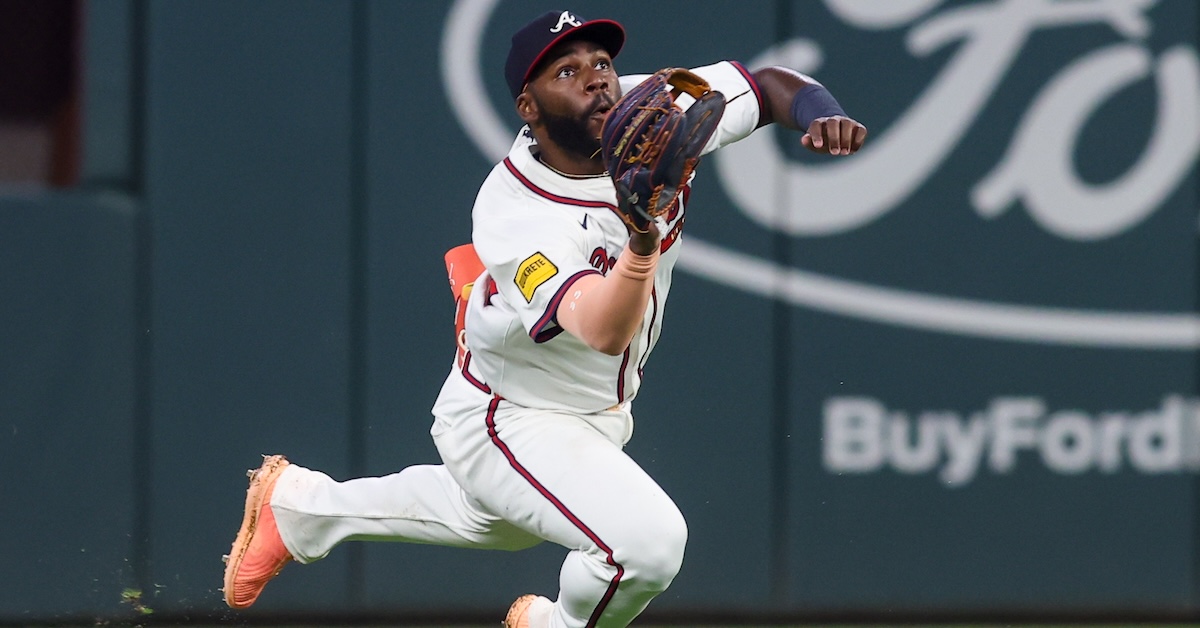
Most of the time, you don’t really have to squeeze your glove when you catch the ball. At least, you don’t have to think about squeezing it. It’s an instinctual thing, and while it’s different if you’re a catcher, the whole point of the glove is to corral the baseball. It was designed just for that. The ball tends to stick in there.
That’s most of the time. Sometimes you really do have to think about squeezing the ball, though. Sometimes there’s geometry involved. I love the geometry.
I love thinking about the angles. How do I position myself so I can catch this throw and apply the tag in one motion? Should I wait on this ball, or should I circle around it so I can charge it and field it on a short hop? At what point do I give up on picking this throw and step back to catch it on the long hop?
Making a great play in the outfield is almost entirely about getting to the ball. As Outs Above Average has confirmed over and over again, an outfielder with great speed and a great jump can arrive early enough to make even the most spectacular play look routine. Here’s Pete Crow-Armstrong making a five-star play look like a walk in the park:
You’d never suspect that ball had just a 5% catch probability. And here’s Nick Castellanos on a ball with a 90% catch probability:
To put this in the most skeptical terms, the only thing an outfielder tells us when they make a diving catch is that they couldn’t get there in time to catch it on their feet. But while it’s not the most valuable skill an outfielder can have, the last mile problem is still an important part of the game. Finding a way to secure the ball while throwing your body after the baseball and into harm’s way is its own art form, and you can’t beat the angles. Today we’ll look at two catches that were improbable not because of the distance traveled or the hangtime, but because of the AP-level geometry necessary to get the ball in the glove.
We’ll start with a play Michael Harris II made just last week. This is by no means his best play. It’s got an 85% catch probability, which makes it a two-star play. But it may be his best pure catch:
Although Harris is an excellent center fielder, he gets a very bad jump here. It’s understandable; the ball is hit directly at him and it comes off the end of the bat kind of funny, so he has to freeze for a second. But once he gets going, he really gets going. He’s charging very hard, and because he has no time to spare, it’s not a pretty catch. He’s not diving straight at the ball. He just has to go down and get it in a somewhat lopsided fashion because he didn’t have time to chop his steps and time it up perfectly. He has to catch the ball and then catch himself with his glove hand in order to break his fall. That’s what makes the catch so amazing. He seems to be slamming his glove straight down into the ground right as the ball reaches it. There’s only a nanosecond window where the ball even has an angle to find its way into the pocket.
As the angle I’ll show you next makes clear, this is something of an illusion. Harris does secure the ball before slamming his glove into the turf, and he rotates it outward to make sure there’s leather above and below the ball when he does so. But he’s doing it all in one motion, and the timing is immaculate. It’s all the more impressive if you keep your eye on Harris’ knee. It’s tearing up a huge divot, because he actually crashes into the ground the moment before he makes the catch, jarring his entire body. Watch his eyes close and his hat snap down on his head from the impact. Just staying steady enough to make this play is spectacular. Managing to hold on to the ball as he smacks it into the grass so hard that it bounces several times creates another level of difficulty. And lastly, we must award extra credit because Harris does so, as always, with a defensive positioning card tucked into his glove:
This is its own skill, apart from getting a great jump, taking a great route, or having great speed. It’s a different kind of kinesthetic intelligence, less valuable maybe, but much richer in terms of its pure artistry. Even at the major league level, not everybody can do this. I’m sure plenty of players could’ve gotten a better jump on that ball. Maybe Harris himself gets a better jump on it most of the time. But it would be hard to beat that catch.
Cedric Mullins made this catch a month ago, and I’ve been watching it ever since:
Statcast gave this play an 80% catch probability, and you can understand why. Mullins never quite gets up to top speed. Whatever comes one step past cruising toward the ball, that’s where he is. It’s another two-star, and that’s nothing to sneeze at, but Pete Crow-Armstrong would probably make it look a whole lot easier.
Mullins was once a fantastic defensive center fielder, but he’s 30 now, and the numbers say he’s slowing down. Still, while he’s not as quick as he once was, he hasn’t unlearned the art of making an improbable catch. The official highlight doesn’t have the angle I like, so I had to make a screen recording from the original broadcast:
This is why I’ve been watching the play over and over again. I just don’t know how Mullins managed to keep this ball in the glove. Let me show it to you one more time, even slower, zoomed in on the glove:
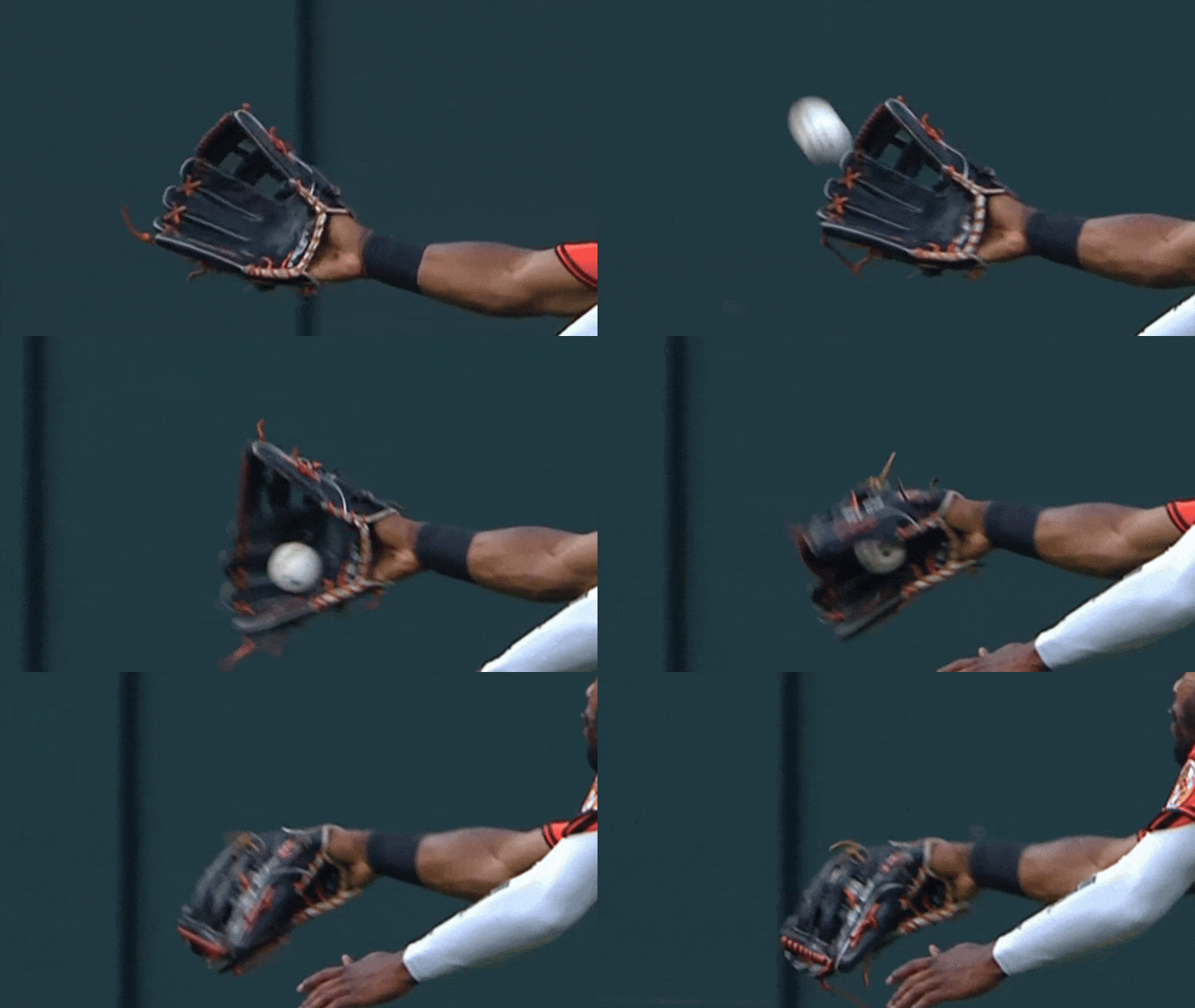
The angles here are mind-blowing. Mullins can’t catch it in the pocket. He doesn’t have time to make that adjustment. Instead, the glove is angled slightly downward. Only the pinkie is parallel to the ground, and that’s where the ball hits. Because this is a big, floppy outfielders glove, the whole thing flexes even further toward the ground when the ball crashes into it. And yet Mullins somehow coaxes the plummeting ball into rolling uphill into the pocket. It’s by design. If he keeps the glove too stiff, the ball might bounce out. So instead, he uses the floppiness as a shock absorber. By letting the ball angle the glove downward this way, he can’t use gravity to keep it inside. Instead, he has to roll with the punch, pointing the glove straight down and fighting gravity as he squeezes the ball. Oh, and he’s doing all this in midair, and he has to maintain possession as he thuds into the earth. This may be a two-star play, but the catch itself deserves its own galaxy.
Davy Andrews is a Brooklyn-based musician and a writer at FanGraphs. He can be found on Bluesky @davyandrewsdavy.bsky.social.
I love that this is just an article about how ridiculous a defender PCA is.
Idk that I’d give the Mullins ball an 80% catch probability. It’s hit decently into the gap and behind him, so he has to turn and move to get there, and while he’s not at top speed, he’s not taking it easy either. Not an especially *difficult* catch, but 80% seems too high. 70-ish seems more correct to me. It wouldn’t surprise me to see that ball go for a double.
Statcast’s methodology on catch probability has always seemed weird to me.
This is the type of thinking that ends up calling Castellanos a good outfielder.
What is it about their methodology that you don’t agree with? It just uses opportunity time, distance, and direction (plus some wall-based adjustments). So it takes into account the ball being hit into the gap behind him like you say. My only real issue is that it doesn’t take into account things like wind, sun, and spin, which (1) mostly even out for players who don’t play in Wrigley and (2) are difficult to quantify in such a way that you’re not just injected noise into your metric.
I also just really doubt anyone can tell the difference between a 70% catch probability and 80% catch probability ball by eyeballing it. It doesn’t take a huge change in opportunity time to go from 70 to 80%.
One problem with the eye test on these is you pretty much never see the jump. Not saying he got an atrocious jump, but the difference between a good jump and an average one is often the difference between having to dive like that and just a casual catch on the run. On that one in particular though, he was running very slowly for an MLB CF. He may have just misjudged it a little.
I know DRS says Mullins is a 30-grade defender in CF. But DRS is also using technology that isn’t nearly accurate enough for the buckets they’re trying to break it down into, and is also prone to giving very extreme values.
It’s clear that his arm is a huge problem…that’s probably 30 grade, maybe even less. It was already a problem before, and it’s definitely a problem now…and he is slower than he used to be. But I’m looking at his catch chart on Statcast right now and I am having a really hard time seeing how his range would be less than a 50.
Johnny Damon out there
This is great stuff!
I know a lot of data and analysis goes into catch probability and the eye test is unreliable. But I have trouble seeing all three plays as roughly equal difficulty. Castellanos catch looks somewhat hard because he plays the ball poorly but the other two OF had to cover a lot of ground. Did they just cover that ground very slowly to make it look hard?
Essentially yes, but in different ways. Mullins was barely above a jog for most CFs. I haven’t seen him play much, so don’t know if that’s unusual for him. Harris was running plenty fast, got a terrible jump. With a good jump and decent speed to the ball, both of those are caught jogging.
The little nuances like he mentioned in the article, about how the ball came off the end of the bat in a weird way, are not incorporated in the catch probability calculation. Individual plays are going to have some uncertainty in terms of what bucket they should really have been in, so you won’t have a problem finding instances where a play isn’t perfectly assessed by the model.