Archive for Josh Donaldson

Josh Donaldson Has Gone Full Edwin Encarnacion

Nothing about Josh Donaldson being great is surprising anymore. There was the late-career breakout in 2012, and then confirmation that the breakout was real in 2013-14. And then, of course, he won the Most Valuable Player award in 2015. We love stories about unexpected rises to prominence more than anything else, and that’s true within baseball and outside of it. Once a player reaches the elite and stays there, the story of the rise fades away, and consistent excellence has a strange way of becoming almost routine — whether it deserves it or not. (Note: it does not.) The really fun part comes, however, when great players do things to try and make themselves more great, pushing themselves past the already absurdly high plateau. From what we’ve seen so far this season, Donaldson appears to be embarking on that hallowed and honorable mission.

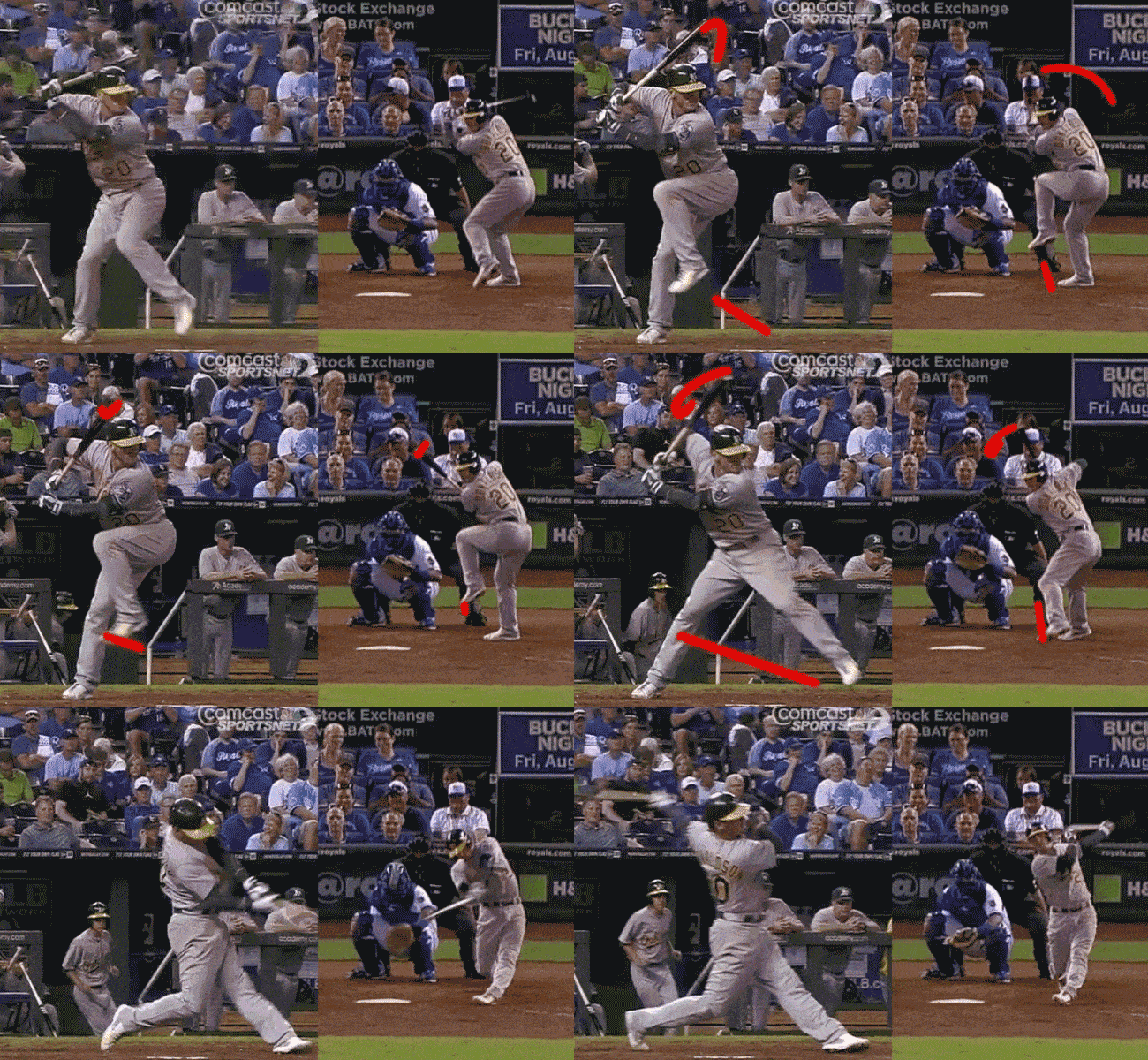
First, a little background to what we’re talking about. Donaldson based his breakout on better patience, all-fields power, and a few aggressive mechanical changes. Those mechanical changes were based on the leg kick and bat tipping of Jose Bautista, so it was a nice coincidence when the two were united on the Blue Jays last season. Here’s a couple GIFs that visually explain some of those changes, from a 2014 interview with Jerry Brewer:

2013 swing — smaller leg kick, controlled bat tipping:

091313_Controlled

2014 swing — bigger leg kick, aggressive bat tipping:

081214_Aggressive

The latter swing is more of the hitter we know today — the guy who consistently murderizes baseballs — and we can see the quite obvious visual similarities to Bautista’s swing. It’s also the swing that, along with his great defense, vaulted him into the top of the WAR leaderboards over the past few years. Since he joined the Jays, however, Donaldson’s batted-ball tendencies have trended more toward his other power-laden teammate, Edwin Encarnacion. There’s certainly potentially something to gain from him moving more toward Encarnacion’s approach, as it has mimicked the sort of trajectory a number of players follow during single-season power surges. Here, allow us to consider how.

Read the rest of this entry »


Lorenzo Cain and A.J. Pollock Sign Atypical Contracts

In yet another sign that baseball season is coming ever closer, the arbitration process this year is coming to a close. Many players signed one-year deals before the teams and players exchanged numbers last month, while others exchanged numbers and struck one-year deals. A few players have actually gone to arbitration. Four players — Lorenzo Cain, Josh Donaldson, J.D. Martinez, and A.J. Pollock — agreed to two-year deals with their teams, buying out no free-agent seasons, but ensuring both parties that arbitration would not be necessary next year. These two-year deals are common and typically come with a discount for the team. For the four players who signed this season, however, there was no discount.

The arbitration process is set up to provide a discount to teams in the years just before free agency. The players get their first taste of actual millions while the team retains control of the player at a price much less than what the market would yield — all without having to mark a multi-year commitment. Some players sign extensions which takie them through free agency while others are non-tendered and set free by clubs who think that even the small, arbitration-produced salaries are too much compared to the expected production.

Read the rest of this entry »


JABO: The Rarity of Josh Donaldson’s Late Ascension

In some seasons, the Most Valuable Player award is a close race between a few worthy position players with a pitcher thrown into the mix if the circumstances align. This year, in the National League, the voting was unanimous for the MVP, and for good reason. In the American League, there were only really two serious candidates for the award, with one fact underlining that point: in MVP voting, each voter ranks players from one to ten, and this year in the AL, every ballot except for one had either Mike Trout or Josh Donaldson in first or second place.

Given that there were only two serious candidates in the AL, there was a fair amount of discussion about who was the worthier of the two players. We could say this was a battle of statistics versus context: a better statistical season (Trout) versus the offensive lifeblood of a playoff-bound Toronto team (Donaldson). Defensively, Donaldson had a better season, but Trout was clearly superior on the offensive side of the ball. Take a look at their full stats side-by-side (wRC+ uses 100 as league average, while UZR is how many runs better the player was than a league average defender):

2015 AL MVP Race
wRC+ (Offense) UZR/150 (Defense) WAR
Mike Trout 172 0.3 9.0
Josh Donaldson 154 9.8 8.7
SOURCE: FanGraphs

In the end, the context that is often added to the MVP award won out: Donaldson led his Toronto team to the playoffs after the city had endured a 21-year postseason drought, compiling an incredible offensive and defensive campaign in the process. As is so often the case, there was no true right or wrong answer on who should have won the award; it was close enough to where both players could have deserved it, and it was a matter of opinion that separated them. When all is said and done, baseball is about winning games, however, and Donaldson benefitted from being a key piece of a team that won more games than Trout’s Anaheim Angels.

Discussing the worthiness of each player winning the AL MVP has already been covered at length. If you’ve paid attention to this award season, you probably know the arguments for and against both Trout and Donaldson: we’ve even recapped a few of them here. What is well-known is who Donaldson currently is. What is less-known is who he Donaldson was, and where he now stands among historical MVPs. In context, who he was is a huge part of the story, and we’ll see that it’s pretty rare that he turned into who he is.

Read the rest of this entry »


JABO: Josh Donaldson’s MVP Push

This past weekend, the Toronto Blue Jays swept the Los Angeles Angels in a three-game series, dominating the Halos by a combined score of 36-10. The series represented a few important points: not only did the three wins vault the Jays over the New York Yankees for sole possession of first place in the AL East, but it also featured a matchup of the current favorites in the AL MVP race, Mike Trout and Josh Donaldson. While Trout went 3-10 during the series (all three hits coming in the series finale), Donaldson showed why he is beginning to be viewed as a possible contender for the league’s MVP, going 8 for 13 with a home run, four doubles and nine RBI.

Up until this season — even up until a month ago, in fact — the idea of Donaldson being a serious front-runner in an MVP race would have been viewed as very optimistic. He’s been in the conversation as one of the best overall position players in baseball since his breakout in 2013 (his 21.2 Wins Above Replacement since the start of the 2013 season is second only to Trout’s 25.2), but a strict comparison with Trout in the past probably would have been seen as a reach. That has little to do with Donaldson: Trout is the best player in baseball, and a normal year for Trout would be the best year of basically anyone else’s career.

Then this past offseason’s trade from Oakland to Toronto occurred, and Donaldson showed that the move to the Rogers Centre was most likely going to pay serious dividends for his statistics. Early on in this season, it became evident he might be tailoring his swing to pull more fly balls when he was playing at home, resulting in an astounding power increase that has showed no signs of slowing down in the ensuing months. His home/road splits are more pronounced than they ever have been, showing the influence of his home park’s friendliness to hitters — and his ability to exploit it:

Josh Donaldson 2015 Home/Road Splits
HR ISO OPS wRC+
Home 20 .323 1.040 181
Away 14 .241 .866 140

Read the rest on Just a Bit Outside.


JABO: Josh Donaldson’s Rogers Centre(d) Approach

For the past two years, there’s been a dark horse in the MVP race. Though he might never had a shot at winning the award with the likes of Miguel Cabrera and Mike Trout putting up the types of seasons they did, Josh Donaldson has nonetheless been one of the best players in baseball since the start of 2013. This year, we’re witnessing an interesting development: a plate approach adjustment to take advantage of the offense-friendly Rogers Centre.

We’ve gotten accustomed to seeing a high level of production out of Donaldson since August of 2012: above average walks, a lot of power and elite defense. His offensive output was tempered in 2013 and 2014 by the fact that he had to play his home games in pitcher-friendly Oakland; the prevailing thought was that moving to the Rogers Centre in 2015 could possibly vault him into an even higher echelon among power hitters.

At the midpoint of this season, that’s exactly what has happened. Take a look at Donaldson’s yearly stats since the start of 2013, the first year he was the productive hitter we see today:

Season BB% K% AVG OBP SLG ISO BABIP wRC+
2013 11.4% 16.5% .301 .384 .499 .199 .333 147
2014 10.9% 18.7% .255 .342 .456 .201 .278 129
2015 7.7% 19.7% .295 .352 .529 .234 .322 142

A few things of note this season: Donaldson’s strikeouts are up, his walks are down a fair amount and his power is more substantial. We tend to see walk rates improve as players age, so this is a little strange. What could be causing his drop in free passes? Let’s look at Donaldson’s stats away from Rogers Centre this year:

Season Home / Away BB% K% AVG OBP SLG ISO BABIP wRC+
2015 Away 11.0% 19.2% .227 .316 .360 .133 .257 92

His rate stats look in line with his career norms since 2013, but everything else has been pulled down in some part by bad batted-ball luck. How about his stats this year at Rogers Centre?

Season Home / Away BB% K% AVG OBP SLG ISO BABIP wRC+
2015 Home 4.7% 20.2% .352 .383 .670 .318 .380 186

There we have it. Compared to his overall stats the past two years, he’s basically not walking, he’s striking out more and he’s hitting for much more power when he’s playing at home. What we seem to be seeing is a different approach when Donaldson is in Toronto — one that allows him to take advantage of his home park’s natural power-boosting tendencies. Let’s go into the reasons for the numbers.

Read the rest on Just a Bit Outside.


Oakland Athletics: Top 10 Prospects

General Manager: Billy Beane
Farm Director: Billy Owens
Scouting Director: Eric Kubota

FanGraphs’ Top 10 Prospects:
(2009 Draft Picks/International Signees Not Included)

1. Chris Carter, 1B, Triple-A
DOB: December 1986 Bats: R Throws: R
Signed: 2005 15th round – Nevada HS (Chicago AL)
MLB ETA: Mid-2010 40-Man Roster: Yes Options: 3

If you want to dream on a power prospect, Carter is your man. He has Ryan Howard-like power potential, although there are concerns over his lack of contact and high strikeout numbers. Carter is likely a .250-.270 hitter in the Majors (His .337 average in double-A was aided by a .406 BABIP). His strikeout rate in double-A was 24.3% in ’09. On the plus side, he also had an ISO rate of .238, an OPS of 1.1011 and a walk rate of 13.8%. Although the 6’4” 210 lbs first baseman is not swift-of-foot, he is a smart base runner who nabbed 13 bags in 18 tries. Daric Barton is Carter’s biggest “roadblock” to the first base job in Oakland; although he’s far from a five-tool player, the prospect is a better all-around player than Jake Fox or Jack Cust.

2. Michael Taylor, OF, Triple-A
DOB: December 1985 Bats: R Throws: R
Signed: 2007 5th round – Stanford University (Philadelphia)
MLB ETA: Mid-2010 40-Man Roster: No Options: 3

Obtained from the Phillies, via the Blue Jays during the Roy Halladay musical chairs, the organization gave up a more promising bat (Brett Wallace) for the better all-around player in Taylor. Oakland has a lot of outfield depth with the likes of Travis Buck, Eric Patterson, Rajai Davis, and Ryan Sweeney, but none of those players can match Taylor’s potential. He’s also MLB ready, so he could step into a full-time or platoon gig in April. Taylor, 24, had a solid ’09 season in double-A where he hit .333/.408/.569 in 318 at-bats. He displayed a reasonable walk rate at 9.6% and kept his strikeout rate below 20% (16.0%) while maintaining excellent power (.236 ISO). Taylor also added 18 steals in 22 tries. Promoted to triple-A, he hit .282/.359/.491 with a .209 ISO in 110 at-bats. Taylor possesses a strong arm and can play both outfield corners, although he sees most of his time in left field.

3. Jemile Weeks, 2B, Double-A
DOB: January 1987 Bats: B Throws: R
Signed: 2008 1st round – University of Miami
MLB ETA: Mid-2011 40-Man Roster: No Options: 3

Weeks battled through injuries in ’09 and appeared in just 80 games. The second baseman opened his season with a power burst that was unsustainable and probably a fluke. He posted a .169 ISO in his first 50 games with high-A (all seven of his homers came in his first 97 at-bats) before moving up to double-A where he posted an ISO rate of .105, which was more in line with his debut (.108 ISO in ’08). A switch-hitter, Weeks performed much better against right-handed pitchers in ’09 with an OPS of .899 vs .615 against southpaws. Defensively, the 23 year old is athletic with a strong arm, but he makes some careless errors.

4. Adrian Cardenas, 2B, Triple-A
DOB: October 1987 Bats: L Throws: R
Signed: 2006 supplemental 1st round – Florida HS (Philadelphia)
MLB ETA: Late-2010 40-Man Roster: No Options: 3

It was an up-and-down season for the 22-year-old Cardenas. He received a quick promotions to triple-A in ’09 but struggled by hitting .175 in May and was sent back to double-A, where he set the world on fire by hitting .326/.392/.446 in 325 at-bats. Moved back up to triple-A in August, he posted a line of .287/.354/.396 in August and .340/.392/.532 in September. In the lower minors, the prospect showed the ability to steal 15-20 bases but he hasn’t topped eight steals in the past two seasons. Cardenas’ bat will have to carry him as he is an average fielder at best at the keystone. A permanent spot at third base could be in the cards, but his power output is below average for the position. The former Phillies draft pick should be ready for the Majors right about the time Mark Ellis‘ contract expires.

5. Tyson Ross, RHP, Double-A
DOB: April 1987 Bats: R Throws: R
Signed: 2008 2nd round – University of California
MLB ETA: Late-2010 40-Man Roster: No Options: 3
Repertoire: 89-94 mph fastball, slider, cutter, change-up

If you love ground-ballers like we do at Fangraphs, then you’ll want to meet Ross. The right-hander posted a 56.6% ground-ball rate on the season, including a 61.9 GB% in 66.3 double-A innings. Just 22, Ross is a promising pitcher despite a modest strikeout rate in double-A (8.55 in high-A, 5.58 K/9 in double-A). His fastball can touch the mid-90s so the strikeouts should come once he improves his secondary pitches. He also needs to improve his command and control a bit after posting a walk rate of 3.48 on the seasons. Ross allowed 10 homers in high-A (1.04 HR/9) despite his impress ground-ball numbers. If his secondary pitches don’t improve, he could become a dominating late-game reliever with his sinking fastball.

6. Pedro Figueroa, LHP, High-A
DOB: November 1985 Bats: L Throws: L
Signed: 2003 non-drafted international free agent (Dominican Republic)
MLB ETA: Late-2011 40-Man Roster: Yes Options: 3
Repertoire: 91-96 mph fastball, slider, change-up

Figueroa was not on the watch list when the season began but quickly jumped onto it. A little older than most prospects in low-A at 23, the southpaw posted a solid strikeout rate of 8.13 K/9 at the junior level while showing OK control with a walk rate of 3.23 BB/9. Moved up to high-A for 11 starts, Figueroa’s walk rate jumped to 4.80 BB/9 but his strikeouts also increased to 9.18 K/9. Overall, he allowed 151 hits in 152.0 innings of work, while producing a respectable ground-ball rate of 46.2%. Because he’s now 24, Oakland could be aggressive with Figueroa and move him up to double-A despite his control issues.

7. Fautino De Los Santos, RHP, Injured
DOB: February 1986 Bats: R Throws: R
Signed: 2005 non-drafted international free agent (Dominican Republic)
MLB ETA: Late-2011 40-Man Roster: Yes Options: 3
Repertoire: 89-95 mph fastball, slider, curveball, change-up

One of the key players in the Nick Swisher trade with the White Sox, De Los Santos made just five starts with Oakland’s system in ’08 before going down with a major injury. He returned in ’09 to make seven rehab starts in rookie ball and he showed his fastball of old, but his secondary pitches are still being worked back in. The right-hander has the potential of a No. 2 starter if he can harness his breaking ball and change-up but he could also develop into a dominating reliever. We’ll know a lot more about De Los Santos’ potential as the season progresses. If healthy, he should opened the season in high-A ball.

8. Sean Doolittle, 1B, Triple-A
DOB: September 1986 Bats: L Throws: L
Signed: 2007 supplemental 1st round – University of Virginia
MLB ETA: Late-2010 40-Man Roster: No Options: 3

Doolittle was yet another prospect bitten by the injury bug in ’09. He started the year in triple-A and was just a quick phone call away from making the Majors before knee problems (and surgery) ended his season. When everything is clicking for Doolittle, he is a .280-.300 hitter with 15-20 homer potential. He has always displayed good walk rates (12.4% in ’09) but he strikes out a bit too much for his power output (21.9%). An above-average defender at first base, Doolittle was moved to right field (Thanks to the presence of Chris Carter) where he is average.

9. Shane Peterson, OF, Double-A
DOB: February 1988 Bats: L Throws: L
Signed: 2008 2nd round – Long Beach State University (St. Louis)
MLB ETA: Late-2010 40-Man Roster: No Options: 3

Acquired in last season’s Matt Holliday trade with St. Louis, Peterson projects to be an average MLB player mainly due to the fact that he possesses below-average power for his best positions (corner outfield, first base). The prospect is actually similar to fellow left-handed hitting Sean Doolittle in the sense that he projects to hit 10-15 homers with a batting average between .270 and .300. After struggling against southpaws in ’08, Peterson rebounded to post a line of .302/.348/.430 against them in ’09. The 22-year-old hitter has more speed than Doolittle and he nabbed 16 bags in 17 tries in ’09.

10. Josh Donaldson, C, Double-A
DOB: December 1988 Bats: R Throws: R
Signed: 2007 supplemental 1st round pick – Auburn University (Chicago NL)
MLB ETA: Late-2010 40-Man Roster: No Options: 3

Part of the loot for Rich Harden during an ’08 trade with the Chicago Cubs, Donaldson has seen his value improve significantly since joining his new organization. At the time of the trade, Donaldson was hitting .217/.276/.349 in low-A ball. He was immediately promoted to high-A with Oakland and finished the year with a line of .330/.391/.564 in 188 at-bats. He continued to hit well in ’09 despite being moved up to double-A and he produced a triple-slash line of .270/.379/.415 in 455 at-bats. Although he posted a 20.2% strikeout rate, Donaldson also walked at a rate of 14.8%, good for a BB/K rate of 0.87. He’s shown flashes of solid power, but he’s more of a line-drive hitter and he had an ISO rate of .145 in ’09. Donaldson has the tools to be an average big league backstop, although he’s still working on his receiving. He threw out 40% of base stealers last season.

Up Next: The San Diego Padres


A’s Choose Quantity Over Quality

The recent trade between the Oakland Athletics and the Chicago Cubs was interesting to say the least. Firstly, it came out of nowhere. Secondly, the haul for Major League pitchers Rich Harden and Chad Gaudin was far less than I would have expected the Athletics to receive, given the value of pitching in today’s game.

I won’t dwell on new A’s starter Sean Gallagher too much, since David wrote a nice piece on him yesterday. But I will say that he is definitely the key piece of the trade and should fit into the rotation immediately.

Eric Patterson is the brother of Cincinnati Reds outfield Corey Patterson. Eric is not a very good defensive player and he has already moved from second base to the outfield. His poor arm strength pretty much limits him to left field, first base or some second base, which hurts his value as a utility player. In nine left field games this season for Chicago, Eric made three errors. He was originally drafted in the eighth round of the 2004 draft after playing college ball at Georgia Tech.

Matt Murton has proven that he is a major league hitter but he has been buried at Triple-A in the Cubs organization despite a .294/.362/.448 line in 308 games over four seasons. He does not have a ton of power so he is best suited to a fourth outfielder or platoon role. Murton is a corner outfielder with average abilities in the field. He was the first round pick of the Boston Red Sox in 2003 and, like Eric Patterson, played at Georgia Tech.

Catcher Josh Donaldson has spent the season struggling at A-ball in the Midwest League. He is currently hitting .223/.282/.358 in 229 at-bats. It’s unfortunate because Donaldson, who was moved behind the plate at Auburn University, was supposed to have a much better bat than glove. He did hit .335/.460/.590 in 173 at-bats during his debut in Short Season ball in 2007. Defensively, he has made seven errors this season in 51 games behind the dish and has six passed balls. He has thrown out 27 of 71 (38 percent) runners attempting to steal a base. He was drafted 48th overall in the supplemental first round of the 2007 draft.

In all, the Athletics received a promising starting pitcher, two bench players and a catcher who may stick behind the plate and may hit enough to play in the majors… for two proven Major League pitchers who can both work out of the starting rotation. Patterson and Murton probably take the roster spots from Wes Bankston and Rajai Davis, offering modest upgrades. Donaldson addresses an organizational weakness at the catching position. Most of the pressure remains on Gallagher… especially if Harden stays healthy for any significant amount of time.

Also, keep an eye on Gaudin if he gets the opportunity to start in the National League. He could thrive there.