
The Brewers Have Defied The Odds
All season, the Milwaukee Brewers were a band propped up by a stud lead guitarist. The drummer was often off-beat, the singer was pitchy, the rhythm guitarist was clearly only in the band because he was the singer’s kid brother, and the bass player was … well actually, the bass player was pretty sweet, too. But man, could that lead guitar shred. He was the reason the band could book any gig in town, the standout performer every night. His name was Christian Yelich, and on September 10, he fell off the stage — or rather, he fouled a pitch off his kneecap, and suffered a season-ending fracture. As Jay Jaffe wrote at the time, the injury dampened what were already somewhat long playoff odds for the Brewers. But the band pressed on, undeterred by the loss of their star. And lo and behold, they’ve sounded incredible.
On September 5, our playoff odds put Milwaukee’s chances of reaching the postseason at just 5.6%. Those were worse odds than in-division rivals St. Louis and Chicago, and also put them at lower Wild Card odds than New York and Arizona. They won five straight games before losing Yelich, but that still only raised their chances to 25%. Yelich had already accumulated 7.8 WAR, and was in excellent position to win a second-straight MVP award, and he fell out of the picture. Without him, the Brewers had just one other 4 WAR player, and just six 2 WAR players. That lack of starter-quality depth placed them in the back half of all the teams in baseball.
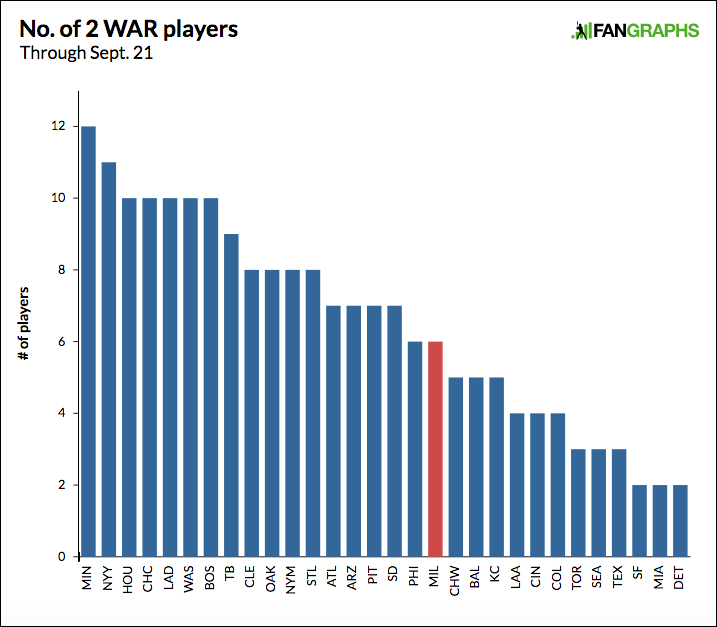
Every team with fewer 2 WAR players than the Brewers has been firmly out of the playoff race for weeks, and a number of teams in front of them — including Boston, Pittsburgh and San Diego — have been out of the race for a while as well. No contender was more poorly equipped to lose a star player for final month of the season than Milwaukee. At least, that was the way it appeared.
That five-game win streak the Brewers were riding when Yelich hit the IL? It ultimately turned into seven games. They finally lost in St. Louis, but rattled off four more wins after that. Then came another loss, this time at San Diego, followed by four more victories. Overall, the Brewers are 15-2 since September 6. In that time, they’ve raised their playoff odds from 5.6% to 97.1%. It’s one of the best runs any team has put together this season, and given the circumstances, it’s come from one of the last teams one would expect.
A portion of the Brewers’ success can certainly be credited to the competition they’ve faced over this stretch. Of their last 17 games, 11 have come against the Marlins, Padres and Pirates. September is a very fortunate time to run into two last place teams and a third non-contender, but to be fair, the Brewers pushed them around exactly the way they should have. They won 10 of those 11 matchups, outscoring their hapless opponents by a jaw-dropping 60-23 margin. Playoff teams are supposed to look dominant against inferior competition, and that’s exactly what Milwaukee was. Their recent hot streak also included three wins in a row over the Cubs and two victories in three games over the Cardinals, the two most direct obstacles to their postseason hopes.
Regardless of who’s been in the opposite dugout, Milwaukee has been brilliant, especially on the mound. Its pitching staff has an ERA of 2.61 over its last 17 games, the best in the majors. That number includes a 10-run outburst by St. Louis, which, if stripped away, drops the Brewers’ ERA to just 2.13. In the rotation, four starters have maintained ERAs under 2.50 over this stretch, with the lowest belonging to Jordan Lyles (1.80) and Chase Anderson (1.93).
All four of those starters, unsurprisingly, are outperforming their respective FIPs by substantial margins, as good walk and home run prevention have combined with low BABIPs to stifle opponents’ scoring chances. But there is no doubting the Brewers’ rotation has been great, and their bullpen has been even better. Jake Mailhot just detailed Drew Pomeranz’s transformation since joining Milwaukee’s relief corps, and Josh Hader has continued to be brilliant if less so than he was in 2018, but the Brewers have also gotten splendid work from Brent Suter (12 scoreless IP since September 6), Freddy Peralta, and Junior Guerra.
This stretch of excellent pitching has happened to coincide with the Brewers being more aggressive than ever when it comes to lifting starters from games. They began getting creative with their pitching management last season, and limiting innings for starters was a part of that approach, as they finished the season with starters averaging fewer than 5.2 (meant to be read as a decimal, not as 5 2/3) innings per game. They’ve dipped to just 4.9 innings per start this season, and over the last 17 games, are averaging just 4.25 innings per start, along with just 66.7 pitches per start. Again, this is while their starters have been among the best in baseball at preventing runs. This is obviously a pre-planned strategy, and for the time being, it’s producing fantastic results.
On Sunday, the Brewers started Brandon Woodruff, who retired each of the Pirates’ first six hitters, striking out three. Despite his great start, Milwaukee manager Craig Counsell replaced him with Jay Jackson in the third inning. Jackson struck out all three batters he faced, only to be replaced in the fourth inning by Gio Gonzalez, who retired the next 10 batters in a row. Three Brewers pitchers combined to pitch a perfect 6.1 innings of baseball, and the staff finished the game without an earned run allowed for the second day in a row (Pittsburgh scored four unearned runs in the same time period).
On the offensive side, Yelich’s offense has predictably difficult to replace. Since his injury, the Brewers have produced a wRC+ of just 86, 17th in the majors. That isn’t remotely the show of force the pitching staff has displayed, but they still haven’t been without heroes at the plate. Yasmani Grandal — consistently the second-best Brewer all season — has kept up his performance, hitting .245/.403/.509 over the Brewer’s hot streak, while Mike Moustakas has homered four times in the 11 games since Yelich’s injury. The team’s best hitter has arguably been Trent Grisham, a 22-year-old rookie outfielder who has a 141 wRC+ since the reigning MVP went down; Eric Thames homered twice to make the difference in a one-run victory over the Pirates on Sunday.
It’s impossible to tell Milwaukee’s comeback story, however, without also discussing the repercussions for other teams. Baseball is a zero-sum game, and if the Brewers have so drastically raised their own playoff odds, it must mean another team has seen their own suddenly tumble. That other team has been the Cubs, who over the same stretch of time that has seen Milwaukee win 15 of 17, has sputtered to a record of just 6-11, including a current losing streak of six games. Just one week ago, the Cubs were in a marvelous spot, having won five in a row against the Padres, Pirates, and Reds and holding a 76.2% shot at the postseason. Then, things got dark. They dropped two in a row to lose a series against Cincinnati — who wound up going 11-8 against Chicago this season — before suffering a four-game sweep to the division-leading Cardinals, a nightmarish stretch that all but wiped out their chances at making the playoffs.
The immediate effects of these two polar opposite stretches are conveyed pretty explicitly in the NL Central playoff odds chart.
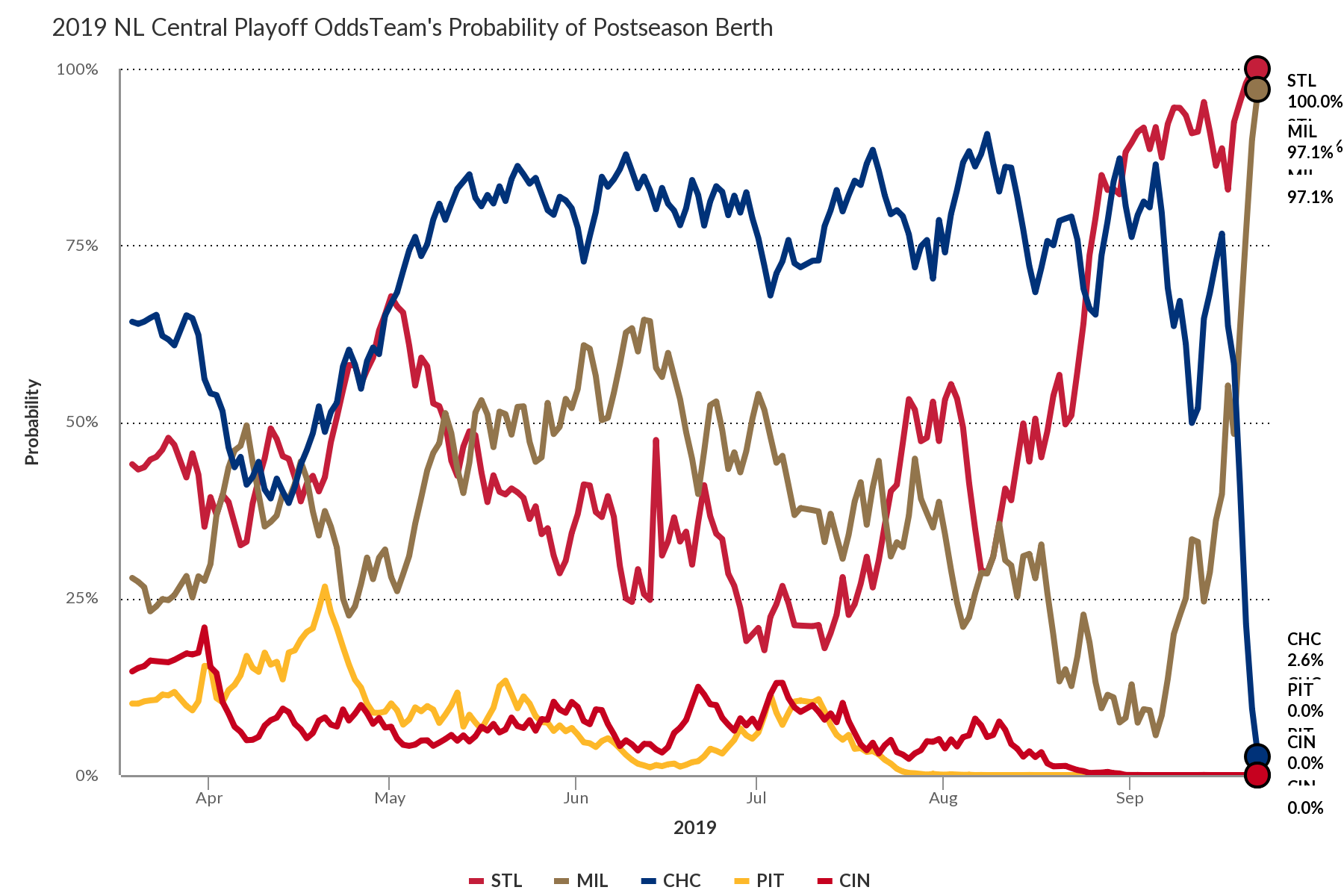
That’s a brutal stretch for the Cubs, especially when considering each of their last five losses came by just a single run. It’s also somewhat fitting, considering how significant a role one could argue luck has played in this season for each of these teams. Despite sitting in third place, the Cubs own the best run differential in the NL Central, at plus-111. Their Pythagorean record places them at 89-67, a whopping seven games better than their actual record of 82-74. The Brewers, meanwhile, have actually been outscored by two runs this season — even after this recent run of dominance — giving them a Pythagorean record of 78-78 that is eight games worse than their actual record of 86-70. They’ve been on the wrong end of more lopsided games than they’ve won, but when the game stays close, they’ve been as good at sealing the deal as just about anyone in baseball, going 26-16 in one-run games. The Cubs, on the other hand, are 19-26 in such contests.
A lot of noise can go into determining one-run games, but having quality high-end relief talent tends to help in ensuring your team comes out on top more often than not. That also happens to be one area that separates the Cubs and Brewers as much as anything else. Milwaukee has benefited from being able to use Hader at the end of games, with his 2.61 ERA and 16.5 K/9 throwing 72.1 innings and finishing 44 games this season. Chicago, however, has struggled to find the same stability at the back of their bullpen. It signed Craig Kimbrel, of course, to offer that service back in June, but he’s never settled in as the team’s closer, owning a 6.53 ERA and 8.01 FIP in 20.2 IP this season and allowing the losing run in two of the team’s four games against the Cardinals over the weekend. With his struggles, the Cubs have given several other pitchers opportunities to become their stopper, but from Pedro Strop to Steve Cishek to even Tyler Chatwood, no one ever nailed down the role.
The past week didn’t completely settle the National League playoff picture, but it came awfully close. With six games left, the Brewers are tied with the Nationals for the first and second Wild Card spots, with the Cubs four games out. The Brewers’ remaining schedule includes two more non-contenders in Cincinnati and Colorado, though Milwaukee has hardly dominated either, going 10-10 against those two teams this season. Chicago, meanwhile, gets to knock Pittsburgh around for three games this week, but must close the year with three more games in St. Louis. The only question that may still need answered in a few days is which of Milwaukee and Washington gets to claim home field advantage for the Wild Card game, something the Nationals will need to overcome a lot to attain, with eight remaining games in the next seven games — five against Philadelphia, with a doubleheader on Tuesday thanks to a rain-out earlier this season, and a season-ending series against Cleveland, who will be fighting for its own Wild Card fate. A one-in-20 shot at the playoffs less than three weeks ago, Milwaukee now seems like a good bet to decide an NLDS trip in its home ballpark.
The more interesting questions, then, involve what a Brewers playoff run this season looks like. Even after this torrid run, our playoff odds still give them just a 13.8% chance of reaching the NLCS, a 5.3% chance of reaching the World Series, and a 1% chance of winning the championship. In going against one of the Nationals’ intimidating starters in the Wild Card game, would the Brewers choose Lyles — a mid-season acquisition from Pittsburgh whose 2.35 ERA after 10 starts in Milwaukee might be tempting to bet on despite the fact that his FIP is more than two runs higher — to lead them into battle, or would a combo of Woodruff, Gonzalez, and Hader be the call? Can their offense hit enough to be more than just a sad reminder of the fact that Yelich isn’t in the lineup?
There are a lot of reasons to be surprised that the Brewers are in this position, and subsequently skeptical of how they’ll handle worthy opponents in the postseason. But there were a ton of questions facing this team even before it lost its MVP, and look at how they’ve responded. The music is still going. The pyrotechnics aren’t as dazzling, and the solos don’t have the same flourish. But the sound is still there. Don’t stop listening yet.
Tony is a contributor for FanGraphs. He began writing for Red Reporter in 2016, and has also covered prep sports for the Times West Virginian and college sports for Ohio University's The Post. He can be found on Twitter at @_TonyWolfe_.
looking at the numbers from 9/11 to yesterday they’re running a 89 wRC+ and not 87…
but even with that- they’ve scored in the 12 games since Yelich has been out 60 runs or 5 per game.
Brewers got really lucky that if this was going to happen, it happened when their schedule got the softest of the entire season. It’ll be interesting to see how they fare when they get into the playoffs and see Max Scherzer right away, and then if they survive there- Buehler, Kershaw, and Ryu(in some order).
From June 14 through July 7 the Brewers played perhaps the softest part of their schedule. They played 7 straight series, 23 games, against sub .500 clubs and went 8-15.
June 14 – 16 @ SF -> 1-2
June 17 – 19 @ SD -> 0-3
June 20 – 23 vs. CIN -> 2-2
June 25 – 27 vs. SEA -> 1-2
June 28 – 30 vs. PIT -> 2-1
July 1 – 4 @ CIN -> 1-3
July 5 – 7 @ PIT -> 1-2
If they could have managed even a 12-11 record during that stretch they’d have 90 wins and be 1 game in front of St. Louis right now.
Point being, you still have to win no matter how soft the schedule is.
would say easy stretches in September are a whole lot easier than easy stretches earlier in the season. teams playing younger guys- and shutting down some of their younger players.
Also and maybe more importantly- hard stretches are hard… look at the Cubs.
Was 0-3
NYM 3-0
Mil 1-2
Sea 2-0
Mil 1-3
SD 2-2
Pit 3-0
Cin 1-2
Stl 0-4
So in that pretty tough stretch they went 13-16. With 2 sweeps against easy teams. You take Seattle and Pittsburgh out and only 8-16.
Agreed, plus many of weaker teams have also thinned out their rosters at the Trade Deadline.
I thought the Brewers were the equal of the Cubs and Cardinals before the season started, but I’ve been stunned at how badly they’ve played at times. Somehow they’re in a ideal position for a wild card spot despite having a neutral run differential. In the rotation, the starters were either hurt (Gonzalez, Woodruff) or horrific (almost everyone else), the bullpen was average, they had something like 2-4 actual hitters at any point during the year. The Cubs, meanwhile, have piled up a run differential of over +100, a little under half as much as the super-teams like the Dodgers and Astros but still a whole lot better than the Brewers.
Tony chalks this up to the bullpens, but aside from Craig Kimbrel being an utter disaster in his approximately 20 innnings, it’s hard to go too far with that. The Brewers’ bullpen FIP- is 9th in the league, and the Cubs are something like 15th; they’re both not too far away from average. Look at ERA-, and the Cubs’ stellar defense (something that makes their pitching look great) puts their bullpen at something like 6th, and the Brewers around 16th. I’m not buying this as a bullpen thing. And Craig Kimbrel has only blown 3 saves, which would put them around the Brewers, but not explaining why they’d even be in the same spot.
I think what may be going on is that the Cubs, because they don’t have any real weak spots in their rotation or lineuyp, they don’t really get “blown out” all that much, especially now that Darvish has settled down into resembling a major league pitcher and Alzolay isn’t getting starts. They’ve lost a huge number of one-run games, which some people interpret as a shaky bullpen, but given the numbers on the bullpens here, I think it’s more likely that they are never really out of it because of the consistency up and down the roster.Meanwhile, the Brewers have had so many bad starters running through that they seem like they’re getting destroyed pretty regularly early in the game, but of course, that doesn’t spill over to the next one.
Why do you make it sound like Alzolay got blown out a ton? He made all of 3 starts this season and gave up 1 earned run in 2 of them. A single disastrous start is hardly noteworthy.
Two starts, and in one of them he gave up seven runs in under 3 innings. I still think he could be something, though.
Sorry forgot that his first appearance was in relief. Felt like a start.
No worries. Also, that start against the Pirates (AKA, Josh Bell’s rockin’ summer party) where he missed all of his spots is seared into my brain.
But you can’t just take aside Kimbrel. 2nd half of the season he’s been one of the 50 worst relief pitchers in all of baseball(with at least 17 innings)- and he’s been used in almost all high leverage situations.
Even with Kimbrel, it’s not that bad, because Kimbrel hasn’t appeared in that many games. Kimbrel himself has lost…4 games? That’s terrible on a rate basis, but the damage has been limited because he has only pitched half the season, if that.
But even there- Kimbrel lost 4 games. How many games are the Cubs behind right now? 4. And 1 of those losses was to the Brewers and then 2 to the Cards. So it totally is that bad.
And would mention that the other guy at the back of the pen- Pedro Strop- has been responsible for 6 losses as well…
So if you drop the worst performing member of the bullpen, then they suddenly magically catch up to the Brewers? How many other teams do we get to drop their least valuable player, replace them with a (presumably) replacement level player, and recalculate their playoff chances?
But the thing is you can’t. Kimbrel has to be included in the mix. For him in 20 innings to be responsible for 4 losses personally is crazy…. The Cubs middle guys might be good- but between Kimbrel/Strop- that’s absolutely killed them this season. 10 losses between the 2 of them…
The point is that the Cubs have gotten atrocious performances from the very members of their bullpen that have been put in high-leverage spots. If you’re asking “why have the Cubs under-performed?”, well, that’s the main reason why. Looking at average bullpen performance misses the point.
Sort the team pitching clutch stat on the home page. The Cubs have the worst September number in MLB.
He’s basically Greg Holland, Part 2. I don’t think teams will be so eager to sign relievers who have held out through all of Spring Training anymore.
Something happened in the last 45 days. Fangraphs posted “The Cubs Are Slowly Pulling Away” on August 9th. Since then:
STL: 31-12 (.721)
MIL: 26-14 (.650)
CHI: 19-22 (.463)
In the last 30 days, the Cubs scored more runs than the Brewers, while allowing more runs than the Brewers. The biggest culprit appears to be BABIP — Cubs starters were 27th in the league during that time at .355, while Brewers starters were 6th at .264. Relievers were about the same: Cubs (.262 (7th); Brewers (.269 (9th)).
And it’s the non-Darvish starters that ran a high BABIP. So some combination of bad starting pitching for non-Darvish starters, bad defense at the start of the game, and bad luck?
It could have been bad luck, bad defense, or just plain getting hit hard…with BABIP, gotta dig into the batted-ball numbers to make an educated guess. As far as defense goes, didn’t Baez get injured in the middle of that run? That couldn’t have helped. But then Addison Russell would slide over to short, right?
Yeah, I only got as far as seeing that BABIP stood out and didn’t want to finish the homework, particularly since I don’t have a good feel for ferreting out pitch quality.
Baez was injured 9/1/19, so that would be a large part of any defensive loss. Heyward has been playing CF a lot, where he is probably below average, but he is still their best defensive outfielder. With a lot of positional fluidity, it is possible that the starting defensive lineups could be worse than the later ones.
I want to add to my previous comment that referencing Dan’s “The Cubs are Slowly Pulling Away” piece wasn’t intended to be snark against a favorite baseball analyst. The point I wanted to make was that on August 9th, the Cubs had a four game lead over the Cardinals, and all signs pointed towards this trend continuing. Within a few weeks, the Cards passed them to take the lead in the division, and within the last few weeks the Brewers have passed them as well. But I think the Cubs started losing their relative position around August 9th.
1 thing you do wonder is if the strategy the Brewers have done in September will be as doable next season w/o the bloated rosters. Since Yelich left they’re averaging using 12.16 position players per game, along with 5.08 pitchers per game(with no extra inning games). Don’t think teams are going to be willing to be as aggressive with only 14 position players and 14 pitchers.
Not sure about what Tony said about the home field. Nats need 2 more wins than Milwaukee to get home field. It’ll be interesting to see what the Brewers do with the Reds/Rockies. Reds especially better than the teams they’ve been feasting on. If Brewers go 4-2 this week, Nats at 6-2 would beat them..
I’m not smart enough to back this up with data, but I’ve long believed (since I first learned of such things) run differential/pythagorean records to be utterly meaningless. You score 1 run one day and give up ten, next day get the same run but shutout the opposition – you’re 1-1. Who cares if you got blown out yesterday? Call me a heretic!
Over two games you are correct. But the more games you throw into the sample, the more the bumps get smoothed out and the more run differential is meaningful
David Stearns has something figured out. They’re way above the X W-L this year, but they did the same thing last year. Same with the 2-WAR player stat in the above article. They are poised to make the playoffs this year with only 6 2-WAR players, but they had 96 wins last year and also only had 6.
I stand by what I said, run differential is meaningless. It’s not even used as a separater, like in soccer, for example. So the Cubs SHOULD have a much better record than the Brewers. I’m sure that will keep them warm in October.
Bring on the downvotes…
Eh, it’s like the FIP stat. It doesn’t mean a lot when analyzing what has already occurred, but it’s superior predictive metric for future performance over some more conventional measures.
Absolutely. Stearns has determined that the best way to battle high payroll teams is with depth. He strives to fill the system with 50 to 55 MLB quality players. Look at their AAA roster. If the Cubs only have 35 of those players, especially on the pitching front, they will be at a disadvantage as the season wears on. The Brewers are 34- 11 the past 2 September s combined.
Wasn’t it just five or six years ago that the Orioles had something figured out? Until they didn’t.
Streaks happen. Outliers exist. Baseball is pretty damned random and sometimes the chances line up. It doesn’t mean MIL is a bad team, it just means they probably don’t posses some secret voodoo.
Because we assume that scoring/giving up runs in one day is tapping the same latent ability the next day. This is obviously dependent on it being actually the same team (trades, injuries do change the team) but it’s a pretty reasonable assumption. It doesn’t necessarily change the win-loss record, but it should give you a better sense of the standing of your team when you’re deciding whether to make upgrades or not.
but how much is run differential dictated by blow out games? I mean the Nats had that game in Arizona where the 8th inning they used Parra and Dozier as pitchers, and gave up 7 runs that inning? That’s got nothing to do with ability at all whatsoever.
Those are pretty rare exceptions and only for parts of the game when they do happen. Besides, those blowouts with mass substitutions and/or position players pitching generally go both ways over the course of an entire season.
Lanidrac covers the issue of using Parra as a pitcher during a blowout game pretty well, but I think this also ties into my point earlier–there’s something about the distribution of pitching talent on the team for the Cubs vs. the Brewers that leads the Brewers to get utterly blown out and destroy their run differential, and the Cubs to not get blown out like that. The Brewers have had some bad, bad pitchers starting games this year and their run differential looks pretty bad. That carries over into other games to the extent that they’re still starting the same pitchers. The Cubs probably don’t get blown out like that, at least not lately, because they have competent starting pitching.
“with eight remaining games in the next seven games” Should that be days?
Brent Suter has allowed a .135 BABIP, 100% LOB rate, and a 0% walk rate in 14 innings with fewer than 7 K’s per 9. That’s hilarious.
I continue to be flabbergasted at the Brewers existence. They are not a good team. In so many ways they are not a good team. I have no idea how they win games. I’ve looked at tons of numbers, it makes absolutely no sense.
It must be a combination of a remarkably well timed run of mostly run prevention luck against bad teams and perfectly timed hitting. That’s all I’ve got.
But then again, the Cubs looked unstoppable against Pittsburgh and then got swept by the Cardinals. Teams are incredibly hot until they’re not anymore.
I think Stearns is exploiting the analytics crowd. His staff is identifying players that are undervalued by the new conventional wisdom. The Brewers then do not expose these players, typically pitchers, to long outings.
They attack teams with multiple, odd pitchers that are difficult to adjust to. Davies, Suter and Gio work under hitting speed. Woody, Hader, Pomeranz and Peralta work with devastating fastballs. Jackson, Guerra, and Albers work with breaking stuff.
Counsell is a master of applying these weapons when it is optimal.
Not exposing your worst pitchers to long outings is literally what the analytics crowd says to do.
There is no such thing as under hitting speed.
My point is that they identify pitchers that maybe have one exceptional trait that allows them to retire hitters in short stints. These pitchers are typically lower priced because they cannot be applied in all situations.
The September roster expansion allows Counsell to deploy these flawed players in settings that favor them.
If everyone is throwing 94, then a pitcher who throws 88 is basically throwing a changeup. If he changes speed off of that, then it is really below the league wide fastball ‘hitting speed’. It’s just an easy way to explain throwing off a batter’s timing. Which is what pitching really is.
The second time through the lineup, the hitters will now adjust to that pitcher but by then he is replaced with a guy throwing 97.
Also isn’t Suter a perfect score SAT guy? If someone is going to do be an outlier I’d expect it to be the smart guy
This unconventional pitching management is a pretty clever move to make a run at a playoff spot, but it’s only sustainable due to September roster expansion. If they do get in, I feel that the Brewers’ starting pitching is going to be vastly overexposed during the playoffs.
I was thinking the same thing but with the next year 26 guys you can do a lot… They’re averaging using just a smidge over 12 position players per game in September and a smidge over 5 pitchers per game. That would be doable in a 26 man roster environment.
They did the same thing last year and made it to game 7 of the NLCS. And they really should have beat the Dodgers last year. This year they won’t make a deep run because they lost Yelich, but the pitching strategy would work in the post season.
yeah. You wonder about next years rules though. Not just the 28 September roster- but also possibly positively the 26 man roster overall- but then the big ? is the 3 man minimum rule . Can’t do like they did last Wednesday and start an inning with a LOGGY.
They really only have one loogy on the team in Claudio. I think they will be fine. Probably not as aggressive as the last two years but I still expect to see them limit starters innings in Sept.
do wonder if the Brewers hot stretch here will hurt Yelich for MVP vote this season.
looking a bit more at Cubs bullpen vs Brewers bullpen. You can really see the difference…
in non save situations.
Cubs have a 3.56 ERA
Brewers have a 4.86 ERA
in save situations.
Cubs have a 4.97 ERA
Brewers have a 3.15 ERA
so yeah while the Brewers bullpen has some not so great numbers- when the chips are down- they are excellent. And this doesn’t even take into account performances in tie games which obviously aren’t save situations.
This reads as standard analysis was used but it didn’t work. With a legion of writers, why not one who isn’t doctrinaire. Fangraphs has already provided recent doctrinaire analysis about the Cubs pulling away.
Last season the Brewers were a game away from the WS using the same strategies. That seems worth a mention. And remarkably, while discussing their performance and outside expectations, you make no mention of what you must have believed was a near impossibility, winning the division. As I write this, they’re one game behind the unmentioned Cards.