
The Giants Are Circling the Most Interesting Managerial Hire in Decades
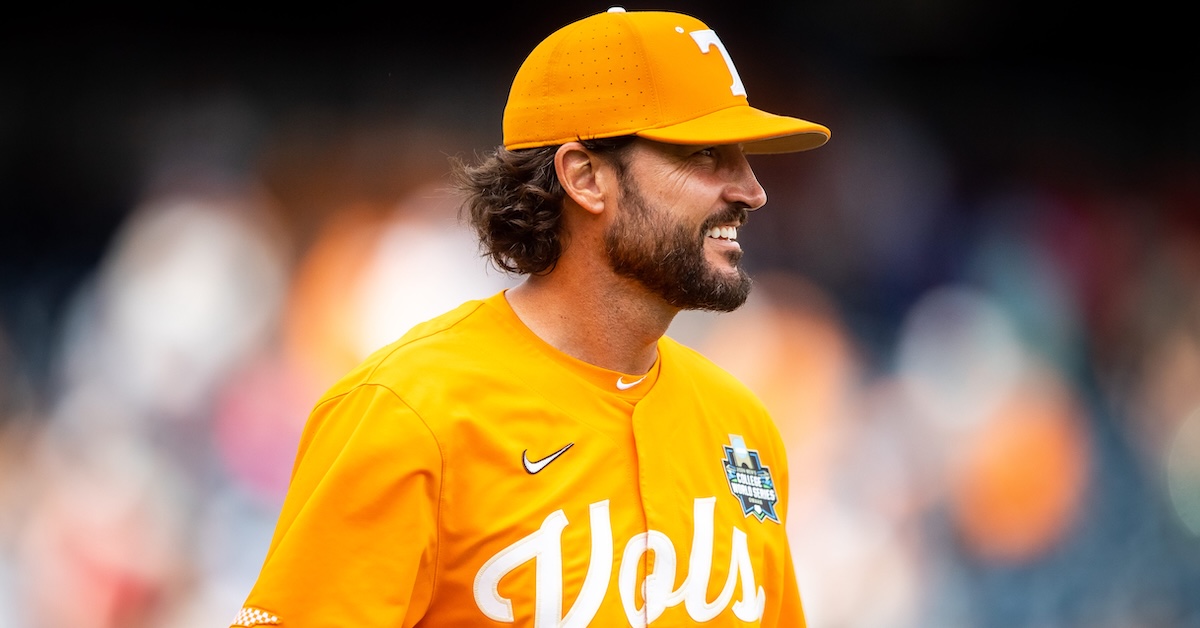
Forgive me for getting excited about this one, because even in sports, it’s not every day that the most interesting outcome happens. But the Giants are, according to The Athletic, “closing in on” hiring a new manager: Tony Vitello.
Two offseasons ago, I wrote about the five categories of major league manager: The hot assistant to a successful skipper; the grizzled baseball lifer; the front office liaison; the recent ex-player who’d been talked up as a future coach since his late 20s; and Aaron Boone.
Vitello is none of those things. When I run the player linker for this post, Vitello’s name is not going to come up in bold. Not only has he never played in the majors, he’s never drawn a paycheck from a professional baseball team in any capacity — not as a player, or a coach, or a scout, or a special assistant.
Vitello has spent his entire adult life working in college baseball: First as an assistant at Missouri, TCU, and Arkansas, and for the past eight seasons as the head coach at Tennessee. There, he’s made three trips to Omaha in the past five seasons, including a 60-win national championship campaign in 2024.
In the other big North American men’s sports leagues — the NFL, NBA, NHL, and MLS — there’s at least some coaching crossover with their NCAA Division I counterparts. In any of those sports, a coach with a track record and profile like Vitello’s would be a shoo-in for professional consideration. And we’re seeing movement between MLB and NCAA teams for support roles and assistant coaches these days: Reds pitching coach Derek Johnson is the former pitching coach at Vanderbilt, and the Detroit Tigers hired pitching coach Chris Fetters directly after his Michigan Wolverines played for a national championship. Current Georgia head coach Wes Johnson famously went from the University of Arkansas to the Minnesota Twins and back to college with LSU.
But Vitello will be blazing a new trail.
Brewers manager Pat Murphy is the only current (pending Vitello’s hire being made official) MLB bench boss with Division I head coaching experience. The last team to hire a college head coach directly for a major league managerial job was the Yankees, who poached Dick Howser from Florida State for the 1980 season.
Neither of those situations are comparable to Vitello’s. Murphy, who resigned from Arizona State in 2009 amid recruiting scandals, spent the next six years as a special assistant and minor league manager in the Padres organization, rising briefly to the post of interim manager of the big league club for 96 games after the midseason firing of Bud Black. From there Murphy joined the staff of Craig Counsell — his former player at Notre Dame — in Milwaukee, and spent eight years as the Brewers’ bench coach before succeeding Counsell in 2024.
Howser spent eight seasons in the majors as a player, then 10 more as the Yankees’ third base coach. His tenure as a college head coach consisted of all of one season and 64 games; he was a pro baseball lifer who went on sabbatical.
So what makes Vitello so special?
The phrase “college coach” conjures up a specific image for lots of people. The 2010s were a confluence of two important trends in baseball history: First, the mainstreaming of independent, statistically-focused and access-agnostic baseball analysis on the internet. A lot of people came into the sport with little patience for received wisdom. Second, the early 2010s were the last hurrah for the generation of coaches who had built college baseball into a serious national sport.
I’m talking coaches like Mike Martin, Augie Garrido, Mark Marquess, Wayne Graham, Jack Leggett — guys who had been around since the 1970s, and were still showing up in Omaha through the end of the decade. To give you a sense of how long a runway we’re talking about: Graham, who played for Casey Stengel during his major league career, had five of his former players make their major league debuts in the 2020s.
These guys are folk heroes, but they were big on received wisdom. They bunted a lot. They were mostly dismissive of analytics and indifferent to the impact of workload on their pitchers’ health. In an era with no NIL money and restrictive transfer rules, many of them ran their clubhouses in a manner that would simply not fly with adult professional players.
So people who haven’t updated their priors since 2016 will hear “college coach” and immediately assume that Vitello is an irredeemable hardass who’ll make Willy Adames drop 30 sacrifice bunts a year and wear out Logan Webb’s elbow by Memorial Day. Especially because Vitello can be, well, a little choleric.
See, the man absolutely loves getting thrown out of baseball games.
Tony Vitello gets ejected in the rubber match vs Auburn. Vitello let EVERY umpire know how poorly they’ve been at their jobs during what has been maybe the worst umpired series in a while.
His 5th ejection and first in 2 years (Mizzou 2023). #Vols pic.twitter.com/GVPCQKl1sM
— Harrison Cordell Fant (@Fantavious9) May 4, 2025
Is that going to fly in the majors?
Not to toot my own horn here, but while a lot of MLB writers are going to be asking themselves who the hell Tony Vitello is, I wrote a 3,000-word feature about Tennessee in July, based on interviews with several of the Volunteers’ top draft prospects, as well as Vitello himself.
The short version is that Vitello’s Tennessee teams would not be recognizable as a college baseball team to someone who came to the future from 2015. They play an aggressive, firewagon brand of baseball defined by massive power at the plate and massive fastball velocity on the mound. Vitello’s national championship team from 2024 scored 657 runs in 73 games; that’s more runs than five major league teams scored in a 162-game season. And their 184 homers would’ve ranked in the top half of the major leagues. In my feature from July, I noted that 17 pitchers who’d played in college during Vitello’s tenure had hit 100 mph in the majors in the first half of 2025; five of those played for Vitello at Tennessee, including Garrett Crochet, Chase Burns, and Chase Dollander. Three pitchers from this draft class — Liam Doyle, Marcus Phillips, and Nate Snead — hit 100 mph for Tennessee this past season.
Vitello navigated the transfer portal as well as any coach in the country. And he told me his model for man-management wasn’t Garrido or Graham or even his dad, a Hall of Fame high school baseball coach. It was Joe Maddon, who won a World Series with the Cubs, with a guiding principle of: “If you don’t fight me on the big stuff, I won’t fight you on the little stuff.”
With all the resources that have poured into college baseball over the past decade, in terms of money, facilities, and technology, the top SEC programs — like Tennessee — are professional operations in all but name. And Vitello, with his $3 million a year salary, gets paid accordingly.
Over the past five years, the Volunteers have won a lot, and crowed about it. That’s endeared Vitello to his players, and made him highly polarizing in the college baseball world at large. I don’t know if Vitello is going to be any good at managing a professional baseball team, but I do know he is going to go into this job on Day 1 as the best manager in the league on the mic, to borrow a pro wrestling idiom.
That’s a big part of why I’m so excited at the idea of Vitello being unleased on professional baseball. He’s smart enough to pick his spots, and he might keep his head down early on, but he has the early Jose Mourinho Troll Gene.
The entertainment factor doesn’t end there. I said Vitello was polarizing earlier; I’m on the positive end of the magnet. His teams play baseball the way I think baseball ought to be played, with bravado and panache, and they’ve kicked ass and taken names from Oxford to Omaha doing things this way.
Above all, this is novel. Is Vitello guaranteed to be a better hire than the hot bench coach? Absolutely not. But Buster Posey, for good or ill, is not a normal president of baseball ops. It’s good that he’s committing, and hiring an unorthodox field manager.
I’m not worried about Vitello’s baseball credentials or his people skills. But he’s not going to have a talent advantage like he had at Tennessee, and he’s not going to be able to build his own roster the way college coaches do. He’ll only be able to use such tools as Posey and GM Zack Minasian give him.
Ultimately, I think there are three areas that are going to make or break Vitello as a major league coach, assuming he ends up in San Francisco.
First: Strength and conditioning. High school recruits and transfers climbed over each other to play for Vitello at Tennessee because it became known as a place where you can add a grade to your raw power in the weight room or 10 mph to your fastball in the pitching lab. Doyle, Phillips, and Snead were all velo jump guys, and when asked about them — including in his interview with me — Vitello gave the credit to Quentin Eberhart, the Vols’ director of baseball sports performance.
I don’t know if the same techniques will work on 32-year-old big league veterans as 19-year-old college kids. At any rate, a college conditioning program is usually about building. A professional conditioning program also has to account for surviving a 162-game regular season, in a body that doesn’t bounce back as well as a teenager’s does. I also don’t know if it’s possible to build the same kind of advantage in the majors by not skipping leg day. Either way, the Giants are going to get their training and medical staffs squared away.
Second: Major league pitching development. Vitello’s pitching coach at Tennessee has been Frank Anderson, father of former A’s left-hander Brett Anderson. He’s done a terrific job at Tennessee, both in terms of winning at the college level and getting his players ready for the draft.
But what Tennessee does on the pitching side will not work in the majors.
There’s a lot of messy deliveries, a lot of bad fastball shapes, some control-over-command… stuff that you can get away with even in the SEC, but that will get you lit up when you’re facing Shohei Ohtani or Fernando Tatis Jr. with the division title on the line. Vitello’s got to come to the professional game knowing what won’t transfer from college, and his pitching coach hire might be the first indication of whether he’ll be successful or not.
The third thing that’ll determine Vitello’s success or failure: Analytics, and the integration of same. Vitello’s not some innumerate caveman; I have no reason to doubt that he’ll follow the numbers when there’s an advantage to be gained there. What concerns me is the fatal flaw in any quantitative analysis: That “analytics” are a garbage-in, garbage-out business.
Giants fans will notice that Vitello is not the first tanned-and-toned out-of-left-field managerial candidate their club has kicked the tires on this decade. In 2021, the Giants’ resident brains-in-jars cooked up a swing path analysis that gave manager Gabe Kapler a crystal ball when picking matchups. The result: Almost every player in a platoon-heavy lineup had a career year, and the Giants won 107 games.
Contrast that to Kapler’s first season as a big league manager, 2018. The Phillies’ internal defensive analytics percolated up some figures that made it look like Scott Kingery was a better defensive shortstop than future Gold Glove winner J.P. Crawford. The Phillies, expected to contend early in Bryce Harper’s tenure, went one game under .500 over Kapler’s two seasons in charge, and to this day there are some corners of the Delaware Valley where saying Kapler’s name out loud will provoke a fight.
In short: Vitello is going to want every edge he can find. (And if the goal is to beat the heavily overpowered Dodgers in a fair fight, he’s going to need it.) The Giants need to produce analysis he can trust, and make sure they put the right people in his ear to help him absorb and disseminate that information to his players.
There’s a lot to like about this hire. Vitello is going to be at home as the frontman for a major league team. He’s a great motivator who’s popular with his players. A field manager who’s used to acting as a de facto GM might mesh really well with Posey, an executive who’s more comfortable the closer he gets to the field.
But I have no idea how this is going to go. That uncertainty — and the fact that the Giants are brave enough to embrace it — is what I like most.
Michael is a writer at FanGraphs. Previously, he was a staff writer at The Ringer and D1Baseball, and his work has appeared at Grantland, Baseball Prospectus, The Atlantic, ESPN.com, and various ill-remembered Phillies blogs. Follow him on Twitter, if you must, @MichaelBaumann.
I am super good with this hire, mostly because it’s not Kurt Suzuki.
Serious question for Michael or anyone who knows: I’ve heard college coaches get criticized for abusing pitchers, usually referring to stuff like letting Quinn Matthews throw a billion pitches. This and the other article Michael wrote reference really hard throwers at Tennessee. We know velocity corresponds with increased injury risk.
So how deep are college rosters and how do they replace injured pitchers? In MLB, you have a practically unlimited number of pitchers at your disposal with the IL and the minor leagues. It’s not ideal, but worst case happens and you call up guys on the 40 man or you put someone on the 60 day IL and add a new 40 man guy. College obviously doesn’t have anything like that.
Do D1 teams ever get in trouble with not having enough pitchers? Maybe the extremely short season compared to MLB mitigates it to the point it doesn’t matter, i.e. less opportunities to get injured = less injuries.
So this never used to be an issue until recently. But the TLDR is that with the recent NCAA rule changes D1 teams can only roster 34 players. The upshot is that they can also give out full scholarships to all 34 (although only the biggest schools can afford that), but they’re mostly locked into those 34.
There is some wiggle room with replacing players who are out for the year, but you’re still limited by who would actually be around and on campus at that point for some type of virtual taxi squad. The transfer portal ensures that if you’re not top 34 (or in a lot of cases, top 9) then your’e finding a new school.
Many are speculating that this will lead to the increase of 2-ways continuing to hit and pitch instead of strict POs. The allure of finding the next poor man’s Ohtani is obviously appealing, but many think that the roster sizes might force you to pitch position players more often.