
The Mets Are Having a Swell Offseason
You already know how it works: January is for signings, trades, and articles that grade those signings and trades. Everything gets a letter, every transaction has a winner and loser, and positive thinkers like me hand out thumbs up left and right. I’ve rarely seen a signing I didn’t like. I think that most trades help out both sides. What about the aggregate effect of all the signings and trades, though? Which teams play the offseason game the best or the worst? Looking at the Mets this winter got me thinking.
How should we evaluate a front office, particularly in the offseason when we don’t have games to look at? I’ve never been able to arrive at a single framework. That’s only logical. If there were one simple tool we could use to evaluate the sport, baseball wouldn’t be as interesting to us as it is. The metrics we use to evaluate teams, and even players, are mere abstractions. The goal of baseball – winning games, or winning the World Series in a broad sense – can be achieved in a ton of different ways. We measure a select few of those in most of our attempts at estimating value, or at figuring out who “won” or “lost” a given transaction. So today, I thought I’d try something a little bit different.
Instead of a single number, I’m going to evaluate the decisions that David Stearns and the Mets made this winter on three axes. The first is what I’m calling Coherence of Strategy. If you make a win-now trade but then head into the season with a gaping hole in your roster, that’s not coherent. If you trade a star for teenage prospects and then extend a 33-year-old, that’s not coherent. Real-world examples are never that simple, but you get the idea. Some spread in decisions is inevitable, but good teams don’t work against themselves more than they have to.
Next, Liquidity and Optionality. One thing we know for sure about baseball is that the future rarely looks the way we expect it to in the present. Preserving an ability to change directions based on new information is important. Why do teams treat players with no options remaining so callously? It’s because that lack of optionality really stings. Why do teams prefer high-dollar, short-term contracts over lengthy pacts in general? It’s because you don’t know how good that guy is going to be in year six, and you certainly don’t know how good your team will be or whether you’ll have another player for the same position. All else equal, decisions that reduce future optionality are bad because they limit a team’s ability to make the right move in the future.
Finally, maximizing the Championship Probability Distribution. We like to talk about teams as chasing wins, but that’s not exactly what’s going on. Teams are chasing the likelihood of winning a World Series, or some close proxy of that. That’s often correlated to wins, but it’s not exactly the same. Building a team that outperforms opponents on the strength of its 15th-26th best players being far superior to their counterparts might help in the dog days of August, when everyone’s playing their depth pieces and cobbling together a rotation, but that won’t fly in October. Likewise, high-variance players with decent backup options don’t show up as overly valuable in a point estimate of WAR, but they absolutely matter. Teams are both trying to get to the playoffs as often as possible and perform as well as they can after arriving there. That’s not an easy thing to quantify, but we can at least give it a shot.
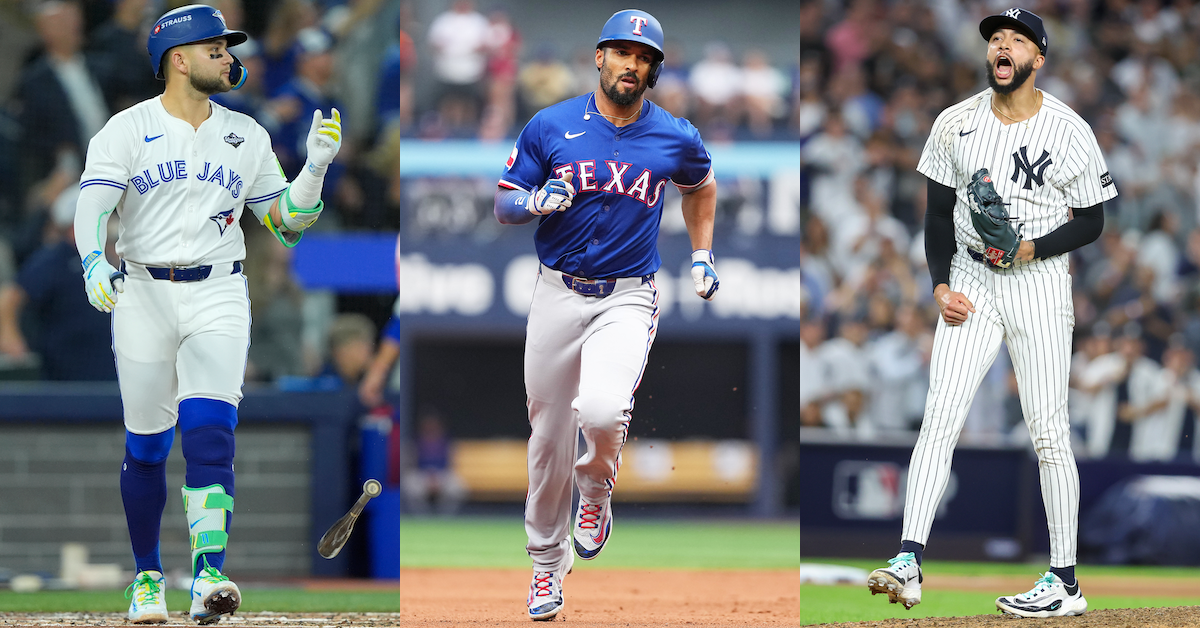
Let’s begin with a look at the transactions that reshaped the lineup. The biggest of these has to be the infield turnover, with Pete Alonso out and Bo Bichette, Jorge Polanco, and Marcus Semien in. Since we’re including Semien, we’ll have to include the departure of outfielder Brandon Nimmo as well. These decisions are clearly coherent; Alonso’s leaving meant space in the infield and an offensive deficit, and the Mets signed multiple free agents to account for that. I’ll analyze the Coherence of Strategy axis at the end of this write-up, but for each individual deal, I’ll focus on the other two axes of analysis.
As far as Liquidity and Optionality is concerned, these offensive moves collectively make for a pretty clear upgrade. Bichette and Alonso project to provide at least roughly similar value in a vacuum, and Bichette’s deal is for $11 million more per year. But it’s only three years, as opposed to the five-year pact that Alonso signed with the Orioles, and Bichette can play more positions defensively. He’s not really a shortstop anymore, but second and third base both seem reasonable. These two contracts are, to me, roughly equivalent, but the Mets signed the shorter-and-richer version that gives them more future flexibility. Polanco is a great example of what that added flexibility buys the Mets. He’s on the team for his bat, but doesn’t have a clear defensive home these days. With Bichette in tow instead of Alonso, Polanco can play first base, moonlight at DH, add in the occasional infield cameo at second or third, and generally focus on his job of producing runs. He’s under contract for two years, so the Mets won’t have much trouble pivoting away from him if his output isn’t up to snuff.
The Semien-for-Nimmo trade helps out here, too. First, Semien’s deal expires after 2028, while Nimmo’s runs through 2030. Second, adding Semien to the roster increased New York’s positional flexibility admirably. Nimmo is a perfectly competent left fielder, but that’s not actually very interesting. Lots of dudes could be perfectly competent left fielders if you give them a shot. Along with first base, it’s the easiest position on the diamond to jam someone into if you don’t know where else to put them.
Between Carson Benge, Tyrone Taylor, and even Brett Baty, the Mets have multiple good candidates to try out in left. Benge is my favorite of those. His aggregate minor league numbers were spectacular in 2025, with batted ball data backing them up. He handles himself well defensively, with good range and a massive arm (he was a two-way player in college), and he has enviable plate discipline for a 22-year-old. That said, I think it would be irresponsible of the Mets to rely exclusively on Benge; he struggled in his first taste of Triple-A last year (53 wRC+ in 103 plate appearances), and he’s clearly still risky. Likewise, though, I think it’d be irresponsible to leave nowhere for Benge to play. He’s a potential difference maker who might already be their second-best outfielder; giving him an achievable way of playing most of the year in the majors is good business.
Taylor and Baty would be nice options as bench bats, and neither would be disastrous as a fill-in outfielder. Baty did the same at second base in 2025, and he’s trending toward multi-position versatility as his big league career unfolds. We can exclude him from this discussion since he’ll be nice depth across the diamond. That just leaves Taylor, and swapping Nimmo for Taylor clearly makes the Mets roster more capable of utilizing Taylor to the fullest extent while also finding playing time for Benge. Taylor goes from a fifth outfielder to a fourth outfielder, and he’ll probably be a starter for at least a few weeks at the beginning of the year if Benge doesn’t break camp with the big league club.
Finally, I think that these deals left the Mets in a similar place in terms of their Championship Probability Distribution. They didn’t do much to the floor of the roster with these moves, and while freeing up a spot for Benge might technically raise their ceiling, I think that if he ends up good enough that he changes their odds of winning the World Series by a noticeable amount, they would have found playing time for him anyway. The infield turnover and the Nimmo/Semien swap did a good job of adding Liquidity and Optionality to the Mets roster, but these moves didn’t really change the top-line picture for 2026 all that much on net.
While they were presiding over a large-scale remodel of the infield, the Mets also redid their bullpen. With closer Edwin Díaz headed to Los Angeles, there was a void at the top, and Stearns signed Devin Williams and Luke Weaver to take his place. Again, there’s not much to say about the Cohesion of Strategy here. Playoff teams need good relievers, and the Mets were going to sign at least one or two this winter.
From a Liquidity and Optionality standpoint, I think that their bullpen now is clearly superior than what it was with Díaz. I think that Williams was one of the best relief pitcher signings of the offseason. Getting a discount after a year of poor observed results – most of his underlying numbers were perfectly fine – is a smart way of doing business in the reliever world. Weaver isn’t as obvious of a slam dunk for a bounce-back, but I love the versatility; he could be a setup man, a multi-inning reliever, or some hybrid of the two. Plus, it wasn’t all that long ago that he was a capable closer.
In 2025, the Mets bullpen was about average – it was excellent by FIP, decent by RA9-WAR, and poor in terms of win probability added. In 2026, we project the Mets bullpen to be slightly above average. But this time, they’re doing it with a little more flexibility, a little less invested in the top guy and a few more options behind him. I expect trades to further bolster this unit during the year. To me, this bullpen looks slightly better than I expected it to – I thought they’d bring Diaz back and mostly sit out the rest of the market. But Stearns seems to favor optionality, and with this new bullpen, the Mets are spreading their financial resources to get value from more than just a single closer.
After fixing the bullpen, it was time to fix the rotation, and so the Mets raided their haul of top prospects to trade for Freddy Peralta and Tobias Myers. From the flexibility side, this trade is a less obvious upgrade. Peralta will be a free agent after this year – very flexible — and Myers has accrued only a year of service time. But the two prospects the Mets sent to Milwaukee for Peralta and Myers were even more flexible – Top 100 guys, ready to play in the majors and with huge swaths of team control remaining.
That’s not to say that the Mets would’ve utilized the flexibility they had well. Jett Williams, the higher-rated of the two prospects the Mets traded for Peralta, feels to me like a better fit for Milwaukee’s model than New York’s. He’s competing for a lot of the same playing time that I’ve mentally allocated to Benge, but with a much riskier offensive game. He’s a good prospect who wasn’t a perfect fit for what they needed. Likewise, Brandon Sproat is a nice pitching prospect with mid-rotation potential, and the Mets have a lot of nice pitchers with mid-rotation potential. I think that both players had their optionality blunted slightly by situation.
The main thing that the Mets sacrificed by trading Williams and Sproat isn’t on-field projection in 2026; it’s prospect capital that could’ve been used to make another deal. But I don’t think they were likely to get a wildly different type of pitcher than Peralta in any other trade they could have made with those two, and both players were getting to the point in the prospect curve where the Mets needed to promote them or trade them; otherwise, the team would’ve risked seeing their value decline if they’d remained in the minors. Trades like this – turning solid-but-not-generational prospects into needed upgrades – sustain good teams who want to compete over long windows. The Dodgers and Yankees have proven extremely adept at these deals over the years. The Mets will need to do this as well if they want to turn into a perpetual contender.
I like this deal quite a bit from a Championship Probability Distribution lens, though. Peralta changes the complexion of the Mets rotation meaningfully. He’s an obvious playoff-caliber starter, definitely the team’s best pitcher even if he’s not a capital-A Ace. There are far fewer possible worlds where the Mets don’t have enough pitching to contend now that they have Peralta; that’s really important for a team with a lineup built to win this year. I think it’s reasonable to say that if the Mets end the season with only two starters they trust in October, they won’t go far. Without Peralta, that outcome felt squarely in play. Now, it seems less likely, and they still have plenty of prospect capital to make another deal if they need it.
A quick aside on Myers: He’s no mere throw-in. He’s probably not as good as his 3.15 career ERA would suggest, but he’s a great swingman option, pretty similar to the role for which I think Sproat was ticketed. The Mets’ logjam of viable starters is so enormous that pitching in relief is likely for fringe starters, and Myers has already shown comfort in a swing role. He’s a great 12th or 13th pitcher on the roster, right down to his remaining minor league option, and I think he fits the Mets quite well.
Another trade fell into New York’s lap at the same time. Luis Robert Jr. decamped from Chicago to Queens in what was mostly a salary dump for the White Sox. This deal is a big upgrade to flexibility. Luisangel Acuña, the major piece headed to Chicago, is out of minor league options. Keeping him on the Mets was going to require exquisite roster balance, and likely would have constrained the team in other ways. Getting rid of Acuña’s gives the Mets space to play Ronny Mauricio in a similar role as they figure out whether he’s part of their long-term core. Realistically, Acuña was probably going to be a waiver casualty this year. Robert, on the other hand, provides maximally flexible; the Mets have a team option with a cheap buyout for 2027, and he’s on an expiring contract if not.
If adding Peralta and Myers increases the team’s floor, then adding Robert increases its ceiling. The median outcome for Robert is that he’s just OK, roughly a league average player with loud tools and exploitable weaknesses. The upside? That’d be an MVP candidate, and an extra difference maker would do a lot to change the Mets’ fortunes. The floor outcomes are, of course, quite bad. But with Taylor around as another option if Robert truly disappoints, it’s clear that the Mets have more good outcomes available to them in center than before, even though our median WAR projection for them hasn’t moved by all that much.
Now, at last, we can talk about the Coherence of Strategy in all of these moves. Stearns and the Mets moved in two consistent directions this winter. First, they front-loaded their commitments and prioritized flexible rosters that allow their top prospect the best chance at major league playing time. This meant letting Alonso leave, signing Bichette and Polanco, and swapping out Nimmo for Semien. It meant new relievers and a trade for Peralta. The Mets will run a higher payroll in 2026 – we have it around $23 million higher at the moment – but they’ll do so without huge long-term commitments, and with flexibility in where they deploy their financial might going forward. The only two players under contract past 2028 are Juan Soto and Francisco Lindor; if the Mets had gone in a different direction, they might’ve been stuck with Nimmo, Alonso, and Díaz for the next handful of seasons, too.
In addition, they built a team that is quite flexible today. Either Bichette or Semien could presumably cover shortstop for a few weeks in a pinch. Baty and Mark Vientos are solid backup options at third; Bichette looked just fine at second in the World Series, even as he was just returning from injury. Taylor can play all three outfield spots, Benge can handle center if needed, and Polanco might be a 1B/DH type in an ideal world, but he can also play the rest of the infield. This roster configuration feels significantly more robust to me than last year’s version; more players with multiple potential roles, more redundancy, similar base-case WAR but more upside.
Evaluating the Mets often feels silly. Yes, we get it, they spend so much money that it barely feels like a constraint. But turning that money spigot into a functioning baseball team isn’t automatic, as we’ve learned from these very Mets over the years. The path of least resistance – retain your own free agents, sign a top pitcher – would have resulted in a meaningfully less flexible team, both in terms of their on-field options for 2026 and their long-term salary structure.
There’s no clear counterfactual here. I can’t tell you what Stearns should have done differently because I don’t actually know what all of his other options were. But I look at this roster and think that it’s very good, not just in name recognition, but also as a functioning team set for the rigors of a full season. I also look at the farm system and think that the Mets did a good job preserving their best future fits while getting good major league value out of their top prospects without obvious major league roles.
I reserve the right to change my opinion on this after seeing a few months of the season play out. From where we are now, though, I’m loving the moves the Mets have made this winter, and I felt compelled to write something about it so that I’m on the record before the year starts. If I were running a team, I hope I’d make moves like this.
Ben is a writer at FanGraphs. He can be found on Bluesky @benclemens.
Stearns knows what he is doing. Their team is better.
This kinda seems like a souped up, high-dollar version of the brewers
So, a perennial playoff contender. Yep, as a Mets fan, I’ll take it.