
The Worst Called Strike of the First Half
Yesterday, I wrote about the worst called ball of the first half, and that post always makes this post a necessity. Within that post, I noticed something: The worst called ball of the first half was thrown by an Angels pitcher, to a White Sox hitter. Last year, the worst called ball of the season was thrown by a White Sox pitcher, to an Angels hitter. It all balanced out. Tremendous! The universe is good.
Well, the worst called strike of the first half was thrown by Max Scherzer, to an outfielder on a rebuilding team, with Wilson Ramos catching. The worst called strike of the previous first half was thrown by Max Scherzer, to an outfielder on a rebuilding team, with Wilson Ramos catching. It didn’t balance out. It’s not tremendous. The universe is bad.
Whenever I write this post, I feel like I say the same thing toward the start. It’s only natural to pair the worst called ball with the worst called strike, but the worst called ball always seems more egregious, since there’s not a direct antipode of a called ball on a pitch right down the middle. Those always come off as unforgivable, whereas with wide strike calls, people can squint and see it. Historic traffic patterns certainly suggest readers are more interested in the bad balls, and I almost want to apologize. Even I don’t really find the bad strikes so bad. This very post makes me feel somewhat guilty.
But, dammit, give this bad strike the credit it deserves. It’s true that the bad strikes almost all look the same. They’re generally pitches away off the plate against left-handed hitters. There’s even a term for this — the lefty strike. We’ve grown accustomed to them. But the bad balls also all look the same. They’re pitches down the pipe that the catcher does something funny with. Pretty much without fail, that’s the story. Each is just a different version of the same thing. I’m drawn to them all, but I’m not not drawn to the bad strikes.
Here’s a bad strike. The most bad strike, so far. When the ball crossed the front plane, it was 10.2 inches from the nearest part of the rule-book zone. That’s according to the tracking software. The pitch was thrown on June 24, by Scherzer to Alex Presley. It happened in the sixth inning, with a full count, so Presley struck out instead of walking. That can’t be easy for Presley to stomach, since unlike Scherzer, he’s still trying to prove he belongs. Alex Presley is a 30-year-old journeyman. Every single opportunity is important. This is his career we’re talking about. This is Presley being penalized for doing something right. This is a bad, bad strike. Watch it over and over until you fully appreciate the extent of the badness.
We’re watching a Max Scherzer fastball. Max Scherzer fastballs don’t spend very much time in the air. To try to adjust for that, here’s a slower-motion version of the video above. Maybe this’ll help some:
You can see that Ramos set up an outside target, and you can also see that Ramos had to move his target, further away. He didn’t have to move it three feet or anything, and that helped, and it also helped that Ramos caught the ball cleanly and subtly brought it back. We’ll get into the explanation part a little later, but now, a still, as is my usual custom:
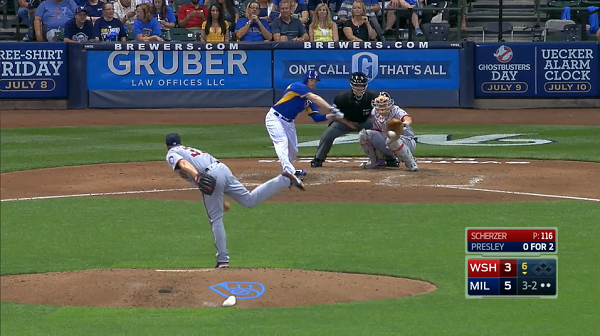
Adding lines, which I also can’t help but do:
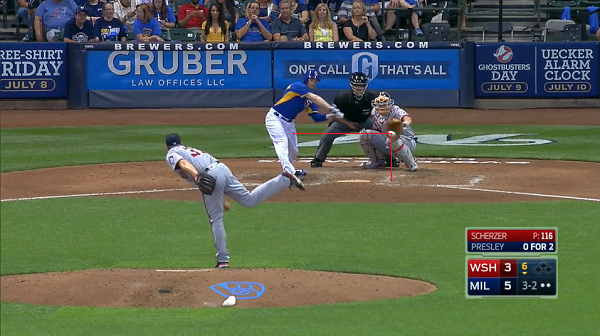
Nothing wrong at all with the pitch height. Very strike-y pitch height. All else being equal, Alex Presley would love a fastball level with the middle of his thigh. But you follow that red line down. It’s damning — it’s around the chalk. Of course, the huge problem here is the off-center camera angle. When the camera is off center, it’s hard for us to trust what we think we see. It’s not our fault. The games just want to mislead us. That additional ambiguity might make it a little harder to get mad at umpires in the moment, and perhaps in some way that works to MLB’s benefit, but to broaden your understanding of the location of this pitch, consider this nearly identical pitch! This one was called a ball. I chose it because the camera angle rocks.

Based on the coordinates, the pitches are essentially twins. This camera angle is so much better, and you see the baseball hovering slightly inside the opposite box. The Gameday interpretation is supported by the visual; the Gameday interpretation is as such:

Via Baseball Savant, Presley has seen his share of called strikes away, but that one is out by itself:

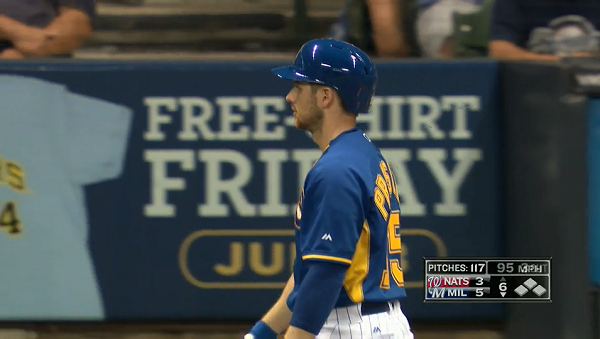
Put it all together and you get Presley’s reaction. To my knowledge, he didn’t loudly curse, nor did he turn to show the umpire up. He didn’t passive-aggressively freeze in his stance, and he didn’t angrily throw his bat. Presley simply turned away all frustrated-like, and then he approached his own dugout with dead eyes. He couldn’t make a scene; he doesn’t have the cachet to make a scene. Presley had to take it. He wore the expression of someone who knew he had to take it.
Let’s think about the lefty strike. Let’s think about what we’ve gotten used to. We’ve gotten used to them because, some years ago, in the early days of PITCHf/x, we could identify them. We realized the zone was shifted, and we realized that sustained, and we got used to those strikes because we kept on seeing those strikes. Familiarity and acceptance through repetition. These days we hardly even bat an eye, but then that might be on us. Maybe we should be making the scene. Consider a called strike to a lefty, over the chalk of the opposite box. Look at this overhead view of home plate:

I know that’s a righty, but that part doesn’t matter. Look at home plate. Look at the boxes. The boxes are far from home plate! If the pitch above to Presley were thrown here, it would back the righty hitter off. He’d panic, if only for a split second, that he was about to get hit by a projectile in the leg. Called strike. The called strike to Presley is a pitch that, if Presley batted on the opposite side, would make him a little fearful. If it were a contentious game, the pitch might even result in a warning or an ejection. The strike zone isn’t that big. The strike zone shouldn’t be that big.
Now, left-handed hitters know about the lefty strike. It’s probably not just a major-league phenomenon. Because of that, left-handed hitters learn somewhere to try to hit the would-be lefty strikes. Even though the rule-book strike zone is supposed to correspond to the general hitting zone, lefties have to shift their hitting zones, acting preemptively. It’s a busted system. It goes all the way to the top, and, it goes all the way to the bottom. There’s no such thing as a quick fix. Umpires need to be re-wired. Hitters need to be re-wired. Re-wiring humans isn’t as easy as re-wiring a toaster. We’ve all gotten used to the lefty strike. That doesn’t mean the lefty strike isn’t stupid.
I should explain something before I finish, though. Ed Hickox rung Alex Presley up. In isolation, it looks bad, even if the camera angle used makes it look less bad. But now let’s think about the circumstances. For one thing, just generally, Presley is a left-handed hitter. So, there’s that history. With Scherzer, you expect him to be in or around the zone, most of the time. If you scroll back up to the Gameday screenshot, you see that Scherzer was almost exclusively working Presley away, so that shifted perspective. The expectation was for an outside pitch, and that’s what Ramos called for. That’s what Ramos caught, pretty cleanly. And then to put things over the top — Presley almost swung. He did swing, but then he stopped himself, before he could commit. Presley made the right decision, but just before that, you could say he made the wrong decision, because what a checked swing does is make a pitch seem closer than a pitch that’s just plain taken. In reality, this pitch wasn’t on the border. A checked swing implies a pitch on the border. A pitch on the border is a coin flip. It was Max Scherzer, pitching to Alex Presley.
So many little subconscious biases. An umpire wouldn’t detect them. An umpire wouldn’t be aware of them. But most of the elements here were saying the pitch wasn’t so bad. Most of the indicators pointed to a reasonable called strike. The only indicator that didn’t was where the pitch actually was.
Jeff made Lookout Landing a thing, but he does not still write there about the Mariners. He does write here, sometimes about the Mariners, but usually not.
how in the world are you gonna tell me Jack Cust was the 3rd best hitting OF in 2007 according to wRC+, he only hit 26 dingers and struck out OVER 30% in his at bats! This stat is gawbidj. enough is enough. ENOUGH IS ENOUGH!
You’re not wrong. I don’t get how a guy that played in 30 less games, scored 25 less runs, and had 45 less RBIs “created” more runs than Vlad Guerrero that year. THANK GOD WE FACTORED IN ALL THAT FOUL TERRITORY IN OAKLAND!
Ah, the good old “I’ll find one example that doesn’t agree with perception, and that will be sufficient to prove my point!” line. It’s usually used to try and take out a defensive metric and not for a hitting one, though, so I appreciate the variety you’re providing.
Do you know what the horizontal movement was on that pitch? If that pitch almost fooled Presley into swinging, maybe it did the same thing to Hickox.
Umpires blink too, just like anybody else.
Robot umps. That is all.
You missed part of this! What was the broadcaster’s reactions to this pitch? I must know.
Nothing at all interesting! 🙁
Yup – let’s rewire the toasters and let the toasters whisper to the Ump the call and then let the Ump do the theater and we’ll get rid of the bad calls and the game will basically look the same without all the unfairness. Also, Ramos is awesome at pitch framing. So little motion in his glove.
I see pitches like this called for strikes all the time at my son’s little league games.
Big Papi would have murdered a telephone.
Big Papi’s not Alex Presley. He tends to get the benefit of the doubt.
These have been some of my favorite articles since notgraphs, and are usually good for a chuckle or two. This one, on the other hand, made me feel sad.
With Eno’s turn against robo umps because so many more strikes would be called… wouldn’t that be balanced out by the elimination of this stupid lefty strike thing?
Having played baseball for many years, there is certainly many times when a random bug flies by your head, or one eye starts to water a little, or you get a little grit in an eye and you completely miss a pitch. I guess I’m lucky one didn’t hit me in the head. The point is the umpires may have this same problem at times and they can’t just not make a call, unless someone calls time you have to make a call. I do know of umpires that will tell you “I missed that one”, what really can you say??
This article could almost use an analysis-article or two of it’s own!
1) Look at this overhead view of home plate:
What jumps out at me here is that with lefty Presley, the ump is looking over his inside corner; with the righty view here, he’s looking over the outside corner. Have you found this to be a pattern with lefty-strike calls – that the ump is looking over the inside corner — so is looking somewhat diagonally at the outside corner, vs straight down the inside corner? Do umpires tend to look over the catcher’s throwing shoulder more than their catching shoulder?
2) Scherzer was almost exclusively working Presley away, so that shifted perspective. The expectation was for an outside pitch
And, the outside pitch that was called a strike, was “less outside” than the preceeding balls. It was still BAD, but not AS BAD as the previous ones…he was “walking the location back in”…as opposed to say “going up the ladder” like pitchers used to do. Makes me wonder how many of the lefty-strikes fit that pattern.
3) So many little subconscious biases. An umpire wouldn’t detect them. An umpire wouldn’t be aware of them.
Here’s the most interesting part to me. Shouldn’t they be? You’re aware of them – I’m aware of them – readers here are aware of them – it’s not rocket science. MLB Umpires are full-time professionals at this, with people monitoring their performance to boot. How on earth can they NOT be trained to self-monitor the natural biases a pitcher tries to play off of?
4) the worst called strike of the first half was thrown by Max Scherzer, to an outfielder on a rebuilding team…He couldn’t make a scene; he doesn’t have the cachet to make a scene. Presley had to take it.
Which brings us back to the “veterans get the calls” mentality that makes some of us (me!) NUTS. I don’t know if it is statistically true – (maybe a topic for an article?) but it sure SEEMS like “schmucks don’t get the calls, vets do”…which just aint right.
The sleazy veterans get calls against the everyday role player schmucks, facilitated by the corrupt umpiring establishment!
#Feelthebot
#Schmuck_At_Bats_Matter
I am more interested in measuring and then the names released of umps and crews who have deviations from a norm from the majority with bad calls either K’s or B’s and when in the count. Something like this once recorded and then made available would make umps more accountable and could fuel more fan excitable behavior.
Right now it is being found that 1B calls have the most reversals (note ASG, was he safe?) and also publish that list.
Umpires are supposed to set up on the inside corner for the hitter with their eyes at the top of the strike zone. So anything higher or more inside than their eyes is a ball, thus making calling outside (and low) strikes more difficult. The pitch from Scherzer was a two-seam (a pretty wicked one) that broke out of the zone, combined that with looking at it diagonally and the pitch being on the outer half away from the umpire, it’s not easy to call. He’d probably admit he blew that one.
Now see, I feel silly that, as a LONG time fan, I honestly can’t say I’ve paid that close attention to where they actually DO set up, vs where they’re supposed to. Just looking at the images in this post, with Presley up, the ump was positioned exactly as you said he should be – but in the righty-batters-box view, his head looks to be in the same position as it was for the lefty batter, and not switched over to his inside corner. I’ll have to start watching for that, just out of curiosity.
OK, I’m talking to myself. I watched some of the all-star game replay – which had a decent mix of lefty/righty batters. The ump consistently DID set up on the inside corner. The catcher positioning is where it was interesting – with a righty batter, he’d usually park such that his left shoulder was lined up right with the inside corner. With a lefty – it was mostly the same – the catcher didn’t move over generally.
What that meant in practice was that with a righty batter, the ump’s head and the catcher’s head more or less lined up on inside pitches, and the ump had a good view of the outside corner. But with a lefty, the ump would shift over to the inside corner while the catcher didn’t, so the ump had a better view of the inside corner and what appeared to be a more obstructed view of the lefty’s outside corner. I’m sure a lot of this depends on the catcher, but it’s something I’ll be watching closer the rest of the season.