
Toronto Blue Jays Top 40 Prospects
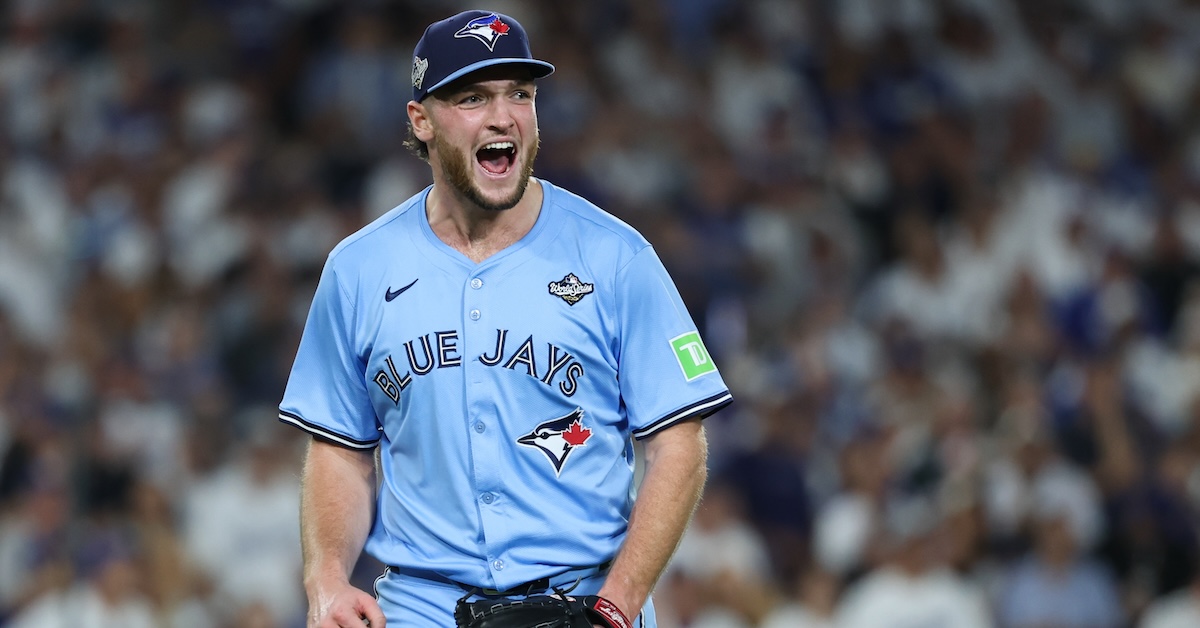
Below is an analysis of the prospects in the farm system of the Toronto Blue Jays. Scouting reports were compiled with information provided by industry sources as well as my own observations. This is the sixth year we’re delineating between two anticipated relief roles, the abbreviations for which you’ll see in the “position” column below: MIRP for multi-inning relief pitchers, and SIRP for single-inning relief pitchers. The ETAs listed generally correspond to the year a player has to be added to the 40-man roster to avoid being made eligible for the Rule 5 draft. Manual adjustments are made where they seem appropriate, but we use that as a rule of thumb.
A quick overview of what FV (Future Value) means can be found here. A much deeper overview can be found here.
All of the ranked prospects below also appear on The Board, a resource the site offers featuring sortable scouting information for every organization. It has more details (and updated TrackMan data from various sources) than this article and integrates every team’s list so readers can compare prospects across farm systems. It can be found here.
| Rk | Name | Age | Highest Level | Position | ETA | FV |
|---|---|---|---|---|---|---|
| 1 | Trey Yesavage | 22.5 | MLB | SP | 2026 | 60 |
| 2 | Arjun Nimmala | 20.3 | A+ | SS | 2028 | 50 |
| 3 | Jake Bloss | 24.6 | MLB | SP | 2026 | 50 |
| 4 | JoJo Parker | 19.4 | R | 3B | 2030 | 45+ |
| 5 | Ricky Tiedemann | 23.4 | AAA | SP | 2026 | 45 |
| 6 | Johnny King | 19.5 | A | SP | 2029 | 45 |
| 7 | Victor Arias | 22.4 | AA | CF | 2026 | 40+ |
| 8 | Juan Sanchez | 18.3 | R | 3B | 2031 | 40+ |
| 9 | Gage Stanifer | 22.2 | AA | SIRP | 2027 | 40+ |
| 10 | Juan Caricote | 17.2 | R | C | 2032 | 40+ |
| 11 | Yohendrick Pinango | 23.7 | AAA | LF | 2026 | 40 |
| 12 | Angel Bastardo | 23.6 | AA | SIRP | 2026 | 40 |
| 13 | Silvano Hechavarria | 22.8 | A+ | SP | 2027 | 40 |
| 14 | Sean Keys | 22.6 | A+ | 3B | 2027 | 40 |
| 15 | Adrian Pinto | 23.3 | A+ | 2B | 2028 | 40 |
| 16 | Josh Kasevich | 25.0 | AAA | SS | 2027 | 40 |
| 17 | Adam Macko | 25.1 | AAA | MIRP | 2026 | 40 |
| 18 | Blaine Bullard | 19.4 | R | CF | 2029 | 40 |
| 19 | RJ Schreck | 25.5 | AAA | RF | 2027 | 40 |
| 20 | Brandon Barriera | 21.9 | A | SP | 2028 | 40 |
| 21 | Tim Piasentin | 18.8 | R | 3B | 2031 | 40 |
| 22 | Grant Rogers | 24.7 | AA | SP | 2027 | 40 |
| 23 | Spencer Miles | 25.5 | A | SIRP | 2026 | 40 |
| 24 | Edward Duran | 21.6 | A+ | C | 2027 | 40 |
| 25 | Franklin Rojas | 18.8 | R | C | 2030 | 40 |
| 26 | Jake Cook | 22.5 | R | CF | 2030 | 40 |
| 27 | Cutter Coffey | 21.7 | A+ | 3B | 2028 | 40 |
| 28 | Brandon Valenzuela | 25.3 | AAA | C | 2026 | 40 |
| 29 | Micah Bucknam | 22.4 | R | MIRP | 2028 | 40 |
| 30 | T.J. Brock | 26.4 | AA | SIRP | 2026 | 40 |
| 31 | Connor Cooke | 26.2 | AAA | SIRP | 2026 | 40 |
| 32 | Chay Yeager | 23.4 | AA | SIRP | 2027 | 40 |
| 33 | Javen Coleman | 24.1 | A+ | SIRP | 2027 | 40 |
| 34 | Yondrei Rojas | 23.2 | AA | SIRP | 2026 | 35+ |
| 35 | Fernando Perez | 21.9 | AA | SP | 2027 | 35+ |
| 36 | Dahian Santos | 22.9 | AA | MIRP | 2026 | 35+ |
| 37 | Charles McAdoo | 23.9 | AA | 3B | 2027 | 35+ |
| 38 | Kai Peterson | 23.4 | AA | SIRP | 2027 | 35+ |
| 39 | Sam Shaw | 19.9 | A+ | LF | 2028 | 35+ |
| 40 | Elaineiker Coronado | 18.3 | R | 2B | 2031 | 35+ |
Other Prospects of Note
Grouped by type and listed in order of preference within each category.
DSL Dudes
Angel Rivero, RHP
Ramon Suarez, LHP
Kennew Blanco, IF
Cristopher Polanco, 2B
This section is a little short because some of the bats from last year’s class were good enough for the main section (good!), while some of the arms with interesting traits got released (a little strange). Rivero has good body control, can throw strikes, and has performed well over two DSL seasons. He’s up to 95 with fair secondaries that could tick up as he develops. Suarez is a deceptive, undersized lefty with a quick arm. He missed the 2025 season and is an intriguing complex follow. Blanco is a little old for the DSL, but he showed enough feel to hit to keep an eye on him. A $2.2 million signee in the 2025 international class, Polanco’s short, almost truncated swing produced neither contact nor power, and his error-strewn defense did not match amateur reports.
Potentially Potent Pitchers
Seojun Moon, RHP
Landen Maroudis, RHP
Lluveres Severino, RHP
Sann Omosako, RHP
Luis Torres, LHP
Holden Wilkerson, RHP
Carson Messina, RHP
Jared Spencer, LHP
Daniel Guerra, RHP
Eminen Flores, RHP
Moon inked a deal last September for $1 million, the largest bonus Toronto has ever given a Korean player. He’s athletic with a projectable frame and good feel to spin it. He’s a 2026 breakout candidate. A high-dollar draft selection, Maroudis regressed across the board in 2025 following an internal brace procedure to repair his torn UCL. He’s athletic with a shapely curve and sinker, but after walking more than 10 per nine in Dunedin, he needs a reset. A veteran of the complexes, Severino finally reached Low-A in 2025. He touches 97 with a hard slider and has some idea of where it’s going, but his command lags and he needs another gear to compensate for his fastball’s hittable shape. You can squint and see paths forward. Like many Brazilians in baseball, Omosako hails from São Paulo’s large community of folks with Japanese ancestry. He has a fluid delivery and can really pitch, but his stuff is soft and he’ll need to prove he can make it work at every level.
Torres is very deceptive, with a short, quick arm that hides the ball. He tends to pitch backwards and low-level hitters often look flummoxed. His stuff was up a tick in May, but he missed most of the 2025 season. Wilkerson has interesting pitch data and does a few things well. He throws strikes, touches 97, and has an interesting cutter and slider. He leaves a lot out over the plate, however, and has been hittable dating back to his college days. Maybe it all works in short stints. Messina signed for $550,000 in 2024. Elbow inflammation kept him on the shelf practically all of last season, but he’s reportedly back and throwing again. Toronto’s 11th rounder last year, Spencer is a lower-slot lefty who could have a plus fastball-slider combo in relief; word on the street is that the shoulder injury he suffered down the stretch is quite serious, so I’m tucking him here for now. Guerra is a high-slot righty who touches 98. His delivery is a little stiff and his secondaries are currently fringy. It makes sense to continue developing him as a starter to see if the extra reps can help him find a breaking ball. Flores is at least an average athlete and he throws hard. He has a smooth delivery too, which actually makes his huge control issues a lot more concerning, because there isn’t an obvious path to getting him in the zone more reliably.
Upper-Level Bats
Jace Bohrofen, OF
Josh Rivera, SS
Bohrofen has power and can play all three outfield spots, but an inability to hit spin has led to a 20 hit tool. Rivera is a solid shortstop with above-average power and a strong arm, but he’s not especially rangy and he can’t hit.
Can They Hit Enough?
Jake Casey, OF
Aaron Parker, C
Andres Arias, OF
Eddie Micheletti Jr., 1B
Yorman Licourt, RF
Yeuni Munoz, RF
Jean Joseph, CF
Do you want a sleeper? Maybe it’s Casey, son of former big leaguer Sean Casey. He hit his way from the MAC to the Cape in 2023, then had a rough junior year and came back to Kent State in 2025. He’s a little older, but also has a playable power-speed blend and could be a platoon outfielder — if he can figure out how to hit spin. He swings over it frequently and that might prove to be a deal-breaker. Let’s give him a year to find out. Parker has at times looked like a bat-first backup catcher. A bad approach limits the utility of his above-average power and the lack of growth in this regard pushed him down from the main section. Defensively, he has a strong wrist and arm, but his skills are well below par. Arias has big league size and a chance to develop plus power. His feel to hit is crude and he needs to repeat the complex. Micheletti had the type of season that usually prompts questions in the comments. He has above-average thump and a good eye, but everything else is light. Licourt is a recent older Cuban signee with big league size and plus power. His equally noticeable swing-and-miss could be fatal, but there may yet be paths forward. Dropping switch-hitting — he ran a 50% strikeout rate as a righty last year — might be a place to start. Munoz has a fast bat and projects to have plus power. His swing doesn’t look comfortable or natural, and spin gives him fits. Joseph held water at Low-A. He’s a center fielder with enough contact and power to stay on his athleticism and projectable frame.
Good Gloves
Eric Snow, INF
Jaxson West, C
J.R. Freethy, UTIL
Snow, Toronto’s sixth-round pick last year, makes a ton of contact, most of it soft. He looks like a depth middle infielder. West was Toronto’s 16th rounder last year. He’s a good receiver, he has an approach, and he never strikes out. It’s a recipe for a long minor league career if nothing else. A rangy second baseman with contact skill and some defensive flexibility, Freethy’s lack of arm strength limits his chances to become a seven-position super-sub type.
Reliever Tower
Ryan Jennings, RHP
Bo Bonds, RHP
Karson Ligon, RHP
CJ Van Eyk, RHP
Nate Garkow, RHP
Conor Larkin, RHP
Hunter Gregory, RHP
Jennings has above-average secondaries and a path to a middle relief role, but his fastball gets hit and he didn’t throw strikes in Triple-A. Bonds has old school deception, with a late glove throw feeding into a sneaky-fast overhand release. He gets 20 inches of vertical break on the heater and lower-level hitters swung under it all day long, but the rest of the package is pretty vanilla. Perhaps Ligon belongs on the main section, as last year’s ninth rounder touches 100 and flashes a good slider. His stiff, high-effort delivery scare me, but credit to him, he matured as a strike-thrower in college. We’ll see how it looks in relief. Van Eyk is generally near the plate and flashes a plus curve. It’s nearly time to see how it plays in short stints. Toronto’s king of deception, Garkow has a soothsayer’s changeup. It has outlier movement traits and gets whiffs like crazy despite mid-70s velo. I’m skeptical but also unwilling to completely write him off until batters actually start doing something against him. Larkin is an intriguing sidearmer with some things that stand out on the spreadsheet — high spin, good velo, the aforementioned slot — but his numbers across 151.2 minor league innings support a more tepid visual eval. Gregory has reached Triple-A. He sits in the mid-90s with a slider that flashes above average. He’s an up-down candidate.
Length Arms, For Now
Jackson Wentworth, RHP
Lazaro Estrada, RHP
Chad Dallas, RHP
Austin Cates, RHP
Gilberto Batista, RHP
Dayne Pengelly, RHP
Sadly, Wentworth’s middle name doesn’t start with a “G.” He has a nice changeup and could work in middle relief if he gets a velo bump in shorter outings. At times throughout his career, Estrada has flashed backend quality stuff, but it was down last year, when he looked like a depth length reliever or spot starter. Dallas, a.k.a. Cheese, is a high-energy guy who has long projected as a reliever on the strength of his slider. He’s started throughout his minor league career, but it might make sense to dovetail his return from Tommy John surgery with a relief role. Cates has a carrying fastball and sinking change combo that gave A-ball hitters fits, particularly after a mid-season promotion. His breaking ball doesn’t seem to entice hitters off the plate; he could be a depth starter. Batista throws strikes despite a challenging delivery. Up to 96, he’s a candidate to develop into a fastball-changeup reliever. An undrafted free agent, Pengelly touches the upper 90s out of a low-three-quarters slot with a low release and above-average extension. He even throws strikes. There’s not much of a breaking ball, but you can see paths to finding one; he seems like a candidate for a sweeper.
System Overview
This is a light system, particularly if you’ve mentally moved Trey Yesavage from the prospect bin to the big league roster. None of the remaining top names are safe bets: We’re doing a lot of projecting on Arjun Nimmala, and the next several players are mostly far away or have recently battled serious injuries. This is a club that probably can swing a trade for a big piece, but Toronto is also liable to be outbid in any competitive sweepstakes.
There’s a major drop-off following the volatile names at the top. Part of that stems from all the injuries, as a ghastly run of torn UCLs has eviscerated the org’s stable of healthy pitching prospects. The Jays are also light on near-ready bats, and even the ones nearest the top of the list have their warts. Part of the explanation here is simply that contention doesn’t come cheap. Toronto parted with a Top 100 prospect to acquire Shane Bieber, and other midseason additions thinned the system further. Anthony Santander and Dylan Cease came at significant financial expense, and both also cost Toronto draft picks. And of course, all the winning the Jays have done in recent years has pushed them toward the back of the draft order for most of the decade.
The result is a system with fewer 40+-FV prospects or better than any of the other lists we’ve published this cycle. There’s a fair amount of 40-level depth, and odds are that one or two of them will exceed this grade; the cupboard isn’t quite bare. Ordinal lists don’t quite capture the way the talent in this tier stacks up, either. The gap between the sixth and 11th player on this list is pretty substantial, bigger than the gap between 11 and, say, 28. In that latter group, we’re balancing injured guys with data darlings, scout favorites, and low-information players, so there’s an element of picking your flavor at play here. You could rearrange the 40-FV tier in any which way and I probably wouldn’t argue much.
It’s baked into several of the blurbs but is also worth a mention on its own: The Jays are really good at building strength. Their guys get stronger and tend to do so quickly. This is a good home for interesting players with below-average (or worse) present power or velocity, and Toronto seems to take at least some players with that in mind. Jake Cook and Blaine Bullard may or may not develop more pop, but they couldn’t be in a better spot to try.
Beyond the obvious benefits, there’s an ancillary upside to getting your players physically mature quickly: It tends to tickle the models of your rivals. There are a lot of younger players here with good power or arm strength for their age, and even a sophisticated acquisition model doesn’t necessarily know that these guys are physically ahead of schedule and perhaps less projectable than most their age.
It’s one of a couple things the Jays do that prospective trade partners should keep in mind. Positional versatility is another. Toronto’s players tend to move around the diamond, sometimes to spots where they don’t really have any business playing. RJ Schreck and the now former Blue Jay Alan Roden, for example, played some center field in Triple-A even though they’re unlikely to spend much, if any, time there in The Show. But while models likely recognize that these are corner bats, the fact that they’ve spent time in center at all may still give them an algorithmic boost out of step with their abilities. I don’t know whether the Jays are playing 4D chess here, are just moving guys around out of need, or simply have a different opinion on their talent. But you have to be a little careful when mining this system. And to be clear, I mean all of this as a compliment to Toronto’s front office.
Brendan covers prospects and the minor leagues for FanGraphs. Previously he worked as a Pro Scout for the Pittsburgh Pirates.
very quick takeaway, a lot of high variance prospects, and many starting pitchers and medium defensive position batters have skillsets that are a bit of a recentish throwback. Who knows if this means anything. Well, some people do.
Good chance for a Josh Bell type out of nowhere, and also for defense not good enough at A and offense not good enough at B types.
Arias is particularly interesting, and one of the guys you mention in the second paragraph. He’s a tweener and he’s performed pretty well but he’s been promoted slowly. And then he didn’t do so hot in AA, and while it was age appropriate for him maybe he just needs a while to adjust to what he’s seeing. Probably a platoon center fielder or fourth outfielder, but you can’t rule out that he puts it all together and is viable starter for a good team.
I have never seen what made Jake Bloss a FV50-level prospect, and now that he’s recovering from injury I really don’t believe it. Pitchers with “stuff” who don’t get a ton of K’s against minor league hitters are often overrated. It’s the Jackson Jobe problem, but on a smaller scale. Either his pitches don’t work well together, his command undermines the stuff, or the stuff just isn’t that good.
Connelly Early’s scouting report from last year reads a lot like this, except he’s left-handed, but he also was striking out tons of batters while getting a bunch of ground balls. It’s pretty clear that whatever he is doing batters can’t pick up on the ball, so the extension plus the deception plus the speed of the delivery is doing something that Bloss is not doing. Whatever is going on with Bloss, the whole package is less than the sum of its parts.
“All the consistency of Ash’s Charizard” is an absolute BAR.
That is all.
I think you’re saying that it’s great, and it is definitely a great deep-cut. But I have no idea what BAR stands for and my look at urban dictionary provided some NSFW definitions instead.
In rap, it’s referred to as a line that is particularly smooth. It means solid wordplay.
Also not an acronym–it’s just “bar” which Lester wrote in all caps for emphasis.
(I think it’s from “bar” as in measure of music, so a rap verse would be referred to as the rapper’s sixteen bars or however many it was, and then having bars just meant having great lyrics, and it got singularized. That was a painfully incongruously earnest explanation.)
I don’t feel bad for not figuring that out. I’m not totally ignorant of hip-hop, but this being a reference to a unit of music was something I was not going to figure out. And then also being a reference to a specifically good performance within that unit of music was something I definitely definitely wasn’t going to figure out.
Now if you can just explain 6-7 to me, I’ll be totally ready to face the world again.
I am absolutely at the intersection point where these two nerdoms live, and I am here for it.
Also, ever since the 2022-23 offseason, all of my Charizards have been named Arson Judge.
Wait, I gotta know more about Mississippi high school bats being a high risk demographic. Why? Are they more risky than, say, Alabama or Tennessee hitters? And why is this Lane Kiffin’s fault, specifically?
I’m glad you asked that because I was thinking the same thing. My money is on there being no good reason to believe it at all except several high-profile HS bats from the state busting around the same time, which then became conventional wisdom in scouting circles.
Let’s take a look at first round draft picks fro Mississippi from 2000 to 2019.
Wendell Fairley (did not make majors)
DJ Davis (did not make majors)
Black Anderson (did not make majors)
Austin Riley (huge success)
Pretty small sample but a 25% hit rate is very good!
Now let’s compare it to Louisiana:
Stryker Trahan (did not make majors)
Gavin Cecchini (bust)
Chase Vallot (did not make majors)
That’s basically Alabama without Austin Riley. In fact, that’s what almost every state looks like. I looked at a whole bunch of other states, and you know what I learned? High school bats bust. Let’s take a look first round HS bats from 2015, including comp rounds:
Nick Gordon (bust)
Alex Jackson (bust)
Derek Hill (bust)
Cole Tucker (bust)
Michael Chavis (bust)
Braxton Davidson (did not make majors)
Forrest Wall (bust)
Blake Anderson (did not make majors)
Chase Vallot (did not make majors)
Jake Gatewood (did not make majors)
You have three buckets when you take a HS bat in the first round. They’re an all-star (or Hall of Famer, in the case of Francisco Lindor). That is a super small chance. There’s becoming a role player, like Lonnie Chisenhall (career fWAR=8.0). That’s probably a sizable minority of those selected. And then you have Nick Gordon and Alex Jackson.
Anthony Alford was another one (strange case though since he played college football while the Blue Jays retained him), and also panned out fairly poorly.
Old-school conventional wisdom stemming from the blend of it being a smaller state and a barrier sport for a lot of the population, which for a while made the competition there a lot lighter than neighboring states. I actually asked a cross-checker about this over the summer and he said that that reputation is starting to change.
What’s a barrier state?
If not for this discussion I would have guessed Mississippi to be better than average vs population size because of the warmer weather.
Just taking a guess here but Mississippi is one of the poorest states, and the increasing costs of competitive youth baseball (showcases, tournaments, etc.) prices out tons of kids now. Travel ball and other more competitive youth sports leagues are more of a class signifier than a true representation of the best young athletes, and that’s especially true in Mississippi.
It’s weird to read your explanation of it. You’re almost certainly right. But I always thought that the gear was the main barrier to entry for poor kids playing baseball. I guess not anymore!
I’ve never quite understand the bloss thing, his injury has added risk and I have never thought of him as more than a number 4 starter. A number 4 starter with significant risk is what? Maybe a 40+?
1 thing I will say I am higher on Stanifer than people seem to be the stuff is so nasty and deep that even with 30-35 command there is a chance for a mid rotation starter
CLE: 267
SEA: 263
MIL: 253.5
LAD: 246
CHW: 190.5
TOR: 179.5
AZ: 171
CIN: 170
you da real MVP
Are the lovely hands from Palmolive?
Madge Approved!
1) I’m calling Pinango becoming a ranked Prospect (many times over) who is still alive in the upper minors a huge win for the Cubs’ Player Development. I’ve been sitting back calling DSL Cubs with prospects since Candelario, and often doing what is largely the accursed “scouting the stat line” approach. Get on the Juan Cabada wagon, I say. Pinango went from tons of GBs in the low minors to much fewer, becoming more viable or whatever along the way, bodes well for the one blemish on Cabada’s age 17 in the DSL
2) Pinango should record his own walk up, I’ve taken the liberty of writing the lyrics: Pinaaaaaaaaaaangooooooo Piiiinangooooooo yes-the-name-is-Yo-hen-drick Pinangoooo….Pinangooooooo Pinaaaaangooooo…etc…If MLB doesn’t work out, he’s a guy a KBO team should be all over (iirc MiLB FA next year)
I hate to praise a FO for being smert within this racket, esp since they’re likely patting themselves on the back for all that hard work riding the wave of a clearly ascending (talking draft 2024 off that Skenes CWS matchup) player, but did like the whole run from
drafting Yesavage on btw 2024-2025. On paper he was an excellent Value, had the resume and health and mix to go higher, shut down locked in a gym where they used Science to Develop, MiLB season went smooth, and “felt” as if they were contentiously opportunistic at the end with workload. His 139 total innings are only like 40 more than 2024 and over 3-4 more months. Ftr I don’t expect any big regular season innings leap this year, 140 MLB innings + playoffs would be plenty, seems well positioned for a long and excellent career if that’s even possible for anyone not born on a CEO “track”
Cubs fan and all: Yesavage had a very similar draft Profile (barf) to Jordan Wicks (healthy, checked the performance boxes, strike throwers, pro physicality featuring some projection, quality if not super mega ultra duper uber velo, command with projection, pitchability, and conditioning/workloads, featured split/change as primary secondary, some aptitude for spin but needed Development, high makeup) minus the pandemic brick walking a true breakout (check out Wicks’ college career before the shutdown), and this campaign along with some other stuff is why I’m still on the wagon
great article as always
suggestion that may make no sense due to additional work- (a)would love to see how each of these non drafted by org prospects ended up in the system (in parenthesis date and substance of trade); (b) signing bonus number (less important suggestion)
also this doesn’t have the box with the links to other 2026 prospect reports that have been out
Man just randomly clicking the top 100 prospects list from February 2024 and it is hilarious how hard it is to nail the above average players…definitely less than half of the 55FV and above prospects look likely to actually ever put up a single 3 WAR season. I know the median outcomes are always way more underwhelming than we think but it’s still illuminating to see how many of these players have lost value compared to merely two years ago
dumb to write off any of these kids and I’m not but even in the 60+ tier half of them may not get anywhere (crews, Holliday, basallo, Salas, lawlar)..Holliday is still close to be a league average floor lock with his age (although he was 70 like Gavin lux was so that better be a floor) but the rest idk. The FV 55 tier hitters is looking incredibly rough