
JAWS and the 2026 Hall of Fame Ballot: Nick Markakis
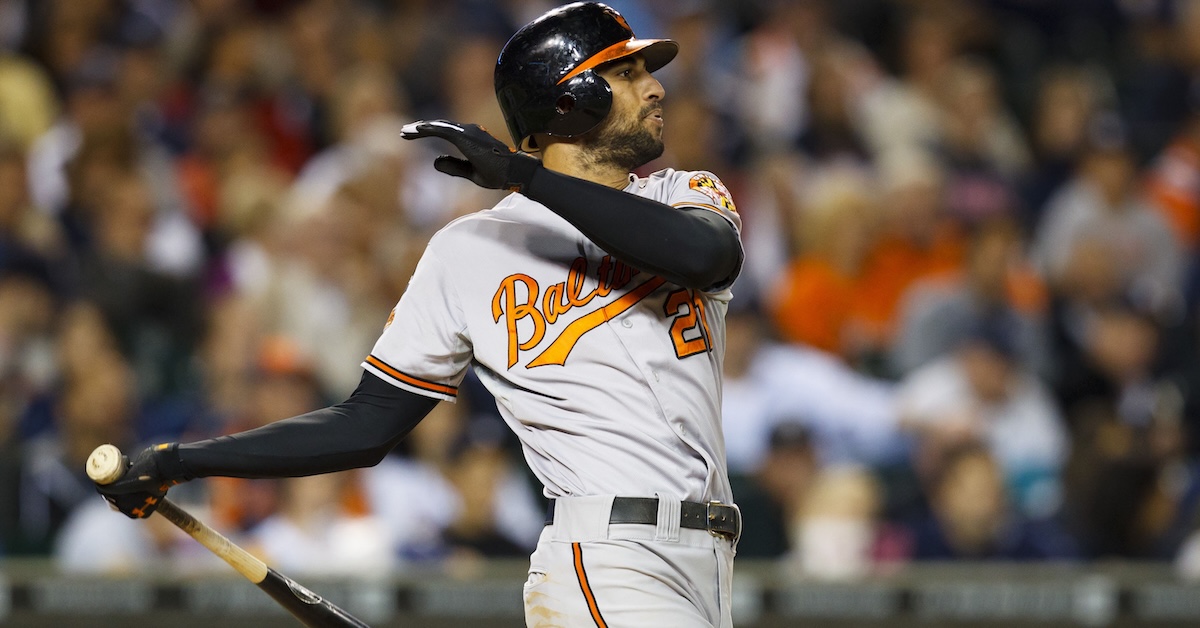
The following article is part of Jay Jaffe’s ongoing look at the candidates on the BBWAA 2026 Hall of Fame ballot. For a detailed introduction to this year’s ballot, and other candidates in the series, use the tool above; an introduction to JAWS can be found here. For a tentative schedule, see here. All WAR figures refer to the Baseball Reference version unless otherwise indicated.
| Player | Pos | Career WAR | Peak WAR | JAWS | H | HR | SB | AVG/OBP/SLG | OPS+ |
|---|---|---|---|---|---|---|---|---|---|
| Nick Markakis | RF | 33.7 | 24.6 | 29.2 | 2,388 | 189 | 66 | .288/.357/.423 | 109 |
Early in his career, Nick Markakis appeared to be a star in the making. In his second and third seasons in the majors (2007 and ’08), the former first-round pick topped 40 doubles, 20 homers, and a .300 batting average while slugging nearly .500. He led the AL in WAR in 2008, his age-24 campaign — not that anyone was aware of it at the time, which helps to explain his omission from that year’s AL All-Star team.
It would take another decade before Markakis finally became an All-Star, and during that stretch, his performances leveled off. He became better known for his durability, his defense (he won three Gold Gloves), and above all, the example he set for younger players while enduring lean years both in Baltimore and Atlanta. He stuck around long enough to help both teams’ rebuilding efforts come to fruition with playoff appearances, racking up so many hits that he generated discussion regarding his potential Hall-worthiness if he persisted long enough to reach the magic 3,000-hit milestone.
Markakis’ retirement after his age-36 season rendered that question moot. He didn’t generate a Hall-caliber résumé or gaudy statistics during his 15-year career, but he received considerable praise for his impact on his teammates. From Braves manager Brian Snitker, who managed him from 2016–20:
“One of the most consistent, professional pros that I’ve ever been around. I’m glad I had the honor to manage him in his last years, because he’s a special player… How consistent he was, how professional he was, the way he played the game, how he grinded every at-bat. He never took a pitch off. And to see what he did late in his career, winning that Gold Glove, and the stabilizing force that he was for our club while I was here. You don’t appreciate a guy like Nick until you manage him. What a great career he had.”
Nicholas William Markakis was born on November 17, 1983 — the same day as fellow first-year Hall of Fame candidate Ryan Braun — in Glen Cove, New York, on the North Shore of Long Island. He was the second of four sons of Dennis, a car salesman, and Mary Lou, a banker. When he was 10, his family moved from Glen Cove to Woodstock, Georgia, 30 miles north of Atlanta.
Growing up, Markakis was a Red Sox fan whose favorite players included Roger Clemens and Nomar Garciaparra. Years later, his choice of jersey no. 21, which he wore first at Young Harris Junior College and then with the Orioles, was in tribute to Clemens, and he kept the number even after the Rocket’s 2007 appearance in the Mitchell Report — surprising given that Markakis became one of the game’s more outspoken players on the subject of performance-enhancing drugs. When he moved to the Braves, Markakis switched to no. 22 because 21 had been retired for Warren Spahn; coincidentally, Clemens wore no. 22 with the Yankees and Astros.
As a teen, Markakis was a member of a travel team, the East Cobb Astros, which featured future major leaguers such as Kyle Davies, Jeff Francoeur, and Jeremy Hermida, but while they showcased their talent, he sat. “I was the one sitting the bench,” Markakis told the Baltimore Sun’s Jeff Zrebiec in 2007. “I never played. They gave me the option to go down to another team, so I could actually play. But I wanted to stick up there. Just being around those guys motivated me a lot.”
While he grew to be 6-foot-1, 210 pounds, Markakis was only 5-foot-9, 165 pounds as a senior at Woodstock High School, where he played the outfield and pitched. That didn’t stop him from dominating. As a 16-year-old junior, he was named the Cherokee County Pitcher of the Year after going 9-5 with a 1.85 ERA and 114 strikeouts in 83 1/3 innings, and he also hit a team-high .425. He was touched by tragedy near the end of the season, as his best friend Taylor Randahl died in a bike accident. On the day of Randahl’s wake, Markakis was scheduled to pitch in the second game of a doubleheader against state power Walton High School in the first round of the state playoffs. He missed the start of the game but entered in the second inning with his team down 3-0 and held Walton scoreless the rest of the way. Woodstock lost, but as Dennis Markakis told Zrebiec, “That is when I knew he had it. To have something like that happen and to be able to put that out of his mind, I knew there was something there.”
After a senior year in which he made the All-Cherokee County team as both a left-handed pitcher and outfielder, Markakis was chosen in the 2001 draft in the 35th round by the Reds, who viewed him as a pitcher. He opted instead to enroll at Young Harris Junior College in northeast Georgia, near the Tennessee border. Continuing his two-way career, he became the first player to be named Baseball America’s Junior College Player of the Year twice, in both 2002 and ’03 while helping Young Harris to back-to-back conference titles. He hit .455 with 17 home runs while going 11-3 with a 4.53 ERA and 98 strikeouts in 91 innings in 2002, after which he was again drafted by the Reds, this time as a 23rd round draft-and-follow. In 2003, he posted what BA called “one of the greatest two-way seasons in junior college history,” going 12-0 with a 1.68 ERA while hitting .439 with 21 homers; both his 160 strikeouts (in 96 2/3 innings) on the mound and 92 RBI led all junior college players. BA reported that his fastball sat 92-94 mph for most of the season, and that his slurvy breaking ball was a plus pitch. In its pre-draft assessment, the publication additionally reported both that Markakis turned down a $1.5 million take-it-or-leave-it bonus offer from the Reds, and that there were rumors he had made inflated bonus demands in hopes of slipping to the Braves in the supplemental portion of the 2003 draft. Instead, he was chosen seventh by the Orioles and signed for a $1.85 million bonus, $450,000 less than MLB’s slot recommendation.
The Orioles viewed Markakis as an outfielder, and he was happy to go along. “I really love both,” he told the Batimore Sun’s Roch Kubatko. “I’m just going to do what they want me to do up there.” Before reporting to Low-A Aberdeen, he joined Greece’s national team, qualifying because his great-grandparents on his father’s side were born in Greece, and encouraged to participate because Orioles owner Peter Angelos had a hand in assembling the team. Markakis helped the team win a silver medal in the European Championships in the Netherlands, hitting .323 with seven RBI in eight games.
At Aberdeen, after a slow start, Markakis hit .293/.372/395 with one home run and 13 stolen bases in 59 games. BA named him the top prospect in the New York-Penn League (and no. 90 on its Top 100), admiring his smooth left-handed stroke and his above-average power projection. He hit .299/.371/.470 with 11 homers and 12 steals at A-level Delmarva, missing the final month of the season to rejoin the Greek squad for the 2004 Summer Olympics in Athens, for whom he even chipped in a couple of innings in relief, showing off a 94-mph fastball. He hit a team-high .346 and homered in Greece’s lone win, over Italy.
Markakis rose to 65th on BA’s Top 100 list in 2005, a season in which he hit a combined .310/.390/.504 with 15 homers split between High-A Frederick and Double-A Bowie before a stint in the Arizona Fall League. He climbed to 21st on the list the following spring, with BA writing, “He has all the physical tools for success — the ability to hit to all fields with power, and the speed, instincts and arm to play anywhere in the outfield. His aptitude for the game is what makes him a premium prospect. ‘His intangibles are every bit as good as his ability,’ one scout said.”
Though he had just 33 games of experience at Double-A, the 22-year-old Markakis made the Orioles out of spring training in 2006. He debuted on April 3 as a defensive replacement as part of a ninth-inning double-switch on Opening Day against the Devil Rays, catching a fly ball off the bat of Jonny Gomes. Two days later, Markakis got his first start, and after walking three times against starter Seth McClung, he hit a ninth-inning home run off Dan Miceli in a 16-6 win. He had his ups and downs, at one point going 70 games between his second and third home runs, but upon moving from ninth to second in the batting order on August 16, he went on a binge, homering nine times in a 14-game span, including three times off the Twins Carlos Silva on August 22, making him the second-youngest player in franchise history with a three-homer game.
Markakis finished his rookie season with 16 home runs, a .291/.351/.448 (106 OPS+) line, and 2.5 WAR. He placed sixth in the AL Rookie of the Year voting, collecting one of the two first-place votes that did not go to winner Justin Verlander.
Markakis improved to .300/.362/.485 (121 OPS+) with 23 homers, 18 steals, and 112 RBI — he’d never top those counting stats again — and 4.2 WAR in 2007. He looked like one of the game’s brightest young stars in 2008, when he drew a career-high 99 walks and put up slash stats he’d never surpass (.306/.406/.491, 136 OPS+). Though he ended up leading the AL with 7.4 WAR — another figure he’d never again reach — he somehow missed out on an All-Star berth. “Hitting 40 doubles in consecutive years by his age-24 season puts him on a list that’s littered with Hall of Famers: Musial, Yastrzemski, Williams, Medwick, Gehrig, Greenberg,” wrote Baseball Prospectus in its 2009 annual. “On the downside, it also includes Ben Grieve.”
In January 2009, the Orioles — who hadn’t posted a winning season since 1997, and had lost at least 92 games in each of the previous three seasons — signed Markakis to a six-year, $66.1 million extension, viewing him as a potential cornerstone for their next winning team. He would become that… albeit more as a supporting cast member than a star, regressing from that stellar performance. From 2009–11, he averaged 15 home runs and 2.6 WAR a year while batting a combined .291/.356/.431 (111 OPS+). He was particularly durable, missing just five games in that span, and in 2011, he won his first Gold Glove, more likely due to his 325 chances without an error than his 4 DRS. The Orioles continued their streak of at least 92 losses during that span, bottoming out at 64-98 in 2009 but improving to 69-93 in ’11, Buck Showalter’s first year at the helm.
After playing 799 games from 2007–11 — tied for third in the majors with Robinson Canó, behind only Adrián González and Prince Fielder (both 802) — Markakis was limited to 104 games in 2012 due to two separate hand injuries. He fractured a hamate bone in his right wrist while swinging a bat on May 30 and missed 40 days, then broke his left thumb in September 8 when he was hit by a CC Sabathia pitch. When available, he hit well (.298/.363/.471, 13 homers, 126 OPS+, 1.7 WAR). Fueled by the arrival of 19-year-old rookie third baseman Manny Machado and a 29-9 record in one-run games, the Orioles won 93 games and claimed a Wild Card berth, but Markakis didn’t heal in time for the postseason. The Orioles got as far as the Division Series, losing to the Yankees in five games.
Though he returned to play 160 games in 2013, Markakis experienced a power outage. He hit more groundballs than ever, managed just 10 homers, batted .271/.329/.356 (88 OPS+), and was in the red defensively for the fourth year out of five (-5 DRS) while totaling just 0.4 WAR. He rebounded slightly in 2014 (.276/.342/.386, 14 homers, 104 OPS+, 1.9 WAR), and thanks to another error-free season with middling metrics (1 DRS), he won a second Gold Glove. The Orioles, who had missed the playoffs with 85 wins the year before, went 96-66 and won their first division title in 17 years. This time Markakis was available, and he came up big in a Division Series sweep of the Tigers, with two hits off Max Scherzer in Game 1, including a go-ahead RBI single, as well as a two-run homer off Verlander in Game 2. He collected three hits in the ALCS opener against the Royals, but the Orioles lost that game in 10 innings and were swept by the eventual AL champions.
Markakis had a $17.5 million mutual option for 2015, his age-31 season, but the Orioles declined their end, paying him a $2 million buyout instead. Somewhat surprisingly given his modest recent performances, he signed a four-year, $44 million deal with the Braves, who after going 79-83 committed to rebuilding by trading away Jason Heyward, Justin Upton, and Evan Gattis — all of their big-name position players besides Freddie Freeman and Andrelton Simmons. Shortly after signing, Markakis underwent surgery to repair a herniated disc in his neck — a condition that Orioles general manager Dan Duquette later admitted was part of the reason they let him walk.
The Braves saw Markakis as a veteran who could serve as a positive example for younger players as they endured the rebuilding process, a familiar scenario from his years in Baltimore. “I’ve been in this situation before,” Markakis said in mid-August as the team headed toward 95 losses. “It’s tough, but every bottom has a light at the top of it. You’ve just got to go about your business, play hard, set good examples and help your teammates any way you can… It’s going to be a long and exciting adventure. But we’ll get there.”
Despite the surgery, Markakis played 156 games in 2015. On June 18, he set a record for consecutive errorless games by a non-pitcher with 392, surpassing Darren Lewis’ mark from 1990 to 1994; the streak ended a week later at 398 games.
From 2015–17, Markakis averaged 158 games, eight home runs, and 1.5 WAR while batting .280/.357/.386 (101 OPS+); though he homered just three times in 2015, he had his highest WAR of the stretch (1.9) that season. The Braves improved a bit over that span, from 95 losses to 93 to 90, transitioning from manager Fredi Gonzalez to Snitker in mid-May 2016, the same year that shortstop Dansby Swanson arrived; second baseman Ozzie Albies debuted in 2017. On August 3, 2017, Markakis collected the 2,000th hit of his career, a single off the Dodgers’ Alex Wood.
With Ronald Acuña Jr. debuting in late April 2018, the Braves turned the corner toward contention, and the 34-year-old Markakis stepped up, hitting a sizzling .323/.389/.488 with 10 home runs in the first half thanks to much-improved exit velocity. He was elected to start the All-Star Game — the first time in his 13-year career he was chosen at all — joining an NL outfield that also included Bryce Harper and the improbably resurgent Matt Kemp. Though Markakis cooled off in the second half, he played all 162 games and batted .297/.366/.440; his 14 homers were his most since 2014, his slugging percentage and 116 OPS+ were his best marks since ’12, and his 2.6 WAR his highest since ’11. Again driven by a lack of errors rather than sterling defensive metrics, he won his third Gold Glove. The Braves won 90 games and the NL East; he went just 1-for-12 in the Division Series against the Dodgers.
Markakis collected 185 hits in 2018, the seventh time he recorded at least 180 in a season. Amid his first-half hot streak, just a few months after I joined the FanGraphs staff, a reader asked me during a chat what I thought would happen if Markakis reached 3,000 hits — that is, if would he get elected to the Hall of Fame like every other 3,000-hit club member with no connections to performance-enhancing drugs or (ahem) bans due to gambling.
“I don’t think he’d get in even if he gets to 3K,” I wrote. “Somebody will be That Guy [who doesn’t get in], and for awhile it looked like Johnny Damon might be the test case, but at least he had some big postseason stuff to hang his collection of hats on. Markakis not so much. I don’t think he’ll get that close, because he doesn’t have that many standout skills, and once his performance takes a dip below average, he’ll be done racking up 160 hits per year.”
Others were thinking about Markakis’ pursuit around that time, and variants of the Hall question would resurface in my chats and on social media. I tended to throw cold water upon the hypothetical because the milestone appeared to be so unlikely — such a Hall of Fame case would have been unprecedented — but it turns out, Dan Szymborski’s ZiPS projection system gave him better odds than I expected at that juncture:
| Before Year | 3000 Hit % | Median Hit Projection |
|---|---|---|
| 2010 | 17% | 2,333 |
| 2011 | 16% | 2,306 |
| 2012 | 15% | 2,301 |
| 2013 | 10% | 2,207 |
| 2014 | 9% | 2,172 |
| 2015 | 11% | 2,246 |
| 2016 | 14% | 2,297 |
| 2017 | 17% | 2,365 |
| 2018 | 21% | 2,524 |
| 2019 | 26% | 2,545 |
| 2020 | 30% | 2,572 |
| 2021 | 11% | 2,488 |
The Braves re-signed Markakis to a one-year, $6 million deal in January 2019, and while he returned to hit .285/.356/.420 (97 OPS+) with nine homers, he missed nearly seven weeks after the Phillies’ Cole Irvin fractured his wrist with a fastball on July 26. He returned in mid-September as the Braves won another NL East title, but again scuffled in the Division Series, going 3-for-21 in a five-game loss to the Cardinals.
Though Markakis re-signed with Atlanta in November 2019, he revisited that decision the following July, after the season was delayed by the coronavirus pandemic. He decided to opt out after Freeman tested positive for the virus. Three weeks into the season, however, Markakis changed his mind. After making his season debut as a pinch-hitter on August 5, the next night he hit a walk-off home run off the Blue Jays’ Wilmer Font.
That turned out to be Markakis’ only homer for the season; he batted .254/.312/.392 (85 OPS+) with -0.2 WAR. The Braves again won the NL East, and following sweeps of the Reds in the Wild Card Series and the Marlins in the Division Series, they reached the NLCS and came within one win of a trip to the World Series before losing to the Dodgers. Alas, Markakis hit just .216/.237/.324 in 38 plate appearances during the postseason and didn’t drive in a single run. He did triple and score the Braves’ only run in Game 6 of the NLCS, but that was the second of three straight losses that ended their season.
Markakis didn’t pursue another landing spot for 2021, and in March of that year, announced his retirement. Showalter and Snitker both hailed his professionalism and the example he set. “It’s like I’ve said about (Don) Mattingly, Nick’s substance was his style,” said Showalter. “There was such a universal respect for Nick from other teams and opponents. He did those things that everybody wasn’t necessarily willing to do. He just brought it every day.”
Markakis isn’t a Hall of Famer, but he won’t be shut out in this election. Longtime Orioles beat writer Dan Connolly included him on his eight-man ballot, a gesture that used to be common when ballots were less crowded. “Markakis is one of the most underrated and underappreciated in the history of the game,” he wrote. “No one in the Orioles’ clubhouse during that time was more respected. No one in that clubhouse played harder or more often than Markakis.” Even without Cooperstown, Markakis left his mark.
Brooklyn-based Jay Jaffe is a senior writer for FanGraphs, the author of The Cooperstown Casebook (Thomas Dunne Books, 2017) and the creator of the JAWS (Jaffe WAR Score) metric for Hall of Fame analysis. He founded the Futility Infielder website (2001), was a columnist for Baseball Prospectus (2005-2012) and a contributing writer for Sports Illustrated (2012-2018). He has been a recurring guest on MLB Network and a member of the BBWAA since 2011, and a Hall of Fame voter since 2021. Follow him on BlueSky @jayjaffe.bsky.social.
Rereading that 2018 Chat, and very prescient of you to leave open the door for Judge’s Hall of Fame case “if he keeps hitting like this for several years”…