
Tyler Naquin: Breakout or No?
On February 18, the Reds signed outfielder Tyler Naquin to a minor league contract with a non-roster invitation to major league spring training. It’s not the kind of transaction that generally generates analysis here at FanGraphs. It was just a standard depth move at the time, the kind of signing every team makes multiples of every off-season. Flash forward nearly three months later, and after an impressive spring training, Naquin is among the top 15 in wRC+ in the National League and part of the best offense in the senior circuit. The Reds utilize a daily strategy of trying to outslug their opponent to make up for what has been a miserable pitching staff, and the results so far have them hovering around .500.
Hot stars happen all the time, and while one week should be readily dismissed as a small sample not worthy of any kind of real scrutiny, a month merits looking into. Where did the player come from? Has anything changed? Is this sustainable? In Naquin’s case, the answers are a bit murky.
Naquin’s background is unique. The 2012 draft was weak in terms of college position players, but Naquin was nonetheless the second one selected at 15th overall. And while there was much debate over his ability to stay in center field, as well as his ultimate power ceiling, scouts were universal in their praise for the Texas A&M product’s hit tool after he led the Big 12 conference in batting average during each of his final two years as an Aggie.
His minor league career was filled with good-but-not-great seasons as he moved up the ladder (probably more slowly than Cleveland anticipated), but he got the call in 2016 and showed unexpected power on his way to 2.1 WAR in 116 games. It’s a figure he’s yet to match, as the following years were defined by injuries and inconsistent performance that saw him waver between fourth outfielder and Quad-A status. Out of time, and out of patience, Naquin was suddenly a six-year free agent looking for work this winter. The Reds offered him the best deal in terms of the combination of money and opportunity, and he’s certainly taken advantage of it.
When looking at 29 games of performance, the first question to ask is has the player been lucky? In Naquin’s case, the answer is yes, but not in the ways one might expect. His .279 BABIP is actually below his career rate, and his HR/FB% ranks sixth in the NL. Much of that is a function of Naquin’s extremely friendly home park; while his exit velocities are up a tick, they’ve merely returned to the levels they were at when he was last good (read: 2016 and ’19). In addition, there are Naquin’s opponents, or more specifically, the Pittsburgh Pirates, who have been on the wrong end of half of his eight home runs. In five games against the black and gold, Naquin is slugging 1.314; in 24 games against other teams, he’s down to .446. He’s hitting bad pitching, which is something all good hitters do. And he’s taking advantage of his ballpark, which is also something all good hitters do. But nothing says he’s been overly fortunate in a way that makes his performance misleading.
Things get a bit more interesting when you look at his approach. During his rookie campaign breakout, Naquin was far from a walking machine, but he drew free passes at an acceptable rate of just under 10%. From 2017-20, that rate dropped to an unacceptable 4.1%. This year, he’s close to a double digit percentage again, but the change in approach is not merely one of taking more pitches, it’s one of better swing decisions, and there’s a subtle difference in the two. Yes, he’s chasing a bit less and swinging in the zone a bit more, but what we are seeing is more swings early and fewer swings late.
First, let’s look at his first-pitch swing percentage:
| Year | First Pitch Swing% |
|---|---|
| 2018 | 26.2% |
| 2019 | 33.7% |
| 2020 | 36.9% |
| 2021 | 41.7% |
That’s early aggression, which is a good strategy in today’s baseball. With so much power stuff (and the associated loss in command because of it) and great hitter patience, first-pitch strike stealing is becoming a more frequent approach. There are plenty of auto-takers in baseball and pitchers will frequently just groove a first pitch fastball in order to get ahead in the count and widen their future options in terms of usage and location. But as stated before, Naquin is not swinging more overall. The decline in his walks was largely the result of something evaluators refer to as “two-strike panic”: once a hitter is one strike away from ending his at-bat, his zone expands and he’s prone to swinging at bad pitches. This year, even with two strikes, Naquin is maintaining his zone.
| Year | BB% | K% |
|---|---|---|
| 2018 | 4.4 | 46.2 |
| 2019 | 5.3 | 43.7 |
| 2020 | 6.8 | 54.0 |
| 2021 | 14.3 | 46.4 |
It’s soft science and a bit of amateur psychology to be sure, but this combination just makes you feel like Naquin is more comfortable in the box. He’s relaxed and confident regardless of the count, and that combination frequently leads to better production.
In addition to the approach changes, Naquin has made some subtle alterations to his actual swing mechanics. The data says he’s pulling the ball more and hitting more balls in the air, and it seems that he has made some slight physical adjustments. Let’s look at a home run from 2018 and one from Monday night. First, look at the set-up:
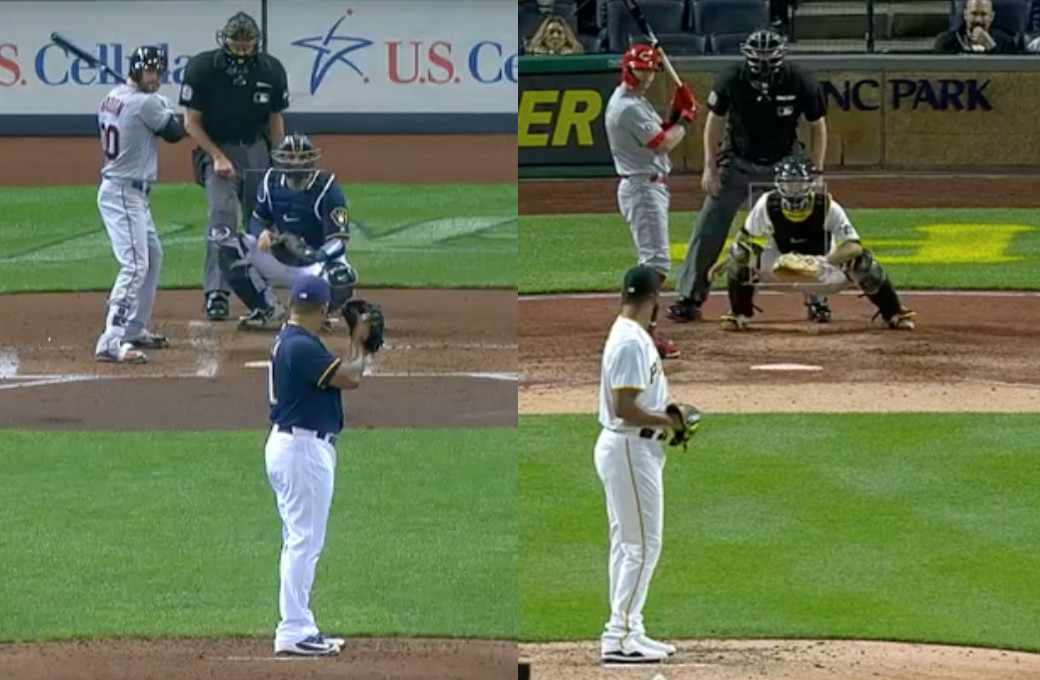
Notice the differences. Two years ago, Naquin is a bit hunched, but notice how his upper half is coiled (you can read the number and name on the back of his jersey), while his lower half is slightly open. In terms of the two halves, he’s disconnected before his swing has even started, which limits the ability to make in-pitch adjustments in terms of location for some players. This year with the Reds, it’s a different story. He’s relaxed, set up straight away and his upper and lower halves are well aligned. The only knock here is that I’d like to see the bat itself back in the 2018 position; as it’s already in the swing plane, he doesn’t need an additional move to get it there. Now let’s see what happens at swing initiation, as defined by what the body looks like at front foot strike.
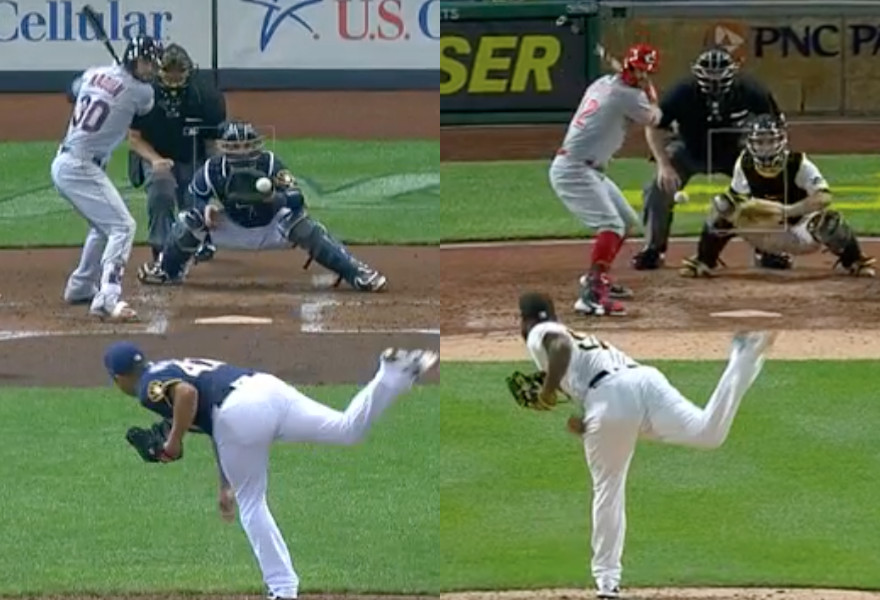
Again, the differences are clear to see. With Cleveland, Naquin was what scouts refer to as an open-to-closed hitter, as he lands in a closed position after the slightly open set-up. This is going to lead to more center/oppo contact, while this year he retains his straight away stance after foot strike, thus simplifying the entire operation and allowing him to turn on more balls.
The thing that bothers me the most about Naquin’s surge is how much pitchers are playing into his game, and how that might change going forward as the advance scouts start to do their work. Like most hitters, Naquin has real trouble with breaking stuff, and he’s suddenly seeing fewer breaking pitches for reasons that are difficult to figure out. In a world where pitchers deviate from the heater more than ever, Naquin has been seeing more than 70% fastballs in 2021. That’s almost certain to drop from here on out and he’ll need to continue to work the count in a way that lessens the chance of seeing such pitches. In addition, his new tendency to go into first-pitch ambush mode should be identified quickly, inspiring teams to get a bit more creative with him early in counts.
Naquin’s breakout is a combination of some good fortune created by his home park and some weak opponents, but there are also some real changes in terms of his approach at the plate, as well as his approach to the swing itself that point to real improvement. It feels more than a bit aggressive to say he’ll finish the year as a top 10 offensive performer in the National League, but finishing the year as an above-average producer certainly feels well within the range of most likely possibilities.
Kevin Goldstein is a National Writer at FanGraphs.
Nice article. I’ve noticed a lot of fan graphs articles recently that have focused on the difference between increased bb% due to passivity and increased bb% due to selectivity. Is this a point of emphasis for fan graphs as a whole right now or am I just seeing things (ps I think it’s for the better to get into the details of that so certainly not complaining).
It’s not some kind of group edict or anything, but I thing looking at those kind of things when it comes to walks is a really good thing!
At the end of the article, you said he’s seen 70% fastballs in 2020. Did you mean 2021? Nice article by the way, interesting read.
Indeed I do. Thanks for the catch and fixed. Also, glad you liked it.
Kevin, my recollection (from reading Fangraphs posts) is that when Naquin first came up with Cleveland and hit very well, pitchers were throwing mostly breaking pitches because they thought, like most young hitters, he hit fastballs well. Then they discovered that fastballs were his WEAKNESS and Naquin went downhill from there. So is there a connection?
Unfortunately, we only have statcast batted ball v. pitch type going back to 2017….. he’s always hit changeups well, which I find interesting, but I’m not sure what conclusion to reach because of it.
Truth is, and I remember commenting this on one of the earlier articles as well, that it was HIGH fastballs specifically, and his heatmaps from 2016 backed this up. Naquin was worse against fastballs than most low-ball hitters, but not to any crippling extent. It has always been the high hard stuff that has killed him.
“Shhhhhhhhhhh about the fastballs!” – Tyler Naquin
Naquin swings the bat about as hard as he possibly can every time he swings. For some reason I simply enjoy seeing that. With that said, his defense is so so bad. The Reds seem hellbent on running out the worst possible defense at all times, and sticking Naquin in center is just like icing on the cake, especially when he has Castellanos and Winker on either side. He constantly is letting balls drop, or making over throws, or something completely inexcusable, as such he is usually the guy they double switch the pitcher for in the 5th or 6th inning, or even sits vs RHP on occasion. I know that isn’t the premise of the article, but it is something that somewhat limits his value.
Not sure I buy the analysis for the supposed changes to his batting approach. Seems like those snapshots chosen from past vs present have different enough camera angles/POVs to account for much/most of the diffs described.
I kind of hope you’re kidding. I think all the changes described are pretty clear from the images.
If anything, the first comparison undersells how open his stance used to be pre-pitch. Also look at his hips. He’s pretty clearly open to closed versus fully aligned.
His shoulder position and load in the older pics is almost Kipnis-esque (whose swing just bothers me even though it is unique). Wonder if it’s an Indians org thing to make sure the bat is already on the swing plane.
Look more carefully at how different the camera angles are between the two sequences of snapshots.
In the old one, the rubber is lined up nearly straight on w/ home plate (and possibly very slightly to the right), and the pitcher is actually even slightly to the right. In the new one, the rubber is lined up at a slant well to the left (as is the pitcher). They are 2 quite significantly different camera angles that probably account for much of the diffs described.
I’m not saying there are no diffs at all in Naquin’s approach, but it’s probably a lot less than described. Also, there’s no video provided. Rather isolated snapshots (especially ones that aren’t aligned well) like these can’t tell the story all that well — we need more, preferably video sequences.
Another batter improving after leaving Cleveland. We’ll see if he can stay healthy all year, but I buy his improvements.
Thanks for illustrating the changes in his batting stance. I wasn’t too familiar with Naquin before he came to Cincinnati but what stuck out to me was how similar his batting stance is to Jesse Winker’s. They both look like they’re kinda leaning back in the box before the pitch. If I look away from the broadcast for a bit and one of them is up to bat it usually takes me a minute to figure out which one it is. Makes me think they’ve been trading tips around the cage, and there are certainly worse guys to try to emulate since Winker has been the best hitter in the NL so far.
Having seen a lot of Naquin, my understanding is he has always struggled mightily against fastballs, so I’m curious where the data that he has real trouble with breaking stuff comes from? Naquin could always handle low fastballs, and anything low in general, but give him a moderately paced fastball above thigh level and it was a swing and a miss. Saw him this year a few games and he was at least fouling off some of those high pitches. Naquin always tantalized with Cleveland and would go stretches where he would look like a solid hitter, but health has always held him back.
True story – late Monday night I was scanning the day’s boxscores and noticed Naquin’s seasonal line, and thought, what the heck’s up with Tyler Naquin? Thanks for the smart analysis, Kevin.