
2019 Trade Value: #31 to #40
As is the annual tradition at FanGraphs, we’re using a week around the All-Star Game — when the industry pauses to take a metaphorical breather — to take stock of the top-50 trade chips in the sport. For more context on exactly what we’re trying to do here, see the Honorable Mentions post linked at the top of the page.
For this post and the three to follow, I’ll present a graphic (by way of the wizard Sean Dolinar) breaking down each player’s objective skill level (represented, in this case, by a five-year WAR projection from ZiPS), contract/team-control details, rank in last year’s series, and then year-by-year details of age, WAR, and contract through the end of 2023, although a couple players have control beyond those five years, and some, you’ll notice, show projections for fewer years to reflect when those players reach free agency. For those readers who are partial to spreadsheets rather than blocks of text, I’ll also include all of the players we’ve ranked so far in grid format at the bottom of the post.
It should be noted that the ZiPS WAR forecasts influenced the rankings a bit. For players who were bunched together, it acted as an impartial tiebreaker of sorts, but the industry opinions I solicited drove the rankings.
With that said, let’s get to the next 10 spots on this year’s Trade Value list.
| Five-Year WAR | +12.1 |
| Guaranteed Dollars | $28.0 M |
| Team Control Through | 2024 |
| Previous Rank | – |
| Year | Age | Projected WAR | Contract Status |
|---|---|---|---|
| 2020 | 27 | +3.0 | $6.3 M |
| 2021 | 28 | +2.8 | $6.5 M |
| 2022 | 29 | +2.6 | $6.8 M |
| 2023 | 30 | +2.1 | $8.5 M |
| 2024 | 31 | +1.6 | $10.0 M |
I get the impression that the average baseball fan might not realize that Max Kepler is good now, and may only have a vague awareness of him as the prospect from Germany who ended up being more than just a generic baseball player who hails from a country off baseball’s beaten path. Now that we have a bigger sample of UZR and StatCast defensive metrics, we know that Kepler is a well above average defender. He’s 11th in outs above average among all outfielders this year and his UZR in the last season and a half is +21.4 runs, making him tops amongst major league outfielders in that span. The tidbit everyone repeated when Kepler initially signed out of Germany at age 16 was that both of his parents were ballet dancers; to be the top outfield defender in baseball at 6-foot-4 and 205 pounds suggests Kepler may be light on his feet as well. He’s having an offensive breakout in his age-26 season while also running a .258 BABIP, and he also signed a pretty team-friendly extension before the season.
| Five-Year WAR | +16.4 |
| Guaranteed Dollars | – |
| Team Control Through | 2024 |
| Previous Rank | – |
| Year | Age | Projected WAR | Contract Status |
|---|---|---|---|
| 2020 | 28 | +4.0 | Pre-Arb |
| 2021 | 29 | +3.8 | Pre-Arb |
| 2022 | 30 | +3.3 | Arb1 |
| 2023 | 31 | +3.0 | Arb2 |
| 2024 | 32 | +2.3 | Arb3 |
I mentioned in Gary Sanchez’s blurb that a couple of clubs had indicated that their metrics took a more positive view of Sanchez’s framing than ours do. Another nugget to emerge from those conversations was that a couple of teams’ internal projections for Jeff McNeil aren’t as rosy as ZiPS. 5.5 years of control of an infielder who is on pace for a 3.6 WAR season and just entering his prime screams trade value, though. I could also play the Matt Olson game from yesterday’s article and point out that McNeil has posted 5.4 WAR in 580 career PA, a mark that would have made him the best second baseman in baseball last year. McNeil was completely generic for the first five seasons of his pro career, then made some swing adjustments in 2018 and has been good ever since. It’s a great story and he’s a nice asset for a club to have; indeed, many teams tried to pry him away from the new Mets regime this offseason, hoping they wouldn’t value him highly. Now McNeil seems like he’ll be a building block for the franchise while making the league minimum and playing a Ben Zobrist-type role, though he’ll be entering arbitration in his decline years.
| Five-Year WAR | +14.0 |
| Guaranteed Dollars | $21.2 M |
| Team Control Through | 2025 |
| Previous Rank | – |
| Year | Age | Projected WAR | Contract Status |
|---|---|---|---|
| 2020 | 26 | +3.1 | $3.8 M |
| 2021 | 27 | +3.2 | $4.3 M |
| 2022 | 28 | +2.8 | $5.5 M |
| 2023 | 29 | +2.7 | $7.5 M |
| 2024 | 30 | +2.2 | $10.5 M |
Polanco and Kepler were roommates as they entered pro ball, then signed extensions on the same day, even doing some catalog work for a jeans and light jackets brand to commemorate being extension and press conference buddies. Polanco’s deal has an extra option tacked on and fewer guaranteed dollars since his performance was less impressive pre-extension than Kepler’s. But Polanco is also having a career year, on pace for his own 4.0 WAR season. There wasn’t much industry consensus on which guy would be the preferred option if a club were forced to choose, and I’m sure I’ll change my mind 20 times before these contracts are over. The Twins continue making shrewd moves, locking up young players to team-friendly deals through their age-31 seasons just before their performance jumps.
| Five-Year WAR | +12.9 |
| Guaranteed Dollars | – |
| Team Control Through | 2025 |
| Previous Rank | HM |
| Year | Age | Projected WAR | Contract Status |
|---|---|---|---|
| 2020 | 25 | +2.7 | Pre-Arb |
| 2021 | 26 | +2.7 | Pre-Arb |
| 2022 | 27 | +2.6 | Arb1 |
| 2023 | 28 | +2.5 | Arb2 |
| 2024 | 29 | +2.4 | Arb3 |
Senzel is another solid all-around position player with long-term control, and has the most upside of this group, with a track record of showing five above average tools (some scouts have tossed a 70 on his bat). He’s also been injured the most of that group of players by far, with two sprained ankles, a migraine, and a foul tip off his eye this season, coming after a 2018 full of other issues, including two bouts of vertigo, a broken finger, and surgery for bone spurs in his elbow. He’s a fill-in option at shortstop and at least average defensively at every other position besides catcher, so you can see both why he’s at the top of this group and why he’s the riskiest bet. Rival clubs are still in on Senzel and saw 2019 as possibly the last chance to acquire him before he’s much higher on this list, but the Reds have never seemed interested in discussing him as a trade piece.
| Five-Year WAR | +17.4 |
| Guaranteed Dollars | $44.0 M |
| Team Control Through | 2021 |
| Previous Rank | #9 |
| Year | Age | Projected WAR | Contract Status |
|---|---|---|---|
| 2020 | 30 | +4.9 | $22.0 M |
| 2021 | 31 | +4.6 | $22.0 M |
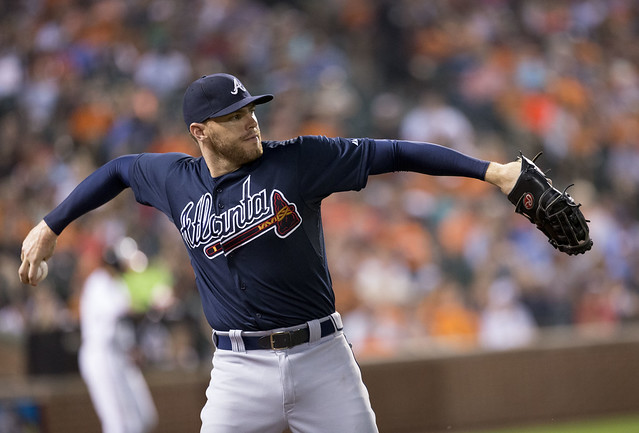
Freeman and the guy two spots higher up were tough to place among all the younger, controllable hitters, since they’re better and more accomplished, but also offer less control at a higher price. As I mentioned in yesterday’s Scherzer blurb, all things being equal, clubs would prefer that the WAR they’re acquiring be concentrated in the fewest possible seasons, as quickly as possible. Freeman offers that option, while the four hitters behind him may all settle in as 2.5 to 3.0 annual WAR types, so as a GM, you’d be picking them at the expense of the next few seasons to get a couple of two-win seasons on the backend, when those players would have to sign another contract to even see those years anyway. And what if one of their frames blows up, or Kepler’s defensive prowess regresses, or Polanco moves to second base, or Senzel is consumed by the Springfield Mystery Spot? Nothing is for sure, but teams don’t want to get too cute and get caught just collecting controllable years like Pokémon cards. You do not have to catch ’em all.
| Five-Year WAR | +17.6 |
| Guaranteed Dollars | – |
| Team Control Through | 2023 |
| Previous Rank | #34 |
| Year | Age | Projected WAR | Contract Status |
|---|---|---|---|
| 2020 | 27 | +4.0 | Pre-Arb |
| 2021 | 28 | +4.0 | Arb1 |
| 2022 | 29 | +3.8 | Arb2 |
| 2023 | 30 | +3.2 | Arb3 |
Hoskins has taken a step forward this year while losing a year of control, so he’s basically held serve in terms of trade value. He’s still a R/R, first base-only type who’s in his peak right now, and that profile traditionally doesn’t age well. If his agent weren’t Scott Boras, I’d suggest that a Twins-esque extension — buying a year of free agency and locking him up through his age-31 season — would make some sense for both sides. Regardless of how he ages, Hoskins is going to be a cheap, 3-4 WAR middle-of-the-order threat for at least the next couple years, albeit one whose arbitration figures could get gaudy with all those counting stats.
| Five-Year WAR | +16.5 |
| Guaranteed Dollars | – |
| Team Control Through | 2021 |
| Previous Rank | HM |
| Year | Age | Projected WAR | Contract Status |
|---|---|---|---|
| 2020 | 27 | +4.1 | Arb2 |
| 2021 | 28 | +3.7 | Arb3 |
The executives I spoke with were a little hesitant to run Baez up the list last year after one season boasting good offensive production, because he did it with a 4.5% walk rate. Well here we are a year later, Baez is 26 and in his prime, and he’s basically doing it again, but now with just 2.5 years of control left. For that short of a term, you don’t need to worry about his performance cratering, but those I spoke with are still nervous about projecting Baez’s hyper-aggressive approach remaining effective when the bat control and bat speed regress a bit. His free agency after the 2021 season will be interesting to watch, as I can’t think of another player in recent memory with an approach like this who will demand nine figures. And before you say Gary Sheffield because they both had 80 bat speed, go look at Sheffield’s strikeout rates.
| Five-Year WAR | +19.6 |
| Guaranteed Dollars | $15.3 M |
| Team Control Through | 2023 |
| Previous Rank | #1 |
| Year | Age | Projected WAR | Contract Status |
|---|---|---|---|
| 2020 | 27 | +4.6 | $6.3 M |
| 2021 | 28 | +4.5 | $9.0 M |
| 2022 | 29 | +4.0 | $11.0 M |
| 2023 | 30 | +3.5 | $13.0 M |
I said Scherzer was the hardest player to place on this year’s list, and that’s true, but Ramirez was a pretty close second. He was the top trade asset in baseball at this point last year by a pretty wide margin. From 2017-2018, he was the third best player in the game by WAR, and the fourth best from 2016-2018. But in 2019, he’s been pretty bad. Looking at his underlying stats, he’s been fairly unlucky but he’s also been a little worse by most of the major statistical indicators. Over the last 30 days, he’s been much better and essentially as good as his expected stats on the year, so I would buy a solid bounce back the rest of the season, with the ZiPS projected season line of 2.7 WAR looking about right.
He may never clear 4.0 WAR again, but I’d expect four more cheap years in the 2.5 to 4.0 WAR range, with maybe one season a bit over 4.0, which is roughly what ZiPS has as well. The rough asset math here is 15 WAR for $31 million over the next 4.5 seasons, which is about $100 million in surplus value even factoring in the time-value of money. The fact that Ramirez is likely to put up just over five fewer wins this year compared to last and that his frame isn’t exactly that of a traditional superstar makes it hard to believe that this season’s performance is a total fluke (I don’t think it is), but I wouldn’t overreact and sell your shares just yet, either.
| Five-Year WAR | +18.5 |
| Guaranteed Dollars | – |
| Team Control Through | 2024 |
| Previous Rank | – |
| Year | Age | Projected WAR | Contract Status |
|---|---|---|---|
| 2020 | 25 | +4.0 | Pre-Arb |
| 2021 | 26 | +4.1 | Pre-Arb |
| 2022 | 27 | +3.7 | Arb1 |
| 2023 | 28 | +3.5 | Arb2 |
| 2024 | 29 | +3.2 | Arb3 |
Like Baez, Alonso is an example of a player whose loud 2018 performance got him on our radar for this list, but we weren’t quick to shoot him up until a 2019 performance proved it wasn’t a fluke. Now here we are. Like Hoskins, Alonso is the dreaded R/R, first base-only profile, although Alonso has cleaned up his body a good bit over the last few years when it looked for a moment like he was more of a DH. I first saw Alonso in his high school days and still remember a game he had against Oscar Mercado when both were seniors. The scouts I was standing with pointed to the sophomore center fielder for Alonso’s team and said that guy was the best prospect on the field. It was Kyle Tucker. Nobody thought the chubby third baseman with some bat control would turn into a plus-plus power monster capable of winning the Home Run Derby, but I suppose we’re in the era of dynamic player development, so bully for the Polar Bear.
| Five-Year WAR | +18.9 |
| Guaranteed Dollars | $34.8 M |
| Team Control Through | 2023 |
| Previous Rank | #21 |
| Year | Age | Projected WAR | Contract Status |
|---|---|---|---|
| 2020 | 27 | +4.0 | $8.0 M |
| 2021 | 28 | +4.0 | $11.8 M |
| 2022 | 29 | +3.8 | $15.0 M |
| 2023 | 30 | +3.8 | $16.0 M |
As referenced in the intro, a few executives I spoke with told me that the second major tier of players they target for trade, behind the elite bats with long-term control, is that of the potential aces who has enhanced value in the playoffs. Nola is at the back of that tier, as the walks have crept up a bit this season, he suffered an elbow strain in 2016 that shut him down for the season in July, and he signed an extension this past winter that means he’ll only be cheap for a couple more seasons compared to some other ace candidates. He’s proven he has the feel and secondary pitches to get by if his stuff diminishes, which he’ll probably need, as his average velo seems likely to end up close to 90 mph by the end of this deal.
| Rk | Pv | Player | Age | 2020 | 2021 | 2022 | 2023 | 2024 |
|---|---|---|---|---|---|---|---|---|
| 31 | 21 | Aaron Nola | 26 | +4.0 $8.0 M |
+4.0 $11.8 M |
+3.8 $15.0 M |
+3.8 $16.0 M |
|
| 32 | – | Peter Alonso | 24 | +4.0 Pre-Arb |
+4.1 Pre-Arb |
+3.7 Arb1 |
+3.5 Arb2 |
+3.2 Arb3 |
| 33 | 1 | Jose Ramirez | 26 | +4.6 $6.3 M |
+4.5 $9.0 M |
+4.0 $11.0 M |
+3.5 $13.0 M |
|
| 34 | HM | Javier Baez | 26 | +4.1 Arb2 |
+3.7 Arb3 |
|||
| 35 | 34 | Rhys Hoskins | 26 | +4.0 Pre-Arb |
+4.0 Arb1 |
+3.8 Arb2 |
+3.2 Arb3 |
|
| 36 | 9 | Freddie Freeman | 29 | +4.9 $22.0 M |
+4.6 $22.0 M |
|||
| 37 | HM | Nick Senzel | 24 | +2.7 Pre-Arb |
+2.7 Pre-Arb |
+2.6 Arb1 |
+2.5 Arb2 |
+2.4 Arb3 |
| 38 | – | Jorge Polanco | 25 | +3.1 $3.8 M |
+3.2 $4.3 M |
+2.8 $5.5 M |
+2.7 $7.5 M |
+2.2 $10.5 M |
| 39 | – | Jeff McNeil | 27 | +4.0 Pre-Arb |
+3.8 Pre-Arb |
+3.3 Arb1 |
+3.0 Arb2 |
+2.3 Arb3 |
| 40 | – | Max Kepler | 26 | +3.0 $6.3 M |
+2.8 $6.5 M |
+2.6 $6.8 M |
+2.1 $8.5 M |
+1.6 $10.0 M |
| 41 | – | Brandon Woodruff | 26 | +2.9 Pre-Arb |
+2.9 Arb1 |
+2.9 Arb2 |
+2.8 Arb3 |
+2.5 Arb4 |
| 42 | – | Mike Soroka | 21 | +2.7 Pre-Arb |
+2.7 Arb1 |
+2.9 Arb2 |
+2.9 Arb3 |
+2.7 Arb4 |
| 43 | 32 | Eugenio Suarez | 27 | +3.5 $9.3 M |
+3.2 $10.5 M |
+3.2 $11.0 M |
+2.7 $11.0 M |
+2.2 $11.0 M |
| 44 | 41 | Max Scherzer | 34 | +5.6 $35.0 M |
+5.6 $35.0 M |
|||
| 45 | 5 | Carlos Correa | 24 | +4.2 Arb2 |
+4.3 Arb3 |
|||
| 46 | 31 | Gary Sanchez | 26 | +3.2 Arb1 |
+3.0 Arb2 |
+2.6 Arb3 |
||
| 47 | 13 | Corey Seager | 25 | +4.0 Arb2 |
+3.9 Arb3 |
|||
| 48 | – | Adalberto Mondesi | 23 | +3.0 Pre-Arb |
+3.0 Arb1 |
+2.9 Arb2 |
+2.8 Arb3 |
|
| 49 | HM | Matt Olson | 25 | +3.4 Pre-Arb |
+3.4 Arb1 |
+3.1 Arb2 |
+2.9 Arb3 |
|
| 50 | – | Luis Castillo | 26 | +3.4 Pre-Arb |
+3.4 Arb1 |
+3.2 Arb2 |
+3.0 Arb3 |
Kiley McDaniel has worked as an executive and scout, most recently for the Atlanta Braves, also for the New York Yankees, Baltimore Orioles and Pittsburgh Pirates. He's written for ESPN, Fox Sports and Baseball Prospectus. Follow him on twitter.
Re: Jose Ramirez:
“Over the last 30 days, he’s been much better”
Since June 20th, he’s put up a 153 wRC+. But dial things back a little bit further to May 31st and he has an 86 wRC+ since that date.
So whether he appears to be turning things around or whether he’s continuing to struggle depends on which small sample size you look at…
His season has been really strange. From the beginning of the season to May 31, he hit .213/.317/.324 with just 4 homers but a very good 13%/16% BB/K ratio.
Then June 1 to June 12 was his worst stretch, when he hit .111/.154/.111 with a so-so 5%/10% BB/K ratio and literally zero power over 39 PA.
From June 14 on, he’s hit .300/.356/.544 with 6 doubles, 2 triples, and 4 home runs and an excellent 9%/7% BB/K ratio in 101 plate appearances.
He’s probably not as good as he has been since June 14, but I think you could make the argument that the early June awfulness was a result of him figuring out a new swing or working on stopping “trying to beat the shift,” which he had been doing all year until then.
Assuming no major injuries, I think he gets his season wRC+ up to at least 100 by the end of the year.
I hope he doesn’t, as I have a very significant bet that he ends below 100.
“From June 14 on, he’s hit .300/.356/.544 with 6 doubles, 2 triples, and 4 home runs and an excellent 9%/7% BB/K ratio in 101 plate appearances.
He’s probably not as good as he has been since June 14,”
I don’t understand this. This stat line is basically 2016-August, 2018 Josie. I think the recency bias of his very (very) bad August, 2018-June, 2019 is affecting people. He’s more or less been the same player this whole time. To me, the biggest issue in 2019 has been that he’s been getting under it too much. Too much of an emphasis on fly balls to the detriment of well struck liners. There was a good article on this on FG a month or so ago. By my eye test, he’s fixed that; he’s been hitting ropes lately. I expect it to continue to improve as he’s too gifted a hitter not to be able to sort out that type of mechanical issue.
fun with arbitrary cut-offs!!!!!
FWIW, I think he’s definitely turned a corner. Over his last 15 games, he looks like peak Josie. Earlier this season, Lindor said JRam would be “back” when he was hitting HRs again. I always disagreed with that. When he’s right, Josie is a doubles machine. As of late, he’s been lacing doubles seemingly every night. I think he’s figured out whatever was bugging him.
3-4 again last night. His wRC+ is up to 77, which is huge progress.
What happens with Freeman is going to be really interesting, because he’s said multiple times he wants to retire a Brave, but considering AA’s history I doubt they give him a Votto-esque contract. A hometown discount might be on the cards and make more people mad about Braves team-friendly contracts.
Freddie’s an interesting case to me for a few reasons:
1) His defense by fWAR (-11.3 already this year) doesn’t jive with his reputation, or with the eye test, if you ask me (and bWAR has him much closer to zero). So it’s not hard to imagine the projections are underselling him somewhat.
2) He’s deceptively athletic, with a great arm and near-average speed, to the extent that he’s been a net positive on the bases. But the baserunning value especially seems likely to decline sharply as his big body ages, so that’s a sneaky little cache of hidden value that will likely dissipate (well, not hidden–it’s captured in wRC+–but less obvious subjectively).
3) By Hugs Above Replacement, he’s without peer. If that’s not worth a few million in an extension, I give up on this team.
I’m with you 100% on the defense, and I’d be interested to know why there’s such a disparity there, and I certainly don’t think there has been a noticeable drop off with his defense from last year to this.
It is very simple. It is because there is not a defensive metric platform that is worth the time it takes to read it.
I’ve never known a fan to not think their 1B is above average on defense.
Have you ever known a Toronto Blue Jays fan? With the exception of Lyle Overbay, the last 20 years have been dismal, defensively, at the cold corner.
I think Jose Abreu is a terrible defender…
That -11.3 is more than half made up by the position penalty of first base. His defense by UZR/150 this year is actually -5.0. And while that’s bad for a first basemen, it had been positive every year since 2013. Just last year it was +8.2.
It’s very possible he is now losing his defensive ability all at once, but it’s not true that his defense has been bad by the metrics before this year.
Oh, I didn’t realize that’s where they input the positional penalty. Thanks for the info!
“By Hugs Above Replacement, he’s without peer.”
Tony Kemp says “Hello.”
still no gallo eh…kinda surprised he’ll be top 30, but i dig it
He’ll probably be top 20.
I’d venture higher than 20.
Hmm, McNeil’s profile reminds of that time Cameron put Joe Panik in the top 50 in 2015 after a few hundred babip heavy at bats. Once McNeil’s babip comes down to earth, and it will, it’s not like there’s a ton left in the profile.
I’m biased, but the more I watch Jeff McNeil play, the more I’m convinced he’s the second coming of Ichiro. His BABIP will probably come down some but I think he can keep this up until he hits reaches his age-related decline years
Probably somewhere between Ichiro and Panik, don’t you think?
After looking more closely at Panik’s numbers, I see the statistical comparison between his early career and what McNeil’s doing now. It’s McNeil’s swing and approach that make me think he’ll fare better than Panik did. I’m not saying McNeil’s going to do this for as long as Ichiro was able to, but that’s only because of his age and injury history. He’s fast, his bat control is incredible, and his mechanics are reminiscent of Ichiro’s, who obviously was able to sustain high BABIPs for multiple seasons. All that combined with his minor league track record and his good underlying Statcast numbers make me believe what he’s doing is sustainable for as long as his body holds up.
McNeil’s downside is that he’s Chris Johnson 2.0. There is no question that career .373 Babip is unsustainable. The question is by how much?
Sometimes I realize that I can’t name 50% of the Braves roster from just two or three years ago, and I despair of my atrocious memory. Then I hear a name like Chris Johnson, and I feel better.
Dude’s got a 97th percentile xBA on baseballsavant, so he’s earned it. I have no idea if it’s sustainable though.
Nobody in the history of baseball has sustained that. I think you can feel safe in saying the first won’t be McNeil.
I do want to clarify, after looking back, that “Chris Johnson 2.0” might be a bit harsh even for downside risk.
Technically, Ty Cobb and Willie Keeler did over their careers, but I think we can all agree it ain’t happening again.
To be fair, nobody has played with that ball before this year.
There are also definitely players who run BABIPs way higher than normal. Domingo Santana regularly runs BABIPs in the .360-.380 range. Alfaro’s BABIP has regressed to .380 after two years of being above .400.
Of course, neither of those guys are slow but a lot of that is because they have huge power, which doesn’t apply to McNeil.
I think it’s pretty clear that he’s going to regress, but there’s enough to make me think we shouldn’t totally dismiss him running a high BABIP for a while.
It is funny how Alfaro is above average speed. He is a bat you can dream on if he could just start making contact. I think he will have a monster season one day, and soon.
There are always a couple young players who’ve put together a couple super high babip seasons in a row, and always a contingent of “this is different” cheerleaders. The highest reasonable prediction for a sustainable babip is about .350 (trout’s career), unless you play at Coors.
I don’t necessarily think there’s that tricky a formula to it. You have guys with big raw power but who, for whatever reason, don’t have the optimal swing to lead the league in home runs (or in Alfaro’s case, even hit them all that often). Instead, they just hit lasers all over the places. Combine that with slightly-above average speed and you’ve got Domingo Santana (.363 BABIP over 1700+ PAs) or Alfaro (.397 BABIP over 700 PAs). But doing it consistently is hard! It’s a risky formula for trying to make a living because if you aren’t all that consistent about hitting line drives then you wind up in Eric Hosmer territory, veering wildly between average hitter and very good one.
Are there other players who can do this? I checked the career leaderboards from 1980 to the present, with a minimum of 1500 PAs (which is roughly 2.5 seasons worth of work, which I think is probably enough), and it’s pretty rare. Trout, Jeter, Goldschmidt, Votto, and Yelich, who are just excellent all-around hitters are about or above .350. The two names (aside from Santana) that stand out are Austin Jackson, who got most of his based on speed, and Reggie Jefferson, a guy with two career steals.
But let’s see about how this ball changes things first.
Given hundreds of mlb players, a few will fall in the “lucky” range for 1700 at bats. The reason you don’t find more when looking at career numbers is because regression comes for them all. Magic doesn’t exist, Santa isn’t real (Claus, not Johan), and Domingo Santiago and Jeff McNeil are not the greatest Babipers since Ty Cobb.
The 50% “half-stabilization” point for hitter BABIP is about 800 PA, so if you pick a random hitter and they show .360 for 1700 PA you’d figure them for .340 or so.
The league BABIP is essentially the same with the new ball, somewhat surprisingly.
When KBO (baseball league in Korea) juiced their ball, the league BABIP jumped from ~0.300 to ~0.330.
McNeil’s xWOBA for 2019 is .366. That would put him above Mookie Betts for 2019 and at a wRC+ of 125-130.
So of the 30 spots remaining, 22 are holdovers from last year. That leaves 8 spots for newcomers. I have:
Franco
Bieber
Bogaerts
Moncada
Marte
Paddack
Gallo
I’m going crazy trying to figure out that last spot. Glasnow and Verlander were my first thoughts, but I doubt it’s either of them.
[Editing out a wrong guess after finding name in last year’s list.]
DeJong?
Personally, I’m with you on Moncada. He is so much better this year than last, and last year he was a 2 WAR player at 23. K% is down 6 percentage points even though the league wide rate is up, he is no longer useless hitting right handed (wRC+ 111), and his defense and baserunning RAR are both better. he’s still just 24 with a lot of team control left, a lot of tools, and the potential to get even better.
The BABIP is very high, probably unsustainably so, but he hits the ball really hard (5th in MLB in exit velocity), to all fields, and runs well so you a BABIP of .350 is not unreasonable.
But ZIPS still doesn’t really think much of him and I think they use ZIPS for this in part to determine excess value. So while he might end up in the next ten, I could also see an argument for leaving him off entirely. Although then I would have at least expected to see him in the honorable mentions.
I think Moncada belongs somewhere on this list, but not above Alonso and Nola. He gets to his value in a very different way, but I think there’s a lot of parallels to Adalberto Mondesi in terms of current value, future value, and team control.
Could it be…..
Lance Lynn???
Marquez?
Keston Hiura should fit somewhere, don’t you think? Small sample disclaimer but 1 WAR in 31 games so far, so roughly a 4-5 WAR player who should now be a full timer and is under team control.
Hiura was in the honorable mentions. If he shows up in the second half of this season, he may end up on next year’s list.
Ah ok, thanks.
It’s gotta be Marquez I think. His stats if you take Coors out of the equation are great (even this year he’s on pace for over 4 fWAR with a crazy Coors inflated ERA) and he just signed a nice team friendly deal.
His ERA also just got blown up by giving up 11 runs in his last start, yesterday, which of course won’t be factored in here.
I do wonder what effect Coors has on trade value. I know the teams are smarter now, but it still can’t help.
Tatis?
Tatis would be an excellent possibility if he hadn’t made last year’s list.
Carrasco could be the last one. He signed a long extension this offseason.
Poor guy is recovering from cancer.
Yeah, but he’s still signed for the next several years, and should be a 3-4 win starter for much of that.
There’s a mighty large and unfortunate “if” attached to that.
I’d think Moncada has to be there. He was considered for the franchise draft at 30 and he’s young and controllable so he should be in the top 20 for this.
Ramon Laureano?
Gotta be Ozzie Albies, doesn’t it?
This is great stuff.
This is obviously going to depend who is the next rung up from these guys, but I’m surprised to see Alonso and Nola so low on this list.
Evaluators must not be sold on Nola as a league ace, but four years of reasonable team control for a guy through his 20s (and one 30-year) is pretty cheap for a guy who had one year as a staff ace and was turning in league-ace-level performance just last year. What pitcher would you reasonably put above that in terms of total value? According to ZiPs, in 2021 only five pitchers are projected for more value: Sale and deGrom (expensive), Cole (free agent), Severino (nasty injury), and Bieber. Nola is probably the second-most valuable pitcher in baseball based on performance and contract, and don’t Blake Snell me because he is projected for almost a full win less than Nola last year AND the sparkling RA9 Snell had last year isn’t as impressive as Nola’s super-impressive RA9 in front of that defense.
As far as Alonso goes, maybe he’s not as cheap as he seems because he’ll get rewarded in arbitration for hitting home runs, and it’s interesting that the projection system thinks that what he’s doing right now is a fluke and that he’ll decline early, but the guy is on pace for a 5-win season, is only 24, and is controlled for an awfully long time, including a couple years for the minimum. There must be a lot of industry skepticism of him, but for my money I think he’s a better buy than Aaron Judge whose offensive performance is clearly superior (and who is very valuable in his own right based on this exercise) but who is 3 years older, has about half as much team control and whose body already seems to be breaking down.
I’m guessing maybe German Marquez (in addition to Bieber) is ahead of Nola. Marquez is cheaper and has an extra year of control. And (before last night), was doing as well as Nola in a much more challenging environment. I would bet that some teams think they can turn Marquez into a Cy Young pitcher away from Coors (whether they can or not is questionable).
I’m kind of shocked to see Senzel this high and Eloy didn’t even make the list. Eloy was a higher rated prospect, and his extension gives more years of control at what will be a marginally higher cost than Senzel gets in arbitration assuming he’s as good as the article surmises. Add in the fact that Eloy is 3 years younger and I think it’s a no-brainer who teams would prefer moving forward.
Eloy was a higher rated prospect by many, but this site had them equal. I think the most important thing here is that Senzel is a potential 5 tool CF while Eloy can rake but may be a DH sooner rather than latter.
Sure, personally I’d prefer Eloy for the extra years of control and age difference. But one being 37 and the other not making it seems off
yeah, hard to imagine any team trading eloy for senzel
“I first saw Alonso in his high school days and still remember a game he had against Oscar Mercado when both were seniors. The scouts I was standing with pointed to the sophomore center fielder for Alonso’s team and said that guy was the best prospect on the field. It was Kyle Tucker.”
My god I’m so thankful I didn’t grow up wherever these guys played high school ball. I’m pretty sure I never played a game with or had to try out against 3 future MLBers.
I played with a couple guys who ended up washing out in low A ball, so I can’t even imagine playing with/against a guy who has MLB All Star talent. The pitcher absolutely demolished me as a kid.
The Atlanta suburbs had some bonkers players too. Franceourstein chimes in about playing against these guys sometimes, and it’s an amazing story every time.
I still think the best Trio is Gallo, Kris Bryant and Bryce Harper all playing for the same traveling team. Like, what the fuck is some 16 year old pitcher supposed to do against that shit?!
Dave Kingman and George Foster were also teammates as teenagers.
I’m wondering how much, if any, extra value is produced by a guy like McNeil or Senzel who can play lots of positions capably? WAR obviously won’t add anything extra for being able to play 3b and 2b and 1b at an average level. But I assume teams might? It makes drafting and free agency a lot more flexible if you can move a guy around easily.
Any idea how much they might add to his value? 0.5 WAR per year? 1? More?
Even if someone plays 2B or 3B exclusively, they still line up all over the infield. I think we’ve reached the point where being able to play one of those positions competently is pretty much the same as being able to play both. Just look at Mike Moustakas.
The value of versatility really depends on the rest of the roster around a guy. McNeil’s ability to play 3rd doesn’t mean much on a team with someone like Nolan Arenado, for example. But it’s super useful for the Mets where there’s plenty of opportunity to mix and match.
I’d guess it’s more of a tiebreaker thing than an explicit value adjustment
Interesting how the scouting FV translates here… look at Alonso. A couple months ago he was the top of the 50 FV class and this is basically what we knew he could do… so a 50/55 FV with 5.5 years more contol is #32 on the list? Yordan Alvarez is similar scouting FV (50/55)… would he also rate this high?
I guess this comment really is all about Alonso and whether a big body 1B slugger is all that valuable. He’s better than Jose Martinez, Luke Voit, etc… but is he THAT much more valuable? Is he really more desirable than bargain salary Jose Ramirez? Kepler and Polanco?
I think a 156 wRC+ with elite exit velocity and solid 1B defense is essentially a best case scenario of a 50 FV prospect. Plus FV, especially at FG, I think attempts to value over the next 6 years (I think it’s 6 years), focusing on the value after the timespan is complete (meaning all years have equal value). While these trade values put a premium on near term production, which is why Freeman appears. It’s been well documented that Kiley & Eric thought Alonso could rake (though maybe not this well), but thought he might decline faster than some of the other prospects at the top so dropped is FV to reflect that. I think that’s being handled differently here.
I agree that the trade value is and should be skewed toward immediate payoff, but I don’t think Alonso’s 50 FV comes from projecting short peak/early decline. I think it comes from the fact that he can only play 1B, and 1B sluggers are not that hard to find. To get a 60/70 FV you also have to have other outstanding tools that make you a scarcer commodity. I think if you were going to give Jose Ramirez or Kepler or Polanco a FV for their upcoming years, they’d get the 60/65 score. So it’s curious that the trade value doesn’t follow the same logic as the FV.
Hoping McDongenhagen will weigh in here and correct me.
I’d say 156 wRC+ with elite exit velocity and solid 1B defense is essentially a best case scenario of a 55 FV prospect as well.
In other words, people thought Alonso’s 2018 was fluky and he proved it wasn’t.
Nobody considers Alonso’s FV to be 50 anymore.
It is as simple as that.
Altuve and McNeil both become free agents in 2025. McNeil is all of 23 months younger. I know it’s something like $100M difference, but I have a real hard time believing that any GM outside of Tampa Bay or Pittsburgh would rather have McNeil’s contract than Altuve’s.
I made a little plot to illustrate the change of each player’s performance from 2018 to 2019. Basically, this is the difference in WAR per 100 games (for hitters) or WAR per 100 IP between 2019 and 2018. Thus positive values indicate better performance this year, and negative values indicate worse performance to date this year. I also plotted a histogram of the same value for all players in the league for context. ….poor Jose Ramirez.

I see you are putting your newfound abilities to good use!
Also, what Stata scheme is that?
I use R, and ggplot in this case.
Nice.
Wow! Very cool plot! Who’s the outlier on the far right of the histogram?
The right tail of the histogram is occupied by:
Cody Bellinger: 4.3
George Springer: 3.0
Joey Gallo: 3.6
Rafael Devers: 3.1
Christian Vazquez: 3.5
Roberto Perez: 3.0
James McCann: 3.8
Hunter Dozier: 3.3
Hunter Pence: 3.8
Lucas Gioloto: 3.3
And the left tail while I am at it:
Mookie Betts: -4.2
Jose Ramirez: -4.2
Lorenzo Cain: -3.4
Travis Shaw: -3.9
Robinson Cano: -3.8
Leonys Martin: -3.9
Daniel Robertson: -3.4
Elias Diaz: -3.5
It’s interesting to see that Mookie Betts has fallen off as much as Jose Ramirez, but has drawn much less attention. I guess that’s because Mookie fell from the stratosphere back to a pretty good player, while Ramirez fell from elite to near replacement.
And finally, Mike Trout is playing 0.22 WAR better per 100 games this year than last. So far he’s added a little excellence to his consistent excellence.
Trout wouldn’t be the first guy to make a leap in performance during his age-27 season. 😉
Looking at guys like Jo Adell and Royce Lewis being specifically left off the Top 50, but the 50 includes the Brandon Woodruff. That would imply that if the Brewers approached the Angels offering Woodruff for Adell, it would be in the Angels’ best interest to accept this offer. However, if the Angels accepted such an offer, I suspect they would be laughed out of town. Are prospects being undervalued in this equation?
It might be that SP who have shown success in the major leagues are undervalued by casual fans, who have a fetish for their own top prospects. Woodruff has 5.5 years of team control, and has been more valuable this year than established stars like Story, Freeman, Realmuto, etc. He’s quite valuable, even if that particular 1-to-1 trade doesn’t make a lot of sense for the 2 clubs.
The long and short of it is “not really.”
There is considerable value in certainty, and Woodruff has begun to tap into that. Adell would neither be the first nor last to destroy AA and not become a star on the major league level.
That’s not to say that the Angels should make that trade. Future value is an uncertain thing, and for prospects it is far more volatile than for young, established players. It’s likely a terrible move considering Adell’s upside, and perhaps a fine move considering his floor.
I’d love to know exactly what this means:
“who has enhanced value in the playoffs. ”
Is this a specific type of pitcher, or just an ace in general?
Yeah, a high-end pitcher has kinda 2× value because they can pitch twice in a five-game series — but they have to be high-end because they have to be adding value over a mid-rotation guy they displace.
Concretely: say you can set up your three top pitchers ABCAB. But then you acquire the mysterious X, and you use XABXA. Add two starts from X, displace a C and a B.
If X is a C himself, you would not do this, he’s around for depth.
If X is a B, you gain one ‘grade’ in one game.
If X is an A, you gain 2 + 1 = 3 grades total.
Basically, once your acquisition is better than your existing #2, you have the 2× bonus multiplier above there.
Unless there’s something truly wild going on, it looks like Ramon Laureano won’t even get an HM, which makes me extremely sad. 🙁
He is a slow moving cannon!
2019 Anagram Value: #40 to #31
#40 Mr. Keep Lax
#39 Film J. Fence
#38 Anglo J. Cooper
#37 Zinc Kneels
#36 Reefer Maddnief
#35 Hossy Shrink
#34 Zebra Vieja
#33 Ja Mires Zero
#32 Post Ealone
#31 Alana Noor
I have to say the 2.5-4 WAR projection for Josie seems absolutely nuts to me (moving forward). Sure, when it’s all said and done, 2019 will not likely be kind to his stat line. But that will clearly be because of a bad 1st half where he was clearly working through some issues. Issues, it should be noted, he seems to have ironed out as of late. Assuming those issues have been figured out, his consistent statistical comp has been Bregman. Saying he’s going to be no more than a 4WAR player means he’ll likely be (given his defense) Benintendi.
Sorry man, I just don’t see that. He may never hit 40 HRs again, but he’s got 20-30 in him, with 20-30SB potential, elite contact skills, an elite eye, and excellent defense. It’s hard to envision that profile worth 2.5WAR. That’s a profile that should rival Lindor for CLE’s offensive WAR leader.
And I disagree with the pessimism about what August, 2018-June 14, 2019 means. I think there have been some great articles on the primary issues. To me, it was a mechanical issue: he was just getting under too many balls. By the eye test, he’s been taking more of a line drive approach lately, and I think that will show in the statcast data as the season progresses. He was basically the flyball version of his 2015 self until recently; he fixed things then and I have little doubt he’s fixed things now. I expect more of his recent 15 gm stat line (.316/.375/.579) moving forward, which is in line with a near 2-3 year sample size (compared to the one year you’re emphasizing in the article).
To further underscore how off I see the 2.5-4 WAR valuation, that essentially makes Josie Ian Kinsler. Does anyone doubt Josie is much better than Kinsler? Josie is a SHB and has better plate discipline than Kinsler ever did. I mean, I think the worst Josie could be moving forward is something between 2017 Lindor and 2018 Brantley or 2018 Benintendi. More realistically, I think he continues at a 2017 Josie pace or 2018 Bregman.