
2019 Trade Value: #1 to #10
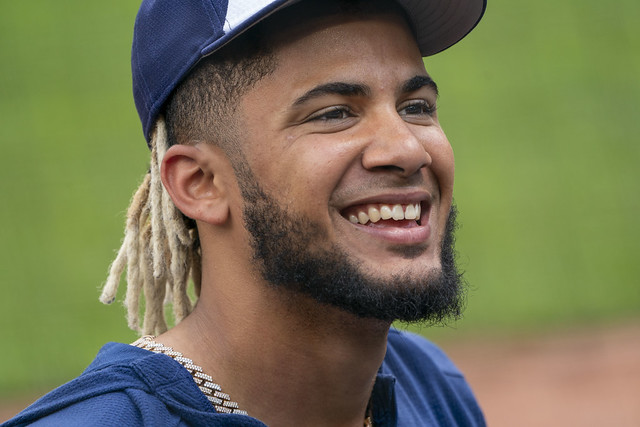
As is the annual tradition at FanGraphs, we’re using a week around the All-Star Game — when the industry pauses to take a metaphorical breather — to take stock of the top-50 trade chips in the sport. For more context on exactly what we’re trying to do here, see the Honorable Mentions post linked at the top of the page.
For this post, I’ll present a graphic (by way of the wizard Sean Dolinar) breaking down each player’s objective skill level (represented, in this case, by a five-year WAR projection from ZiPS), contract/team-control details, rank in last year’s series, and then year-by-year details of age, WAR, and contract through the end of 2023, although a couple players have control beyond those five years, and some, you’ll notice, show projections for fewer years to reflect when those players reach free agency. For those readers who are partial to spreadsheets rather than blocks of text, I’ll also include all of the players we’ve ranked so far in grid format at the bottom of the post.
It should be noted that the ZiPS WAR forecasts influenced the rankings a bit. For players who were bunched together, it acted as an impartial tiebreaker of sorts, but the industry opinions I solicited drove the rankings.
With that said, let’s get to the final 10 spots on this year’s Trade Value list.
| Five-Year WAR | +22.1 |
| Guaranteed Dollars | – |
| Team Control Through | 2025 |
| Previous Rank | #18 |
| Year | Age | Projected WAR | Contract Status |
|---|---|---|---|
| 2020 | 21 | +3.3 | Pre-Arb |
| 2021 | 22 | +3.8 | Pre-Arb |
| 2022 | 23 | +5.0 | Arb1 |
| 2023 | 24 | +5.1 | Arb2 |
| 2024 | 25 | +4.9 | Arb3 |
Vladito hasn’t been the otherworldly hitter many were hoping for or expected during his first taste of the big leagues, but no one I spoke with is worried. First of all, he’s running a .270 BABIP and underperforming his xwOBA by 17 points, suggesting he “deserves” to have a wRC+ over 100, which is still below his lofty pre-season projections, but not by much. And also, it’s been 66 games and he’s 20 years old.
Given his size and eventual move to first base, Vlad needs to mash, so his profile will be more sensitive to offensive performance than others might be, but the track record of the “that guy looks like a generational hitter” and “gets to the big leagues at 20” profiles is really strong. Vlad has an extra year of control over Gleyber Torres and Walker Buehler, so the projected five-win peak seasons are a push, and I lean to the extra year. Interestingly, there were concerns raised by executives about how all three of these guys will age; history tells us (I mean it feels like it does?) that at least one of them will turn out a good bit worse than we’re expecting.
| Five-Year WAR | +22.7 |
| Guaranteed Dollars | – |
| Team Control Through | 2023 |
| Previous Rank | #16 |
| Year | Age | Projected WAR | Contract Status |
|---|---|---|---|
| 2020 | 27 | +5.3 | Pre-Arb |
| 2021 | 28 | +4.9 | Arb1 |
| 2022 | 29 | +4.6 | Arb2 |
| 2023 | 30 | +4.2 | Arb3 |
Chapman is on pace for his second-straight 6 WAR season and he’s entering his prime, but is still pre-arbitration eligible since he was a college player who had a slower trip through the minors compared to other elite big leaguers. A lot of his value comes from defense, which we know ages quickly since it’s so tied to athleticism, but there’s also plenty of bat here to support a 3-4 WAR player in his post-prime years. Chapman puts the small market A’s in a tough spot, as they’d likely prefer to keep a franchise player around for awhile, but one wonders if they can pay something close to a market rate for seasons in Chapman’s 30s. Tampa Bay did this with Evan Longoria and luckily found a taker for his money just before things headed south. Scott Boras is Chapman’s agent, so an extension seems unlikely, but Boras just avoided the open market with Xander Bogaerts, so anything is possible.
| Five-Year WAR | +21.9 |
| Guaranteed Dollars | $23.0 M |
| Team Control Through | 2027 |
| Previous Rank | #15 |
| Year | Age | Projected WAR | Contract Status |
|---|---|---|---|
| 2020 | 23 | +4.5 | $1.0 M |
| 2021 | 24 | +4.5 | $3.0 M |
| 2022 | 25 | +4.7 | $5.0 M |
| 2023 | 26 | +4.2 | $7.0 M |
| 2024 | 27 | +4.0 | $7.0 M |
I made my feelings known about the Albies extension when it happened in April. The Braves can keep him around for $45 million for the next 8.5 seasons, which you could argue is the market rate for one of Albies’ post-arb seasons (they’re getting four). He’s still just 22 and has essentially played two full seasons, accumulating 7.7 WAR with roughly average offense but is at least plus on defense and on the bases.
He has some issues with selectivity, with the swing getting too big (especially from the left side), and there are different theories and explanations floating around about a silver bullet, like his spot in the batting order. The track record of plus-plus athletes with plus-plus bat control who get to the big leagues at age 20 is strong, but I’m mostly thinking of guys with one or two of those qualities, rather than all of them; that’s how unique Albies is. When the swing change revolution started, Eric and I theorized that the qualities that let little guys hit bombs are simply elite athleticism and elite bat control (the ball helps, too). For all the talk about what he doesn’t do well, nobody seems to mention that this guy is 5-foot-8, 165 pounds, and hitting 20 bombs a year in the TV league when lots of American guys his age were getting ready to go to Cape Cod. Don’t worry yourself with picking holes in Ozzie’s game — they’re always going to be there but guys with this resume and these skills have the tools to adapt.
| Five-Year WAR | +25.1 |
| Guaranteed Dollars | $26.5 M |
| Team Control Through | 2022 |
| Previous Rank | #22 |
| Year | Age | Projected WAR | Contract Status |
|---|---|---|---|
| 2020 | 28 | +6.1 | $12.5 M |
| 2021 | 29 | +6.0 | $14.0 M |
| 2022 | 30 | +5.0 | $15.0 M |
Over the last two seasons, Yelich is the third-best player in the game and he’s still got 3.5 years left on an extension, so he’s exactly the kind of player who everyone can agree upon. It’s actually somewhat unique in this exercise to find a guy who has done enough to make us confident in how good he is, is in his peak years, is under team control at a low price, has demonstrated consistency, and has all the intangibles like makeup, but has no real injury history, and no red or even yellow flags. A rebuilding club may not be eager to trade assets for an MVP candidate given their competitive window, but I think it’s safe to say that all 30 teams would value Christian Yelich in the same range on their individual trade value lists were they to conduct a similar exercise. Yelich is also a great example of betting on projectable athletes with advanced feel to hit to all fields. In 2015, he played 126 games and hit seven homers; in 2019, he’s projected to finish with 49.
| Five-Year WAR | +30.9 |
| Guaranteed Dollars | – |
| Team Control Through | 2024 |
| Previous Rank | #19 |
| Year | Age | Projected WAR | Contract Status |
|---|---|---|---|
| 2020 | 21 | +6.1 | Pre-Arb |
| 2021 | 22 | +6.4 | Arb1 |
| 2022 | 23 | +6.2 | Arb2 |
| 2023 | 24 | +6.3 | Arb3 |
| 2024 | 25 | +5.9 | Arb4 |
Soto was initially a bit lower on this list but when I dove in deeper, I could see what’s got ZiPS like a kid with a sparkler on the 4th of July. Last year, Soto had to be the most complete 19-year-old big league hitter in a generation, and it still feels like he isn’t getting enough credit for that. He’s been almost exactly the same this year as a 20-year-old (he’s four months older than Vlad Jr.), but because he doesn’t have a famous dad, wasn’t on prospect lists, and wasn’t bored dominating minor leaguers, he flies a bit under the radar. I guess the nitpick would be the Soto is so fully realized so early in his career as a corner outfielder that he has the skills of an older player and may age quickly, but that’s really reaching and I think he’s going to get better before he gets worse. Do yourself a favor and take five minutes today to appreciate how good Juan Soto is. Here’s a video from when I first saw him in the fall of 2014 as an amateur who wasn’t even the best prospect at this showcase. And here he is less than four years later, hitting 22 big league homers in a row.
| Five-Year WAR | +27.7 |
| Guaranteed Dollars | $90.0 M |
| Team Control Through | 2024 |
| Previous Rank | #7 |
| Year | Age | Projected WAR | Contract Status |
|---|---|---|---|
| 2020 | 26 | +6.3 | $11.0 M |
| 2021 | 27 | +6.0 | $11.0 M |
| 2022 | 28 | +5.6 | $11.0 M |
| 2023 | 29 | +5.2 | $28.5 M |
| 2024 | 30 | +4.6 | $28.5 M |
Bregman really turned it on last year and is now a 35 homer guy with more walks than strikeouts who’s also a good third baseman. He’s be a good candidate to break through the “name an active baseball player that people recognize” haze since he’s on a winning team, he dabbles in winning Twitter wars, and he isn’t afraid to talk trash or promote himself like famous athletes instinctively do in other sports. He’s also a good example of a guy using player development to dial in how to maximize his tools; Bregman wasn’t the consensus top talent in his draft class and he wasn’t a completely different player then than he is now, he just didn’t lift the ball as much. Bregman is under control (he gave up two free agent years at $28.5 million a piece in March) for the same duration as Soto and for a bit more money, but there’s also more bulk performance, more defensive value, and a more traditional development path, and Soto hasn’t broken into the 6-7 WAR area yet, even if I think he’s got a good shot to do it.
| Five-Year WAR | +25.6 |
| Guaranteed Dollars | – |
| Team Control Through | 2023 |
| Previous Rank | #26 |
| Year | Age | Projected WAR | Contract Status |
|---|---|---|---|
| 2020 | 24 | +5.9 | Arb1 |
| 2021 | 25 | +5.6 | Arb2 |
| 2022 | 26 | +5.1 | Arb3 |
| 2023 | 27 | +4.8 | Arb4 |
Speaking of breaking through into the 6-7 WAR range, Bellinger has done that in just 94 games this year. Bregman may have a louder personality but I’ve yet to find a human that doesn’t enjoy watching this (apart from opposing fans). Having Bellinger on the best team in baseball, that’s also a traditional power and in the No. 2 media market, seems like a great way to promote the game to younger fans. I worry that I’ll see a bunch of fringy high school players adopting this swing, just as we’ve seen 11-year-old shooting pull-up 35-footers to emulate Steph Curry, but that’s a small price to pay for kids loving baseball. Bellinger has one less year of control than Bregman but will be cheaper, and is also a multi-positional fit, and if he keeps this up, he may also just be better. I would start suggesting a blockbuster extension here but Bellinger is also represented by Scott Boras.
| Five-Year WAR | +35.5 |
| Guaranteed Dollars | $177.8 M |
| Team Control Through | 2030 |
| Previous Rank | #4 |
| Year | Age | Projected WAR | Contract Status |
|---|---|---|---|
| 2020 | 28 | +8.5 | $36.0 M |
| 2021 | 29 | +8.1 | $35.5 M |
| 2022 | 30 | +7.1 | $35.5 M |
| 2023 | 31 | +6.3 | $35.5 M |
| 2024 | 32 | +5.5 | $35.5 M |
Hey, it’s the best player in baseball! You probably knew he wasn’t going to be No. 1 on this list given the $400-plus million left on his new contract, which goes through 2030. Trout is already a Hall of Famer and when he’s not busy plodding along on a trajectory to be the best baseball player who ever lived, he enjoys rooting for Philly sports teams and (checks notes one more time) being a fan of weather. It’s a tough break for baseball to not get a dynamic personality as it’s generational talent but Trout’s a great player and literally no one other than the commissioner has anything bad to say about him, so let’s continue with the theme of today’s article and appreciate how much amazingly better Mike Trout is at playing baseball than any of us are at anything. Also, per StatCast’s xwOBA, he’s actually been pretty hit-unlucky this year. ZiPS has him projected to finish the season with 9.9 WAR, which I guess is an average season for him now.
Placing Trout on this list around a bunch of elite players in their early-to-mid-20s with long-term control and cheap contracts is tricky. The consensus with the execs I spoke with was to take Trout if there was any issue with the other player. Cody Bellinger’s ranking hangs on a one-year breakthrough, two pretty expensive arbitration years on the back end, and a high maintenance swing; you can poke some holes in that and the placement of all of the guys behind him. Trout’s deal is way under market, with loads of surplus value until the 2026-2030 part, when you’re on the hook for $35 million a year. We don’t really have any idea how good he’ll be then, since he doesn’t have any comps.
It still won’t be a bad contract, but it does become an ownership issue, and smaller markets would be putting all of their eggs in the Trout basket for almost a dozen years. I’d still have no problem with that — this is the guy you bet on if you’re gonna bet on someone — but it may surprise you to learn that some clubs said they’d obviously love to have Trout but aren’t positive they could or would both take on over $400 million and trade most of their best prospects in a hypothetical trade scenario. One GM told me “most of the league couldn’t even begin to consider taking on that contract … all but a select few teams could even consider acquiring it.” There would be enough teams excitedly jumping in to create a bidding war, but the days of Mike Ilitch or George Steinbrenner making impulsive unilateral moves are over, as if the last two winters weren’t enough proof.
| Five-Year WAR | +27.5 |
| Guaranteed Dollars | – |
| Team Control Through | 2024 |
| Previous Rank | #39 |
| Year | Age | Projected WAR | Contract Status |
|---|---|---|---|
| 2020 | 21 | +4.8 | Pre-Arb |
| 2021 | 22 | +5.5 | Pre-Arb |
| 2022 | 23 | +5.7 | Arb1 |
| 2023 | 24 | +5.8 | Arb2 |
| 2024 | 25 | +5.7 | Arb3 |
As we continue down the parade of insanely exciting young players who can make tags and slides interesting, we get to Tatis, who is the newest on the scene. Eric and I had some concerns that he may be a higher-strikeout, lower-contact type due to his power-focused approach and longer limbs. That’s mostly been true so far in his rookie season, but Tatis’ .433 BABIP is obscuring it for the time being. Even with some regression back to BABIP Earth, he’s still somewhere around the Manny Machado-level of talent that was promised: a dynamic 3.5 to 6.0 WAR player who has the ability to jump even higher into rarified territory. So while there are still some concerns, the fact that Tatis is 20 years old and playing a solid shortstop gives him some margin for error in long-term projections.
As I discussed in the introduction, the decision to not leave Tatis down for the first two weeks of the season cost the Padres roughly $50 million in value on paper, but there are all kinds of other benefits that can make up some, if not all, of that value. If Tatis is more inclined to sign a long-term extension, the Padres could actually come out ahead depending on the terms.
| Five-Year WAR | +33.2 |
| Guaranteed Dollars | $55.0 M |
| Team Control Through | 2028 |
| Previous Rank | #17 |
| Year | Age | Projected WAR | Contract Status |
|---|---|---|---|
| 2020 | 22 | +5.9 | $1.0 M |
| 2021 | 23 | +6.7 | $5.0 M |
| 2022 | 24 | +7.1 | $15.0 M |
| 2023 | 25 | +6.8 | $17.0 M |
| 2024 | 26 | +6.7 | $17.0 M |
And here we are at No. 1. Many of you predicted this in the comments, and it seemed pretty obvious from the start to me and everyone I ran this list by. Acuna was being hyped by very reasonable people last year as the next best player in the game, whenever Trout decides to let that happen. That still seems to be the thought around the game, but it’s also important to note that it wasn’t so obvious when last year’s list was written. On that day, Acuna had a 109 wRC+ and a 30% strikeout rate. Since then, he put up a 141 wRC+, 41 homers, and 6.4 WAR in 163 regular season games, good for ninth in all of baseball in that period, all at ages 20 and 21. He didn’t have a great showing in the Braves playoff series loss to the Dodgers but did produce one of the more electric moments in recent memory with a grand slam off Walker Buehler.
On top of being the consensus best young player in the game by just about every measure, Acuna also signed a team-friendly extension before the season, tying him to the Braves through 2028 (his age-30 season) for $124 million if both options are picked up. Tatis would be No. 1 if he had Acuna’s extension and Acuna had Tatis’ service time situation, but it would take something close to that extreme to close this gap. Here’s hoping that this year’s No. 1-Ranked Trade Value (by a good margin) has a season better than Jose Ramirez’s 2019.
…
Meg and I recorded a podcast that will go up today where I discussed how the list was made, projected some guys to jump onto and fall off of the list, and even offered some names I may want to shift around a week from now. Give that a listen to get the full context for those topics, but I’ll run down some of them here.
I thought I understood the Scherzer deal when I placed him 44th on the list, but found out, after talking through it with some rules and admin-focused industry sources, in the days after posting it that the terms would work out a bit differently in a trade scenario, which still seems unlikely. Since Scherzer’s short term payments are all non-assignable signing bonuses and all of his remaining salaries are deferred, the real cost is nothing until 2023, then the time-value of money takes the net present value well below the $35 million per year sticker price. With that clarified, I would now move Scherzer into the late-20s to land closer to deGrom, whose deferrals I broke down head-to-head in deGrom’s blurb.
I sent various versions of this list to sources the week before publishing, and got some responses back this week after the series had already kicked off. Some thought that Adalberto Mondesi ought to be moved down, while Austin Meadows moving up, to the point that Meadows (who was 54th at press time) now seems like a better trade asset than Mondesi (48th). That low in the rankings, six spots is a pretty small difference, but it appears significant enough that I wouldn’t be surprised if Mondesi finds himself on the outside looking in next year, while Meadows seems likely to rank, barring injury or underperformance.
Along those lines, and in the spirit of our preseason Picks to Click column, here are 15 names from the Honorable Mentions that I think have the best shot to make next year’s list: Austin Meadows, Eloy Jimenez, Alex Verdugo, Austin Riley, Yordan Alvarez, Lucas Giolito, Jo Adell, Bo Bichette, Keston Hiura, Carson Kelly, Bryan Reynolds, Mackenzie Gore, Dustin May, Gavin Lux, and Michael Kopech.
That concludes the 2019 Trade Value Series. I hope you enjoyed this installment. On to the deadline!
| Rk | Pv | Player | Age | 2020 | 2021 | 2022 | 2023 | 2024 |
|---|---|---|---|---|---|---|---|---|
| 1 | 17 | Ronald Acuna Jr. | 21 | +5.9 $1.0 M |
+6.7 $5.0 M |
+7.1 $15.0 M |
+6.8 $17.0 M |
+6.7 $17.0 M |
| 2 | 39 | Fernando Tatis Jr. | 20 | +4.8 Pre-Arb |
+5.5 Pre-Arb |
+5.7 Arb1 |
+5.8 Arb2 |
+5.7 Arb3 |
| 3 | 4 | Mike Trout | 27 | +8.5 $36.0 M |
+8.1 $35.5 M |
+7.1 $35.5 M |
+6.3 $35.5 M |
+5.5 $35.5 M |
| 4 | 26 | Cody Bellinger | 23 | +5.9 Arb1 |
+5.6 Arb2 |
+5.1 Arb3 |
+4.8 Arb4 |
|
| 5 | 7 | Alex Bregman | 25 | +6.3 $11.0 M |
+6.0 $11.0 M |
+5.6 $11.0 M |
+5.2 $28.5 M |
+4.6 $28.5 M |
| 6 | 19 | Juan Soto | 20 | +6.1 Pre-Arb |
+6.4 Arb1 |
+6.2 Arb2 |
+6.3 Arb3 |
+5.9 Arb4 |
| 7 | 22 | Christian Yelich | 27 | +6.1 $12.5 M |
+6.0 $14.0 M |
+5.0 $15.0 M |
||
| 8 | 15 | Ozzie Albies | 22 | +4.5 $1.0 M |
+4.5 $3.0 M |
+4.7 $5.0 M |
+4.2 $7.0 M |
+4.0 $7.0 M |
| 9 | 16 | Matt Chapman | 26 | +5.3 Pre-Arb |
+4.9 Arb1 |
+4.6 Arb2 |
+4.2 Arb3 |
|
| 10 | 18 | Vladimir Guerrero Jr. | 20 | +3.3 Pre-Arb |
+3.8 Pre-Arb |
+5.0 Arb1 |
+5.1 Arb2 |
+4.9 Arb3 |
| 11 | 40 | Walker Buehler | 24 | +3.9 Pre-Arb |
+3.9 Arb1 |
+4.0 Arb2 |
+3.8 Arb3 |
+3.4 Arb4 |
| 12 | 20 | Gleyber Torres | 22 | +4.5 Pre-Arb |
+4.9 Arb1 |
+5.2 Arb2 |
+5.1 Arb3 |
+4.8 Arb4 |
| 13 | 2 | Francisco Lindor | 25 | +6.5 Arb2 |
+6.5 Arb3 |
|||
| 14 | 45 | Rafael Devers | 22 | +3.8 Pre-Arb |
+4.2 Arb1 |
+4.2 Arb2 |
+4.3 Arb3 |
|
| 15 | 3 | Aaron Judge | 27 | +4.6 Arb1 |
+4.7 Arb2 |
+4.2 Arb3 |
||
| 16 | 30 | Shohei Ohtani | 24 | +2.9 Pre-Arb |
+3.0 Arb1 |
+2.9 Arb2 |
+2.8 Arb3 |
|
| 17 | – | Ketel Marte | 25 | +3.4 $4.0 M |
+3.3 $6.0 M |
+3.0 $8.0 M |
+2.8 $10.0 M |
+2.5 $12.0 M |
| 18 | – | Yoan Moncada | 24 | +2.9 Pre-Arb |
+3.0 Arb1 |
+2.9 Arb2 |
+2.8 Arb3 |
|
| 19 | – | Xander Bogaerts | 26 | +4.5 $20.0 M |
+4.2 $20.0 M |
+3.7 $20.0 M |
+3.2 $20.0 M |
+2.7 $20.0 M |
| 20 | 35 | Blake Snell | 26 | +4.0 $7.0 M |
+4.0 $10.5 M |
+3.7 $12.5 M |
+3.5 $16.0 M |
|
| 21 | – | Shane Bieber | 24 | +4.3 Pre-Arb |
+4.3 Pre-Arb |
+4.3 Arb1 |
+4.3 Arb2 |
+4.0 Arb3 |
| 22 | – | German Marquez | 24 | +4.2 $4.5 M |
+4.2 $7.5 M |
+4.3 $11.0 M |
+4.2 $15.0 M |
+3.8 $16.0 M |
| 23 | – | Wander Franco | 18 | +1.2 Pre-Arb |
+2.3 Pre-Arb |
+3.9 Pre-Arb |
+4.5 Arb1 |
+5.3 Arb2 |
| 24 | 25 | Jacob deGrom | 31 | +4.5 $23.0 M |
+4.5 $33.5 M |
+3.8 $33.5 M |
+3.5 $30.5 M |
+3.3 $32.5 M |
| 25 | 11 | Kris Bryant | 27 | +4.7 Arb3 |
+4.3 Arb4 |
|||
| 26 | 46 | Jose Berrios | 25 | +3.5 Arb1 |
+3.5 Arb2 |
+3.4 Arb3 |
||
| 27 | 8 | Trea Turner | 26 | +4.2 Arb2 |
+4.0 Arb3 |
+3.6 Arb4 |
||
| 28 | – | Joey Gallo | 25 | +2.9 Arb1 |
+3.0 Arb2 |
+2.8 Arb3 |
||
| 29 | HM | Paul DeJong | 25 | +3.4 $1.5 M |
+3.4 $4.0 M |
+3.0 $6.0 M |
+2.9 $9.0 M |
+2.5 $12.5 M |
| 30 | – | Chris Paddack | 23 | +2.5 Pre-Arb |
+2.5 Pre-Arb |
+2.7 Arb1 |
+2.6 Arb2 |
+2.3 Arb3 |
| 31 | 21 | Aaron Nola | 26 | +4.0 $8.0 M |
+4.0 $11.8 M |
+3.8 $15.0 M |
+3.8 $16.0 M |
|
| 32 | – | Peter Alonso | 24 | +4.0 Pre-Arb |
+4.1 Pre-Arb |
+3.7 Arb1 |
+3.5 Arb2 |
+3.2 Arb3 |
| 33 | 1 | Jose Ramirez | 26 | +4.6 $6.3 M |
+4.5 $9.0 M |
+4.0 $11.0 M |
+3.5 $13.0 M |
|
| 34 | HM | Javier Baez | 26 | +4.1 Arb2 |
+3.7 Arb3 |
|||
| 35 | 34 | Rhys Hoskins | 26 | +4.0 Pre-Arb |
+4.0 Arb1 |
+3.8 Arb2 |
+3.2 Arb3 |
|
| 36 | 9 | Freddie Freeman | 29 | +4.9 $22.0 M |
+4.6 $22.0 M |
|||
| 37 | HM | Nick Senzel | 24 | +2.7 Pre-Arb |
+2.7 Pre-Arb |
+2.6 Arb1 |
+2.5 Arb2 |
+2.4 Arb3 |
| 38 | – | Jorge Polanco | 25 | +3.1 $3.8 M |
+3.2 $4.3 M |
+2.8 $5.5 M |
+2.7 $7.5 M |
+2.2 $10.5 M |
| 39 | – | Jeff McNeil | 27 | +4.0 Pre-Arb |
+3.8 Pre-Arb |
+3.3 Arb1 |
+3.0 Arb2 |
+2.3 Arb3 |
| 40 | – | Max Kepler | 26 | +3.0 $6.3 M |
+2.8 $6.5 M |
+2.6 $6.8 M |
+2.1 $8.5 M |
+1.6 $10.0 M |
| 41 | – | Brandon Woodruff | 26 | +2.9 Pre-Arb |
+2.9 Arb1 |
+2.9 Arb2 |
+2.8 Arb3 |
+2.5 Arb4 |
| 42 | – | Mike Soroka | 21 | +2.7 Pre-Arb |
+2.7 Arb1 |
+2.9 Arb2 |
+2.9 Arb3 |
+2.7 Arb4 |
| 43 | 32 | Eugenio Suarez | 27 | +3.5 $9.3 M |
+3.2 $10.5 M |
+3.2 $11.0 M |
+2.7 $11.0 M |
+2.2 $11.0 M |
| 44 | 41 | Max Scherzer | 34 | +5.6 $35.0 M |
+5.6 $35.0 M |
|||
| 45 | 5 | Carlos Correa | 24 | +4.2 Arb2 |
+4.3 Arb3 |
|||
| 46 | 31 | Gary Sanchez | 26 | +3.2 Arb1 |
+3.0 Arb2 |
+2.6 Arb3 |
||
| 47 | 13 | Corey Seager | 25 | +4.0 Arb2 |
+3.9 Arb3 |
|||
| 48 | – | Adalberto Mondesi | 23 | +3.0 Pre-Arb |
+3.0 Arb1 |
+2.9 Arb2 |
+2.8 Arb3 |
|
| 49 | HM | Matt Olson | 25 | +3.4 Pre-Arb |
+3.4 Arb1 |
+3.1 Arb2 |
+2.9 Arb3 |
|
| 50 | – | Luis Castillo | 26 | +3.4 Pre-Arb |
+3.4 Arb1 |
+3.2 Arb2 |
+3.0 Arb3 |
Kiley McDaniel has worked as an executive and scout, most recently for the Atlanta Braves, also for the New York Yankees, Baltimore Orioles and Pittsburgh Pirates. He's written for ESPN, Fox Sports and Baseball Prospectus. Follow him on twitter.
Thank you Kiley, very cool!
Now pick a player in the Top 10 and try to build a fair-value trade for him, using only prospects from a single system.
FWIW, I don’t think it’s possible to do this with Acuna or Albies because of how long their team control is and how young they are. Trading them would somehow manage to weaken a team’s competitiveness in 2024 instead of strengthening it.
But what about Bellinger or Yelich or Chapman?
Certainly you remember last year when Kiley tried to fashion a trade for both Lindor and Ramirez (though he used other players from the top 50 list).
In fact, pre-extensions, he lists Freeman, Acuna, and Albies as fair trade value for Lindor and Ramirez. How times have changed in only one year…
https://blogs.fangraphs.com/which-teams-could-even-trade-for-lindor-and-ramirez/
Trade Values according to https://www.baseballtradevalues.com
10. Vladimir Guerrero Jr. – 182
9. Matt Chapman – 102.4
8. Ozzie Albies – 111.0
7. Christian Yelich – 116.3
6. Juan Soto – 114.3
5. Alex Bregman – 151.3
4. Cody Bellinger – 151.5
3. Mike Trout – 82.4
2. Fernando Tatis Jr. – 103.7
1. Ronald Acuna Jr. – 178
Prospect Systems (Top 5 Prospects)
Rays – 275.3 – Top 2 – (Franco – 111.5, Mckay 56.9)
Padres – 219.1 – Top 2 – (Gore – 81.9, Urias – 67.7)
Basically you can offer the top 2 prospect from either of these systems and it would be good value for any of these players.
I have never heard of this website before. It looks like they’ve worked pretty hard to do it right, but the lack of transparency annoys me a bit. You can’t see the projections or the actual minor league values, so it kind of ends debates instead of begins them. And you can’t evaluate it. And the list here doesn’t line up all that well with the list we just saw. I like that someone tried to do this, but it’s kind of unsatisfying.
I guess if they were transparent a bunch of other websites would rip them off.
Hi, I’m the guy who created it. We explain our methodology in great detail on the site, for valuing both veterans and prospects. Because it’s intended to be a business, we have to protect a few things, so we’re trying strike a balance between how much of our process to disclose and how much to hold back.
We are also trying to be as transparent as possible by matching our values to actual trades — we’re keeping a scorecard of how we’re doing against reality right now, and we also show how our values matched up to this past offseason’s trades. We don’t expect to get everything right, but we do think we’re generally close.
Now that this series on FG has completed, we’ll take a pass at seeing how our top 50 matches up. We fully respect this series, so we want to make sure we generally align. The approaches our slightly different — ours is largely based on what front offices do, vs. this one which emphasizes what they say — but so far the trends are largely the same.
Thanks for the feedback!
just wanted to note, in defense of both methods here and on the other site, that a deviation between REVEALED preferences (what trades people make) and STATED preferences (this series of posts based on talking to front offices) is just as valuable as if both things were perfectly correlated. Any systematic deviation between what people say they want, and what they show they want through their actions, is worth picking at
That seems an academic concern. What we want to see is how well a tool is actually predicts what a fair trade would be. I agree with SadTrombone that BaseballTradeValues isn’t as good as looking at recent trades and using FanGraphs’ prospect ratings to determine a fair trade. A lot of that is disagreeing with BTV’s estimation of players’ values. For example, Mike Zunino has been useless this year, makes $4M, and is in line for ARB3 salary (or more likely, non-tendering) and BTV lists him as worth an FV45 player. I’m quite sure that he has zero value. BTV also makes the error that you can accumulate a # of lesser prospects in exchange for a star when we know that stars require a TOP Prospect in return. BTV doesn’t account for this.
Thanks for the feedback. We actually do account for that — we have a quality-for-quality role, wherein at least one player traded has to be worth at least half the value of the other. We also limit the number of players you can have in a trade. Both of those rules are there to ensure you can’t just trade 10 marginal players for one good one.
And as I mentioned, we are publishing the data of how our values match real-life trades, for full transparency. So far there hasn’t been one that would have been rejected by our model.
Hi John–thanks for stopping by and responding. Like I said, I like what you’re doing, even if it is unsatisfying to me right now.
I don’t think you need to reveal the methodology per se, and maybe this is somewhere on the website but I can’t navigate to it, but I can’t figure out what the projections for the major leaguers are, or the $/win, or the values for the scouting grades are for the minor leaguers, or anything like that.
I would put it this way…it very well be more accurate but it’s less interesting without that sort of information.
I think a trade for Albies is very possible because a he’s probably the least skilled player on this list. That is NOT a knock on Albies, it’s just the reality of the contract.
Now if Albies starts running a wRC+ around 130, he might be untradeable because the contract is so team friendly.
Well, Albies has a career wRC+ of 148 against lefties, so if he could put up a 120 wRC+ against righties he could easily get there. Trouble is, his career wRC+ against righties is just 89, most likely because he hits from his less powerful side against them.
#FreeAlbiesBat #FriendsDontLetFriendsSwitchHit
I believe he talks about the BTV site in quite a bit of detail on the fangraphs podcast a couple of weeks ago.
Chris Sale’s contract has deferrals too…
2019 Ol’ Cars O’ Car’s Car Anagram Value: #50 to #1
#50 Also Cistulli
#49 Moto Slant
#48 Its Adorable Demon
#47 Eeyore’s Crag
#46 She Crazy Nag
#45 Coral Rose Car
#44 HMS Crazee Rx
#43 Niue Rose Gauze
#42 Mookie’s Ark
#41 Rod Drawn Buffoon
#40 Mr. Keep Lax
#39 Film J. Fence
#38 Anglo J. Cooper
#37 Zinc Kneels
#36 Reefer Maddnief
#35 Hossy Shrink
#34 Zebra Vieja
#33 Ja Mires Zero
#32 Post Ealone
#31 Alana Noor
#30 Crisp Haddack
#29 Alpon Judge
#28 Jello Yoga
#27 True Ranter
#26 Sore Sore Jib
#25 Skirty Barn
#24 Major Bed Cog
#23 Car Far Wonder
#22 Queer Marz G-Man
#21 Brie Banshee
#20 Kellen Slab
#19 A Boxed Stranger
#18 Anaconda Mayo
#17 Telemarket
#16 Ohio Hash Nite
#15 Aura DeJong
#14 Al Served Fear
#13 Frodo Ran Clinics
#12 Leg Store Berry
#11 Re Buehrle Walk
#10 Girl + Mud = Javier Error
#9 Capt. Math Man
#8 See Izzo Bail
#7 Retchy Sicilian
#6 O Just A No
#5 Max Ben Lager
#4 Lice Dog Brenly
#3 Mr. T. Toukie
#2 Taters Inna Fjord
#1 Nanodracula
My goodness so many of these are absolute gold. “Taters Inna Fjord” and “Nanodracula” are quite worthy of those top two spots.
Bob Brenly’s poor doggo…
Also, thank you for doing this this week, you wonderful internet stranger.
Taters Inna Fjord can only mean one thing….Finnish Baseball!!!
https://www.youtube.com/watch?v=zDrLcPxSBRk
Oh my god thank you for this. Just the YouTube rabbit hole I needed to finish off the last couple hours of the work week.
I think you mean Norwegian Baseball.
https://en.wikipedia.org/wiki/Paarlahti
Nanodracula is also ranked #1 on the FangGraphs trade value list.
If you ever apply for a writing job, put this comment at the top of your portfolio.
Nanodracula is definitely worthy of the #1 spot.
Really hope Nanodracula becomes Acuna’s actual nickname from now on.
Anaconda mayo????
Jello Yoga is a sport within itself.
Matt Chapman aka Capt Meth Man dealing to heart broken hitters he keeps putting out
portly vlad ranked high for a DH
Soto, also, that -10 UZR/150 in LF as a 20 year old doesn’t bode well for the long-term future defensively.
Even if Soto eventually has to move to first, it seems like there should be more daylight between Soto and VladJr since they’re the same age and Soto has 200 games of 144 wRC+ while VladJr remains all projection (a fat dude underperforming his xwOBA by OMG 17 points barely registers).
A few things I would say about the Top 10, which is obviously the province of entirely valuable players and who could be ordered a bunch of different ways (although I really think Acuna would be at #1 everywhere).
After looking at the writeup, I have no idea why Trout is #3 aside from the fact that it’s blasphemous to have Trout at #7 or #8. I agree that most teams could fit that contract into their budget, but it seems really unlikely that most teams would be willing to give up that much in surplus value and also the 10-player package (headlined by a couple elite prospects) that it would take to land him. If that’s the case, then why is he that high? Would the bidding for the 5 teams that are willing to trade for him run so hot that it would outstrip the bidding for the 29 teams bidding on Juan Soto, or 20-some teams bidding on Bellinger?
As far as Soto goes, what would you say if you had a guy who hits like Joey Votto in his age-25 season, but in his age-20 season? And that you would have him through 2025? Just move Soto to first base if you’re that worried that he can’t improve his outfield defense. There are people out there who have made the argument that Soto is going to be a better player over the next 5-6 years than Acuna and while I don’t agree, I find the arguments pretty compelling.
Tatis Jr. is probably going to be a megastar but can we have a conversation about putting someone at #2 who is succeeding in a way that he will probably never do again? The BABIP isn’t even close to what we expect him to do. The projection systems have him running one at .340, which seems much more reasonable, but which probably knocks him down to a sub-120 wRC+. Maybe he starts turning more of those hard hits into home runs and his BABIP drops even more, but isn’t it a little concerning that the way he’s likely to succeed in the future isn’t anything like what he’s doing now? I don’t even know if I’d drop him out of the top 5, but the range of outcomes is incredibly high for a guy who is lighting the league on fire at age 20.
Soto’s offensive floor seems to be Votto, while his ceiling could be peak JD Martinez. Also for all of the highlights he makes, Tatis is running a negative DRS and UZR and is tied for the 5th most errors in baseball. Tatis over Soto here seems to be big time recency bias
I know you are a Red Sox fan, but peak Votto>peak JD. There is not a young player in the game whose floor is Votto.
Juan Soto, for all his awesomeness, has a career wRC+ of 144. Make no mistake, that’s amazing.
Joey Votto has played parts of 13 seasons in the majors. Among those 13 seasons
2007: wRC+ of 127 in 24 games as a call-up
2008: wRC+ of 124 in 151 games as a full season rookie
5 straight seasons of a 150+ wRC, peaking at 178 in 2012
2014: wRC+ of 128 in 62 games of an injury shortened season
3 more seasons of a 150+ wRC when healthy again, including a 174 in 2015
2018: wRC+ of 131 as age came calling
2019: wRC+ of 94 so far. Poor Joey’s only year of being a below average hitter.
Healthy Joey Votto has had exactly ONE season as “bad” as Juan Soto prior to age 34, and that was his rookie year.
Juan Soto’s first 200 games in the majors have been phenomenal. I do think he’s got something like Joey Votto’s career in front of him. But that’s a hopeful outcome, not a floor.
Soto’s rookie season was much better than Votto’s and he was younger. Also, you’re focusing on all the good Votto years and discounting the bad. I’m not saying Votto is Soto’s floor, but his ceiling isn’t Votto, it’s Ted Williams. I know that sounds crazy, but people don’t appreciate Juan Soto. He’s everything Bryce Harper was supposed to be.
Are you suggesting there’s a 1-in-10 chance that Juan Soto is a top-five player all time? That seems… optimistic.
First, I said it was his ceiling as a hitter. Second, there aren’t a ton of comps for 19 year olds, and basically half of them are inner-circle HOFers. But as the reaction shows, people don’t appreciate Juan Soto enough and just how good of a hitter he is at his age.
The take! It’s so hot! IDK if I can even handle it!
Let’s just take a second and remember that Soto has only played with these hyper-juiced balls, and he’s only been in the league for about 15 minutes.
Rember, Geovany Soto came up and won the RoY while being called the “next Mike Piazza”.
You got a tiny ass sample size, a whole lot of hype, and you’re clearly drunk on that sir. I would strongly suggest pumping the breaks on “Ted Williams ceiling”.
at least he’s played above AA, unlike other players on this list we could name where people are saying “ted williams is the FLOOR”
I’m all for tempering expectations w.r.t. prospects but no reason to react to hyperbole with hyperbole.
865 PA is not a tiny ass sample size and juiced balls don’t improve your wRC+ or WAR .
Geovany Soto recorded wrc+ 120 and war 3.5 (563 PA)in his 25 y.o. season.
Juan Soto recorded wrc+ 146 and war 3.7 (494 PA) in his 19 y.o. season.
Very very different.
You trying to tell me that there’s no young player who has a floor of “top 30 ALL TIME in OPS+”?
Coming up with a floor for Soto isn’t all that useful to us, because his floor is basically what he is doing right now. That’s good because coming up with a comp for what he’s doing right now is hard. Joey Votto’s peak was way higher than this, but guys who consistently churned out years like Soto’s doing now are guys like Brian Giles or Rafael Palmeiro, both of whom were insanely valuable because of their career longevity. Maybe Bobby Bonilla? These “worst case scenarios” barring injury are still basically regular all-stars.
Well what Soto is doing right now might be his floor, or it might be his ceiling. It’s hard to say because he’s had 200 games in his career and his performance this season looks pretty much exactly like his performance last season. Given how player performance now often peaks much earlier than we traditionally thought, we can’t really make any pronouncements as to what his floor or ceiling are, until he actually puts up a season that’s either much better or much worse than what he’s already done.
Speaking of Bobby Bonilla, I’m really surprised he didn’t make the list.
Full career JD is a more powerful hitter than Votto, but isn’t on base nearly as often. His highlights are shinier, but his career is less. JD is younger though, and Votto is fading fast, but I would be surprised if that’s enough to catch him in total career value.
JD has had 3 seasons with wRC+ of 150+: 154, 167, 170
Votto has had a whopping 8: 155, 172, 157, 178, 155, 174, 158, 164
Soto’s defense is rated much better by Statcast which ranks him as slightly above average and it’s important to remember that prior to being called up, he’d never played there. The eye test is that he makes some mistakes that you’d expect, but generally is adequate and even good at times. I’ve never been a huge believer of defensive metrics, especially a single season of defensive metrics. I know it’s not the consensus, but Soto is a better hitter than Acuna and will add power as he ages. So while he gets better, a lot of what makes Acuna great will fade. Given a choice between the two, I’d take Soto.
ZiPS projects Soto for 48 (48!) HR in 2021. That’s astonishing – only 2 other players are even above 35 and they are much more TTO-oriented sluggers (Gallo, Stanton).
Personally I would switch Soto and Tatis in the rankings. Tatis has a ton of helium from a combination of a) highlight-reel defensive plays & baserunning, b) top prospect hype, c) exploding onto the scene immediately, and d) name recognition.
I still think he’ll be a great player! But he’s outperformed his xwOBA by more than anyone else this year, and his projected ROS wRC+ is around 100. That’s great for a 20yo shortstop! But if you’re telling me you wouldn’t trade him straight up for Trout…
Tatis-for-Trout isn’t a completely ridiculous proposition. Trout has a massive contract that he’s likely to outperform, but it’s still a burden that’s worth consideration. Tatis is young and athletic with tools that should age well through his years of control. He plays a premium defensive position and has room for improvement. If you look at future projected production and take into account the contract values, there’s a similar amount of surplus there. At some point it would depend on if you would rather have the declining years of what may possible be the greatest player we’ve ever seen, or the rising years of a budding superstar with a wide error bar on his future projections.
As for the helium note, it’s valid but the value he adds with his legs is what allows him to outperform his xwOBA. He’s so fast and his instincts are so sharp that he gets hits and extra bases from that skill, and xwOBA doesn’t account for that. If he and Franmil Reyes had the exact same batted ball profile (i.e. xwOBA), I’d expect Tatis to “overachieve” and Franmil to “underachieve” every time. I agree that his .421 BABIP is due for regression, but it’s not going to crater.
You have to take baserunning and defense into account here. Soto has a monster bat, but Tatis has monster potential with every other tool. A player who adds significant value with his legs, glove, and arm will produce even if the slash line dips. I’m admittedly biased here. But I believe that if nothing else this project shows that Tatis is an elite player who deserves to be grouped with the very best in the game.
I said it last year (before Acuna’s big breakout second half) that I’m not so sure Soto is the better hitter. They finished last year with basically the same wRC+, and while Soto is ahead this year, Acuna hits the ball harder and on the ground less (though Soto has improved there). They both have the same xWOBA, while Acuna still has the higher xWOBACON (.482 to .448). I still am not comfortable putting Soto ahead of Acuna as a better offensive player, and the defense and baserunning almost certainly make Acuna the better young player.
Acuna’s wOBA is 30 points lower than Soto’s this year and he’s a full year older which affects the trajectory and arc of their careers. Acuna’s put up a wRC+ of 124 this year to Soto’s 142. Maybe Acuna is just a second half guy and we’re dealing with SSS here. Both great players, but not only because of the results, but also because of the way he approaches hitting at his age, I think Soto’s clearly the better hitter of the two.
“Acuna’s wOBA is 30 points lower than Soto’s this year and he’s a full year older which affects the trajectory and arc of their careers. ”
Yes, but as noted, they have the same xWOBA and Acuna a significantly better xWOBACON. To be clear, I really like Soto as a player. I’m just not comfortable saying he’s clearly the better offensive player at this point.
xWOBACON does not mean much when one player is running 15.4%/21.0% K/BB while the other has 9.9%/23.5%.
It does if you expect one guy to perform better enough on contact to offset some of the difference in wOBA from walking less and striking out just a bit more.
I mean that is why you have xWOBA which incorporates walks and strikes out. That their xWOBA is similar should be your main point. Saying that Acuna has a higher xWOBACON adds literally zero information once you know that Soto has superior K/BB numbers.
Fair enough.
Regarding Soto, it brings me back to a thing I always said about Yelich . Even despite his age, he had another gear in the future since he looked so young. Maturity isn’t an age thing, everyone matures at different times. I could grow a beard before I turned 13, and I peaked in athletic performance quite young as well. I was the guy who had no projection in him. Yelich finally looks like he is growing into his body, he spent many years in the MLB where he looked like he was going through puberty. That isn’t a joke, go back and look at him when he was called up.
Now Soto, on the other hand looks physically mature. This isn’t saying he won’t have a long peak, this isn’t saying he won’t get better. This is just saying that IMO when you state his age it really isn’t as important as the other guys. If your policy was to card people who look under 30, he wouldn’t be one getting carded. I mean, look at this image of him https://www.washingtonpost.com/sports/2019/05/23/juan-soto-grew-up-idolizing-robinson-can-now-hes-playing-against-him-regularly/?utm_term=.c4f64c657974
This isn’t hating on Soto, as he might be my favorite player in baseball, and I realize people don’t have a better way of projection than age, but he is a man. He doesn’t have a lot of projection in him, and I’d love to be wrong.
So a nice example of why it’s too early to make judgments like this (particularly given they finished last season with almost the exact same wRC+).
It’s been 3 games since we discussed this. In that time, Acuña’s wRC+ and wOBA have increased to 130 and .374. Soto’s have fallen to 138 and .387. Just too early in their careers to say one is “clearly the better hitter of the two.”
I think the big thing with Trout is that you should have more confidence in his consistency than almost anyone on the list.
Lets look at the guys playing the very best right now: if Yelich or Bellinger play at the same level they are now, they’re .. still just a little less good than Mike Trout.
Trout could decline by 3-4 war per season and -still be better than Alex Bregman is projected to be-. Ditto Soto.
Kiley says that Trout doesn’t have any comparables, but he does historically, and universal, all-time amazing talents tend to age gracefully: Willie Mays had a 6 win season at age 40.
The only folks with Trout’s sort of performance who didn’t age well are the ones who were taken out by injury and other issues (Like Mickey Mantle). That Trout has no joint or muscular injury history by this point is great: he’s not on the path to some kind of recurring injury woe. There’s always the chance of freak stuff, of course.
> universal, all-time amazing talents tend to age gracefully
This is because players who don’t age gracefully (Griffey Jr) aren’t considered universal, all-time talents.
I remember the certainty of graceful aging being an argument for giving Pujols a massive deal when he hit free agency.
I’d disagree, Griffey, Pujols and Mantle are all examples of people who were thrown off the track by recurring injury woes.
I definitely thought Soto was underrated. That bat is generational. I figured he would be #2 or 3. Obviously the margins at the top here are all pretty slim behind Acuna with that contract, but I still thought Soto was lower than he should have been.
I disagree with you on Trout (we talked about this yesterday), but I’m totally with you on Tatis. He’s barely more proven than Guerrero if you strip down the bonkers babip. I can’t imagine him being #2 if his babip were a still elite .350, but it is also hard to imagine that smart GMs don’t understand this. Him and Vladdy were a coin flip as who was top prospect, and even accounting for luck, Tatis has been a bit better, but Vladdy gives you an extra year. I thought these guys were going to both be in the 7-10 range. Half of the top 10 looks fairly interchangeable. Chapman, Bregman, Yelich, Bellinger, and Soto: I feel like differentiating is a bit like splitting hairs. Acuña makes sense at one, the extreme contracts make Albies and Trout harder to place (I basically agree on where they are), and then how much stock can you put into highly touted rookies that have shown at least some question marks, one despite his numerical success?
“[Tatis Jr.] and Vladdy were a coin flip as who was top prospect”
Well, this part is simply not true.
I mean, if one of them had an edge, it was Guerrero, which would further illustrate my overall point.
IIRC, baseball america or ESPN had tatis as the top prospect over Vlad, likely due to defense + baserunning.
Keith Law had Tatis at #1, and he was one of the only ones not to have Vladdy at the top spot.
The thing about Tatis is that he is playing on the high end of the defensive spectrum, where you can be a star with a 130 wRC+ (see Seager, C and Correa, C who were both on Hall of Fame career paths with that kind of batting line until injury intervened). Guerrero is going to be a 1b/DH by 22, meaning he has to not just hit, but -really, really- hit in order to be as valuable as Tatis – like 150-160-170 wRC+ sort of hit.
Tatis has a much higher floor because of his position and athleticism. Look at how Dansby Swanson’s career has gone. It seems like a disappointment and a failure to be the star he was hoped to be, but he’s still quite valuable because he has the glove to stay at shortstop and get through his struggles.
If Vlad struggles to the tune of a 110-120 wRC+, well, guys who hit like that and can only DH literally get nontendered! (see Cron, CJ)
Tatis with his inflated BABIP has a 153 wRC+. Take it down to an elite-but-achievable 350 and you, to eyeball it, look like you’d have something around 125 or so.
If you can put up a 125 at shorstop you’re a 4+ win player.
If Vlad puts up a 125, he’s like a 1.5 win DH, maybe less.
That performance floor is why Tatis has trade value he does, it’s why Seager and Correa maintain so much value on this list despite few years of control and recent injury troubles, and it shows how the comp to Manny Machado works out so well. Even when he’s struggled and had a pretty bad season (2017), Machado was an above average player because he was playing elite defense at 3b – and that year his wRC+ got all the way down to league average!
Putting up 130s, Machado has been a 6 win player.
Last year Dansby Swanson put up an 80 wRC+ in over 500 plate appearances and was still a 1.8 win player. Its almost impossible for a player with Tatis’s skill set to be worthless.
Tatis’s xWOBA is .333, which equates to like a 100-105 wRC+ depending on the ballpark. I think you are throwing around floor too easily. Swanson has a .338 wOBA this year (106 wRC+) and has put up 1.7 wins, about 3 wins over a season. His steamer projection also has him with a 100 wRC+ and ~3 wins over a season. If you think his floor involves him running .350 BABIP then obviously he is going to have a high floor. I do agree with the concept that he has a higher floor just because of his value on defense but just think it is lower than what you expect.
That is my concern. In terms of expected performance this year at the plate guess who is closest via xba when I looked a week ago? Gardner. It might have changed since then, and I don’t want to research it again…but
At that time Garnder had put up (in reality) within 5 points of his xba, xoba, xslg this season. So if he had hit exactly the same as Gardner this year where would he rank? That is not even a MLB average bat. For the record, I think he is a star, and will probably end up a superstar, but just imagine him with Brett Gardners line this year.
The problem is that the xstats ppl have emphasized over and over again that xwOBA is not meant to be predictive. xwOBA takes a long time to gain reliability or stabilize. It has some predictive value, but it’s not a projection system. wOBA itself has some predictive value. A lot of times when there is a big discrepancy, wOBA and xwOBA will converge. wOBA tells you somethings that xwOBA does not tell you and vice versa. I wouldn’t be surprised if Tatis has a wOBA of around .350-.360 for the rest of the season and improves on that as he gets older.
A second way of figuring this out is to just give him a .340 BABIP and backcalculate all of his stats. That too points to a roughly .350-.360 wOBA which is a 125ish wRC+ in Petco in his rookie season.
Fast players can sustain high BABIP. Tatis legs out infield hits and puts extra pressure on the defense to get extra bases, so he should consistently outperform his xwOBA. I don’t know if we’ll see him sustain a .400+ BABIP across a full season, but it’s not entirely impossible. I feel like .350-.360 is doing him a disservice.
Just want to point out people said that Gallo was going to be 1B/DH and he is now a capable center fielder so make that of what you will.
To be fair, Sano is also another player who was told that and his OF adventure was a disaster. Nevertheless, Sano is still going strong at 3B.
The Yankees would be willing to trade Aaron Judge and Gleyber Torres for Mike Trout. They both ranked in the top half of the #10-20 list. The Yankees would probably throw in some pitching as well. That trade would never happen, but the Yankees would be willing. So that’s where he gets that much value from.
Just for the fun of it, I’d like to see that trade for both teams. Trout at Yankee stadium? Yowzas.
I think Mike Trout playing for the Yankees would drive me out of baseball fandom. Don’t bring up such a sad idea!
Regarding Trout, the ridiculous package required to get him is why he’s so high. He is worth a ton in prospects or even other players. The reason he’s only three instead of #1 is probably because there might actually be three teams or so that just couldn’t absorb the cost without getting rid of other players (Mets almost definitely, Nationals might have issues, and teams like the Cubs and Astros are gonna get crushed by Arbitration players). Where as every team can definitely absorb Acuna’s and Tatis’s contracts.
Theres also a bunch of smaller market teams, like say the Royals, that could certainly pay Trout but probably wouldn’t because it would mean devoting 1/3 or more of their payroll to one player, and no matter how good that player is that’s a very risky play that limits their ability to build a winner around him.
Just off the top, its hard to see how the Marlins, Rays, Royals, Pirates could pull that off, and then there’s a bunch of teams that maybe could but still would definitely have it impact the rest of their team building (the Brewers/Indians tier).
I think if the Angels asked the Yankees for their best offer, it would be better than what the Padres could get for Tatis from anyone. And not even that close. They would start with Judge if need be and keep going from there. Given a glimmer of hope, a team like the Yankees could not help but get drunk with desire for Trout to play for them from age 27 on. A top-5 all time player to be remembered mostly as a Yankee? The limit of what they’d give almost doesn’t exist.
But that’s the thing. The Angels would never do that. There is no deal they would take. Close your eyes and try to envision picking up your phone and seeing the news that Trout was traded. I could sooner imagine being married to Kathy Ireland. That’s why, not even joking here, Trout should be retired from this list.
I go back and forth on this. Do we think that the Yankees would legitimately trade away Torres, Judge, Sanchez, plus prospects for the right to pay him that much money? It is not clear to me that the Yankees operate this way anymore, nor do the Dodgers, or any other big market team. Teams don’t like bidding against themselves anymore (even though in this case it would just result in a no-deal), nor giving up lots of prospects, nor handing out massive long-term contracts. This is a situation that combines all three. The fact that it’s even a question whether someone would do this says a lot about Trout.
Well, you could at least imagine them doing that. You don’t immediately hang up the phone. Tatis for Judge and Torres would have you immediately asking “hello?”
But honestly I think you would not trade for Trout if you had to give up those three because then the Yankees would not be nearly as good in the short term. But then, can you imagine saying no to an offer where in the end you have 27 year old Mike Trout? Oh boy.
I think Acuna obviously has to be 1 with that contract but I also have a sneaking suspicion that Mike Trout is still going to be churning out 8-10 WAR seasons into his mid-30s and we’ll look back and wonder why we expected one of the greatest players of all time to follow the aging decline of a normal player
Bonds, who is really Trout’s only modern era comp, had his best seasons start at the age of 35 and then reeled off 4 straight seasons of 200+ wRC+.
weird!
I think Bonds is not really a good comp for anyone for obvious reasons but you can find a whole host of integration era all-time greats and see that overall their aging curves were quite gentle unless serious injury problems got involved. Willie Mays was a 6 win outfielder at age 40!
Trout can decline so much and still be an MVP candidate.
I was going to say Willie Mays, just from the WAR path, was the best case scenario
I like the idea of Willie Mays on the warpath
Looks like Soto lost a full win from the ZIPS 2021 on his page
That projection seemed aggressive. Him not taking a step forward (he’s still great) is important data. I think he’ll get better, but maybe not that much.
Rick Hahn traded the player ranked #2 in trade value in 2019 back in 2016 for James Shields who provided the White Sox 2.5+ seasons, 436 innings, and -0.5 WAR… all to save like $22m on Shields contract. Not only is he still employed as the GM of the Sox, he isn’t on the hot seat!!!!
Terrible trade, but isn’t this what fans do: Go-For-IT! acquire stars for a quixotic playoff run and then blast the GM for giving up prospects for a declining star. Generally, you’re probably best off NEVER trading prospects for veteran players or signing FA’s, but sometimes you have to.
I think Hahn’s record overall is good: Moncada, Giolito, and Jimenez are all in the Top-65, Robert and Kopech will likely be in next year’s Top-50, Madrigal in the Top-100, and Vaughn and Cease coming as well. Sign Gerrit Cole and this team joins the Twins and Indians in a revamped AL Central.
This, BTW, is why prospects are valued so ridiculously high right now. Nobody wants to be the guy who traded away Fernando Tatis Jr anymore. But I am pretty sure that if someone wants your guy who has literally no statistics in affiliated ball yet and who was signed for $700K a year ago that’s not an untouchable.
The trade looked bad at the time but it’s equally clear that folks didn’t expect Tatis to be this good, even the ones who panned the deal.
I can’t be the only person who remembers the Adam Wainwright deal. Or the Mark Teixeira trade.
…or the Larry Andersen trade #oldguy #stillbutthurt
LOLMets.
Tatis Jnr was not having a good time at the period so it seemed worthwhile. Hindsight is 20-20. As an A’s fan we got ragged on for the Russell trade but while Russell has stalled we turned that trade into Marcus Semien and 2 other pieces currently contributing to winning. If asked whether I’d do it again in 2014 I’d say no, in 2019 I would do that trade anytime.
This is probably the section of the countdown that I agree most with. Sure, there could be debate over whether player x should be ahead of player y in the top 10 but overall, this section should pretty much be consensus.
With Bregman though, are we overlooking that we’re paying 90 million for 27 WAR while with Juan Soto we would be getting more WAR for substantially less? Does Bregman’s better position/defense really put him that much over the hump than a player like Soto?
There’s more upside with Bregman. If he improves further as a hitter and maintains his defense at 3b/SS, he could break into the 8-10 win territory.
Soto would have to turn into Barry Bonds to do that since he’s playing bad corner outfield defense.
A 20 year old hitting wrc+142 has way more upside as a hitter than a 25 year old hitting wrc+152.
When Bregman was 21, he was hitting wrc+ 126 in A+.
Mike’s point, I think, is that there is more to baseball than just hitting.
but thats included in the WAR figure. Soto is projected for more WAR than Bregman in the same time span, but Bregman is ranked higher despite earning way more in salary. I am wondering if its because Bregman can play third and short and Soto barely plays a corner spot. But Soto’s lackluster defense should be incorporated into his WAR projections, so even with his defensive issues, he still has a higher projected WAR than Bregman and at a lot lower salary
As I discuss elsewhere in this thread re: Tatis, the reason for this is performance floor. Bregman’s an outstanding 3b who can fill in acceptably at shortstop. He can maintain a 3-4 win status even if his hitting declines to being merely very good, and if he steps forward and has a breakout offensive year he could approach double digit WAR. His floor and his ceiling are both positively impacted by his position.
Soto’s playing iffy defense in a corner. More of his carrying tool is his bat, which is fundamentally more valuable, but it also means his value is entirely dependent on it, making both the floor and the ceiling lower (even if the ‘median outcome’ is higher).
Lets imagine a scenario where both Soto and Bregman put up 50 batting runs above average. This would be roughly a 160ish wRC+ over the course of a season.
Bregman is going to pick up another 15-20 runs due to his defense and the positions he plays.
Soto is going to -lose- 10-12 runs due to his defense and the position he plays.
Now, you expect Soto to have a fundamentally higher average offensive runs total, but the point where you become fungible as an asset when you are a bat-only player is a lot higher – DH types can get DFA’d when they are 15-20% above league average offensively!
Alex Bregman could have an injury plagued, off season where he only put up a league-average batting line and still be a 2.5-3 win player, just like 2017 Manny Machado
If Juan Soto puts up a league average batting line, or even a 110 wRC+ type of line, he’s below replacement level!
Batting’s more reliable and you get more of it for longer with Soto, but your downside risk is magnified and your upside risk is muted by being a bat-only corner player.
Note that Yelich and Bellinger, while they’re playing corners, are doing so at significantly above-average levels defensively, as both players can provide a servicable center field. Soto doesn’t have that going for him; if he just came out and hit like Cody Bellinger has here in 2019 for a whole season, he’d finish the season 2-3 WAR behind where Bellinger is pacing simply due to that defensive gap: Bellinger’s having a legendary RF defensive season, and Soto is a bad left fielder (-10 UZR/150 at his age is incredibly bad).
I know they are all very unlikely, but of the top 50, who is the most likely to actually be traded either this month or this offseason?
Kind of incredible that not a single one of them seems remotely likely to be dealt in the next year. In season I’d say McNeil just because his team currently sucks and he doesn’t seem like he has the skillset of someone you can definitely build around. After the season, maybe Lindor if the Indians decide to blow it up.
Indians would have zero attendance if tbey traded Lindor.
Nobody expects them to keep him but they need to keep him as long as possible.
Plus, their pitching is getting ridiculous. Bullpen near the top and a likely rotation of Bieber, Clevinger, Kubler, Bauer, and (Who the heck is) Plesac.
They can’t trade their best bat just yet.
Might never be bad enough to do it before he lraves.
I think it has to be deGrom or McNeil. It is still pretty unlikely, but with BVW in charge you can’t say any guy is safe. DeGrom is a stud pitcher for a team that might not be making a run anytime soon (although maybe they will!), while the Mets basically buried McNeil this offseason (and early reports had him being traded to the Mariners in the Cano deal; can you imagine how excited Mariners fans would be getting Kelennic, Dunn, and McNeil?).
Dark horse pick: Blake Snell. The Rays are opportunistic like that. It still probably won’t happen.
I feel like a pitcher might get dealt (Snell is my bet, but I’d put about a 10% chance on any particular pitcher on this list getting dealt except Buehler at 0%), but it’s hard to tell who.
For a position player… Chapman if the A’s fall off? It would be surprising, but it wouldn’t be unprecedented
Chapman will *not* be traded this year regardless of the A’s success ROS. Donaldson was traded with two arb years left. Chapman is still pre-arb next year.
I have another thought, related to this: Which guys on the honorable mention list have a reasonable chance of getting traded?
Corey Kluber
Trevor Bauer
JP Crawford
Matt Boyd
Whit Merrifield
Man, even those guys look unlikely. It is hard to trade for value these days, apparently.
I dunno…on either of your questions, are we getting to the point where the majority of trades will be need-for-need trades instead of today-vs-future trades?
You are telling me that in 2022, 30 year old Trout is projected for the same WAR as a 24 year old Acuna?
Nope, not buying that.
Mike Trout will be putting up 9+ WAR until MLB forces him to retire at 65.
I know Kiley is not saying Acuna is a Mike Trout level talent but still it’s worth stating that when Trout was a rookie (age 20/21) he put up a 167 wRC+, which turned out to be a floor because the next 7 seasons he’s produced at that level or above. Acuna, in his 20/21 season is putting up a 123 wRC+.
Yes, but in Acuna’s 20 season (last year, this year is his 21), he put up a 143 wRC+, and it’s possible his 21 season wRC+ will not end at 123.
Still not Trout, or really near, because no one is or shall be, now or forevermore.
rustydude,
A players age X season is determined by how old they are on June 30th. There’s no such thing as an age 20/21 season. Also, Acuña turned 21 in December so this makes no sense regardless.
I still don’t think we have a good read yet on what Suntrust Field’s righty park factors really are, which could make a big difference for that wRC+ figure. (We only have a 2.5 year sample to look at and Fangraphs uses 5 year regressed park factors for WAR calculations IIRC). Acuna has been even better this year according to Statcast, with a .391 xwOBA (vs .369 actual wOBA) due to some improvements in strikeout rate and launch angle. If that xwOBA were his actual wOBA he’d likely be back in the 140-150 range.
Anecdotally, I swear there have been several balls this year that look like he’s absolutely smoked (and Statcast verifies) when in the box but only carry 5-10 rows deep to left/left center.
Where does Keston Hiura fit?
Right there ^
Full plot for those who are interested. The second plot is the same, but plotted in rank order from 1-50.
I also included Mookie Betts because there was a lot of discussion about where he would place, and also because he’s actually the player with the biggest drop off in performance this season in all of baseball. As you can see his luck has changed for the worse, but a deeper look suggests that his luck has actually returned to normal. Is 2018 Betts similar to 2015 Harper?
My methodology supports the writeup that Trout is performing even better despite being a bit unlucky.

I am a heightest. I know it is wrong, but I think size truly matters. I just think it is so much harder to have a small frame and continue to hit for power, so much has to go right. Betts, Altuve, Jram, Benintendi, etc. Those guys have all experienced large dropoffs in performance, and if you take away one aspect of their game all of a sudden they are above average players, but they aren’t superstars. I’m always concerned with injury when guys carry a weight that is considered to high for their size when a lot of their value predicates on their legs (altuve, jram, neither of their listed weight is anywhere close to right) and the other two I sort of feel as if they were running way above expectation anyhow. Betts led the league in just enough/lucky home runs last year, and in 2016. He easily could have hit 10 less home runs. What happens if that was the case? His numbers would of been well above average, but he wouldn’t of been in MVP contention, or even close to it. Benintendis value is a concerning one for me as well, because a down year in x category all of a sudden he is a league average player (slightly worse this year).
one of the things I notice about Bellinger and Yelich in particular is how freakin skinny they are now. Even ten years ago they’d be getting bulked out of their minds (legally or otherwise). Wonder if this is a systematic change
Betts had the 6th best Barrels/PA rate in the majors last year and the highest xwOBA of all players in baseball with over 200 PAs (yes, higher than Trout). To talk about “just enough” homers and suggest his offensive output was anything but extraordinary is insane. He was the best hitter in baseball last season and Statcast says he deserved it.
Stoppage, they no longer count that stat, but for the longest time ESPN home run tracker did. And Betts led by a long shot. Part of it is Fenway, I am not saying anything that isn’t a fact.
I am curious what people think about the trade value of Domingo German. He has only one year of service time and he is pitching at a 4.5WAR per 200 IP pace over 88 innings. He has pitched better than a few pitchers on this list with less team control.
Thoughts?
I think German certainly merited inclusion on the “Cost-Effective Starters with Control and 3-Plus WAR Upside” HM list. Unfortunately I think the timing of his injury and poor stretch leading up to the IL stint hurt is current perceived value. His ERA is also outpacing what other metrics such as FIP, xFIP, and SIERA think he should be doing run prevention wise.
I personally prefer all the pitchers in the top 50 and several of the guys on the HM list over him, but he’s a valuable piece who could certainly move onto this list with a strong second half and start to next season. I’d probably take him over Sonny Gray (we know the Yankees would) and potentially Boyd if you aren’t a full believer in his new found ability to throw strikes as well as having less team control.
This is just going to piss of Mike. I suspect that he will continue to pump out 10 WAR seasons simply out of spite. Acuna and Tatis May turn out to be studs but I’ll still put my money on Trout to generate the most surplus value.
Juan Soto is currently putting up a 4 fWAR season. I would NOT be comfortable banking on the kind of improvement ZIPS expects. Kudos to the front office people for properly contextualizing the performance of such a young player, I guess.
Tatis is running an insane BABIP. His xwOBA is .333. Searching for a player with a similar wOBA and similar defensive and baserunning value gives you . . . Ozzie Albies. Albies shouldn’t be six spots behind, right?
If you believed that they would perform in exactly the same fashion going forward, maybe.
If I believed that, I would have Albies way ahead. I don’t have to tell you how team-friendly his contract is.
xwOBA is not meant to be predictive. xwOBA takes a lot of PAs to become reliable and it’s just not reliable right now, just like Tatis’ wOBA isn’t reliable. That’s what projection systems are for. ZiPS clearly has Tatis way ahead of Albies. I don’t think the list is going off of ZiPS, but if you want to make a statistical argument, I don’t think Albies has one over Tatis.
There is very likely a raw statistical case for Albies over Tatis, based on Zips. Tatis is projected for ~6 more war in this 5-year projection, but that’s it for team control. Albies has 3 more years. I think you gotta believe that if you did project those 3 years, you’d get more than 6 WAR. And Tatis is likely to make close to $45 million in arbitration assuming he’s as good as he projects. So, Albies will produce more WAR for about the same money.
One of the things I find fascinating in this piece is that ZiPS basically expects that a player’s peak is typically his 24 year old season, not 26-27 like was previously thought. When did this shift start to occur?
Pretty sure it is related to defense and base running value, without looking further into it. The expectation is that physically players peak younger and then injuries and other issues start to eat away at “athletic” based skills.
If you look at the pitchers, they are peaking from 26-28 still.
And while I do think the decline in athletic skills may vary from player to player on where their “peak is” both Heyward and Betts (guys considered elite defenders) have both likely peaked defensively and the numbers are bearing that out (both DRS and UZR).
Drug testing?
It looks like Max Scherzer is the only player on here who is currently operating under a contract signed in free agency, is that correct?
(edit: excluding international free agents, obviously)
Yes. And I believe Trout and Freeman are the only other players listed who could theoretically have signed in free agency. None of the other players entered 2019 with 6+ years of service time. And some of the others didn’t sell for pennies on the dollar: Bregman, Boagarts, and deGrom also have somewhat reasonable contracts. Jose Ramirez also seems hellbent on making his contract player friendly jk.
Even Ramirez is a stretch.
He’s shown signs of life for a while and never took his batting issues afield.
It’ll be a while before it shows up in his bat but his season splits are tendening back to 2016-17. (.296 (.879 OPS) in the last 30 games)
His 2018 hitting was outrageous but that isn’t all he brings to the table.
And he’s still fairly young.
What his slump did was make the contract fair.
Excellent work, Kiley!
It seems odd to me that Betts has been left off this list. I’m not saying it’s necessarily wrong, but I can’t be the only one that has mixed feelings about it. Yes, he’s only got 1.5 years of control left, and yes he will likely make $28 million next year, but he’s also Mookie Betts. Which is to say, he’s been the second best player in baseball over the last five and a half seasons.
Correa, Bryant, Seager, Scherzer and Freeman each have 2.5 years left. Do teams really prefer an extra year of Scherzer with deferred money over Mookie? And what about Seager, Correa, and Bryant’s injury histories? Freeman plays 1B and is set to make 22 million! Will Seager, Correa, Bryant, and Scherzer all fall off next year’s list too when they drop down to 1.5 years of control?
The math might work out, but I doubt a contender (say a team in the Nationals current situation) with a rapidly closing window, who is going all in for 2018 and 2019, would take any of these guys over Mookie.
Scherzer has been better than Betts over the past 5.5 seasons. He also projects better for ROS by Zips, and has a playoff bonus value. I think every contending team in baseball would take Scherzer over Betts, probably even without the extra year.
Whoops meant 4.5 years. 2014 was only a half season for Mookie. Otherwise he’d be higher than Scherzer
I just read Kiley’s edit about Scherzer’s deferred money though, so now I think I’m convinced in Scherzer’s case. Not really about Correa, Seager, Bryant, or Freeman though
“Will Seager, Correa, Bryant, and Scherzer all fall off next year’s list too when they drop down to 1.5 years of control?”
The very fact that you are asking this question suggests you don’t understand this exercise very well.
FYI The only player to make the top 50 trade value list with 1.5 years of control left since 2014 was Chris Sale when he had $13.5M left.
No need to be condescending. I understand it but would personally include more 1.5 year players. I don’t think this methodology realistically stresses near term success as much as teams actually do (A’s trading Russell for Hammels and Samardzija rentals, Cubs trading Torres for Chapman who’d never sniff one of these lists ect…). At the end of the day, I think people would put a premium on Betts if he were suddenly to become available
Chapman would never sniff this list because there is only one prospect in the top 50 and Chapman was traded for a #27 prospect.
I think I’m just low man on Seager post-injury but I wouldn’t trade Betts for him right now in a vacuum. Though I think it’s more that I feel Seager shouldn’t be on this list over several of the HMs than Betts merits inclusion in his stead.
I’d easily take the extra control over Bryant and Freeman. Closer on Scherz, but still Scherz.
Correa has huge upside and the bat is very much there but there’s also a decent chance he plays in just as many games in 2.5 years as Betts does in 1.5. I still think I slightly favor Correa especially if he can move off short to preserve the body a bit.
And yes these guys are all going to fall off the list next year. If Betts fell off after being #6 last year there’s almost zero chance any of these guys stay barring team friendly extensions.
Also on your final point, the idea is there is a weight between current and future value. The Nats might prefer Betts over some of those guys but would the majority of teams or even majority of contenders? Unlikely. And if you can get 80% of Betts value out of another guy for 2 years at a lower pay rate versus just 1 year of Betts in his most expensive arb year I think most teams take the former barring outlier competitive circumstances.
Feels like he would have more real life value than value on paper. Kiley has said multiple times that teams prefer to maximize value in a short window over having it spread over the long term.
I’d imagine a good amount of players on the back end of this list would have less real life value than Betts. Guy like Suarez, Woodruff, Kepler, McNeil, etc. I would be very surprised if teams weren’t wiling to trade these talents for the 8-9ish WAR you’d get from Betts over 1.5 seasons. (Plus you’d also be “buying” the chance to extend him, which has tons of value as guys like him almost never hit the market.)
I think this may be a consequence of the “median team” evaluation. Betts could be quite attractive to some playoff-adjacent teams with their window threatening to close but maybe they can squeeze out one more run next year. It only takes a couple of those to bid. (I haven’t done the work of looking for the teams who might actually do it though.)
Just because I know what the Braves look like right now, I think the Braves would be a team that might trade some prospects for a guy LIKE Betts (really, honestly, more a guy like Scherzer, because they need pitching more than anything).
Especially since there seems to be something in the water in Atlanta that makes agents dumber than dirt when it comes to extensions /s
Just because I like to see how many down-votes I can get, here are my top 5 busts:
1) Tatis
2) Berrios
3) Marquez
4) Bieber
5) Woodruff
and here’s 5 guys that I feel we’ll appear overlooked when we look at this next year.
1) Luis Robert
2) Brandon Lowe
3) Brendan McKay
4) Kyle Tucker
5) Kenta Maeda
That is a risky comment topic!
Maeda seems pretty random, but I don’t disagree with your list (young pitchers and the position player running a .400 BABIP). I’ll add my own additional candidates below based on how I believe their perceived value will change with more information about their true talent level.
Upward movers next year:
1. Ohtani
2. Alonso
3. Adell
4. Alvarez
5. Vlad
Other downward movers (outside of the guys with only 2 years control who will move down/off the list):
1. Senzel
2. deGrom
3. Judge
4. Moncada
One BABIP driven position player and 4 pitchers are certainly good bets. I think Tatis can retain a lot of value and stay on the list even if he craters to an extent.
My top 3 busts would probably be:
1) Marquez
2) Seager
3) Mcneil
Your next 5 is interesting and several of those guys could make this list next year but Maeda especially feels random. His contract is both long and team friendly but he’s also topped out at 3 fWAR so far and his usage with the Dodgers is too inconsistent/limited to put up the value necessary to make this list IMO.
TBH I’d probably take Lowe over Mcneil right now.
After crunching some numbers, Maeda is definitely a long shot and there are probably others more deserving of that spot. He does have a ridiculously good contract though and was probably a better fit for the list last year.
I upvoted this out of spite.
Haha, my reverse physiology worked. Also, i just downvoted your comment out of reverse spite. Come at me, bro!
A complete list of players with a higher projected 2024 zWar than Trout (5.5)
– Tatis (5.7)
– Soto (5.9)
– Acuna (6.7)
Wow! To think it’s not out of the question that Trout could still be the best player in baseball 5 seasons from now…
Keep in mind Soto was not on anyone’s radar until he came up and crushed MLB pitching.
While Soto did exceed expectations, you can’t be a top 50 prospect without being on a lot of people’s radar.
I’ll take the over on that one. Trout kind of breaks the system. There is just not comparable data to project his early 30s. Chances are he declines, but losing 3-4 WAR? By 32? I’m not buying it.
Lol, so far in his career Trout has been as boringly consistent as Hank Aaron, except at a 1 win/season higher level. I’d give him about a 70% chance of having > 5.5 WAR in his age-32 season, cause I agree he breaks the system.
Not that there’s much of a difference between 10 and 14, but Guerrero over Devers is somewhat surprising.
Feels like you’re hoping Guerrero takes the defensive/athletic leap that Devers did.
So if the Angels offered Mike Trout to the Padres for Fernando Tatis Jr, the Padres should decline? I’m not saying it isn’t true, but I’m having trouble getting my head around that.
This isn’t a perfect exercise since team details matter but essentially that is what the list is saying. That said any team that can afford Trout’s contract and have breathing room payroll wise should prefer Trout in this situation IMO.
If I were the Padres I’d take Trout over Tatis even with the contract. The Rays, for example, would likely hold Tatis since their margin for payroll error is slim to none
Note – based on the ZiPS projections, Mike Trout will have 110.3 WAR by the end of his age-32 season. That would be 15th on the all-time list, 2 wins behind Mickey Mantle.
~39 Wins over the next 5.5 years? I’m taking the over, and it’s not that close.
That would be a 7 win/season average. I went to the Fangraphs WAR grid and subjectively found these 5 best comps…all of whom were CFs that came into the majors as fully-formed superstars in their early 20’s. Here is their average WAR/yr during their age 28-32 seasons:
Willie Mays: 8.8
Ty Cobb: 8.3
Hank Aaron: 7.6
Tris Speaker: 7.0
Mickey Mantle: 6.4
Only Mantle fell below the 7 win/season pace…and if either his ACL or liver had been in adequate shape he’d have probably topped that threshold as well. I’d take the over too.
I haven’t seen any discussion of this, so might as well throw it out here…. Have the angels wasted the most talent in baseball by trade value over the past decade? Am I missing a team?
One player or full roster?
Single player it would be LAA but trading Trout might bring rioting. The Pujols deal has them in a hard spot. It seems they’re always two pitchers short.
Full roster, quite a few teams have wasted a lot of trade value by trying for a longer run than anybody could hope for instead of cashing in and rebuilding. It’s a tricky balance keeping fans happy and managing competitive windows. Even deep pocket teams run into trouble.
The monster grand slam Vladito just hit in Detroit might give him a spark.
Matt Olson and Matt Chapman are perfect A’s, these guys need to be franchise players. I would also say Laureano
I’m curious about the significant divergence of Vlad Jr and Eloy. Both elite prospects with questionable defensive homes. Neither are destroying the league in their first taste of MLB. Eloy is controllable via option for two additional seasons. Vlad is top 10 and Eloy is honorable mention.
As others have pointed out, having Fernando Tatis Jr. at #2 is absolutely nuts. Personally I wouldn’t even have him in the top ten, but I realize that I’m lower on his long-term potential than most. He’s had an absurd amount of luck at the plate this season for someone with a below average hard hit rate and below average contact rate, while I think he would end up at third on a team that didn’t have Manny Machado signed to a long-term deal. Tatis Jr. has the worst error rate of any shortstop this season, and while that should improve somewhat as he gets more experience, he already has below average range that should only continue to decline.
Hey jdbolick- I’ve seen you point this out on multiple threads now…and you’re absolutely correct. He has a really high BABIP which is of course unsustainable. But given his speed…we really don’t know where his true baseline is for that.
Serious question though, and I’m not trolling, just genuinely curious. Does the fact that he’s still just 20 and in the Major Leagues, not just holding his own but thriving, not give you pause to think he’s a special talent? He’s generated 3.3 WAR in just 278 PA. Yes…folks have hot steaks all the time. But when you pull a list of folks that just had AB’s in the Majors at age 20, it’s a who’s who of all stars. He also had a 65 FV as a prospect…so it’s not like this came out of nowhere.
His speed definitely helps, but hard hit rate and average exit velocity are two important things to look at for Tatis Jr. when assessing the plausibility of his current BABIP, with his hard hit rate being slightly below average and his average exit velocity being well below average. Those figures tell us that his BABIP isn’t just inflated, but massively so. Steamer has Tatis Jr. projected for 1.1 WAR over the remainder of the season while ZiPS has him at 0.8. Below average defense, below average contact rates, and below average quality of contact are all red flags. Tatis Jr. is very talented and it’s certainly possible that he could improve in all three of those areas, but over the short term he’s extremely unlikely to sustain anything even close to his current level of performance.
Thanks jdbolick. I get what you’re saying…his underlying stats don’t support these outcomes. I probably agree. I guess my point is, players aren’t supposed to dominate MLB when they are 20 years old. Even if you went with Steamer’s projections on out…and extrapolated that over a full season…a 2-war season for a 20-year old SS who skipped AAA is REALLY good. Most players his age are in A ball. So you can be right that he will regress…and he can still be outstanding. If you pull up the players that had positive WAR this young in the modern era…they all got a lot better over the next few years. (Except maybe Harper…that’s a weird dude). Eric and Kiley aren’t known to overrate folks too much. They are pretty practical and pretty connected. If they are off…I think it’s by a couple of spots…not 10 or so.
One last thing here…the BABIP worries me the most as it’s such an outlier. The hard hit rate and average exit velocity worry me less so. For one, as I’ve beaten a dead horse on for a bit now…he’s 20. Just having near average exit velocity and hard hit velocity at that age in the Majors is pretty incredible. Most 20 year-old players would be completely over-matched.
However if you dig in more…the numbers look more impressive. He is ranked 69th overall in Barrel %. That’s of course well above average and ahead of such folks as Mookie Betts, Ketel Marte, Charlie Blackmon, Khris Davis, Rafael Devers, Max Kepler, Juan Soto, Trevor Story, Francisco Lindor and Alex Bregman. His hard hit % alone is above Marte, Rizzo, Blackmon, Jeff McNeill, Rys Hoskins, Nolan Arenado, Bregman and Vladito.
There are plenty of unimpressive hitters in those ranges as well (Jonathan Villar?) but I think it underlines that there are some extremely successful hitters in his range or lower on these important metrics…including a couple of MVP candidates. You can have that hard hit percentage and barrel rate and be a very dangerous hitter.
Skipping AAA has nothing to do with anything, as many prospects do that. Being a positive value in the major leagues at 20 years old is definitely impressive, but no one has said that Tatis Jr. isn’t a valuable young player. I and others are saying that he doesn’t belong anywhere close to #2 on this list, but he’d still be in the upper half.
His offensive skills probably will improve, but his luck so far this season has been so absurd that any improvement is very unlikely to offset the massive regression.
I enjoy their work but you only have to look at last year’s list to see players dropping 10+ spots.
Tatis Jr.’s exit velocity is nowhere near the league average, though, it’s well below at the 34th percentile.
Because they make contact much more frequently than Tatis Jr. does. You’re not getting the significance of what I’m saying. Quality of contact can be overcome and rate of contact can be overcome, but it’s very difficult to overcome them simultaneously and Tatis Jr. is below average in both. Marte and Rizzo and Blackmon etc. put balls in play at a higher frequency, which means that their hard hit rate is going to be lower than someone like Trevor Story. Story has a Z-Contact rate of 82.0% this season, which is nearly identical to the 82.1% for Tatis Jr. The difference is that when Story does make contact the quality of that contact is vastly higher than Tatis Jr.’s (12.1% soft to 23.2% soft).
Cool series, as usual and excellently done Kiley!
Hey, can anyone tell me is Fernando Tatis Jr better than his dad? I saw his dad play during his days too, always thought he was decent….but NEVER like this.
I am beyond stunned Whit and Muncy did not make these lists – The 2 most under-rated players in baseball, even in the fangraphs world it appears