
2022 Positional Power Rankings: Second Base
This morning, Jay Jaffe covered the league’s first basemen. Now, Ben Clemens examines the state of the keystone.
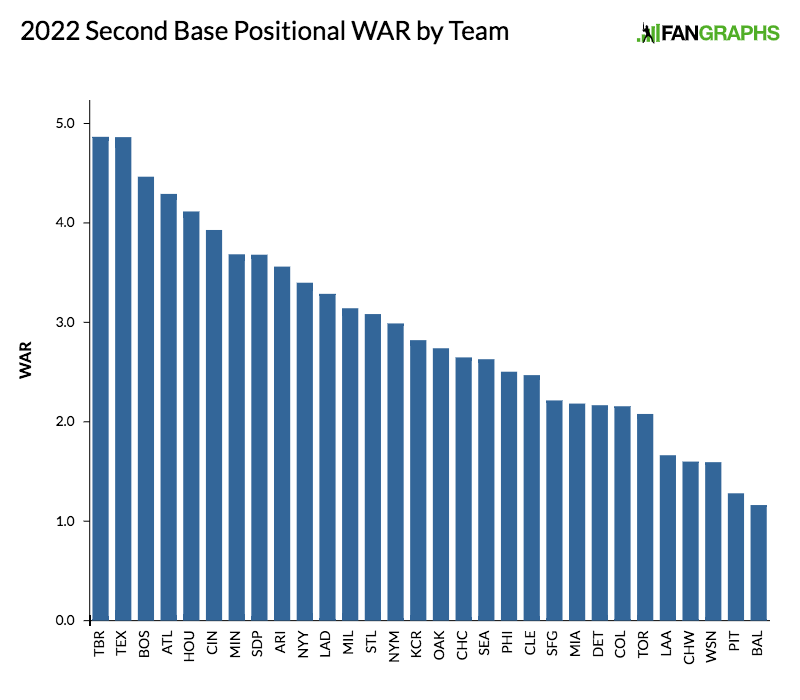
Second base is deeper than ever this year. A logjam at shortstop — there were more talented free agent shortstops than there were teams that needed someone at the position — pushed talent over to second base. Indeed, two of the top three spots on this list are teams that signed marquee free agent shortstops and parked them at second. That’s part of a broader trend toward a widening of the talent pool that teams see as worthy of a starting job. Not only will you see shortstops like Trevor Story here, but also bat-first mashers like Max Muncy and elite defenders like Nicky Lopez. The old keystone archetype — a contact-first bat with serviceable defense but without the range or arm for short — still shows up in spades, too. Some diminutive second basemen have even started hitting for power — hi, Jose Altuve and Ozzie Albies. It’s a variegated group, but they all stand in the dirt between first and second — or, until next year, in short right field.
| Name | PA | AVG | OBP | SLG | wOBA | Bat | BsR | Fld | WAR |
|---|---|---|---|---|---|---|---|---|---|
| Brandon Lowe | 602 | .245 | .333 | .500 | .353 | 22.1 | 1.3 | -0.6 | 4.5 |
| Vidal Bruján | 63 | .237 | .300 | .365 | .291 | -0.9 | 0.3 | 0.1 | 0.2 |
| Taylor Walls | 35 | .222 | .311 | .350 | .292 | -0.5 | -0.0 | 0.5 | 0.1 |
| Total | 700 | .243 | .329 | .480 | .344 | 20.7 | 1.6 | 0.0 | 4.9 |
Lowe might be the most unheralded star in baseball. All he’s done over the last three years is put up 10.3 WAR in 1,166 plate appearances, largely by hitting .258/.343/.526. Only Marcus Semien has outproduced him, and that projects to continue this year. Lowe’s skillset – plus power, plus patience, and not enough strikeouts to ruin things – isn’t one you normally see at second base, but his offense is hugely valuable, and the Rays have long figured out a way to put their best players in the lineup and sort out the exact fit later.
That commitment to positional flexibility means that Lowe will spend time away from second base, either in the outfield or at DH. That’s where Tampa Bay’s depth comes in; Bruján, our 55th-ranked prospect, looks like a roughly average major leaguer already and Walls was a borderline top 100 prospect before graduating. Both of them bring plus defense to the table, as well, which gives the Rays extra flexibility in their defensive positioning. The overall package – a star at the top, multiple top prospects in reserve – gives the Rays perhaps the highest floor at second base, with plenty of upside from there. They do rank first, after all.
| Name | PA | AVG | OBP | SLG | wOBA | Bat | BsR | Fld | WAR |
|---|---|---|---|---|---|---|---|---|---|
| Marcus Semien | 623 | .263 | .338 | .478 | .349 | 17.5 | 1.0 | 4.1 | 4.6 |
| Brad Miller | 35 | .233 | .323 | .444 | .329 | 0.4 | -0.1 | -0.1 | 0.2 |
| Charlie Culberson | 21 | .242 | .292 | .385 | .292 | -0.4 | 0.0 | -0.1 | 0.0 |
| Yonny Hernandez | 14 | .239 | .346 | .309 | .300 | -0.2 | 0.0 | 0.0 | 0.0 |
| Nick Solak | 7 | .258 | .326 | .402 | .317 | 0.0 | -0.0 | -0.0 | 0.0 |
| Total | 700 | .261 | .336 | .469 | .345 | 17.3 | 1.0 | 4.0 | 4.9 |
Semien was the best second baseman in the game in 2021, and he’s projected to be superb again this year. He does it with one simple trick: lifting and pulling the ball for extra-base hits. Fine, he has a ton of other good skills, too – he walks more than average, strikes out less than average, and grades out well defensively – but Semien’s ascension to All-Star production has a lot to do with his power ticking up, and we think he’ll repeat that this year.
One thing to keep an eye on: Semien is projected for the second-highest OBP of his career. Most of that comes from a BABIP rebound – he didn’t do well in that category last year, basically the only thing he didn’t excel at – but if you’re looking for downside here, it would be Semien getting on base at a lower clip and being merely a good hitter instead of an excellent one.
Behind Semien, the Rangers have multiple capable backups. Swanson — er, Culberson, it’s so hard to know for sure — is a competent utility infielder and Miller should contribute all over the diamond against right-handed pitching. Hernandez is a good fallback as well. The depth here should keep the lights on if Semien is out for a short stint, though he’s of course the headliner.
| Name | PA | AVG | OBP | SLG | wOBA | Bat | BsR | Fld | WAR |
|---|---|---|---|---|---|---|---|---|---|
| Trevor Story | 630 | .260 | .333 | .481 | .346 | 12.1 | 1.8 | 4.3 | 4.2 |
| Christian Arroyo | 42 | .249 | .307 | .421 | .314 | -0.3 | 0.0 | 0.2 | 0.1 |
| Enrique Hernández | 21 | .255 | .333 | .458 | .339 | 0.3 | 0.0 | 0.1 | 0.1 |
| Jonathan Araúz | 7 | .239 | .304 | .383 | .299 | -0.1 | -0.0 | 0.0 | 0.0 |
| Total | 700 | .259 | .331 | .476 | .344 | 11.9 | 1.8 | 4.6 | 4.5 |
Boston had a revolving door at second last year, but they solved that problem by copying Toronto’s gambit from a year ago of bringing in a prized free agent shortstop and sliding him down the defensive spectrum. Story is a solid defensive shortstop, which means he’s an excellent defensive second baseman, and his lift-and-pull offensive game should result in wall-ball doubles and “he got just enough of it” homers galore in Fenway. Leaving Coors is less of a problem when you’re going to another excellent hitter’s park, and departing Rockies hitters have fared well in their new homes historically. While he’s unlikely to ever bat near .300 again, extra-base hits and solid walk rates should still create excellent above-average offensive production.
If Story misses time with injury or spends time covering shortstop, the Sox will have to decide whether they’d rather play Arroyo or Jackie Bradley Jr. every day. Hernández is the team’s starting center fielder, but he could shift to second if Story is out for an extended period. Neither of those options is particularly appetizing; Boston’s best bet is for their prized free agent to remain healthy. Bold take, I know.
| Name | PA | AVG | OBP | SLG | wOBA | Bat | BsR | Fld | WAR |
|---|---|---|---|---|---|---|---|---|---|
| Ozzie Albies | 665 | .274 | .329 | .489 | .346 | 11.6 | 2.5 | 3.5 | 4.2 |
| Orlando Arcia | 28 | .252 | .309 | .407 | .308 | -0.4 | -0.0 | 0.2 | 0.1 |
| Brock Holt | 7 | .242 | .315 | .340 | .291 | -0.2 | -0.0 | -0.0 | 0.0 |
| Total | 700 | .273 | .328 | .484 | .344 | 11.0 | 2.4 | 3.7 | 4.3 |
Albies is a mainstay atop lists of contract-inclusive value, but he’s also just great. After a forgettable, injury-shortened 2020, he’s back to his old tricks, swinging early and often and making frequent, loud contact. It’s a strange profile – he swings so much and stands only 5-foot-8, so the power is hard to comprehend – but he hits home runs at a 22-per-600 PA pace, so swinging a lot sure seems to work for him. Combine that with excellent baserunning and solid defense, and you get a perennial All-Star.
2020 aside, Albies has also been extremely durable – he averaged 158 games per year in ’18, ’19, and ’21 combined. The Braves will need that health to continue, because their roster behind Albies is shockingly thin at the moment. Arcia is a competent backup, but he’d be stretched as an everyday player. He’s also the backup at shortstop, and the team doesn’t yet have anyone else on the roster to handle the position; Holt, a minor league free agent signing, is the next best option. If Albies is healthy, though, that won’t matter – Atlanta will have one of the best second base situations in the game, just like always.
| Name | PA | AVG | OBP | SLG | wOBA | Bat | BsR | Fld | WAR |
|---|---|---|---|---|---|---|---|---|---|
| Jose Altuve | 637 | .277 | .346 | .469 | .349 | 18.9 | 0.3 | -3.5 | 4.0 |
| Aledmys Díaz | 28 | .251 | .310 | .406 | .308 | -0.1 | -0.1 | 0.0 | 0.1 |
| Niko Goodrum | 28 | .218 | .293 | .367 | .289 | -0.6 | 0.1 | -0.1 | 0.0 |
| Alex De Goti | 7 | .216 | .282 | .330 | .270 | -0.2 | -0.0 | 0.0 | 0.0 |
| Total | 700 | .273 | .341 | .461 | .344 | 18.0 | 0.3 | -3.5 | 4.1 |
Every year, it feels like Altuve must be declining towards average. He’s 31, but he feels older than that because he’s been part of the Astros since their darkest tanking days. He also saw his production decline every year from 2017-20, culminating in a near-replacement level pandemic season that was only salvaged by a blisteringly hot playoff performance. Joke’s on our frail human pattern recognition, though: Altuve put that decline behind him with a monstrous 2021, combining durability, batting prowess, and defensive stability to the tune of 5.2 WAR.
He likely won’t match that production this year, but his track record speaks for itself at this point. He’s going to avoid strikeouts, rack up barrels, and pop enough home runs that you’ll doubt he’s as short as he looks on the field. It’s an exceedingly rare profile, and you might get laughed out of the building for predicting 25-homer power for a 5-foot-6 prospect, but Altuve is just a unicorn.
Díaz, his main backup, is a league average bat with positional flexibility, a useful cog if Altuve’s injury issues flare up again or he simply needs some time off. If things go as planned in Houston, he’ll be under-utilized, but his presence helps mitigate a worst-case scenario. Goodrum provides an extra layer of redundancy; he’s capable of backing up nearly every position on the diamond, though he’ll likely combine that with uninspiring offense.
| Name | PA | AVG | OBP | SLG | wOBA | Bat | BsR | Fld | WAR |
|---|---|---|---|---|---|---|---|---|---|
| Jonathan India | 644 | .260 | .364 | .449 | .353 | 12.8 | 0.1 | 1.8 | 3.8 |
| Donovan Solano | 28 | .276 | .325 | .395 | .312 | -0.4 | -0.0 | -0.1 | 0.0 |
| Max Schrock | 14 | .252 | .307 | .395 | .303 | -0.3 | -0.0 | -0.0 | 0.0 |
| Alejo Lopez | 14 | .274 | .334 | .370 | .310 | -0.2 | -0.0 | 0.0 | 0.0 |
| Total | 700 | .261 | .361 | .444 | .350 | 11.8 | 0.1 | 1.7 | 3.9 |
While Cincinnati’s experiment with Eugenio Suárez at shortstop failed miserably, it gave India a spot on the big league club, and he ran with it. His well-rounded offensive game – he hits for power and walks quite a bit without a ruinous strikeout total – helped anchor the Reds lineup last year, and he projects to be the best hitter on their offensively challenged squad in 2022.
If there’s a worry about India, it’s how sustainable his offensive production is. We’re not talking about someone with a long track record of dominance at the major league level – or even a long track record, period. He topped out at Double-A Charlotte in his second professional season, 2019, and then made the Reds’ roster to start ’21. That’s not automatically cause for concern – he’s hit well at every level he’s attempted – but at the top of the list, I’m often looking for risk factors, and “good projection for a guy with only 1,300 professional plate appearances” definitely qualifies. It will probably be fine – India very much looked the part in 2021, and his projections bake in that lack of track record – but it’s something worth keeping an eye on, particularly on an otherwise-uninspiring Cincinnati offense.
| Name | PA | AVG | OBP | SLG | wOBA | Bat | BsR | Fld | WAR |
|---|---|---|---|---|---|---|---|---|---|
| Jorge Polanco | 588 | .274 | .331 | .474 | .343 | 13.1 | 0.0 | -3.6 | 3.2 |
| Luis Arraez | 63 | .301 | .364 | .399 | .333 | 0.9 | -0.0 | -0.0 | 0.3 |
| Jose Miranda | 35 | .276 | .324 | .451 | .331 | 0.4 | -0.0 | 0.1 | 0.2 |
| Nick Gordon | 14 | .252 | .300 | .382 | .296 | -0.2 | 0.0 | -0.1 | 0.0 |
| Total | 700 | .276 | .333 | .464 | .341 | 14.1 | -0.0 | -3.6 | 3.7 |
Polanco was Minnesota’s everyday second baseman last year until he took over shortstop, and the Carlos Correa signing brings him back to the keystone. He’s the best hitter you probably think is a bad hitter; he has a career 109 wRC+ and socked 33 homers in 2021. His game isn’t flashy, and I don’t think he’ll repeat those home run numbers, but a simple formula allows him to succeed: rarely strike out, walk at a reasonable clip, and put the ball in the air frequently. He has just enough power to convert those frequent fly balls into homers, even if he runs a hard-hit rate well below the major league average. So long as you’re a high-volume hitter with enough pitch recognition to avoid getting yourself out, you don’t need to crush every single pitch you hit.
Arraez and Miranda are both overqualified backups, and they’ll work into the Twins lineup at multiple positions as the team tries to put its best offensive players on the field. We project Arraez for a .302 batting average; I know it’s a bad offensive statistic, but that’s still incredibly impressive. His value is all in high BABIP and low strikeout rates, while Miranda strikes out more, walks less, and brings the thunder. The Twins have an overlapping middle infield machine, and their trio of second basemen will be key parts of what promises to be an excellent offense.
| Name | PA | AVG | OBP | SLG | wOBA | Bat | BsR | Fld | WAR |
|---|---|---|---|---|---|---|---|---|---|
| Jake Cronenworth | 553 | .272 | .345 | .446 | .339 | 10.8 | -0.4 | 1.6 | 3.2 |
| Ha-Seong Kim | 98 | .241 | .311 | .403 | .309 | -0.6 | 0.2 | 0.0 | 0.3 |
| Jurickson Profar | 28 | .241 | .329 | .386 | .313 | -0.1 | 0.0 | -0.1 | 0.1 |
| CJ Abrams | 21 | .245 | .298 | .367 | .289 | -0.5 | 0.0 | 0.1 | 0.0 |
| Total | 700 | .266 | .338 | .435 | .333 | 9.7 | -0.2 | 1.6 | 3.7 |
When San Diego acquired Cronenworth, he felt like a throw-in in the trade that netted them Tommy Pham, but he’s developed into a piece of San Diego’s offensive core. He’s also Exhibit A in why skills matter in context, because if you look at some of his batted ball metrics, you’d wonder why he ranks so highly on this list. He’s in the 23rd percentile for hard-hit rate and 38th percentile for barrel rate. You don’t have to be a sabermetric genius to know that those numbers are low.
In Cronenworth’s case, though, it doesn’t matter. His carrying tool isn’t power; it’s an unerring eye and sterling bat control that combine to make him one of the toughest outs in the big leagues. His 5.4% swinging strike rate means he can wait pitchers out, and he lifts and pulls the ball frequently enough to hit for above-average power despite the low measurables. It’s an odd way to compile a career 118 wRC+, but there are no style points in baseball; offense is offense.
Defensively, Cronenworth fits in across the infield, which means Ha-Seong Kim will get plenty of run at second base. Kim had a disappointing rookie season at the plate, but was excellent defensively. He probably won’t run a .241 BABIP again, and a bit of offensive improvement would make him a roughly average player, which gives the Padres enviable depth if Cronenworth gets hurt. Kim can also fill in elsewhere — in case the team needs, say, a few months of shortstop innings.
| Name | PA | AVG | OBP | SLG | wOBA | Bat | BsR | Fld | WAR |
|---|---|---|---|---|---|---|---|---|---|
| Ketel Marte | 539 | .291 | .352 | .485 | .356 | 14.2 | 0.0 | -0.3 | 3.4 |
| Sergio Alcántara | 77 | .225 | .314 | .331 | .287 | -2.4 | -0.0 | 0.4 | 0.1 |
| Wilmer Difo | 49 | .241 | .306 | .341 | .285 | -1.6 | -0.0 | -0.0 | 0.0 |
| Josh Rojas | 28 | .248 | .328 | .395 | .315 | -0.2 | 0.0 | -0.0 | 0.1 |
| Drew Ellis | 7 | .213 | .304 | .375 | .298 | -0.2 | -0.0 | 0.0 | 0.0 |
| Total | 700 | .278 | .343 | .454 | .342 | 9.9 | 0.0 | 0.0 | 3.6 |
Marte was always going to be Arizona’s best hitter — it’s just a matter of where they want to play him. In 2021, that was mostly center field, but we think that a bevy of young players will rotate there, leaving Marte to mostly play second and pick up scraps of playing time elsewhere. That’s great news for Arizona’s second base PPR placement – and of course, neutral news for the team overall, because you don’t get to convert your position in this exercise into wins.
Marte will probably never replicate his superlative 2019, but he was excellent when healthy in 2021, to the tune of a .318/.377/.532 slash line. He possesses a rare combination of bat-to-ball skills (7.2% career swinging strike rate) and raw power (97th-percentile maximum exit velocity); his .295 batting average since joining the D-backs doesn’t look like a fluke, and neither does his .495 slugging percentage. He could stand to walk more often, and his defense is inconsistent, but he’s a natural infielder, so concentrating his playing time on the dirt should yield improvements there. There aren’t a lot of bright spots in Arizona at the moment, but wherever Marte ends up playing, he’ll be one of them — and for longer five more years, to boot.
| Name | PA | AVG | OBP | SLG | wOBA | Bat | BsR | Fld | WAR |
|---|---|---|---|---|---|---|---|---|---|
| Gleyber Torres | 539 | .265 | .340 | .438 | .335 | 9.0 | -0.2 | -3.1 | 2.6 |
| DJ LeMahieu | 140 | .284 | .349 | .413 | .332 | 1.9 | -0.1 | 0.7 | 0.8 |
| Marwin Gonzalez | 14 | .233 | .300 | .365 | .291 | -0.3 | -0.0 | -0.0 | 0.0 |
| José Peraza | 7 | .252 | .299 | .377 | .294 | -0.1 | 0.0 | -0.0 | 0.0 |
| Total | 700 | .268 | .341 | .431 | .333 | 10.4 | -0.3 | -2.5 | 3.4 |
Did you know that Torres is only… wait, Gleyber Torres is 25 now? Yes, we’re a long way from the halcyon days of 2019, and Torres’ star has dimmed considerably in the interim. We’re projecting somewhat of a return to form, and Torres was valuable even in his poor 2021 season; average offense and average fielding (below-average for a shortstop is still average, to be clear) makes for an acceptable player.
“Acceptable” isn’t amazing for a Yankees team hoping to win the American League this year, though, which means that Torres’ leash might be quite short. LeMahieu is an excellent second option. If he bounces back, and Josh Donaldson stays healthy, and… the Yankees have a complicated infield, is what I’m getting at here. There’s talent there, and it wouldn’t surprise me if one of the two Bombers ends up among the AL’s best second basemen, but it’s a fluid situation in need of some stability at the moment.
| Name | PA | AVG | OBP | SLG | wOBA | Bat | BsR | Fld | WAR |
|---|---|---|---|---|---|---|---|---|---|
| Chris Taylor | 252 | .247 | .330 | .430 | .327 | 2.1 | 0.5 | -1.8 | 1.0 |
| Gavin Lux | 182 | .252 | .328 | .423 | .324 | 1.0 | 0.1 | -0.4 | 0.7 |
| Max Muncy | 126 | .249 | .371 | .509 | .374 | 5.9 | -0.0 | 0.0 | 1.0 |
| Hanser Alberto | 112 | .283 | .307 | .397 | .303 | -1.3 | -0.0 | -0.0 | 0.3 |
| Mookie Betts | 21 | .279 | .374 | .505 | .374 | 1.0 | 0.1 | 0.3 | 0.2 |
| Zach McKinstry | 7 | .238 | .301 | .414 | .307 | -0.1 | -0.0 | -0.0 | 0.0 |
| Total | 700 | .256 | .334 | .438 | .332 | 8.6 | 0.6 | -1.9 | 3.3 |
Whether it’s center field or second base, the Dodgers never miss a chance to platoon Lux and Taylor. That’s a much better plan in the infield, where Lux can provide his signature pop without looking like a fish out of water defensively. That pop might not be what we expected a few years ago – he was our number two overall prospect before the 2020 season – but he’s a patient, powerful hitter who I could easily see bopping 20 home runs year in and year out.
That’s assuming he plays every day, which isn’t a given in the Dodgers’ Rube Goldberg lineup. Muncy will get some run at second when he isn’t DH’ing or playing first. Taylor won’t always be at second even against lefties; he’s too valuable across the diamond. Alberto will cover that role from time to time. The exact composition of Taylor’s plate appearances is up in the air, and might depend heavily on injuries, so don’t take this projection as gospel. Just know that LA will give Lux and Taylor plenty of at-bats and fill in the gaps with some exciting upper-minors bats, veteran role players, and defensively stretched boppers. Oh, and check out that sweet Betts projection near the bottom!
| Name | PA | AVG | OBP | SLG | wOBA | Bat | BsR | Fld | WAR |
|---|---|---|---|---|---|---|---|---|---|
| Kolten Wong | 581 | .265 | .336 | .412 | .325 | 0.7 | 0.9 | 4.2 | 2.7 |
| Luis Urías | 63 | .253 | .346 | .433 | .337 | 0.7 | -0.1 | 0.1 | 0.3 |
| Mike Brosseau | 28 | .231 | .304 | .401 | .305 | -0.4 | -0.0 | 0.0 | 0.1 |
| Keston Hiura | 14 | .227 | .303 | .416 | .311 | -0.1 | -0.0 | -0.0 | 0.0 |
| Jace Peterson | 14 | .237 | .330 | .378 | .312 | -0.1 | 0.0 | -0.1 | 0.0 |
| Total | 700 | .261 | .335 | .413 | .325 | 0.7 | 0.8 | 4.2 | 3.1 |
You’re never gonna believe it; Wong combined elite defense and a sneaky-good bat on his way to another excellent season at the keystone. A balky oblique limited him to 116 games, but when he was on the field, he produced at a borderline All-Star clip, the fifth straight season he’s managed that trick. The formula is consistent: he’s been within 10 points of a 100 wRC+ in each of those years, and at least according to advanced defensive metrics, provided piles of value with his glove year after year.
At this point in Wong’s career, ascending to a higher level of production doesn’t look likely, but that’s fine: the Brewers are getting exactly what they want out of him, for now at least. There are warning signs on the horizon; 2021 represented his lowest walk rate since 2015 and highest strikeout rate of his career. He made up for it with a career high in home runs, and his lefty pull power is a good fit for Milwaukee, but a decline in dingers could push him more towards average than standout. That’s more of a 2023 problem, though; for now, all signs point to another season of unheralded but valuable production.
| Name | PA | AVG | OBP | SLG | wOBA | Bat | BsR | Fld | WAR |
|---|---|---|---|---|---|---|---|---|---|
| Tommy Edman | 490 | .271 | .321 | .408 | .315 | -0.1 | 2.5 | 2.9 | 2.3 |
| Nolan Gorman | 140 | .253 | .298 | .433 | .312 | -0.3 | 0.0 | 0.8 | 0.6 |
| Edmundo Sosa | 49 | .254 | .310 | .389 | .303 | -0.5 | -0.1 | 0.3 | 0.1 |
| José Rondón | 14 | .233 | .287 | .412 | .300 | -0.2 | -0.0 | -0.0 | 0.0 |
| Brendan Donovan | 7 | .250 | .320 | .374 | .304 | -0.1 | -0.0 | 0.0 | 0.0 |
| Total | 700 | .265 | .315 | .411 | .313 | -1.2 | 2.4 | 3.9 | 3.1 |
Far be it from me to doubt the exalted Depth Charts projection system, but this one shocked me. After a little thinking time to calm the Cardinals-fan part of my brain, though, I can kind of understand it. Edman projects as a league average hitter, which is precisely what he’s been in his career to date. I’m skeptical that he’ll reverse his downward OBP trend (.350 to .317 to .308 in the past three seasons), but if he can stick around in the vicinity of average at the plate, the rest of his game will churn out value at a high clip.
Good defense? He’s got that; OAA credited him with 13 outs saved in 2021. Baserunning? He added eight runs on the basepaths last year, and that hardly feels like a fluke; he’s one of the fastest runners in the league and also a canny base stealer. Production comes in all shapes and sizes, and the Cardinals have shown a knack for developing players who can consistently make the most of their skill set.
Gorman, who we see as Edman’s primary backup, is another Cardinals specialty: a guy who doesn’t quite have the defensive chops for where he’s deployed but who plays there anyway because of his bat. A natural third baseman, he’s blocked by Nolan Arenado, but he hit so well in the minors (.274/.320/.465 as a 21-year-old in Triple-A) that the team will likely use him all around the infield to get his plus power into the lineup.
| Name | PA | AVG | OBP | SLG | wOBA | Bat | BsR | Fld | WAR |
|---|---|---|---|---|---|---|---|---|---|
| Jeff McNeil | 350 | .281 | .346 | .430 | .336 | 7.0 | -0.5 | -0.9 | 1.9 |
| Robinson Canó | 161 | .259 | .308 | .407 | .307 | -0.7 | -0.4 | -0.7 | 0.4 |
| Eduardo Escobar | 140 | .244 | .304 | .449 | .320 | 0.9 | -0.2 | -0.0 | 0.6 |
| Luis Guillorme | 42 | .254 | .347 | .349 | .310 | -0.1 | -0.1 | -0.1 | 0.1 |
| Travis Blankenhorn | 7 | .231 | .288 | .405 | .298 | -0.1 | -0.0 | -0.0 | 0.0 |
| Total | 700 | .266 | .328 | .423 | .324 | 7.1 | -1.1 | -1.7 | 3.0 |
Before the 2019 season, choosing a second baseman between McNeil and Canó was a problem the Mets were happy to have. In 2022? Not so much. McNeil had his worst season as a professional last year, and Canó didn’t even play; he was suspended after testing positive for PEDs a second time. At 39, he probably can’t stand up to the rigors of playing second every day, which means McNeil will get the lion’s share of the playing time, so the team will simply have to bank on him returning to form.
That’s certainly a possibility; we think he’ll be an above-average hitter and his usual middling self defensively. His biggest issue in 2021 was production on contact, which is a notable problem for a free-swinging, high-contact hitter. McNeil has never been a slugger, but he got a ton of value from pulling everything he hit in the air, and that pull power evaporated last year. If he can regain that old form, he might actually be better than he was before; he made meaningful gains in his approach that were lost in his poor batted ball results, limiting his chases while remaining aggressive in the zone. If he’s elevating and pulling the ball again this year, this ranking is too low. If not, the Mets will be scrambling for a solution, hoping Canó can hold up to a bigger workload, or plugging in Escobar and hoping the knock-on effects don’t ruin their defense elsewhere on the infield.
| Name | PA | AVG | OBP | SLG | wOBA | Bat | BsR | Fld | WAR |
|---|---|---|---|---|---|---|---|---|---|
| Nicky Lopez | 434 | .269 | .335 | .361 | .307 | -4.3 | 0.8 | 3.8 | 1.7 |
| Whit Merrifield | 238 | .281 | .327 | .411 | .318 | -0.2 | 1.0 | 0.9 | 1.1 |
| Adalberto Mondesi | 21 | .247 | .287 | .430 | .305 | -0.2 | 0.2 | 0.1 | 0.1 |
| Ivan Castillo | 7 | .256 | .295 | .356 | .282 | -0.2 | -0.0 | 0.0 | 0.0 |
| Total | 700 | .272 | .330 | .380 | .311 | -5.0 | 2.0 | 4.8 | 2.8 |
Ah yes, just what I’d do with an electric defensive shortstop: slot him in at second base and force Merrifield into the outfield. An awkward positional logjam at short forced Lopez back to the keystone, where he’s over-qualified defensively. He might never hit for power in the big leagues — he has an admirable ability to make solid contact but the oomph just isn’t there — but he doesn’t need to if he can walk and avoid strikeouts at the excellent rates he’s managed thus far in his career. Add that to his defense and baserunning, and you have a valuable middle infielder, though one I’d prefer at short.
For the 77th consecutive year, Merrifield is an intriguing trade target who plays multiple positions for a Kansas City team that appears to be stuck in neutral. Fine, it hasn’t been quite that long, but it certainly feels like it – his listed position might change, but Merrifield keeps cranking out the singles and steals while putting in time at multiple spots. If Mondesi can’t stay healthy, Merrifield will pick up far more playing time here while Lopez shifts to shortstop, a defensive alignment that looks far better to me than what they’re rolling with now.
| Name | PA | AVG | OBP | SLG | wOBA | Bat | BsR | Fld | WAR |
|---|---|---|---|---|---|---|---|---|---|
| Tony Kemp | 441 | .259 | .354 | .390 | .328 | 6.3 | -0.0 | -2.0 | 2.1 |
| Jed Lowrie | 126 | .242 | .314 | .390 | .306 | -0.4 | -0.4 | -0.6 | 0.3 |
| Sheldon Neuse | 70 | .243 | .294 | .396 | .298 | -0.7 | -0.0 | 0.0 | 0.2 |
| Nick Allen | 28 | .232 | .284 | .343 | .274 | -0.8 | -0.0 | 0.0 | 0.0 |
| Chad Pinder | 21 | .246 | .306 | .424 | .314 | 0.1 | -0.0 | -0.0 | 0.1 |
| Vimael Machín | 14 | .230 | .314 | .343 | .289 | -0.2 | -0.0 | -0.0 | 0.0 |
| Total | 700 | .252 | .336 | .389 | .318 | 4.1 | -0.5 | -2.6 | 2.7 |
If Kemp has his way, he’ll walk into the All-Star game. Newfound patience brought his game to new heights last year, and an encore seems plausible; two straight years of walking more than he strikes out is no joke. It’s a good thing, too: at 5-foot-6, he’s not hitting for a ton of power, and he’s an average defender. He looks more at home in the outfield, and if Oakland had a different roster configuration, he might end up there, but second base welcomes all comers, and Kemp’s plate discipline is too good not to find him a spot somewhere on the field.
Lowrie, recently re-signed, looked rejuvenated last year. We’re penciling him in for a lot of time at DH, but when healthy, he’ll likely handle second against left-handed pitching. Neuse is next on the list, and he’s basically a utility infielder; he doesn’t excel defensively anywhere, and doesn’t get on base much, but he does hit for power. Allen is a glove-first shortstop prospect who might chip in occasionally. Pinder will mostly play the outfield, but is available for offense-first lineups or fancy substitutions.
| Name | PA | AVG | OBP | SLG | wOBA | Bat | BsR | Fld | WAR |
|---|---|---|---|---|---|---|---|---|---|
| Nick Madrigal | 476 | .296 | .344 | .403 | .325 | 0.8 | -1.1 | 2.4 | 2.0 |
| Nico Hoerner | 112 | .277 | .342 | .382 | .316 | -0.7 | -0.1 | 0.7 | 0.4 |
| Jonathan Villar | 77 | .249 | .318 | .395 | .310 | -0.8 | 0.2 | -0.5 | 0.2 |
| David Bote | 21 | .234 | .316 | .401 | .311 | -0.2 | -0.0 | -0.1 | 0.0 |
| Ian Happ | 14 | .240 | .340 | .459 | .344 | 0.2 | 0.0 | -0.0 | 0.1 |
| Total | 700 | .285 | .340 | .400 | .322 | -0.7 | -1.0 | 2.5 | 2.6 |
Forget Madrigal realism; I believe in the power of Madrigal thinking. Though he missed most of last season due to injury, he’s already showed that his contact-first, contact-second, defense-third, contact-fourth approach plays at the major league level. It’s not going to be all about barrels – in fact, it will almost exclusively be about non-barrels, given that he has exactly two in his short career, and one of the lowest hard-hit rates in the game. But strike out this rarely – 7.4% in his career so far – and walk just a little bit, and you’ll achieve an enviable OBP. Look at that .297 projected batting average! Sprinkle in a few doubles and some improved baserunning, and he could be a big part of the team’s future.
When Madrigal gets a rest, or if he misses time with injury, Hoerner is an excellent second option. He’s going to have a super-utility role this year as the Cubs figure out where he fits long-term, with infield, outfield, and Zobristian multi-positional beast all in play. Also in play? A bat that never quite reaches major league average, which would make the rest of the package rather less enticing. But this season is a fact-finding exercise for the team, and Hoerner is a nice fit for that.
| Name | PA | AVG | OBP | SLG | wOBA | Bat | BsR | Fld | WAR |
|---|---|---|---|---|---|---|---|---|---|
| Adam Frazier | 546 | .267 | .330 | .381 | .311 | 0.6 | -0.5 | 0.6 | 2.1 |
| Dylan Moore | 98 | .209 | .297 | .373 | .294 | -1.3 | 0.2 | -0.0 | 0.3 |
| Abraham Toro | 49 | .250 | .328 | .412 | .322 | 0.5 | -0.1 | -0.0 | 0.2 |
| Donovan Walton | 7 | .251 | .323 | .395 | .312 | 0.0 | -0.0 | -0.0 | 0.0 |
| Total | 700 | .258 | .325 | .382 | .309 | -0.2 | -0.4 | 0.6 | 2.6 |
With Carson Cistulli gone, Frazier doesn’t have a rabid defender at FanGraphs anymore, so I’ll assume the mantle for one blurb only. If you’re looking for a second baseman who will get on base and play good defense, Frazier is your man. If you’re looking for power… well, maybe Toro can help you out with that, I guess? I’ll be shocked if Frazier reaches 10 homers, but I expect him to provide average value anyway by avoiding strikeouts, taking walks, and hitting enough line drives to make the whole package work.
When Frazier is sitting or DH’ing to rest his legs, Toro and Moore will alternate as backups. Toro will move all around the diamond to get at-bats, and might pick up extra work at second base if Frazier falters now that Eugenio Suárez has third base locked down. Moore is a defensive wizard, but not much more than that, as his sub-.300 OBP projection attests. He’ll be a wonderful late-game defensive replacement at second when he isn’t in the game as a defensive replacement in the outfield.
| Name | PA | AVG | OBP | SLG | wOBA | Bat | BsR | Fld | WAR |
|---|---|---|---|---|---|---|---|---|---|
| Jean Segura | 602 | .281 | .334 | .417 | .324 | 0.2 | 0.5 | 0.1 | 2.3 |
| Johan Camargo | 56 | .256 | .320 | .438 | .325 | 0.1 | -0.1 | -0.1 | 0.2 |
| Ronald Torreyes | 28 | .248 | .291 | .362 | .283 | -0.9 | -0.0 | 0.1 | 0.0 |
| Nick Maton | 14 | .217 | .295 | .348 | .283 | -0.5 | -0.0 | 0.0 | 0.0 |
| Total | 700 | .277 | .330 | .415 | .322 | -1.1 | 0.4 | 0.1 | 2.5 |
Segura is a great way for me to explain how deep second base is at the moment. He’s probably going to hit for an average offensive line while playing plus defense, the same thing he’s done in each of his years in Philadelphia. He’s been a roughly average shortstop over the course of his career, which makes him a plus defensive second baseman, and he racked up 9 OAA last year. We project him for 2.3 WAR per 600 PA, roughly half a win higher than an average player.
And yet – Philly comes in 19th in these rankings. The league is awash in solid second basemen at the moment. Teams are getting quite good at fitting all manner of players in at the position – see Max Muncy, second baseman – which broadens the talent pool. There’s less than one win of projected difference between the sixth-best second base situation and the 20th-best. We’ve got the Phillies listed down here, but I’d hardly be shocked if they ended the season in the top 10. The position is simply that deep and close.
| Name | PA | AVG | OBP | SLG | wOBA | Bat | BsR | Fld | WAR |
|---|---|---|---|---|---|---|---|---|---|
| Andrés Giménez | 294 | .250 | .304 | .415 | .310 | -1.7 | 0.8 | 2.3 | 1.2 |
| Richie Palacios | 140 | .265 | .343 | .405 | .327 | 1.2 | 0.2 | -0.6 | 0.6 |
| Yu Chang | 98 | .237 | .292 | .420 | .305 | -0.9 | -0.1 | 0.4 | 0.3 |
| Owen Miller | 84 | .245 | .297 | .375 | .293 | -1.7 | -0.1 | 0.2 | 0.2 |
| Ernie Clement | 56 | .248 | .296 | .348 | .282 | -1.6 | -0.1 | 0.3 | 0.1 |
| Gabriel Arias | 28 | .259 | .308 | .410 | .310 | -0.2 | -0.0 | 0.0 | 0.1 |
| Total | 700 | .250 | .309 | .403 | .308 | -4.9 | 0.7 | 2.6 | 2.5 |
What, you were expecting Francisco Lindor? Giménez, the star of Cleveland’s return for Lindor, struggled mightily at the plate in 2021 but made up for it with phenomenal defense. He’s a natural shortstop, but fellow former Met Amed Rosario is the incumbent there, so second base is the easiest fit for the moment. I’m skeptical that Giménez will ever hit for the power we project – 15 homers in 500 plate appearances is a lot for someone his size – but if he can keep his contact rates high, his speed will give him a nice offensive floor.
Behind him, it’s a ton of guys who should probably be good but don’t have a major league track record. Chang has a .273 OBP in 348 major league PAs, Miller excelled at Triple-A before 200 putrid major league PAs last year, and Palacios hit across multiple levels of the minors without earning a big league call-up. Why are our projections so divided? Because if Giménez becomes the full-time shortstop, whichever of these young players has the first hot streak will likely run away with the second base job.
| Name | PA | AVG | OBP | SLG | wOBA | Bat | BsR | Fld | WAR |
|---|---|---|---|---|---|---|---|---|---|
| Tommy La Stella | 392 | .270 | .335 | .409 | .323 | 2.1 | -0.7 | -3.2 | 1.3 |
| Thairo Estrada | 119 | .261 | .314 | .420 | .316 | -0.1 | -0.0 | -0.6 | 0.4 |
| Mauricio Dubón | 98 | .260 | .310 | .395 | .304 | -1.0 | -0.1 | 0.2 | 0.3 |
| Wilmer Flores | 70 | .271 | .332 | .450 | .336 | 1.1 | -0.2 | -0.4 | 0.3 |
| Luke Williams | 21 | .227 | .292 | .344 | .279 | -0.6 | -0.0 | 0.1 | 0.0 |
| Total | 700 | .266 | .326 | .411 | .319 | 1.5 | -1.0 | -4.0 | 2.2 |
La Stella missed half of last season due to injury, but when he played, he provided lefty production that helped shore up the Giants’ weakest infield position. He’ll do the same this year as the big half of a platoon, though he’s more than just that, and I expect him to draw assignments against lefties with tough curveballs, a pitch he’s fared well against in his career. La Stella probably won’t play a full season — he’s never reached 400 plate appearances in a single year — but there’s upside in his bat; he had rotten batted ball luck in 2021 and was still a useful player, and I expect him to walk more often.
All four of the names behind La Stella are natural platoon partners with different shortcomings. Dubón is the best defender of the three but likely the worst hitter. Estrada is a worse fielder than Dubón but a better hitter, even if he doesn’t replicate the power he showed last year. Flores is the best bat of the three, particularly against lefties, but I’m not sure he can handle the position defensively; he’s more of a break-glass-in-case-of-emergency offensive boost. Williams doesn’t have an obvious spot on the team, but he’s the kind of hitter the Giants excel at working with.
| Name | PA | AVG | OBP | SLG | wOBA | Bat | BsR | Fld | WAR |
|---|---|---|---|---|---|---|---|---|---|
| Jazz Chisholm Jr. | 441 | .236 | .300 | .430 | .313 | -0.8 | 0.6 | -2.4 | 1.4 |
| Joey Wendle | 182 | .261 | .315 | .401 | .308 | -1.1 | -0.1 | 0.5 | 0.6 |
| Jon Berti | 77 | .239 | .330 | .351 | .303 | -0.8 | 0.2 | -0.1 | 0.2 |
| Total | 700 | .243 | .307 | .414 | .311 | -2.6 | 0.7 | -2.0 | 2.2 |
Is Chisholm the future face of the franchise in Miami? Their young pitchers will likely have something to say about that, but he’s the most exciting position player on the team, and if they want to contend this year, they’ll need him to make the leap from intriguing youngster to thumping, dual-threat lineup anchor. That’s easier said than done, but the tools are absolutely there. He posted impressive raw power numbers, barreled up 8.6% of his batted balls, and stole 23 bases with blinding straight-line speed.
When Chisholm handles shortstop duties or gets a rest, Wendle will bring his singles-and-defense skill set to the party. He’s bottled competence — slot him in at second or third, and he’ll stabilize your defense while chipping in on the offensive end. This is the exact role the Marlins envisioned when they acquired him, and he also provides needed redundancy; Chisholm should be able to slide to shortstop in the event of injury, or Wendle could take over third and leave the other backups to pick up the slack here.
| Name | PA | AVG | OBP | SLG | wOBA | Bat | BsR | Fld | WAR |
|---|---|---|---|---|---|---|---|---|---|
| Jonathan Schoop | 476 | .265 | .309 | .441 | .321 | 1.5 | -0.2 | -2.4 | 1.7 |
| Harold Castro | 77 | .269 | .299 | .358 | .285 | -2.0 | -0.1 | -0.3 | 0.0 |
| Kody Clemens | 63 | .231 | .287 | .407 | .298 | -1.0 | -0.0 | 0.0 | 0.1 |
| Isaac Paredes | 42 | .256 | .343 | .419 | .331 | 0.5 | -0.1 | 0.0 | 0.2 |
| Willi Castro | 28 | .252 | .301 | .400 | .302 | -0.3 | 0.0 | -0.1 | 0.1 |
| Zack Short | 14 | .206 | .309 | .377 | .301 | -0.2 | -0.0 | 0.0 | 0.0 |
| Total | 700 | .260 | .308 | .424 | .314 | -1.5 | -0.4 | -2.8 | 2.2 |
Twenty-third on the list, and we’re still projecting average WAR-per-PA totals; second base is deep. Schoop is a known quantity at this point in his career — he won’t run a gaudy OBP, but he’ll hit for enough power to accrue an average batting line while fitting in defensively at second. He played a lot of first base last year, which hurt his overall value, but will return to his natural position with Spencer Torkelson expected to handle most of the reps at first.
The rest of this list is guesswork, with Paredes my favorite of the group. That projected .343 OBP is no joke, and he’s a model darling despite lackluster production in a brief major league career. Clemens has intriguing power and Short might have a major league future if he can cut down on a recent swell in strikeouts, but if the Tigers had their druthers, Schoop would hold down the position just long enough for Paredes to ascend. That ignores both Castros, because I think they’re more warm bodies than part of the team’s long-term plans at second.
| Name | PA | AVG | OBP | SLG | wOBA | Bat | BsR | Fld | WAR |
|---|---|---|---|---|---|---|---|---|---|
| Brendan Rodgers | 518 | .281 | .327 | .474 | .342 | 0.0 | -0.5 | 0.2 | 1.9 |
| Garrett Hampson | 91 | .248 | .305 | .397 | .303 | -2.9 | 0.3 | -0.4 | 0.0 |
| Ryan McMahon | 63 | .255 | .332 | .461 | .339 | -0.1 | -0.0 | 0.2 | 0.2 |
| Alan Trejo | 21 | .243 | .285 | .408 | .296 | -0.8 | -0.0 | 0.1 | 0.0 |
| Tim Lopes | 7 | .256 | .311 | .403 | .309 | -0.2 | -0.0 | -0.0 | 0.0 |
| Total | 700 | .273 | .323 | .460 | .335 | -4.0 | -0.3 | 0.2 | 2.2 |
Rodgers, Hampson, and McMahon represent three consecutive incarnations of “top Rockies hitting prospect.” They’re projected to share second base duties this year while also locking down third and part of an outfield position, with Rodgers getting the majority of the reps at second. That’s likely his long-term home; it’s his best fit defensively and Colorado could use his bat in the lineup.
A free swinger with plus power, Rodgers could use a bit of lift to really maximize his fit in Coors. Even without that, though, he looks like an average hitter now, with upside for more as he further acclimates to the majors. That’s a bat the team has no trouble finding space for — in fact, he has the third-highest WAR projection among all Rockies hitters, behind only McMahon and Kris Bryant.
McMahon will spend most of his time at third base, but he’s a similar story: average offense that could use more fly balls for Coors to turn into doubles and homers. Hampson is the only one of the trio without a regular home; we think he’ll back up second, short, and left, but three straight years of wRC+’s below 70 have sapped his expected playing time significantly. That means more reps at second base than McMahon, but much less playing time overall.
| Name | PA | AVG | OBP | SLG | wOBA | Bat | BsR | Fld | WAR |
|---|---|---|---|---|---|---|---|---|---|
| Cavan Biggio | 364 | .226 | .338 | .401 | .323 | 0.4 | -0.0 | -0.3 | 1.4 |
| Santiago Espinal | 294 | .258 | .316 | .367 | .299 | -5.5 | -0.2 | 1.1 | 0.6 |
| Otto Lopez | 42 | .256 | .308 | .370 | .295 | -0.9 | 0.0 | -0.1 | 0.1 |
| Total | 700 | .242 | .327 | .384 | .311 | -6.0 | -0.3 | 0.8 | 2.1 |
Acquiring Matt Chapman to play third base simplifies things for the Jays: they can play a lefty utilityman against right-handed pitching, a righty utilityman against left-handed pitching, and use both to chip in across the diamond on off days. That sounds like a waste of Biggio’s bat, but those aforementioned at-bats will add up. Espinal grades out as the better defender, which suggests we’ll frequently see him at second while Biggio tags in elsewhere to give someone a rest day.
If Biggio takes a step forward this year, this might be less of a platoon and more of a 75/25 split, but that’s somewhat harsh to Espinal. Before the Chapman trade, he looked like Toronto’s everyday third baseman, and while our projections are skeptical that he can repeat his solid 2021 offensively, the defensive bona fides are there. If he surprises just slightly to the upside, he’s an average hitter with plus defense. That’s a nice player to have in a complementary role, and one of the benefits of adding a star elsewhere on the diamond.
| Name | PA | AVG | OBP | SLG | wOBA | Bat | BsR | Fld | WAR |
|---|---|---|---|---|---|---|---|---|---|
| Matt Duffy | 210 | .270 | .341 | .370 | .314 | -0.4 | -0.2 | -1.4 | 0.6 |
| David Fletcher | 196 | .275 | .321 | .367 | .300 | -2.7 | 0.2 | -0.1 | 0.5 |
| Tyler Wade | 133 | .227 | .302 | .334 | .281 | -3.9 | 0.5 | -0.2 | 0.1 |
| Michael Stefanic | 84 | .265 | .328 | .384 | .312 | -0.4 | -0.1 | 0.2 | 0.3 |
| Luis Rengifo | 42 | .244 | .310 | .390 | .304 | -0.4 | -0.0 | 0.1 | 0.1 |
| Jack Mayfield | 35 | .231 | .282 | .405 | .294 | -0.7 | 0.0 | -0.1 | 0.1 |
| Total | 700 | .259 | .322 | .367 | .302 | -8.6 | 0.4 | -1.5 | 1.7 |
Or, in layman’s terms, a shrug emoji. Three different players with at least 100 PA in their projections might work if you’re the Dodgers, running out 75 stars at 10 positions and rotating them to keep everybody fresh. It’s less exciting when you’re rotating three guys projected for an aggregate 1.2 WAR in 539 PA. Of the three, I like Fletcher the most, and the Angels do too, which is why he’s going to be their starting shortstop. You can’t start at both positions, so someone else has to pick up the slack at second, which feels like a natural fit for Fletcher’s premium defense and hey-wow-better-than-I-thought-but-no-home-runs offensive line.
That leaves Duffy as the obvious fit at second, and he’s your standard average regular: he doesn’t hit for much power and doesn’t walk a ton, but he makes up for it by rarely striking out. He’s a natural third baseman, and a solid defender there, but I don’t see any reason it can’t translate to second, and the Angels could really use one extra competent hitter in their lineup, so they’ll have to hope he can make the defense work.
After that, Wade is a fast and fun player who probably makes more sense as an outfielder, where he can show off his premium speed. The Angels have a bunch of outfielders, though, so he’ll also get some time here. Stefanic has the best per-PA projection of the bunch; he was excellent in Triple-A last year and will likely get a chance this year, and perhaps an extended chance if the team deals with injuries. Rengifo is available too, if things go really wrong somewhere and their depth is tested.
| Name | PA | AVG | OBP | SLG | wOBA | Bat | BsR | Fld | WAR |
|---|---|---|---|---|---|---|---|---|---|
| Josh Harrison | 350 | .259 | .317 | .377 | .304 | -3.3 | -0.5 | -0.6 | 0.9 |
| Leury García | 252 | .259 | .311 | .371 | .298 | -3.7 | 0.2 | -0.9 | 0.5 |
| Danny Mendick | 63 | .233 | .306 | .360 | .293 | -1.1 | -0.1 | 0.2 | 0.1 |
| Romy Gonzalez | 28 | .231 | .289 | .406 | .299 | -0.4 | 0.0 | -0.0 | 0.1 |
| Yolbert Sanchez | 7 | .269 | .304 | .377 | .295 | -0.1 | -0.0 | 0.0 | 0.0 |
| Total | 700 | .256 | .312 | .374 | .300 | -8.6 | -0.3 | -1.3 | 1.6 |
Harrison and García should provide the White Sox with at least a stabilizing presence at second, but it’s a weak point for the team. After trading Nick Madrigal last year, they don’t have an obvious replacement waiting in the wings, and didn’t have the budget or desire to add a top-end replacement in free agency. Scraping together near-average performance from an assortment of veterans and utility players will probably be enough given how good the rest of the lineup is, but this will definitely be one of the weak points on an excellent Chicago club.
The position stands out enough, in fact, that they may look to improve it via trade during the year. Whether that works out remains to be seen, but in the meantime, I’m glad they at least brought in two veterans who will make the position a minor weak point rather than a gaping hole in the lineup.
| Name | PA | AVG | OBP | SLG | wOBA | Bat | BsR | Fld | WAR |
|---|---|---|---|---|---|---|---|---|---|
| César Hernández | 448 | .254 | .328 | .392 | .314 | -3.7 | -0.2 | -0.6 | 1.2 |
| Luis García | 161 | .269 | .309 | .441 | .320 | -0.5 | -0.3 | -1.3 | 0.4 |
| Ehire Adrianza | 49 | .245 | .316 | .381 | .304 | -0.8 | -0.1 | -0.4 | 0.1 |
| Dee Strange-Gordon | 28 | .257 | .287 | .347 | .276 | -1.1 | 0.0 | -0.2 | -0.0 |
| Alcides Escobar | 7 | .245 | .293 | .352 | .282 | -0.2 | 0.0 | -0.1 | -0.0 |
| Lucius Fox | 7 | .216 | .299 | .331 | .280 | -0.3 | 0.0 | -0.0 | 0.0 |
| Total | 700 | .257 | .321 | .400 | .312 | -6.7 | -0.5 | -2.5 | 1.6 |
Hernández is the latest in a proud tradition of competent infield veterans who the Nationals seem adept at picking year in and year out. At 31, he’s on the downside of his career, but he’s coming off a strong run of 15 WAR in the last six seasons, even with 2020 in the picture. He’s one of the modern second base archetypes: decent approach at the plate, solid contact skills, below-average power, and enough defense to look good at second or bad at shortstop.
That’s just a stopgap. García is the long-term solution here. He has underwhelmed in two cracks at the majors, but has a chance to be an offensive force; he swings early and often and makes loud contact when he connects. His approach might cap his offensive ceiling, but if he improves at pitch selection, the offensive upside is huge, and the Nats are enthused enough by his defense that they’re trying him out part-time at shortstop this year as well, which explains his light plate appearance projection here.
| Name | PA | AVG | OBP | SLG | wOBA | Bat | BsR | Fld | WAR |
|---|---|---|---|---|---|---|---|---|---|
| Kevin Newman | 245 | .265 | .310 | .372 | .296 | -5.0 | -0.0 | -0.4 | 0.4 |
| Cole Tucker | 189 | .228 | .307 | .361 | .293 | -4.3 | 0.0 | 0.4 | 0.3 |
| Diego Castillo | 119 | .248 | .309 | .385 | .302 | -1.7 | -0.1 | -0.3 | 0.2 |
| Hoy Park | 77 | .239 | .340 | .379 | .316 | -0.3 | -0.0 | -0.2 | 0.2 |
| Michael Chavis | 49 | .242 | .295 | .437 | .313 | -0.3 | -0.1 | -0.2 | 0.1 |
| Tucupita Marcano | 21 | .241 | .313 | .338 | .289 | -0.5 | -0.0 | 0.1 | 0.0 |
| Total | 700 | .247 | .311 | .376 | .299 | -12.1 | -0.2 | -0.6 | 1.3 |
Here’s Pittsburgh’s depth chart, or as I like to call it, “the sampler platter.” The Pirates aren’t trying to maximize their wins at the major league level this year, and they’re likely to give everyone with a pulse a chance at second base to see who works best. My money is on Park, a singles-and-walks prospect who suddenly showed power in 2021. He’s hardly a lock to succeed, but players with his blend of skills often amount to more than the sum of their parts, and Pittsburgh has the luxury of a long runway to let him try to take off.
If Park isn’t the answer, Marcano might be. He’s Park minus the power breakout in 2021, but I like his combination of bat control and defense and think he could be a major league regular down the line. Castillo is another interesting option; like Park, he was acquired from the Yankees at the trade deadline last year and added power to an offensive game previously defined by slap-hitting. Tucker and Newman have kicked around the majors putting up uninspiring batting lines over the past several years, and they perpetually seem to be locked in a battle for playing time at the same spots, but the answer might end up being “neither” unless one of them breaks out offensively soon.
| Name | PA | AVG | OBP | SLG | wOBA | Bat | BsR | Fld | WAR |
|---|---|---|---|---|---|---|---|---|---|
| Rougned Odor | 336 | .213 | .287 | .424 | .304 | -4.2 | -0.5 | -1.1 | 0.7 |
| Shed Long Jr. | 119 | .229 | .295 | .388 | .296 | -2.2 | 0.0 | -0.6 | 0.2 |
| Jorge Mateo | 84 | .236 | .277 | .387 | .285 | -2.4 | 0.0 | -0.2 | 0.1 |
| Ramón Urías | 63 | .248 | .322 | .400 | .315 | -0.2 | -0.1 | -0.3 | 0.2 |
| Chris Owings | 56 | .216 | .281 | .365 | .280 | -1.8 | -0.0 | 0.2 | 0.0 |
| Jahmai Jones | 42 | .226 | .293 | .372 | .290 | -1.0 | -0.0 | -0.1 | 0.0 |
| Total | 700 | .223 | .290 | .403 | .299 | -11.8 | -0.6 | -2.2 | 1.2 |
Odor looked like he might bounce out of the league years ago, but he’s rebounded to a state of generic journeyman infielder, and the Orioles needed one of those with Urías handling starting shortstop duties this year. I don’t expect Odor to make anyone in Baltimore forget Brian Roberts, but he’ll pop a few home runs and keep the spot warm for a year while the Orioles work out their plans.
Those plans might quickly evolve to include Long, who was a minor league free agent signee after a disappointing run in Seattle. He hasn’t played much in the past three years, which means there’s plenty of downside, but for a team looking to strike gold by giving reclamation projects at the major league level a chance, he’s an ideal fit. If he pans out, the Orioles might have a younger Rougned Odor on their hands to complement the regular one they already have. The rest of the plate appearances will be split by a variety of utility players the team is testing out in hopes of finding one who sticks.
Ben is a writer at FanGraphs. He can be found on Bluesky @benclemens.
Not sure I’ve ever seen a team so up in the air about who’s going to play for them as the 2022 Guardians. Particularly for a team with plans/delusions to contend. There are literally multiple players who could end up being their primary 1B, 2B, SS, LF, and RF. That’s 5 of the 8 defensive positions that are completely unsettled.
Let me guess: Bradley (1B), Naylor (RF, 1B), Kwan (RF, LF), Nolan Jones (LF, RF), Palacios (LF, 2B), Rosario (SS, LF), Andres Gimenez (SS, 2B), Arias (SS, 2B), Bradley Zimmer (any outfield spot), Mercado (any outfield spot), Owen Miller (literally anywhere), Yu Chang (literally anywhere), Ernie Clement (2B, for some reason?).
They can’t possibly need all of these guys on their 40 man roster, do they? I think if I were a Guardians fan, I’d want Naylor at 1B, Kwan and Palacios playing as much as possible, and a big shrugging emoji for SS and the last spot in RF/2B that Kwan and Palacios haven’t covered.
Pretty much. You could throw Jones into the 1B mix. And Clement has also played left and short. And while he’s never played 2B, Rosario would probably be a better fit there than at SS.
There’s definitely a lot of dead weight on the 40 man roster: Zimmer, Mercado, Clement, Hentges, Allen, and probably several others. But if they cut ties with any of those guys they have to add someone else. Not sure who that would be.
Greg Allen–isn’t he on the Pirates now? Or is this a different Allen who really shouldn’t be on a 40-man roster? I sort of get why Zimmer is still on a roster somewhere, since he can play CF. Mercado too, although he’s pretty redundant with Straw since they’re both right-handed. Clement is the one I really can’t figure out.
Oh, I added pitchers into the mix so that would be Logan Allen. The original one, not the new improved version.
Clement isn’t that hard to figure out. Francona LOVES him because he looks like a ballplayer, he hustles, etc. He’s basically Eric Hosmer at a different position and with less talent. But some managers have a thing for that type of player…
Clement isn’t even a poor man’s version of Willie Bloomquist, so he must be oozing the Hosmerian intangibles 😉
I find this positional rankings interesting, but it’s frustrating to read something like the this quote: “Polanco was Minnesota’s everyday second baseman last year until he took over shortstop, and the Carlos Correa signing brings him back to the keystone.”
Because that’s just wrong. Polanco only had 25 starts at SS last season and 9 of them were in April; he only had 10 starts there the last 3 months of the season. He was MN’s starting 2B last season and only played SS because they had few options outside of Simmons last season (who had COVID…issues). Polanco never “took over” at SS.
The White Sox doing almost nothing at second base is one of the many elements of a very odd off season for them.
I get not picking up Hernandez’s option after he struggled with them after the trade, but Harrison is kind of a lateral move, talent wise, and Harrison only cost $500,000 less than Hernandez would have. Both aren’t a whole lot different than Leury Garcia, although bringing in somebody to be the putative starter frees him up to play a supersub role.
None of it is as bizarre as not giving Carlos Rodon the qualifying offer, picking up Kimbrel’s option and assuming that people would be lining up to acquire him at $16M, or going to arbitration with Giolito after reportedly only being $50,000 apart, but the general approach of “let’s just bring in a couple more relievers, hope all the starters stay healthy/good, and that second base and right field are adequate” seems strange for a team in their position.
I guess it is money, but I don’t understand why they seem to be treating $190M-ish as some hard cap. It is still well short of the CBT and easily a record payroll for them. This is the window. They’ve decided to settle for “good enough.” It might work, but why not maximize your odds and go for that first round bye instead of trying to be merely good enough to make the playoffs and then hoping things break right? Especially with two first round exits and only one win in each year.
eh, harrison has looked much better of late than hernandez. its marginal, but is an upgrade
You’d have to put a lot of faith in those 90 games in Washington then. Other than that he’s been below replacement level for the better part of a half-decade
i do not see why, at all, they could not have lightly surpassed eduardo escobar’s 2Y/$20M deal with the Mets— especially since they gave 85% of that contract to Joe Kelly, who i love but who I do not think is 85% as important as an above-average switch-hitting starting 2B. i also do not see why they could not have surpassed the fairly lightly regarded pair of prospects that Seattle send to SD for Adam Frazier, who would be a short-term solution but would add a lefty bat and cost just $2M more than Harrison, who he has roundly outperformed over the last few years, is 4 years younger, and would’ve added some defensive utility as well.
I remember last year I thought they should try to trade Madrigal in a deal for Ketel Marte. That would have made a huge amount of sense for both teams.
My guess is that because they gave up so much for Kimbrel, they feel obligated to get something for him. But it seems like that money would have been better spent on a 2B upgrade? There weren’t a lot of options in FA but it doesn’t look good now.
Anyway, it’s too late now because Jung hurt himself, but the ideal move for them would have been to try and get Andy Ibanez from Texas. Who isn’t great, but seems like less of a black hole than whoever they run out there. Maybe they could convince them to take Jake Burger for Ibanez or something.
Whoever wins the 2B job in Pittsburgh is just keeping it warm for Nick Gonzales anyways.
Newman is kind of interesting to me (aside from the whole “plays for the team I root for” thing) because he has what seems like one of the most valuable offensive skills, not striking out (because he doesn’t swing and miss in the zone, not that much out of the zone either); and he does nothing with it.
I seem to remember from a discussion in the Nick Madrigal foul balls article (https://blogs.fangraphs.com/unpacking-the-impact-of-foul-balls-on-strikeouts/) that the issue is partly that he puts weakly hit balls into play instead of fouling them off?
Anyway he was good enough defensively at short next year that I hope whatever playing time he gets at the beginning of the season is there, Oneil Cruz is probably going to get a little seasoning aka waiting for service time deadlines to pass in AAA.
Newman is the least interesting guy listed. Other than the juiced ball from 2019, he’s shown zero power. He can’t really hit either. At least the other guys may be able to do some damage at the plate. I’d prefer to have the other guys get a chance at second or short over him.
I really mean “interesting” and not “good.” As a Pirates fan i have been forced to develop interests in things other than good baseball.
Yeah, I gotcha. Newman is quite a weird player in terms of the contact. I guess my frustration is I really want to see the organization start being more decisive about how they’re going to handle this slew of middle infield options both in Pgh and knocking on the door. And my frustration is that the ship has likely already sailed on Newman and possibly Tucker (who may be something if he’s able to change his swing).
In a vacuum, not striking out is good. Outside the vacuum, he’s been the 3rd worst out of 114 qualified hitters (by wRC+) over the last 3 seasons, ahead of only Jackie Bradley and Elvis Andrus
Don’t sleep on Ji-hwan Bae.
Until then, I’d want to see what Diego Castillo can do.
I’m kinda hoping the new Cole Tucker we’re seeing this spring is legit and he wins the 2B job.
I think Cole Tucker might be the prospect I was most wrong about in recent memory. Unlike most guys who flopped, he didn’t have a lot of extenuating circumstances like injuries. He just was worse at everything than I expected.
I know I’m an idiot for not properly understanding such a foundational concept, but can someone re-explain WAR to me? I always imagined the replacement player to be just league-average, and am deeply confused about how every team in the league can have a positional WAR above 0. What am I missing?
Replacement level is supposed to be the generic player that’s freely available. Think like a quad A journeyman. Average mlb player is better than that. Even regular below average is still above the theoretical replacement level. You’re asking “how much better (or not) is this player than any random player I can get for free?”
Replacement player basically means someone you can pull off of waivers or up from AAA. The math behind it is the average value players that are organizational depth. Negative WAR means the team would be better promoting Joe Shmo from AAA than playing Albert Pujols every day (for example). An average WAR value is typically around 2.0. https://www.fangraphs.com/library/misc/war/ is a good primer on how WAR works, but long story short there’s wins above average WAA and wins above replace WAR
A replacement player is one available to every MLB team – as AAA depth, or a waiver wire pick up – so, the idea being, easily replacable for a major league team.
A replacement level team would win ~40 games a year (I can’t remember the exact number).
A team can’t get a league average player for a negligible cost – league average players are pretty valuable (imagine if the Angels had a league average roster, outside of Trout, Rendon and Ohtani – that would be a very good team!) – and worth about 2 WAR a year for a starting pitcher/full time position player.
The current replacement level is 47 and 2/3 wins per season (so a bit higher than you suggest).
The average team wins 81 games, which means that the average team should have 33 and a third WAR. Most of this will go to the regulars (9 position players including a DH, 5 starting pitchers, 1 closer), so an average regular is worth about 2 wins a season.
0.0 WAR is what would be expected from the average AAA/AAAA type player, the idealized “replacement”-level player— because that’s the talent floor, the generic fourth-string or so guy at a position, that any team can acquire for basically nothing. It varies a little depending on position, but a MLB *average* starting position player generates about 2 WAR over a full season, not 0— the Robbie Grossmans, Cesar Hernandezes, etc caliber guys are about 2 WAR players. For starting pitchers, it’s about the same, a 2 WAR starter is usually a #4/5, an innings-eater type. Generally there aren’t many negative WAR players, since they in theory can be easily replaced by marginally better 0.0 WAR guys, but there’s a lot of 0-1.5 WAR guys in the league, ie bench quality players who may be starting on bad teams, who balance out the stars such that 2 WAR is about average.
Thank you, all! Much appreciated.
I guess we are assuming Muncy plays DH mostly and not 2B?
I think that’s the assumption FG is making, and I think it’s a wrong one. Turner is projected here for 470 PAs at 3B and only 105 at DH. Given his age and history of mild nagging injuries, I’m expecting Turner to get maybe 40% of the DH time, while Taylor and Muncy covers 3B and 2B depending on comfort and Muncy’s recovery. Pollock is also pretty old, so during Turner’s 3B days, I could see Pollock being the DH and Taylor going to LF and Muncy at 2B.
Yeah, I see significant time for Turner at DH too. Probably pretty difficult to predict playing time for this Dodgers team
It wouldn’t be surprising if there is little comfort in Muncy playing third. He hasn’t played much there in recent years and he seems to do better at second, where the Dodgers seem to have been comfortable with him playing.
Muncy maybe not but there’s also Rios and Alberto to play third. Even maybe Jake Lamb too. Taylor can also play if need be. Plenty of opportunities for Turner to DH. It’s possible Lux ends up in AAA and Rios is the lefty bench bat with Muncy the primary 2B.
I’ll take the over on those Brendan Rodgers projections, and by a lot. That combination of bat speed, raw power and hand-eye he has is just not normal.
We’ve known about his tools for nearly a decade now, but that disaster of an approach is just isn’t allowing him to maximize them. Even at Coors Field I’m not seeing a realistic path to a good OBP
Hitting .315 might be a way to do it, and I suspect he’s gonna do that at some point in the very near future
Those ads that you can’t close for ten seconds are scum.
I do not think this is a deep 2B crop. Literally zero superstars and mostly utility players. Overall quality of baseball is way down and this is more of a reflection of that than depth. I guess when it is all a pile of mediocrity you can call it deep… or shallow.
Unless you count Mookie as a 2B
Semien’s a superstar from a production standpoint, although at his age that probably isn’t going to continue. Lowe isn’t far off
What on earth are you talking about? 2B has three top-20 players now that Story is one, the others being Semein and Lowe. They all have performed and thus project comparably to superstar shortstops like Correa, Seager, and Lindor. There’s also three perennial All-Star talents after that leading trio: Albies, Altuve, and India.
I think this has a lot more to do with SS vs 2B public perception than reality; if Seager had been resigned by LAD, for instance, then Turner would be a superstar 2B instead of a superstar SS. He’s obviously still the same player.
As for depth… 25/30 teams project to get at least 2.0 WAR from 2B. That’s better than all positions except C and 3B; C has far fewer stars than 2B and I think is much better suited to be called mediocre. 3B is better, but I think 3B is probably the best & deepest position in baseball, and that has been the case for some time now.
Mondesi is only playing SS until he gets hurt and then Witt takes over.
Unless it doesn’t happen until June and the Royals are still in the playoff picture. Then you might see Witt stay at third, Lopez back to short, Merrifield at 2B and someone better than Dozier in RF (maybe a Joc Pederson type midyear pickup).
I’m pretty convinced the reason why Lopez is at 2B is because thats where they expect/want him to be long term and they see Witt is the future at SS (which i would agree with) over Lopez.
Even the Royals have no faith in Mondesi staying healthy (Dayton Moore straight up said as much on this very site a few months back) so putting him at SS seems to be a sign that they fully expect someone else to play SS some/most of the season. If they wanted Lopez there, they would just put him there to start.
But maybe I’m reading too much into it.
I might be reading too much into it as well – probably the main thing is that Mondesi has pretty much been exclusively a SS, so moving Lopez and Witt makes more sense at the outset. Long term it makes the most sense to keep Witt at SS and move one or both of Mondesi or Lopez for other needs (Lopez is actually a bit older than Mondesi but does have more years of team control).
BTW – I would love to see what Mondesi could do in a full, healthy season. He could actually be an above-average regular despite his absolutely putrid plate discipline.
I think there was an interview with Dayton Moore where he literally said “we can’t count on Mondesi to stay healthy anymore.” If you take that at face value, it makes sense to convert him to a utility guy covering SS, 2B, and 3B whenever one of those guys is hurt.
Mondesi actually played mostly 2B when he came up (53 of his first 72 starts where at 2B) because they still had the corpse of Alcides Escobar at SS. He also played exclusively 3B last year when he came back from injury and Lopez was at SS (20 games). So I dont think the Royals have any problem putting him elsewhere on the infield if that was the plan.
related note; the Royals have basically an unbroken 20 year streak of fielding below avg to awful SS’s. Mondesi, Escobar, Bethancourt, Pena, Neifi Perez…..and probably a bunch others I have erased from memory.
Not surprisingly, The Royals have the worst team WAR at the SS position this century at 17.9. To give you an idea of how bad that is, the 26th place team is at 30.9 WAR.
Other than DH it’s hard to imagine a position where he wouldn’t be a big injury risk
Cesar Hernanded coming off a 2 WAR season and a career high in HR with a good glove is 28/30. Has 2B ever been this strong?
I am surprised that Marte is not higher. 7 fWAR in 2019, and he had f2.9 WAR in 2021 playing only 90 games because of multiple injuries. I thought the CF positional adjustment was +2.5, which is the same for 2B.
If he plays 150 games, I think he is closer to 4.5-5 WAR this season not the 3.4 that he has projected. Why is massive regression projected, as he is still ‘only’ 28.
Interestingly, FanGraphs uses 2.5 as the positional adjustment for CF, 2B, and 3B. Baseball-Reference uses 2.0 for 3B, 2.5 for CF, and 3.0 for 2B. I honestly am very curious how each site arrives at these numbers and I am skeptical regarding accuracy, although I have no idea what the best numbers would be.