
2026 Positional Power Rankings: Starting Rotation (No. 16-30)
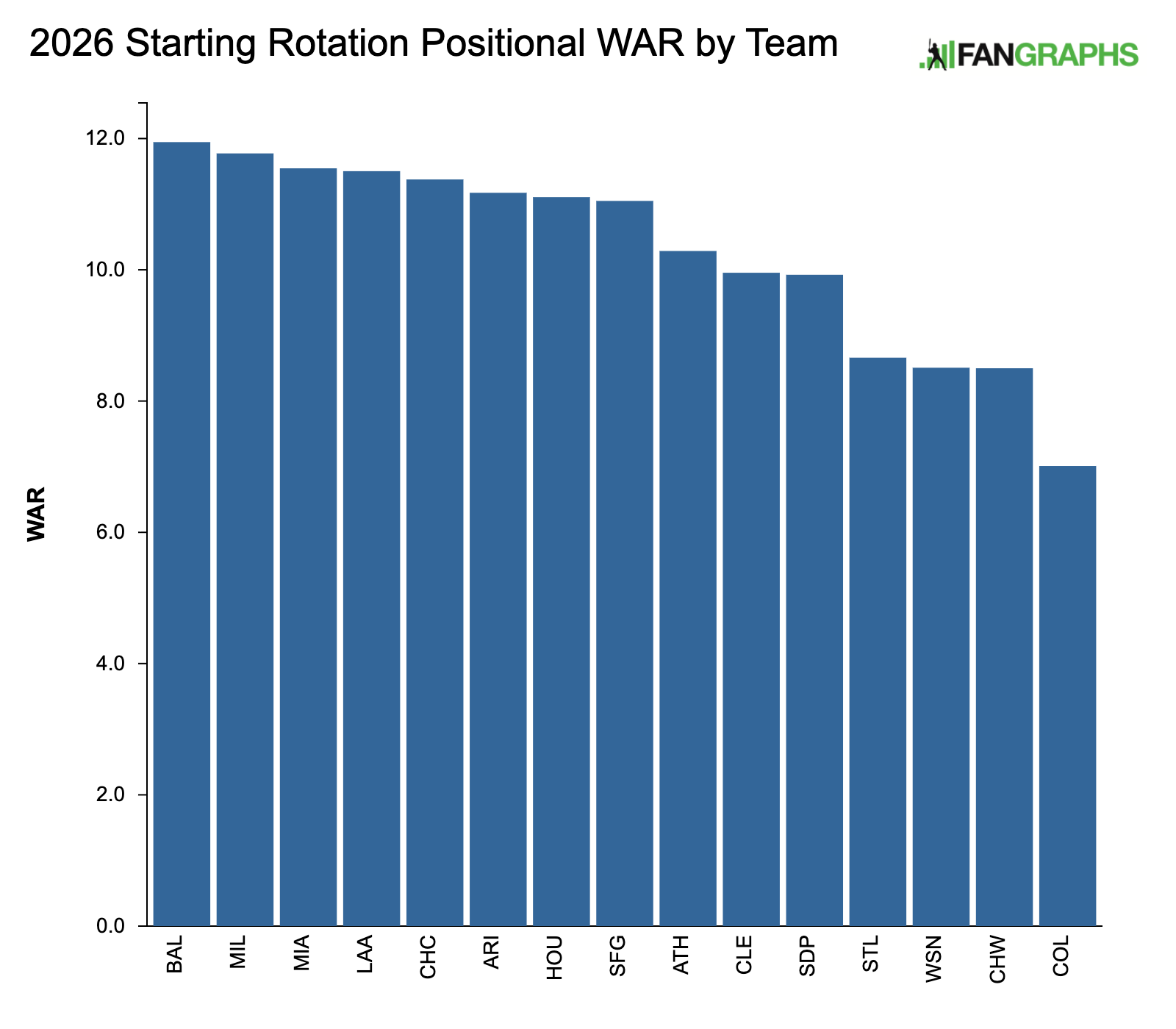
In football, they say that defense wins championships; in the baseball version of that adage, it’s pitching that leads to rings. The rotation plays a huge part in determining a team’s trajectory over the course of a season; a good one can carry you to October, while a bad one can sink you. To that end, it’s not terribly surprising that only two of the 15 teams in this portion of our power rankings are projected for records over .500; three others are right at .500, while the rest, of course, check in beneath that mark, ranging from the 79-win Padres down to the 66-win Rockies.
Still, pitching is also an avenue to greatly outperform the projections. Injured guys come back stronger than expected, prospects make a leap, established arms enjoy some unforeseen development — it happens every year. And while injuries can end a player’s season, they can also create opportunities for pitchers who are currently stuck further down the depth chart. The teams in the 16-20 range are generally a stone’s throw from winding up in the top half of the rankings, so it wouldn’t be too shocking if one of them made the playoffs. And while the teams at the bottom face a particularly steep climb, three teams in the bottom 10 of last year’s rankings reached the postseason — the Cubs, Guardians, and Blue Jays — and there is a good chance we see something similar this season. In fact, it could be two of the same three teams, with Houston taking the place of the defending AL pennant winners, who have climbed into this year’s top 10. I also wouldn’t be surprised if the Padres made the playoffs from this group, though these projections are a sobering reminder of where they are right now.
| Name | IP | K/9 | BB/9 | HR/9 | BABIP | LOB% | ERA | FIP | WAR |
|---|---|---|---|---|---|---|---|---|---|
| Chris Bassitt | 166 | 8.2 | 3.1 | 1.2 | .297 | 72.3% | 4.18 | 4.29 | 1.9 |
| Shane Baz | 152 | 8.8 | 3.2 | 1.3 | .292 | 71.5% | 4.28 | 4.24 | 1.8 |
| Trevor Rogers | 151 | 7.7 | 2.9 | 1.1 | .296 | 71.9% | 4.08 | 4.08 | 2.2 |
| Kyle Bradish | 146 | 9.5 | 2.8 | 1.0 | .295 | 73.3% | 3.62 | 3.54 | 3.1 |
| Zach Eflin | 146 | 6.9 | 1.7 | 1.4 | .296 | 70.7% | 4.35 | 4.30 | 1.5 |
| Dean Kremer | 91 | 7.7 | 2.7 | 1.3 | .293 | 71.5% | 4.35 | 4.35 | 1.0 |
| Tyler Wells | 17 | 8.1 | 2.3 | 1.6 | .282 | 71.9% | 4.36 | 4.47 | 0.2 |
| Cade Povich | 9 | 8.9 | 3.1 | 1.2 | .295 | 72.8% | 4.08 | 4.02 | 0.1 |
| Brandon Young | 8 | 7.9 | 2.6 | 1.4 | .295 | 71.8% | 4.37 | 4.31 | 0.1 |
| Trey Gibson | 9 | 8.0 | 3.3 | 1.2 | .297 | 70.1% | 4.43 | 4.34 | 0.1 |
| Total | 894 | 8.2 | 2.8 | 1.2 | .295 | 71.9% | 4.14 | 4.13 | 11.9 |
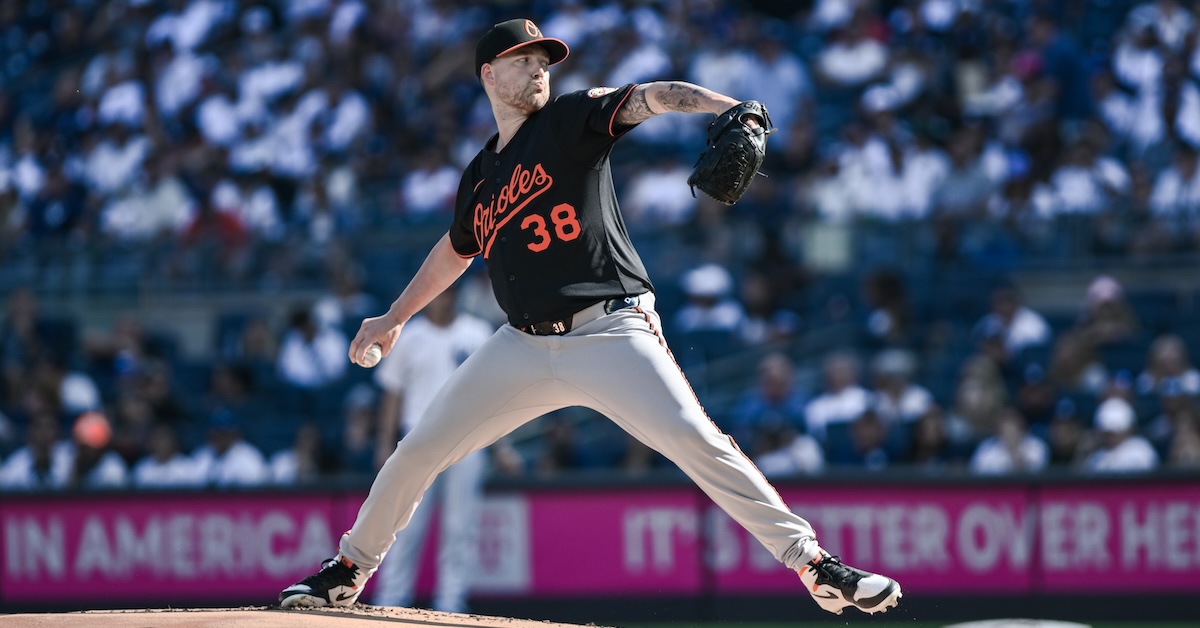
I had some smoke for the Orioles after their tepid 2024-25 offseason left little hope of their pitching being good enough for the AL East. What a difference a year makes, though, as I quite like their rebuilt rotation heading into 2026. Bradish looked amazing in six starts back from injury late last season and seems ready to return to the level of dominance he showed in 2023 – provided he can stay healthy, of course. The fantasy community is fully bought in on his return, pushing him to the 20th starter off the board in NFBC’s Main Event drafts. The O’s 2024 trade with Miami was elevated to win-win status last year, as Rogers showed that he still has juice when healthy; his excellent 2025 even topped his breakout 2021 on a per inning basis. The next step is a full season of work. His career high was 133 innings in 2021 and he was at 110 last year. Baltimore is no doubt hoping he can at least reach the 151 frames projected here.
Baz is the X-factor for this team. He finally stayed healthy for a full season, but it came at Steinbrenner Field, where he allowed 2.0 HR/9 in 16 starts, resulting in a 5.90 home ERA. The Orioles likely saw the star version of Baz on the road and felt they could get more of that across a full season. His road home run rate was a far more manageable 0.9 mark, leading to a 3.86 ERA/1.21 WHIP combo in 84 innings. Home run suppression will play a substantial role in his final ERA.
It was an ugly, injury washout season for Eflin in 2025, as he threw 71.1 innings of near-6.00 ERA ball. If healthy, I think there’s a massive rebound incoming. I don’t see any reason to believe he isn’t still the same guy he was from 2023-24 when healthy. That’s a key caveat, of course, but he certainly looked to be at 100% this spring. The Orioles brought in Bassitt as another innings-eating veteran who should at least deliver 30 cromulent starts while still holding enough upside to reach a mid-3.00s ERA after posting a 4.06 mark in 341.1 innings the last two seasons.
Kremer might be the bargain bin version of Eflin and Bassitt; he has shown he can chow down on a bunch of innings and keep his team in the game every fifth day. He’ll start the season in Triple-A and almost assuredly be the first man up in the event of any long-term opening.
Povich’s prospect shine has all but dimmed, while Young has always been an org-level arm with backend starter upside. If the Orioles are left turning to either for any significant amount of time, things have gone south. Gibson (no. 83) and Luis De León (no. 64) give them a pair of Top 100 guys who could be available at some point in 2026. Gibson has reached Triple-A and will be a phone call away, while De León is a bit further off; he still needs to refine his command and control. He has just one pro stop with a sub-10% walk rate (28 inning in Low-A in 2024) and hasn’t yet reached Triple-A, so without a big developmental step, he’s likely a summer consideration at best.
| Name | IP | K/9 | BB/9 | HR/9 | BABIP | LOB% | ERA | FIP | WAR |
|---|---|---|---|---|---|---|---|---|---|
| Brandon Woodruff | 151 | 9.5 | 2.4 | 1.3 | .285 | 73.8% | 3.75 | 3.78 | 2.9 |
| Chad Patrick | 141 | 8.4 | 2.9 | 1.4 | .283 | 71.4% | 4.42 | 4.46 | 1.5 |
| Jacob Misiorowski | 127 | 10.3 | 4.1 | 1.1 | .283 | 72.8% | 3.99 | 4.05 | 1.8 |
| Quinn Priester | 122 | 7.5 | 3.1 | 1.1 | .292 | 71.2% | 4.12 | 4.16 | 1.4 |
| Kyle Harrison | 90 | 8.9 | 3.6 | 1.2 | .291 | 72.2% | 4.27 | 4.30 | 1.0 |
| Logan Henderson | 75 | 9.0 | 2.8 | 1.4 | .281 | 72.5% | 4.15 | 4.16 | 1.1 |
| Brandon Sproat | 76 | 7.7 | 3.4 | 1.1 | .289 | 70.7% | 4.21 | 4.28 | 0.9 |
| Robert Gasser | 50 | 8.3 | 2.8 | 1.2 | .287 | 72.2% | 4.06 | 4.21 | 0.7 |
| Shane Drohan | 16 | 8.4 | 3.8 | 1.2 | .289 | 72.0% | 4.29 | 4.35 | 0.2 |
| Aaron Ashby | 9 | 9.3 | 4.4 | 0.8 | .296 | 73.4% | 3.76 | 3.85 | 0.1 |
| Carlos Rodriguez | 9 | 8.3 | 3.6 | 1.3 | .283 | 71.1% | 4.44 | 4.53 | 0.1 |
| Total | 866 | 8.8 | 3.2 | 1.2 | .286 | 72.2% | 4.11 | 4.16 | 11.8 |
Injuries have reshuffled the Brewers rotation a few times already this spring, leading to Misiorowski, their young flamethrower, getting the ball on Opening Day. His control issues bake in some downside for Miz, but the upside is obvious and massive. While he is getting the Opening Day nod, the Brewers still see at Woodruff as their ace, provided he’s healthy. He remade himself a bit last year to combat a severe velocity drop and it worked. He shaved 10 points off his fastball usage, developed a cutter to take its place, and ended up with a career-best 26.8% K-BB. Milwaukee has the depth, at least right now, to manage him carefully and add extra days of rest where necessary.
While it’s easy to see Patrick as last year’s Tobias Myers, the comp robs Patrick of the clear stuff advantage he has over Myers, which gives him a better shot at sustaining his success. Patrick’s 105 Stuff+ is 16 points clear of Myers’ 2024 mark. Priester had a great summer breakout last year and seemed primed to build on that success in 2026, but the hopes of that have been dashed a bit by a nerve injury in his wrist that is apparently in the thoracic outlet syndrome family. And I’ll just be real, that’s a toxic family. You don’t want any part of it! Priester’s version is the least serious of the three varieties, and early estimates have him out for a month or so, but I’m skeptical. Worse yet, he could feasibly lose his job in the meantime because of how many options the Brewers have available.
Maybe Harrison will follow in Priester’s path as a former top prospect acquired from Boston in his post-hype phase. An excellent spring helped him secure a role in the rotation, though a late-March blister is at least worth watching in case it sets him back a little bit. Sproat was part of Freddy Peralta trade and could be in line for his first full season despite the projections coming in light on his innings. He threw 141.2 innings between Triple-A and the majors in 2025, so he should at least be in consideration for 30 starts if he’s pitching well. The Brewers have consistently gotten the most out of their pitchers, so it’s always exciting when they bring in big prospects from somewhere else, even an org as adept at pitching dev as the Mets have been of late.
Health has eluded Gasser and Henderson throughout their pro careers, including this spring for Henderson, as some lingering elbow soreness is thought to be part of why he isn’t breaking camp with the team. Gasser made his return from TJ last year; he threw 44 innings mostly at Triple-A, so even a best-case scenario is unlikely to result in a full workload this year. I still have a soft spot for him and think he could be this year’s Patrick for 80-90 innings if the opportunity presents itself. And don’t be surprised if Milwaukee gets the most out of Drohan, who was part of the Harrison trade. He might wind up being a lefty out of their bullpen, but he’s got a live arm.
| Name | IP | K/9 | BB/9 | HR/9 | BABIP | LOB% | ERA | FIP | WAR |
|---|---|---|---|---|---|---|---|---|---|
| Sandy Alcantara | 188 | 7.5 | 2.6 | 1.0 | .292 | 69.7% | 4.08 | 3.92 | 2.7 |
| Eury Pérez | 135 | 9.7 | 3.1 | 1.3 | .282 | 71.7% | 4.04 | 3.93 | 2.3 |
| Max Meyer | 127 | 8.1 | 3.0 | 1.2 | .297 | 71.3% | 4.23 | 4.15 | 1.5 |
| Chris Paddack | 122 | 6.9 | 2.3 | 1.5 | .293 | 68.8% | 4.84 | 4.68 | 1.0 |
| Braxton Garrett | 104 | 7.8 | 2.2 | 1.1 | .298 | 72.2% | 3.88 | 3.92 | 1.6 |
| Robby Snelling | 95 | 7.8 | 3.1 | 1.1 | .295 | 72.9% | 4.03 | 4.10 | 1.3 |
| Janson Junk | 55 | 6.5 | 1.9 | 1.2 | .296 | 69.0% | 4.34 | 4.14 | 0.7 |
| Thomas White | 24 | 8.9 | 4.4 | 1.1 | .291 | 72.6% | 4.21 | 4.36 | 0.2 |
| Ryan Gusto | 17 | 7.6 | 3.1 | 1.3 | .294 | 71.2% | 4.45 | 4.43 | 0.2 |
| Dax Fulton | 9 | 7.5 | 4.2 | 1.0 | .295 | 71.2% | 4.44 | 4.51 | 0.1 |
| Total | 876 | 7.9 | 2.7 | 1.2 | .293 | 70.9% | 4.20 | 4.12 | 11.5 |
Are the Marlins on the rise? They won 79 games last year while their ace, Alcantara, spent 175 innings shaking off the post-TJ cobwebs with a 5.36 ERA. He looked more like the star version of himself down the stretch, going at least six innings in each of his last eight starts with a 2.63 ERA, this after a 6.55 through his first 23. A return to 200 innings is on the table for him in 2026.
Pérez and Meyer are both in line for their best seasons as big leaguers. Much like Alcantara, Pérez’s 2025 was marked by the normal ups and downs of a return from TJ, especially in August, when he bookended his month with six scoreless against the Yankees and five earned in less than an inning at the Mets. He closed the season with a 2.70 ERA and 33 strikeouts in his last 20 innings. Meyer was undercut by a June hip surgery, but his skills had returned before that, with a 16.8% K-BB%, up six points from 2024. A career 1.97 HR/9 has been the biggest hurdle to getting his 5.29 ERA in line with his 4.05 SIERA. The projections see his talent and don’t believe that either his home run rate or his .310 BABIP are his true level. Hopefully he can stay healthy enough to prove them right.
Paddack had a fantastic spring (19.1% K-BB%) to lock down a rotation spot, but it seems likely that he’s just keeping the spot warm for a number of better options. Garrett lost out on the fifth spot to Junk, but some of that might be the Marlins slow-rolling his recovery from an elbow surgery that cost him all of 2025. Junk is a control artist who had stretches of success last year but will always be fighting an uphill battle with a 17% strikeout rate. Snelling was dancing around a rotation spot this spring, but was always a long shot as a non-roster invitee. He was excellent in 63.2 innings at Triple-A last year and should be among the first couple arms up for Miami.
White slotted in ninth on this year’s Top 100, well clear of Snelling at no. 80, but for 2026 alone, Snelling likely has the edge, as he’s a year older and has a lot more experience in the high minors. As pointed out in his Top 100 write-up, White saw a big spike in walks last year (up to about 14%), though it was a new development as opposed to a career-long issue. If his control takes a leap early, he can put himself in line for a first half call-up. Two factors will determine the order of the Garrett-Snelling-White trio getting called up: 1) who is on schedule and 2) how long they’re needed. Garrett’s also the only one of the three on the 40-man, which could give him an edge.
Fulton, Gusto, and Bradley Blalock are also on the 40-man roster and one of them could be called up ahead of those three for a one-off start if a big leaguer is simply being skipped. Blalock garnered some attention when the Marlins got him from the Rockies, because despite atrocious results last year, there are some who see his high arm action as a legitimate weapon that can be leveraged outside of Coors. The extent to which that is true remains to be seen, as the underlying numbers didn’t suggest much success, but the park change alone should be enough to improve his 9.36 ERA.
| Name | IP | K/9 | BB/9 | HR/9 | BABIP | LOB% | ERA | FIP | WAR |
|---|---|---|---|---|---|---|---|---|---|
| Yusei Kikuchi | 169 | 9.2 | 3.3 | 1.3 | .303 | 73.8% | 4.21 | 4.21 | 2.3 |
| José Soriano | 176 | 8.4 | 3.9 | 0.8 | .301 | 71.7% | 3.86 | 3.84 | 2.9 |
| Reid Detmers | 135 | 9.9 | 3.3 | 1.2 | .293 | 71.5% | 4.07 | 3.86 | 2.2 |
| Grayson Rodriguez | 113 | 9.4 | 3.0 | 1.2 | .296 | 72.7% | 3.95 | 3.87 | 1.9 |
| Caden Dana | 69 | 7.9 | 3.9 | 1.5 | .291 | 69.6% | 4.99 | 4.96 | 0.3 |
| Jack Kochanowicz | 60 | 5.6 | 3.3 | 1.2 | .298 | 67.6% | 4.99 | 4.94 | 0.3 |
| Ryan Johnson | 50 | 7.9 | 2.9 | 1.2 | .296 | 71.5% | 4.28 | 4.15 | 0.8 |
| Alek Manoah | 43 | 7.6 | 3.7 | 1.3 | .290 | 68.8% | 4.75 | 4.73 | 0.3 |
| George Klassen | 33 | 8.2 | 3.8 | 1.2 | .295 | 70.9% | 4.53 | 4.48 | 0.3 |
| Sam Aldegheri | 26 | 6.6 | 4.2 | 1.5 | .291 | 68.7% | 5.35 | 5.42 | 0.0 |
| Mitch Farris | 9 | 7.9 | 3.9 | 1.4 | .294 | 70.7% | 4.81 | 4.77 | 0.1 |
| Total | 884 | 8.6 | 3.5 | 1.2 | .297 | 71.4% | 4.28 | 4.22 | 11.5 |
Mike Maddux joined the Angels in the hopes of converting a rotation that has ranked 28th in WAR since 2023 into a formidable group. The projections at least see something for him to work with. I’ve been a Detmers and Soriano stan the last few years, and I just can’t seem to quit them. Detmers was nasty out of the bullpen last year and will get another opportunity to start this year, while Soriano took a step back and churned out a modest 10.2% K-BB%. He’s still a groundball machine with a 100-mph sinker, so I wouldn’t rule out a potential leap. I suppose I can’t aggressively promote Detmers and then pretend Kikuchi is all that far from him in talent, if not outright better. Detmers at his best has limited homers much more effectively, but they aren’t fundamentally different.
Rodriguez is headed west after missing all of 2025. He will start the season on the IL after a tumultuous spring that culminated in dead arm. At 26, he’s young enough and has enough raw arm talent that we shouldn’t write him off yet, but I fear the projections are anchored a bit to who he was, not who he is currently. Kochanowicz’s 14.1% strikeout rate was the fifth lowest in baseball (min. 110 innings) last year, so it won’t take much to improve. It’s also why his 20.8% mark this spring is actually notable. Johnson was a 2024 second-rounder who – in classic Angels fashion – made the 2025 team with zero pro experience. He put up a capable 15.3% K-BB% in 14.2 innings of work in 2025, but a .426 BABIP and 2.45 HR/9 tanked the results. He was sent to High-A to finish his season stretching out as a starter. Credit to the Angels for not holding the 7.36 ERA against him and realizing he’s one of their best five right now, at least after Rodriguez’s injury.
Manoah’s -1.3% K-BB% this spring tells you all you need to know about where he is right now. He had just a 6.7% mark in 38.2 minor league innings last year, too. Klassen is the Angels’ top prospect and had a good enough spring to flirt with a rotation spot, especially in an org known for aggressively promoting their prospects, but with just six innings at Triple-A, they want him to get a bit more seasoning ahead of his debut.
Walbert Urena is tracking toward securing a spot in the bullpen, but keep an eye on him. He might have the nastiest stuff on the team. He was ripping 100-mph sinkers in spring and even finding the plate a bit, with an 7.9% walk rate. Brendan nailed it in his Angels list write-up when he said that Urena’s more a thrower than a pitcher, but a tweak or two to this live of an arm can yield big results. Even if he doesn’t work his way into the rotation, he could push toward the ninth inning, perhaps settling in as a multi-inning stopper ahead of whomever takes control of that wide open closer’s role for new manager Kurt Suzuki.
| Name | IP | K/9 | BB/9 | HR/9 | BABIP | LOB% | ERA | FIP | WAR |
|---|---|---|---|---|---|---|---|---|---|
| Matthew Boyd | 167 | 8.0 | 2.6 | 1.2 | .285 | 72.7% | 3.89 | 4.04 | 2.4 |
| Shota Imanaga | 148 | 8.2 | 2.0 | 1.6 | .280 | 74.4% | 4.04 | 4.32 | 1.8 |
| Edward Cabrera | 139 | 9.6 | 3.6 | 1.1 | .285 | 71.8% | 3.92 | 3.93 | 1.9 |
| Jameson Taillon | 141 | 7.0 | 2.1 | 1.5 | .285 | 71.1% | 4.39 | 4.48 | 1.5 |
| Cade Horton | 127 | 7.9 | 2.9 | 1.2 | .281 | 71.6% | 4.12 | 4.24 | 1.4 |
| Justin Steele | 81 | 8.4 | 2.5 | 1.0 | .291 | 73.8% | 3.58 | 3.65 | 1.4 |
| Colin Rea | 46 | 7.1 | 2.5 | 1.3 | .289 | 70.8% | 4.36 | 4.41 | 0.5 |
| Javier Assad | 17 | 7.4 | 3.3 | 1.1 | .288 | 72.8% | 4.09 | 4.36 | 0.1 |
| Ben Brown | 19 | 9.9 | 3.0 | 1.1 | .290 | 71.9% | 3.78 | 3.56 | 0.4 |
| Jordan Wicks | 8 | 8.1 | 2.7 | 1.1 | .292 | 73.4% | 3.84 | 3.94 | 0.1 |
| Total | 893 | 8.1 | 2.6 | 1.3 | .284 | 72.4% | 4.03 | 4.15 | 11.4 |
I was positively stunned to see the Cubs in my section of the starting pitcher write-ups this year. Maybe it’s just that I love most of their starting five and gave that a lot of weight, because they are sorely lacking in depth behind this group. Boyd’s skills aren’t in question, but he averaged 50 innings a season from 2021-24 before his 179.2-inning campaign last year. The Imanaga-Cabrera-Horton trio will go a long way to determining the team’s fate in 2026. Imanaga’s velo is up nearly two ticks this spring, which is all well and good, but even that spike couldn’t help his ever-present home run problem (3.46 HR/9 in 13 spring innings). I’d laugh that off as a small sample fluke if it weren’t for his 1.64 mark in the majors. Those long balls will always make him a volatile arm who is a multi-homer inning away from a disastrous outing. His 3.28 career ERA despite the homers shows just how good he is when he keeps the ball in the park.
Concerns about a Horton backslide make sense when looking at his 2.67 ERA against a 4.26 SIERA, but that’s only if he holds firm at a 13.4% K-BB%, and there is plenty of reason to believe he can be quite a bit better than that. Premium velocity and a deep arsenal offer avenues for strikeout upside. He showed it throughout his minor league career and is hinting at more already in 2026 with a sharp spring (25% K, 19% SwStr). Cabrera, on the other hand, has shown nothing but strikeout prowess. OK, that’s an overstatement, but his 25.9% career rate has been the centerpiece of his profile, though it has been regularly drowned out by his 11.7% walk rate and a litany of injuries. His 137.2 innings last year was his first time eclipsing 100 and it vindicated his proponents, as a fullish, only modestly injured season allowed him to fully break out thanks to a career-best 8.3% walk rate supporting the strikeouts.
I’ve pointed to a lot of impressive springs in this article, all while acknowledging that the tiny samples can only be so indicative of skill changes, and yet even with those same caveats in place, I must express my grave concern over what we’ve seen from Taillon so far. His skills have waned to those of a backend starter, which is fine, but he wasn’t even close to that level this spring, toting a meager 4.1% K-BB% in his five starts (13.1 innings). The velocity is down another tick to 91.4 mph, and the guys he doesn’t walk (12.2% walk rate) are definitely getting a hit (17.6 H/9) and very often a homer (6.75 HR/9). And yes, the Dodgers did a lot of the damage, dropping 10 earned runs on him, but he gave up 16 more runs in his other starts, so it’s not one dud tanking a small sample.
Let’s not overlook Rea’s excellent contributions last year, as every one of his 159.1 innings were important to the Cubs. He’s lived in a remarkably tight four-point SIERA band over the last three seasons — 4.37, 4.33, 4.36 — so a low-to-mid-4.00s output feels like a reasonable expectation. Brown is lurking and could be an early replacement for Taillon. He had a 18.9% K-BB% in 106 innings last year, but a .347 BABIP and 1.52 HR/9 saddled him with an ERA near 6.00, nowhere near his 3.52 SIERA. He’s also still just a two-pitch pitcher, meaning he’s likely best as a 1-3 inning guy out of the ‘pen. Ideally, the Cubs can keep things afloat until Steele returns, but it’s also a bit risky for them to pin their hopes on their fallen ace returning from a UCL revision less than a year ago (April 2025).
| Name | IP | K/9 | BB/9 | HR/9 | BABIP | LOB% | ERA | FIP | WAR |
|---|---|---|---|---|---|---|---|---|---|
| Zac Gallen | 182 | 8.4 | 2.9 | 1.1 | .295 | 72.2% | 4.03 | 3.99 | 2.1 |
| Merrill Kelly | 169 | 8.0 | 2.7 | 1.2 | .294 | 73.6% | 3.94 | 4.03 | 2.2 |
| Brandon Pfaadt | 162 | 8.0 | 2.1 | 1.2 | .302 | 70.3% | 4.22 | 3.95 | 2.0 |
| Ryne Nelson | 157 | 7.4 | 2.5 | 1.2 | .291 | 71.8% | 4.09 | 4.14 | 1.7 |
| Eduardo Rodriguez | 124 | 8.1 | 3.2 | 1.2 | .299 | 72.9% | 4.22 | 4.23 | 1.5 |
| Michael Soroka | 60 | 9.0 | 3.3 | 1.1 | .291 | 70.9% | 4.08 | 4.03 | 0.7 |
| Corbin Burnes | 39 | 8.6 | 2.8 | 0.9 | .292 | 74.0% | 3.51 | 3.59 | 0.6 |
| Kohl Drake | 8 | 7.9 | 3.4 | 1.2 | .295 | 72.1% | 4.33 | 4.38 | 0.1 |
| Mitch Bratt | 9 | 7.6 | 2.3 | 1.2 | .294 | 72.1% | 4.14 | 4.15 | 0.1 |
| Cristian Mena | 9 | 8.5 | 3.3 | 1.1 | .295 | 73.2% | 3.91 | 3.95 | 0.1 |
| Total | 919 | 8.1 | 2.7 | 1.2 | .296 | 72.2% | 4.07 | 4.04 | 11.2 |
If Kelly weren’t starting the season on the IL, this rotation would basically be exactly like last year’s. Kelly is returning after a half-season layover in Texas, and the D-backs re-signed Zac Gallen after he declined the qualifying offer… to a contract that ended up being worth the exact same amount of money as the QO. Are his previous heights still achievable, or is he now an innings-eating no. 3 type? Nelson is the upside play here. He’s shown he can make it through a full season multiple times over now, but without a jump in strikeout rate, he likely peaked with his 2025 campaign.
Pfaadt’s fortunes will probably always be determined by how many home runs he gives up; his career 1.43 HR/9 has overshadowed his 16.5% K-BB% and saddled him with a 5.13 ERA. He even took a big step forward against lefties last year after severe platoon issues in his first two seasons, but the homers just shifted to the righties, so his results were worse than in 2024. Pfaadt has reworked his arsenal, getting even further away from his four-seamer, and we’ll see if heavier emphasis on his secondaries can finally shave that homer rate down. The ERA estimators suggest that E-Rod is half a run better than the low-5.00s mark he posted last year, though he likely won’t get there without some improvement to the 1.46 HR/9 he posted over his 154.1 innings.
I continue to hold a soft spot for Soroka while fully understanding that his flaws and persistent health issues make it tough to bank on more than the 60 innings we have him projected for here, though we do expect him to pick up some additional innings in the bullpen. Burnes is recovering from a June 2025 Tommy John, so he might be able to give them a strong September after shaking off the cobwebs, but he’s unlikely to be his stud self upon his immediate return.
| Name | IP | K/9 | BB/9 | HR/9 | BABIP | LOB% | ERA | FIP | WAR |
|---|---|---|---|---|---|---|---|---|---|
| Hunter Brown | 183 | 9.7 | 3.0 | 0.9 | .290 | 75.2% | 3.34 | 3.44 | 3.8 |
| Cristian Javier | 148 | 8.4 | 3.8 | 1.5 | .278 | 71.0% | 4.67 | 4.78 | 1.2 |
| Tatsuya Imai | 153 | 8.5 | 3.7 | 1.2 | .305 | 71.6% | 4.37 | 4.27 | 1.8 |
| Mike Burrows | 129 | 8.9 | 3.1 | 1.3 | .287 | 72.7% | 4.11 | 4.18 | 1.7 |
| Lance McCullers Jr. | 95 | 8.7 | 4.3 | 1.1 | .296 | 71.7% | 4.38 | 4.45 | 1.0 |
| Spencer Arrighetti | 70 | 9.0 | 4.0 | 1.3 | .287 | 71.8% | 4.46 | 4.55 | 0.5 |
| Ryan Weiss | 47 | 8.9 | 3.3 | 1.2 | .295 | 71.9% | 4.20 | 4.20 | 0.6 |
| Jason Alexander | 26 | 6.8 | 3.0 | 1.3 | .297 | 71.0% | 4.51 | 4.62 | 0.2 |
| AJ Blubaugh | 9 | 8.3 | 3.7 | 1.3 | .286 | 72.0% | 4.41 | 4.55 | 0.1 |
| Kai-Wei Teng | 9 | 8.6 | 3.8 | 1.1 | .292 | 69.3% | 4.42 | 4.37 | 0.1 |
| Hayden Wesneski | 9 | 8.6 | 2.9 | 1.3 | .287 | 71.9% | 4.23 | 4.25 | 0.1 |
| Ronel Blanco | 9 | 9.1 | 3.6 | 1.3 | .284 | 74.0% | 4.13 | 4.33 | 0.1 |
| Total | 886 | 8.8 | 3.5 | 1.2 | .291 | 72.4% | 4.17 | 4.22 | 11.1 |
The horror movie villains rise again! Just when it looked like the Astros might enter a transition phase into a rebuild, they retooled to put themselves in position to stay competitive out west. A trade and a pair of overseas signings helped completely remake the rotation. Brown backed up his platform 2024 with an even better 2025, and has now established himself among the game’s best. It’d be fun to dream on Javier returning to his pre-injury prominence of 2021-22, but he isn’t missing bats at anywhere near that clip these days and has subsequently become more hittable since Tommy John surgery. We always knew the .230 BABIP he ran those two seasons was him peaking. That’s just not a sustainable level for anyone, but especially not a soft-tossing kitchen sink righty.
Houston was a surprise landing spot for Imai, and the duration of his deal — at three years, it fell shy of Ben’s prediction (five years) and the crowd’s (four years) — was unexpected as well. It’s always hard to predict how someone will do when coming over from NPB, but Imai has all the tools to be good immediately thanks to a swing-and-miss arsenal. The concerns are his size and control. There just aren’t many successful righties under 6-feet. He has lowered his walk rate every year since 2010 (it was down to 7% last season), but the projections have him trending toward a 10% mark, and if he’s having to constantly strike his way out of trouble, it could result in a bevy of four- to five-inning outings. If McCullers can’t stay healthy and find some consistency, Weiss will get an opportunity. He is back after a strong two-year stint in the KBO. He upped his velocity nearly three ticks to 94.6 and started missing bats with his slider. He’ll likely work multi-inning stints out of the bullpen until a rotation spot opens up.
Burrows came over in a three-way deal with Pittsburgh and Tampa Bay on the heels of a solid 96-inning debut (16.4% K-BB%). A full season of something near that level would be great for the Astros. They don’t really need a huge skills breakout from him to feel good about their end of the deal. Arrighetti has filthy stuff and has shown he can miss bats, but he’s always had modest control at best. He’s still thrown just 180.1 career innings, and the ‘Stros likely need to stay committed to him starting for depth purposes, but if it doesn’t work out, it’s easy to envision a successful bullpen transition in the future.
I’m not even going to waste your time with my bevy of Blubaugh puns and will simply say that he posted a 28.2% strikeout rate in his 32-inning sample last year. Wesneski and Blanco are both working their way back from Tommy John, making them second-half reinforcements at most and more likely to contribute in 2027.
| Name | IP | K/9 | BB/9 | HR/9 | BABIP | LOB% | ERA | FIP | WAR |
|---|---|---|---|---|---|---|---|---|---|
| Logan Webb | 202 | 8.5 | 2.0 | 0.7 | .303 | 73.6% | 3.19 | 3.03 | 4.5 |
| Robbie Ray | 174 | 9.1 | 3.4 | 1.3 | .289 | 73.7% | 4.12 | 4.23 | 1.5 |
| Tyler Mahle | 137 | 7.4 | 2.7 | 1.2 | .292 | 72.5% | 4.05 | 4.15 | 1.3 |
| Adrian Houser | 147 | 6.4 | 3.0 | 1.0 | .299 | 70.7% | 4.23 | 4.24 | 1.2 |
| Landen Roupp | 118 | 8.4 | 3.5 | 1.0 | .297 | 72.8% | 3.95 | 3.92 | 1.3 |
| Trevor McDonald | 46 | 7.0 | 3.0 | 1.0 | .297 | 70.3% | 4.20 | 4.23 | 0.4 |
| Carson Whisenhunt | 42 | 7.1 | 3.1 | 1.1 | .295 | 71.3% | 4.33 | 4.35 | 0.4 |
| Blade Tidwell | 18 | 7.9 | 3.5 | 1.2 | .291 | 71.7% | 4.31 | 4.37 | 0.2 |
| Carson Seymour | 17 | 7.2 | 3.3 | 1.0 | .298 | 71.5% | 4.15 | 4.22 | 0.1 |
| Keaton Winn | 8 | 8.1 | 2.6 | 1.0 | .301 | 71.7% | 3.91 | 3.78 | 0.1 |
| Total | 909 | 7.9 | 2.9 | 1.0 | .296 | 72.5% | 3.91 | 3.92 | 11.0 |
The Giants once again have one of the older staffs in the league, maintaining their average age of 31 from last year. Webb is a true anchor and one of the best pitchers in the game. He’s looking to maintain the huge strikeout surge he saw in 2025, and perhaps his 14% swinging strike rate this spring points toward some sustainability. Can a 34-year-old Ray stay healthy for a second straight season? He last did that so from 2021 to 2022, and the Giants are in a spot where they need at least another 150 innings, if not a full repeat of his 182.1 from last year. Mahle was quietly solid with Texas in 2025, but only for 86.2 innings; health remains the biggest concern here. He’s going from one pitcher’s park to another, which should help protect him even if he can’t recapture his standout strikeout rate from 2020-23 (27%). It’s a tough scene when guys with question marks the size of Ray’s and Mahle’s are your no. 2-3 starters.
From there, Houser and Roupp take different paths to similar outcomes as backend starters, with Houser more control-oriented and Roupp generating more strikeouts. It isn’t unheard of for older, established players to take a step forward and tap into some upside, but San Francisco doesn’t really have guys primed to do that. Whisenhunt and Tidwell throw hard but rarely know where it’s going, while McDonald is a sinker-heavy groundballer who’s still been able to consistently miss bats. He probably has the best growth profile of the bunch.
| Name | IP | K/9 | BB/9 | HR/9 | BABIP | LOB% | ERA | FIP | WAR |
|---|---|---|---|---|---|---|---|---|---|
| Luis Severino | 171 | 7.2 | 2.8 | 1.2 | .294 | 69.3% | 4.48 | 4.42 | 2.0 |
| Jeffrey Springs | 162 | 7.7 | 2.8 | 1.4 | .289 | 72.5% | 4.38 | 4.49 | 2.0 |
| Aaron Civale | 130 | 7.8 | 2.9 | 1.4 | .286 | 69.6% | 4.64 | 4.58 | 1.4 |
| Jacob Lopez | 122 | 9.4 | 3.6 | 1.3 | .288 | 72.7% | 4.17 | 4.26 | 1.7 |
| Luis Morales | 105 | 8.0 | 3.6 | 1.3 | .288 | 71.2% | 4.46 | 4.54 | 1.1 |
| J.T. Ginn | 50 | 8.6 | 3.2 | 1.1 | .296 | 71.3% | 4.14 | 4.09 | 0.7 |
| Gage Jump | 49 | 7.8 | 3.1 | 1.2 | .293 | 71.3% | 4.31 | 4.32 | 0.6 |
| Luis Medina | 33 | 8.1 | 4.0 | 1.1 | .293 | 69.9% | 4.51 | 4.44 | 0.4 |
| Gunnar Hoglund | 35 | 6.6 | 2.7 | 1.5 | .291 | 69.8% | 4.86 | 4.93 | 0.2 |
| Braden Nett | 16 | 7.6 | 4.3 | 1.1 | .295 | 70.3% | 4.71 | 4.72 | 0.1 |
| Mason Barnett | 9 | 7.7 | 3.7 | 1.2 | .291 | 70.2% | 4.57 | 4.53 | 0.1 |
| Total | 880 | 7.9 | 3.1 | 1.3 | .290 | 70.9% | 4.43 | 4.45 | 10.3 |
How many different ways can I find to describe a pitcher struggling with a difficult home environment? That was the clear throughline for the staff as a whole last year, with Severino even outright expressing his dislike for pitching in West Sacramento. He thrived on the road (3.02 ERA/1.07 WHIP) but had an ERA nearly double that at home (6.01/1.53). Can we get that 99-mph heater from the WBC to show up in regular season action this year? That would change things, but I think that was adrenaline-fueled awesomeness from getting to represent the D.R. more than it was a new level.
Springs and Civale are the Spiderman meme pointing at each other, and the Athletics surely hope that Civale can walk the same tightrope as Springs of having consistent success on the road to balance out his tough home starts. Lopez broke type, as he thrived at home (2.64 ERA) but gave it all back on the road (5.40). Homers played a role in the difference – he allowed 1.2 HR/9 at home compared to 1.7 on the road – but he also just pitched better at home, with a 25% K-BB%, 11 points clear of his road mark. Morales acquitted himself well in a 48.2-inning debut after slotting in 96th on last year’s Top 100. He is far from a finished product, but a 97-mph heater and nasty slider might be enough to carry him while he figures out the finer points of pitching.
Pitching in Coors Jr. makes it hard to have any real confidence in the fringe depth populating the A’s upper minors. Outside of Jump (no. 81 on the Top 100), there isn’t a clear path to success for this team. Medina might be able to find something with his 98-mph heater in the bullpen in his first year back from Tommy John.
| Name | IP | K/9 | BB/9 | HR/9 | BABIP | LOB% | ERA | FIP | WAR |
|---|---|---|---|---|---|---|---|---|---|
| Gavin Williams | 168 | 9.2 | 3.8 | 1.1 | .288 | 74.6% | 3.85 | 4.08 | 2.1 |
| Tanner Bibee | 182 | 8.4 | 2.7 | 1.2 | .287 | 73.1% | 3.91 | 4.04 | 2.5 |
| Slade Cecconi | 155 | 7.5 | 2.3 | 1.5 | .291 | 70.8% | 4.45 | 4.45 | 1.2 |
| Parker Messick | 129 | 8.3 | 3.1 | 1.2 | .294 | 73.3% | 4.04 | 4.19 | 1.4 |
| Joey Cantillo | 111 | 9.6 | 3.9 | 1.1 | .290 | 75.4% | 3.81 | 4.02 | 1.4 |
| Logan Allen | 105 | 7.4 | 3.5 | 1.2 | .294 | 73.0% | 4.31 | 4.53 | 1.0 |
| Austin Peterson | 18 | 6.6 | 2.3 | 1.4 | .290 | 71.2% | 4.43 | 4.54 | 0.1 |
| Doug Nikhazy | 8 | 8.1 | 4.2 | 1.3 | .288 | 72.9% | 4.43 | 4.68 | 0.1 |
| Ryan Webb | 9 | 7.3 | 4.0 | 1.2 | .295 | 71.4% | 4.61 | 4.80 | 0.0 |
| Trenton Denholm | 9 | 5.9 | 2.5 | 1.4 | .292 | 70.6% | 4.68 | 4.78 | 0.0 |
| Total | 894 | 8.4 | 3.2 | 1.2 | .290 | 73.3% | 4.07 | 4.23 | 10.0 |
Once again, I think the projections are sleeping on the Guardians! I pled their case last year and I’d say they are far better positioned this season, yet they move up just two spots. With the news of Messick beating out Allen for the no. 5 spot, they are now taking their best five north. The floor might be a bit wobbly due to sheer inexperience, but the ceiling is a good bit higher than these projections suggest. Williams emerged in the second half of last year, and another buzzy spring, powered by a 2.7% walk rate, is raising expectations again. Still, it’s worth noting that when he was the talk of the Cactus League last year, he posted a 5.9% walk rate and then went on to deliver an 11.8% in-season mark. So while strong strikeout and walk rates in spring can be indicative of real improvement, they aren’t a guarantee of anything.
Bibee is still Cleveland’s de facto ace, drawing the Opening Day nod. His 2025 highlights the ups and downs of a long season. He rebounded from a pair of April duds (13 earned runs in 10.2 innings) that ballooned his ERA to 5.85 through four starts to get it back down to 3.79 nearing July before a pair of 6.15 ERAs in July and August shot it back up to 4.77. Then in September, when they needed him most, he pitched his best, posting a 1.30 ERA (with the underlying skills to support it) and earning two massive wins against the Tigers to help secure the division crown. The 2023-24 version (3.25 ERA/1.14 WHIP/19% K-BB) of Bibee is still in there, and those implosion starts seemed to be the key difference: He had three other starts with five-plus earned runs outside of the two in April compared to just three in 56 career starts coming into 2025.
The Guardians round out the rotation with three upside arms in their mid-20s. Cantillo took the reliever-to-starter path, joining the rotation on July 3 and putting up his best work of the season with a 2.96 ERA/1.21 WHIP/16% K-BB in 67 innings. The WHIP suggests a sub-3.00 ERA is likely unsustainable with this skill set, but he just needs to be near his 3.83 SIERA to help the rotation, especially if he’s ready for a full season workload. Like Williams, if he can hold on to his spring control gains (6% walk rate), there is huge breakout potential, but even an incremental improvement down to 8-9% from his career 10.1% mark would undoubtedly help.
Cecconi has revamped his arsenal this year, adopting a cutter and using it 31% of the time, primarily at the expense of his slider and four-seamer. The overhaul helped him to a 28.6% strikeout rate in spring, and this is another case where he doesn’t have to perfectly hold this level to take a step forward. He’s had a 19.4% strikeout rate in 236 career innings, so a jump to 23-24% this year would be great. More importantly, I’m curious to see if these changes help him with his home run problem. He allowed 0.71 HR/9 this spring and it wasn’t just some lucky HR/FB rate; he was at 20%. Instead, it was at least in part due to a huge spike in his groundball rate, up 12 points to 53%. Substantially cutting his career 1.68 HR/9 would likely benefit him more than the strikeout boost, but ideally he can deliver both.
Messick impressed in a seven-start sample down the stretch last year. His command-forward profile yields a high floor and low ceiling, making him the least likely of this trio to be a frontliner, but just hitting his projections would be more than enough for Cleveland. Things thin out quickly after the top five. Allen can eat some innings as the first man up, but he’d be lucky to repeat his 4.25 ERA with a 1.40 WHIP. Peterson and Nikhazy are deep org prospects who are on the 40-man and might get a chance by virtue of that if the team needs a stopgap. The sneaky summer savior could be former top prospect Daniel Espino (no. 101 in 2024).
| Name | IP | K/9 | BB/9 | HR/9 | BABIP | LOB% | ERA | FIP | WAR |
|---|---|---|---|---|---|---|---|---|---|
| Nick Pivetta | 173 | 9.9 | 2.7 | 1.4 | .280 | 74.1% | 3.92 | 3.98 | 2.6 |
| Michael King | 161 | 9.5 | 3.3 | 1.1 | .288 | 74.9% | 3.68 | 3.87 | 2.9 |
| Joe Musgrove | 158 | 8.3 | 2.3 | 1.2 | .292 | 72.3% | 3.89 | 3.99 | 2.3 |
| Randy Vásquez | 125 | 6.2 | 3.3 | 1.3 | .286 | 69.4% | 4.80 | 4.95 | 0.7 |
| Germán Márquez | 101 | 6.7 | 3.1 | 1.4 | .299 | 68.7% | 5.00 | 4.83 | 0.6 |
| Griffin Canning | 94 | 8.0 | 3.4 | 1.4 | .292 | 71.8% | 4.53 | 4.60 | 0.6 |
| Walker Buehler | 51 | 7.6 | 3.5 | 1.5 | .295 | 69.4% | 4.98 | 4.92 | 0.2 |
| JP Sears | 17 | 8.0 | 2.5 | 1.6 | .280 | 71.3% | 4.50 | 4.68 | 0.1 |
| Matt Waldron | 9 | 7.1 | 2.8 | 1.4 | .289 | 68.2% | 4.83 | 4.69 | 0.0 |
| Total | 889 | 8.2 | 3.0 | 1.3 | .289 | 71.9% | 4.26 | 4.33 | 9.9 |
If you fell into a coma in 2021 and woke up to see the Padres rotation, you might think it’s really good, especially if I only gave you two bits of news: 1) King’s transition to starting went beautifully and 2) Pivetta developed into a solid mid-rotation arm. Of course, I’d eventually have to break the news that Buehler has gone from an ace to a no. 5 (no. 6??) and then deliver the crushing blow that no, it likely doesn’t matter that Márquez is out of Coors, as he wasn’t just Colorado-bad last year, but flat out bad bad.
So what does San Diego actually have here? King has in fact become quite a nice starter, but he lost half of 2025 to injury. He did make it back in time to finish the season with four starts and looks poised for a full workload in 2026. Unfortunately, the Padres rotation has degraded around King to the point where they now need a big season from him. That said, it’s Pivetta, not King, who would be identified as their ace. His first year as a Padre certainly fit the bill, but did he really curb his home run issues (1.09 HR/9 in 2025; 1.46 career) or just catch a career-low HR/FB rate (10% in 2025; career 15%)? The projections are rightly skeptical that he actually fixed the flaw.
Musgrove’s inning projection could be in peril; he suffered a setback that will put him on the IL to start the season as he’s working back from a October 2024 Tommy John surgery. Despite the extended recovery time, he will likely have some of the standard hiccups associated with TJ returns, so the projected ratios might also be aggressive. That Vásquez was able to put up a 3.84 ERA despite just a 4.6% K-BB% last year is as impressive as it is improbable. Only Antonio Senzatela and Erick Fedde ran a lower K-BB rate in at least 130 innings, and they had ERAs of 6.65 and 5.49, respectively. Rarely does someone draw positive spring attention for a 20.3% strikeout rate, but after a 13.5% mark last year, Vásquez is doing just that. More importantly, it has come with a 2.3-mph velo boost. Still, ven if he maintains both, he’ll likely be at the mercy of his BABIP to reach a sub-4.00 ERA again.
I flippantly suggested it doesn’t matter that Márquez is no longer stuck in Coors, but let’s dream a moment: What if it does? His return from essentially two missed seasons (24 innings combined across 2023-24) was a complete nightmare last year, but maybe just being healthy and outside of the most difficult home park in the league will be enough to regain some level of the core skills that aided him to a 3.84 FIP in 2017-21. Yes, I had to use a sample where the most recent season is five years old just to deliver a glimmer of hope. Seems my initial flippancy might’ve had merit after all.
I’d be remiss if I ignored Buehler’s solid spring (at least, prior to Sunday’s action), which, paired with Musgrove’s start on the IL, earned him the fifth starter role. A 19% K-BB% helped him outrun a .345 BABIP, but his velocity was down another 1.4 mph to 92.6 and he still only had a 3.09 ERA despite not allowing a homer. The problem is, the Padres might need 80-90 innings out of him, and his last outing — seven runs on 11 hits in 3.1 innings — shows why that might be dicey proposition. Canning is a smart dice roll as he recovers from a ruptured Achilles. He could give them some solid innings upon his return, and with the dearth of prospects in the high minors, he’s more need than luxury. He and Sears are cromulent major leaguers who could overachieve for a few months. Sears just hasn’t been able to miss bats more consistently, as he’s more control than command, which leads to far too many homers.
| Name | IP | K/9 | BB/9 | HR/9 | BABIP | LOB% | ERA | FIP | WAR |
|---|---|---|---|---|---|---|---|---|---|
| Matthew Liberatore | 150 | 7.5 | 2.9 | 1.1 | .293 | 70.9% | 4.22 | 4.19 | 1.5 |
| Dustin May | 153 | 8.2 | 3.3 | 1.1 | .288 | 70.2% | 4.19 | 4.18 | 1.7 |
| Andre Pallante | 133 | 6.3 | 3.5 | 0.9 | .300 | 70.4% | 4.25 | 4.22 | 1.3 |
| Michael McGreevy | 127 | 6.3 | 2.2 | 1.0 | .294 | 71.2% | 3.99 | 4.02 | 1.5 |
| Richard Fitts | 115 | 6.8 | 2.7 | 1.3 | .291 | 70.7% | 4.42 | 4.50 | 0.7 |
| Kyle Leahy | 85 | 7.4 | 3.3 | 1.0 | .295 | 71.5% | 4.16 | 4.15 | 1.0 |
| Hunter Dobbins | 69 | 6.4 | 2.9 | 1.2 | .291 | 70.2% | 4.46 | 4.52 | 0.6 |
| Quinn Mathews | 40 | 8.2 | 4.6 | 1.1 | .291 | 72.6% | 4.31 | 4.52 | 0.3 |
| Pete Hansen | 9 | 6.0 | 2.9 | 1.3 | .293 | 70.7% | 4.60 | 4.76 | 0.0 |
| Tink Hence | 8 | 7.7 | 3.7 | 1.2 | .289 | 71.4% | 4.40 | 4.50 | 0.1 |
| Total | 888 | 7.1 | 3.0 | 1.1 | .293 | 70.8% | 4.23 | 4.25 | 8.7 |
This is such a Cardinals rotation, which is to say there’s no real ace and the whiffs will be light. Liberatore made it through a full season last year with 29 starts, but it was a grind. He started strong, struggled through the summer, and then closed nicely in September. His profile is being raised in March by an elite spring training effort (30.4% K-BB%), and the Cards are hoping their former five-time Top 100 prospect can take a leap this year.
May might’ve found the perfect organization for his strikeout-free ways. He’s struggled to turn his undeniably nasty stuff into strikeouts, but he does generate tons of grounders, and the Cardinals infield defense was third in Fielding Run Value, led by shortstop Masyn Winn. Brendan Donovan and Nolan Arenado have been replaced by JJ Wetherholt and Nolan Gorman, so a repeat in that FRV success won’t be easy.
The other homegrown starters in the rotation fit the May mold: low Ks, strong control and heavy groundball inducement sum up Leahy, McGreevy, and Pallante to varying degrees. Pallante’s been on the extreme end for two of them, with a 16% strikeout rate and 64% groundball rate over 460 career innings. McGreevy’s 110 Location+ was tied for fourth highest in baseball, while his 15% strikeout rate was 137th of 143 pitchers (min. 90 innings). Leahy is a strikeout stud by comparison at 20% in his career, though we’ll see how much of that he can hold as he moves from the bullpen into the rotation this year.
Mathews might be ready to break the mold on this Mickey 17 rotation of control artists, as he posted legitimately strong strikeout rates coming up through the minors (31%). Those unfortunately come at the expense of his control, however, with a 12% walk rate, including an eye-popping 18% mark in 111 Triple-A innings. There was no sign of improvement this spring, so he will head back to Triple-A to start the season. Dobbins and Fitts come over in a pair of trades with Boston. Dobbins is working back from an ACL injury, so he will start the season on the IL; his skills fit the Cardinals mold I’ve outlined throughout this section. Fitts will begin in the Triple-A rotation (and yes, he has the same profile, too).
OK, I’ve finally run out of ways to talk about low-strikeout control artists.
| Name | IP | K/9 | BB/9 | HR/9 | BABIP | LOB% | ERA | FIP | WAR |
|---|---|---|---|---|---|---|---|---|---|
| Cade Cavalli | 137 | 7.7 | 3.2 | 1.0 | .297 | 70.2% | 4.19 | 4.14 | 1.8 |
| Zack Littell | 151 | 6.8 | 1.9 | 1.5 | .292 | 69.8% | 4.62 | 4.60 | 1.4 |
| Miles Mikolas | 139 | 5.9 | 2.1 | 1.5 | .295 | 69.3% | 4.77 | 4.76 | 1.0 |
| Foster Griffin | 129 | 8.1 | 2.6 | 1.2 | .299 | 71.4% | 4.12 | 4.01 | 1.9 |
| Jake Irvin | 117 | 6.8 | 2.9 | 1.4 | .291 | 69.2% | 4.81 | 4.81 | 0.7 |
| Josiah Gray | 79 | 7.8 | 3.8 | 1.6 | .286 | 70.3% | 4.97 | 5.08 | 0.2 |
| Andrew Alvarez | 68 | 6.5 | 3.5 | 1.0 | .297 | 71.1% | 4.36 | 4.49 | 0.8 |
| Brad Lord | 26 | 7.2 | 2.9 | 1.1 | .293 | 69.9% | 4.25 | 4.22 | 0.3 |
| Mitchell Parker | 17 | 6.9 | 3.0 | 1.2 | .293 | 70.4% | 4.49 | 4.42 | 0.2 |
| Riley Cornelio | 8 | 6.7 | 4.0 | 1.4 | .292 | 70.0% | 4.99 | 5.03 | 0.0 |
| Trevor Williams | 8 | 7.2 | 2.6 | 1.4 | .301 | 70.5% | 4.59 | 4.44 | 0.1 |
| DJ Herz | 8 | 9.7 | 4.2 | 1.1 | .286 | 73.5% | 4.02 | 4.14 | 0.1 |
| Total | 888 | 7.1 | 2.7 | 1.3 | .294 | 70.1% | 4.53 | 4.51 | 8.5 |
Despite trading MacKenzie Gore, their de facto no. 1 of the last year two years, there are some points of interest in this Nats rotation, starting with Cavalli, who seems poised for his first full season in the majors. He had four starts of five innings and zero to three earned runs apiece (3.15 ERA) before a rough first inning in his season finale (four unearned runs) ran his pitch count up and limited him to four frames. If he can consistently show his swing-and-miss stuff, there’s breakout upside here. If not, he might just be a righty Gore.
Griffin is returning to the States after an excellent three-year run in Japan (2.57 ERA/1.03 WHIP) during which his command of a deep arsenal helped him put up a 20% K-BB% that tied him with two others for second behind Roki Sasaki. Without the added velo or refined pitch mix of the other pitchers returning from Asia (Anthony Kay is also coming back from NPB, while Cody Ponce 폰세 & Ryan Weiss return from the KBO), there has been a question about how well he will adapt back to MLB.
Irvin showed some promise after a full season in 2024, though I pointed out in last year’s rankings that trouble could be looming if he didn’t fix his 1.39 HR/9. That number went up to 1.9, which tells you all you need to know about his 2025. This spring, he has dialed down his four-seamer usage in favor of a cutter (plus more sliders and changeups) to positive results, chief among them a 0.68 HR/9. If he carries even some of those gains into the regular season, he could return to the 2-WAR level of his 2024.
A pair of veteran control artists join the Nats this year in Mikolas and Littell, a duo they hope to get a combined 300-plus innings from in 2026. Littell led baseball with a 4.2% walk rate rate last year and has a solid 3.80 ERA and 1.17 WHIP over 433 innings since 2023, and yet he didn’t get signed until early March, likely due to his lack of dominance (19.7% strikeout rate). Mikolas has similarly excellent walk rates but even worse strikeout stuff somehow (16% strikeout rate since 2023). Ideally, this pair holds the line with capable quality start and quality start-adjacent outings through July before being traded for some C+-level prospects, allowing some of the younger arms to take over in the second half. The problem is finding these theoretical younger arms.
Gray, a former Top 100 prospect, was working his way back from Tommy John surgery, but has been diagnosed with a flexor strain, and will start the season on the IL. Meanwhile both of the Nats’ top pitching prospects are working back from surgeries of their own: Susana from a September lat surgery and Sykora from an August Tommy John. In December, the team traded for flame-throwing Red Sox prospect Luis Perales, who spent 2025 recovering from Tommy John. He and his 99-mph fastball should get an opportunity if he’s pitching well at Triple-A come summertime. Herz showed flashes of upside in 2024 before missing 2025 with… yep, Tommy John. BRAD LORD! and The Great Cornelio are pitchers with fantastic names who are just ok on the mound, though at least neither of them is currently recovering from TJ.
| Name | IP | K/9 | BB/9 | HR/9 | BABIP | LOB% | ERA | FIP | WAR |
|---|---|---|---|---|---|---|---|---|---|
| Shane Smith | 160 | 8.5 | 3.4 | 1.2 | .286 | 71.0% | 4.18 | 4.27 | 2.0 |
| Davis Martin | 150 | 7.0 | 3.1 | 1.3 | .294 | 70.2% | 4.54 | 4.55 | 1.5 |
| Sean Burke | 141 | 8.5 | 4.0 | 1.4 | .289 | 71.3% | 4.73 | 4.78 | 1.1 |
| Anthony Kay | 120 | 7.4 | 3.4 | 1.2 | .300 | 71.5% | 4.40 | 4.45 | 1.4 |
| Erick Fedde | 99 | 6.9 | 3.5 | 1.5 | .290 | 69.6% | 4.95 | 4.95 | 0.6 |
| Jonathan Cannon | 80 | 6.8 | 3.1 | 1.4 | .292 | 69.5% | 4.79 | 4.79 | 0.7 |
| Drew Thorpe | 43 | 6.8 | 3.2 | 1.4 | .290 | 70.4% | 4.81 | 4.83 | 0.3 |
| Tanner McDougal | 31 | 7.8 | 4.3 | 1.2 | .294 | 70.7% | 4.74 | 4.80 | 0.2 |
| Noah Schultz | 24 | 7.5 | 4.0 | 1.1 | .294 | 70.4% | 4.57 | 4.67 | 0.2 |
| Hagen Smith | 16 | 8.6 | 4.7 | 1.2 | .290 | 70.5% | 4.67 | 4.78 | 0.1 |
| Grant Taylor | 15 | 10.1 | 3.3 | 0.9 | .291 | 73.7% | 3.45 | 3.29 | 0.4 |
| Total | 879 | 7.7 | 3.5 | 1.3 | .292 | 70.7% | 4.56 | 4.60 | 8.5 |
Excitement is rising for the South Siders, though it’s primarily on the hitting side right now. That said, there is some intrigue on the bump. They struck gold with Rule 5 pick and former Brewer Shane Smith, who earned an All-Star bid, hit the rookie wall in June/July, and then closed the year with some of his best work. It was an impressive rookie campaign he hopes to best this year, even if it’s just the same skills across more innings. Martin and Burke had bouts of success in their first full-ish seasons (142.2 and 134.0 innings, respectively) in the big leagues en route to a combined 2.0 WAR, so these projections have some improvement for them.
Kay returns from NPB after having undergone a complete makeover on the mound. He overhauled his arsenal, added velocity, and became a groundball machine. Now the 31-year-old lefty hopes to follow in the footsteps of 2024 Fedde, who Chicago brought back this offseason after he turned into a pumpkin in 2025. Prospects Schultz and Hagen Smith have tremendous upside, though both need a lot of work on their command and control, so barring a leap in development, they’re unlikely to be major contributors in 2026. The best pitcher on the big league roster is likely reliever Grant Taylor, who the White Sox hope to get 100 total innings from by way of multi-inning relief stints and perhaps some turns out of the rotation, as they haven’t closed the book on him as a starter. McDougal and Jedixson Paez are second-tier prospects who could be vying for summer innings in Chicago.
| Name | IP | K/9 | BB/9 | HR/9 | BABIP | LOB% | ERA | FIP | WAR |
|---|---|---|---|---|---|---|---|---|---|
| Kyle Freeland | 160 | 6.7 | 2.4 | 1.4 | .313 | 68.6% | 5.02 | 4.61 | 1.6 |
| Michael Lorenzen | 143 | 7.2 | 3.3 | 1.5 | .303 | 69.3% | 5.07 | 4.92 | 1.1 |
| Jose Quintana | 144 | 6.4 | 3.6 | 1.3 | .302 | 70.2% | 4.86 | 4.85 | 1.2 |
| Tomoyuki Sugano | 116 | 5.7 | 2.1 | 1.6 | .308 | 69.1% | 5.17 | 5.05 | 0.8 |
| Ryan Feltner | 100 | 7.4 | 3.7 | 1.3 | .308 | 68.1% | 5.17 | 4.75 | 0.9 |
| Chase Dollander | 98 | 7.8 | 4.0 | 1.4 | .302 | 68.1% | 5.19 | 4.93 | 0.7 |
| Antonio Senzatela | 43 | 5.5 | 3.0 | 1.4 | .317 | 68.0% | 5.45 | 5.08 | 0.2 |
| Tanner Gordon | 33 | 6.5 | 2.1 | 1.7 | .306 | 68.0% | 5.25 | 4.90 | 0.3 |
| McCade Brown | 15 | 8.3 | 3.9 | 1.5 | .303 | 68.5% | 5.23 | 4.95 | 0.1 |
| Gabriel Hughes | 8 | 6.5 | 3.2 | 1.3 | .309 | 68.9% | 4.97 | 4.70 | 0.1 |
| Sean Sullivan | 9 | 6.6 | 2.6 | 1.6 | .298 | 67.1% | 5.28 | 5.04 | 0.1 |
| Total | 868 | 6.8 | 3.1 | 1.4 | .307 | 68.9% | 5.09 | 4.86 | 7.0 |
Aw, remember when Colorado was 28th last year? That was fun. With Paul DePodesta at the helm, the Rockies have at least advanced past the “concepts of a plan” stage as they finally have someone in charge who plans to view their stadium at altitude as an advantage. In the short-term, they have Dollander and The Vets, pairing their hopeful future ace with four mid-30s arms, including newcomers Lorenzen, Quintana, and Sugano. It’s still a bleak outlook according to the projections, but after a 43-win season, it almost certainly can’t get worse.
The concern with the new arrivals is that none of them miss bats at even an average rate (Lorenzen 21%, Sugano and Quintana 16%). The best way to help pitchers in Coors is a strong defense, particularly in the outfield. The recently acquired Jake McCarthy will combine with Brenton Doyle and Jordan Beck to form an excellent trio, and they’ll get plenty of opportunities to show off their skills with the ball in play that often. Freeland’s 4.41 SIERA was the second best of his career, but still only yielded a 4.98 ERA along with a career-worst 5-17 record.
There will likely continue to be on-the-job growing pains for Dollander as he learns to work his stuff at the major league level in its toughest venue for half of his games. The raw stuff is there to make a leap, and it should play up out of the bullpen. Feltner remains my favorite pitcher on this staff and I still think he could flourish elsewhere. Alas, he remains in Colorado. Gordon has looked good in spring with a 23% K-BB% in 11 innings, dialing down the fastball for more sliders and changeups. Perhaps there’s something to build upon and he can deliver 70-80 useful innings.
Great write up on the Cleveland group. I think 25th is mostly a product of a lack of upper-level depth. They’ll need a big spring from Khal Stephan or if they are in contention I think a SP-trade is the most likely move they make at the deadline.
I’ll take certainly take the over on 25th, but the margin for error is pretty thin.
Ooh I should’ve mentioned Stephan… my miss on that one!!
Yeah, the 25th seems low. They were 19th last year with 9.8 WAR and are being projected for 10.0 WAR which is in line with last year.
So why the drop? Last year the Cardinals were 25th place with 7.6 WAR. Seems like maybe there’s too much starter WAR in the projections. Not sure but also not sure what else would explain that.