
2026 Positional Power Rankings: First Base
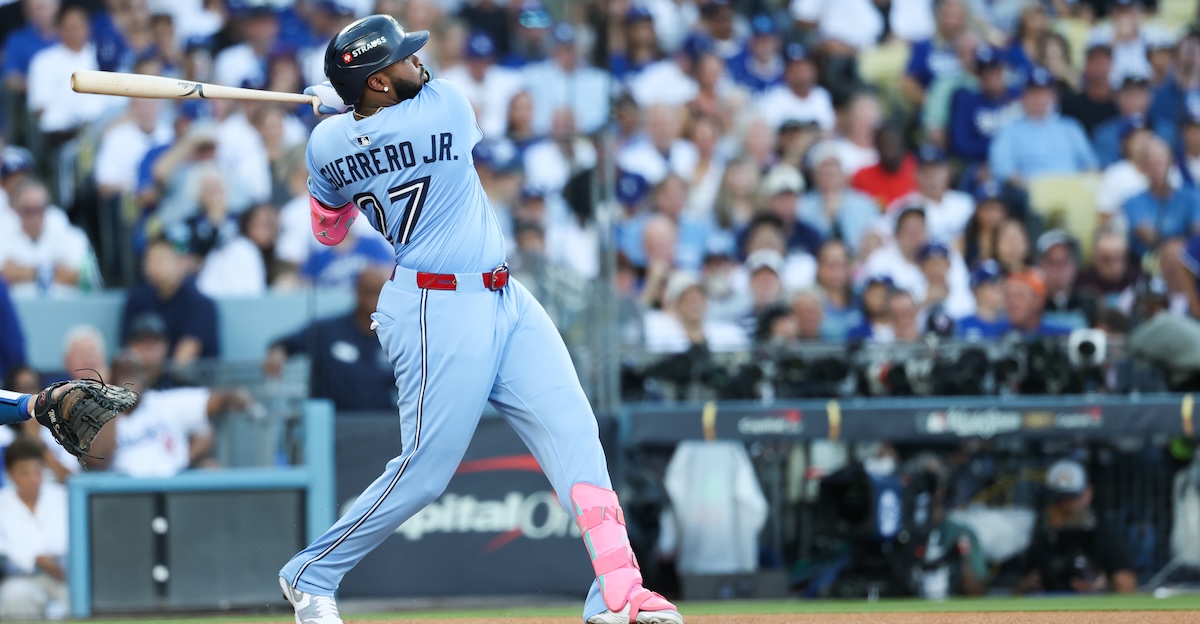
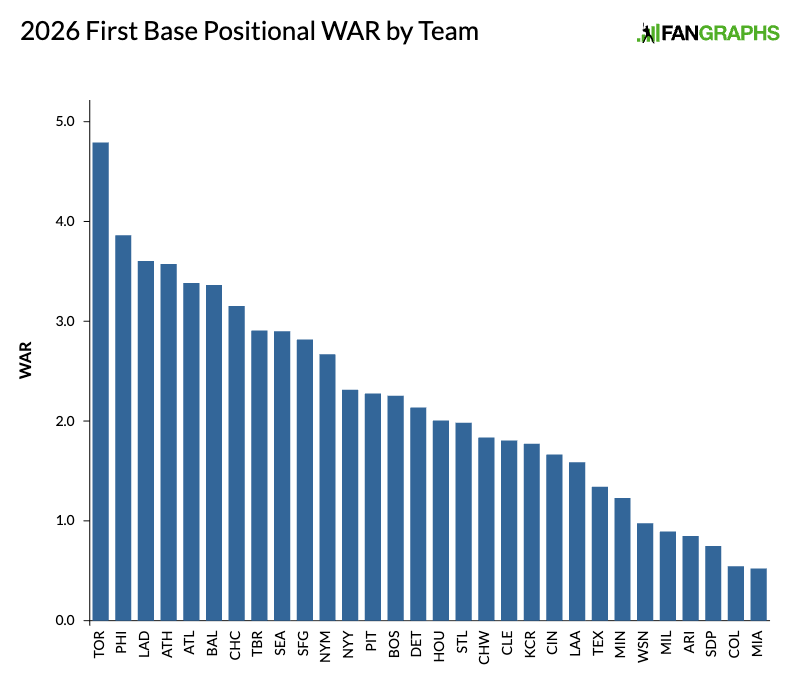
Vladimir Guerrero Jr., Bryce Harper, and Freddie Freeman walk into a bar — the same bar, in fact, as the one they walked into last year, and in the same order; the trio and their assorted backups topped these rankings in 2025, just as they do in ’26. But where they towered over the rest of the field last year, with a full win gap between the third-ranked Dodgers and the fourth-ranked Rays, this time it’s only Guerrero who’s separated from the pack. The 0.9-WAR gap between the Blue Jays and Phillies is just 0.1 WAR less than the gap between those Phillies and ninth-ranked Mariners.
It’s not hard to understand what’s happening. Guerrero is 27 years old, and if he didn’t have his best season by the numbers in 2025 — though a half-billion dollar extension and a near-miss of a championship is still a pretty great year — our projections suggest he’ll rebound. Harper, on the other hand, is 33 and Freeman 36, and while they remain championship-caliber players, both are increasingly prone to the aches and pains that can leave a mark on their performances, as explained below.
It’s not just that those older guys are past their peaks — likely future Hall of Famers, but trending down just the same — it’s that an influx of younger talent is pushing the middle of the pack upward. The 23-year-old Nick Kurtz, 27-year-olds Ben Rice and Jonathan Aranda, and 28-year-olds Michael Busch and Josh Naylor all rank among this year’s top dozen; none was the primary first baseman on a team ranked above no. 14 last year.
Collectively, however, the position lacks the big boppers of yesteryear. In 2024, first basemen combined to produce just a 107 wRC+, the position’s lowest mark for our splits dating back to 2002. They improved to a 109 wRC+ in 2025, but it was still the fourth-lowest mark of that span, with their batting average (.254), on-base percentage (.326), slugging percentage (.429), and isolated power (.175) all among the bottom five as well. Individually, the number of primary first basemen reaching 20 homers (13 in each of the past three seasons) is below what it was in all of the non-pandemic seasons from 2013–22. All of which offers a bit of evidence that some of the game’s offensive talent is flowing into more difficult positions, and who wants to complain about that?
| Name | PA | AVG | OBP | SLG | wOBA | Bat | BsR | Fld | WAR |
|---|---|---|---|---|---|---|---|---|---|
| Vladimir Guerrero Jr. | 651 | .294 | .379 | .521 | .382 | 37.3 | -1.3 | -1.3 | 4.7 |
| Kazuma Okamoto | 28 | .250 | .329 | .453 | .335 | 0.5 | -0.1 | -0.0 | 0.1 |
| Ernie Clement | 14 | .271 | .306 | .398 | .305 | -0.1 | -0.0 | 0.1 | 0.0 |
| Anthony Santander | 7 | .228 | .308 | .443 | .323 | 0.1 | -0.0 | -0.0 | 0.0 |
| Total | 700 | .291 | .375 | .515 | .378 | 37.8 | -1.4 | -1.2 | 4.8 |
After signing a $500 million extension last April, Guerrero didn’t have his best year with the bat, at least during the regular season; his postseason, however, was one for the ages (.397/.494/.795 with eight home runs). Demonstrating new-found selectivity, he set career lows in overall swing rate (42.2%), in-zone swing rate (61.1%), and chase rate (21.2%), and matched his career low in strikeout rate (13.8%), the sixth-lowest mark among players with at least 20 homers. But while his 137 wRC+ (.292/.381/.467) matched his career mark, it was a substantial step below his big 160-plus seasons from 2021 and ’24, and likewise, his 3.9 WAR was well short of those five- and six-win seasons.
For all of his selectivity, Guerrero didn’t hit the ball quite as hard as in years past; in fact, his 92.0-mph average exit velocity was a career low even while his 120.4-mph maximum set a career high. On the other hand, he fell short of his xSLG for the fifth straight season, this time by a hefty 39 points. Defensively, he had arguably his best season with the glove (8 DRS, -1 FRV), and for the fifth straight season, he played at least 156 games. A charismatic 27-year-old superstar who shows up every day? We’ll take it.
Given that durability, Guerrero rarely needs a backup, but when he slots at DH (as he did 24 times in 2025), the Jays have enough moving parts that either Clement, their starting second baseman (and top returning backup, with six starts at first), or Okamoto, who logged over 500 games at first in Japan, figures to step in.
| Name | PA | AVG | OBP | SLG | wOBA | Bat | BsR | Fld | WAR |
|---|---|---|---|---|---|---|---|---|---|
| Bryce Harper | 651 | .274 | .365 | .492 | .366 | 26.7 | -0.1 | 0.5 | 3.8 |
| Alec Bohm | 28 | .278 | .331 | .428 | .328 | 0.3 | -0.0 | -0.1 | 0.1 |
| Dylan Moore | 14 | .214 | .307 | .393 | .307 | -0.1 | 0.0 | -0.1 | 0.0 |
| Otto Kemp | 7 | .234 | .313 | .395 | .310 | -0.0 | -0.0 | -0.0 | 0.0 |
| Total | 700 | .272 | .362 | .486 | .363 | 26.8 | -0.1 | 0.3 | 3.9 |
Headlines about his strange personal wellness habits and possible discontent this winter overshadowed a good-not-great age-32 season for Harper, who played through lingering inflammation in his right wrist before spending most of June on the injured list. The time off did him good, as he slugged .446 with nine homers in 253 plate appearances before the stint, and bopped 18 homers with a .517 SLG in 327 plate appearances after.
Still, he wound up playing in just 132 games and hitting .261/.357/.487, with his OBP and SLG his lowest marks since 2016, and his 131 wRC+ his lowest mark since ’19. He swung more often, chased more often, and came up empty more often than usual, though his swinging strike rate dropped from 17.2% to 14.3% after his absence. When he made contact, there was nothing particularly “off” about his season; Harper hit the ball as hard as usual in terms of exit velocity, and posted similar barrel and hard-hit rates, and his expected stats were within 10 points of his actual ones. Defensively, he slipped a bit in his second full season at first base, from 5 DRS and 5 FRV in 2024 to -3 DRS and -1 FRV in about 100 fewer innings in ’25.
Harper hasn’t played more than 145 games in a season since 2019, his first year with the Phillies. Bohm, their regular third baseman, has been the top fill-in lately, good for about a dozen starts a year. Moore is a utilityman who can play every infield position, while Kemp is a four-corners type who is a step down from the alternatives, both offensively and defensively.
| Name | PA | AVG | OBP | SLG | wOBA | Bat | BsR | Fld | WAR |
|---|---|---|---|---|---|---|---|---|---|
| Freddie Freeman | 644 | .284 | .367 | .482 | .363 | 26.5 | -1.1 | -0.9 | 3.5 |
| Dalton Rushing | 21 | .229 | .323 | .411 | .321 | 0.1 | -0.0 | -0.0 | 0.0 |
| Enrique Hernández | 14 | .225 | .281 | .369 | .284 | -0.3 | -0.0 | -0.1 | -0.0 |
| Max Muncy | 14 | .220 | .347 | .438 | .342 | 0.3 | -0.0 | -0.1 | 0.0 |
| Miguel Rojas | 7 | .256 | .311 | .374 | .301 | -0.1 | -0.0 | 0.1 | 0.0 |
| Total | 700 | .279 | .363 | .476 | .359 | 26.6 | -1.2 | -1.0 | 3.6 |
The right ankle injury that Freeman played through in the 2024 World Series and that required offseason surgery afterwards cost him some mobility, which affected his defense; his -7 DRS and -1 FRV marked the first time he was in the red via both metrics in the same season. Offensively, he ran hot and cold, with a .638 SLG and 193 wRC+ through May, a .312 SLG and 76 wRC+ in June and July, and then a .561 SLG and 151 wRC+ in August and September. It was quite a journey to a .295/.367/.502 (139 wRC+) line and 24 homers, final numbers very close to his 2024 marks, with better contact stats but a worrying spike in his strikeout rate — from 15.7% to 20.4%, his first time above 20% since 2016. Steady Freddie still looks very much like a key component of a championship team and a future Hall of Famer, with a shot at 3,000 hits (he’s at 2,431 through age 35), if no longer a threat to place among the league’s top five in MVP voting.
Hernández was the Dodgers’ main backup to Freeman last year, making 16 of the 17 available starts, but it wouldn’t be a surprise if the Dodgers used Rushing — who made seven late-inning appearances and one start at first, on top of 305 minor league innings there — more often in that capacity to find playing time for him when he’s not catching. Muncy has just five innings at the spot since his season-ending 2021 elbow injury.
| Name | PA | AVG | OBP | SLG | wOBA | Bat | BsR | Fld | WAR |
|---|---|---|---|---|---|---|---|---|---|
| Nick Kurtz | 581 | .261 | .352 | .521 | .371 | 25.6 | -0.6 | -1.6 | 3.4 |
| Tyler Soderstrom | 49 | .256 | .325 | .458 | .337 | 0.8 | -0.1 | -0.2 | 0.1 |
| Andy Ibáñez | 35 | .245 | .305 | .383 | .301 | -0.4 | -0.1 | 0.1 | 0.0 |
| Brett Harris | 21 | .235 | .317 | .364 | .302 | -0.3 | -0.0 | 0.1 | 0.0 |
| Jeff McNeil | 14 | .271 | .342 | .418 | .331 | 0.2 | -0.0 | -0.0 | 0.0 |
| Total | 700 | .259 | .346 | .502 | .362 | 25.8 | -0.8 | -1.7 | 3.6 |
The fourth pick of the 2024 draft out of Wake Forest, Kurtz entered the season as a 50-FV prospect ranked no. 31 on our Top 100 Prospects list after playing just 12 minor league games (five in Double-A). Called up to Sacramento after 20 games at Triple-A Las Vegas, he hit a ridiculous .290/.383/.619 with 36 homers, including four in one game in Houston on July 25, and won AL Rookie of the Year honors. He missed qualifying for the batting title by just 13 plate appearances, but his 170 wRC+ was exceeded only by Aaron Judge and Shohei Ohtani.
His performance wasn’t without nits to pick; the Sacramento bandbox helped (.290/.382/.657, 22 homers, 176 wRC+ at home), and he struggled against lefties (.197/.261/.423, 83 wRC+, 35.3% strikeout rate in 153 plate appearances). Overall, he hit the ball hard, with a 98th-percentile barrel rate (18.4%), and 92nd-percentile exit velo and hard-hit rate (92.7 mph and 51.4%, respectively). His defense was a minor concern (-5 FRV, but 2 DRS), but at 23 years old, he figures to rank among the upper reaches of this list for the foreseeable future.
Soderstrom, who handled first before moving to left field upon Kurtz’s arrival, is coming off his own breakout. He swings left-handed as well, but was better against southpaws than Kurtz. The 32-year-old Ibáñez and 27-year-old Harris are righties who can play more difficult positions; the former figures to make the roster as a utilityman, while the latter is a third baseman providing minor league depth at both corners.
| Name | PA | AVG | OBP | SLG | wOBA | Bat | BsR | Fld | WAR |
|---|---|---|---|---|---|---|---|---|---|
| Matt Olson | 686 | .253 | .346 | .473 | .352 | 21.3 | -1.8 | 3.0 | 3.4 |
| Dominic Smith | 7 | .244 | .311 | .374 | .301 | -0.1 | -0.0 | 0.0 | 0.0 |
| Eli White | 7 | .237 | .295 | .371 | .291 | -0.1 | 0.0 | 0.1 | 0.0 |
| Total | 700 | .253 | .345 | .471 | .351 | 21.1 | -1.8 | 3.0 | 3.4 |
After a comparatively subpar 2024, Olson started the 2025 season even more slowly, hitting just .214/.337/.384 through May 15 before turning things around. From May 16 onward, he hit for a 147 wRC+, 10th-best among all qualifiers, and finished with a .272/.366/.484 line, 29 homers, a 136 wRC+ — 19 points above 2024 — and 4.7 WAR, tops among all first basemen. He tightened up his approach at the plate, cutting his swing rate from 49.7% to 45.3% and his chase rate from 29.3% to 23.7%; both went from career highs to his lowest marks since joining the Braves. His quality of contact improved, with his average exit velocity jumping from the 85th percentile to the 95th, and his hard-hit rate from the 83rd to the 95th. Despite setting a career high in opposite field rate (28.5%) and a career low in pulled air rate (16%), his xSLG improved from .454 to .492. Defensively, his 17 DRS and 8 FRV both led all first basemen and helped him snag his third Gold Glove.
Olson, who turns 32 on March 29, has played in 782 straight games dating back to May 2, 2021. White played the only nine innings at first that Olson didn’t cover last year, while Smith — a non-roster invitee who’s trying to make the team as a DH in the wake of Jurickson Profar’s suspension — has extensive experience there.
| Name | PA | AVG | OBP | SLG | wOBA | Bat | BsR | Fld | WAR |
|---|---|---|---|---|---|---|---|---|---|
| Pete Alonso | 595 | .264 | .343 | .515 | .363 | 25.5 | -2.0 | -2.7 | 3.1 |
| Ryan Mountcastle | 77 | .257 | .305 | .432 | .317 | 0.4 | -0.0 | 0.0 | 0.2 |
| Samuel Basallo | 14 | .239 | .307 | .448 | .324 | 0.2 | -0.0 | -0.1 | 0.0 |
| Coby Mayo | 14 | .233 | .309 | .431 | .320 | 0.1 | -0.0 | -0.0 | 0.0 |
| Total | 700 | .262 | .337 | .502 | .357 | 26.2 | -2.1 | -2.8 | 3.4 |
Alonso jumped to the Orioles after opting out of his Mets deal following his best season since 2022, signing a five-year, $155 million contract. He cleaned up his mechanics, focusing on the position and firing of his hips, and setting career bests with a 93.5 mph average exit velo, 18.4% barrel rate, and 54.4% hard-hit rate; those marks all placed in the 97th percentile or better. His xSLG jumped 101 points to .572, and his .272/.347/.524 slash line represented a career-high batting average and his highest slugging percentage since 2019. Meanwhile, his 141 wRC+ matched his 2022 mark for the second best of his career.
Alonso’s streak of 416 consecutive games is second only to Matt Olson, but in the field, alas he’s the polar opposite of the Atlanta stalwart; his -9 DRS and -8 FRV both set career worsts and ranked last among all first basemen. It would make sense for the Orioles to slot him at DH more often than the Mets did in recent years (three times in 2024–25). Basallo and Mountcastle, who both figure to log time at DH (the former while sharing catching duties with Adley Rutschman), can also play first, and the latter is a much better fielder than Alonso, though he’s coming off a career-worst campaign in which he plunged to an 81 wRC+ and -0.4 WAR. Mayo, the frontrunner to open the season at third base with Jordan Westburg out due to a UCL sprain, played 70 games at first for Baltimore last year.
| Name | PA | AVG | OBP | SLG | wOBA | Bat | BsR | Fld | WAR |
|---|---|---|---|---|---|---|---|---|---|
| Michael Busch | 595 | .253 | .339 | .476 | .351 | 19.4 | -1.1 | 1.1 | 2.9 |
| Tyler Austin | 56 | .246 | .319 | .447 | .327 | 0.8 | -0.1 | 0.0 | 0.2 |
| Moisés Ballesteros | 21 | .264 | .327 | .400 | .317 | 0.1 | -0.0 | -0.1 | 0.0 |
| Miguel Amaya | 14 | .240 | .308 | .389 | .305 | -0.1 | -0.0 | -0.1 | 0.0 |
| Matt Shaw | 7 | .244 | .321 | .408 | .319 | 0.0 | 0.0 | 0.0 | 0.0 |
| Jonathon Long | 7 | .246 | .330 | .380 | .314 | 0.0 | -0.0 | 0.0 | 0.0 |
| Total | 700 | .252 | .337 | .468 | .346 | 20.3 | -1.3 | 1.1 | 3.2 |
Busch followed up his inaugural season with the Cubs with an outstanding campaign during which he hit .261/.343/.523 while placing fifth in the National League in homers (34) and sixth in slugging percentage and wRC+ (140); among first basemen in either league, only Alonso had a higher wRC+. Closing up his stance, shortening his swing and not swinging quite as hard helped him cover the plate better; on pitches on the outer third, he improved from a .224 AVG/.360 SLG to a .287 AVG/.630 SLG. He also improved his squared-up and blast rates — which is to say he was more efficient at transferring his bat speed to the ball — with his average exit velocity jumping from 89.9 mph to 92.2, his barrel rate from 11.2% to 17.1%, his hard-hit rate from 39.9% to 47.3%, and his xSLG from .432 to .548. After the All-Star break, he became the team’s leadoff hitter against righties.
While Busch started just 11 of the Cubs’ 42 games against lefties and hit just .207/.274/.368 (81 wRC+) against all southpaws, manager Craig Counsell doesn’t plan to platoon him this year, only to move him lower in the lineup. Counsell does figure to find playing time for the righty-swinging Austin, whose return from five seasons in Japan has been forestalled by a patellar tendon debridement on his right knee; he’ll be out until midseason. Of the other options, the righty-swinging Amaya, the backup catcher, and the lefty-swinging Ballasteros, the primary DH, both have minor league experience at first, while the righty-swinging Shaw is a budding superutilityman who’s never played a regular season game there.
| Name | PA | AVG | OBP | SLG | wOBA | Bat | BsR | Fld | WAR |
|---|---|---|---|---|---|---|---|---|---|
| Jonathan Aranda | 483 | .266 | .350 | .435 | .342 | 10.8 | -2.0 | 3.5 | 2.1 |
| Yandy Díaz | 161 | .292 | .365 | .452 | .355 | 5.3 | -0.4 | -0.1 | 0.8 |
| Tre’ Morgan | 28 | .246 | .337 | .358 | .309 | -0.1 | -0.0 | 0.1 | 0.0 |
| Richie Palacios | 14 | .232 | .321 | .337 | .295 | -0.2 | 0.0 | 0.0 | 0.0 |
| Ryan Vilade | 14 | .241 | .312 | .371 | .301 | -0.2 | -0.0 | 0.1 | 0.0 |
| Total | 700 | .270 | .352 | .433 | .342 | 15.6 | -2.4 | 3.7 | 2.9 |
Aranda finally broke out to make his first All-Star team before fracturing his left wrist in a collision with Giancarlo Stanton on July 31; he didn’t return until the final weekend, when he homered twice to close his season on a comparatively high note. In all, his .316/.393/.489 line placed him second in the American League in batting average, third in OBP, and fifth in wRC+ (146) among players with at least 400 plate appearances (he had 422). While not blessed with exceptional bat speed, Aranda improved the quality of his swing decisions from the 10th percentile of Robert Orr’s SEAGER metric to the 46th. He cut his groundball rate from 50.5% to 38.3%, and improved both his average exit velo (from 91.9 mph to 93.0) and hard-hit rate (from 48.5% to 54.1%); even while using the whole field more, he boosted his pulled air rate (from 20.6% to 24.1%). Though a notoriously bad defender in his prospect days, he graded out well by the metrics (7 DRS, 2 FRV).
Díaz, the team’s regular DH, spotted at first when Aranda was healthy and did the bulk of the work there once he went down; he remains a potent hitter but the metrics suggest his already-shaky defense has fallen off further. Morgan, a lefty-swinging prospect, lacks the typical power for first base but grades out as an elite defender. Palacios, also a lefty, was limited to 17 games by a fractured ring finger and a right knee sprain. Vilade, a righty, is a well-traveled 27-year-old outfielder with just two innings of major league experience at first base.
| Name | PA | AVG | OBP | SLG | wOBA | Bat | BsR | Fld | WAR |
|---|---|---|---|---|---|---|---|---|---|
| Josh Naylor | 588 | .269 | .332 | .450 | .335 | 15.2 | 0.6 | 1.2 | 2.7 |
| Luke Raley | 84 | .222 | .309 | .388 | .308 | 0.3 | -0.1 | -0.3 | 0.1 |
| Rob Refsnyder | 21 | .234 | .323 | .390 | .313 | 0.2 | -0.0 | -0.1 | 0.0 |
| Patrick Wisdom | 7 | .184 | .262 | .389 | .282 | -0.1 | -0.0 | -0.0 | -0.0 |
| Total | 700 | .262 | .328 | .440 | .331 | 15.5 | 0.5 | 0.8 | 2.9 |
Traded from the Guardians to the Diamondbacks to the Mariners inside of eight months, Naylor nonetheless posted his best numbers even before carving out a niche in the national consciousness with a spotlight-stealing postseason. Though he dipped from 31 homers to 20, he set career highs with a 128 wRC+ (.295/.353/.462) and 3.1 WAR, and despite third-percentile speed stole 30 bases in 32 attempts, a huge surprise given his 5-foot-10, 235-pound build. Like Busch, he traded some power for contact, swinging hard less often but squaring the ball up with greater frequency and ranking among the best at hitting balls in the upper third of the zone or higher. While he cut his strikeout rate from 16.6% to 13.7%, unlike Busch, his approach didn’t transfer to greater exit velocities or a higher barrel rate; in fact, he outdid his .271 xBA by 24 points and his .436 xSLG by 39 points. The Mariners haven’t gotten much from their first basemen in recent years; they’ve bet $92.5 million over five years that Naylor is the answer.
Raley is normally a solid lefty-swinging platoon bat, but he was limited to 70 games and a grim .202/.319/.311 (91 wRC+) line due to an oblique strain and back spasms; he’ll see most of his playing time in right field. The lefty-mashing Refsnyder hasn’t played first base since 2020, but has experience there if the Mariners need it. Wisdom, back from a year in the KBO, returns to claim ownership of the highest strikeout rate among active players with at least 1,000 plate appearances (36.7%); we’ll see if Bobby Dalbec and Jose Siri can catch up.
| Name | PA | AVG | OBP | SLG | wOBA | Bat | BsR | Fld | WAR |
|---|---|---|---|---|---|---|---|---|---|
| Rafael Devers | 532 | .253 | .351 | .469 | .350 | 17.4 | -1.3 | 1.0 | 2.6 |
| Bryce Eldridge | 84 | .234 | .302 | .416 | .308 | -0.1 | -0.1 | -0.2 | 0.1 |
| Luis Arraez | 63 | .308 | .346 | .401 | .326 | 0.8 | -0.0 | -0.8 | 0.1 |
| Jerar Encarnacion | 14 | .237 | .301 | .401 | .306 | -0.0 | -0.0 | 0.0 | 0.0 |
| Casey Schmitt | 7 | .248 | .305 | .403 | .308 | -0.0 | -0.0 | -0.0 | 0.0 |
| Total | 700 | .255 | .343 | .454 | .341 | 18.1 | -1.5 | 0.0 | 2.8 |
It’s been a journey for the 29-year-old Devers. Poor communication by chief baseball officer Craig Breslow regarding the Red Sox’s signing of Alex Bregman led to clashes over DHing and then learning first base in-season following Triston Casas’ injury. Instead of rebuilding trust, Breslow dealt Devers to the Giants in mid-June while the slugger was still owed a quarter-billion dollars. He didn’t miss a beat, playing in 163 games and hitting .252/.372/.479 with 35 homers and a 135 wRC+, one point below his 2024 mark.
It’s fair to wonder if the shoulder woes that curtailed his 2024 season and slowed his progress last spring underlay a less aggressive approach that yielded career-low swing and chase rates (47.2% and 25.2%, respectively, about five and seven points below his career norms); his 15.4% walk rate was nearly six points above his career mark, and his 26.3% strikeout rate a full-season high. Nonetheless, he thumped his way to 94th-percentile or higher rankings for his exit velo, barrel and hard-hit rates. His small-sample defensive metrics at first were fine (2 DRS and -1 FRV in 249 innings).
The 21-year-old Eldridge, a 55-FV prospect who placed 16th on our Top 100, is a 6-foot-7, 240-pound behemoth with 70/80 raw power. Bone spurs in his left wrist — surgically removed in October — limited him to 102 games, but of greater concern is his high strikeout rates (29.3% in Double- and Triple-A, 35.1% in his brief major league stint). He could use more seasoning, but he figures to contribute at both first base and DH in 2026. Arraez, who signed based on the Giants’ assurances he would play second base, offers contact galore and positional flexibility, offset by DH-caliber glovework.
| Name | PA | AVG | OBP | SLG | wOBA | Bat | BsR | Fld | WAR |
|---|---|---|---|---|---|---|---|---|---|
| Jorge Polanco | 441 | .251 | .327 | .442 | .333 | 8.8 | -0.8 | 4.3 | 1.9 |
| Mark Vientos | 161 | .250 | .311 | .450 | .328 | 2.6 | -0.4 | -0.3 | 0.5 |
| Brett Baty | 91 | .249 | .317 | .424 | .322 | 1.0 | -0.1 | 0.2 | 0.3 |
| Ryan Clifford | 7 | .210 | .305 | .388 | .305 | -0.0 | -0.0 | 0.0 | 0.0 |
| Total | 700 | .250 | .322 | .441 | .330 | 12.4 | -1.2 | 4.2 | 2.7 |
Tasked with replacing Pete Alonso, the Mets have turned to (squints at notes) a 32-year-old switch-hitting infielder who has never played first base before. Polanco is coming off a big season with the Mariners; a minor oblique strain in late March prevented him from batting right-handed for five weeks, but he still put up a 240 wRC+ in March and April. After going ice cold in May and June, he was the Mariners’ most productive hitter by wRC+ from July 1 onward — his 153 wRC+ outdid Cal Raleigh’s 137 — and he finished with a 132 wRC+ (.265/.326/.495) and 26 homers. It was a big rebound from a rough, injury-plagued 2024, one keyed by a closed-up stance and simplified mechanics that helped him improve his bat speed and make better contact; both his 90.8 mph average exit velo and 45.8% hard-hit rate set career highs, while his 13.6-point drop in strikeout rate (from 29.2% to 15.6%) was the largest ever.
Whether Polanco really does assume full-time first base duty or sees time at both first and DH, the Mets don’t lack for alternatives, particularly with the Bo Bichette signing impeding both Vientos and Baty at third. Vientos bashed 27 homers and hit for a 132 wRC+ in 2024 but slipped to 17 homers and a 97 wRC+ last year, with defense so bad he couldn’t hold down the job. Baty, on the other hand, hit his way into the lineup at second and will now fill a Jeff McNeil-type role, vying for playing time in right field and at first base in addition to his previously established infield spots.
| Name | PA | AVG | OBP | SLG | wOBA | Bat | BsR | Fld | WAR |
|---|---|---|---|---|---|---|---|---|---|
| Ben Rice | 371 | .244 | .331 | .468 | .345 | 10.1 | -0.7 | 0.0 | 1.6 |
| Paul Goldschmidt | 266 | .256 | .325 | .412 | .320 | 1.9 | -0.5 | -0.4 | 0.5 |
| Cody Bellinger | 35 | .264 | .326 | .448 | .332 | 0.6 | 0.0 | 0.3 | 0.2 |
| Amed Rosario | 14 | .262 | .296 | .380 | .294 | -0.2 | 0.0 | -0.0 | 0.0 |
| Oswaldo Cabrera | 7 | .237 | .303 | .370 | .296 | -0.1 | -0.0 | -0.0 | 0.0 |
| J.C. Escarra | 7 | .235 | .313 | .369 | .301 | -0.1 | -0.0 | -0.0 | 0.0 |
| Total | 700 | .249 | .327 | .442 | .333 | 12.2 | -1.1 | -0.1 | 2.3 |
Goldschmidt began the 2025 season as the Yankees’ full-time first baseman; trading power for contact, he hit a sizzling .338/.394/.495 (148 wRC+) through the end of May. As the weather heated up, he cooled to a .226/.277/.333 (69 wRC+) performance from June onward, and by September was rarely starting against righties, against whom he hit just .247/.289/.329 (74 wRC+) compared to .336/.411/.570 (169 wRC+) against lefties. At 38, he’s taken a sizable pay cut to serve as the short half of a platoon.
Instead, the 27-year-old Rice will get most of the reps, and a share of the catching as well, perhaps against the occasional lefty given that he managed a 104 wRC+ against them. In his first full season in the majors, Rice hit a robust .255/.337/.499 (133 wRC+) with 26 homers overall while making exceptionally loud contact; his 31.2% squared-up rate placed in the 89th percentile, and his exit velo, barrel rate and hard-hit rate all ranged from the 92nd to the 97th percentiles. He was solid at first base, a position where he’s still played less than 1,300 innings professionally.
Bellinger played just seven games at first base for the Yankees last year but has extensive experience and competence there. Rosario, the short half of their third-base platoon, has yet to log a professional inning at first; the Yankees’ plans to add that to his positional repertoire have yet to come to fruition in a Grapefruit League game, but presumably there’s still time.
| Name | PA | AVG | OBP | SLG | wOBA | Bat | BsR | Fld | WAR |
|---|---|---|---|---|---|---|---|---|---|
| Spencer Horwitz | 469 | .269 | .359 | .418 | .341 | 9.7 | -1.1 | 1.9 | 1.8 |
| Ryan O’Hearn | 189 | .267 | .341 | .420 | .331 | 2.3 | -0.4 | -0.2 | 0.5 |
| Rafael Flores Jr. | 21 | .246 | .309 | .386 | .305 | -0.2 | -0.0 | -0.2 | -0.0 |
| Endy Rodríguez | 14 | .243 | .310 | .387 | .306 | -0.1 | -0.0 | 0.0 | 0.0 |
| Nick Yorke | 7 | .254 | .309 | .365 | .296 | -0.1 | -0.0 | 0.0 | -0.0 |
| Total | 700 | .267 | .351 | .416 | .336 | 11.5 | -1.6 | 1.5 | 2.3 |
As of late August, the Pirates were in danger of finishing the season without a single hitter — not just a single regular — producing at a league-average level or better. Thanks to a torrid September, Horwitz finished at .272/.353/.434 (119 wRC+), comfortably above the bar. The 28-year-old lefty doesn’t have the typical power for the position; in 2025 he placed in the eighth percentile in bat speed, the 14th percentile in exit velocity, the 20th percentile in hard-hit rate, and the 42nd percentile in barrel rate. Nonetheless, he does square the ball up with consistency (26.6%, 58th percentile), doesn’t strike out much (17.8%), takes his walks (10.7%), and plays first base competently.
O’Hearn, a 32-year-old lefty whom the Pirates signed to be their primary right fielder — his two-year, $29 million deal is somehow the largest free agent outlay in franchise history – has played 200 games at first over the past three seasons. He’s coming off a career-high 17 homers and a 127 wRC+ (.281/.366/.437), his highest mark since his abbreviated 2018 rookie campaign. His 135 wRC+ in a career-high 109 plate appearances against lefties will buy him some time at first base while Horwitz, who managed just a 74 wRC+ against lefties, sits.
Flores is a 6-foot-3 catcher acquired from the Yankees in the David Bednar trade. He’s got big power but big swing-and-miss, not to mention concerns about his size and throwing behind the plate. Notably, he played six of his seven major league games at first base, and could get a look in a bench role if Henry Davis is sent down.
| Name | PA | AVG | OBP | SLG | wOBA | Bat | BsR | Fld | WAR |
|---|---|---|---|---|---|---|---|---|---|
| Willson Contreras | 525 | .251 | .344 | .445 | .344 | 10.6 | -1.1 | 0.9 | 2.0 |
| Triston Casas | 91 | .240 | .340 | .434 | .335 | 1.2 | -0.2 | -0.2 | 0.2 |
| Romy Gonzalez | 42 | .268 | .312 | .433 | .319 | 0.0 | -0.1 | 0.1 | 0.1 |
| Andruw Monasterio | 21 | .242 | .319 | .363 | .303 | -0.3 | -0.0 | -0.1 | -0.0 |
| Isiah Kiner-Falefa | 14 | .253 | .296 | .337 | .280 | -0.4 | 0.0 | -0.0 | -0.0 |
| Kristian Campbell | 7 | .248 | .335 | .381 | .318 | -0.0 | -0.0 | -0.0 | 0.0 |
| Total | 700 | .251 | .340 | .437 | .338 | 11.1 | -1.3 | 0.6 | 2.3 |
Casas struggled to a 56 wRC+ and -0.6 WAR before undergoing season-ending surgery to repair a ruptured left patellar tendon in early May. Ten months later, he’s hitting in minor league exhibitions but not yet running the bases. Beyond the Devers debacle, his fill-ins combined for -0.2 WAR, so the team traded for Contreras, himself no stranger to positional drama.
First bumped off catcher about six weeks into his five-year, $88.5 million deal with the Cardinals, he didn’t catch at all last year, so instead of ranking among the game’s best offensive backstops, he’s a 33-year-old first baseman who at least remains solidly above average thanks to exceptional bat speed. Contreras hit .257/.344/.447 (124 wRC+) last year with a career-high 13.8% barrel rate, but fell 41 points short of his xSLG. He fared well defensively, with 4 FRV and -1 DRS. For a team that’s gotten less than 1.0 WAR from its first basemen in four of the past five years, he looks like a godsend.
Given a glut of outfielders likely to spill into the DH column, it’s an open question as to where the 26-year-old Casas, who posted a 127 wRC+ from 2022–24, will play once he finishes rehabbing. Of more immediate concern is which utilityman fills in for Gonzalez, who mashed lefties at a .317/.370/.561 (153 wRC+) clip in 273 plate appearances in 2024–25, but just hit the 60-day IL following a debridement of his left (non-throwing) shoulder. Monasterio, who hit .270/.319/.437 (111 wRC+) for Milwaukee and owns a career 107 wRC+ against lefties, is the frontrunner; he has 36.1 innings of experience at first, compared to none for Kiner-Falefa.
| Name | PA | AVG | OBP | SLG | wOBA | Bat | BsR | Fld | WAR |
|---|---|---|---|---|---|---|---|---|---|
| Spencer Torkelson | 602 | .235 | .324 | .445 | .332 | 9.1 | -0.6 | -0.4 | 1.9 |
| Colt Keith | 77 | .264 | .334 | .433 | .333 | 1.2 | -0.0 | 0.1 | 0.3 |
| Zach McKinstry | 14 | .239 | .312 | .382 | .304 | -0.1 | 0.0 | -0.0 | 0.0 |
| Jace Jung | 7 | .221 | .318 | .374 | .307 | -0.0 | -0.0 | 0.0 | 0.0 |
| Total | 700 | .239 | .325 | .442 | .331 | 10.2 | -0.6 | -0.3 | 2.1 |
The first pick of the 2020 draft, Torkelson had his best season to date, hitting 31 homers to go with a .240/.333/.456 (118 wRC+) line. All of those rate stats were career bests, as was his 2.3 WAR, which doesn’t sound like much until you realize he’d netted just 0.6 WAR through his first three years. His offensive rebound, such as it was, was fueled by several adjustments at the plate, including a move deeper in the batter’s box and further away from the plate, a much more open stance (from two degrees to 17 degrees), a steeper tilt to his swing, and a steeper angle of attack. He squared up the ball a bit more frequently, and his 13.5% barrel rate placed in the 83rd percentile; that said, the rest of his contact was comparatively middling, and both his .226 xBA and .456 xSLG were substantially below his marks from 2023, previously his most productive season. His defense (0 DRS, -1 FRV) was much improved relative to that season, fueling what was essentially a league-average performance. He’s still just 26, young enough that it’s reasonable to hope for continued improvement.
Thanks to better plate discipline and better contact, Keith improved from a 95 wRC+ as a rookie to a 109 (.256/.333/.413) last year. Slotted at second base with middling results in 2024, he split his time between DH and the three infield spots besides shortstop last year, and now the plan is for the lefty-swinging 24-year-old to mainly play the corners.
| Name | PA | AVG | OBP | SLG | wOBA | Bat | BsR | Fld | WAR |
|---|---|---|---|---|---|---|---|---|---|
| Christian Walker | 588 | .231 | .306 | .430 | .318 | 2.8 | -1.2 | 4.5 | 1.6 |
| Isaac Paredes | 98 | .243 | .346 | .438 | .343 | 2.4 | -0.2 | -0.1 | 0.4 |
| Zach Dezenzo | 7 | .240 | .304 | .397 | .306 | -0.0 | -0.0 | -0.0 | 0.0 |
| Joey Loperfido | 7 | .239 | .301 | .392 | .302 | -0.1 | -0.0 | -0.0 | 0.0 |
| Total | 700 | .233 | .311 | .431 | .321 | 5.1 | -1.5 | 4.3 | 2.0 |
Signing an aging righty to a three-year deal to play first base didn’t work when it came to José Abreu, and while history didn’t repeat itself to the fullest degree in the first year of Walker’s three-year, $60 million pact, he struggled early and landed on the midseason Replacement Level Killers list before saving face thanks to a respectable second half. In all, Walker hit just .238/.297/.421 (99 wRC+). His 52.2% swing rate, 28.6% chase rate, and 15% swinging strike rate were all roughly four points above his 2024 numbers, and likewise his 6.3% walk rate and 27.7% strikeout rate crept in the wrong directions by similar amounts. His whiff rates against breaking balls and offspeed pitches both spiked, the former from 30.8% to 44.2%, the latter from 28.% to 35.3%. That’s a lot more empty swings, though when he did connect, his quality of contact was still pretty good. He also declined precipitously in the field according to both FRV (from 10 to 2) and DRS (from 7 to -7). It’s not a great place to be for a soon-to-be 35-year-old first baseman.
Paredes has been the subject of trade rumors all winter, but with Jeremy Peña’s broken finger drawing Carlos Correa back to shortstop, he’s temporarily back in the lineup at third base. He’s got a smattering of experience at first, and is younger (27) and has a more potent bat than Walker (.254/.352/.458, 128 wRC+ in an injury-shortened 2025), but the odds of the Astros sinking the cost of Walker à la Abreu in order to clear a path for him seem very low.
| Name | PA | AVG | OBP | SLG | wOBA | Bat | BsR | Fld | WAR |
|---|---|---|---|---|---|---|---|---|---|
| Alec Burleson | 504 | .276 | .329 | .446 | .335 | 10.3 | -0.9 | -0.1 | 1.7 |
| Nolan Gorman | 112 | .220 | .300 | .416 | .310 | 0.0 | -0.3 | 0.1 | 0.2 |
| Yohel Pozo | 63 | .264 | .289 | .415 | .303 | -0.4 | -0.1 | -0.5 | 0.0 |
| Iván Herrera | 14 | .274 | .362 | .437 | .349 | 0.4 | -0.0 | -0.0 | 0.1 |
| Thomas Saggese | 7 | .249 | .301 | .374 | .296 | -0.1 | -0.0 | 0.0 | 0.0 |
| Total | 700 | .266 | .321 | .437 | .328 | 10.3 | -1.3 | -0.4 | 2.0 |
With Willson Contreras now in Boston, the Cardinals are turning first base over to Burleson, who has split time between first and the outfield corners since reaching the majors in 2022. The 27-year-old lefty is coming off his best offensive season, having hit .290/.343/.459 — all career highs — with a 124 wRC+ that matches his predecessor. Burleson increased his fast swing rate from 18% to 29.2%, and made better contact, with his his barrel rate jumping from 6.5% to 9.4%, his average exit velocity improving from 89.7 mph to 91, and his xSLG rising from .444 to .471. Fielding has never been his strength; he was consistently below average in both corners and was in the red (-3 DRS, -1 FRV) in 356 innings at first.
Since landing at no. 53 on our 2022 Top 100 Prospects list, Gorman has yielded diminishing returns; in 2025, his age-25 season, he hit .205/.296/.370 (88 wRC+) with a 33.8% strikeout rate and -0.2 WAR. He’s been dreadful at second and third, where the Cardinals have currently slotted him to replace Nolan Arenado; the jury is still out on his ability to play first, but the metrics say he was average in his first 41 professional innings there last year. Pozo, a light-hitting backup catcher, could be an even lighter-hitting first baseman if the Cardinals choose to deploy him there; he has over 600 minor league innings at the spot, but just 14 so far in the majors.
| Name | PA | AVG | OBP | SLG | wOBA | Bat | BsR | Fld | WAR |
|---|---|---|---|---|---|---|---|---|---|
| Munetaka Murakami | 490 | .232 | .342 | .449 | .342 | 11.3 | -0.8 | -0.8 | 1.8 |
| Lenyn Sosa | 182 | .251 | .285 | .409 | .299 | -2.0 | -0.3 | -0.8 | -0.0 |
| Miguel Vargas | 14 | .237 | .327 | .403 | .321 | 0.1 | -0.0 | -0.1 | 0.0 |
| Curtis Mead | 7 | .246 | .312 | .377 | .304 | -0.1 | -0.0 | -0.0 | 0.0 |
| Tim Elko | 7 | .233 | .281 | .393 | .293 | -0.1 | -0.0 | 0.0 | 0.0 |
| Total | 700 | .237 | .326 | .436 | .329 | 9.2 | -1.2 | -1.7 | 1.8 |
Murakami averaged 39 homers per 143-game season during his eight years in NPB, with a high of 56 (and a .710 SLG) in 2022 and 22 in just 56 games last year, in a season where he missed significant time due to a recurrent oblique strain. In December, he signed a two-year, $34 million deal with the White Sox, covering his age-26 and -27 seasons. While he has 80-grade raw power, his 28.6% strikeout rate and 73.4% zone contact rate last year — as well as his history of struggling for contact against higher-velocity and secondary pitches — raise some concerns about how well his offense will translate stateside, and how much he’ll need to adjust to a higher caliber of pitching; he may need to reposition his hands so he can better time fastballs. While he has experience at both infield corners, he grades out as a 30 defender. It could be a bumpy ride.
Sosa and Vargas, both 26-year-old righties, are the top fallbacks and potential platoon complements to the lefty-swinging Murakami. Sosa led the White Sox with 22 homers last year but hit just .264/.293/.434 (100 wRC+) while splitting time between second, first, and DH, with a smattering of third. He’ll likely slot as a reserve, while Vargas, who hit .234/.316/.401 (101 wRC+) with 16 homers while splitting time at both infield corners, is slated to be the starting third baseman.
| Name | PA | AVG | OBP | SLG | wOBA | Bat | BsR | Fld | WAR |
|---|---|---|---|---|---|---|---|---|---|
| Kyle Manzardo | 371 | .240 | .323 | .449 | .332 | 6.4 | -0.4 | 0.1 | 1.2 |
| Rhys Hoskins | 231 | .223 | .316 | .409 | .316 | 1.0 | -0.7 | -0.4 | 0.4 |
| CJ Kayfus | 70 | .243 | .321 | .411 | .320 | 0.5 | -0.0 | 0.1 | 0.2 |
| David Fry | 21 | .218 | .294 | .377 | .293 | -0.3 | -0.0 | -0.0 | 0.0 |
| Gabriel Arias | 7 | .229 | .284 | .378 | .288 | -0.1 | -0.0 | -0.0 | -0.0 |
| Total | 700 | .234 | .319 | .429 | .324 | 7.4 | -1.1 | -0.3 | 1.8 |
The 25-year-old Manzardo was solid in his first full major league season, hitting .234/.313/.455 (113 wRC+) with 27 homers while splitting time between DH and first base. Shoring up an area of weakness from his 53-game rookie season, he absolutely crushed breaking balls, slugging .561 against them, but he hit just .213 and slugged .411 against fastballs. His 83 wRC+ against lefties suggests the need for a platoon partner, and his shaky defense at first (-7 DRS, -2 FRV in 459.2 innings) suggests some DH duty is in store.
Enter the righty-swinging Hoskins, who turns 33 today, and who only signed with Cleveland on a minor league deal in late February. Hoskins hit a modest .237/.332/.416 (109 wRC+) with 12 homers in 90 games for the Brewers last year, missing two months due to a sprained left thumb and barely playing in September upon returning. He owns a 137 wRC+ against lefties for his career (109 over the past two seasons, after missing all of 2023), so he should at least fit into a platoon role. While his defense at first has generally been rough, last year’s 2 DRS and 1 FRV represented his first time above average in both in the same season.
Kayfus, a 24-year-old lefty, profiles as a platoon first baseman. He hit .300/.390/.539 (151 wRC+) with 14 homers at Double- and Triple-A and then .220/.292/.415 (96 wRC+) in a 44-game trial with the Guardians, but he could be squeezed back to Triple-A by Hoskins. The 30-year-old Fry, a superutilityman who can catch, was an All-Star in 2024, but he was a shadow of his former self last year after returning from Tommy John surgery.
| Name | PA | AVG | OBP | SLG | wOBA | Bat | BsR | Fld | WAR |
|---|---|---|---|---|---|---|---|---|---|
| Vinnie Pasquantino | 546 | .260 | .328 | .466 | .340 | 10.1 | -1.5 | -1.8 | 1.6 |
| Salvador Perez | 112 | .251 | .299 | .442 | .316 | -0.1 | -0.5 | -0.6 | 0.1 |
| Jac Caglianone | 28 | .255 | .320 | .450 | .332 | 0.3 | -0.0 | -0.1 | 0.1 |
| Nick Loftin | 14 | .243 | .327 | .367 | .308 | -0.1 | -0.0 | 0.0 | 0.0 |
| Total | 700 | .258 | .323 | .460 | .335 | 10.2 | -2.1 | -2.4 | 1.8 |
After losing substantial time to injuries in both 2023 and ’24, Pasquantino played in 160 games last year and hit .264/.323/.475, setting career highs in slugging percentage and homers (32). He improved his fast swing rate (from 19.7% to 26.4%) and his barrel rate (from 7.1% to 10.8%), and finished with a 116 wRC+, his highest mark since his 72-game rookie season. That said, his season wasn’t without its warts; his defense eroded, he matched his career-low 7.2% walk rate from 2024, and he hit a career-worst .212/.250/.364 (64 wRC+) in 164 plate appearances against lefties. So despite the increased playing time, his 1.5 WAR mark essentially matched those of his 131-game 2024 and 72-game ’22. Kauffman Stadium’s cozier dimensions should boost his production, but despite his popularity — particularly in the wake ofhis World Baseball Classic heroics for the upstart Team Italy — there’s a case to be made that he shouldn’t be in the lineup every day.
The same is true for the going-on-36-year-old Perez, whose .236/.284/.446 (95 wRC+) line made him a drag on the offense during his 30 games at first and 38 games at DH; meanwhile, the continued decline of his defense at catcher further dragged his WAR down to 0.5, making 2025 his third year below 1.0 out of the past four. And then there’s Caglianone, a 2024 first-round pick with 80-grade raw power; the Royals let him flail at a .157/.237/.295 (46 wRC+) clip in 62 games en route to -1.6 WAR. Anybody notice a pattern here?
| Name | PA | AVG | OBP | SLG | wOBA | Bat | BsR | Fld | WAR |
|---|---|---|---|---|---|---|---|---|---|
| Sal Stewart | 364 | .264 | .328 | .440 | .333 | 3.8 | 0.0 | 1.4 | 1.1 |
| Spencer Steer | 196 | .237 | .319 | .407 | .318 | -0.3 | -0.1 | 0.0 | 0.3 |
| Nathaniel Lowe | 91 | .255 | .336 | .408 | .326 | 0.4 | -0.3 | -0.0 | 0.2 |
| Eugenio Suárez | 49 | .235 | .312 | .474 | .336 | 0.6 | -0.2 | 0.0 | 0.1 |
| Total | 700 | .253 | .325 | .429 | .328 | 4.5 | -0.5 | 1.4 | 1.7 |
The Reds appear ready to turn first base over to the 22-year-old Stewart, a 2022 first-round pick out of a Miami high school. After hitting a combined .309/.383/.524 (152 wRC+) with 20 homers and 17 steals at Double- and Triple-A last year — and then .255/.293/.545 (124 wRC+) with five homers in an 18-game cup of coffee with the Reds — the 6-foot-1, 224-pound righty placed 34th on this spring’s Top 100 list as a 50-FV prospect. Though he’s often late on fastballs and rarely pulls them in the air, he’s an exceptional hitter in most other regards, especially when it comes to hitting bad balls. Primarily a third baseman in the minors, he’s below average there, and with Ke’Bryan Hayes and Eugenio Suárez on the roster, his opportunity is at first, where prior to this spring he had played just 13 games between the majors and minors.
Steer was the Reds’ regular first baseman in 2025, though he hit just .238/.312/.411 (97 wRC+), albeit with 21 homers. With experience in both outfield corners, plus second and third base as well as first, the 28-year-old righty has numerous paths to playing time. Lowe, an NRI on a minor league deal, struggled mightily in Washington but made a solid late-season rebound with Boston after being released; on a team short of left-handed bats, he has a shot at sticking. Suárez, who’s coming off a 49-homer, 125-wRC+ season split between Arizona and Seattle, will mainly DH; he has just six innings of major league experience at first base.
| Name | PA | AVG | OBP | SLG | wOBA | Bat | BsR | Fld | WAR |
|---|---|---|---|---|---|---|---|---|---|
| Nolan Schanuel | 616 | .265 | .357 | .402 | .334 | 9.8 | -1.5 | -1.9 | 1.7 |
| Jeimer Candelario | 35 | .204 | .274 | .353 | .276 | -1.1 | -0.1 | -0.1 | -0.1 |
| Oswald Peraza | 28 | .219 | .284 | .345 | .279 | -0.8 | 0.1 | 0.2 | -0.0 |
| Adam Frazier | 14 | .234 | .294 | .332 | .277 | -0.4 | -0.0 | -0.1 | -0.0 |
| Trey Mancini | 7 | .232 | .293 | .376 | .291 | -0.1 | -0.0 | -0.0 | -0.0 |
| Total | 700 | .259 | .348 | .395 | .327 | 7.4 | -1.5 | -2.0 | 1.6 |
Schanuel hit the ball in the air more than ever and set career highs in exit velocity, barrel rate, and hard-hit rate, but he was nonetheless in the 16th percentile or lower in the last three of those categories. Similarly, he set a career high in slugging percentage while taking his share of walks (10.5%) and rarely striking out (12.6%), but when the end result is a .264/.353/.389 (109 wRC+) line, it’s tough to get excited, even if he is just entering his age-24 season. Granted, the lower reaches of this list contain even less productive first basemen, but most of them can at least put a charge in the ball with some regularity.
As for the alternatives, the 25-year-old Peraza is a former top 50 middle infield prospect who hit a desiccated .164/.223/.250 (32 wRC+) in 265 plate appearances split between the Yankees and Angels. Candelario is a 32-year-old switch-hitting NRI who only lasted about halfway through his three-year, $45 million deal with the Reds, during which he hit .207/.265/.394 (76 wRC+) with -0.9 WAR; he lost the last six weeks of 2024 to a broken toe, and was released immediately following an eight-week IL stint for a lumbar strain. Frazier, a 34-year-old NRI, has just 1.1 innings at first base in his career, but extensive experience at every other position besides pitcher and catcher. Versatility and a left-handed swing give him the inside track on a roster spot; what he hasn’t done lately is hit (.267/.319/.365, 89 wRC+ in 2025).
| Name | PA | AVG | OBP | SLG | wOBA | Bat | BsR | Fld | WAR |
|---|---|---|---|---|---|---|---|---|---|
| Jake Burger | 581 | .242 | .293 | .444 | .316 | 2.6 | -1.0 | 0.9 | 1.2 |
| Mark Canha | 35 | .236 | .324 | .349 | .301 | -0.3 | -0.1 | -0.2 | 0.0 |
| Josh Smith | 35 | .244 | .332 | .370 | .311 | 0.0 | -0.0 | -0.4 | 0.0 |
| Joc Pederson | 21 | .236 | .338 | .435 | .337 | 0.4 | -0.0 | -0.0 | 0.1 |
| Justin Foscue | 14 | .224 | .304 | .378 | .300 | -0.1 | -0.0 | -0.0 | 0.0 |
| Ezequiel Duran | 14 | .246 | .292 | .376 | .291 | -0.2 | 0.0 | -0.1 | -0.0 |
| Total | 700 | .242 | .298 | .433 | .315 | 2.4 | -1.1 | 0.2 | 1.3 |
Burger failed to satisfy the Rangers’ appetite for a productive first baseman, as he hit just .236/.269/.419 (89 wRC+) with -0.1 WAR, was briefly optioned to Triple-A in May, wound up on the Replacement Level Killers list in July, and spent time on the IL for oblique, quad, and left wrist injuries. His 40.2% chase rate keyed the third-lowest OBP (.269) and walk rate (3.2%) of any player with at least 350 plate appearances. He was generally flummoxed by both four-seamers (.173 AVG/.360 SLG, 28.6% whiff) and sliders (.219 AVG/.313 SLG, 39.8% whiff). Both he and the Rangers believe that mechanical issues caused by his oblique strain sapped his pull-side power, and the early returns in correcting his swing are positive, so the Rangers are back for another bite.
After seven seasons of above-average production for five teams, Canha slipped to a .212/.272/.265 line (49 wRC+) with -0.7 WAR with the Royals last year while missing time due a left abductor strain and left tennis elbow; the 37-year-old righty-swinging NRI faces an uphill battle after the Andrew McCutchen signing. Smith, a 28-year-old lefty, played 27 games at first, and additionally filled in at shortstop and third base when Corey Seager and Josh Jung were out, but with Marcus Semien traded, he’s now the primary second baseman. Pederson, a 33-year-old platoon DH, endured an 0-for-41 stretch last year and hit .181/.285/.328 (76 wRC+) overall; he has played just 24 innings at first since his 20-game introduction in 2019. Foscue, a 27-year-old righty, only managed a modest .261/.341/.474 (103 wRC+) at Round Rock and hasn’t hit a lick in 53 plate appearances in the majors. Duran played 25 games at first last year while spending additional time at five other positions; given his career 82 wRC+ (57 last year), he’s an emergency option.
| Name | PA | AVG | OBP | SLG | wOBA | Bat | BsR | Fld | WAR |
|---|---|---|---|---|---|---|---|---|---|
| Josh Bell | 434 | .252 | .336 | .420 | .330 | 5.8 | -1.8 | -2.4 | 0.9 |
| Victor Caratini | 112 | .253 | .324 | .381 | .311 | -0.3 | -0.3 | 0.0 | 0.1 |
| Eric Wagaman | 77 | .258 | .309 | .403 | .310 | -0.3 | -0.1 | -0.1 | 0.1 |
| Kody Clemens | 63 | .231 | .292 | .424 | .309 | -0.3 | -0.0 | 0.4 | 0.1 |
| Tristan Gray | 7 | .220 | .278 | .377 | .284 | -0.2 | -0.0 | -0.0 | -0.0 |
| Gio Urshela | 7 | .262 | .308 | .375 | .298 | -0.1 | -0.0 | -0.0 | -0.0 |
| Total | 700 | .250 | .326 | .411 | .322 | 4.8 | -2.2 | -2.1 | 1.2 |
Bell spent all season with one team (the Nationals) for the first time since 2021, though his .219/.307/.372 (91 wRC+) first half wasn’t appreciably worse than his first-half performances with Cleveland in 2023 or Miami in ’24 before being moved to contenders. He did heat up in the second half to finish with a .237/.325/.417 line (107 wRC+) and 22 homers; the Twins signed him to a one-year, $7 million deal with a mutual option and, one can assume, the hope that if they’re as bad as they look on paper, his bat will interest another team.
Bell is generally a reliable source for about 20 homers, a 10% walk rate, and an above-average wRC+, even if only slightly; teams have been dreaming on the 33-year-old switch-hitter for years given his raw power. Alas, he’s netted just 0.4 WAR over the past three seasons and has become a liability at first base, with -13 FRV and -20 DRS in 1,551 innings during that stretch, including -4 in each metric in 253 innings in 2025.
Caratini, a 32-year-old switch-hitter, has developed into a useful backup catcher/DH/first baseman. Last year, he hit .259/.324/.404 (104 wRC+) with the Astros; though his defense behind the plate took a turn for the worse (-3 FRV and -2.6 FRM in 49 games), he’s slated to be Ryan Jeffers’ backup and serve as the primary DH. Wagaman, a 28-year-old righty, struggled to the tune of an 85 wRC+ and -0.4 WAR as a late-blooming rookie for the Marlins and looks like Triple-A depth, while Clemens, a 29-year-old lefty, has developed into a versatile thumper who can play second or the outfield corners as well as first.
| Name | PA | AVG | OBP | SLG | wOBA | Bat | BsR | Fld | WAR |
|---|---|---|---|---|---|---|---|---|---|
| Andrés Chaparro | 217 | .239 | .309 | .413 | .313 | 0.1 | -0.3 | 1.5 | 0.5 |
| Abimelec Ortiz | 217 | .229 | .297 | .398 | .302 | -1.9 | -0.4 | 0.3 | 0.1 |
| Luis García Jr. | 175 | .272 | .312 | .430 | .320 | 0.9 | -0.1 | -0.1 | 0.4 |
| Yohandy Morales | 56 | .236 | .297 | .362 | .289 | -1.1 | -0.1 | 0.2 | -0.0 |
| Matt Mervis | 35 | .216 | .283 | .396 | .294 | -0.5 | -0.1 | 0.1 | 0.0 |
| Total | 700 | .243 | .304 | .408 | .309 | -2.5 | -0.9 | 2.1 | 1.0 |
While the Nationals have moved on from Bell, they lack a proven first base option, and are mulling the possibility of moving the 25-year-old García over from second to make way for Nasim Nuñez at the keystone. Unfortunately, García doesn’t hit like a first baseman; his .252/.289/.412 (91 wRC+) line was a ringer for his career norms instead of a progression from what appeared to be a breakout 2024 (.282/.318/.444, 110 wRC+). That said, his .281 xBA and .470 xSLG closely resembled his 2024 expected stats.
As for the alternatives, Chaparro is a 26-year-old righty originally signed out of Venezuela by the Yankees; he came to the Nationals from the Diamondbacks in the 2024 deadline Dylan Floro trade, at which point Eric Longenhagen described him as a 35-FV prospect “with [a] fair contact/power blend, [a] nice upper-level corner infield depth option.” He took 132 plate appearances for the Nats in 2024 and 73 in ’25, but hit a combined .203/.268/.358 (74 wRC+) in those chances, though at Triple-A last year he hit 14 homers in 48 games with a .275/.384/.577 (150 wRC+) line. Ortiz is a 24-year-old lefty who was part of the five-prospect package for MacKenzie Gore in January; he’s a 35+-FV prospect who hit .257/.356/.479 (124 wRC+) with 25 homers split between Double- and Triple-A. Morales is a 24-year-old righty-swinging 35+-FV prospect who split time at the infield corners at Double- and Triple-A, hitting .265/.339/.430 (109 wRC+) with 15 homers. Contrary to his nickname, Mervis — a lefty NRI who turns 28 on April 16 — has failed to mash in his major league opportunities. Last year, he hit just .175/.254/.383 (72 wRC+) in 42 games for the Marlins.
| Name | PA | AVG | OBP | SLG | wOBA | Bat | BsR | Fld | WAR |
|---|---|---|---|---|---|---|---|---|---|
| Andrew Vaughn | 560 | .246 | .307 | .417 | .315 | 1.2 | -1.6 | -1.7 | 0.7 |
| Jake Bauers | 126 | .216 | .316 | .409 | .317 | 0.5 | 0.0 | -0.5 | 0.2 |
| Tyler Black | 14 | .221 | .323 | .355 | .303 | -0.1 | 0.0 | -0.0 | 0.0 |
| Total | 700 | .240 | .309 | .415 | .315 | 1.6 | -1.5 | -2.2 | 0.9 |
Traded to the Brewers for Aaron Civale last June 13, Vaughn — the third pick of the 2019 draft by the White Sox out of Cal-Berkeley — looked like a major bust, having netted -1.9 WAR while hitting .248/.303/.407 (97 wRC+) in 2,451 plate appearances for Chicago since arriving in 2021, with ill-fated attempts to try him in the outfield corners undermining even modest offensive gains. He broke out in a big way after being called up to Milwaukee in early July when Rhys Hoskins sprained his thumb, hitting .308/.375/.493 (142 wRC+) with nine homers and 1.9 WAR in 64 games.
While he swung a bit harder, and with a bit more tilt, after the trade, the biggest difference was that he cut his chase rate from 36.1% to 24.6% and his overall swing rate from 49.7% to 44.7%, and so nearly tripled his walk rate (from 3.6% to 9.4%) while trimming his strikeout rate (from 22.3% to 14.6%) and getting a big bounce in BABIP (from .217 to .328) while producing more balls in play. He also posted above-average metrics at first in 514.1 post-trade innings, something he’d never done before. Some regression is probably inevitable, but having found what works, his chances of maintaining his gains are better.
Bauers hit for a career-best .235/.353/.399 (114 wRC+) while splitting time between first base and left field. He improved his bat speed from 73.8 mph to 76.5, cut his strikeout rate from 34.1% to 27.1%, and produced a career-best average exit velocity (91.7 mph) while being almost entirely shielded from lefties (7.8% of his plate appearances). He’s yet another reminder that good teams do a better job of putting their players in positions to succeed.
| Name | PA | AVG | OBP | SLG | wOBA | Bat | BsR | Fld | WAR |
|---|---|---|---|---|---|---|---|---|---|
| Carlos Santana | 343 | .224 | .314 | .362 | .300 | -4.1 | -0.7 | 2.4 | 0.3 |
| Pavin Smith | 224 | .237 | .333 | .391 | .319 | 0.8 | -0.6 | 0.1 | 0.4 |
| Tyler Locklear | 98 | .244 | .322 | .398 | .316 | 0.1 | -0.0 | 0.0 | 0.2 |
| Tim Tawa | 28 | .223 | .291 | .370 | .290 | -0.6 | -0.0 | 0.1 | -0.0 |
| Ildemaro Vargas | 7 | .251 | .299 | .356 | .288 | -0.2 | -0.0 | 0.0 | -0.0 |
| Total | 700 | .231 | .320 | .377 | .308 | -3.8 | -1.3 | 2.6 | 0.8 |
Santana set career lows in OBP, SLG, exit velo, barrel rate, and hard-hit rate while batting .219/.308/.325 (82 wRC+) in a season split between his third stint with the Guardians (who released him in late August) and the Cubs, for whom he made just 19 plate appearances. Now on his eighth team in the past six seasons, the switch-hitting soon-to-be 40-year-old appears slated to complement the lefty-swinging Smith and, as the better defender, get additional playing time when his counterpart is DH. But while Santana remains more reliable against lefties than righties, in 2025 he batted just .231/.318/.346 (89 wRC+) against southpaws, only his second time below a 100 wRC+ in the past nine seasons; he hit .214/.304/.316 (79 wRC+) against righties, and hasn’t been above 100 against them since 2019. After winning a Gold Glove in 2024, he was again excellent at first (12 DRS, 6 FRV).
The 30-year-old Smith is a former first-round pick who’s never generated 1.0 WAR in a single season and has posted a 100 wRC+ only in the past two years, albeit in limited duty. Last year, he hit .258/.362/.434 (123 wRC+) with eight homers in 87 games, just eight of which came after July 5, sandwiched between IL stints for oblique and quad strains. Even in 283.1 innings at first and none in the outfield (unlike in years past), he was shaky (-4 DRS, -2 FRV).
Locklear is a 25-year-old righty acquired in last summer’s Suárez trade, after which he hit .175/.267/.262 (52 wRC+) in 116 plate appearances; he graduated from rookie status as a 40+-FV prospect. He’s out until mid-May or early June after undergoing surgery to repair the labrum in his left shoulder and ligaments in his left elbow following a nasty season-ending collision.
| Name | PA | AVG | OBP | SLG | wOBA | Bat | BsR | Fld | WAR |
|---|---|---|---|---|---|---|---|---|---|
| Gavin Sheets | 371 | .240 | .307 | .403 | .309 | 0.3 | -0.9 | 0.2 | 0.5 |
| Nick Castellanos | 154 | .249 | .296 | .407 | .304 | -0.4 | -0.3 | -1.7 | -0.0 |
| Ty France | 70 | .251 | .319 | .380 | .308 | 0.0 | -0.1 | 0.0 | 0.1 |
| Jake Cronenworth | 56 | .234 | .332 | .374 | .313 | 0.3 | -0.1 | -0.3 | 0.1 |
| Miguel Andujar | 28 | .274 | .317 | .415 | .317 | 0.2 | -0.0 | -0.3 | 0.0 |
| Sung-Mun Song | 14 | .243 | .304 | .363 | .292 | -0.2 | 0.0 | 0.0 | 0.0 |
| Jose Miranda | 7 | .229 | .282 | .355 | .280 | -0.2 | -0.0 | -0.0 | -0.0 |
| Total | 700 | .244 | .308 | .399 | .308 | 0.1 | -1.5 | -2.0 | 0.7 |
Like Andrew Vaughn, Sheets finally showed signs of life thanks to a change of scenery after several disappointing seasons with the White Sox. While adding over two miles per hour of bat speed and increasing his fast swing rate from 29.7% to 51.9%, he hit .252/.317/.429 for a 111 wRC+ — his highest since his 54-game 2021 rookie campaign, undergirded by his best contact stats since then — and set career highs with 19 homers and 1.3 WAR. He wasn’t exactly good against lefties (89 wRC+ in 153 plate appearances), but that represented a huge improvement on his 27 wRC+ in 176 plate appearances against them previously. He played only 99.1 innings at first base but was fine there, as opposed to left field, where he was a liability.
Speaking of defensive liabilities, Castellanos was the majors’ worst outfielder during his four-year run with the Phillies (-41 DRS, -45 FRV). He wasn’t much of a hitter, either, with last year’s 90 wRC+ (.250/.294/.400) marking a career worst. He’s never played first base professionally. France is an NRI who has netted zero WAR with a 93 wRC+ in 1,025 PA for four teams over the past two seasons.
Cronenworth spent the majority of his time at first base in 2023–24 but played just 13 games there in ’25, returning to second base. Andujar hit .318/.352/.470 (125 wRC+) with 10 homers in 341 plate appearances for the A’s and Reds, a nice rebound after half a dozen seasons of injuries and inconsistency; he’ll be part of a DH mix that could also include Sheets and Castellanos.
| Name | PA | AVG | OBP | SLG | wOBA | Bat | BsR | Fld | WAR |
|---|---|---|---|---|---|---|---|---|---|
| Troy Johnston | 231 | .262 | .323 | .417 | .322 | -2.1 | 0.2 | 0.7 | 0.2 |
| TJ Rumfield | 210 | .261 | .331 | .402 | .321 | -2.0 | -0.4 | 0.4 | 0.1 |
| Blaine Crim | 133 | .259 | .328 | .431 | .328 | -0.5 | -0.3 | 0.2 | 0.2 |
| Charlie Condon | 84 | .244 | .316 | .390 | .310 | -1.5 | -0.2 | 0.3 | -0.0 |
| Edouard Julien | 35 | .249 | .354 | .395 | .332 | -0.0 | -0.1 | -0.2 | 0.0 |
| Tyler Freeman | 7 | .274 | .354 | .386 | .329 | -0.0 | 0.0 | -0.0 | 0.0 |
| Total | 700 | .258 | .327 | .410 | .322 | -6.3 | -0.6 | 1.4 | 0.5 |
Rockies first basemen somehow netted -3.1 WAR last year, -2.3 of that from Michael Toglia; he and just about everybody else responsible for that are gone save for Crim, a 28-year-old righty who homered five times in 20 games for Colorado after being plucked off waivers from Texas in August. Beyond his cup of coffee, Crim hit .281/.370/.494 (113 wRC+) with 21 homers in 109 games at Triple-A. An oblique strain has sidelined him for most of camp, opening the door for a host of others.
The biggest buzz surrounds Rumfield, a 25-year-old lefty acquired from the Yankees in late January. He’s a 40-FV prospect who hit .285/.378/.447 (121 wRC+) with 16 homers and impressive contact stats (81% contact rate overall, 89.5% in-zone) at Triple-A last year, but he lacks the power of a typical first baseman. Notably, he’s not on the 40-man roster, but Johnston, a 28-year-old lefty, is. He hit .277/.331/.420 (109 wRC+) with a respectable 9.3% barrel rate in 44 games for the Marlins, for whom he played first base and both outfielder corners; last summer, Eric Longenhagen described him as “undersized, but hitterish… in his prime and probably has a window looming here where he is an above-replacement player.” Julien, a 26-year-old lefty, had a rough season (.220/.309/.324, 81 wRC+, 29.3% strikeout rate in 64 games) for Minnesota and landed in Triple-A for the second straight year, then was traded to Colorado in late January. He’ll likely make the team given his ability to play both first and second base.
Ideally, Condon, the third pick of the 2024 draft out of the University of Georgia (where he won the Golden Spikes award) is the long-term solution here. The 6-foot-5 righty is a 50-FV prospect (no. 67 on our Top 100) with 70-grade raw power but significant contact concerns due to his struggles with breaking balls and offspeed stuff. He didn’t play until May 5 last season due to a fracture in his left wrist, then hit a combined .268/.376/.444 (131 wRC+) with 14 homers in 99 games split between the Complex League, High-A, and Double-A.
| Name | PA | AVG | OBP | SLG | wOBA | Bat | BsR | Fld | WAR |
|---|---|---|---|---|---|---|---|---|---|
| Christopher Morel | 308 | .223 | .303 | .409 | .310 | -1.2 | -0.0 | 0.2 | 0.4 |
| Liam Hicks | 133 | .244 | .343 | .344 | .310 | -0.5 | -0.2 | -0.8 | 0.1 |
| Griffin Conine | 98 | .222 | .302 | .383 | .301 | -1.1 | -0.2 | 0.4 | 0.1 |
| Graham Pauley | 70 | .229 | .303 | .379 | .299 | -0.9 | -0.0 | 0.3 | 0.0 |
| Deyvison De Los Santos | 70 | .233 | .281 | .378 | .286 | -1.6 | -0.1 | 0.3 | -0.0 |
| Connor Norby | 21 | .245 | .304 | .403 | .308 | -0.1 | -0.0 | 0.0 | 0.0 |
| Total | 700 | .229 | .308 | .387 | .305 | -5.5 | -0.6 | 0.4 | 0.5 |
Given his high strikeout rates and shaky defense at several positions, the 26-year-old Morel has been sub-replacement level in his past two seasons. Now the Marlins have brought him in to learn first base, a position that was at least suited to his offensive output when he bopped 26 homers with a 120 wRC+ for the Cubs in 2023… but less so given his 11 homers and a 90 wRC+ for the Rays in ’25. Morel hit just .219/.289/.396 while striking out a career-high 35.7% of the time; among players with at least 300 plate appearances, only Michael Toglia struck out more often. While Morel’s 27.2% pulled air rate places him in the 94th percentile of players with at least 200 plate appearances, he just doesn’t make enough contact for it to matter.
Hicks, a 26-year-old lefty, is a solid hitter for a backup catcher (.247/.346/.346, 98 wRC+), which doesn’t quite equal being a solid hitter for a backup first baseman. Conine, a 28-year-old lefty corner outfielder who has hit a respectable .261/.320/.435 (109 wRC+) in 175 plate appearances over two seasons, is learning first base this spring in an effort to claim more playing time. De Los Santos, a 23-year-old, 40-FV corner infield prospect, has 70-grade raw power but slugged just .363 at Triple-A last year. Pauley is a 25-year-old lefty-swinging third baseman with a smattering of first base experience; last year, he hit .224/.311/.366 (90 wRC+) in 62 games for the Marlins. His bid to beat out Norby for the starting third base job this spring has been slowed by right forearm tightness.
Brooklyn-based Jay Jaffe is a senior writer for FanGraphs, the author of The Cooperstown Casebook (Thomas Dunne Books, 2017) and the creator of the JAWS (Jaffe WAR Score) metric for Hall of Fame analysis. He founded the Futility Infielder website (2001), was a columnist for Baseball Prospectus (2005-2012) and a contributing writer for Sports Illustrated (2012-2018). He has been a recurring guest on MLB Network and a member of the BBWAA since 2011, and a Hall of Fame voter since 2021. Follow him on BlueSky @jayjaffe.bsky.social.
What stands out to me from this is how darn high the bar at 1B is to hit! I know this isn’t a new observation, but for me, it drives it home! A lot of these players even further down the list have decent name recognition!
The criminal undervaluing of Ben Rice must end!!
But is he? He’s ranked just outside of the top third. He’s 27. He’s got 708 career plate appearances. 530 of them came last season. There’s an argument that he’s overvalued.
To be fair to Rice, the Yankees did have players blocking him at the position for a while. They’d stuck themselves with known ancients Paul Goldschmidt, DJLM, and a way too banged up Anthony Rizzo at 1B before even considering calling up the prime age kid posting big badass stats in the upper levels.
2025 fWAR/600…
Kurtz, 5.6
Olson, 4.7
Freeman, 3.6
Harper, 3.6
Guerrero, 3.4
Churn that butter, my dude.
It’s probably not going to keep going this way because it’s small samples and all, but the splits on Nick Kurtz are beyond awesome. I’ll reproduce the line from above, with his line vs righties for comparison.
vs L: .197 / .261 / .423 slash line, 83 wRC+
vs R: .336 / .439 / .714 slash line, 211 wRC+
The only hitter I’m aware of who had splits like this and hit this well was Jim Thome. I think there was a mailbag a few months ago where someone (Jay? Davy?) tried to find the biggest platoon splits of all time, and Thome was on there because he destroyed right handed pitching that even though he was playable against right handed pitching it didn’t matter. On FG splits only go back to 2002, but here are Thome’s splits from 2002-2006:
vs L: .236 / .337 / .431 slash line, 100 wRC+
vs R: .297 / .440 / .665 slash line, 176 wRC+
The most extreme year in that range was 2006, where Thome had a power outage against left-handed pitching (6 homers in 191 PAs) but destroyed right-handed pitching (36 homers in 299 PAs), leaving him with an 88 / 193 wRC+ split.
I don’t actually think Kurtz is going hit like Jim Thome, and certainly not like that into his mid-30s. But when you start trying to find players who have destroyed right-handed pitching like that, he’s the only one I could find who maintained it over any length of time. The others had short but amazing peaks and then it all fell apart. Here’s Chris Davis in 2013:
vs L: .235 / .289 / .475 slash line, 104 wRC+
vs R: .316 / .415 / .728 slash line, 203 wRC+
And here’s Ryan Howard in 2009:
vs L: .207 / .298 / .356 slash line, 71 wRC+
vs R: .320 / .395 / .693 slash line, 178 wRC+
As soon as I read the first line I was waiting for Chris Davis’ name to pop up haha.
Dude truly had a weird/unique career.
I heard a story, which may or may not be true, that his career roughly parallels the story of his treatment for ADHD. That:
But he was also a fairly big guy, so there was always a risk of things going to pieces, and near the very end (in 2020) I think he was also hurt enough that he couldn’t really do baseball things right.
Perusing his page, since it was a fun career, and I can’t believe he’s only 40. With the right breaks, he’s still in the league as a part-time DH, a la late-career Thome.
I remember Cleveland platooning Thome early in his career. And those splits definitely track with his career numbers: 1.034 OPS vs righties, .766 vs lefties.
I just found the mailbag where that question was asked, it’s Sept 13 of last year. Jim Thome has the fourth largest platoon split ever despite hitting for league average or so against them. He was just that good against right handed pitching. He’s in the territory of calling up multiple extra LOOGYs if you’re going up against a team with Thome in a series.
If Kurtz keeps this up, we might actually get to see that. Teams might sign guys like Sam Moll and Tim Mayza to super expensive split contracts or something. Drew Pomeranz would never have to retire. I wonder why we don’t see more of that.
John Lowenstein was notorious for his platoon splits. He didnt play as long or well as Thome, but he definitely had a skill.
Lowenstein and Gary Roenicke were well known platoon partners back in the day. What’s odd is that Roenicke was almost as good against righties (.749 OPS) as Lowenstein (.764 OPS). While being much better against lefties (.816 vs .526). Which makes you wonder if there was a need for the platoon at all.
I found a guy who maintained splits that were super extreme over several years, but it was also right before he dropped off: Shin-Soo Choo from 2010 through 2013:
vs L: .233 / .334 / .304 slash line, 85 wRC+
vs R: .311 / .419 / .526 slash line, 163 wRC+
One of these four years were in the same range as what Kurtz, Thome, Davis, and Howard did in their most extreme years (which is Kurtz’s only year in his case), and another was close. He had a split of more than 100 points in 2013 and of more than 80 points in 2010.
But he’s also a very different sort of player than those four.
He had a .428 BABIP vs. RHP and .234 vs. LHP. Both should regress to the mean, but by how much will be interesting to watch.
Kurtz becoming this generation’s Jim Thome would be fun as hell to witness.
Mostly because we would get another Jim Thome.
Probably more likely he is this generation’s Ryan Howard instead…which would still be an amazing outcome.
I am very skeptical about Ben Rice catching at all this year. He has not caught at all this Spring Training vs last year he caught a decent amount in Spring Training. I think his estimated player time at catcher is too optimistic and his estimated PA at 1B/DH but especially 1B is too low.
Something feels off about the predicted fielding value for players who are moving to 1B. Jorge Polanco (who has never played the position) is predicted to be the highest defensive value and Morel is seen as above average.
Even for returning players it feels like there’s a strong age bias.
Defensive projections are pretty dicey, but I think part of what is going on is that they’re predicting players who used to play second base as being plus at first because historically second basemen who moved to first base have handled it very well.
I can see how that works for Morel, who was bad but not atrocious at second base, not like he was at third or in left field. But Polanco has been unplayable at second base since 2023.
And the projections don’t know this, but if the Mets don’t park him at DH and insist on playing him at first base, Polanco will hurt himself and then he definitely won’t be able to play it effectively.
One big contrast between this and the catcher list is how many teams seem to be not trying very hard at first base. Not just that the WAR for the bottom teams is lower, a lot of which is positional adjustment. But with the catcher list the only teams that have no upside at the position are the Rays with Fortes/Feduccia and the Angels with O’Hoppe/la deluge. Even the Nats at 29th have Harry Ford. (I’m a Pirates homer so you could put them on the list if you want.)
On this list, everyone from the Rangers on down seems to be locked into mediocrity at best, except maybe the Brewers if you believe in Vaughn in Milwaukee. We’ve got Jake Burger, Carlos Santana, and Gavin Sheets starting on teams that are trying to contend at least somewhat. Maybe unfair to Sheets who was decent last year, but it was definitely a step up and he was only decent.
Doesn’t even look like there are any intriguing prospects or recent prospects high on the depth charts below Sal Stewart.
*
I might even go farther and say that the Reds are the last one and that the Angels also aren’t really trying with Nolan Schanuel at first. Except the Angels have so many holes that Nolan Schanuel rates as something like their third or fourth best position player.
As for the others:
Rangers: I was really surprised that the Rangers decided to go back into this with Jake Burger at first. Lowe signed a minor league contract with the Reds, they least they could do is bring him in and platoon him with Burger.
Twins: The left hand does not know what the right hand is doing. Are they rebuilding? Are they going for it? Nobody knows except the new control person, and maybe not even him.
Nationals: I think Abimelec Ortiz deserves a shot somewhere but he is probably a DH. Yohandy Morales isn’t ready yet, but could be. But I think their first baseman of the future is either James Wood or Daylen Lile. They need to figure out which one of those guys can handle a corner outfield spot, and which one it is that they can handle. And if the other one can’t handle it I think then he’s their future first baseman.
This is getting long, I’ll do the next ones in another comment.
Continuing on for the teams that don’t seem to be trying.
Brewers: I don’t believe in Andrew Vaughn or Jake Bauers, but the Brewers seem to. They traded a good chunk of their other breakout players from last year, I guess they believe in that .377 xwOBA from last year. Bauers
is supposedly there to platoon with Vaughn, but Vaughn had a 111 wRC+ last year against right handed pitching and Bauers was only at 119. I think they could really use a better version of Bauers, a guy who totally crushes right handed pitching to split time between first and at least one other position. But I don’t think that guys like Matt Wallner or Luke Raley or Max Muncy were available.
D-Backs: Another team that doesn’t know whether it is coming or going. Carlos Santana basically stopped hitting last year. I think they wanted to turn over the position to Smith and see what he could do but he’s hurt. I think he’s likely a platoon bat only, but maybe a good one.
Padres: I think the owners have stopped suing each other long enough to sell the team, but this is a team in transition so Preller is trying to patch everything up with duct tape. I actually think a Sheets / Castellanos platoon could work for them, but only if Castellanos’s splits are more like 2024 than 2025. Or they’ll install Song as the primary guy at second base, moving Cronenworth to first. This one could work out.
Rockies: I don’t see why they moved Condon to first base, he’s a decent runner and had decent instincts in the outfield. I would move Condon back to the outfield and Sterlin Thompson to first. If Riggio forces things he could take over at second base and move Julien to first for a platoon with Thompson.
Marlins: It’s unclear to me if Agustin Ramirez is going to hit enough to be a first baseman, if he’s going to get good enough at defense to platoon with Joe Mack, or neither one. Unless PJ Morlando slows way, way down I don’t see anyone else who could eventually take over there. This looks real, real bleak.
Vaughn/Bauers is not a platoon. At least not from the beginning. Vaughn is a starting 1B and Bauers is a bench bat with some versatility. If both him and Vaughn hits well (and Mitchell is on IL), they can go with Bauers-Chourio-Frelick OF against righties.
I’m not sure that LAA isn’t trying with O’Hoppe.
He ran a 113wRC+ in 2023 (in 199 PA’s) & a 102 in 2024 in 522 PA’s..& his defense wasn’t bad in 2024.
He just fell off a cliff last year.
Not unreasonable to think he can bounce back & with all the holes (& lack of FA options), not sure that running it back with O’Hoppe isn’t their best move.
He’s still only 26.It was only 2-3 years ago that he was considered one of the best young catchers in MLB.
Yeah, that was probably somewhat unfair to O’Hoppe. Which makes even more of contrast between C and 1B.
I think this reflects a reality of first base/DH replacement level: Its not terribly difficult to find a guy who can’t really play defense and who can give you 10-15% above average offense. Those guys are kind of everywhere and the replacement level accounts for that.
But guys who can do 25-30% above average at any position are very rare. Some of them can’t play defense and end up at 1B/DH, others are somehow shortstops or catchers or whatever, but there’s just not actually that many of them.
This means that the range between replacement level and great player is really narrow – The 1B floor is high, but there’s just not that many guys in MLB who offer you a significant separation from that floor. So you get a lot of teams who are not currently competitive sitting basically at the floor level – its expensive to get someone who moves the needle, but trivial to get someone mediocre.
Other positions have a more even spread of talent – you have corner outfielders who are the best players in the league, guys who are MVP/All Stars in their best years, guys who are a step down from that but still very good, etc, all the way down to replacement level guys. But 1B doesn’t play out that way – there is no ‘middle class’. (there’s what, 2 teams on this list with a guy projected to be more than 2 but less than 3 wins?). Those players are just not common because it’s a very narrow band of performance: 15-20% better than average offense, no defensive value. Those guys aren’t THAT valuable, but there’s also not very many of them!
I think Guerrero’s couple weeks last season where he was playing thru injury really tanked his season line which to be fair is common with lots of players who play thru smaller injuries.
From the start of the season thru June 26th he hit 281/387/449.
June 25th and 26th he was HBP in back to back games by the Guards and from June 27th thru the All Star break he hit 259/368/362.
After the All Star break from July 18th thru August 18th he hit 362/435/690.
August 18th he left the game against the Pirates with a hamstring injury and sat out the next 4 games but didn’t go on the IL.
From August 24th thru the end of the season he hit 269/319/350.
The 2 stretches after the injuries he had 3 HRs in 203 PAs.
Hopefully this year he can avoid getting banged up because I think if he does he is due for a huge season.
After being very up and down for a few years, Guerrero really seemed to find his level last year, playing almost exactly to career averages. Expecting a significant increase in both batting and baserunning value as the average outcome seems overly optimistic to me.
Matt Olson only needs to hold on for another 1851 games (~11.5 season) to break the Cal Ripken jr record! That stretches until he’s 43-44, his current contract ends at age 35 and unless hes complete trash by then he’s likely to get a contract for 1-3 years. We’ll assume a rosy scenario where he’s good enough to get a 3yr deal at 35 for a 1b only player. That gets us to 38 when he’s not likely to be good enough for full-time at bats, so how much would he have to pay a basement dwelling team to let him play full-time for another 5-6 years?
Any Yankees fan upset about the DC projections should take a deep breath and remember who there manager is.
Noted genius Aaron Boone 😆
Consider me a believer in Christopher Morel. He’s had legitimate success in the past, and he’s hitting (and pulling) more balls in the air than he was in 2023. His contact rates are worse, but I don’t think they’re so much worse that he should be a 90 wRC+ guy instead of 120.
Crazy to look at this collection of first basemen in 2026 vs this here in 1998:
fWAR – Player
8.5 – Mark McGuire
8.1 – John Olerud
6.9 – Rafael Palmerio
6.7 – Jeff Bagwell
6.3 – Mo Vaughn
5.7 – Carlos Delgado
5.0 – Andres Galarraga
5 more players between 3-4
10 more players between 2-3
Those top seven players hit 287 HRs between them, an average of nearly 41 each.
My, how times and substances have changed!
John Olerud is one of the most underrated players of his generation. He’s a guy that’s in the hall of very good yet far inferior players like Tino Martinez and Bill Mueller got more hof votes.
Hey now John Olerud probably wasn’t taking steroids
(Or Delgado or Vaughn)
Despite the large gap between Guerrero Jr and the field, I suspect he won’t be the best 1B in MLB this year. Check back in 6 months I guess.