
2026 Positional Power Rankings: Starting Rotation (No. 1-15)
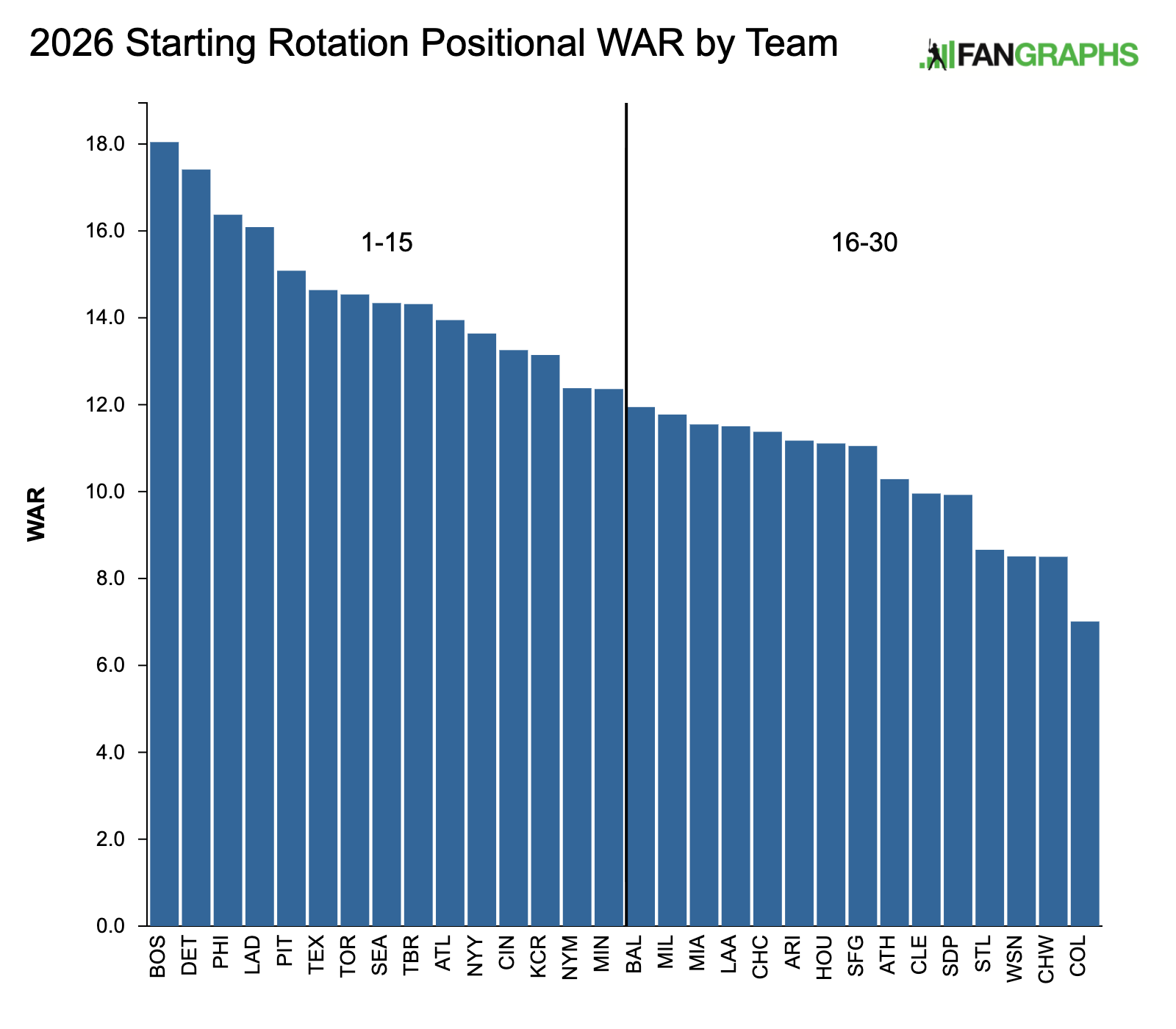
Looking at the best rotations in baseball is a great way to learn about how the best teams in baseball build their staffs. Recently, they’re coalescing around a common plan. It’s hard to get through a 162-game season these days. Five pitchers certainly won’t do it. Every team used at least eight starters last year. Only five teams used fewer than 10 starters, even. You can’t just fill your rotation with five great pitchers and move on with life.
Many of the best teams in the game have solved that issue by building a rotation in two parts. At the top, you’ve got your elite starters, as many as you can get. The top four teams in our rankings have all gone out and proactively added aces in recent years, whether they had some homegrown ones to start with or not. These are the guys who, health willing, have guaranteed spots in a potential playoff rotation.
That said, it usually isn’t possible to assemble an entire playoff rotation out of elite starters, even though you only need four guys instead of five thanks to the postseason schedule. The Dodgers managed it by a) having more money than Croesus and b) signing a unicorn who moonlights as a playoff-caliber starter when he isn’t busy being the best DH in baseball. Everyone else has to solve for two constraints: having enough innings to fill an entire season, and having enough upside that at least one or two of your mid-pack starters will be good enough to pitch in October.
In other words, don’t just look at the five starters who are going to take the ball to begin the season. Consider the potential shape of these teams by year’s end, the prospects who might be up in the second half and the workload-limited rehabbers. Regular season workloads are about survival as much as dominance. The long grind of the season gives teams plenty of time to toss a ton of options into their divining pan and see what shakes out. Everyone’s trying to win, and it seems like most teams are doing so by acquiring more pitchers than they need and letting the most effective ones rise to the top during the year.
| Name | IP | K/9 | BB/9 | HR/9 | BABIP | LOB% | ERA | FIP | WAR |
|---|---|---|---|---|---|---|---|---|---|
| Garrett Crochet | 197 | 11.2 | 2.4 | 0.9 | .300 | 77.5% | 2.90 | 2.81 | 5.8 |
| Sonny Gray | 178 | 9.4 | 2.4 | 1.1 | .304 | 73.3% | 3.72 | 3.49 | 3.7 |
| Ranger Suarez | 169 | 7.9 | 2.6 | 0.9 | .302 | 73.5% | 3.62 | 3.61 | 3.4 |
| Brayan Bello | 153 | 7.5 | 3.2 | 1.0 | .301 | 70.7% | 4.22 | 4.13 | 1.9 |
| Johan Oviedo | 58 | 8.7 | 3.7 | 1.1 | .294 | 71.0% | 4.29 | 4.27 | 0.8 |
| Patrick Sandoval | 52 | 8.4 | 3.7 | 0.9 | .304 | 72.6% | 3.97 | 3.88 | 0.8 |
| Connelly Early | 52 | 9.0 | 3.3 | 1.0 | .297 | 72.1% | 3.87 | 3.84 | 0.9 |
| Kutter Crawford | 27 | 8.4 | 2.6 | 1.4 | .288 | 70.8% | 4.33 | 4.25 | 0.3 |
| Payton Tolle | 24 | 9.2 | 2.9 | 1.3 | .292 | 72.4% | 4.08 | 4.00 | 0.4 |
| Tyler Uberstine | 9 | 7.6 | 3.1 | 1.3 | .296 | 70.1% | 4.62 | 4.50 | 0.1 |
| Total | 919 | 9.0 | 2.8 | 1.0 | .300 | 73.2% | 3.70 | 3.61 | 18.2 |
Boston spent much of the winter getting better at pitching. Crochet was the team’s ace in 2025, and he will be again this year. The only question mark about his game heading into his first year with the Red Sox was how he’d handle the workload, and he ended up leading the American League in innings pitched. That’ll do. But one man does not a rotation make, and the rest of the starting group was so-so.
The first upgrade was trading for Gray, who has aged out of ace status but still looks like a solid number two. Given that he’s 36, losing fastball velo, and relies heavily on an arsenal of secondary pitches, the end is coming at some point. But there’s not much indication that it’s coming this year; he’s still drawing chases, missing bats, and keeping the ball on the ground. I wouldn’t want to count on him as my top option, but he’s the best-projected no. 2 starter in baseball. That’ll also do.
Suarez’s profile is similar; you’ll probably feel sad if he’s your best pitcher, but he’s been a productive mid-rotation guy on dominant pitching staffs for years now and projects to do the same thing in Boston. It’s reasonable to worry about his durability – he’s never thrown more than 157 innings in a season – but the results speak for themselves. He’s been weak against righties in his career, perhaps a concern with the snug left field dimensions in Fenway, but his ability to induce grounders is so good that it’ll probably work out just fine.
The rest of the rotation looks better for having so much might at the top. Bello is a great fourth starter. Oviedo has some interesting characteristics worth investigating, but if he doesn’t pan out, there are plenty of backup options. Sandoval showed some promise before UCL surgery in 2024. Crawford had a nice 2024 of his own before a freak wrist injury cost him all of last year; he’s been slow to ramp up this spring, but it’s just as well – there’s no space for him until injuries or underperformance shake something free. Tolle and Early are each Top 100 prospects who pitched very well across multiple levels in 2025. On most teams, they’d be optimistically projected as third starters. Here, they’re depth. Boston’s rotation is great at the top and comically deep; sounds like the top-ranked team to me.
| Name | IP | K/9 | BB/9 | HR/9 | BABIP | LOB% | ERA | FIP | WAR |
|---|---|---|---|---|---|---|---|---|---|
| Tarik Skubal | 200 | 11.0 | 1.8 | 0.8 | .287 | 77.5% | 2.67 | 2.62 | 6.3 |
| Framber Valdez | 195 | 8.3 | 3.0 | 0.8 | .295 | 73.8% | 3.41 | 3.53 | 3.6 |
| Jack Flaherty | 160 | 9.9 | 3.3 | 1.2 | .294 | 72.7% | 4.01 | 3.89 | 2.5 |
| Casey Mize | 145 | 8.0 | 2.5 | 1.2 | .294 | 72.2% | 4.05 | 4.02 | 2.1 |
| Justin Verlander | 141 | 7.4 | 2.8 | 1.3 | .288 | 71.5% | 4.31 | 4.38 | 1.7 |
| Keider Montero | 27 | 7.5 | 3.1 | 1.3 | .290 | 71.2% | 4.40 | 4.48 | 0.3 |
| Drew Anderson | 27 | 10.0 | 3.3 | 1.1 | .296 | 72.6% | 3.95 | 3.83 | 0.4 |
| Troy Melton | 17 | 8.1 | 2.6 | 1.2 | .289 | 72.5% | 4.02 | 4.05 | 0.2 |
| Sawyer Gipson-Long | 9 | 7.9 | 2.4 | 1.2 | .293 | 71.4% | 4.07 | 4.04 | 0.1 |
| Ty Madden | 9 | 7.9 | 3.5 | 1.2 | .293 | 71.1% | 4.46 | 4.45 | 0.1 |
| Total | 930 | 9.0 | 2.7 | 1.0 | .292 | 73.4% | 3.66 | 3.66 | 17.4 |
The Tigers must have looked at Boston’s offseason and liked what they saw, because they ended up doing a very similar thing. Last year’s rotation was great but thin. Skubal led the majors in pitching WAR, made 31 starts, and generally overmatched everyone he faced. He’s a free agent after this year, which means the long-term picture is cloudy, but the short-term picture is quite clear: champagne for his real friends, real pain for opposing batters.
Now he’ll be doing that with a running mate who might draw Cy Young votes of his own. Valdez had a long wait in free agency, but he signed a deal right around market expectations when it was all said and done. He’s getting paid ace money to be one of the best number two starters in baseball. His profile is always a little unsettling – average strikeout rate, average walk rate – but his preternatural ability to keep the ball on the ground makes it all work. Valdez isn’t so much “in a jam” as he is “waiting to induce a double play.” He posted one of the lowest home run rates in baseball as a lefty in a park with a short porch for righties to aim at. You can afford to walk a few guys if you don’t let them score cheaply, and Valdez certainly doesn’t.
Flaherty and Mize are back having been pushed down the rotation hierarchy a bit, which feels right to me; each seemed a little stretched in their prior spot. They’re likely to provide quality innings, but neither has the lights-out stuff necessary to go toe to toe with the league’s best, making them perfect mid-rotation starter options. Verlander fits into that mix as well; even at 43, he has enough juice to get through a lineup once or twice, and playing in a cavernous park will help hide his greatest liability, namely the long ball. I’m not sure how I’d order these three guys, but it’s a nice group that complements the spectacular top two slots well.
The depth options include Montero, who was impressive as a spot starter last year, and Melton, a former top 100 prospect who had been working out of the bullpen before suffering an elbow injury in spring training. Anderson is another great depth piece; he just got finished dominating the KBO and has looked sharp in his reintroduction to baseball stateside so far. So long as the pitching attrition remains reasonable, this group should do a good job picking up any slack the top quintet can’t handle.
| Name | IP | K/9 | BB/9 | HR/9 | BABIP | LOB% | ERA | FIP | WAR |
|---|---|---|---|---|---|---|---|---|---|
| Cristopher Sánchez | 200 | 8.7 | 2.2 | 0.8 | .298 | 74.3% | 3.21 | 3.20 | 4.8 |
| Jesús Luzardo | 179 | 9.9 | 2.8 | 1.2 | .291 | 73.0% | 3.78 | 3.63 | 3.5 |
| Aaron Nola | 180 | 8.9 | 2.3 | 1.3 | .294 | 71.2% | 4.12 | 3.89 | 3.1 |
| Zack Wheeler | 157 | 9.8 | 2.4 | 1.0 | .287 | 74.4% | 3.31 | 3.33 | 3.5 |
| Andrew Painter | 99 | 7.8 | 3.5 | 1.4 | .291 | 70.6% | 4.72 | 4.69 | 0.8 |
| Taijuan Walker | 86 | 6.3 | 3.2 | 1.5 | .292 | 70.0% | 4.96 | 5.09 | 0.5 |
| Bryse Wilson | 9 | 6.3 | 2.8 | 1.5 | .292 | 68.9% | 4.94 | 4.92 | 0.0 |
| Alan Rangel | 9 | 7.4 | 2.9 | 1.5 | .288 | 69.7% | 4.76 | 4.68 | 0.1 |
| Jean Cabrera | 9 | 6.6 | 3.7 | 1.4 | .292 | 68.9% | 5.03 | 5.06 | 0.0 |
| Yoniel Curet | 8 | 7.8 | 4.7 | 1.5 | .286 | 68.3% | 5.28 | 5.39 | 0.0 |
| Total | 935 | 8.8 | 2.6 | 1.2 | .293 | 72.4% | 3.90 | 3.84 | 16.4 |
While the cast keeps changing, the Phillies have had one of the best pitching staffs in baseball for a half-decade now. Wheeler and Nola, the old mainstays, each have question marks around them as we enter the season. With Wheeler, it’s health: Surgery to address thoracic outlet syndrome (the “good” kind!) cut his 2025 season short, and he’s going to debut late as a result. We’re expecting a slight decline from 2025, but truthfully, the error bars are huge. I think he’ll likely pick up close to where he left off after a promising spring, but shoulder injuries are notoriously finicky. Nola is dealing with something a little scarier: ineffectiveness after injuries. He missed half the 2025 season with ankle and rib issues, and when he was on the field, he was below average for the first time in his career. The good news is that he looked sharp in the WBC, and an offseason of recovery seems likely to help him recalibrate. I’m expecting a strong bounce back, as are our projections.
Neither of those two sit atop this chart, though. Sánchez is the new ace in town, and he’s coming off of a transcendent 2025 season. He keeps the ball on the ground and pounds the strike zone with a devastating sinker/changeup combo. He’s also made 30-plus starts for two straight seasons, stepping into the durable top-of-rotation role the team needs as its previous standard-bearers age. He has great results, great durability, and even a brand new extension that will keep him in town for years to come.
Luzardo signed an extension of his own this winter after a career year in 2025. He finally showed the full range of his prodigious talent all at once, and made 32 starts while doing so. It’s fair to worry about regression, but honestly, I think you could frame it as his results regressing upwards towards his talent. He’s really, really good when he’s right. Injury is always a concern, but right now, things are looking sunny.
That’s the best top four in baseball. The Phillies are a bit weaker after that, which is why they’re third on this list instead of first. Painter was the top pitching prospect in baseball before he missed two straight years due to TJ, and while the volatility and ceiling are both high here, he was pretty bad in Triple-A in 2025. I wouldn’t want to count on him; I’d prefer having him as contingent upside. Walker is a nice fifth starter stopgap, on the other hand, and will cover Wheeler’s spot in the rotation to start the year. After that, it’s “I hope we don’t need this guy” time; Wilson was below replacement level in 2025, Rangel was so-so in Triple-A, and Curet’s probably a reliever in the long run. I left Cabrera out because while he’s intriguing, he hasn’t yet made Triple-A, so I think he’s unlikely to be called upon before the second half of the season.
| Name | IP | K/9 | BB/9 | HR/9 | BABIP | LOB% | ERA | FIP | WAR |
|---|---|---|---|---|---|---|---|---|---|
| Yoshinobu Yamamoto | 155 | 9.5 | 2.5 | 1.0 | .283 | 73.1% | 3.38 | 3.35 | 3.6 |
| Tyler Glasnow | 134 | 10.5 | 3.3 | 1.1 | .289 | 73.6% | 3.68 | 3.59 | 2.6 |
| Emmet Sheehan | 126 | 10.2 | 3.2 | 1.3 | .283 | 72.8% | 3.97 | 3.91 | 2.3 |
| Blake Snell | 121 | 11.2 | 4.0 | 1.0 | .289 | 75.5% | 3.55 | 3.54 | 2.5 |
| Shohei Ohtani | 116 | 10.7 | 3.1 | 1.2 | .278 | 74.6% | 3.51 | 3.65 | 2.3 |
| Roki Sasaki | 93 | 9.4 | 3.2 | 1.2 | .297 | 71.7% | 4.16 | 4.05 | 1.5 |
| River Ryan | 47 | 7.4 | 3.7 | 1.4 | .292 | 70.0% | 4.80 | 4.86 | 0.3 |
| Kyle Hurt | 24 | 9.4 | 4.2 | 1.2 | .292 | 71.7% | 4.33 | 4.29 | 0.3 |
| Justin Wrobleski | 29 | 8.2 | 3.0 | 1.3 | .291 | 71.7% | 4.27 | 4.26 | 0.4 |
| Gavin Stone | 17 | 8.0 | 2.9 | 1.3 | .292 | 70.5% | 4.41 | 4.29 | 0.2 |
| Landon Knack | 9 | 8.0 | 3.4 | 1.6 | .286 | 69.5% | 4.94 | 4.88 | 0.1 |
| Total | 871 | 9.9 | 3.2 | 1.2 | .287 | 73.1% | 3.80 | 3.78 | 16.1 |
The Dodgers probably don’t care too much about where they finish on these power rankings. Sure, having a good regular season rotation is correlated with having a good playoff rotation, but it’s not the same thing, as L.A. clearly showed last year. We’re projecting low innings totals across the board; every other team on today’s list has two or more players projected for Yamamoto-plus workloads. That might make the headline WAR numbers here look middling, but make no mistake, the top of this rotation is absurd.
Each of the top five starters has a projected ERA below 4.00, with Yamamoto leading the way. It might seem silly to have the guy who revitalized the concept of the playoff complete game down for such a light workload, but that’s the point: The Dodgers know he’s good, and they know they’ll make the playoffs, so they want him fresh in October. The same goes for Ohtani, who’s an excellent pitcher when he’s on the mound, but who the Dodgers badly want at full strength when it counts the most. I don’t have much to say about those two guys aside from that: They’re great, and we all know it.
Honestly, I could extend that sentiment to Snell and Glasnow. They’re both low-innings-total guys by nature; Snell has only exceeded 150 innings pitched twice in his long career, and Glasnow’s never even hit that mark. Snell probably won’t top it this year, either, given that he’s starting the season on the IL and isn’t due back until late May. They’re both superb, electric and have pinpoint command, but the Dodgers care far more about health. When you’re this good, that’s just how it works. In addition to a six-man rotation, I expect the team to skip starts for both of these guys plenty even when they’re available.
Sheehan might be the closest thing to a workhorse here, because he’s excellent but doesn’t have a spot in the four-man rotation the team uses in postseason play. I think that means they’ll let him eat; last year was his first back from TJ, but the training wheels are likely coming off now. His approach is simple – three pitches he trusts, little fluff – but it’s also exciting. He was long held back by command issues, but he looked sharper than ever in 2025. Give his plus fastball good location, and it could carry his entire profile. Sasaki’s eventual role is anyone’s guess, but the Dodgers are certainly going to give him a chance to start again. If it doesn’t work, well, they know his hellacious stuff plays up in relief.
That leaves a pile of former top prospects and swingmen to eat up the rest of the innings that the Dodgers will surely need to fill. Ryan and Stone are the most intriguing of those to me, but I have to admit that it’s all hard to separate out, and Stone himself is already injured. The real shine here comes from the names at the top; the rest of the guys are just marking time until October.
| Name | IP | K/9 | BB/9 | HR/9 | BABIP | LOB% | ERA | FIP | WAR |
|---|---|---|---|---|---|---|---|---|---|
| Paul Skenes | 189 | 10.6 | 2.4 | 0.8 | .291 | 76.9% | 2.84 | 2.82 | 5.4 |
| Mitch Keller | 175 | 7.8 | 2.7 | 1.1 | .298 | 70.6% | 4.19 | 4.09 | 2.3 |
| Bubba Chandler | 137 | 8.3 | 3.5 | 1.1 | .292 | 71.8% | 4.11 | 4.18 | 1.9 |
| Braxton Ashcraft | 127 | 7.9 | 2.7 | 1.0 | .299 | 72.8% | 3.83 | 3.82 | 2.0 |
| Jared Jones | 96 | 8.8 | 3.2 | 1.1 | .293 | 72.3% | 3.93 | 3.93 | 1.4 |
| Carmen Mlodzinski | 63 | 7.8 | 3.1 | 0.9 | .298 | 72.8% | 3.81 | 3.82 | 1.0 |
| Hunter Barco | 55 | 8.2 | 3.7 | 1.1 | .295 | 72.6% | 4.16 | 4.31 | 0.7 |
| José Urquidy | 34 | 6.7 | 2.6 | 1.4 | .289 | 68.8% | 4.80 | 4.72 | 0.2 |
| Thomas Harrington | 8 | 7.1 | 2.8 | 1.3 | .292 | 70.2% | 4.57 | 4.54 | 0.1 |
| Mike Clevinger | 8 | 7.1 | 3.2 | 1.3 | .294 | 70.3% | 4.69 | 4.70 | 0.0 |
| Total | 893 | 8.6 | 2.9 | 1.0 | .295 | 72.7% | 3.82 | 3.81 | 15.1 |
I’ll just say it upfront: This is low for Skenes, right? There’s some regression baked into the ERA, and some park effect baked into the WAR from there, but we’re talking about the best pitcher in baseball. Forget the WAR column and trust your eyes. He throws everything. He’s enormous and durable. He’s 23 and already one of the faces of the sport. Let’s move on to the rest of the group.
There’s upside here! Chandler is a top 10 overall prospect with huge stuff and a tenuous-but-increasing feel for the zone. His minor league strikeout numbers augur a breakout; the main question is whether he can keep the ball close enough to the zone to avoid bad counts and walks. Ashcraft worked mainly in relief as a rookie, but he also throws hard and boasts multiple excellent secondaries. He still needs to put it all together, but if you’re willing to dream a little, you can see top-of-rotation stuff in him.
Jones has one of the best fastballs in baseball, and showed a sudden improvement in his command as he forced his way to the majors in 2024. He missed all of 2025 with elbow surgery, however, and guys coming off of TJ often have trouble replicating the arm angles that helped them throw the kind of backspinning fastball that Jones uses. I’m watching both of these guys carefully; if they both click, this rotation is going to be excellent.
Keller doesn’t offer the same upside as that young trio, but he’s a nice, steady complement to Skenes and the youths. He’s finished four straight seasons with an ERA between 3.91 and 4.25, and he made between 29 and 32 starts in each of them. He’s a metronome, in other words, something the Pirates desperately need given the grind of the regular season and the workload concerns in their rotation.
Mlodzinski is probably a reliever in the long run, but he’s holding down Jones’ spot in the rotation until he’s done rehabbing. Urquidy is a swingman too. Barco might be the next man up in the young-and-intriguing-prospect-with-command-issues camp. He has a funky delivery and plenty of weapons to back it up, and he looked good in his first taste of Triple-A.
| Name | IP | K/9 | BB/9 | HR/9 | BABIP | LOB% | ERA | FIP | WAR |
|---|---|---|---|---|---|---|---|---|---|
| Jacob deGrom | 169 | 10.0 | 2.1 | 1.2 | .282 | 74.2% | 3.50 | 3.45 | 3.7 |
| Nathan Eovaldi | 173 | 8.5 | 2.3 | 1.1 | .289 | 72.1% | 3.78 | 3.76 | 2.9 |
| MacKenzie Gore | 160 | 10.3 | 3.4 | 1.1 | .293 | 73.3% | 3.82 | 3.71 | 2.9 |
| Jack Leiter | 148 | 8.6 | 3.7 | 1.2 | .281 | 71.0% | 4.29 | 4.28 | 2.0 |
| Kumar Rocker | 112 | 8.0 | 2.8 | 1.1 | .296 | 70.6% | 4.22 | 4.05 | 1.5 |
| Jacob Latz | 51 | 8.7 | 4.3 | 1.2 | .285 | 71.5% | 4.38 | 4.41 | 0.6 |
| Cody Bradford | 35 | 7.7 | 2.1 | 1.4 | .285 | 70.0% | 4.33 | 4.22 | 0.4 |
| Jordan Montgomery | 37 | 7.4 | 2.9 | 1.2 | .296 | 71.2% | 4.37 | 4.33 | 0.4 |
| Cal Quantrill | 8 | 6.7 | 3.0 | 1.4 | .290 | 66.8% | 5.06 | 4.86 | 0.0 |
| Tyler Alexander | 9 | 7.4 | 2.4 | 1.5 | .290 | 68.8% | 4.68 | 4.48 | 0.1 |
| Total | 901 | 9.0 | 2.9 | 1.2 | .288 | 72.0% | 3.97 | 3.91 | 14.6 |
I’ve never seen deGrom projected for so many innings. I’ve also never seen him projected for such a high ERA. What a delightful reversal from his unhittable-but-fragile past. He and another distinguished elder statesman, Eovaldi, make for an interesting contrast. Eovaldi had a down year for volume, but posted a 1.73 ERA in 2025; he’s hoping for more volume at the same rate, while deGrom is looking to get back to his previous dominance while pitching a full season.
When those two geriatrics (both years younger than me, just so we’re clear) aren’t trying to keep the kids off the outfield lawn, Texas’ own kids will be on the mound. Gore, the team’s big offseason addition, has shoved in the first half and melted in the second half for two straight years. The top-end talent is there, the question is whether he can maintain his form through the dog days of summer. Leiter, a fellow former top prospect, had the opposite problem last season; he started slow and flashed in the second half. Our projections think he’ll be a solid average starter, but I think the error bands are huge around that in both directions; there’s a reason he was the second pick in the 2021 draft, but there’s also a reason that he didn’t establish himself in the majors until 2025.
Could Rocker, Leiter’s former college teammate, make it three phenoms powering the rotation? His 2025 would suggest not, but he has the stuff to do it and will start the year as the fifth starter as a result. Latz is almost the anti-Rocker; not a ton of strikeouts, not a ton of prospect pedigree, but he had his best year in 2025, albeit with some sequencing luck that probably won’t repeat. Bradford is nice depth, but since he’s returning from elbow surgery, we expect a lot of his work to come in the bullpen. Montgomery is also on the shelf after elbow surgery, and won’t be back until after the All-Star break at the earliest. In other words, there’s a lot of injury risk here to go with the interesting names.
| Name | IP | K/9 | BB/9 | HR/9 | BABIP | LOB% | ERA | FIP | WAR |
|---|---|---|---|---|---|---|---|---|---|
| Dylan Cease | 173 | 10.5 | 3.4 | 1.1 | .287 | 74.7% | 3.57 | 3.53 | 3.7 |
| Kevin Gausman | 182 | 8.8 | 2.6 | 1.2 | .291 | 73.2% | 3.88 | 3.83 | 3.0 |
| Cody Ponce | 133 | 8.8 | 2.7 | 1.2 | .294 | 71.9% | 4.05 | 3.96 | 2.0 |
| Trey Yesavage | 104 | 9.8 | 3.7 | 1.0 | .284 | 73.0% | 3.79 | 3.79 | 1.7 |
| Shane Bieber | 109 | 8.2 | 2.1 | 1.1 | .293 | 73.5% | 3.70 | 3.69 | 1.9 |
| Max Scherzer | 94 | 8.9 | 2.4 | 1.6 | .283 | 72.8% | 4.22 | 4.33 | 1.2 |
| José Berríos | 83 | 7.5 | 2.7 | 1.4 | .290 | 71.8% | 4.37 | 4.51 | 0.8 |
| Eric Lauer | 18 | 8.3 | 2.8 | 1.4 | .284 | 73.6% | 4.16 | 4.36 | 0.2 |
| Ricky Tiedemann | 8 | 9.3 | 4.4 | 1.1 | .288 | 71.7% | 4.21 | 4.34 | 0.1 |
| Total | 902 | 9.1 | 2.8 | 1.2 | .289 | 73.1% | 3.90 | 3.90 | 14.5 |
Signing Cease, the winter’s best free agent starter, gives Toronto an enviable duo at the top of their rotation. He’s the premier slider slinger in all the majors at the moment, using his phenomenal feel for the pitch to sustain gaudy strikeout rates while mostly skating through danger. When he’s spinning the ball, Cease is hard to hit; when he’s forced into the rest of his arsenal, he sometimes struggles. Gausman is the opposite. His slider is vestigial, a show-me pitch he rarely uses. Instead, he runs fastballs up and splitters down. Both pitchers are capable of taking over games with their premium offerings; both are prone to blowups when their One Stupid Trick Batters Can’t Stand isn’t working.
Yesavage is vying to turn that duo into a trio. Like Gausman, he has a great four-seam fastball and drops an impossible splitter off of it. He’s still working on commanding the ball, though; he ran ugly walk rates at every level of the minors, and even in his transcendent 2025 postseason, he walked more than 10% of the batters he faced. He’ll have a delayed start to his season thanks to a shoulder injury, and he might not be fully stretched out for quite some time as a result. We have him down for some bullpen appearances to manage his workload, but for me, the bigger question will be how batters adapt to his oddball arm angle with more time to prepare.
Actually, we think that almost everyone in this rotation is also going to be in the bullpen at some point. We have Ponce, Yesavage, Bieber, Scherzer, Berríos, and Lauer down for double-digit relief innings. Some of that is for workload reasons, but a lot of it is because all of these guys project similarly and the Jays have played coy about how they’ll manage the abundance of good-but-not-great options backing their top duo.
Personally, I think that the third-best starter on the Jays is actually Ponce. He was flatly absurd in 2025, winning KBO MVP with ludicrous stats, and I expect that to play well in the majors, though perhaps in short stints given his long history as a swingman. I’m also excited to see what Bieber does this year. He was one of the most electric pitchers in baseball before missing most of the last two years with injury, and while he looked diminished upon his return, Bieber at full strength is clearly a great pitcher. I’d be surprised if Scherzer is seriously in the mix for starts when everyone is healthy, but he’s an awesome insurance policy. I like this rotation quite a lot, even if I’m not sure who it will contain on any given day.
| Name | IP | K/9 | BB/9 | HR/9 | BABIP | LOB% | ERA | FIP | WAR |
|---|---|---|---|---|---|---|---|---|---|
| Bryan Woo | 195 | 9.1 | 2.0 | 1.2 | .279 | 73.7% | 3.47 | 3.57 | 3.5 |
| Luis Castillo | 179 | 8.4 | 2.5 | 1.2 | .284 | 73.5% | 3.82 | 4.00 | 2.3 |
| George Kirby | 173 | 8.8 | 1.7 | 1.1 | .291 | 72.7% | 3.52 | 3.41 | 3.3 |
| Logan Gilbert | 163 | 9.8 | 2.1 | 1.2 | .282 | 74.6% | 3.41 | 3.43 | 3.1 |
| Bryce Miller | 141 | 8.0 | 2.7 | 1.3 | .280 | 71.5% | 4.11 | 4.19 | 1.6 |
| Emerson Hancock | 34 | 7.2 | 2.9 | 1.3 | .286 | 70.9% | 4.35 | 4.49 | 0.3 |
| Cooper Criswell | 17 | 7.4 | 2.7 | 1.1 | .293 | 71.6% | 4.02 | 4.11 | 0.2 |
| Dane Dunning | 9 | 7.9 | 2.9 | 1.1 | .291 | 71.3% | 4.13 | 4.16 | 0.1 |
| Casey Lawrence | 9 | 4.6 | 2.1 | 1.5 | .293 | 68.8% | 4.99 | 5.11 | 0.0 |
| Total | 922 | 8.7 | 2.2 | 1.2 | .283 | 73.0% | 3.70 | 3.76 | 14.3 |
Seattle’s rotation is built around high quality depth rather than one transcendent star. We’re projecting Woo for the most innings, but the triumvirate of him, Kirby, and Gilbert are essentially identical in our per-inning rate estimates. Woo’s at the top because he was the only member of that trio to pitch a full season in 2025, and it was a great one: solid peripheral statistics and an electric 2.94 ERA, driven by a mix-and-match pair of fastballs and excellent command. I’m expecting some BABIP regression (he allowed a .238 mark in 2025, unlikely to persist), but I’m also expecting tons of innings with very few walks, a game that’s perfectly suited for cavernous T-Mobile Park.
How do I know that approach works in Seattle? Because that describes Kirby’s game almost perfectly. He’s posted a FIP between 2.99 and 3.37 in each year of his big league career — less impressive than you’d think due to park effects, but still quite impressive. Last year was his worst season yet, but the biggest issue was availability; he missed two months with a shoulder injury and started slow upon his return. He never walks anyone. He throws a broad mix of pitches. He won’t strike out the side very often, but his game is a great fit for a ballpark where free baserunners are the worst thing you can do. Gilbert is the boom/bust version of those two; he too has great command, but he misses more bats thanks to a wipeout splitter. He had a down 2025 on a volume front thanks to a strained elbow, but posted a career-high strikeout rate. I’m excited to see if he can lean into that aspect of his game further this year.
That leaves Castillo and Miller as absurdly overqualified back-end starters. Castillo is certainly on the downswing, but he still eats innings and throws strikes. Miller had a bummer season in 2025, with poor rate stats and missed time thanks to elbow inflammation. He’s hoping to get back on track this year, and the good news is that he can do it from the last slot in the rotation and without a ton of pressure, though he’s already dealing with an oblique injury.
Hancock, Criswell, Dunning, and Lawrence are a below-average set of depth options, but I don’t mind that for Seattle. The M’s have a lot of great pitching, and they’re already going to have trouble figuring out who to move to the bullpen should they reach October. Their depth is in how many legitimate playoff starters they have, not in who is floating around the very bottom of the roster.
| Name | IP | K/9 | BB/9 | HR/9 | BABIP | LOB% | ERA | FIP | WAR |
|---|---|---|---|---|---|---|---|---|---|
| Drew Rasmussen | 160 | 8.1 | 2.3 | 1.0 | .288 | 72.9% | 3.64 | 3.72 | 2.9 |
| Ryan Pepiot | 160 | 9.2 | 3.2 | 1.3 | .280 | 72.7% | 4.05 | 4.19 | 2.2 |
| Shane McClanahan | 139 | 9.7 | 2.5 | 1.0 | .289 | 75.6% | 3.33 | 3.39 | 3.1 |
| Steven Matz | 124 | 8.0 | 2.4 | 1.1 | .298 | 73.0% | 3.95 | 3.93 | 2.2 |
| Nick Martinez | 121 | 6.9 | 2.5 | 1.1 | .294 | 69.6% | 4.32 | 4.17 | 1.7 |
| Ian Seymour | 84 | 8.6 | 2.7 | 1.3 | .283 | 71.0% | 4.17 | 4.20 | 1.0 |
| Joe Boyle | 65 | 10.1 | 4.8 | 1.0 | .289 | 72.9% | 4.05 | 4.12 | 0.9 |
| Yoendrys Gómez | 8 | 9.1 | 3.6 | 1.3 | .285 | 72.0% | 4.25 | 4.35 | 0.1 |
| Ty Johnson | 9 | 8.9 | 3.3 | 1.2 | .287 | 70.8% | 4.22 | 4.22 | 0.1 |
| Joe Rock | 9 | 7.2 | 2.9 | 1.1 | .294 | 71.5% | 4.19 | 4.25 | 0.1 |
| Brody Hopkins | 8 | 7.8 | 4.2 | 1.2 | .289 | 70.3% | 4.66 | 4.79 | 0.1 |
| Total | 887 | 8.6 | 2.8 | 1.1 | .289 | 72.5% | 3.91 | 3.94 | 14.3 |
I’m down on this group relative to the projections, but it’s never quite as simple as that in Rays-land. McClanahan was one of the most electric pitchers in baseball in 2022, but he tore his UCL in 2023 and hasn’t pitched in the majors since then. He’s certainly a question mark, but the high-end outcomes, even with an innings limit, are much better than these projections. Likewise, Rasmussen’s projection looks solid, but I think there could be even more under the hood. The man has a career 2.89 ERA across nearly 500 innings; I get variance and regression, but he might be meaningfully better than we have him down for here.
My issue with the Rays is that you can’t just use two starting pitchers. Pepiot has been a nice third starter in Tampa Bay, and I think he’ll deliver more of the same this year after returning from a season-opening IL stint. He doesn’t have the upside of McClanahan and Rasmussen, though. Matz hasn’t been an effective starter for a few years now; I see him as a five-and-dive type at this point in his career. The same goes for Martinez. He’s valuable more because he can move between the rotation and the bullpen than because of any spectacular performance in either role.
Those are their preferred starters. If any of those guys miss time – and again, it’s a pile of older players and hurlers with checkered injury histories – the bottom falls out fast. Seymour is a multi-inning reliever with a violent delivery, more of a spot starter than someone you can count on for six innings every five days. Boyle has command issues that keep his starts short. Hopkins intrigues me – he’s a Top 100 prospect who looked great in Double-A last year – but his command is still spotty, and I think he needs more minor league seasoning. I know that the Rays frequently construct pitching staffs that I underestimate, but this time, I think there are just too many risks and not enough backup plans.
| Name | IP | K/9 | BB/9 | HR/9 | BABIP | LOB% | ERA | FIP | WAR |
|---|---|---|---|---|---|---|---|---|---|
| Chris Sale | 165 | 10.9 | 2.4 | 1.0 | .298 | 76.0% | 3.15 | 3.06 | 4.0 |
| Spencer Strider | 149 | 10.6 | 3.1 | 1.1 | .294 | 72.6% | 3.84 | 3.62 | 2.7 |
| Reynaldo López | 132 | 9.0 | 3.1 | 1.1 | .294 | 73.3% | 3.83 | 3.80 | 1.9 |
| Grant Holmes | 141 | 8.5 | 3.5 | 1.2 | .300 | 72.3% | 4.20 | 4.24 | 1.4 |
| Bryce Elder | 109 | 7.5 | 3.0 | 1.1 | .301 | 69.6% | 4.43 | 4.19 | 1.1 |
| Spencer Schwellenbach | 79 | 8.8 | 1.9 | 1.1 | .294 | 73.3% | 3.52 | 3.49 | 1.5 |
| Hurston Waldrep | 61 | 8.0 | 3.9 | 1.0 | .298 | 71.4% | 4.29 | 4.26 | 0.6 |
| JR Ritchie | 34 | 7.5 | 3.4 | 1.2 | .296 | 70.0% | 4.49 | 4.46 | 0.3 |
| Didier Fuentes | 23 | 8.5 | 3.0 | 1.3 | .292 | 71.0% | 4.38 | 4.27 | 0.3 |
| José Suarez | 18 | 8.5 | 3.0 | 1.1 | .298 | 72.7% | 4.03 | 3.98 | 0.2 |
| Martín Pérez | 9 | 6.9 | 3.4 | 1.2 | .301 | 71.1% | 4.53 | 4.51 | 0.1 |
| Total | 922 | 9.2 | 3.0 | 1.1 | .297 | 72.6% | 3.89 | 3.80 | 13.9 |
When the top of Atlanta’s rotation is clicking, it’s fearsome. Sale missed time in 2025, and at almost 37 he’s no longer the workhorse he once was, but he has the best FIP (and third-best ERA) in baseball in the past two years. It’s fair to worry about his health, but he’s one of the best few starters in the game on a per-inning basis. Strider was once in that class as well, and I certainly wouldn’t rule it out again, but his recovery from elbow surgery has been rocky to say the least. The arm angle and backspin that made his fastball so devastating completely vanished last year. He struggled to both miss bats and draw bad swings, leading to the lowest strikeout rate and highest walk rate of his career. A lot is riding on his ability to, well, generate ride. An oblique injury will delay the start of his season by a few weeks, too; never an auspicious way to start the year.
López was a revelation in 2024, but he missed most of the 2025 season with a shoulder injury. We have him down for plenty of bullpen work this year while he readjusts to a starter’s workload, and there’s huge uncertainty in what he’ll look like after his sterling return to the rotation two years ago. That was the best season of his career by a decent amount; it’s a tough projection with big error bars.
Holmes and Elder aren’t going to light the world on fire, but you can count on both for volume. They’re both slated to start the year in the rotation as a bridge to the two phenoms listed below them. Throw Suarez into that mix as well; he’s holding down Strider’s spot to open the season. Schwellenbach was emerging as a top young starter when an elbow injury cut his 2025 season short; he avoided TJ but still won’t be back until midseason thanks to surgery to remove bone spurs. If he picks up where he left off, he might take Strider’s number two spot, thanks to plus command of a varied arsenal that he uses to pound the zone and make hitters put the ball on the ground.
Waldrep also had surgery to remove some loose bodies from his elbow earlier this year, which means he’ll return midseason as well. He’s still in the process of adjusting to the majors, but got his feet wet at the end of the 2025 season and looks ready for a rotation spot when he’s healthy. Fuentes might not be far behind his timeline; he’s a Top 100 prospect whose excellent spring won him an Opening Day bullpen role, though he could get more starter seasoning at Triple-A after some of the hurt guys come back. Ritchie, another top prospect, could follow him. Sale is by far the best pitcher in this group, but there’s a solid mixture of high-upside youth and high-floor volume behind him. I’d have them higher than 10th in my own personal rankings, particularly after Schwelly and Waldrep return.
| Name | IP | K/9 | BB/9 | HR/9 | BABIP | LOB% | ERA | FIP | WAR |
|---|---|---|---|---|---|---|---|---|---|
| Max Fried | 189 | 8.4 | 2.6 | 0.8 | .288 | 73.7% | 3.32 | 3.42 | 3.9 |
| Carlos Rodón | 155 | 9.4 | 3.3 | 1.2 | .283 | 72.2% | 4.00 | 3.98 | 2.3 |
| Gerrit Cole | 136 | 8.9 | 2.6 | 1.3 | .280 | 72.7% | 3.93 | 3.99 | 2.1 |
| Cam Schlittler | 121 | 8.9 | 3.3 | 1.2 | .286 | 72.4% | 4.03 | 4.11 | 1.7 |
| Will Warren | 110 | 8.9 | 3.2 | 1.2 | .291 | 71.1% | 4.25 | 4.14 | 1.4 |
| Ryan Weathers | 100 | 8.4 | 3.2 | 1.2 | .285 | 71.3% | 4.14 | 4.16 | 1.2 |
| Luis Gil | 59 | 9.2 | 4.3 | 1.3 | .277 | 71.5% | 4.39 | 4.51 | 0.6 |
| Clarke Schmidt | 18 | 8.8 | 3.1 | 1.2 | .286 | 72.4% | 4.00 | 4.07 | 0.3 |
| Ryan Yarbrough | 10 | 7.3 | 2.6 | 1.4 | .281 | 70.1% | 4.42 | 4.62 | 0.1 |
| Paul Blackburn | 9 | 7.5 | 2.7 | 1.3 | .292 | 70.2% | 4.40 | 4.33 | 0.1 |
| Total | 905 | 8.8 | 3.1 | 1.1 | .285 | 72.3% | 3.93 | 3.97 | 13.6 |
The Yankees have done a good job of rebuilding a solid rotation on the fly. Cole, the old ace, is returning from injury, with plenty of uncertainty around how he’ll look. I’m more optimistic than our projections about his talent level, but there’s obviously plenty of risk here. Rodón, originally signed as a running mate for Cole atop the rotation, has been inconsistent. He’s been either ineffective or unavailable plenty since joining the Yankees, and he’s starting 2026 on the IL to boot. I buy his projection as a solid number three starter, but I wouldn’t want to count on him for more than that; projections and pitch models agree that he’s declined from his fearsome peak.
Fried, on the other hand, looks as good as ever. He fits right in atop the rotation, which might shift Cole down into a secondary role upon his return. Fried doesn’t post gaudy strikeout numbers, but he keeps the ball on the ground, never walks anyone, and keeps hitters off balance with a wide array of nasty pitches. He’s pitching to induce weak swings, and while that plan doesn’t work for everyone, he’s been great at it for years now. He probably won’t win a Cy Young, but he pitches a lot and doesn’t give up many runs. What more could you want?
No one else in the rotation is a sure thing, but the Yankees only need two of their next four names to work out to end up with a great group. Schlittler exploded onto the scene last year, and while I worry about his command, hitters can’t seem to solve his fastball/cutter/curveball combo. I’m expecting some bumps in the road, but he looks like the real deal to me. Warren also has huge upside thanks to plus secondaries and good movement on his average-velo fastball. He didn’t quite put everything together in 2025, and our projections are down on him as a result, but he’s one adjustment away from being excellent.
Gil shows flashes of dominance, but until he can get his walk rate into the single digits, he’s at risk of falling into a bullpen role, where I do think he’d be quite good. Weathers looks set for swingman duties in the long run, though he’s starting the season in the rotation after joining the team in an offseason trade. His fastball-slider approach looks like a relief fit to me, but he’s durable enough that he can provide emergency innings in a pinch too, a wonderful Swiss Army Knife player for a team that has a lot of good pitchers but also plenty of injury and effectiveness concerns. Finally, Schmidt might provide a lift in the second half of the season as he works to return from elbow surgery that cost him much of his 2025 season.
| Name | IP | K/9 | BB/9 | HR/9 | BABIP | LOB% | ERA | FIP | WAR |
|---|---|---|---|---|---|---|---|---|---|
| Brady Singer | 171 | 8.5 | 2.9 | 1.3 | .295 | 70.8% | 4.38 | 4.28 | 2.4 |
| Andrew Abbott | 166 | 8.2 | 2.8 | 1.3 | .288 | 72.8% | 4.18 | 4.26 | 2.7 |
| Nick Lodolo | 153 | 9.2 | 2.5 | 1.2 | .293 | 70.2% | 4.13 | 4.04 | 2.4 |
| Rhett Lowder | 109 | 6.9 | 2.9 | 1.3 | .294 | 69.1% | 4.65 | 4.59 | 1.1 |
| Chase Burns | 99 | 10.4 | 2.6 | 1.2 | .291 | 73.3% | 3.74 | 3.51 | 2.3 |
| Hunter Greene | 83 | 10.6 | 2.9 | 1.2 | .275 | 72.5% | 3.73 | 3.73 | 1.8 |
| Brandon Williamson | 66 | 7.4 | 3.7 | 1.5 | .291 | 69.7% | 4.97 | 4.98 | 0.4 |
| Chase Petty | 16 | 7.0 | 3.8 | 1.3 | .293 | 68.1% | 5.06 | 4.90 | 0.1 |
| Julian Aguiar | 9 | 6.6 | 2.8 | 1.5 | .291 | 67.9% | 5.00 | 4.94 | 0.1 |
| Jared Lyons | 9 | 6.8 | 3.8 | 1.5 | .292 | 68.7% | 5.31 | 5.23 | 0.0 |
| Total | 879 | 8.6 | 2.8 | 1.3 | .291 | 71.0% | 4.27 | 4.21 | 13.3 |
Greene is Cincy’s ace, and if he weren’t injured, they’d finish much higher in these rankings. He’s out until at least July after surgery to remove bone chips, though, and there’s no guarantee he’ll hit the ground running. He has Cy Young upside, but he’s yet to make a full complement of starts in his big league career, and rust is always a concern when you miss as much time as he will. I think this is a hope for the best, prepare for the worst kind of scenario.
Singer, Lodolo, and Abbott all excelled in 2025, giving the Reds a workable plan B. I’m not expecting repeat performances, because each had some blemishes in their peripheral statistics, but that’s already baked into these projections. None of them have top-of-rotation stuff, but I’d be perfectly happy with any of them in the middle, which is key for the Reds as they try to break a 13-year division title drought. You can never have enough starting pitching – the Greene injury is a good reminder – and having three durable starters with solid run prevention numbers gives the team an enviable floor.
They will need a standout, though, and that’s where Burns comes in. The second pick of the 2024 draft has an electric fastball that explodes from a high arm angle, and the slider he pairs with it is one of the best in the business. Consistency is still a concern, and he’s not fully stretched out after throwing 100 total innings last year, but when he’s on, he’s sensational. There’s no guarantee he’ll deliver the goods this year, but I like the odds of at least one of him or Greene anchoring the rotation by year’s end.
Lowder missed 2025 with a smorgasbord of injuries, but he’s healthy again and his slider, always his best pitch, looks as good as ever this spring. Combine that with a sinker that will help him avoid long balls in their dinger-happy home environment, and he’s a nice fifth starter when healthy. Williamson can cover some starts if needed, but the Reds are deep enough that he’s starting the year in long relief even with Greene on the IL. It’s a testament to the front office that the team can run out five legit starters and a spare even with their best pitcher unexpectedly unavailable.
| Name | IP | K/9 | BB/9 | HR/9 | BABIP | LOB% | ERA | FIP | WAR |
|---|---|---|---|---|---|---|---|---|---|
| Cole Ragans | 163 | 11.1 | 3.2 | 1.0 | .292 | 74.2% | 3.40 | 3.19 | 4.1 |
| Michael Wacha | 164 | 7.0 | 2.6 | 1.2 | .290 | 70.9% | 4.31 | 4.33 | 2.1 |
| Seth Lugo | 160 | 7.6 | 3.0 | 1.3 | .294 | 71.8% | 4.39 | 4.47 | 1.6 |
| Noah Cameron | 142 | 7.6 | 2.9 | 1.2 | .293 | 72.1% | 4.20 | 4.30 | 1.6 |
| Kris Bubic | 135 | 8.7 | 3.1 | 1.0 | .298 | 73.6% | 3.75 | 3.71 | 2.5 |
| Ryan Bergert | 40 | 7.4 | 3.7 | 1.3 | .293 | 70.5% | 4.66 | 4.63 | 0.3 |
| Stephen Kolek | 44 | 6.4 | 2.8 | 0.9 | .301 | 69.6% | 4.25 | 4.17 | 0.5 |
| Bailey Falter | 25 | 6.7 | 2.9 | 1.3 | .288 | 70.2% | 4.57 | 4.60 | 0.2 |
| Mason Black | 16 | 7.3 | 3.7 | 1.3 | .293 | 69.1% | 4.86 | 4.79 | 0.1 |
| Ben Kudrna | 8 | 6.9 | 3.9 | 1.1 | .295 | 69.4% | 4.80 | 4.71 | 0.1 |
| Total | 898 | 8.2 | 3.0 | 1.1 | .293 | 72.1% | 4.09 | 4.07 | 13.1 |
This one could go a few different ways. Ragans returned from a rotator cuff strain last September and might have an innings limit as a result, but he’s one of the best pitchers on the planet when healthy. He’s still figuring out his best pitch mix – he shelved his cutter in 2025, for example – but with a fastball, changeup, and slider this good, there are no wrong answers. He even showed improved command last year. If their season comes down a single game, the Royals will feel good about their chances.
The group backing Ragans was uneven in 2025. Wacha started strong but fell off hard down the stretch. Lugo started even stronger, then fell off even harder, with a 7.51 ERA (6.81 FIP) after the All-Star break. A back injury cut his season short, and the Royals will just have to hope that the injury caused the ineffectiveness rather than vice versa, because the volume he and Wacha provide has been integral to the pitching staff for the past two years.
Elsewhere, and stop me if you’ve heard this one before: Bubic started strong but strained his rotator cuff just after his first All-Star appearance. It was a spectacular half-season, an outlier in his sixth major league year, but he’s displayed enough promise in fits and starts that we think he’s going to hold onto some of the gains he made. Cameron is well-suited as a fifth starter, but he’s not much more than that.
Even if Lugo and Wacha trail off, the Royals have other options available. Bergert and Kolek came to Missouri in a single trade with the Padres and provided voluminous innings with excellent run prevention in 2025. I don’t think they’ll repeat their ERAs this year, but the innings seem eminently achievable, even with Kolek starting the season on the IL with an oblique strain. Put Falter in that category, too. He’s another deadline acquisition who won’t embarrass you in a spot start. I could see this group ending up as either one of the best in baseball, or as a pile of fifth starters without enough juice outside of Ragans, but one thing I don’t expect them to be short on is competent volume.
| Name | IP | K/9 | BB/9 | HR/9 | BABIP | LOB% | ERA | FIP | WAR |
|---|---|---|---|---|---|---|---|---|---|
| Freddy Peralta | 162 | 9.8 | 3.4 | 1.2 | .279 | 73.4% | 3.83 | 3.93 | 2.6 |
| David Peterson | 163 | 8.1 | 3.5 | 0.9 | .298 | 72.7% | 3.85 | 3.90 | 2.3 |
| Clay Holmes | 153 | 7.4 | 3.4 | 0.8 | .302 | 71.9% | 3.89 | 3.93 | 2.1 |
| Nolan McLean | 145 | 8.7 | 3.5 | 0.9 | .290 | 72.4% | 3.82 | 3.94 | 2.0 |
| Kodai Senga | 120 | 8.9 | 4.0 | 1.1 | .286 | 74.3% | 3.87 | 4.11 | 1.5 |
| Sean Manaea | 97 | 9.3 | 2.8 | 1.3 | .287 | 71.2% | 4.17 | 4.10 | 1.2 |
| Jonah Tong | 16 | 10.2 | 3.7 | 1.0 | .289 | 74.1% | 3.71 | 3.68 | 0.3 |
| Tobias Myers | 17 | 7.6 | 2.6 | 1.3 | .289 | 72.3% | 4.16 | 4.25 | 0.2 |
| Christian Scott | 8 | 8.5 | 2.5 | 1.2 | .287 | 71.0% | 4.03 | 3.99 | 0.1 |
| Jonathan Pintaro | 8 | 8.6 | 3.7 | 1.0 | .291 | 72.5% | 3.95 | 4.09 | 0.1 |
| Total | 890 | 8.7 | 3.4 | 1.0 | .291 | 72.7% | 3.89 | 3.97 | 12.4 |
A year ago, lackluster pitching helped keep the Mets out of the playoffs. Enter Peralta, the team’s big trade addition this winter. He’s heading into his ninth major league season, so you know what you’re getting by now: an electric fastball, a sharp slider, and around 5.5 innings per start. His fastball gets weak contact as much as it gets whiffs, but no matter how you slice it, the net results have been consistently excellent. Peralta feels more like a playoff force than a regular season workhorse to me, but even if it’s not your standard ace’s workload, the per-inning numbers should be excellent.
My hot take for this article: McLean will be the staff ace by year’s end regardless of how well Peralta pitches. His rare combination of grounders and strikeouts has me imagining Zack Britton as a starter. McLean’s sinker puts worms in danger. His curveball is one of the prettiest in baseball. That whiffs-and-weak-contact pairing is rare and often comes with huge command issues, but McLean even improved on that in his big league debut last year. The projections haven’t bought in yet, but I sure have.
A quartet of mid-rotation veterans will help back those two elite options. Peterson is a classic sinkerballer, Holmes is turning into one as he continues his transition from bullpen to rotation, and Senga mixes flashes of brilliance with rough patches. He posted a 1.39 ERA in the first half last year, and then got optioned to the minors by the start of September. Good Senga is great, bad Senga is unplayable, and I think the Mets will get mostly the former with a smattering of the latter this year. I’m not quite sure what to expect of Manaea, who has gone from back-end starter to ace and then back to back-end starter while on the Mets and also missed a lot of last year with injury.
The Mets don’t need all four of those guys to pan out. They might not even need three of them to pan out if Tong makes the leap to stardom this year; he has the fastball to do it, but the rest of his game remains a question mark. Myers can even fill in when he’s not making multi-inning appearances out of the bullpen. There are a lot of unknowns here, but I think that this will be a top 10 rotation by year’s end. I’m just not sure which five Mets will be in it.
| Name | IP | K/9 | BB/9 | HR/9 | BABIP | LOB% | ERA | FIP | WAR |
|---|---|---|---|---|---|---|---|---|---|
| Joe Ryan | 167 | 9.8 | 2.1 | 1.3 | .286 | 72.9% | 3.79 | 3.72 | 3.1 |
| Bailey Ober | 155 | 8.1 | 2.1 | 1.5 | .289 | 71.3% | 4.32 | 4.28 | 2.1 |
| Simeon Woods Richardson | 135 | 8.1 | 3.3 | 1.3 | .290 | 71.4% | 4.39 | 4.37 | 1.7 |
| Taj Bradley | 131 | 8.5 | 3.2 | 1.2 | .292 | 71.0% | 4.25 | 4.12 | 1.8 |
| Mick Abel | 117 | 8.1 | 4.1 | 1.1 | .297 | 70.8% | 4.55 | 4.48 | 1.0 |
| Zebby Matthews | 85 | 8.9 | 2.2 | 1.3 | .299 | 72.9% | 3.98 | 3.79 | 1.5 |
| David Festa | 33 | 9.2 | 3.1 | 1.2 | .297 | 72.1% | 4.06 | 3.90 | 0.6 |
| Connor Prielipp | 24 | 8.3 | 3.3 | 1.0 | .299 | 72.1% | 4.07 | 4.03 | 0.3 |
| Travis Adams | 19 | 6.9 | 3.1 | 1.2 | .298 | 69.8% | 4.57 | 4.43 | 0.2 |
| John Klein | 9 | 7.7 | 3.2 | 1.2 | .294 | 70.0% | 4.53 | 4.52 | 0.1 |
| Total | 874 | 8.6 | 2.8 | 1.3 | .292 | 71.6% | 4.21 | 4.13 | 12.4 |
No one told Ryan that the Twins are heading into a rebuild. He’s been reliable and available for four straight years, and he’s coming off career bests in starts, innings, and ERA. He strikes a ton of guys out and rarely issues walks. Realistically, he’s likely to be a prized addition to someone else’s rotation at the deadline, because while Minnesota retools, Ryan is too good to sit around wasting time.
With rotation mainstay Pablo López out for the season thanks to elbow surgery, the rest of this group is squarely looking towards the future. Those two and Ober are the only holdovers from Minnesota’s 2023 playoff run. Ober would be a great fifth starter thanks to steady volume. Here, though, he’s the number two guy, and possibly also on the way out of town at the deadline. That means a youth movement is going to be sweeping the Twins rotation.
Bradley, acquired in a deadline deal last year, hasn’t yet turned his enormous potential into big league results. He has huge stuff and displayed great command in the minors, but it just hasn’t clicked yet on the biggest stage. He’s still only 25, despite being prospect famous for a half decade now, and I think this is a perfect spot for him to develop with less win-now pressure than he faced in Tampa Bay. Guys with his tools tend to work out in the end, and I’m sure the Twins will give him every opportunity to do so.
The same could be said of Abel, another deadline acquisition. He has loud stuff and command issues, and the Twins will give him a long leash to figure out how to turn that into results. They’ll do the same with Matthews, who’s starting the year in the minors after a rough spring but boasts a mind-bending slider that he builds his entire approach around. Woods Richardson doesn’t have the same upside as those three, but he could develop into a back-of-rotation stalwart. Festa is cut from a similar cloth, though he’s starting the year on the IL with a shoulder injury and likely won’t return imminently. I don’t know who will end up being the best of this crop of five young starters the Twins have assembled, and they don’t either, but 2026 is a great time to start finding out.
Ben is a writer at FanGraphs. He can be found on Bluesky @benclemens.
While I will no longer maintain that the Tigers need to find how to graft multiple more left arms on to Skubal’s body, as in previous years, I will maintain that a four-armed Skubal would be extremely cool.