
2026 Positional Power Rankings: Center Field
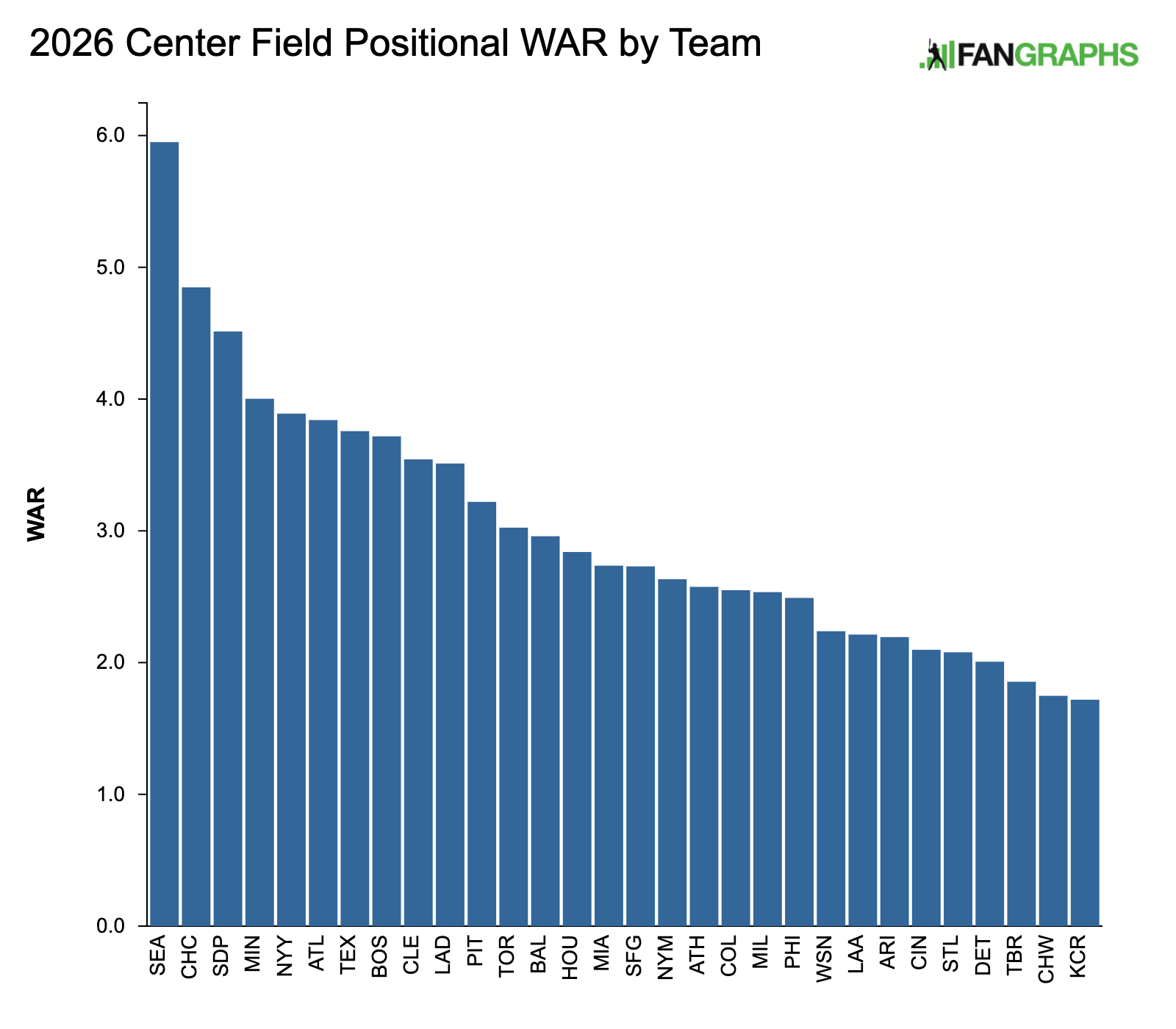
The introduction to last year’s center field rankings highlighted a changing of the guard at the position, initiated by Mike Trout’s departure from the top of the heap in 2024 and continuing with Aaron Judge vacating the no. 2 spot in the rankings in 2025. This year, Trout might be headed back to center field (👀👀👀), but this isn’t a return of the old guard. He no longer sits atop the hierarchy (spoiler alert: the Angels check in at 23rd); the transition is complete.
But the new guard isn’t just new; they’re also young. Which, duh. That’s how lifecycles work. Something gets old or ineffective, and we replace it with a newer, younger model. Perhaps this changing of the guard is enough to explain the simultaneous youth movement happening at the position. Because this is a very young crop of center fielders. This year, the average age of the player at the top of each team’s depth chart is 26.9. Is this data point merely a momentary dip before the average age of center fielders begins its gradual ascent once more? Or is it part of a larger trend? Has center field become a young person’s position? Is the middle pasture strictly playable by folks speedmaxxing and rangemogging their opponents? Will all center fielders soon be wearing JNCOs in their tunnel fits and dressing their Labubus in Gucci?
As it turns out, yes.
The graph below shows the average age of the players with center field as their primary position for each season going back to 1988. And though there is some year-to-year fluctuation, the trend is decidedly downward:
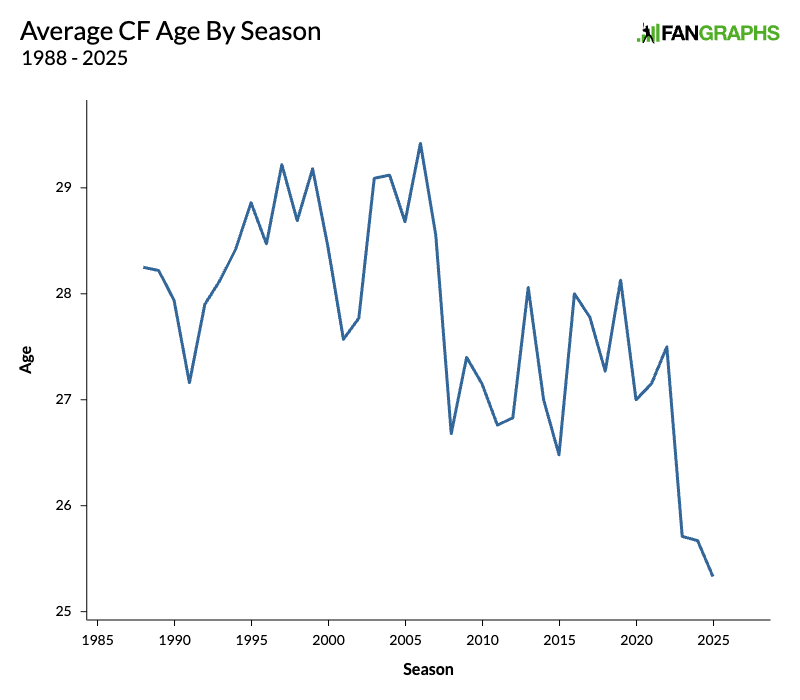
Twenty years from now, center field will be manned exclusively by literal teenagers, rolling their eyes after every pitch and insisting that their suffering is unique, that no one else in the history of the universe knows what it’s like to have a crush who doesn’t know you exist. No, but seriously, it is probably better to have our most youthful, vibrant players out there doing all that running around. No one wants to watch Trout range back to rob a home run, and instead turn to dust like the witches at the end of Hocus Pocus. Oh wait, we might be getting that too.
| Name | PA | AVG | OBP | SLG | wOBA | Bat | BsR | Fld | WAR |
|---|---|---|---|---|---|---|---|---|---|
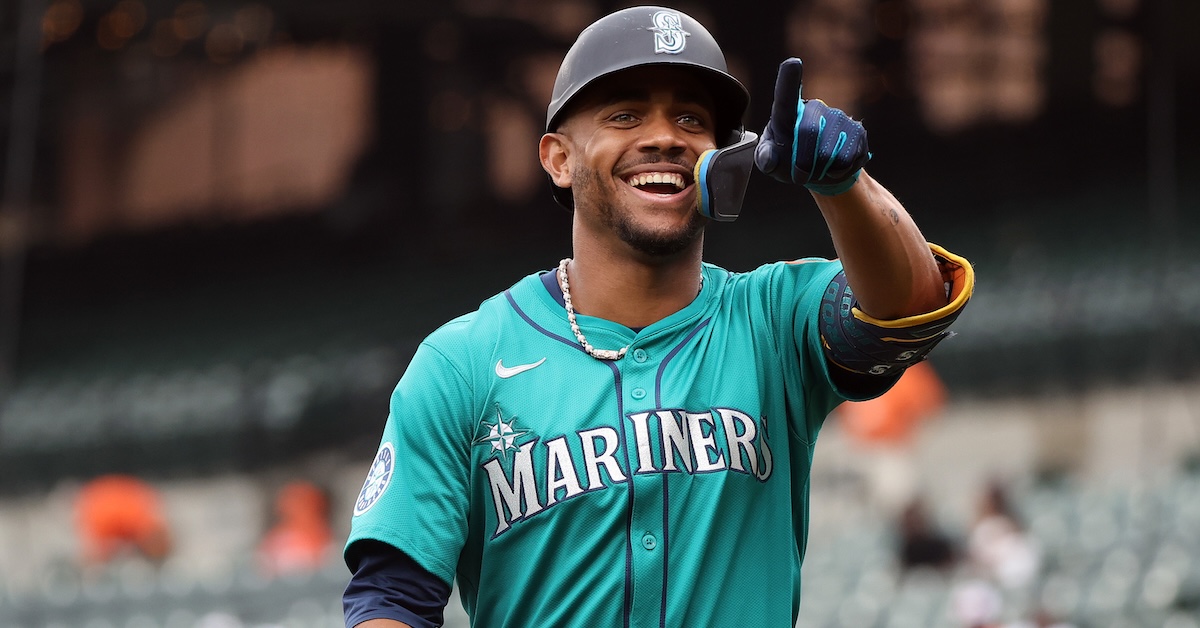
| Julio Rodríguez | 679 | .270 | .330 | .477 | .345 | 23.0 | 2.0 | 6.5 | 5.9 |
| Victor Robles | 14 | .246 | .314 | .366 | .301 | -0.0 | 0.0 | 0.1 | 0.1 |
| Luke Raley | 7 | .222 | .309 | .388 | .308 | 0.0 | -0.0 | -0.0 | 0.0 |
| Total | 700 | .270 | .330 | .474 | .344 | 22.9 | 2.1 | 6.6 | 6.0 |
Rodríguez is to a happy medium as a hamster is to gravity — unfamiliar with the concept. At least not at the plate. Given his 93rd-percentile sprint speed and 95th-percentile arm strength, he’s consistently an above-average defender in center field. But in the batter’s box, Rodríguez is either slumping or the hottest hitter on the planet.
In 2025, he logged 5.7 WAR with a 126 wRC+. But if you never got over the 98 wRC+ he posted in April, or if you remain blown away by his 167 wRC+ in August, those numbers probably feel befuddling. The extreme highs and lows within his performance make it impossible for the final averages to truly feel representative of his season. The emotions evoked by the peaks and valleys distort our perception. The rational among us can acknowledge that despite how it feels at times, he’s a solidly above-average player. And though he brings an energy that makes him easy to root for, it’s hard to love him unconditionally, knowing how heartbreaking it feels to watch him endure a prolonged cold streak.
Obviously, no one in Rodríguez’s position wants to be a heartbreaker. Any player would prefer to be a reliable presence in the lineup, and last season, Rodríguez actually did inch closer to that profile. Though a notoriously slow starter, he managed a 107 wRC+ through June after hitting for an 86 wRC+ over that same span the prior season. He also dramatically cut down on his month-to-month variation in performance. In 2023 and 2024, his monthly wRC+ values spanned a range of over 150 points, whereas in 2025, that number dropped to 69.
The added consistency, such as it was, was thanks in part to an overall uptick in production. He trimmed his strikeout rate by four percentage points relative to 2024 by decreasing his whiff and chase rates. Improved plate discipline paired with minor adjustments to his hitting mechanics allowed for better timing and contact quality, which boosted his power numbers. Taken together, it was a nearly six-win season and another 30-30 effort. It would just be nice if it felt that way the whole time.
| Name | PA | AVG | OBP | SLG | wOBA | Bat | BsR | Fld | WAR |
|---|---|---|---|---|---|---|---|---|---|
| Pete Crow-Armstrong | 644 | .254 | .303 | .456 | .324 | 7.2 | 3.0 | 11.9 | 4.7 |
| Dylan Carlson | 21 | .230 | .321 | .364 | .304 | -0.1 | -0.0 | 0.0 | 0.1 |
| Chas McCormick | 14 | .228 | .306 | .365 | .296 | -0.2 | -0.0 | 0.0 | 0.0 |
| Kevin Alcántara | 7 | .231 | .294 | .366 | .290 | -0.1 | -0.0 | -0.0 | 0.0 |
| Justin Dean | 7 | .208 | .288 | .298 | .265 | -0.3 | 0.0 | 0.0 | 0.0 |
| Matt Shaw | 7 | .244 | .321 | .408 | .319 | 0.0 | 0.0 | 0.0 | 0.0 |
| Total | 700 | .252 | .303 | .449 | .322 | 6.7 | 2.9 | 12.0 | 4.8 |
Crow-Armstrong is a four-tool player, namely, glove, arm, speed, and celebrations. The PCA highlights that float around the internet are usually defensive web gems or clips of him doing a crotch high-five with Seiya Suzuki (I guess it’s more of a low-five at that point, but you understand). Crow-Armstrong got his first prolonged big league action in 2024, and though his work in center field sparkled from the start, he was pretty meh at the plate. But through the first four months of 2025, it looked like he’d adjusted to the level. In addition to adding a couple of ticks to his bat speed, he improved his swing decisions, leading to better contact quality. Through July, he hit for a 137 wRC+ with a .560 SLG, whereas in 2024, he posted a wRC+ of 86 and slugged .384. However, from August 1 on, his wRC+ dipped to 45 and he slugged just .295.
After that flashy start, opposing pitchers adjusted their approach, throwing him fewer four-seamers up, more sinkers down and away, and generally making the calculus more complicated for him. And as the season wore on, the changes Crow-Armstrong made to his stance began regressing, looking more like his 2024 mechanics, when he stood more open and with his feet closer together.
For him to keep building in 2026, he’ll need to recalibrate in the box and continue to counter as the league shows him different looks. But unlike other young players, more than half of PCA’s value comes from playing elite defense at a premium position, so as he works through the growing pains of being a soon-to-be 24-year-old hitter in the majors, he’ll always have his glove — and a deep love for celebrating his teammates’ success.
| Name | PA | AVG | OBP | SLG | wOBA | Bat | BsR | Fld | WAR |
|---|---|---|---|---|---|---|---|---|---|
| Jackson Merrill | 623 | .270 | .321 | .462 | .335 | 14.0 | 0.3 | 4.8 | 4.3 |
| Bryce Johnson | 56 | .231 | .307 | .327 | .284 | -1.0 | 0.1 | -0.0 | 0.1 |
| Ramón Laureano | 21 | .242 | .311 | .427 | .320 | 0.2 | -0.0 | 0.0 | 0.1 |
| Total | 700 | .266 | .319 | .451 | .331 | 13.1 | 0.4 | 4.8 | 4.5 |
Heading into 2025, Michael Baumann suggested that Merrill could build on his rookie success by working more walks. Though the Padres center fielder did increase his walk rate from 4.9% to 6.8%, the path he took to add those walks wasn’t exactly in the spirit of Baumann’s recommendation, as he also added 5.4 points to his strikeout rate by swinging at more pitches out of the zone and making less contact overall.
On the positive side, when Merrill did make contact, he still impacted the baseball, proving he hasn’t lost the ability to hit for power. His slightly diminished production at the plate stemmed more from not seeing the ball well than issues with his swing path, strength, or timing. And given that his season was broken up by three separate IL stints — a right hamstring strain in April, a concussion in June, and a left ankle sprain in late August — it would be understandable if he never totally got comfortable at the plate.
In the field, the shortstop-turned-center-fielder wasn’t quite as impressive in 2025 as he was in 2024. Despite his above-average sprint speed, his range was diminished, suggesting he may have been running more cautiously following multiple leg injuries. But though his legs were a bit, uh, hamstrung, he partially made up for that weakness by adding an impressive 2.7 mph of velocity to his arm strength.
Given a fully healthy season, it’s easy to envision Merrill bouncing back from a mild sophomore slump. If he should miss time, Johnson is the next man up. A career fourth outfielder and average defender in center, Johnson is coming off his best season in terms of both playing time and production, posting a 135 wRC+ over 84 plate appearances.
| Name | PA | AVG | OBP | SLG | wOBA | Bat | BsR | Fld | WAR |
|---|---|---|---|---|---|---|---|---|---|
| Byron Buxton | 476 | .249 | .317 | .489 | .342 | 10.9 | 2.2 | 0.4 | 3.2 |
| James Outman | 70 | .216 | .307 | .389 | .305 | -0.5 | 0.1 | -0.0 | 0.2 |
| Austin Martin | 49 | .254 | .347 | .345 | .312 | -0.1 | 0.0 | -0.1 | 0.2 |
| Luke Keaschall | 35 | .265 | .352 | .396 | .331 | 0.5 | 0.1 | -0.0 | 0.2 |
| Emmanuel Rodriguez | 28 | .217 | .340 | .360 | .315 | 0.0 | -0.0 | 0.0 | 0.1 |
| Ryan Kreidler | 21 | .196 | .291 | .304 | .270 | -0.7 | -0.0 | -0.0 | 0.0 |
| Walker Jenkins | 21 | .239 | .321 | .364 | .304 | -0.2 | 0.0 | -0.1 | 0.1 |
| Total | 700 | .244 | .320 | .451 | .331 | 9.9 | 2.4 | 0.2 | 4.0 |
After a string of seven seasons in which injuries prevented him from amassing even 400 plate appearances, last year was Buxton’s best season to date, but not because he did anything we hadn’t seen him do before. Rather, he did the things we already knew he was capable of doing and he did them for a prolonged period of time, slashing .264/.327/.551 with 35 homers and 24 stolen bases in 126 games and 542 plate appearances. That said, he didn’t totally avoid the IL. A collision with Carlos Correa sidelined him for a couple of weeks in May and ribcage inflammation took him out for a fortnight in early August.
The glaring weakness in Buxton’s 2025 season was his defense. Though he remains speedy as ever, Statcast’s breakdown of his jumps on fly balls suggests he struggled reading and reacting to the ball off the bat. Further, the average velocity on his throws has dropped around 3 mph relative to a few years ago. His performance remains above average by Fielding Run Value, but the decline is notably sharp given his reputation as an elite defender.
Should injuries return to torment Buxton further, the Twins have a cornucopia of options behind him, but only a couple are particularly noteworthy. Jenkins was Minnesota’s first-round pick in 2023. He reached Triple-A last year and was 31st on our Top 100 this offseason, but he’s currently out with a hamstring strain. Outman had a strong rookie season with the Dodgers in 2023, but has hit well below average since then.
| Name | PA | AVG | OBP | SLG | wOBA | Bat | BsR | Fld | WAR |
|---|---|---|---|---|---|---|---|---|---|
| Trent Grisham | 546 | .217 | .327 | .414 | .326 | 6.6 | -0.6 | 0.2 | 2.8 |
| Cody Bellinger | 126 | .264 | .326 | .448 | .332 | 2.1 | 0.0 | 1.2 | 0.8 |
| Aaron Judge | 21 | .285 | .418 | .588 | .416 | 1.8 | -0.0 | 0.1 | 0.3 |
| Jasson Domínguez | 7 | .250 | .325 | .404 | .318 | 0.0 | 0.0 | -0.0 | 0.0 |
| Total | 700 | .228 | .330 | .425 | .330 | 10.5 | -0.5 | 1.4 | 3.9 |
Grisham’s 2025 was unlike any other season in his career thus far. He set new high watermarks for himself, posting a .464 SLG and a 129 wRC+, but also reached new lows, with negative contributions on the basepaths and in the field. The projections expect he’ll regress a bit in both directions — negatively on offense and positively in terms of his fielding and baserunning. That’s reasonable, but truthfully a projection system isn’t really going to know what to do with a player who dramatically changes his own archetype. The model compromises by splitting the difference and favoring the more recent data points, but it’s more likely that either the changes stick or revert completely, depending on the specifics of the changes. In this case, Grisham opened up his stance, unleashed the top end of his bat speed more often, lowered his already impressive chase rate, and eliminated a bunch of whiffs.
As for Grisham’s defense and baserunning, he’s not getting as much mustard on his throws, he’s taking less efficient routes, and his sprint speed is down over two ticks relative to his peak. Maybe he can improve his paths to the ball, but entering his age-29 season, he’s unlikely to suddenly start running faster or throwing harder again. I’m inclined to think most of last year’s changes carry over to 2026. If so, the Yankees might consider swapping Bellinger and Grisham in the outfield, since Bellinger is at least a neutral defender in center.
Grichuk is the veteran option to fill in as needed in the outfield, but the Yankees are hoping Domínguez (or perhaps Spencer Jones) will complicate that calculus by playing well enough to demand regular playing time.
| Name | PA | AVG | OBP | SLG | wOBA | Bat | BsR | Fld | WAR |
|---|---|---|---|---|---|---|---|---|---|
| Michael Harris II | 581 | .275 | .309 | .460 | .329 | 7.2 | 1.3 | 5.3 | 3.6 |
| Mauricio Dubón | 49 | .258 | .298 | .366 | .290 | -0.9 | -0.0 | -0.2 | 0.1 |
| Jorge Mateo | 35 | .224 | .269 | .357 | .273 | -1.2 | 0.3 | 0.1 | 0.0 |
| Mike Yastrzemski | 14 | .229 | .323 | .416 | .321 | 0.1 | -0.0 | 0.1 | 0.1 |
| Eli White | 14 | .237 | .295 | .371 | .291 | -0.3 | 0.0 | 0.1 | 0.0 |
| Brett Wisely | 7 | .236 | .305 | .358 | .292 | -0.1 | -0.0 | 0.0 | 0.0 |
| Total | 700 | .270 | .307 | .445 | .322 | 4.8 | 1.6 | 5.4 | 3.8 |
Harris has developed the unfortunate habit of doing less than nothing at the plate until June, at which point he suddenly rounds into form and puts up solid numbers for the remainder of the season. The plot twist in 2025 was that he didn’t hit his stride until July, and then didn’t sustain it through the end of the season.
After making sizable changes to his stance and picking up his bat speed, his groundball rate plummeted and he was able to pull more balls in the air, translating to a 138 wRC+ (more than doubling his 51 mark through May). But in September, the midseason changes lost their effectiveness. He still used his new, much more open stance, he still had the timing down, and he was still swinging hard, but he struggled to maintain pull-side power. The only difference was a subtle shift deeper in the box, presumably to gear his timing even more toward pulling the ball, but he was perhaps intercepting the ball at a less favorable point in the pitch’s trajectory (say, as a slider is diving down and away). Regardless of the reason for his September swoon, it makes it all the more difficult to trust Harris once he gets past his typical slow start to the season.
Last year with the Astros, Dubón played every defensive position except catcher. The Braves are already taking full advantage of his versatility, since he is both the primary backup for Harris in center and the team’s starting shortstop while Ha-Seong Kim 김하성 recovers from finger surgery. White played some center last year, but he’ll be busy platooning with Yastrzemski in left, in lieu of the now-suspended Jurickson Profar. If you see a dog engulfed in flames, drinking coffee in the Braves’ dugout, don’t worry. Everything is fine.
| Name | PA | AVG | OBP | SLG | wOBA | Bat | BsR | Fld | WAR |
|---|---|---|---|---|---|---|---|---|---|
| Evan Carter | 350 | .240 | .331 | .389 | .317 | 1.9 | 0.9 | -0.9 | 1.6 |
| Wyatt Langford | 259 | .257 | .349 | .453 | .347 | 7.6 | 0.6 | 1.8 | 2.0 |
| Michael Helman | 77 | .217 | .276 | .355 | .277 | -2.1 | 0.1 | 0.3 | 0.1 |
| Sam Haggerty | 14 | .247 | .317 | .361 | .299 | -0.1 | 0.1 | 0.0 | 0.0 |
| Total | 700 | .244 | .331 | .408 | .323 | 7.2 | 1.7 | 1.2 | 3.8 |
The Rangers are likely to deploy Carter, Langford, and Helman/Haggerty in a sort of three-way platoon to cover center and left. Carter’s defense makes him the primary option in center, but over 68 big league plate appearances against left-handed pitching, his wRC+ is -13. The good news is that in 2025 he logged a 15 wRC+ versus lefties — demonstrating an upward trend! — and Rangers manager Skip Schumaker told reporters that Carter will get opportunities to face southpaws early in the season to see if he can continue to progress. Though he debuted in September of 2023, a lumbar sprain injury took him out for most of 2024, and he missed a couple of months in 2025 thanks to a quad strain, back spasms, and a fractured wrist. Which is to say, it’s fair to still consider him a developmental work-in-progress as he looks to stay healthy enough to post his first full season in the majors.
When Carter isn’t in the lineup, Langford becomes the best defensive option in center, with either Helman or Haggerty in left. Langford came up as a left fielder, with poor defensive grades, but he handled center reasonably well over a 319-inning sample in 2025. Meanwhile, Helman and Haggerty are both competing for a utility role on the roster. Helman is the better defender, but Haggerty is the more proven hitter and his platoon splits align well with Carter — he posted a 128 wRC+ over 94 plate appearances against left-handers last year and a 66 wRC+ against right-handers. Helman, who bats from the right side, could presumably handle the short side of the platoon as well, but in his first 120 big league plate appearances, he’s actually posted reverse splits.
| Name | PA | AVG | OBP | SLG | wOBA | Bat | BsR | Fld | WAR |
|---|---|---|---|---|---|---|---|---|---|
| Ceddanne Rafaela | 602 | .261 | .303 | .428 | .315 | -1.8 | 1.0 | 8.8 | 3.2 |
| Jarren Duran | 84 | .258 | .326 | .441 | .331 | 0.8 | 0.4 | 0.7 | 0.5 |
| Nate Eaton | 7 | .240 | .298 | .375 | .294 | -0.1 | 0.0 | 0.0 | 0.0 |
| Kristian Campbell | 7 | .248 | .335 | .381 | .318 | -0.0 | -0.0 | -0.0 | 0.0 |
| Total | 700 | .260 | .306 | .428 | .317 | -1.2 | 1.5 | 9.4 | 3.7 |
Though the Red Sox have at least six outfielders in the mix for playing time, five of them will have to fight over the corner spots because Rafaela is virtually a lock to handle most of the reps in center. In his second full season in the majors, Rafaela made marginal improvements at the plate — walking a touch more and tapping into a bit more power, while also striking out less — but that still only elevated his offensive profile to slightly below average. And that’s fine, because a 91 wRC+ is perfectly adequate for a player who finished the year third in FRV. Not third among center fielders. Third league-wide. Only Patrick Bailey and Alejandro Kirk provided more value, and a decent chunk of their contributions comes from catcher framing. So while the Red Sox are certainly happy that the 2025 version of Rafaela added a tick of bat speed and made smarter swing decisions to improve both his rate and quality of contact, he’s really here to flash the leather and run like the wind. And with 99th-percentile range, 93rd-percentile arm strength, and 92nd-percentile sprint speed, who can really be bothered by a measly 4.8% walk rate?
Whenever Rafaela needs a break from all that running, Duran can step in as perhaps the league’s most capable backup. He’s been above average at the plate over the last three seasons and has at times flashed Gold Glove-caliber defense, but as Jay Jaffe wrote back in February, both his hitting and fielding have been uneven, which is perhaps why Boston is prioritizing playing time for younger players like Rafaela and Roman Anthony.
| Name | PA | AVG | OBP | SLG | wOBA | Bat | BsR | Fld | WAR |
|---|---|---|---|---|---|---|---|---|---|
| Steven Kwan | 511 | .279 | .349 | .390 | .326 | 6.3 | 0.9 | 3.4 | 3.1 |
| Angel Martínez | 77 | .236 | .290 | .370 | .289 | -1.4 | 0.0 | 0.2 | 0.2 |
| Chase DeLauter | 49 | .249 | .320 | .405 | .317 | 0.2 | -0.1 | 0.0 | 0.2 |
| Petey Halpin | 28 | .217 | .277 | .333 | .270 | -0.9 | -0.0 | 0.1 | 0.0 |
| Daniel Schneemann | 21 | .219 | .299 | .359 | .291 | -0.3 | -0.0 | 0.0 | 0.0 |
| Kahlil Watson | 7 | .211 | .283 | .367 | .285 | -0.1 | -0.0 | -0.0 | 0.0 |
| Stuart Fairchild | 7 | .220 | .297 | .352 | .288 | -0.1 | 0.0 | 0.0 | 0.0 |
| Total | 700 | .267 | .335 | .385 | .317 | 3.6 | 0.8 | 3.7 | 3.5 |
After spending the last several years largely failing to either acquire or draft (and develop) outfielders, the Guardians have backed themselves into a corner such that the team is now starting a center fielder who has played just 31 big league innings at the position. Kwan has won the Gold Glove in left in each of his first four seasons in the majors, and he’s clearly committed to his craft (he’s mastered the art of the deke). But he’s also 5-foot-8 with middling speed and an arm that’s only somewhat above average. Yet even in the face of those unfavorable circumstances, he probably is Cleveland’s best option. Though the team hasn’t officially announced Kwan as the starter, all of his Cactus League innings have been in center field, while DeLauter, the other prime candidate for the job, has played his spring games in right.
Though DeLauter has notched seven plate appearances in the majors, that’s not immediately obvious when you land on his player page. But after hitting the toggle to display postseason numbers, you’ll remember that the Guardians made the bold move of calling him up to make his debut in October after not appearing in a game at any level since July 11.
Selected in the first round of the 2022 draft, DeLauter is Cleveland’s top prospect, with the potential to hit for average and power, but his lengthy injury history combined with his lack of experience in the majors make it too risky to hand him the starting job from the jump. Instead they’ll rely on Kwan, the team’s only real mainstay in the outfield, to carry even more of the burden of poor roster construction. Martínez got a prolonged look in center last season (his second in the majors), but he didn’t defend well or produce at the plate, so he’s likely to take on a backup role this year.
| Name | PA | AVG | OBP | SLG | wOBA | Bat | BsR | Fld | WAR |
|---|---|---|---|---|---|---|---|---|---|
| Andy Pages | 574 | .257 | .311 | .455 | .329 | 8.0 | -0.2 | 0.1 | 3.0 |
| Alex Call | 63 | .240 | .344 | .390 | .326 | 0.7 | -0.1 | 0.2 | 0.3 |
| Tommy Edman | 49 | .250 | .305 | .407 | .309 | -0.1 | 0.1 | 0.3 | 0.2 |
| Michael Siani | 7 | .197 | .275 | .286 | .254 | -0.3 | 0.0 | 0.0 | -0.0 |
| Enrique Hernández | 7 | .225 | .281 | .369 | .284 | -0.2 | -0.0 | -0.0 | 0.0 |
| Total | 700 | .254 | .313 | .444 | .326 | 8.1 | -0.2 | 0.7 | 3.5 |
In his second season in the majors, Pages got much better results at the plate, improving both his batting average and power production. But there is reason to doubt whether he’ll be able to repeat that performance. His SLG rose from .407 in 2024 to .461 in 2025, while his xSLG dropped a few points from .433 to .428. Relatedly, his hard-hit and barrel rates both decreased, and he rolled over more pitches, yielding more groundballs. His steep, uppercut swing got longer, but his bat speed lost half a tick, making it harder for him to support such a long swing. He did fare better against breaking pitches, a common pain point for young hitters to overcome, but he regressed against sinkers, cutters, and changeups. In the field, on the other hand, his progress feels more sustainable. He added nearly two ticks of velo to his already elite arm strength and added to his range by making better reads on fly balls.
Acquired at last year’s trade deadline, Call will serve as the Dodgers fourth outfielder. He’s a middling defender at worst, and he posted an above-average season in center field as recently as 2023. Call hits a bit better than your average bench bat, but there’s nothing eye-catching about how he does it. He’s extremely passive at the plate and he’s got a short, slow swing that doesn’t yield much power, but if he can replicate his 113 wRC+ from 2025, that’ll make for a perfectly adequate backup.
| Name | PA | AVG | OBP | SLG | wOBA | Bat | BsR | Fld | WAR |
|---|---|---|---|---|---|---|---|---|---|
| Oneil Cruz | 532 | .237 | .323 | .440 | .328 | 5.4 | 3.0 | -1.1 | 2.8 |
| Jake Mangum | 84 | .282 | .321 | .379 | .306 | -0.6 | 0.1 | 0.9 | 0.4 |
| Jhostynxon Garcia | 70 | .231 | .288 | .379 | .291 | -1.4 | -0.1 | -0.2 | 0.1 |
| Billy Cook | 7 | .225 | .287 | .357 | .282 | -0.2 | 0.0 | -0.1 | 0.0 |
| Dominic Fletcher | 7 | .242 | .295 | .369 | .291 | -0.1 | -0.0 | 0.0 | 0.0 |
| Total | 700 | .242 | .319 | .424 | .321 | 3.1 | 3.1 | -0.4 | 3.2 |
Entering 2025, everyone was dying to know whether Cruz would be a viable defender in center field. Over 1,000 defensive innings later, the answer is still murky. By this point, we can usually rely on the advanced metrics to provide objective clarity, but the two metrics considered most accurate by baseball nerds disagree wildly about Cruz. Statcast’s FRV thinks he was mostly average, but added a few runs of positive value by throwing harder than any other fielder in the league. The Fielding Bible’s DRS clocked him at -14 runs — well below average.
Though they disagree on the magnitude and direction of his defensive impact, where the two metrics agree is that his range is the much weaker component of his defense. And it is truly baffling that a player with 93rd-percentile sprint speed doesn’t also have elite range. But digging deeper into Statcast’s breakdown of his defense suggests that Cruz is struggling with his initial reads and reactions, which is completely understandable for someone new to the position, and something he could reasonably improve as he accrues more experience.
Cruz also had a bit of a down year at the plate, but the projections expect he’ll bounce back, and I largely agree. Cruz tends to post numbers that align relatively closely with his expected stats, but in 2025, his actual numbers clocked in well below expectation, suggesting he endured some bad batted ball luck.
Mangum actually posted a better wRC+ than Cruz last year, and played better defense in center (according to both metrics), but he was also a 29-year-old rookie, so make of that what you will. If Garcia, who is just 23, improves his plate discipline and hits well at Triple-A early in the season, he could edge out Mangum for the backup role.
| Name | PA | AVG | OBP | SLG | wOBA | Bat | BsR | Fld | WAR |
|---|---|---|---|---|---|---|---|---|---|
| Daulton Varsho | 595 | .226 | .292 | .444 | .315 | 1.5 | -0.2 | 2.4 | 2.7 |
| Myles Straw | 63 | .234 | .295 | .318 | .273 | -2.0 | 0.2 | 0.6 | 0.1 |
| Nathan Lukes | 35 | .270 | .334 | .405 | .323 | 0.3 | -0.1 | 0.3 | 0.2 |
| Jonatan Clase | 7 | .224 | .293 | .360 | .288 | -0.1 | 0.0 | 0.0 | 0.0 |
| Total | 700 | .229 | .294 | .430 | .311 | -0.3 | -0.0 | 3.2 | 3.0 |
The projection systems doesn’t seem to buy anything about Varsho’s 2025 season. Granted he appeared in just 71 games and only logged 271 plate appearances after missing time with a shoulder injury and hamstring strain, so side-eyeing a 24 point jump in wRC+ is justified. But despite the injuries, he added two ticks to his bat speed and pivoted to a more closed stance. The changes more than doubled his barrel rate from the prior two seasons, improved his timing, and increased his ability to pull balls in the air. Varsho outperformed his expected stats somewhat, but not enough to negate the gains he made at the plate.
In the field, the shoulder injury sapped an average of 10 mph of velo from his throws. If he’s able to build back any of that lost strength, he should be one of the top three or four defensive center fielders because, omitting the noodle arm, his range is already elite. If you pro-rate his nine OAA to a full season, he’d rank second among center fielders behind only Crow-Armstrong and Rafaela, who are basically tied for first.
The Jays have a bevy of utility bench bats to plug in as needed. In fact, they could construct the world’s second-hardest version of the classic board game Guess Who? (the Orioles’ version ranks first), so I recommend conserving the vast mental energy required to discern between guys like Straw and Lukes until you actually see one of them appear in a game.
| Name | PA | AVG | OBP | SLG | wOBA | Bat | BsR | Fld | WAR |
|---|---|---|---|---|---|---|---|---|---|
| Colton Cowser | 504 | .233 | .317 | .419 | .320 | 4.0 | 0.9 | -2.8 | 2.2 |
| Blaze Alexander | 98 | .232 | .314 | .365 | .302 | -0.7 | -0.1 | 0.5 | 0.4 |
| Leody Taveras | 56 | .250 | .305 | .392 | .304 | -0.3 | 0.2 | 0.2 | 0.2 |
| Dylan Beavers | 35 | .246 | .338 | .407 | .327 | 0.5 | 0.0 | -0.0 | 0.2 |
| Tyler O’Neill | 7 | .235 | .320 | .443 | .329 | 0.1 | -0.0 | -0.0 | 0.0 |
| Total | 700 | .235 | .317 | .409 | .317 | 3.5 | 1.0 | -2.2 | 3.0 |
Speaking of similar looking dudes, say hello to everyone (other than Taveras) in the mix to play center field for the Orioles. Like last year, the plan is for Cowser to get most of the reps in center despite being better suited to left. He’s got a strong arm, but average speed limits his range and his ability to really excel in the middle pasture. Nevertheless, he is the best option currently on Baltimore’s roster.
Following a strong rookie season in 2024, Cowser missed the first two months of 2025 with a fractured thumb and just over a week in August due to a concussion. Whether due to injury or a standard sophomore slump, Cowser went from roughly 20% above average at the plate to 20% below average. He posted a league-worst strikeout rate of 35.6% (minimum 350 plate appearances), and though he still hit for some power, his average took a dive. Cowser’s contact quality remained strong, but he was swinging less, whiffing more, and thus, making less contact to begin with. And though Cowser added some bat speed, his swing also got longer in a way that may have messed with his timing. He still caught up to four-seamers fine, but he regressed against most other pitch types.
Acquired from the Diamondbacks in the offseason, Alexander will start the season filling in for Jackson Holliday at second base while he recovers from a broken hamate, but he’s capable of providing passable defense at pretty much every position but shortstop and catcher. If Cowser misses time and Alexander is occupied elsewhere, Taveras has a strong defensive track record in center field, though his bat lacks thump. Beavers and O’Neill are both better off covering the corners, but Beavers has enough speed to occasionally slide over to center.
| Name | PA | AVG | OBP | SLG | wOBA | Bat | BsR | Fld | WAR |
|---|---|---|---|---|---|---|---|---|---|
| Jake Meyers | 469 | .251 | .319 | .378 | .307 | -1.7 | 0.4 | 4.3 | 2.1 |
| Zach Cole | 140 | .216 | .294 | .395 | .300 | -1.4 | 0.0 | -0.1 | 0.4 |
| Cam Smith | 42 | .243 | .316 | .383 | .308 | -0.1 | 0.0 | 0.1 | 0.2 |
| Joey Loperfido | 21 | .239 | .301 | .392 | .302 | -0.2 | -0.0 | -0.0 | 0.1 |
| Brice Matthews | 21 | .220 | .304 | .383 | .302 | -0.2 | 0.0 | -0.0 | 0.1 |
| Taylor Trammell | 7 | .215 | .308 | .392 | .308 | -0.0 | -0.0 | -0.0 | 0.0 |
| Total | 700 | .242 | .313 | .383 | .306 | -3.6 | 0.5 | 4.2 | 2.8 |
Meyers is projected to regress following his first above-average season at the plate since his debut in 2021. He only amassed 381 plate appearances after missing two months with a calf strain, and he went on to play through the month of September with lingering soreness. Some might consider a 104-game sample too small to take seriously, but his top line numbers look even stronger if you omit the month when he was clearly still hampered by a leg injury. Through June, Meyers slashed .308/.369/.405, good for a 120 wRC+, whereas after missing July and August, his September slash line was .204/.271/.204, which translated to a 39 wRC+. Projection systems don’t know that an injury skewed his numbers, so while it’s fair to expect some regression following a spike in production, it’s arguable that the regression should start from the 120 wRC+ he posted while fully healthy, rather than the 107 wRC+ that includes a month played on one leg.
Given that, another above-average season is within reach, especially considering the refinements Meyers made to his pitch selection. He shaved several percentage points off his chase and whiff rates, and demonstrated a laser focus on driving pitches in the heart of the zone.
After debuting in 2025, both Cole and Smith will be part of the outfield mix for the Astros. A first-round pick in 2024, Smith has the higher ceiling and will get most of the starts in right, making Cole the primary backup option in center if Meyers misses significant time. Otherwise, the Astros probably prefer to let him continue to develop with regular playing time at Triple-A.
| Name | PA | AVG | OBP | SLG | wOBA | Bat | BsR | Fld | WAR |
|---|---|---|---|---|---|---|---|---|---|
| Jakob Marsee | 553 | .231 | .330 | .376 | .314 | -0.6 | 2.0 | -0.8 | 2.1 |
| Esteury Ruiz | 77 | .246 | .325 | .386 | .314 | -0.1 | 0.5 | 0.2 | 0.4 |
| Javier Sanoja | 49 | .258 | .306 | .380 | .299 | -0.6 | -0.1 | 0.1 | 0.1 |
| Kyle Stowers | 21 | .243 | .324 | .454 | .334 | 0.3 | -0.0 | -0.0 | 0.1 |
| Total | 700 | .235 | .327 | .380 | .313 | -0.9 | 2.4 | -0.5 | 2.7 |
In Marsee’s first taste of big league action, he posted a .292/.363/.478 slash line over 234 plate appearances with five homers and 14 stolen bases, all while playing above-average defense in center. Despite the impressive top line, it’s possible to poke holes in Marsee’s debut performance. He somewhat overperformed his peripherals, but if his wOBA in 2026 is in the same neighborhood as his .347 xwOBA from 2025, I think Marsee and the Marlins would take it. The stronger indictment might be how much Marsee cooled in September following a red-hot August. His walk rate dropped from 12.4% to 6.2%, he hit more groundballs and fewer line drives, and his contact quality dipped while his chase and whiff rates rose.
As a professional, Marsee has built a reputation for putting up numbers that seem to overstate his underlying tools. Do we trust the 132 wRC+ he put up in 2025? Do we at some point concede that he is who the numbers say he is? Or do we continue waiting for the other shoe to drop? If Marsee struggles in 2026, it might mean that evaluators were correct in projecting him as a backup, one who’s better off in a corner outfield spot. But it might also mean that the league has adjusted and it’s his turn to counter with adjustments of his own.
The Marlins must be pretty committed to Marsee, since their next best option is Ruiz. Last year’s numbers seem to suggest that he’s lost a step or two, severely diminishing what he offers in the field and on the basepaths, which is especially troubling since he still doesn’t hit much.
| Name | PA | AVG | OBP | SLG | wOBA | Bat | BsR | Fld | WAR |
|---|---|---|---|---|---|---|---|---|---|
| Harrison Bader | 532 | .251 | .309 | .395 | .308 | -0.8 | -0.2 | 1.3 | 2.0 |
| Jung Hoo Lee | 119 | .271 | .333 | .404 | .322 | 1.2 | -0.0 | 0.0 | 0.6 |
| Grant McCray | 21 | .223 | .287 | .359 | .284 | -0.4 | 0.0 | 0.0 | 0.0 |
| Luis Matos | 14 | .249 | .299 | .409 | .307 | -0.0 | 0.0 | 0.0 | 0.1 |
| Drew Gilbert | 7 | .230 | .305 | .375 | .300 | -0.1 | -0.0 | -0.0 | 0.0 |
| Will Brennan | 7 | .266 | .309 | .375 | .299 | -0.1 | -0.0 | -0.0 | 0.0 |
| Total | 700 | .254 | .313 | .395 | .309 | -0.2 | -0.2 | 1.3 | 2.7 |
After Lee looked overmatched manning center field in 2025, the Giants signed Bader to play the position in 2026, allowing Lee to slide over to right. Bader hit new career highs at the plate in 2025, recording a 122 wRC+ and topping 500 plate appearances for the first time. He added two ticks of bat speed, bumped his barrel rate up to 10.2%, and improved his hard-hit rate to 40.3%. But it’s not all good news. As you read this next part, imagine Macaulay Culkin in Home Alone scrolling Bader’s player page.
Bader. Your expected stats. Woof.
As noted elsewhere, sometimes a player outperforms his peripherals and it’s no big deal. Maybe it’s part of a consistent pattern for that player. Maybe the difference between expected and actual isn’t all that dramatic. Maybe the expected stats are still really good. Bader’s xBA, xwOBA, and xSLG are all 23rd percentile or worse, with his xSLG checking in a full 75 points below his SLG, whereas in recent seasons his xSLG has lived at or above the actual number. His plate discipline isn’t all that inspiring either. His chase and whiff rates are among the worst in the league, and are the worst that Bader’s posted in his career. I’m not as low on Bader as the projections, but I agree that he’s unlikely to match his numbers from last season.
Meanwhile Bader’s defense is gently declining along with his sprint speed. Still, as a former Gold Glover, he’s got a long way to go before it becomes anything resembling a problem. If Bader misses time or needs a day off, Lee can bop over to center while McCray or Matos covers right. Neither dazzle in the field or at the plate, but they’re capable backups.
| Name | PA | AVG | OBP | SLG | wOBA | Bat | BsR | Fld | WAR |
|---|---|---|---|---|---|---|---|---|---|
| Luis Robert Jr. | 560 | .235 | .298 | .405 | .304 | -1.9 | 1.2 | 2.3 | 2.3 |
| Tyrone Taylor | 70 | .232 | .284 | .372 | .286 | -1.3 | 0.2 | 0.2 | 0.2 |
| Carson Benge | 56 | .241 | .320 | .385 | .309 | 0.0 | 0.0 | -0.5 | 0.2 |
| Vidal Bruján | 7 | .227 | .296 | .327 | .277 | -0.2 | -0.0 | -0.0 | 0.0 |
| Cristian Pache | 7 | .204 | .278 | .300 | .260 | -0.3 | -0.0 | 0.1 | 0.0 |
| Total | 700 | .235 | .298 | .399 | .302 | -3.6 | 1.4 | 2.1 | 2.6 |
The Mets entered 2025 planning to allocate most of the playing time in center to Jose Siri, preferring to go heavy on defense, even if it meant going lighter on offense. But Siri only appeared in 10 games before a tibia fracture wiped out most of his season. After that, the Mets cycled through alternatives, but never lit on one they liked. At first, some playing time went to Taylor, some to Jeff McNeil. Then they traded for Cedric Mullins at the deadline. Mullins and Taylor defended well enough, but neither really hit. McNeil provided more offense, but not enough glove for a premium defensive position.
Needing a more definitive solution to their problem, the Mets traded for Robert in January, while McNeil was shipped to the A’s. Whether Robert is the answer the team is looking for is very much up in the air. He does offer strong defense, which speaks to the Mets’ recent emphasis on run prevention. But Robert has been hobbled by injuries the last two seasons (a hip flexor strain in 2024 and a hamstring strain in 2025), which perhaps contributed to his below-average offense.
Despite the diminished results, Robert’s underlying metrics in 2025 suggest a bounce back is certainly possible. He is one of those players who typically outperforms his expected stats, but last season he underperformed them pretty dramatically. If he were to just draw even with his expected stats from last year (.246 xBA, .426 xSLG, .321 xwOBA) that would be a marked improvement over his actual line (.223/.297/.364 with a .289 wOBA). And should the injury bug return, Taylor remains on the roster as an extremely viable backup.
| Name | PA | AVG | OBP | SLG | wOBA | Bat | BsR | Fld | WAR |
|---|---|---|---|---|---|---|---|---|---|
| Denzel Clarke | 420 | .229 | .301 | .369 | .295 | -7.4 | 0.9 | 3.1 | 1.3 |
| Lawrence Butler | 175 | .246 | .314 | .430 | .323 | 0.8 | 0.4 | 1.0 | 0.9 |
| Colby Thomas | 63 | .242 | .298 | .428 | .313 | -0.2 | -0.1 | 0.3 | 0.2 |
| Zack Gelof | 21 | .228 | .299 | .399 | .305 | -0.2 | 0.0 | 0.1 | 0.1 |
| Junior Perez | 14 | .209 | .289 | .363 | .286 | -0.3 | 0.0 | -0.0 | 0.0 |
| Jeff McNeil | 7 | .271 | .342 | .418 | .331 | 0.1 | -0.0 | -0.0 | 0.0 |
| Total | 700 | .234 | .304 | .391 | .304 | -7.3 | 1.3 | 4.5 | 2.6 |
Clarke debuted in 2025 and immediately made headlines by making a catch unlike anything anyone had ever seen before. Then he came back the next day and did it again. And again. And again. And so on and so forth for like a week. Or at least it felt that way. Web gems do not a major leaguer make, but elite defense day in and day out at a premium position absolutely does. If Clarke were to replicate his defensive production from last season over the course of say, 145 games, he would lead the league in FRV. Even if he’s still a below-average hitter, that type of defensive production would make him roughly a 3-WAR player.
Now obviously, everyone would prefer that he also hit a little. He’ll need to start by doing something about that 38.4% strikeout rate. If he can convert some of those punchouts into walks, his speed opens up another avenue for him to provide value on the basepaths. Clarke was already trending in this direction before he got sidelined by an adductor strain in late July, but over those last couple of weeks, his strikeout rate was 32.7% with a walk rate of 5.8% (compared to 3.8% on the season).
Butler will log most of his innings in right, but if Clarke isn’t in the lineup, Butler can slide over and still offer average defense in center. When Butler is manning center, the A’s will handle his absence in right by either giving some run to one of their Triple-A outfielders, or letting Gelof try his hand out there, since McNeil is slated for most of the playing time at second base (Gelof’s natural position).
| Name | PA | AVG | OBP | SLG | wOBA | Bat | BsR | Fld | WAR |
|---|---|---|---|---|---|---|---|---|---|
| Brenton Doyle | 595 | .248 | .297 | .411 | .306 | -12.9 | 1.7 | 10.3 | 2.2 |
| Jake McCarthy | 70 | .275 | .336 | .406 | .325 | -0.5 | 0.3 | 0.2 | 0.3 |
| Tyler Freeman | 21 | .274 | .354 | .386 | .329 | -0.1 | 0.0 | -0.0 | 0.1 |
| Mickey Moniak | 14 | .266 | .308 | .481 | .336 | 0.0 | -0.0 | 0.0 | 0.1 |
| Total | 700 | .251 | .303 | .411 | .309 | -13.4 | 2.0 | 10.5 | 2.5 |
Doyle has always been a defense-first center fielder, and since good defense in center is super valuable, that’s a viable profile. But it is a delicate balance. You need to be at least as good at defense as you are bad on offense. In 2024, Doyle was a touch below average at the plate (97 wRC+), but he racked up 14 FRV in the field, making him worth 3.6 WAR. In 2025, Doyle took enough of a step back at the plate (65 wRC+) that he’s now in danger of becoming a defense-first center fielder… who isn’t quite good enough at defense (11 FRV in 2025) to justify keeping his bat in the lineup.
Looking at Doyle’s platoon splits from last season reveals a yikes-worthy gap in performance that hasn’t always been there. He posted a 119 wRC+ versus lefties and a 47 wRC+ versus righties last year. But in the two years prior, he was actually better against right-handers (78 wRC+) than he was against left-handers (66 wRC+). This newfound deficiency against same-handed pitching seems to speak to a broader struggle tracking pitches. Looking at Doyle’s performance by pitch type, his most notable dips in performance came against sinkers, cutters, and changeups — all pitches designed to look like fastballs, but with a plot twist. If Doyle starts seeing the ball better, he should resume passable production at the plate, restoring balance to his profile.
Traded to the Rockies from the Diamondbacks, McCarthy sits behind Doyle on the depth chart here, and should also see time in left. After spending the last four seasons on the Triple-A shuttle, McCarthy is now out of options and relying on his speed and defense to keep him on the roster.
| Name | PA | AVG | OBP | SLG | wOBA | Bat | BsR | Fld | WAR |
|---|---|---|---|---|---|---|---|---|---|
| Garrett Mitchell | 378 | .238 | .317 | .385 | .309 | -0.8 | 0.8 | 0.4 | 1.5 |
| Blake Perkins | 196 | .223 | .308 | .342 | .290 | -3.6 | 0.2 | 1.3 | 0.5 |
| Sal Frelick | 56 | .271 | .335 | .387 | .318 | 0.3 | 0.1 | 0.5 | 0.3 |
| Brandon Lockridge | 35 | .242 | .309 | .339 | .288 | -0.7 | 0.2 | 0.2 | 0.1 |
| Jackson Chourio | 21 | .272 | .318 | .469 | .336 | 0.4 | 0.1 | -0.0 | 0.1 |
| Jett Williams | 7 | .222 | .307 | .369 | .298 | -0.1 | 0.0 | -0.0 | 0.0 |
| Steward Berroa | 7 | .208 | .291 | .309 | .270 | -0.2 | 0.0 | 0.0 | 0.0 |
| Total | 700 | .238 | .315 | .373 | .304 | -4.7 | 1.3 | 2.4 | 2.5 |
For the second consecutive year, the Brewers enter the season hoping to deploy Mitchell and Perkins as a modified platoon in center. Perkins is a switch-hitter with more modest splits, so it won’t be a strict platoon. Rather, Perkins will get most, if not all, of the starts against lefties, and around 25% of the starts against righties, with Mitchell handling the rest. Or at least that’s how it worked in 2024, which was the last season when Mitchell and Perkins overlapped on the roster for any meaningful amount of time. Both have missed significant time over the last three seasons with a smattering of strains, fractures, and subluxations. Consequently, it’s hard to get a firm read on how either of them might produce given a full, healthy season.
It’s safe to say both offer above-average defense, but Perkins is the rangier of the two. On offense, Mitchell has been the more productive hitter, despite a cold start to last season. Perkins has a shorter, more controlled swing that’s more geared toward slap-hitting, while Mitchell’s is longer, steeper and more likely to offer power, which Milwaukee could sorely use. But no one is making the team choose between the two, so the Brewers will do what the Brewers always do and attempt to optimize their usage so as to enjoy the best of both worlds.
| Name | PA | AVG | OBP | SLG | wOBA | Bat | BsR | Fld | WAR |
|---|---|---|---|---|---|---|---|---|---|
| Justin Crawford | 469 | .276 | .331 | .383 | .314 | -0.5 | 1.4 | -1.3 | 1.7 |
| Brandon Marsh | 112 | .256 | .331 | .415 | .325 | 0.9 | 0.1 | -0.3 | 0.5 |
| Johan Rojas | 91 | .247 | .294 | .350 | .283 | -2.4 | 0.5 | 0.9 | 0.2 |
| Pedro León | 28 | .217 | .288 | .376 | .291 | -0.5 | -0.0 | -0.1 | 0.0 |
| Total | 700 | .267 | .324 | .383 | .311 | -2.6 | 2.0 | -0.8 | 2.5 |
The Phillies outfield was a problem last year. And not in the complimentary way, like when youths say things like, “Paige Bueckers is A Problem.” Philadelphia’s outfield ranked 19th in wRC+ at 95, and 25th in FRV at -11. The largest step they took to address the problem was an addition by subtraction, achieved by releasing Nick Castellanos, who contributed a 90 wRC+ and -12 FRV. But they also lost Harrison Bader to free agency and Johan Rojas (at least for the first half of the season) to a PED suspension. Bader and Rojas covered around 60% of the center field playing time last year, with Marsh mostly handling the rest. With Max Kepler also gone (and also suspended for PEDs), Marsh will spend most of his playing time in left field this season. The Phillies chose not to add a center fielder over the winter, which means they’re all-in on Crawford, the organization’s no. 3 prospect who checked in on this year’s Phillies list with a 45+ FV grade.
Crawford profiles as a contact-hitter with 70-grade speed. His most recent report indicates his defense is still flawed, but his speed compensates for what his reads and reactions lack. As Michael Baumann detailed last month, Crawford’s biggest risk factor is his groundball-to-fly ball ratio. At Triple-A last year, Crawford put the ball on the ground at a nearly 60% clip, while his fly ball rate sat at just 17.7%. Not every player needs to hit for power, but it’s hard to be successful in the majors without hitting the ball in the air more often than that. But Crawford has hit at every level of the minors, and there is no Plan B, so clearly the Phillies are confident he’ll be able to make it work in the majors too.
| Name | PA | AVG | OBP | SLG | wOBA | Bat | BsR | Fld | WAR |
|---|---|---|---|---|---|---|---|---|---|
| Jacob Young | 315 | .251 | .313 | .332 | .288 | -6.4 | 1.0 | 3.7 | 1.0 |
| Dylan Crews | 210 | .244 | .309 | .401 | .310 | -0.5 | 0.5 | 1.8 | 1.0 |
| Robert Hassell III | 119 | .242 | .300 | .345 | .285 | -2.7 | 0.1 | 0.1 | 0.2 |
| Joey Wiemer | 56 | .208 | .284 | .342 | .277 | -1.6 | -0.0 | 0.2 | 0.1 |
| Total | 700 | .244 | .307 | .356 | .293 | -11.3 | 1.6 | 5.8 | 2.2 |
Young is sort of Denzel Clarke lite. Like Clarke, Young earns his roster spot with his work in the field. He’s hit a bit better than Clarke so far in his career, and though his defense isn’t quite on Clarke’s level, it’s up there with Rafaela and Crow-Armstrong. Young’s offense dipped in 2025, but after outperforming his expected stats in both 2023 and 2024, he underperformed those numbers by a wide margin last year, suggesting some better batted ball luck could drive a bounce back in 2026.
Young has the slower, more controlled swing of a contact hitter, which he pairs with advanced plate discipline to minimize strikeouts and put the ball in play more often. And putting the ball in play tends to lead to good things for him. As evidence, he led the league in bunt hits in 2024. In fact, bunt hits make up a disproportionate amount of Young’s overall offensive output. Taking the 19 bunt hits he’s logged in the majors thus far and flipping them from hits to outs would drop his career average from .247 to .226.
Crews is the Nationals’ next-best option. The second overall pick in 2023, he rose through the minors as a center fielder and he’s logged 143 innings at the position so far in the majors. For now, he’s better suited to right field, but he isn’t a liability in the middle pasture. If Crews is needed in center, it would open up playing time in the outfield for Hassell, who got a taste of big league action last year, but still needs to prove his offensive tools will translate to the majors.
| Name | PA | AVG | OBP | SLG | wOBA | Bat | BsR | Fld | WAR |
|---|---|---|---|---|---|---|---|---|---|
| Mike Trout | 252 | .233 | .347 | .442 | .340 | 5.2 | -0.5 | -0.4 | 1.4 |
| Bryce Teodosio | 238 | .219 | .273 | .320 | .262 | -10.1 | 0.8 | 2.0 | 0.2 |
| Jo Adell | 91 | .235 | .299 | .462 | .326 | 0.9 | -0.1 | -1.2 | 0.3 |
| Josh Lowe | 42 | .251 | .313 | .416 | .315 | 0.0 | 0.2 | -0.1 | 0.2 |
| Jose Siri | 35 | .201 | .260 | .370 | .274 | -1.1 | 0.1 | 0.4 | 0.1 |
| Nelson Rada | 35 | .240 | .321 | .305 | .284 | -0.9 | 0.0 | 0.1 | 0.1 |
| Chris Taylor | 7 | .213 | .292 | .335 | .279 | -0.2 | -0.0 | -0.0 | 0.0 |
| Total | 700 | .228 | .307 | .389 | .303 | -6.2 | 0.5 | 0.7 | 2.2 |
Trout playing center field feels like a bad idea. The most likely outcomes involve him getting injured or playing so poorly that the reminder of his decline forces all of us to confront our own mortality. And how dare Trout remind us that we’re all dying? And though Trout’s quote about how playing right field is harder on his body than playing in center isn’t exactly intuitive, it does bring to mind another quote: “Whether you think you can, or you think you can’t, you’re right.” If Trout thinks he can play center field again, I’m inclined to believe him. And he’s earned the right to try. Plus, it’s not like the Angels have a better option. Adell and Lowe have both been negative value adds in the outfield over the last few seasons. They could hand the keys to Jose Siri, but would it be worthwhile if it means pissing off the face of the franchise?
As for what to expect from Trout in center, he last played there in 2024, and was only slightly below average in 203 innings. Since then, he’s lost a touch more sprint speed, but his arm strength is holding fairly steady. Unless his aging curve suddenly morphs into a cliff, playing Trout in center is unlikely to be significantly worse than the -8 FRV Adell posted out there in 2025.
On offense, Trout demonstrated last year that he still has enough in the tank to hit well above average. But at this point in his career, he does require a backup plan. If he misses time, Teodosio could get a second stint in the majors after making his debut last season and playing solid defense, though he still needs to prove that his power will play in the big leagues. An undrafted free agent out of Clemson in 2021, Teodosio hit well in the lower minors, but his production slowed once he got to Double-A. His above-average chase and whiff rates, both at Triple-A and in the majors, suggest he may struggle to make contact against high-end pitching.
| Name | PA | AVG | OBP | SLG | wOBA | Bat | BsR | Fld | WAR |
|---|---|---|---|---|---|---|---|---|---|
| Jordan Lawlar | 434 | .237 | .312 | .383 | .305 | -3.4 | 1.1 | 0.7 | 1.5 |
| Alek Thomas | 189 | .243 | .290 | .382 | .292 | -3.4 | 0.3 | 0.8 | 0.5 |
| Jorge Barrosa | 28 | .227 | .297 | .338 | .282 | -0.7 | -0.0 | 0.2 | 0.0 |
| Tim Tawa | 21 | .223 | .291 | .369 | .290 | -0.4 | -0.0 | 0.0 | 0.0 |
| Corbin Carroll | 14 | .259 | .347 | .494 | .359 | 0.5 | 0.1 | 0.1 | 0.1 |
| Tommy Troy | 7 | .238 | .308 | .352 | .293 | -0.1 | 0.0 | 0.0 | 0.0 |
| Ryan Waldschmidt | 7 | .239 | .336 | .360 | .311 | -0.0 | -0.0 | 0.0 | 0.0 |
| Total | 700 | .238 | .306 | .382 | .301 | -7.7 | 1.5 | 1.8 | 2.2 |
Drafted sixth overall in 2021 as a high school shortstop, Lawlar will start in center field for the Diamondbacks in 2026. Lawler’s path to big league playing time has been blocked for a few years now by middle infielders Geraldo Perdomo and Ketel Marte. He got an abbreviated look playing third base in 2025, but the trade for Nolan Arenado nixed that idea. Michael Baumann already did the deep dive on whether Lawlar can handle the move to the outfield, and the TLDR is that he has the requisite speed and arm strength to pull it off, but tracking fly balls might come with a bit of a learning curve. To that end, this article, which features quotes from Diamondbacks manager Torey Lovullo praising what he’s seen from Lawlar in camp so far, contains a video in which he makes an impressive sliding catch after initially misreading the ball off the bat.
In addition to learning a new position, Lawlar still needs to prove he can hit big league pitching. He only got 74 plate appearances in the majors last year, so he really hasn’t had much of an opportunity to adjust to the level; there’s no need to hit the panic button yet. But his 52 wRC+ and 35.1% strikeout rate from last year won’t look quite so glaring on his player page once a nicer looking row of numbers pops up below it.
Thomas got most of the starts in center last year and played well enough to stick on the roster as a fourth outfielder, but not so well that Arizona’s front office was content to let him reprise his role as a starter.
| Name | PA | AVG | OBP | SLG | wOBA | Bat | BsR | Fld | WAR |
|---|---|---|---|---|---|---|---|---|---|
| TJ Friedl | 441 | .245 | .337 | .380 | .319 | -0.5 | 0.3 | -0.7 | 1.6 |
| Dane Myers | 203 | .245 | .306 | .374 | .299 | -3.5 | 0.2 | -0.9 | 0.3 |
| Will Benson | 35 | .225 | .312 | .412 | .315 | -0.1 | -0.0 | 0.0 | 0.1 |
| JJ Bleday | 14 | .230 | .317 | .424 | .322 | 0.0 | -0.0 | -0.1 | 0.0 |
| Blake Dunn | 7 | .232 | .320 | .341 | .297 | -0.1 | 0.0 | -0.0 | 0.0 |
| Total | 700 | .243 | .326 | .380 | .313 | -4.2 | 0.5 | -1.6 | 2.1 |
At this point in their careers, both Friedl and Myers are 30-year-old platoon bats who play good but not great defense in center and have spent chunks of the past two (or more) seasons bitten by the injury bug. A weird thing about Friedl is he actually had reverse platoon splits for the first few years of his career. Then in 2024, he was largely platoon neutral, before completing his Animorphs transition to conventional platoon splits in 2025.
If the new splits hold, the left-handed-hitting Friedl will get the starts versus right-handed pitchers, while Myers, who was acquired from the Marlins over the offseason for seemingly this exact purpose, will start against lefties from the right side of the plate. Neither are particularly exciting. Both hit for more contact than power, but have struggled to do so consistently. But Frankensteining them together should provide the Reds with competent defense, above-average offense, and insurance should the injury bug return with a renewed bloodlust, as neither is so terrible against same-handed pitching that they couldn’t stand in as needed.
| Name | PA | AVG | OBP | SLG | wOBA | Bat | BsR | Fld | WAR |
|---|---|---|---|---|---|---|---|---|---|
| Victor Scott II | 574 | .226 | .299 | .325 | .279 | -14.3 | 4.0 | 5.2 | 1.6 |
| Nathan Church | 70 | .253 | .310 | .359 | .295 | -0.9 | 0.0 | 0.1 | 0.2 |
| José Fermín | 28 | .242 | .340 | .364 | .314 | 0.1 | 0.0 | -0.0 | 0.1 |
| Lars Nootbaar | 21 | .247 | .343 | .409 | .330 | 0.3 | -0.0 | 0.0 | 0.1 |
| Thomas Saggese | 7 | .249 | .301 | .374 | .296 | -0.1 | -0.0 | 0.0 | 0.0 |
| Total | 700 | .231 | .303 | .333 | .284 | -14.8 | 4.0 | 5.3 | 2.1 |
Scott improved at the plate in his second season with the big league club, though it would have been tough not to. After posting a 40 wRC+ in 2024, he was good for a 76 in 2025. Perhaps more importantly for a player who ranked second in sprint speed last year, trailing only Trea Turner, he raised his OBP from .219 to .305. And though he only reached base at a 30% clip, Scott still managed to swipe 34 bags. Furthermore, he could easily use that speed to generate even more value by attempting to take an extra base more often while the ball is in play. Last year, he attempted to advance an extra 90 feet at a rate in line with the league average, but since his speed is well above the league average, there’s untapped potential here.
And while he should hit more once he adjusts to the level, Scott still profiles as the type of center fielder who is in the lineup every day for his defense and running. On defense, he ranked fourth in FRV among center fielders, but his Statcast numbers suggest his reaction times are actually on the slower side, meaning there’s a chance he could get even better in the field.
Church is waiting in the wings should a path to playing time open up. An 11th-rounder in 2022, he recently made some swing adjustments that added a power component to his contact-centric profile. His defense isn’t as strong as Scott’s, but he’s said to be an above-average runner who takes efficient routes to the ball.
| Name | PA | AVG | OBP | SLG | wOBA | Bat | BsR | Fld | WAR |
|---|---|---|---|---|---|---|---|---|---|
| Parker Meadows | 420 | .231 | .306 | .385 | .302 | -3.7 | 0.8 | 1.4 | 1.5 |
| Javier Báez | 154 | .237 | .274 | .376 | .281 | -4.0 | 0.1 | -0.6 | 0.1 |
| Matt Vierling | 84 | .245 | .311 | .381 | .303 | -0.7 | -0.0 | -0.6 | 0.2 |
| Wenceel Pérez | 21 | .240 | .305 | .396 | .305 | -0.1 | 0.0 | 0.0 | 0.1 |
| Riley Greene | 14 | .264 | .333 | .477 | .347 | 0.4 | -0.0 | 0.1 | 0.1 |
| Trei Cruz | 7 | .218 | .312 | .339 | .291 | -0.1 | -0.0 | -0.0 | 0.0 |
| Total | 700 | .235 | .300 | .384 | .299 | -8.2 | 0.9 | 0.3 | 2.0 |
Injuries have prevented Meadows from stringing together consistent playing time since his call up in August of 2023. His season debut last year was pushed back to June 2 due to a nerve issue in his throwing arm. He got off to a slow start, then he found himself back on the IL in late July with a strained quad. But upon his return in September, he posted a 103 wRC+ the rest of the way and cut his 35.8% strikeout rate from July down to 21.1%.
It’s only one month of data, but it’s the most recent and relevant indication we have of what Meadows might look like if healthy this year. The lingering effects of his injuries also seemed to eat into his typically quite strong defensive production, primarily taking the teeth out of his throws, but perhaps limiting his range somewhat as well.
Meadows also struggled badly against left-handed pitching last season, posting a 47 wRC+ against southpaws and an 83 wRC+ against righties. This hasn’t been true for him in past years, but if the trend continues, the Tigers are likely to deploy Báez against tough lefties. But even though Báez does fare much better against left-handers than he does against right-handers, it’s unlikely he and Meadows will fully platoon, since Báez has backup duties on the infield as well.
| Name | PA | AVG | OBP | SLG | wOBA | Bat | BsR | Fld | WAR |
|---|---|---|---|---|---|---|---|---|---|
| Cedric Mullins | 448 | .225 | .300 | .380 | .298 | -5.7 | 1.0 | 0.0 | 1.3 |
| Jonny DeLuca | 133 | .232 | .296 | .379 | .295 | -2.1 | 0.2 | -0.3 | 0.3 |
| Jacob Melton | 56 | .224 | .286 | .367 | .287 | -1.2 | 0.2 | 0.2 | 0.1 |
| Chandler Simpson | 49 | .287 | .328 | .345 | .298 | -0.6 | 0.4 | -0.2 | 0.1 |
| Victor Mesa Jr. | 14 | .233 | .292 | .369 | .290 | -0.3 | -0.0 | -0.0 | 0.0 |
| Total | 700 | .231 | .300 | .376 | .297 | -9.9 | 1.8 | -0.3 | 1.9 |
Generally speaking, looking at a man with obvious red flags and thinking, “But maybe I can fix him,” doesn’t end well for anyone involved. If anyone can pull it off, though, it might be the Rays. Mullins is entering his age-31 season, coming off a down year during which he missed time with a hamstring strain. His arm strength has declined dramatically over the past couple years, and even though his sprint speed is holding strong, his range in center isn’t what it used to be. That’s at least four red flags right there, and the Rays certainly haven’t fixed the injury one, as Mullins has been nursing a sore back this spring.
And not to pile on, but he also struggled against right-handed pitching last season. The Rays think they have that one solved, as reporting indicates they intend to use Mullins as the strong side of a platoon with DeLuca. Mullins bats from the left side, so in that sense, putting him on the strong side of the platoon to face opposite-hand pitching tracks, but given his reverse splits, it also doesn’t. So what are the Rays thinking? Well historically, Mullins hasn’t posted reverse splits. Last year could easily be an aberration. But there’s still some risk to this strategy, especially since his platoon-partner, who bats from the right side, also has a recent track record of reverse splits: DeLuca posted typical splits his rookie season (2023), but that was only a sample of 45 plate appearances.
Whether or not this strategy works out, Tampa Bay is primarily looking to avoid a repeat of last season, in which a total of five players logged at least 140 innings in center field. Mullins may not stay healthy and DeLuca may not hit lefties, but as long as the Rays don’t find themselves pivoting to Plan E again, that’s progress.
| Name | PA | AVG | OBP | SLG | wOBA | Bat | BsR | Fld | WAR |
|---|---|---|---|---|---|---|---|---|---|
| Luisangel Acuña | 322 | .251 | .299 | .340 | .282 | -8.0 | 1.2 | 1.1 | 0.7 |
| Brooks Baldwin | 224 | .251 | .305 | .412 | .311 | -0.3 | 0.0 | -0.6 | 0.8 |
| Derek Hill | 77 | .235 | .291 | .367 | .289 | -1.5 | 0.1 | 0.2 | 0.2 |
| Everson Pereira | 49 | .227 | .298 | .396 | .304 | -0.4 | -0.0 | -0.2 | 0.1 |
| Braden Montgomery | 21 | .229 | .293 | .361 | .287 | -0.4 | -0.0 | -0.1 | 0.0 |
| Tristan Peters | 7 | .225 | .297 | .343 | .283 | -0.2 | -0.0 | -0.0 | 0.0 |
| Total | 700 | .247 | .300 | .371 | .294 | -10.9 | 1.3 | 0.4 | 1.8 |
Acuña has amassed just 233 plate appearances across four stints in the big leagues since his debut in September of 2024. Given the small, disjointed nature of the sample, it would be irresponsible to draw too much from what he’s done so far. His plate discipline numbers in the majors compared to what he did in the minors make it clear he’s still tentative in the box against big league pitching. When he does settle in, he’s expected to combine just enough bat speed with bespoke barrel control to hit for some power, despite standing just 5-foot-7.
At the time of his call-up, Acuña was projected as a high-end utilityman on a team looking to contend, but on the White Sox, he’ll get regular reps as a starting center fielder. In the minors, he spent most of his time on the middle infield, but he did get a decent chunk of innings in center back in 2024 and handled it fairly well. Shortstop to center field conversions are trendy these days, and between his plus arm strength and 97th-percentile sprint speed, he has the makings of the next on-trend success story.
Should Acuña fail to adjust, either at the plate or in the field, the White Sox could also take a longer look at Baldwin, another utilityman with limited exposure to the big leagues, who David Laurila has described as “a poor man’s Ben Zobrist.” However, Baldwin’s season debut is likely to be delayed by a bout of right elbow inflammation.
| Name | PA | AVG | OBP | SLG | wOBA | Bat | BsR | Fld | WAR |
|---|---|---|---|---|---|---|---|---|---|
| Kyle Isbel | 490 | .243 | .297 | .371 | .292 | -10.1 | 0.1 | 3.7 | 1.3 |
| Lane Thomas | 147 | .232 | .303 | .392 | .304 | -1.6 | 0.1 | -0.9 | 0.3 |
| Tyler Tolbert | 28 | .225 | .281 | .323 | .268 | -1.1 | 0.2 | 0.1 | 0.0 |
| Kameron Misner | 14 | .209 | .299 | .352 | .289 | -0.3 | 0.0 | 0.1 | 0.0 |
| Drew Waters | 14 | .229 | .295 | .373 | .293 | -0.3 | 0.0 | -0.0 | 0.0 |
| Maikel Garcia | 7 | .269 | .332 | .404 | .322 | 0.0 | 0.0 | 0.1 | 0.0 |
| Total | 700 | .239 | .298 | .373 | .294 | -13.4 | 0.4 | 3.1 | 1.7 |
Once a defense-first center fielder turns 30, the clock is officially ticking on when his defense will no longer be good enough to compensate for his negative contributions on offense. Isbel is entering his age-29 season, so the Grim Reaper hasn’t put Kauffman Stadium into his GPS quite yet, but he is researching truck stops along the route. Once a top-five defender, Isbel has now slid back to somewhere in the top 10. He’s working with throws that are a few ticks slower and slightly more sluggish reaction times. He’s been a below-average hitter for the last four seasons with nothing in the underlying data to suggest that will change, and he doesn’t use his speed to steal bases. Which is to say, Isbel needs his defense to hang in there if he’s going to break even from a value perspective.
Since one of Isbel’s challenges at the plate is left-handed pitching, it’s helpful to have someone around who can handle the bat against southpaws. That’s where Thomas comes in — one of just three free agents the Royals signed to a major league contract this offseason. Over his last two healthy seasons (he missed most of 2025 with plantar fasciitis, but reported to camp fully healthy), Thomas owns a 150 wRC+ versus lefties, compared to Isbel’s last two seasons in which he managed a mere 42 wRC+. Despite his 94th-percentile speed, Thomas has pretty abysmal range in the outfield, but averaging 91 mph on throws can cover up a lot of woes.
Kiri lives in the PNW while contributing part-time to FanGraphs and working full-time as a data scientist. She spent 5 years working as an analyst for multiple MLB organizations. You can find her on Bluesky @kirio.bsky.social.
I understand why the Guardians are putting Kwan in CF. Anyone have useful historical precedents for “we took a gold glove LF and put him in CF” that will make this seem better?
Willie Wilson with KC Royals in the 80’s. Started out as a LF because they had Amos Otis in CF then moved to CF when Otis got old.
Brett Garner in 2013
Starling Marte in 2018. He wasn’t the reigning gold glover due to a PED suspension in 2017 (or he might not have won anyway), but he had won gold gloves in 2015-6.
As a Mariner fan that blurb on Julio was spot on. We all know he’s great…we all know he’s an amazing cornerstone for our team…we all would cry bloody hell if we didn’t have him…but man, some of those months where he looks lost at the plate are REAL frustrating. Which makes us less reasonable about our valuation of him.
Julio Rodriguez, Michael Harris II, and Jackson Chourio are all like this. They are so talented that when they are on they look like a future hall of famer, and when they aren’t playing well they look like they should go to AAA.
Harris is probably the most extreme of all of them.
It’s still early with Chourio, but he’s definitely looking like a slow starter. Not sure why that happens with some guys. Maybe spring training isn’t enough to get the timing down.
Calling him solidly above average was weird.
I just hope that in 20 years we aren’t all lamenting how we hoped he’d one year put together that season where his August 2025 was replicated in April, May, June, July and September, too.
will he ever top his rookie year OPS again? It was .858 and he’s going the other direction
Steamer has Varsho with -1.2 Def vs zips with 9.0 Def. Interesting.
I absolutely LOVED this write up – so much detail on the bat tracking adjustments…and I loved that Animorphs reference as much as Rachel Berenson loves violence.
Separately…why does Brandon Marsh have the same DEF/650 in CF as he did in LF?
I agree with the CF one, to be clear.
I hadn’t thought about Animorphs in 30 years until I read that bit. Those books rocked.
Man, so far SD has ranked average to very below average, except for Manny Machado at #9 for 3b. We are #3 in CF! I am sure Tatis in RF will be ranked high.
The Padres lineup just is worse than I thought.
That’s a very optimistic projection for Michael Harris II. From your lips…
Not so sure the plan is a Mitchell/Perkins platoon in CF. The Brewers thought Lockridge had some power he never tapped into, and judging by how his new swing has performed this spring, I think hes at least the weak side of a platoon in CF on opening day
Lockridge has always been intriguing to me. He got left unprotected in the Rule 5 draft a couple times and I always thought he would make for a good 5th outfielder while a team helped him to learn to hit. Nobody went for him then, but now two teams have traded for him.
In any case, I sure hope for his sake he has some more power than what he has shown so far because he has shown a tendency to expand the zone too much in his MLB appearances. His in-zone contact is pretty good so he has something to build off of. But he either needs to fix his chase rate or get more power to play regularly.
Well the Brewers just optioned Perkins, so I guess we will find out if the power he found this spring can translate to the regular season
I’m hopeful the 2024 Young comes back and he is worth 3 WAR.
i totally understand why Trout was put 23rd, and it might be the copium talking, but i think theres a real good chance Trout has a resurgent season – his “bad” year last year still resulted in the 25th highest xwOBA(.358) in the majors, which would put him 3rd for CFers last year. i think he stays healthy and looks good (if not great) this year and is more like a top 10-15 CFer
Was surprised to see how many of the 30 teams’ playing time leaders were projected for an OBP on the sunny side of .350
I’m imaging the big drop in Average CF Age around 2007 is entirely due to Steve Finley retiring
For a man who grew up during the 50’s, when CF was the premier position in the game, it is very disappointing to see the depths to which this position has fallen. In 1956 the NL featured Hall of Famers Willie Mays, Duke Snider and Richie Ashburn and the AL added Mickey Mantle and Larry Doby to this illustrious group. That is 5 Hall members out of only 16 teams. On this list, only Mike Trout is a sure thing. Buxton was severely limited by injury and, while most are still young, there doesn’t appear to be any transcendent talents among these players, though Julio Rodriquez may reach that level. Equally shocking is seeing ONeil Cruz, who hit .200, with an 87 OPS+ and less than stellar defense as high as #11. As the article says, most of these players are young but, as a group, there isn’t much in the way of complete players among them.
I think once we collectively realized that you can still play shortstop even if you are taller than 6’1″, SS became the prestige position in the game. And much like SS back in the day, defense is the #1 priority in today’s game at the CF position. They’ve flipped. When you look at teams’ behavior, they’re much more willing to punt on offense at CF than SS for improved D, which makes sense given how flyball oriented the game is.
That is definitely the direction the game has taken since those glory days in CF. As you say, the positions have flipped. The SS position was the place where many Latin players first appeared on rosters and earned their place in the game. Among the first was Chico Carrasquel with the White Sox. Luis Aparicio, Zoilo Versalles, Leo Cardenas and Willie Miranda were some others who quickly come to mind. These were mostly fast, light hitting players. Only two, Ernie Banks and Vern Stephens, hit over 180 HR’s as a SS among players who played before 1980. The position changed dramatically when Cal Ripken, Jr. appeared and it is now the premier position and power hitting shortstops are no longer rare.
I did a little research to see why there is such a dearth of exceptional CF’s and was surprised to find that there is only one Hall of Famer who was a center fielder who threw left-handed since 1930, Ken Griffey, Jr. Since being left-handed would preclude these players from playing SS, it isn’t unreasonable to think some of the talented lefties would have found CF, despite the positions rigorous requirements, to be their best fit on the diamond.
I wonder how many of these lefties with MLB physicality ended up on the mound in HS…and how many dads taught their LH-dominant sons to throw righty so they could stay in the infield.
There’s also an age factor. The top three projected CFs for 2026 are 25, 23, and 22. Julio Rodriguez’s stats through age 24 are well ahead of where Snider and Ashburn were at that age. Ditto Merrill and PCA through their respective ages. Mantle and Mays are two of the all-time greats and Doby was kept out of the AL/NL until age 23.
It’s too early to engrave their plaques, but we don’t know who won’t make the hall yet.
(Looking at the CF leaderboards through age 24, maybe another issue is willingness to move players off center? Ronald Acuna and Mookie Betts are both qualified as CF through their age 24 season; Betts moved aside for Jackie Bradley Jr., as I’m sure I don’t need to tell bosoxforlife, and Acuna’s injuries I guess took him out of center and may keep him from his potential. Though in the 50s, even the coldest-hearted spreadsheet guy would have kept all those players in center till late in their careers.)
This list takes a real dive around #16, and then again around #28. I realize the Rays are really good at figuring out how to make things work but that outfield looks horrendous.
If Wyatt Langford plays a full season in center field instead of platooning I’m confident he’ll be in the top three of this list next year. We shall see.
I think a big part of the age regression besides PEDs is that defense has become more measurable. In the past if a CF had slowed a step a club would keep running them out into centerfield until it became obvious that they couldn’t hack if. There can be older centerfielders that remain elite defenders. Kevin Kiermaier roll out of bed and come out of retirement and post a positive season at the position without hitting a lick. But those players are rare.
Red Sox are still talking up Rafaela’s ability to play second. They need someone to put the foot down and say just play him at center you fools! 2nd base doesn’t look so great if Mayer struggles with Gonzales out for at least a few months. They have a better back up plan than they did last year but if any of the other infielders get hurt and Mayer struggles it’s going to be a mess of moving parts.