Author Archive

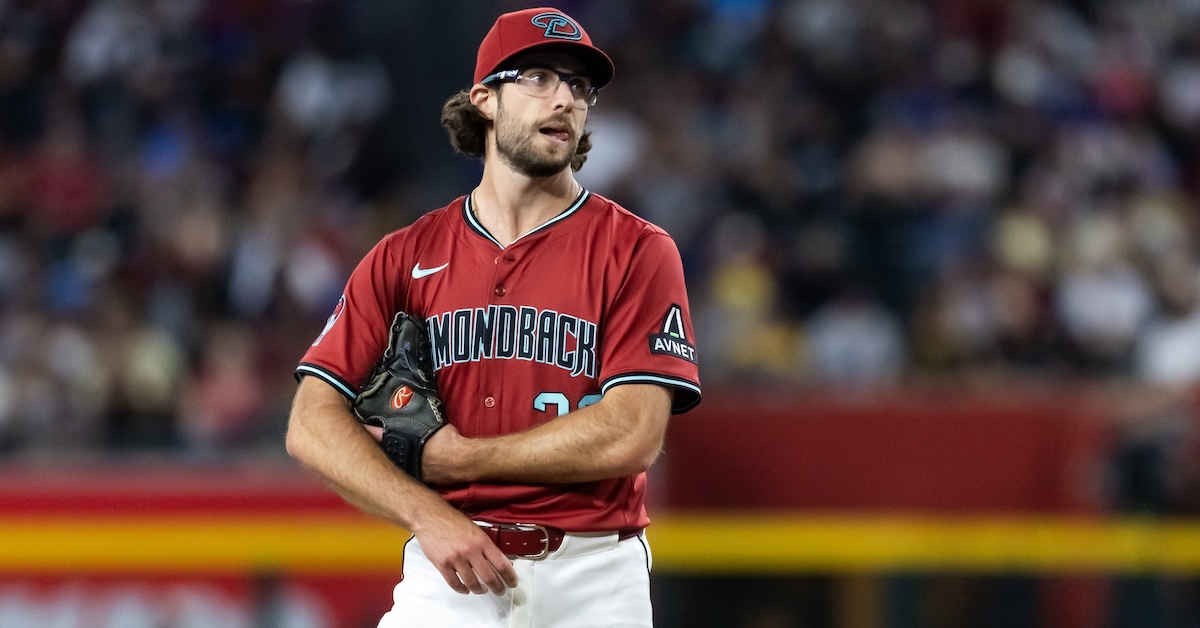
Is Nick Pivetta a Sorcerer or Something?

Denis Poroy-Imagn Images

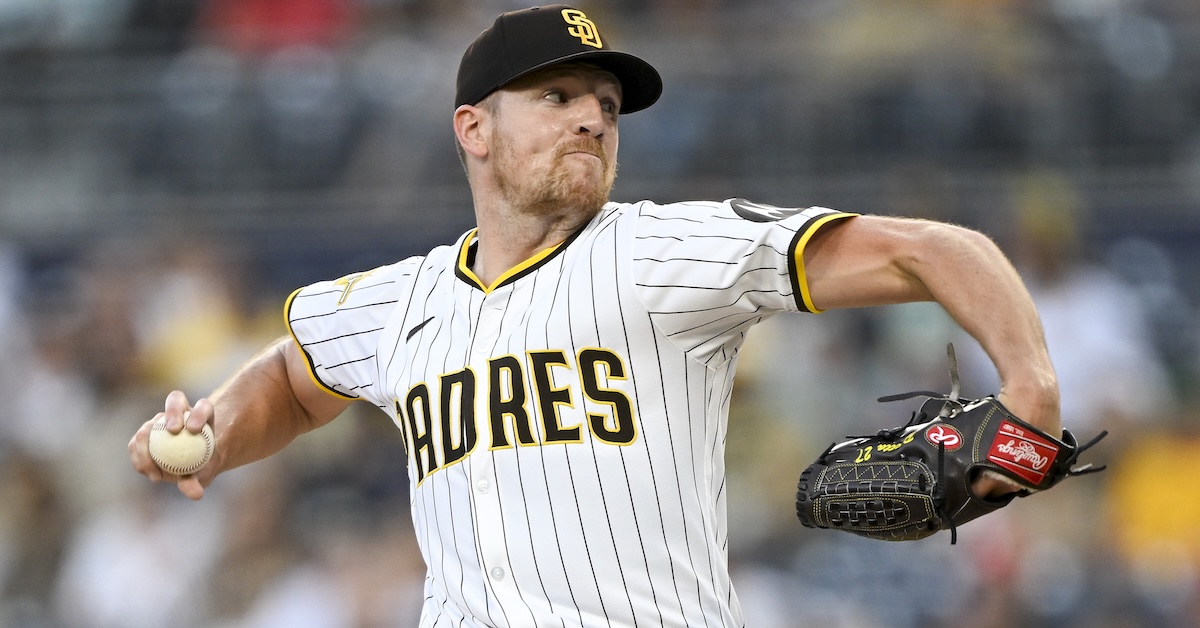
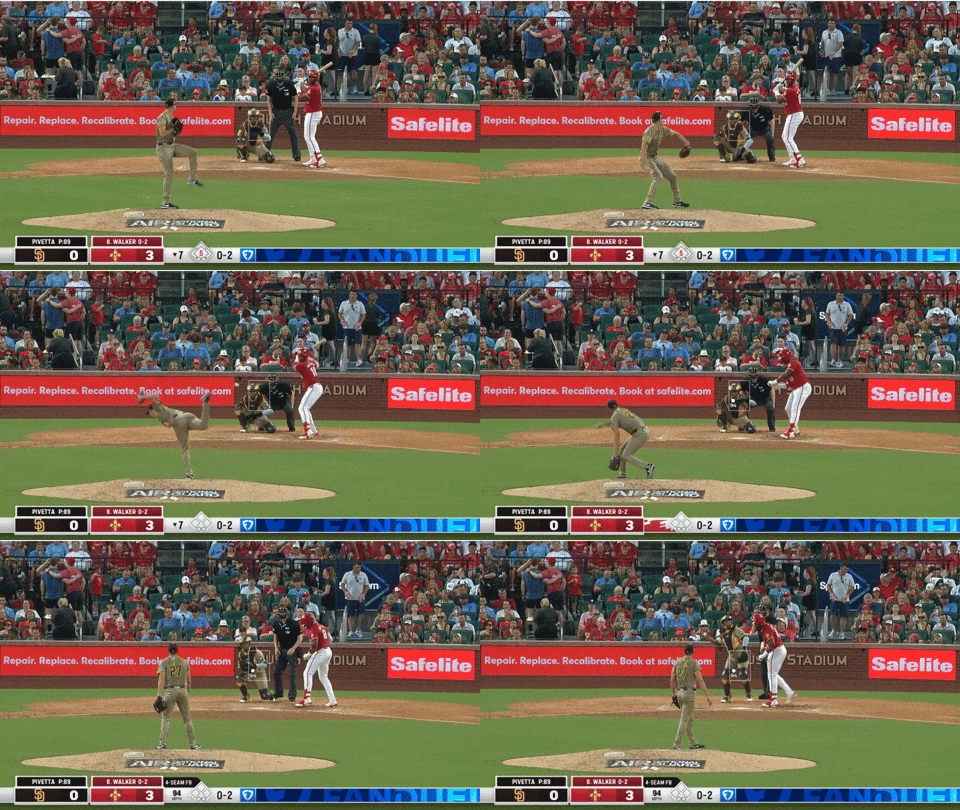
Here’s Nick Pivetta’s signature pitch:
Or maybe it’s this one, complete with a skip-off:
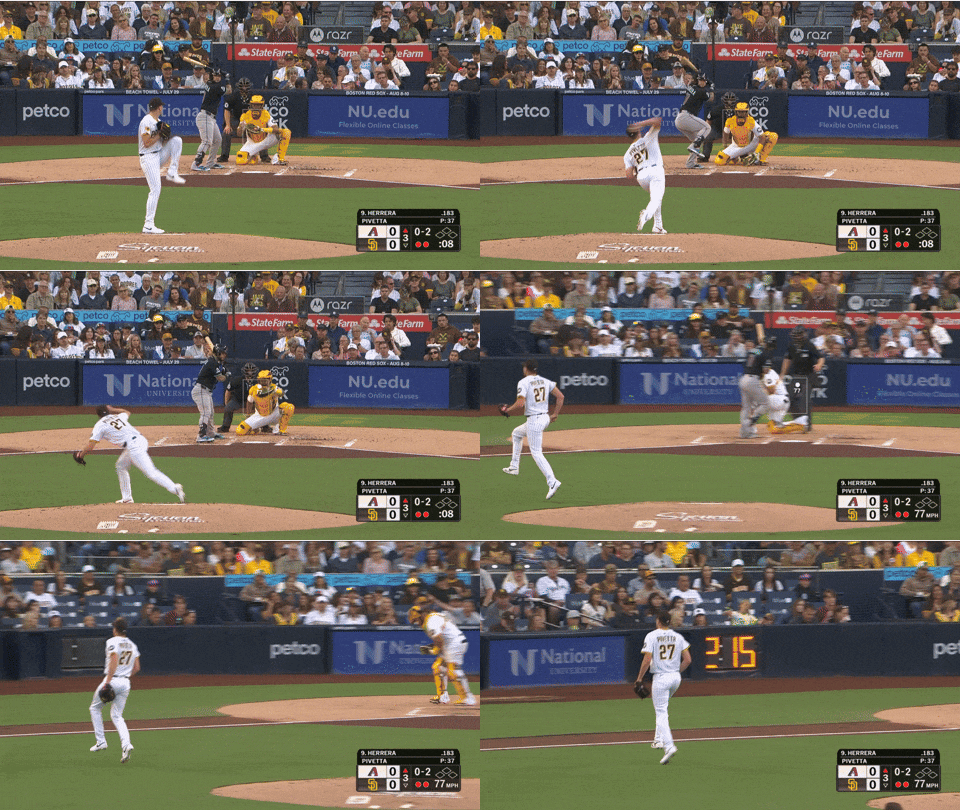
OK, the man just likes skipping:
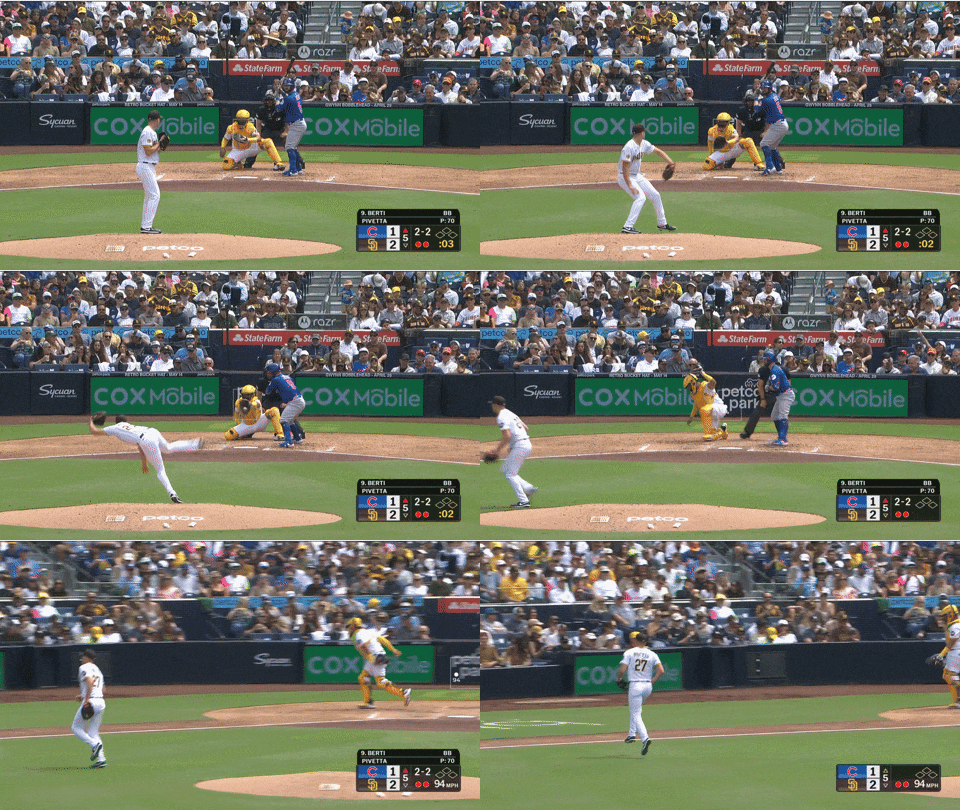
You might wonder why all of his signature pitches are tossed down the middle for called strikeouts. That’s because Pivetta is the league leader in a statistic I didn’t know I loved until I looked it up: called strikeouts on pitches right down the pipe. He’s the 2025 leader. He’s the leader over the past five years, in fact. Keep your reality-distorting sweepers and letter-high four-seamers; Pivetta gets the job done more simply.

This feels like an impossible skill to cultivate. You hear all the time about pitchers going into a lab somewhere and adding velocity or spin. New pitches? They’re a dime a dozen these days. A starter who hasn’t added a sweeper and cutter sticks out like a sore thumb now that technology and training make it easier than ever to branch out. Every year, the sliders get slidier, the curveballs get curvier, and the fastballs get faster. Meanwhile, Pivetta throws 94-mph “heaters” down the middle for strike three. How?? Read the rest of this entry »
Michael Harris II Is On Fire

Dale Zanine-Imagn Images

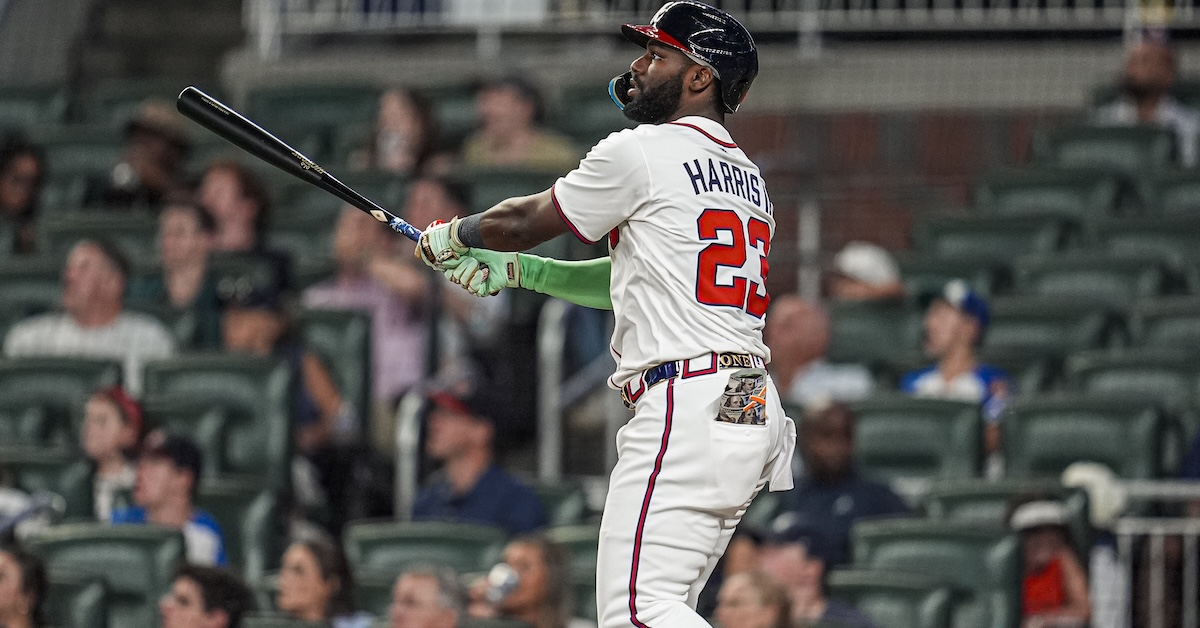
At the All-Star break, Michael Harris II was heading for his worst season as a professional. His solid defensive skills couldn’t make up for his woeful 47 wRC+, a .210/.234/.317 batting line that had neither on-base skills nor power. Between a league-low walk rate and only six homers, Harris had “accumulated” -0.8 WAR, a shockingly low number for the Braves standout. Only two Rockies, Brenton Doyle and Michael Toglia, had worse numbers.

Since the All-Star break, Michael Harris II has been one of the best hitters in baseball. In a mere 30 games, he’s racked up 2.2 WAR thanks almost entirely to his offensive prowess. He’s hitting a bruising .398/.413/.732, good for a 217 wRC+. That power outage? Forgotten. Harris has more home runs since the break (nine) than before it. Only two players in baseball – Nick Kurtz and Shea Langeliers – have a better wRC+ over that time span, or more WAR.

It can be hard to hold two opposing ideas in your head, particularly when those two ideas are “Michael Harris can’t hit” and “Michael Harris is one of the best hitters in baseball.” One purposefully silly way of saying it: Harris has accumulated 158% of his 2025 WAR in the second half of the season. Another wild thing about this ridiculous tear: Between when I filed this piece on Monday afternoon and when it was published on Tuesday, Harris went 4-for-4 with a home run and gained 16 points of wRC+ and 0.3 WAR. For the rest of this article, the numbers I use are updated through the end of play on Sunday.

It’s unquestionably true that almost anything can happen for 100 plate appearances, but this is stretching the limits of “almost anything.” You don’t run a 200 wRC+ for a month on accident. You don’t run a 47 wRC+ for half a season on accident either. I had to investigate. Read the rest of this entry »


Ben Clemens FanGraphs Chat – 8/18/25

Read the rest of this entry »


Five Things I Liked (Or Didn’t Like) This Week, August 15

Curt Hogg/USA TODAY NETWORK via Imagn Images

Welcome to another edition of Five Things I Liked (Or Didn’t Like) This Week. August is a great time for reflection in the baseball world. The trade deadline has passed, which means what you see is pretty much what you get roster-wise. The playoff picture is generally clear, but no one has clinched yet. It’s too early to think about postseason rotations, but too late to think about turning the year around. The urgency mostly isn’t there – unless you’re a Mets fan trying to ward off 25 years of ghosts, of course. But the downtime of the baseball season has its own small delights, and even when you aren’t watching the brightest stars on the biggest stage, baseball is awesome. So thanks as always to Zach Lowe of The Ringer for the column format, and let’s get going.

1. Opportunity
The Twins might have traded away a ton of their major league roster at the deadline, but that doesn’t mean they’re filling up the lineup with replacement players they found at a local tryout. Seven of the nine everyday position players on the current squad were drafted by Minnesota in the first two rounds. The other two, Alan Roden and Kody Clemens, aren’t exactly nobodies – they’re both third round draft picks the Twins acquired this year, and of course Clemens’ dad is famous too.

It’s tough sledding for Quad-A players looking for a major league shot. But while the starters still look like your average major leaguer when it comes to their amateur pedigree, the bench is another matter. Mickey Gasper was a 27th rounder who didn’t debut until he was 28. But he’s only the second-most improbable Twin. Ryan Fitzgerald went undrafted in 2016, didn’t reach Triple-A until he was 27, and finally got his major league break earlier this year as a 30-year-old. He went 0-3 in a single game as an injury replacement, pinch-ran in another, and got sent back down. Sometimes life in the bigs is nasty, brutish, and short.
Read the rest of this entry »


The Most Feared Hitter in Baseball

Charles LeClaire-Imagn Images

“Who is the most feared hitter in baseball?” is not a question I set out to answer. That would be too easy! Step one: Write “Aaron Judge.” Step two: Let out a bemused chuckle. Obviously it’s Aaron Judge. Who would have commissioned such a silly article? Step three: Get lunch. That does sound pretty tempting, I must admit, but that’s not this article. This one is a little bit weirder.

I started by asking the opposite question: “Who is the least feared hitter in baseball?” I had a simple idea for how to test it. Take a look at the rate of pitches over the heart of the plate that each batter sees when behind in the count – more strikes than balls. A hitter who sees tons of pitches down the middle in a bad hitting situation isn’t a guy who scare opponents. Pitchers are so not afraid that they’re chucking pitches down Broadway even in the situations where that’s least necessary and least advantageous. Read the rest of this entry »


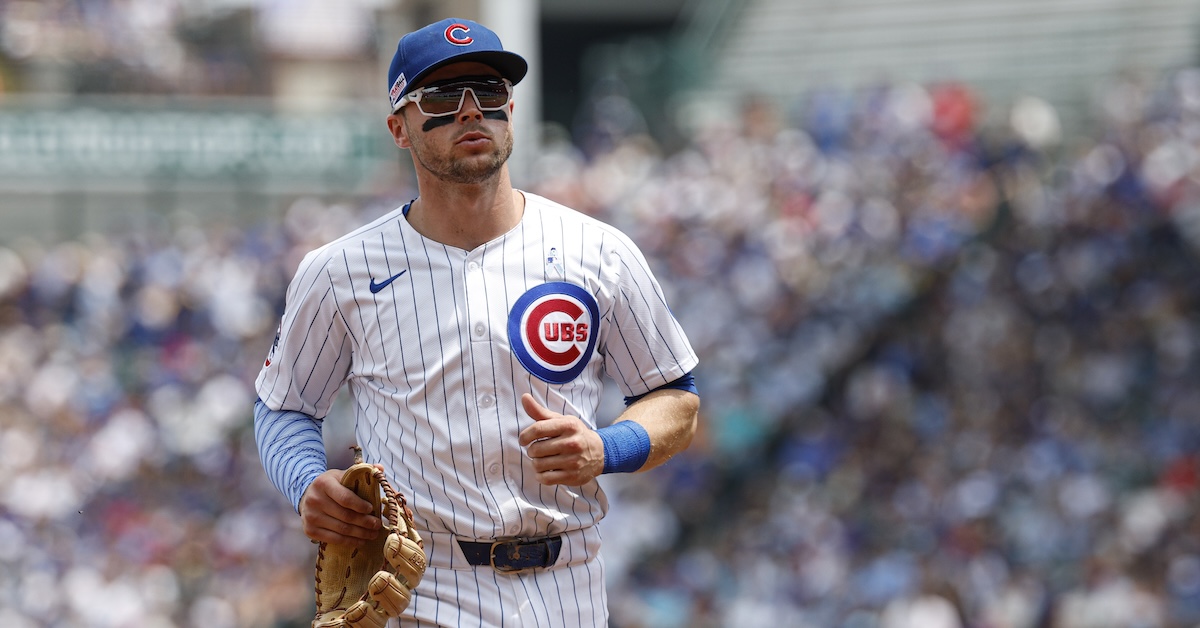
Nico Hoerner, Still At It

Kamil Krzaczynski-Imagn Images

Before they fell into the turbulent wake of the white-hot Brewers, the Cubs were flirting with the best record in baseball for much of the season. You know the highlights: Pete Crow-Armstrong flies through the air and smacks homers. Kyle Tucker is a superstar making a name for himself before hitting free agency. Michael Busch is having a mini-breakout of his own. Seiya Suzuki is a consistent power threat. Dansby Swanson is a metronome in the form of a glove-first shortstop.

You can keep naming names for quite a while, in fact, before you get to the Cubs’ two longest-tenured hitters. Ian Happ debuted way back in 2017. He’s transitioned from a superutility role to the corner outfield while featuring in the middle of the lineup for nearly a decade, a first-division regular though rarely an All-Star. He’s not the focus of today’s article, though. That would be the other longest-tenured Cub, Nico Hoerner.

Hoerner got a cup of coffee at the end of the 2019 season, played a bench role in 2020, and got injured repeatedly just as he seemed to be settling in as a starter in 2021. He’s been a locked-in everyday guy ever since, at shortstop for a year and then at second after Swanson signed with the team in free agency. And between a succession of newer and more exciting Cubs debuting and the jack-of-all-trades nature of his game, Hoerner’s stardom is often overlooked. But overlooked or not, Hoerner is a star, and so I thought I’d examine his consistent excellence as he churns through yet another quietly outstanding season. Read the rest of this entry »


Ben Clemens FanGraphs Chat – 8/11/25

Read the rest of this entry »


The Underperforming and Overachieving Pitching Staffs of 2025

Mark J. Rebilas-Imagn Images

Last week, I took a peek at which offenses have exceeded (or missed) expectations this year. I did that by taking every player’s preseason projection and actual playing time to create a projected wOBA for the entire offense. I compared that to what has actually happened. The difference? That’s what we’re looking for, how much a team has surprised to the good or bad in 2025.

I couldn’t leave it at just one phase of the game, though. Pitching can be measured the same way (ish, see methodological notes below if you’re interested in the nitty gritty). I didn’t want to compare ERA (too noisy) or FIP (too regressed, aka not noisy enough). I settled on wOBA as a good representation of how well a pitching staff is doing overall. It’s a middle point between the two other options, so we are neither ignoring what happens on balls in play, nor caring too much about sequencing. Here, for example, are the Texas Rangers, the biggest overachievers of the season:

Rangers Pitchers vs. Expectations
Player Batters Faced Proj wOBA Allowed wOBA Allowed Difference
Jacob deGrom 525 .266 .270 0.003
Patrick Corbin 475 .342 .318 -0.024
Jack Leiter 432 .325 .302 -0.023
Nathan Eovaldi 421 .305 .214 -0.091
Tyler Mahle 308 .313 .255 -0.057
Kumar Rocker 287 .297 .350 0.053
Jacob Latz 232 .320 .293 -0.027
Hoby Milner 223 .302 .228 -0.074
Shawn Armstrong 201 .309 .234 -0.075
Jacob Webb 200 .308 .294 -0.014
Robert Garcia 187 .285 .314 0.029
Caleb Boushley 152 .323 .321 -0.001
Luke Jackson 152 .313 .317 0.005
Chris Martin 140 .278 .278 0.000
Cole Winn 99 .331 .217 -0.114
Dane Dunning 46 .319 .331 0.012
Merrill Kelly 45 .314 .346 0.032
Jon Gray 44 .311 .306 -0.005
Gerson Garabito 41 .323 .417 0.094
Luis Curvelo 27 .326 .304 -0.022
Marc Church 23 .315 .334 0.019
Danny Coulombe 16 .298 .284 -0.015
Phil Maton 10 .314 .158 -0.156
Codi Heuer 5 .325 .521 0.195
Team 4291 .308 .284 -0.024

Right away, you can see why they’ve beaten expectations by so much. Four-fifths of their starting rotation, four of the five pitchers who have faced the most batters, have performed meaningfully better than their preseason projections. The fifth is Jacob deGrom, who had one of the best projections in baseball coming into the season and has hit it on the nose. Even their most-used bullpen arms have been pleasant surprises. That’s how you allow the fewest runs in baseball by a mile, apparently. Read the rest of this entry »


Five Things I Liked (Or Didn’t Like) This Week, August 8

Chadd Cady-Imagn Images

Welcome to another edition of Five Things I Liked (Or Didn’t Like) This Week. Between a vacation, the All-Star break, the Trade Value Series, and the trade deadline, Five Things has been on a bit of a summer hiatus. Baseball itself doesn’t stop, of course; weird and delightful things happen whether I’m documenting them or not. But I still couldn’t shake the feeling that this week had an extra helping of whimsy. Balls took funny hops. Good pitchers got shelled in unexpected ways. Balks took center stage. Leads changed hands late, defenders kicked things into high gear – there was so much delightful baseball this week that I struggled to narrow it down to five things. Seven things just doesn’t have the same ring to it, though, so let’s quickly nod to Zach Lowe of The Ringer for the column inspiration and get going.

1. The True King of Contact
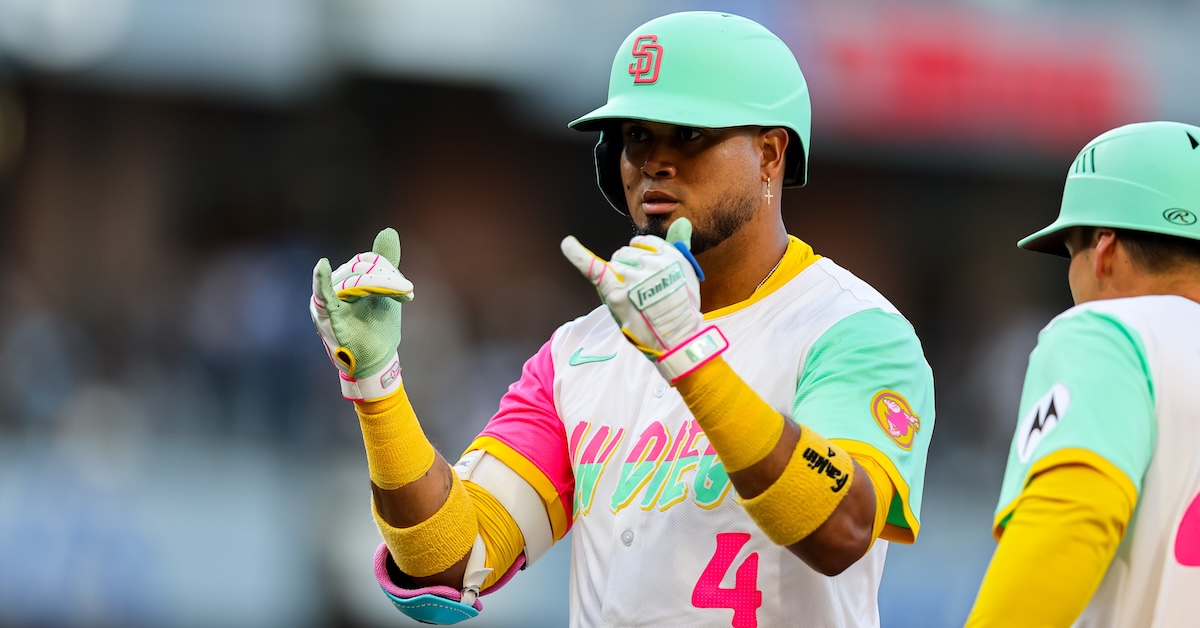
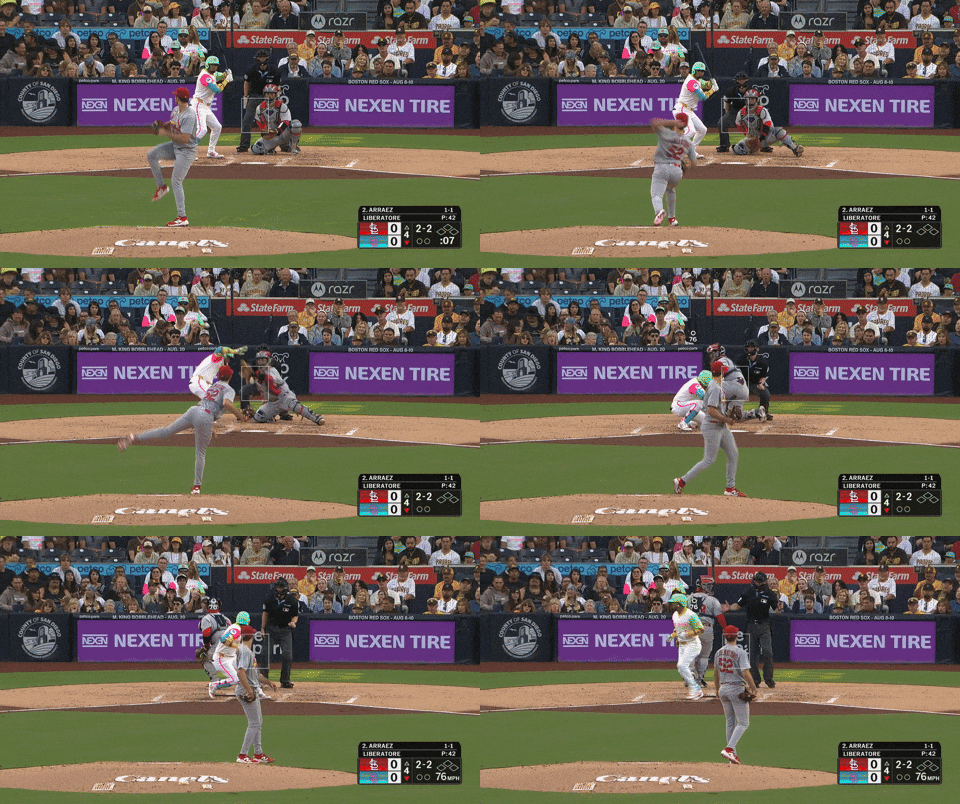
Writing about Luis Arraez can be a bummer sometimes. Not because he’s bad – he’s emphatically not – but because merely mentioning his name reinvigorates the age-old argument between those who say there are too many strikeouts and those who insist that slug is in the air. Should everyone be doing what Arraez is doing? Is he an anachronism? Is he underrated? Overrated? He’s so good at what he does – and what he does is so different from what most good baseball players do – that these questions are frustratingly omnipresent in any discussion about Arraez.

That said, I think I found an Arraez play that won’t divide the audience. The key is for it not to involve a ball in play, a walk, or a strikeout. Take a look at this beauty:

Read the rest of this entry »


The Underperforming and Overachieving Offenses of 2025

Gregory Fisher-Imagn Images

If you’re a fan of a large-market team that has recently been struggling to score runs, you may be eligible for compensation. Wait, no – that’s not right. You may be eligible to complain about your team in my weekly chat? Not quite it, either. Let’s try it one more time… If you’re a fan of a large-market team that has recently been struggling to score runs, you are eligible to read this article and see to what extent your team has let you down and to what extent it’s just a narrative.

The Yankees and Mets have been having a tough time of late, which always brings out doubters, both fans and rivals. I don’t quite know what to tell those grumpy souls. You’re upset with the Yankees offense? Well yes, sure, absolutely, carry on, but they do have the highest team wRC+ in baseball. The Mets let you down? Without a doubt, they’re the Mets, so on and so forth – but they’re top 10 in baseball in wRC+, too. Orioles offense bumming you out? Yeah, I mean, they’ve been a bummer, but they’ve also been impacted by injuries, which seems hard to blame them for.

I came up with a quantitative test for how much teams have disappointed relative to preseason expectations. I took the actual playing time that each team has allocated so far. Then, I used preseason projections to come up with the offensive numbers we’d expect from each team given who has played and how good we projected them to be. I compared that to how good the team has actually been. The difference between those two numbers is the aggregate overachievement or underperformance that can’t be attributed to injury.
Read the rest of this entry »