Author Archive

Dan Szymborski FanGraphs Chat – 5/21/2020

12:00
Avatar Dan Szymborski: And the chat has begun, sayeth the clock.

12:01
Avatar Dan Szymborski: And as powerful as I like to imagine I am — though I am not — I cannot stop time.

12:01
Avatar Dan Szymborski: And it’s really hard to even break a watch!

12:01
Carl: Do you happen to know what Eric means when he projects a player as a “second division regular”? I keep missing his chats to ask. Who is a current MLB player that would constitute a “second division regular”?

12:01
Avatar Dan Szymborski: I don’t have the context, but before divisions, contenders and non-contenders were widely called first division and second division in the vernacular

12:02
Avatar Dan Szymborski: so a second division regular, if Eric is using it as I would expect him to, is a starter on a bad team who wouldn’t really push a contender towards the playoffs.

Read the rest of this entry »


Which Players Lose Out in the 2020 Service Time Agreement?

This spring, one of the stickiest issues in the negotiations between the owners and the MLBPA was that of service time credit, a subject that has long caused labor friction. If the 2020 season occurs, the issue of service time credit will largely take care of itself. But what if there is no 2020 season? The lost salaries are hard enough, but the lost service time would have made those losses even greater. Using ZiPS to consider just 15 prominent free agents-to-be after the 2020 and 2021 seasons, I estimated that those players alone would lose roughly $316 million on their next contracts.

In return for $170 million in guaranteed money — an advance if play happened to recommence this year — and agreeing not to sue for their lost salaries, the players struck a deal. If 2020 is not played, the free agents-to-be in 2021 will still hit the market this winter, as players will be credited for the same amount of service they accrued in 2019.

MLB’s system of arbitration and free agency is based on bright lines; five years and 171 days and you have to go through salary arbitration, while one more day lets you hit free agency. The agreement between players and owners benefits them collectively, but inevitably, some individuals will find themselves on the wrong side of one of those new bright lines. And in this case, a few dozen young players, many of whom are among the brightest young talents in baseball, would still be under an additional year of team control if 2020 is lost. Read the rest of this entry »


COVID-19 Roundup: MLB Furloughs Accelerate

This is the latest installment of a series in which the FanGraphs staff rounds up the latest developments regarding the COVID-19 virus’ effect on baseball.

The Rent-is-Too-Damn-High Team

The Oakland A’s and the county stadium authority are in a dispute over ballpark rent. This isn’t the first time there’s been such a dispute at the stadium sometimes known as the Oakland Coliseum. In 2014, the lease-extension negotiations between the A’s and the county stadium authority broke down over a dispute over withheld payments. The Oakland Raiders also withheld rent payments in 2015, part of an ongoing dispute that ended with the Raiders leaving for Las Vegas thanks to a sweetheart deal in their new city.

What’s new this time, of course, is the effect of pandemic economics. Citing the force majeure clause in the contract between the Athletics and the stadium authority, A’s general counsel D’Lorna Ellis referenced the unavailability of the stadium for play to justify the team deferring payment “until [they] have a better understanding of when the Coliseum will be available for use.”

The Coliseum Authority Executive Director made the issue a bit more confusing with contradictory statements, first saying that “because they haven’t used it, they were not able to generate revenue and they have no ability to pay,” before assuring the San Francisco Chronicle that the A’s never suggested revenue was an issue.

Coliseum Authority board member Ignacio De La Fuente, a former president of Oakland’s City Council, was less conciliatory than Gardner. Read the rest of this entry »


The Biggest Losers in a Seasonless Season

While we can hope there’s a 2020 season that provides both quality baseball and sufficient safety protocols for players, team personnel, and those who work in the game’s orbit, a lot of things have to come together to make such a season happen. A number of COVID-19-related health concerns and continued issues between labor and ownership could cause the season to stall before it ever starts.

In a very real sense, if this happens, everybody loses. But in a baseball sense, the consequences of a lost 2020 season won’t weigh equally on every team. While we maintain the fiction that every team enters the season with a real chance to win the World Series, our story’s ending is more like that of one of those German fairy tales; even if Ron Gardenhire is unlikely to be eaten by a wolf, the Detroit Tigers were always long shots to go 70-92.

Teams had different ideas about what they wanted to accomplish in 2020, and for some teams, this season was more crucial for their long-term goals — in one way or another — than it was for others.

Cincinnati Reds

Many analysts, myself included, have bemoaned the lack of ambition many teams have displayed the last few offseasons, with winning clubs seemingly most concerned with not paying luxury tax penalties or spinning tales of financial hardship too fanciful even for the Brothers Grimm. Read the rest of this entry »


Another Day, Another New Plan Projected

As owners and the players discuss ways to start up the 2020 season, we’ve started to see the outline of a possible plan for play become less foggy. 162 games has, of course, long been impossible; now, the owners are proposing roughly a half-season rather than the expected 100-110 games. 82 games starting in early July gives us less baseball than usual, but it could also result in the “baseball year” following its same basic schedule rather than ending in late November. After all, teams normally play about that many games after early July! This likely represents the desire of the owners to play as many games as possible in the home parks rather than the considerably more exotic Super Spring Training plans that have been floated over the last six weeks.

But a shorter schedule isn’t the only proposed change coming for 2020 baseball. Forecasting how the Players v. Owners fight over revenue-sharing shakes out is beyond my abilities as a projectionista, but there are many other new tidbits that do fall within my scope. For one, while the league standings are still likely to be organized along the usual lines, teams would only play their regional division “partners” and the corresponding geographical division of the other league. This has the rather odd result of the Wild Card standings consisting of a lot of teams that would never play each other. But as ugly as that sounds, the main concern is playing the season rather than maximizing its fairness. For the purposes of these projections, I’ve assumed teams will play 52 games, or 63% of the schedule, in their division with 30 games out of division.

The designated hitter is also expected to become universal this year. I’ve long been of the opinion that as soon as interleague play became a daily activity, pitcher-hitting was on borrowed time. When interleague play consisted of special chunks of the season, NL teams could design their rosters to call up a Wily Mo Pena, a competent DH type without a full-time spot on the team, large pitching staffs having mostly killed off the designated pinch-hitter job. Once DH games became sprinkled throughout the system, it put NL teams at a slight disadvantage when planning to have an extra bat on the roster. Read the rest of this entry »


Dan Szymborski FanGraphs Chat – 5/14/20

12:03
Avatar Dan Szymborski: AND GOT HERE

12:03
Avatar Dan Szymborski: I was finishing an article and it was a race against the clock!

12:04
Danny Almonte’s fastball: If you could make a chimera of any 2 current pitchers, who would they be for: the best, the most fun to watch, the most unique?

12:04
Avatar Dan Szymborski: A Bartolo Colon who pitches like Gerrit Cole!

12:05
Avatar Dan Szymborski: AND HE WOULD BE ALL OF THOSE THINGS

12:05
Danny Almonte’s fastball: Player you love who has a surprisingly low WAR?

Read the rest of this entry »


COVID-19 Roundup: Major Sports Inch Towards Play

This is the latest installment of a series in which the FanGraphs staff rounds up the latest developments regarding the COVID-19 virus’ effect on baseball.

The NBA Plans Its Return

The NBA, like the NHL, is in a bit of a different situation than MLB in that its season was mostly already done before COVID-19 reared its ugly morphology. NBA commissioner Adam Silver reportedly conversed with NBA owners Tuesday, providing an optimistic outlook about the resumption of play, and while the exact numbers have not been released, a confidential survey of NBA players taken by NBPA representatives indicated that there is an overwhelming desire to finish the season. And in an attempt not to force the decision right now, the NBA and NBPA also agreed to extend until September the deadline for the owners to trigger the clause that allows them to suspend the CBA.

Premier League Considers Possibility of Lost Season

The Premier League’s chief executive, Richard Masters, indicated that he has discussed the possibility of being unable to resume the 2020 season with the teams. The UK has given clearance for the league to resume on June 1 and they were previously targeting a return to play on June 8, but the teams put the kibosh on the possibility of playing games on neutral grounds (this kind of thing is a bigger deal in association football than it is in baseball). There’s another significant roadblock in that the players are not yet officially convinced that it’s safe to resume the season.

The NHL Discussing Resumption

The NHL’s Return to Play committee continued talks on Tuesday. One of the undecided questions is what the NHL playoffs will look like, one scenario being a 24-team playoff that eliminates the need to finish the regular season at all. Prominent players such as Sidney Crosby and Alex Ovechkin have previously expressed a preference for going straight to the playoffs.

Arizona Sports Are Go

Arizona governor Doug Ducey announced on Tuesday that major league sports could resume play in the state when the state’s stay-at-home order expires on Friday. Most of the scenarios in which MLB resumes play in 2020 require games to be played in some combination of Arizona, Florida, and Texas, so Arizona giving the green light to the return of professional sports was a necessary part of these plans. This is especially true in light of news that Los Angeles County envisions its stay-at-home orders remaining in effect into August. Los Angeles may not be alone if there are new COVID-19 peaks in communities with major league parks.

While baseball can resume in Arizona, there are still strings attached in that the teams will have to follow CDC safety guidelines, though one would hope that they would do so even if Arizona hadn’t laid it down as a requirement.

MLB/MLBPA Talks Are in Progress

We’ll have a lot more on this, but in any COVID-19 roundup, it can’t be forgotten that MLB started discussions with the MLBPA on the exact steps needed to start the 2020 regular season. One surprise in the first day was that the owners did not broach the topic of the extremely controversial givebacks they want from the players. And if you’re wondering why there’s been such a push from the league to play at least some of the season in teams’ home parks, it comes down, at least in part, to revenue sources that would not be as readily available at the spring training venues.

Mariners Avoid Furloughs

To avoid any cuts and furloughs through October 1, the Mariners are implementing a 20% pay cut on employees making at least $60,000 per year. Employees who would see a dip under $60,000 with a 20% pay cut will not see their salaries drop below that $60,000 line. Some of the top executives, including general manager Jerry Dipoto, are taking unspecified cuts that are greater than 20%. Personally, I’m mildly surprised to discover that Dipoto isn’t paid by the trade.

Not every teams’ staff is so lucky. There are concerns in baseball that teams will use the shutdown as an excuse to permanently slash some costs and one NL executive told ESPN’s Buster Olney that he expected significant upheaval:

“I bet 40% of those let go never get back in baseball again,” an NL official said. “A lot of these guys have been in the game for their whole adult lives, and they’re making pennies. And you’re just going to throw those guys on the street, into this economy?”

Said another team exec: “Baseball will come back, and I bet teams could make up the cost of keeping these people on within four or five years. It just doesn’t make any sense to me that these [teams] need to dump people making $40,000, $50,000. Those savings are not difference-making” within the MLB context.


COVID-19 Roundup: The Billion-Dollar Question

This is the latest installment of a series in which the FanGraphs staff rounds up the latest developments regarding the COVID-19 virus’ effect on baseball.

MLB Explores Revenue-Sharing

One of the trickiest aspects of opening the 2020 season may not be the direct effects of COVID-19 but instead how to divide up what will be a smaller-than-usual pile of cash. MLB and the MLBPA answered one question last month, coming to an agreement on the service time issues. While this decided some things in the event there is no 2020 season and no revenues to divide, the league is arguing this agreement didn’t conclusively answer what would happen if there actually is a season.

Perhaps the biggest unanswered question revolves around player salaries. While the initial agreement involved pro-rating normal salaries for however many games are actually played, there’s a disagreement between MLB and the MLBPA about whether this assumed normal games with fans in attendance rather than fan-free ones. This isn’t just obscure legalese but a serious roadblock.

In my opinion, teams have very real concerns about league revenues without fans in attendance, more real than the general complaints about revenue in normal seasons. The problem is, owners don’t exactly have a long history of good-faith negotiations with players. It’s not unreasonable for players to be suspicious given the games played by team owners over the years despite players seeing a declining share of the revenues while team valuations skyrocket. Read the rest of this entry »


MLB’s Possible Three Division Monte

With so much uncertainty surrounding the “when” and “if” of a 2020 MLB season, it’s not surprising to see a constant progression of new plans. What it comes down to is that there’s no obvious one-size-fits-all solution that maximizes player and staff safety, baseball quality, the number of baseball games, and league revenue simultaneously. It’s only in such an odd year that things like playing in spring training parks, Arizona/Florida leagues, neutral playoffs, fanless games, and Thanksgiving baseball actually seem plausible rather than falling in the category of whimsical skylarkings.

While states re-opening for business seems like a dubious decision, often running counter to the advice of public health experts, it appears inevitable that many jurisdictions will resume much of their pre-COVID-19 economic activity, though with additional precautions and wariness of others. We’re far from being able to expect normal game conditions, with fans and hot dog vendors, but increasingly, there’s a push to play a large percentage, if not all of the season, in teams’ home parks.

With travel likely to be both more difficult and more perilous, CBS Sports’ RJ Anderson reported a proposal for a three-division alignment for the 2020 season. This would likely involve teams at least starting in just a few stadiums before an eventual move to their home cities depending on the course of the virus. Read the rest of this entry »


ZiPS Time Warp: Joe Mauer

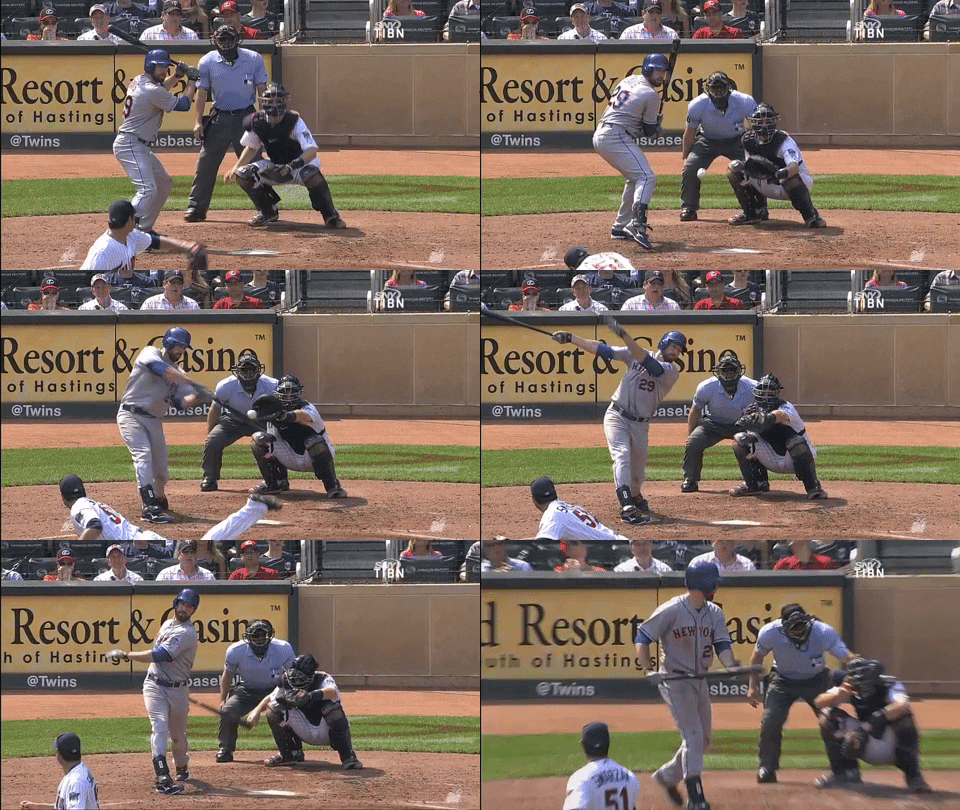
If we didn’t know it was real, Joe Mauer’s career with the Minnesota Twins might strike us as being more like a fairy tale than an actual story. That is, until August 19, 2013. That was when Mets first baseman Ike Davis hit a foul tip that hit Mauer square in his helmet.

The moribund Twins, coming off a 69-93 season, had the first overall draft pick in 2001 for the second time in franchise history. The first time the Twins had the No. 1 pick, they drafted Tim Belcher, who didn’t sign when the team wouldn’t pay the going rate for a top selection. Minnesota also failed to sign their second round pick, Bill Swift; none of the players they actually did sign ever played a game in the majors. Read the rest of this entry »