Author Archive

Postseason Preview: New York Yankees vs. Minnesota Twins ALDS

Let us dispense with this first, so that we can move on: Derek Jeter isn’t here, and neither are the rest of the Core Four. For that matter, there’s no Johan Santana, Michael Cuddyer, Francisco Liriano, or Joe Mauer. The four Yankees teams that manhandled the Twins in the 2003, ’04, ’09 and ’10 Division Series by a combined total of 12 wins to two are no more relevant to this series than Babe Ruth or Lou Gehrig. Aside from “Yankees Bullpen: Still Very Good,” there’s no point overthinking the results of the 2017 AL Wild Card Game, either. These 101-win Twins and 103-win Yankees are a pair of excellent, evenly-matched squads here to write new stories instead of extending old ones.

Some thoughts on the series, which begins at Yankee Stadium on Friday at 7:07 pm ET.

Keeping It 100

This year was the first in major league history with four 100-win teams, and while that seems impressive, it’s an indication of the game’s competitive balance issues (a topic worth revisiting on another day). While 33 teams have won at least 100 games in a season during the Wild Card era, only three previous times have two of them crossed paths in the postseason, all within the past three years: the 2017 World Series between the Astros (101-61) and Dodgers (104-58), the 2018 Division Series between the Red Sox (108-54) and Yankees (100-62), and the subsequent ALCS matchup between those Red Sox and the Astros (103-59). Inevitably, one of these teams will be the unlucky 13th 100-game winner to make a first-round exit, after the 1998 Astros (102-60), 1999 Diamondbacks (100-62), 2001 A’s (102-60), 2002 A’s (103-59), 2002 Yankees (103-58), 2002 Braves (101-59), 2003 Braves (101-61), 2003 Giants (100-61), 2008 Angels (100-62), 2011 Phillies (102-60), 2015 Cardinals (100-62), and 2017 Indians (102-60). It’s going to hurt.

Not all 100-win teams are created equal, of course. This pair had similar levels of scoring and runs allowed, and both similarly overachieved relative to their Pythagen records. However, the Yankees distinguished themselves in a few ways:
Read the rest of this entry »


Verlander’s Twin Milestones Cap a Year of Record Strikeouts

In a season that had already seen strikeout rates and totals reach unprecedented highs, Justin Verlander helped himself to not one but two impressive, K-related milestones on Saturday night against the Angels in Anaheim. With his fourth-inning strikeout of Kole Calhoun, he became the 18th pitcher to reach 3,000 for his career, and the second this season after CC Sabathia. Two innings later, he whiffed Calhoun again for his 300th (and final) strikeout of the season. The two milestones — which had been paired in a single game once before, by the Diamondbacks’ Randy Johnson on September 10, 2000 against the Marlins — added a couple more bullet points to his case for a second AL Cy Young award, but they also served to remind us what a silly season it’s been for swings and misses.

After leading the AL for the fifth time last year with a career-high 290 strikeouts, Verlander began this season 294 short of 3,000, a distance that suggested that the 36-year-old righty would need until early in the 2020 season to reach the milestone. That still appeared to be the case when I checked in on him on May 1, in the context of Sabathia joining the 3,000 club; on June 24, when I wrote about Verlander dominating despite so many home runs surrendered; and on August 16, when I checked in on the progress of several stars who had enhanced their Hall of Fame cases this year. At that last juncture, Verlander was averaging 12.0 strikeouts per nine and needed 77 to reach 3,000. Figuring six innings and thus eight strikeouts per start, times eight starts — either actual or their equivalent via shorter late-season outings as the playoffs approached — my back-of-the-envelope math suggested he’d fall short.

The night that last piece was published, Verlander whiffed 11 A’s in seven innings, though he wound up on the losing end of a 3-2 game. It was his sixth straight game with at least 10 strikeouts, already a personal best, and he pushed the streak to seven games with an 11-strikeout complete game against Detroit on August 21 — yet another loss, however, as the two hits he surrendered to the Tigers, both solo homers, were enough to topple him. Two starts later, he punched out 14 Blue Jays while notching his third career no-hitter, and despite generally drawing down his pitch counts over his last four starts — 106 pitches on September 12 versus the A’s, 87 on September 17 versus the Rangers, 92 on September 22 against the Angels, and then just 80 on Saturday night — he had two more starts with double-digit K’s and totaled 36 over his final 23 innings. Where my estimate from mid-August to the end of the season was for 48 innings and 64 strikeouts, he instead threw 60.1 innings with 83 strikeouts. His rate per plate appearance rose from 34.5% (with a 5.4% walk rate) prior to August 16, to 38.7% (with a 3.7% walk rate) from that point onward. While the Tigers and Rangers both finished among the majors’ top five in batter strikeout rates, the A’s and Angels were in the bottom seven, so it’s not like Verlander had a particular advantage down the stretch. His was an impressive rally. Read the rest of this entry »


Team Entropy 2019: Hey, There’s Still Meat on This Bone!

This is the fourth installment of this year’s Team Entropy series, my recurring look not only at the races for the remaining playoff spots but the potential for end-of-season chaos in the form of down-to-the-wire suspense and even tiebreakers. Ideally, we want more ties than the men’s department at Macy’s. If you’re new to this, please read the introduction here.

The final weekend of the 2019 season is upon us, and while five of the divisions and all of the super-complicated tiebreaker scenarios are off the table, with three games to play, each league has multiple scenarios that could result in at least one tiebreaker game. Seven hundred or so words is worth a picture, so first, behold this:

Read the rest of this entry »


Félix Hernández and the Rocky Road to Cooperstown

Wearing his emotions on his sleeve start to finish — from the moment that he walked through the bullpen door to chants of “Let’s go, Félix!” to his own tearful salute to the fans upon being pulled with one out in the sixth inning — on Thursday night at T-Mobile Park in Seattle, Félix Hernández made the 418th and likely final start of his 15-year run with the Mariners. He tipped his cap to the King’s Court upon entering, fell behind early while struggling with his command and control, strutted a bit after a strikeout, exulted in Dylan Moore’s spectacular, run-saving catch to end the fifth inning, competed like hell with a tenacity that far outstripped his stuff, and then bowed to the frenzied crowd of 20,921 before exiting the field. Some 2,800 miles way in Brooklyn, watching the outing on my office TV as I pecked out an article full of objective measures regarding his place in history, I struggled to keep it together. I can only imagine how Mariners fans felt.

It’s an understatement to say that the parting of Hernández — whose seven-year, $175 million contract has run its course — and the rebuilding Mariners is a bittersweet moment for the pitcher, the team, and their long-suffering fans, or fans of great baseball players in general. There’s certainly plenty of reason to ponder the peaks of his run and recall the good times, the hopes he represented as a teenaged arrival on a team whose championship aspirations had been so often thwarted. His dazzling combination of an electrifying, darting sinker, a knee-buckling curve, and a signature hard changeup propelled him to a Cy Young award, two ERA titles, six All-Star appearances, a perfect game, and 2,524 strikeouts. He arrived as “King Félix,” and grew into the moniker. From 2009-14, he was the best pitcher in the American League by ERA, FIP, strikeouts, and WAR.

For as cool as all of that was, the reality is that this sendoff is as much about Hernández’s decline as his stardom, and the ache and sorrow over close calls and missed opportunities that have deprived him of a chance to test his mettle in the postseason. He’s no Ernie Banks, hanging around into his 40s in a reduced role at a new position. This parting is all happening more than six months before the pitcher’s 34th birthday, an age when he should still be a productive major leaguer if not necessarily one at the pinnacle of his career. Perhaps he still can be, but his recent performance doesn’t suggest it, not with a season ERA that has almost literally tripled since 2014, when he netted his second ERA title and finished as the runner-up in the AL Cy Young voting for a second time. For the first 12 years of his career, he was clearly on a Cooperstown-bound path, but there’s little to indicate he can continue traveling that road.

The rare 21st century pitcher to debut before his 20th birthday — Dylan Bundy, Elvis Luciano, and Julio Urías are the others — Hernández got an early start towards stardom. While pitchers who debut at that tender age have a leg up when it comes to reaching the Hall of Fame just as their position-playing counterparts do, the effect is not as great. I noted in connection with Ronald Acuña Jr.’s debut last year that 25 of the 244 players who had at least one plate appearance in their age-19 seasons (10.2%) wound up in Cooperstown, about 8.7 times the overall rate (1.18%). For pitchers active in their age-19 seasons, the total is 17 (not counting Babe Ruth, who converted to position playing) out of 296 (5.7%), about 4.9 times the overall rate. It’s a reasonable assumption that the difference between the two rates owes a fair bit to some combination of injury rates and workloads as they relate to young pitchers, but that’s a question for another day. Read the rest of this entry »


Maximum Launch Angle is a Blast

Wherever you sit along the spectrum of baseball observers, from newcomer through casual fan, diehard, junkie, nerd and professional, you are by no means obligated to care about Statcast. Publicly available numbers quantifying three-dimensional coordinates, velocity, spin rate, and more are now attached to everything this side of how often the third baseman adjusts his cup between pitches, but that doesn’t mean it’s necessary for you even to acknowledge their existence in order to enjoy what you’re watching. Nevertheless, some of us do get a kick out of the occasional peek at those numbers, not for their own sake but because they increase our understanding of the game — and of ourselves.

Somewhere along the way — in fact, even before Statcast itself arrived — I realized that I have a particular appreciation for what I have termed “launch angle porn.”

I’ll allow you that nervous giggle before you get your mind out of the gutter. This is, after all, a family site, and while others have gone down the road of documenting bodily functions within the national pastime, that’s not where I’m heading. The trajectories to which I refer concern the flight of baseballs, and more specifically, the visceral thrill of watching the beginning of a towering home run even amid the unending barrage of such hits and their resultant highlights. In that instant of contact between ball and bat, particularly when viewed on a two-dimensional screen of whatever size, we have no idea of the final distance that struck sphere will travel, and we can only infer its exit velocity in the roughest sense. After the sight and sound of contact — and particularly, the mellifluous melody of a ball hitting the sweet spot of a wooden bat — launch angle is the first feedback we get, quickly followed by a very excited play-by-play announcer and a slugger admiring his own handiwork. Consider these three examples, classics from the late 20th century by three of the most prolific home run hitters ever.

Here’s Reggie Jackson at the 1971 All-Star Game, hitting one off the Tiger Stadium transformer on the roof:

Read the rest of this entry »


Team Entropy 2019: Is This Thing Even On?

This is the third installment of this year’s Team Entropy series, my recurring look not only at the races for the remaining playoff spots but at the potential for end-of-season chaos in the form of down-to-the-wire suspense and even tiebreakers. Ideally, we want more ties than the men’s department at Macy’s. If you’re new to this, please read the introduction here.

You’ll be shocked to learn that when it comes to chaos, some teams just don’t want to cooperate. That’s the story of Team Entropy this year. Since I last checked in on September 13, our chances of seeing complex scenarios necessitating multiple tiebreakers have more or less gone in the direction of the Cubs’ season, which is to say sharply downward at cartoonish speed.

Chicago has not only lost 11 of its last 17 games since September 5, it’s lost six straight, including five in a row by one run and four in a row to the Cardinals, three of which featured the Cubs holding the lead or being tied in the ninth inning. Craig Edwards had the gory details on Monday. This isn’t all on the Cubs’ shoulders, however. With just six days of regular season baseball remaining, four of the six divisions have been clinched, and the Wild Card hopes of the Mets and Phillies are on life support; the Diamondbacks are done. Fortunately, the possibility of at least one tiebreaker in each league still looms. So let’s take a closer look at what’s left.

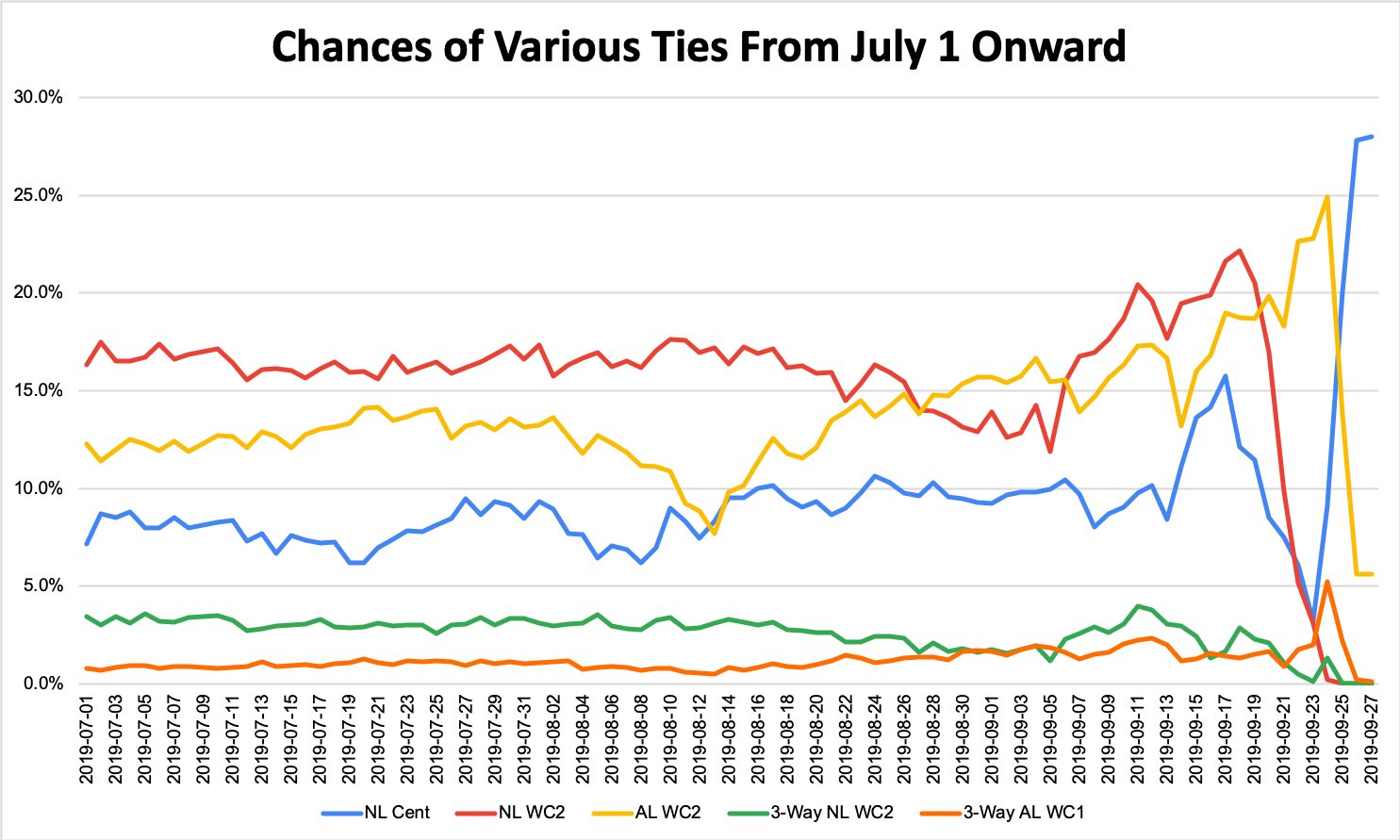
Contrary to the previous installments of this year’s series, the greater excitement is now in the American League. While the Indians (92-64) trail the Twins (96-60) by four games and have an elimination number of three in the AL Central race, Cleveland is just half a game behind Tampa Bay (93-64) for the second AL Wild Card spot, and two games behind Oakland (94-62) for the first. The chances of three teams winding up tied are just 2.0%, but that’s actually higher than they’ve been for most of the time since July 1. Sean Dolinar was kind enough to supply me with an archive of our tiebreakers page, and since July 1, there have only been four days that ended with greater odds of such a tie, all in the span from September 11-14. Woohoo! Read the rest of this entry »


Domingo Germán Won’t Pitch in the Postseason, but Baseball’s DV Loophole Needs to Be Closed

When ESPN’s Buster Olney reported on Friday that Yankees right-hander Domingo Germán will not pitch again this year, either in the regular season or the postseason, in the wake of a reported violation of the Joint MLB-MLBPA Domestic Violence Policy and a likely suspension, it was a instance of the league and the players’ union lucking into the right outcome. While players suspended for violating the Joint Drug Agreement by taking performance-enhancing drugs have been ineligible to participate in that year’s postseason since 2014, that’s not the case for those suspended under the DV policy introduced in August 2015. Not only does that make for a jarring incongruity given the relative severity of those transgressions, allowing recently suspended players to participate in the playoffs can lead to unsavory behavior on the part of teams, as we’ve seen multiple times since the policy was introduced. It’s time for the players and the league to close this loophole.

Germán was placed on administrative leave on Thursday in connection with an incident that reportedly took place at the pitcher’s residence late Monday or early Tuesday, after the pitcher and his girlfriend appeared at CC Sabathia’s charity gala. The 27-year-old righty, who in his first full major league season has emerged as a viable rotation cog, had pitched in relief of Sabathia on Wednesday night in preparation for a more flexible role come the postseason. The announcement of his placement on leave dimmed some of the luster of the Yankees’ victory over the Angels later that night, which not only marked their 100th win but clinched their first AL East title since 2012.

No police report was filed in connection with the incident at Germán’s residence, and no charges were filed. The incident was reported directly to the league, which, according to The Athletic’s Lindsey Adler, conducted a preliminary investigation on Tuesday and Wednesday, interviewing people around the team. While Yankees manager Aaron Boone said he heard “whispers” of an investigation on Wednesday, the team was not informed until Thursday morning that the pitcher had been placed on administrative leave. Via Adler:

“I learned on the drive in that he was going on administrative leave,” Boone said Thursday afternoon. “Heard some of the whispers and whatnot, but this is a Major League Baseball investigation and issue. We’re just trying to be as cooperative as we can while this goes on.”

A player can be placed on administrative leave for up to seven days, though that period can be extended; during that time, he is paid but not allowed to have any contact with his team. By inference, the mere placement of a player on leave means that the league and the union agree that the allegation in question is substantive — that there is enough evidence to merit preventing him from playing. As Adler noted, “[S]ources told The Athletic the union had the option to appeal his immediate placement on administrative leave but did not take the opportunity to do so.”

Not every player suspended under the policy was placed on leave beforehand, but it is worth noting that the only two of the 14 players investigated who were not suspended, Yasiel Puig and Miguel Sanó, did not require any leave, as the allegations pertained to incidents that took place in the offseason. Neither was ultimately disciplined due to insufficient evidence that they violated the policy. Read the rest of this entry »


Jay Jaffe FanGraphs Chat – 9/23/19

12:03
Avatar Jay Jaffe: Good afternoon, folks, and welcome to another edition of my Monday chat. Excuse the slow start on my part – I’ve got a piece on Domingo German, DV suspensions, and the postseason that’s going live soon and that requires more attention than most posts when it comes to an editorial pass. On a lighter note… well, things aren’t great for Team Entropy (update coming tomorro) but we’ll manage. And now, on with the show…

12:03
TomBruno23: How about that Cards-Cubs series?

12:06
Avatar Jay Jaffe: I did not actually watch much of it, alas. Because the weather is so good here in NYC, and because the next few weekends will be so hectic, I spent much of my weekend with my daughter — her first trip to the Bronx Zoo on Saturday and then first to the Metropolitan Museum on Sunday. Very fun times.

Less so for the Cubs, apparently. Between their mounting injuries and the ongoing failures of Craig Kimbrel — who, let’s face it, can’t possibly be at 100% right now — it’s a grim ending for them, and a bummer for #Team Entropy. It’s an impressive showing by the Cardinals, and the fact that the Yelich-less Brewers have risen to the occasion while the Cubs have fizzled is impressive as well.

12:06
stever20: Where do you think Maddon is managing next year?  I’d think he’d look really nice in say DC.

12:09
Avatar Jay Jaffe: Given that the Nationals have rebounded from their dreadful start to (likely) make the playoffs, I don’t see Davey Martinez getting ousted. If it’s an NL East landing spot for him, I suspect that the Phillies are the more likely destination — particularly when held in contrast to the Mets; i can’t see them willing to pay his high salary or see him willing to sign on for the chaos that comes with working for the Wilpons. Maybe the Padres, but as with Philadelphia, the firing of the managers often suggests that the GM is next on the chopping block, so I’m not sure how attractive either scenario is.

12:10
Mike Sixel: Would you put either Gibson or Perez on the Twins post season roster?

Read the rest of this entry »


The Irresistible Pull of a Yastrzemski in Fenway

A Yastrzemski hit a home run in Fenway Park on Tuesday night, and if you’re any kind of student of baseball history, you might have felt some goosebumps. Two hundred miles away in the Yankee Stadium press box, I certainly did, because I’m old enough to remember the final years of the career of Carl Yastrzemski, a former Triple Crown winner and inner-circle Hall of Famer who retired in 1983 while owning the all-time lead in games played (3,308, since surpassed by Pete Rose) and the number eight spot on the all-time hit list (3,419, now ninth). I also recall the flicker of promise that was his son’s professional career in the mid-1980s, and the sad news that he passed away in 2004 at the too-young age of 43. With all that in mind, I can’t help but pull for Mike Yastrzemski, a 29-year-old rookie who on May 25 of this season became the first grandson of a Hall of Famer to play in the majors.

I was hardly alone. By all accounts, the youngest Yaz — who lists at nearly the same size (5-foot-11, 180 pounds) as his grandfather (5-foot-11, 175 pounds) and swings from the left side — was welcomed with open arms for his Fenway debut. He strolled across the outfield grass with “Poppy Yaz” prior to the game, receive a warm ovation upon coming to the plate to lead off the contest, and, in the fourth inning, sent a Nathan Eovaldi fastball 401 feet to center field:

The home run made Yastrzemski the first Giants rookie in 47 years to reach 20 homers (Dave Kingman did it in 1972) and just the second Giant to hit 20 in the past four seasons (Kevin Pillar beat him by 16 days). The blast and the hoopla that surrounded his debut were the highlights of what became a grueling, 15-inning, 24-pitcher September slog; it lasted five hours and 54 minutes, which in single-game terms is about as long as his grandfather’s career. Yastrzemski made a strong effort to bring it to an end earlier by leading off the 14th inning with a ground-rule double, his only other hit in eight trips to the plate. His Giants teammates stranded him, though they did go on to win, 7-6. Read the rest of this entry »


Luis Severino’s Electrifying Return Bolsters Yankees Rotation

NEW YORK — On Tuesday night, in the Yankees’ 152nd game of the season, staff ace Luis Severino finally made his 2019 debut. The 25-year-old righty, who after back-to-back All-Star seasons had been laid up by shoulder woes since spring training, spun four scoreless innings in an 8-0 rout of the Angels. His fastball sizzled, topping out at 98.8 mph and sitting 96-97, and his tantalizing performance fuels hopes that he can make a substantial postseason contribution to a 99-win team whose rotation has been its weakest link.

“That’s Sevy out there,” gushed catcher Austin Romine afterwards. “We need Sevy where we’re going. He’s pitched in big games for us and we look forward to him pitching in more big games for us.”

Romine could be forgiven for forgetting the quality of Severino’s last big game (six runs in three innings in Game 3 of last year’s AL Division Series against the Red Sox) and focusing on the fact that the Yankees simply don’t have any other starter of Severino’s caliber. In both 2017 and ’18, the young righty threw least 190 innings, notching at least 220 strikeouts and 5.0 WAR, and receiving down-ballot Cy Young consideration. His 11.0 WAR in that span trailed only Max Scherzer, Chris Sale, Jacob deGrom, and Corey Kluber, a group that accounted for three of the four Cy Youngs awarded.

Tuesday night qualified as a big game only in the grand scheme of things, as relatively little was at stake in the standings. The Yankees began the night with a nine-game AL East lead over the Rays, and a magic number of three to clinch, though in the battle for the AL’s top postseason seed, they were also tied with the Astros at 98-53. The Angels (68-83) have not only clinched a losing season, but their lineup has been defanged, as Mike Trout, Shohei Ohtani, and Justin Upton have recently been shut down due to season-ending injuries, while Tommy La Stella hasn’t played since July 2.

Read the rest of this entry »