Note: This article was published shortly before a San Diego radio station reported that general manager A.J. Preller said that Fernando Tatis Jr. has finally been cleared to begin his hitting progression.
A 23-year-old star shortstop walks into a doctor’s office and… well, we don’t exactly know what happens next, at least in the case of Fernando Tatis Jr. On Monday, Tatis had his left wrist examined by the surgeon who repaired the fracture he sustained during the offseason, but the Padres did not announce a timetable for his return, because while he had been cleared to resume nearly all baseball-related activity, doctors had yet to allow him to swing a bat at full intensity. That holding pattern lasted until Friday morning, shortly after this article was originally published, when general manager A.J. Preller revealed that Tatis was finally cleared to take hacks. The green light comes with team in the midst of a four-week skid after briefly supplanting the Dodgers atop the NL West.
All the uncertainty has been par for the course, as the entire saga of Tatis’s wrist injury is rather murky. In early December, shortly after the lockout began, he was reportedly involved in a motorcycle accident in the Dominican Republic, via which he sustained “minor scrapes.” He apparently did not begin feeling the effects of the injury until he began taking swings in mid-February in preparation for spring training. On March 14, with the lockout finally over, the team announced that x-rays revealed he had suffered a fracture; when asked about the motorcycle accident at the time, the shortstop responded, “Which one?” and acknowledged “a couple incidents” without further specificity. Tatis underwent surgery to repair his scaphoid bone on March 16, at which time general manager A.J. Preller estimated a three-month recovery and a mid-June return.
That timetable proved to be too optimistic. As of early May, Tatis was running and taking grounders, but on June 14, Preller told reporters, “Another MRI scan continues to show healing, but it was not quite at the level for … a full green light.” In other words, he had not been cleared to hit, though he was able to play catch at full intensity. Eight days later, he was able to swing “at 40% intensity” for what acting manager Ryan Christenson called “a systems check” (manager Bob Melvin was in COVID-19 protocol at the time). After a visit to doctors on June 28, Tatis said he expected to be taking swings in two weeks, but he did not get the expected green light in Monday’s follow-up.
Via the San Diego Union-Tribune’s Kevin Acee, the delay reflected the team exercising caution because there had not been a full consensus from among the doctors the Padres were consulting on whether Tatis has healed enough to begin swings:
Multiple people insist Tatis has had no setbacks. As stated in previous tweet, team is being extremely cautious. As is often the case in these situations, doctors differ on opinions re: what is "enough" healing. Tatis could begin swing progression by the weekend.
The hope that Tatis would finally be cleared at some point this weekend has now been realized. The expectation is that his “progression from dry swings to swinging against live pitching is expected to take about 10 days,” after which Tatis will go on a rehab assignment whose length of time will be dictated by how comfortable he feels and how quickly he gets up to speed. Thus, even with Friday’s announcement, it sounds like he won’t be back until the end of this month or early in August. Read the rest of this entry »
As free-agent signings go, you could be forgiven for having missed Martín Pérez’s return to the Rangers. His agreement to a one-year, $4 million deal happened amid a flurry of signings in mid-March, just after the lockout ended, and the transaction even slipped through the cracks in our coverage. That will happen for a guy who’s been knocked around while bouncing around, but in his return to Texas, the 31-year-old lefty has pitched his way onto the AL All-Star team, making him the longest-tenured major leaguer from among this year’s first-time honorees.
The honor is well-deserved. In 106 innings thus far, Pérez has pitched to a 2.72 ERA (71 ERA-) and 3.07 FIP (76 FIP-). His FIP ranks fifth in the AL, and his ERA and 2.3 WAR both rank sixth. Already, all of those numbers represent career bests, including his WAR, which matches his total from 2016. At that time, Pérez was just 25 years old but already in the post-hype phase of his career.
The Rangers originally signed Pérez out of Venezuela on July 2, 2007, via a $580,000 signing bonus. As a 17-year-old he held his own against college draftees in the Northwest League in 2008 and made prospect lists in each of the next five seasons as the team looked to his arrival, hopeful that he could help further the Rangers’ run after back-to-back pennants in 2010 and ’11. The hype was intense. As Jamey Newburg, who has covered Rangers’ prospects dating back to the late 1990s, wrote for D Magazine in June, after splitting his 2009 season between Low-A and Double-A stops, “[H]e flashed unnatural confidence for a teenager, a willingness to throw any pitch in any count. Baseball America tabbed him as the 17th-best prospect in baseball, third among left-handed pitchers (behind Brian Matusz and Madison Bumgarner and ahead of Aroldis Chapman). His feel for the craft and unassuming build triggered comparisons to the likes of Ron Guidry and Johan Santana.” No pressure, kid!
Pérez debuted as a 21-year-old in 2012 and spent part or all of the next six seasons with the team, but the hopes that he would develop into a homegrown ace faded as he battled injuries (including 2014 Tommy John surgery) and a hitter-friendly ballpark. In his time in Texas, he pitched to a 4.63 ERA (103 ERA-) and 4.44 FIP (103 FIP-), totaling 8.6 WAR. The Rangers signed him to a four-year, $12.5 million extension in November 2013, one that included club options for the ’18–20 seasons, but after picking up the first one, they had seen enough, declining his $7.5 million club option for 2019 and paying him a $750,000 buyout.
After reaching free agency, Perez signed modest one-year deals with the Twins and Red Sox, the latter twice; each of those deals included a club option that the team subsequently rejected as well, with Boston giving him what amounted to a 23% pay cut to return for 2020. Though his nomadic stretch began with a very solid first half for Minnesota in 2019, his second-half fade sent him packing. Last year, he pitched his way out of the Red Sox rotation and into its bullpen for the final two months of the season. For those three years, he pitched to a 4.88 ERA (106 ERA-) and 4.75 FIP (107 FIP-) and 2.8 WAR, with his 2021 numbers — a 4.74 ERA (105 ERA-) and 4.82 FIP (114 ERA-) in 114 innings — suggesting that he would be in for more of the same in 2022, though not necessarily with a contender.
To the Rangers, even those unimpressive 2021 numbers represented an improvement upon most of their returning options. While bigger names such as Clayton Kershaw and Carlos Rodón spurned the team’s advances to sign with contenders, just before the lockout Texas landed Jon Gray via a four-year, $56 million deal to head the rotation. Pérez was added in the post-lockout frenzy in the belief that he still represented not only a potential improvement but also a possible mentor for a young staff. “We want a guy with some experience, that’s been through some ups and downs in the big leagues and does things the right way,” said manager Chris Woodward at the time. “That would be probably more beneficial than anything they’ll do on the field to be honest with you. But the next part of that would be the expectation to compete on the field. Obviously we want to bring in somebody that’s gonna be good and that’s gonna pitch quality innings for us.”
Pérez has more than lived up to expectations for the Rangers already, not only with his performance but also, as Newburg reported, with his mentoring of several minor league hurlers. The 6-foot, 200-pound southpaw has never been a pitcher who has missed a ton of bats, and he isn’t suddenly doing so now; though his 19.7% strikeout rate represents a career high, it’s still 1.7 points below the rate of the average starter this season. That said, he’s coupled a slight increase in strikeouts (from 19.1%) with a slight drop in walk rate (from 7.1% to 6.0%), and so his 13.8% strikeout-walk differential is not only a career high, but also nearly double his 7.0% mark from 2012 to ’21. Read the rest of this entry »
From the point at which the Twins chose him with the second overall pick out of a Georgia high school a decade ago, Byron Buxton figured to make an All-Star team, or several of them. Yet not until Sunday, in the midst of his eighth major league season, did the powerful and fleet-footed center fielder officially become one. Buxton was among the reserves added to the American League team via a vote by his fellow players.
The honor is well deserved given that the 28-year-old Buxton ranks fourth among all outfielders in WAR (limiting the definition to those who have played at least 50% of their games in the pasture):
By WAR and wRC+, where his mark of 132 is in a virtual tie for 11th among the same group, Buxton is clearly having a strong season, but as his slash line shows, it’s been an uneven one. He’s hardly the first player to make an All-Star team despite carrying an on-base percentage below .300, even in the past decade; Salvador Perez did it annually from 2014-18, in seasons where his first-half OBP was as low as .259, and where his final mark as low as .274 (both 2018). Likewise with batting average when, for example, Mike Zunino had a first-half mark of .198 just last year. Read the rest of this entry »
For the first time in 30 years, a pair of brothers will be in the same All-Star Game lineup. On Sunday, when the full squads were announced, catchers Willson Contreras of the Cubs and William Contreras of the Braves both made the National League team. They’ll each be in the starting lineup, as Willson won the fan vote as the NL’s starting backstop, and William, who was elected as a reserve catcher by his fellow players, has been named to replace the injured Bryce Harper as the starting designated hitter.
This is the first time since 2003 that a pair of brothers has been named to the Midsummer Classic. That year, the Reds’ Aaron Boone was a reserve for the NL while the Mariners’ Bret Boone was a reserve for the American League. The last time two brothers started the same game was in 1992, when the AL squad featured Toronto’s Roberto Alomar at second base and Cleveland’s Sandy Alomar Jr. at catcher.
By my count, a total of 18 19 sets of brothers (including one set of three brothers) has made the All-Star team at least once, with 10 sets making it in the same season at least once; both of those counts include players who were selected but did not get into the game. Five sets started in the same year at least once:
On the day he was officially named to the National League All-Star team for the second time, Sandy Alcantara continued to roll, underscoring his case to start the All-Star Game for the NL. The 26-year-old righty’s seven shutout innings against the Mets extended his scoreless streak to 19 innings and his run of starts lasting at least seven innings to 12 in a row, the longest in the majors in seven years.
Matching zeroes with Taijuan Walker at Citi Field, Alcantara held the Mets to six hits and one walk while striking out four; the Marlins won 2-0 in 10 innings. The surprise wasn’t that he stifled the Mets so much as it was that he made a comparatively early exit by his high standards. Alcantara’s pitch count of 93 was 10 short of his major league-leading average through his first 17 turns, and was his shortest outing since his 83-pitch start against the Giants on Opening Day. In his last two starts, he’d thrown a career-high 117 pitches in a June 29 complete game against the Cardinals, then 107 in his July 5 follow-up, eight innings of two-hit shutout work against the Angels.
After Sunday’s game, manager Don Mattinglypraised Alcantara’s labor-intensive effort, suggesting that he didn’t have his best stuff, particularly when it came to throwing his slider for strikes:
“It was probably one of his best performances from the standpoint where he wasn’t clicking with all his stuff… Today, he had to fight. He didn’t have all his stuff today. Him and [catcher Jacob Stallings] did a nice job of using his stuff and getting through it.”
Jay Jaffe: Good afternoon, folks! Welcome to another edition of my Friday chats. Apologies that it’s been awhile — travel and holidays have gotten in the way.
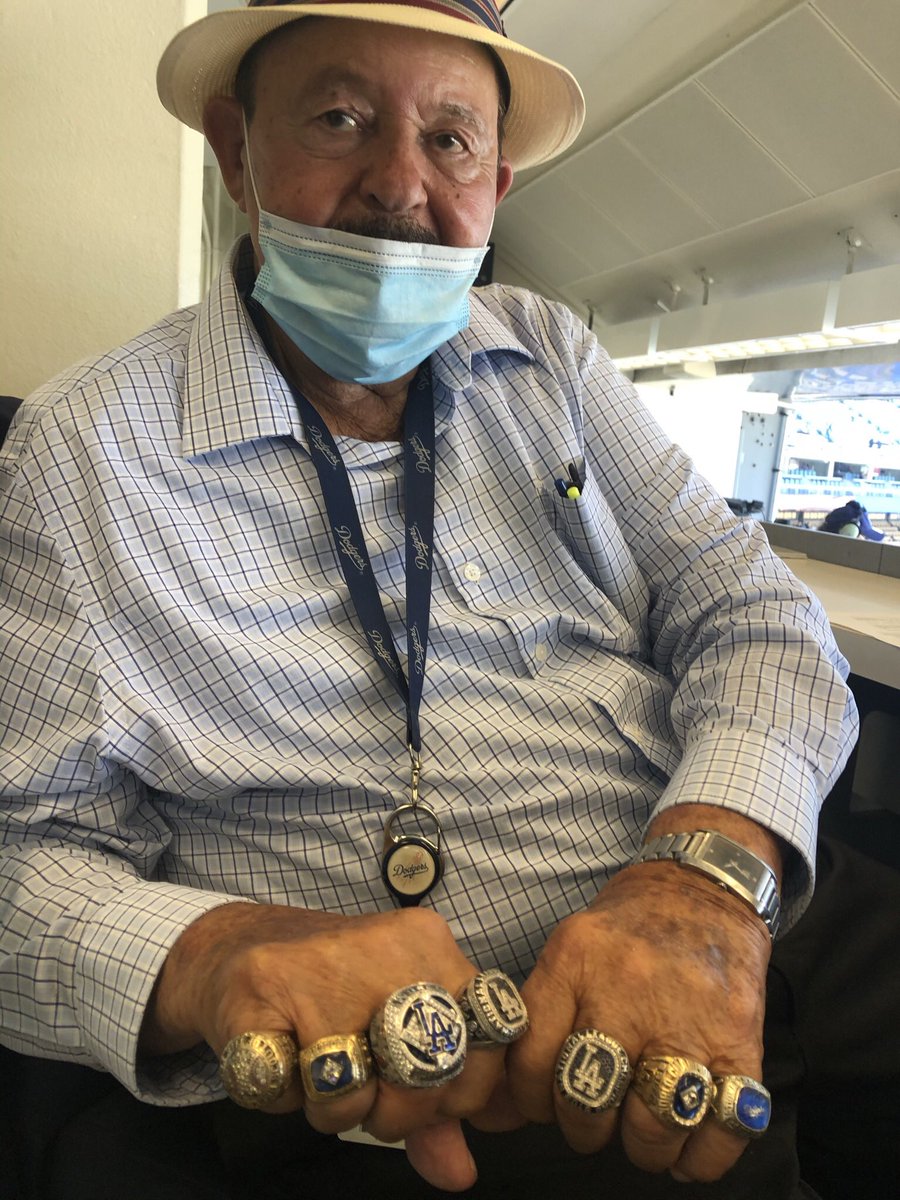
Jay Jaffe: Also wanted to share this obituary of Dodgers superscout Mike Brito, who passed away yesterday at 87. Ubiquitous around Dodger Stadium with his radar gun and his Panama hat, he signed 32 future major leaguers including Fernando Valenzuela, Julio Urías, and Yasiel Puig https://www.baseballamerica.com/stories/obituary-mike-brito-legendary-…
Took this picture of Mike Brito last year. He loved his @Dodgers World Series rings and took great pride in wearing them. Lock them in a safety box? Not for Mike Brito! Loved that he was so proud. RIP to a true baseball man and such a calm, friendly person.
Shohei Ohtani is doing remarkable things again. The reigning AL MVP has been on an exceptional run as a pitcher lately, not only making a bit of history but also bolstering his cases to start the All-Star Game and to win additional hardware. While his hitting was the more amazing of his two endeavors in 2021, his improvements on the mound have pushed him into new territory.
On Wednesday night, Ohtani threw seven innings of two-hit ball against the Marlins, striking out 10 and allowing just one unearned run. That run came in the first inning, as the fans in Miami (they do have those, right?) were still settling into their seats. Jon Berti reached on a throwing error by shortstop Luis Rengifo, took third on a Joey Wendle double, and scored on a Garrett Cooper sacrifice fly. The run ended Ohtani’s streak of scoreless innings at 21.2, the longest of his career, but from there he cruised. He didn’t allow a hit after giving up a one-out single in the second to Miguel Rojas and retired 15 straight batters from that point until he walked Jesús Sánchez with one out in the seventh. For good measure, Ohtani also drove in the go-ahead runs via a two-run single off Trevor Rogers and later walked, stole a base, and scored another run. Nobody has had a game like that in at least the last century.
With his 10 strikeouts, Ohtani reached double digits for the third game in a row, something he’d never done before in his stateside career, and something only one other pitcher (Corbin Burnes) has done this season; six pitchers did it last year, with two (Shane Bieber and Robbie Ray) putting together four-game streaks. Over his past four starts, Ohtani hasn’t allowed a single earned run and has struck out 40 batters, something only seven other pitchers have done (one of them twice) since 1913, the year that earned runs became an official stat:
40 Strikeouts and No Earned Runs in a 4-Start Span
That’s some pretty cool company, even if the list heavily skews towards the recent past thanks to ever-increasing strikeout rates — so much so that Ohtani required fewer innings to complete the feat than all but one pitcher (Sale). It’s also worth pointing out that none of the aforementioned hurlers were regularly taking their cuts as hitters on the days they weren’t pitching. Read the rest of this entry »
The Giants won a franchise-record 107 games last year, then reloaded after being knocked out of the Division Series by the Dodgers. But since posting a 14-7 record through the end of April, things haven’t gone their way. Though they snapped a six-game losing streak with a late-inning comeback against the Diamondbacks on Wednesday night, they’ve dropped 12 of their last 16 games, largely against sub-.500 teams. As the season’s midway point approaches, they’re barely above .500 at 41-39, and what’s more, they just lost their hottest hitter, Evan Longoria, to an oblique strain.
It’s not clear at this writing how Longoria was injured, but losing him is a blow nonetheless. The 36-year-old third baseman is hitting .242/.331/.462 with eight home runs; his 123 wRC+ is fourth among Giants regulars. In the two weeks prior to his injury, as the team has struggled, he hit for a team-high 166 wRC+ (.316/.413/.553) with three of those eight homers.
Longoria already missed the first 30 games of the season due to surgery to repair a torn ligament in his right index finger, making this the fifth straight season in which he has landed on the injured list. Last year, he was limited to 81 games due to a dislocated sternoclavicular joint in his left shoulder as well as a right hand contusion. In 2020, he missed the first seven games of the season due to an oblique strain; reportedly, he tweaked the muscle on his right side while swinging on July 14 of that year and was back in the lineup on July 30. In terming his current strain mild, manager Gabe Kapler offered similar optimism that this won’t be a long-term absence, though Longoria is out through at least the All-Star break. Read the rest of this entry »
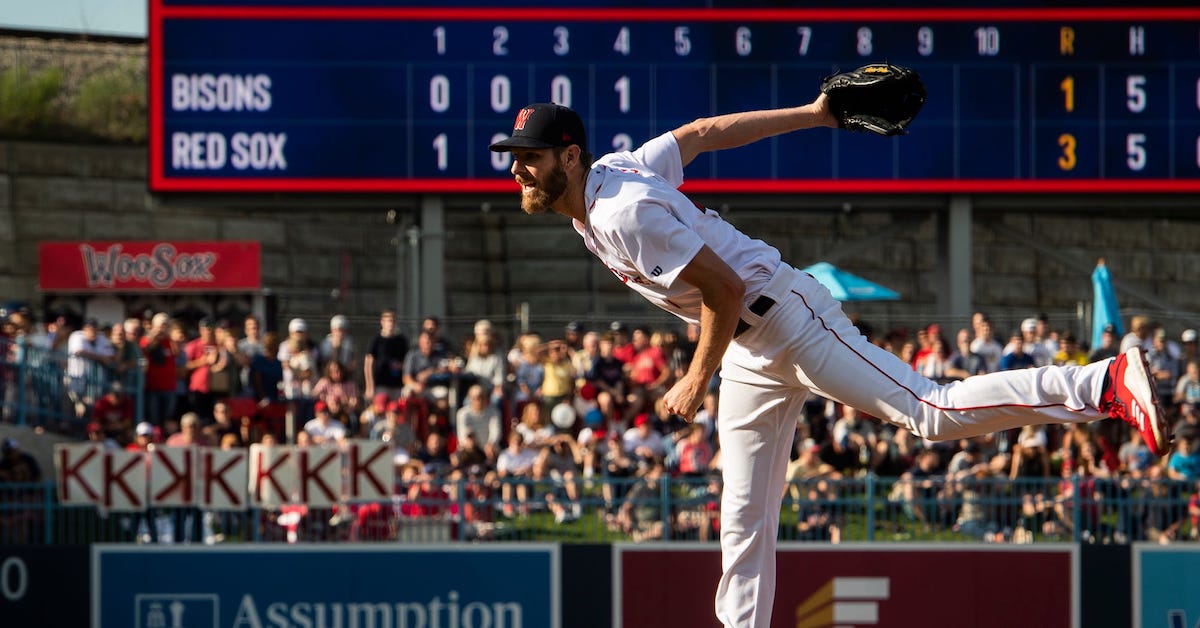
The Mets aren’t the only team awaiting an ace’s return from injury. Chris Sale is scheduled to start for the Red Sox’s Triple-A Worcester affiliate on Wednesday, and if all goes well, the 33-year-old lefty could join the big club after that, in time to help a team whose rotation is looking rather threadbare as it heads into a crucial stretch of the season. While Sale pitches for Worcester, fast-rising prospect Brayan Bello — whose rotation slot Sale is filling — will debut in Boston against the Rays.
After winning 92 games and falling just two wins short of a trip to the World Series in 2021, the Red Sox stumbled to a 14-22 start, and were just 23-27 at the end of May. Though they went 20-6 in June, they actually lost ground to the Yankees, who went 22-6. After splitting their first four games of July, they’re 45-36, 13 games out of first place, and while they now occupy the top AL Wild Card spot, they’re about to face a major test. The three-game series they began on Monday kicked off a brutal 27-game stretch against teams .500 or better, with seven apiece against the Rays (44-37) and Yankees (58-23, a 116-win pace) followed by three against the Blue Jays (44-38), four against the Guardians (40-39), three against the Brewers (47-36) and three against the Astros (53-27).
That’s a weighted opponents’ winning percentage of .595 for that span, a 96-win pace over the course of 162 games, with all but Cleveland currently occupying a playoff spot. The good news for the Red Sox is that 17 of the 27 games are at home, but the bad news is that their rotation currently has three starters (Nathan Eovaldi, Rich Hill, and Garrett Whitlock) on the injured list and a fourth (Michael Wacha) whose status is in question after being scratched on Sunday, forcing manager Alex Cora and chief baseball officer Chaim Bloom to piece things together on a day-by-day basis. Hence the higher stakes when it comes to the progress of Sale and the debut of Bello. Read the rest of this entry »
For the Mets, help is on the way at long last in the form of a pair of multiple Cy Young award winners. On Sunday, Jacob deGrom dominated in his first rehab start for the team’s Single-A affiliate, his first competitive start in nearly a year, and on Tuesday, Max Scherzer is scheduled to start for the big club for the first time in nearly seven weeks. The two aces should provide a boost for a team whose lead in the NL East has dwindled since reaching double digits at the end of May.
The 34-year-old deGrom, who had been sidelined since March 27 due to a stress reaction in his right scapula, struck out five of the six hitters he faced for the St. Lucie Mets, reaching 100 mph with his four-seam fastball against the first three of those hitters. Wearing a garish camouflage-and-stars-and-stripes jersey, he threw 24 pitches, 18 for strikes; the only blemish on his performance was hitting the Jupiter Hammerheads’ Ian Lewis in the foot with a cutter.
That was deGrom’s first competitive appearance since last July 7, interrupting what had the look of a season for the ages. Through 15 starts and 92 innings, he had pitched to a 1.08 ERA and 1.24 FIP, striking out 45.1% of all hitters, walking just 3.4%, and averaging 99.2 mph with his fastball. His elbow couldn’t handle the stress, though not until September was his “inflammation” revealed to be a low-grade sprain of his ulnar collateral ligament. The two-time Cy Young winner, who underwent Tommy John surgery back in October 2010, shortly after completing his first professional season, thankfully did not need surgery to heal this time around. “I have been told my UCL is perfectly fine,” he said in mid-March, before his shoulder injury.
By his own description at least, his shoulder is fine as well. “I felt like I had control of everything — the main thing was trying to locate the fastball and pitch off that. Everything felt good,” he said after Sunday’s start. “[My shoulder] feels 100 percent. Because it was bone… you can’t really push it. I had to wait until the bone was healed and move forward from there.”
DeGrom said he expects to make at least one more start for St. Lucie. He’ll probably need a couple of additional turns at higher levels to build his pitch count to the point of a late-July return to the Mets. Expecting him to pick up where he left off a year ago is probably a recipe for disappointment given how far off the charts that performance was, but the bar for him to improve the team’s outlook isn’t nearly that high.
As for Scherzer, he pitched to a 2.54 ERA and 2.96 FIP and struck out 30.6% of hitters through his first eight starts as a Met before straining an oblique muscle in his May 17 start. His 47-day stay on the injured list is the longest of his major league career, capped by a pair of starts for the Double-A Binghamtom Rumble Ponies late last month, with pitch counts of 65 and 80. The 37-year-old three-time Cy Young winner additionally made quite an impression by treating his teammates to a feast of bone-in ribeye, filet mignon and lobster that reportedly cost upwards of $7,000; he also purchased a pair of AirPods headphones for each teammate. In Tuesday’s return against the Reds, he’s expected to throw about 90 pitches over six innings.
When Scherzer landed on the IL, the Mets were 26–14, seven games ahead of the pack in the NL East. By the end of the month, they were 34–17, their third-best mark through 51 games, behind only their celebrated 1986 and ’88 teams. Additionally, their 10.5-game lead through the end of May was the third-largest of any team since division play began in 1969, trailing only those of the 2001 Mariners and ’17 Astros. The Mets couldn’t maintain that pace in June, however, going just 13–12 against a difficult schedule that included the Dodgers, Padres, Brewers, and Astros, against whom they went a combined 5–9. Though they’ve perked up via a 3–1 start in July, the surges of the Braves (24–6 since the end of May) and Phillies (21–9 in that span) have narrowed their cushion to four games.
Through the end of May, the Mets had outscored opponents by nearly a run and a half per game, but since then, they’ve been outscored by about four-tenths of a run per game:
The Mets’ June Swoon
Period
W
L
Win%
RS
RA
PythW-L%
April/May
34
17
.667
5.22
3.80
.641
June/July
16
13
.552
4.07
4.48
.456
SOURCE: Baseball-Reference
During both segments of the season, they’ve outplayed their Pythagorean winning percentage, with a trio of particularly lopsided June losses (13–2 to the Padres on June 8, 10–2 to the Brewers on June 15, 9–1 to the Astros on June 28) distorting their run differential. Take those away and they have a 4.35 to 3.77 advantage in per-game scoring since the start of June, as well as a .565 Pythagorean percentage. Alas, those games did happen, they did count, and the pitching staff is showing some wear and tear:
Mets Pitching by Months
Starters
ERA
FIP
K%
BB%
HR/9
April/May
3.83
3.76
22.4%
6.7%
1.02
June/July
4.53
3.95
26.9%
6.9%
1.45
Relievers
ERA
FIP
K%
BB%
HR/9
April/May
3.50
3.52
27.7%
9.3%
0.99
June/July
3.79
4.34
25.8%
9.5%
1.44
Most of the deterioration in the team’s pitching owes to the long ball, though to be fair, there’s a lot of that going around, as the major league home run rate has risen from 1.02 per nine innings in April and May to 1.21 per nine since. The problem has been particularly acute for Carlos Carrasco (2.04 per nine in June and July), Tylor Megill (2.70) and Trevor Williams (4.26) — the last two in particularly small samples, admittedly — and has driven the overall downturn in their performances.
The 35-year-old Carrasco is the only Met to make a full complement of starts (16) thus far, that after making just 12 starts last year due to a right hamstring injury. He pitched to a 3.98 ERA and 2.79 FIP through the end of May thanks to improved results on his slider and changeup, both of which got whacked around last year. While he began June with strong starts against the Nationals and Padres, he was bombarded for seven homers and 19 runs in 17.2 innings over a four-start stretch against the Angels, Marlins, and Astros (twice), allowing more runs than innings pitched in all but the Miami start. He did pitch well against the Rangers on Sunday (5.2 innings, one run, eight strikeouts), lowering his ERA to 4.64 and his FIP to a more respectable 3.68, but batters have slugged .439 or better against all four of his main offerings (four-seam, sinker, slider, and changeup) in June and July, a trend that could be hazardous if it continues.
The 26-year-old Megill turned in some impressive outings early in the season, highlighted by his throwing the first five innings of the team’s combined no-hitter against the Phillies on April 29, but after being torched for eight runs in 1.1 innings on May 11, he landed on the injured list with biceps inflammation. Upon returning a month later, he yielded six runs in 6.2 innings over two starts, suffered a shoulder strain and was shut down; he’s now on the 60-day IL, meaning that the earliest he could return would be mid-August. As for the 30-year-old Williams, he’s been very useful out of the bullpen (2.00 ERA, 2.62 FIP in 18 innings), but his performance in the rotation (5.86 ERA, 6.27 FIP in 27.2 innings) has been erratic at best.
Fortunately, Taijuan Walker has done good work (2.72 ERA, 3.09 FIP) in making 14 starts, and Chris Bassitt has been solid (4.01 ERA, 3.92 FIP), though the latter just landed on the IL in Friday with what is reportedly a bout of COVID-19. David Peterson has done the bulk of the fill-in work in the absence of Scherzer and other injured pitchers and has been the unit’s unsung hero, posting a 3.24 ERA and 3.78 FIP in 58.1 innings.
For as fluffed-up as the Mets bullpen’s ERA has been since June, there’s been some very good news, in that Edwin Díaz has been absolutely lights out. Since blowing a save against the Giants on May 24, he’s allowed just one run in 13.2 innings, pitching to a 0.66 ERA and -0.25 FIP (yes, negative) and striking out 54.7% of batters faced. Overall, he owns a 1.93 ERA and 1.63 FIP and has allowed just one barreled ball all season. Meanwhile, Adam Ottavino is showing signs of returning from his wilderness years with the Yankees and Red Sox; since the start of June, he’s posted a 0.71 ERA, and overall for the season he’s carrying a 2.67 ERA and 3.28 FIP. On the down side, the struggles of lefties Chasen Shreve and Joely Rodríguez stand out, with the pair combining to allow 15 runs in 17 innings since the start of June. As a group, Mets lefty relievers (mainly that pair plus a couple of spot appearances) allowed a .283 wOBA through the end of May, but that’s up to .363 since, giving general manager Billy Eppler something to add to his trade deadline shopping list.
The Mets’ offense isn’t blameless when it comes to the team’s recent struggles, dipping from a 116 wRC+ through the end of May to 99 since. Unlike the rotation, there’s no cavalry on the immediate horizon, but given the 45 wRC+ they’ve received from catchers Tomás Nido, James McCann, and Patrick Mazeika, the possibility of recalling top prospect Francisco Álvarez offers some appeal. The 20-year-old backstop, who placed seventh on our preseason Top 100 Prospects list, was just promoted to Triple-A Syracuse, however, and the Mets aren’t likely to rush him to the majors.
In the grand scheme, a Mets team that has gotten a combined eight starts from its two aces through the first half of the season has played .625 ball nonetheless. The team already owns a 97.9% chance at a playoff spot and a 51.7% chance at a first-round bye, and the returns of Scherzer and deGrom will soon overshadow their June swoon.


 Jay Jaffe

 man and such a calm, friendly person.