Who was the Nationals’ best player in 2022? Before you try to answer, I should acknowledge that this is not a fair question to ask. For starters, it’s a trick question. More importantly, you haven’t been watching the Nationals. You’ve been doing the best you can to avoid even thinking about the Nationals. That’s called self-care, and I commend you for it. Even the Nationals’ general manager called it “a daily grind to come here and lose baseball games.” He also called trading Juan Soto a “courageous move by ownership,” so maybe don’t listen to him.
Regardless, go ahead and give it a shot! Keibert Ruiz would be a reasonable guess. The promising young catcher posted 1.7 WAR this season. You could also be forgiven for going with Joey Meneses, who put up 1.5 WAR in just 228 plate appearances since his promotion in August. Read the rest of this entry »
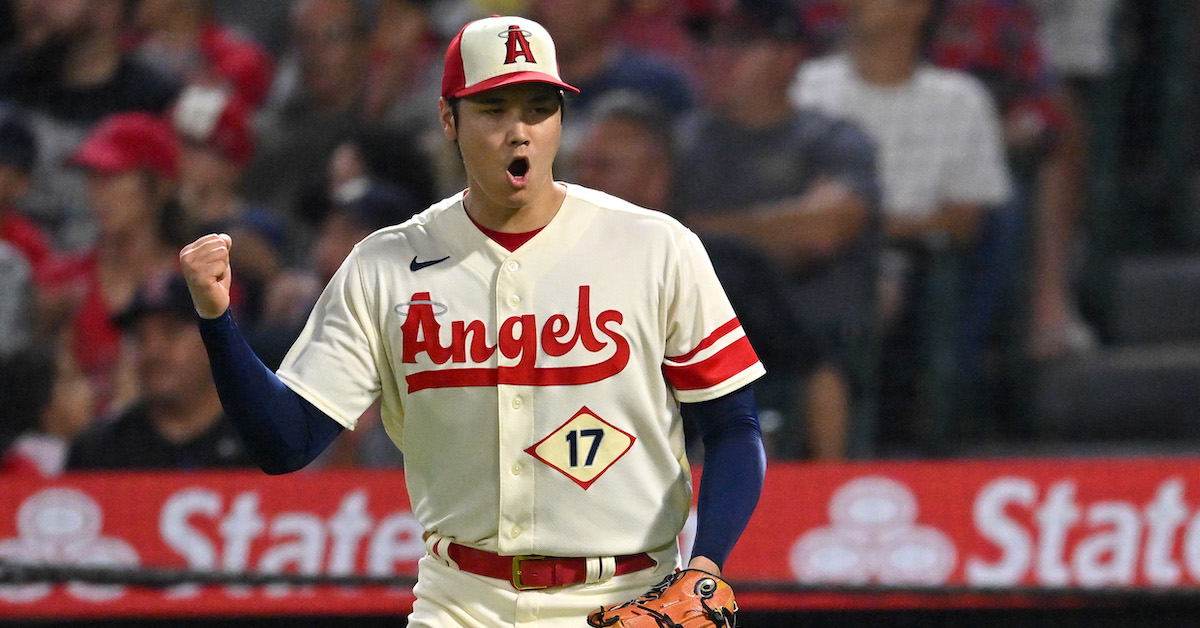
Shohei Ohtani is one of the best pitchers in baseball and one of the best hitters in baseball. That’s the first thing everyone thinks when his name comes up, and it always will be. He pitches and hits! How could you talk about anything other than that?
While that’s true, it’s leaving out something important. Ohtani is fascinating not just because he’s a two-way player, but because he’s completely overhauled his pitching approach in the middle of his best season yet. When Ohtani threw eight two-hit innings in his latest start, he hardly resembled the pitcher he was in 2021 – or even early in 2022.
When Ohtani pitched and hit his way to the American League MVP award last year (my colleague Jay Jaffe recently covered his quest to defend that title), he did so with a garden-variety pitch mix. He relied most on his four-seam fastball and complemented it with two plus secondaries, a slider and a splitter. He mixed in the occasional cutter and curveball, but mostly stuck with his best three offerings. It’s a classic pairing: fastball, breaking ball, offspeed pitch. It worked because all three pitches are excellent; if you had a 100 mph fastball, a fall-off-the-table splitter, and a biting slider, you’d probably do the same.
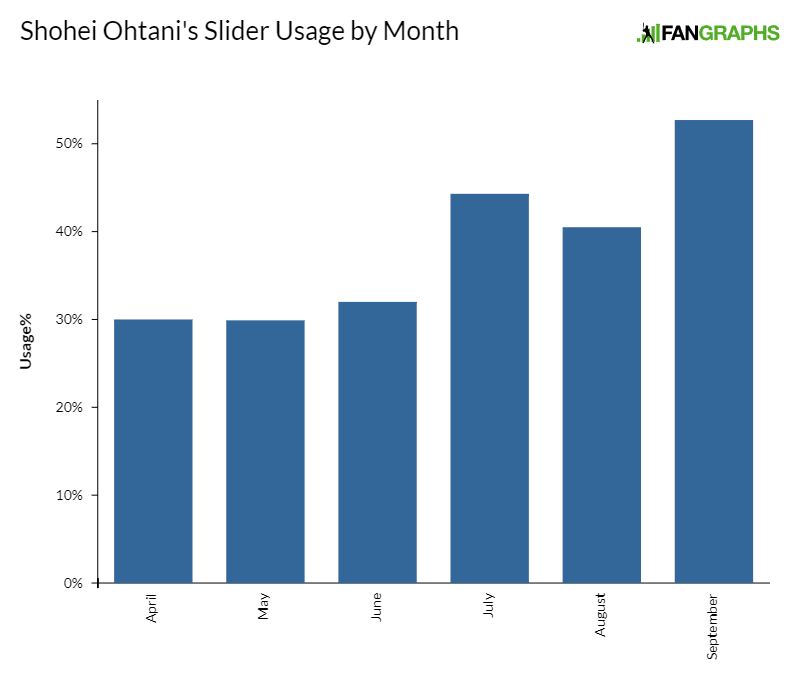
Over the offseason, though, Ohtani overhauled his slider. He came out this season throwing it harder and more frequently. In his third start of the year, he flirted with perfection against a loaded Astros lineup, and from that point on, he was a slider-first pitcher. Look at his slider usage by month this year and marvel:
Dave Raymond has fond memories of June 13, 2012. Then in his final year as a broadcaster for the Houston Astros, the now TV play-by-play voice of the Texas Rangers got to call a historic pitching performance — and it wasn’t even his biggest thrill of the day. Prior to the game, he was in the presence of a legend.
Raymond had an inkling that the season would be his last with the Astros. He was in the final year of his contract, and an ownership transition was resulting in numerous changes throughout the organization. With his future up in the air, Raymond decided that he was going to “hit all the high notes,” making sure to enjoy aspects of his job that can sometimes be taken for granted. That’s how he met Willie Mays.
“In San Francisco, Willie was always down in the clubhouse, just available to chat,” recalled Raymond, who graduated from Stanford University before becoming a broadcaster. “I’d never wanted to bother him all those years, but I decided to make it a point to talk to him, whether that was for five minutes, 10 minutes, or whatever. So I went to the ballpark early, hoping to ask him some questions and hear a few stories. For instance, he’d hit his 500th home run at the Astrodome, and they’d brought him a cake afterwards.”
The hoped for five-to-10 minutes ended up being far longer. Mays held court for hours, to the point where Raymond had to tell the iconic Hall of Famer that he needed to head upstairs, as the game was about to start. As he was getting up to leave, he added that the Astros would be returning to San Francisco right after the All-Star break, and maybe they could talk again. Mays responded by saying, “Well, you’ve got to come over to my house then.” Read the rest of this entry »
It’s been a strange season for Mike Trout, one that’s featured a hot start, an epic slump that accompanied the worst losing streak in franchise history, and a diagnosis of a long-term back injury followed by an absence of 30 games. The good news is that since returning to activity on August 19, he’s gradually recovered his form, and this past week he set a career best by homering in six straight games.
Trout began his streak on September 4 with an eighth-inning homer off the Astros’ Brandon Bielak — the only run the Angel scored in a 9-1 loss — but his next three came against the Tigers (Tyler Alexander, Eduardo Rodriguez, and Will Vest), all in wins. He continued the streak with a homer off the Astros’ Lance McCullers Jr. in a loss on Friday night, but his three-run second-inning shot off José Urquidy on Saturday helped power the Halos to a victory.
In the annals of Halos history, that last home run lifted Trout past Bobby Bonds, who homered in five straight games for the Angels from August 2–7, 1977. The streak additionally pushed Trout past the Rangers’ Corey Seager (July 8-12) for the longest of this year. Trout had already surpassed his personal best of homers in four straight games, set in 2017 (May 12–15) and matched in ’19 (April 4–7). Read the rest of this entry »
Every year, a huge throng of pitchers changes teams at the trade deadline. It happens for obvious reasons: teams with postseason aspirations and second-division pitching staffs try to augment their squad, juggernauts shore up their bullpen, or any of several variations on those themes. For the most part, it’s a simple re-allocation of good pitching: teams that don’t need it this year trade pitchers to teams that do, and reap prospects or otherwise interesting players in return.
Sometimes, though, teams make trades for a slightly different reason. Pitchers aren’t static; you can’t call someone up on the phone and trade for a 3.40 ERA, or 2.4 WAR per 200 innings pitched, or anything of the sort. You trade for a pitcher, and as we detail frequently in the electronic pages of FanGraphs, pitchers change the way they approach their craft all the time. They might take a new approach, or learn a new pitch, or switch roles. Learning a new pitch isn’t practical in the heat of a playoff chase, but changing the allocation of existing pitches is far easier. Let’s take a look at two starting pitchers who have changed their pitch mix significantly since being traded at the deadline, as well as two others who have made smaller changes. Read the rest of this entry »
While Dylan Cease was chasing a no-hitter and Aaron Judge was homering in three straight games, Shohei Ohtani enhanced his own cases for the AL Cy Young and MVP awards. On Saturday, he threw eight innings of one-run ball against the Astros in a game that the Angels won in 12 innings, continuing his dominance of the AL West leaders. On Monday, he homered twice and drove in three runs in a 10–0 rout of Detroit, running his totals to five homers, 10 RBIs, and a .414/.469/1.000 line in a seven-game span against the Blue Jays, Yankees, Astros, and Tigers (oh my!). Much to Tungsten Arm O’Doyle’s chagrin, the Angels even went 5–2 in those games.
A year after winning the AL MVP award for his unprecedented wire-to-wire excellence both as a pitcher and a designated hitter, Ohtani has continued to thrive in both contexts. But where he didn’t get any attention when it came to the 2021 Cy Young race, this season, he’s pitched his way into the picture.
Saturday’s start was Ohtani’s 23rd of the season, matching last year’s total, and he’s now at 136 innings, topping the 130.1 he threw in ’21. His three true outcome peripherals have improved markedly, to the point that he’s shaved nearly a full run off his FIP relative to last season:
Shohei Ohtani Pitching Peripherals
Season
K%
BB%
K-BB%
HR/9
BABIP
ERA
ERA-
FIP
FIP-
2021
29.3%
8.3%
21.0%
1.04
.269
3.18
72
3.52
80
2022
33.0%
6.0%
27.0%
0.93
.298
2.58
66
2.54
62
At this writing, with 136 innings in the Angels’ 136 games, Ohtani is officially qualified for the ERA title, though that won’t be the case after Wednesday night, at least until his number comes up again. In any event, it’s worth pointing out that he has the AL’s highest strikeout rate and is one-tenth of a percentage point behind Shane McClanahan for the K-BB% lead. Meanwhile, he also has the league’s second-lowest FIP, behind only Kevin Gausman’s 2.13. Read the rest of this entry »
When the Cardinals re-signed Albert Pujols in late March, few imagined that the transaction would amount to much more than a victory lap and a nice bit of closure for a 42-year-old all-time great. Though he hit well in limited duty in April, Pujols struggled to such a great extent for the next two months that a midseason retirement wouldn’t have been a surprise. Over the past six weeks, however, he’s been one of the hottest hitters in baseball, and on Saturday, he made a bit of history.
In a 16–7 rout of the Diamondbacks in Arizona, Pujols went 4-for-4 with a pair of homers, both off Madison Bumgarner, with exit velocities of 105.4 mph and 107.5 mph. He also ripped a 109.4-mph single off the left field wall against Bumgarner, then capped his night with a softer single off Chris Devenski.
Via his first homer, Pujols surpassed Cardinals legend Stan Musial for second place in total bases. Not second in team history or second since Babe Ruth, or the start of the integration or expansion eras — that’s second all-time, behind only Hank Aaron:
His was a pretty quiet ascent; few noted Pujols passing Bonds in 2021 or Mays earlier this year.
In celebration of Albert Pujols (@PujolsFive) passing Stan Musial (@stanthemaninc) and becoming 2nd All-Time in MLB history in total bases, I have created a progressive timeline for All-Time Career Total Bases!
Perhaps it shouldn’t be surprising that Pujols ranks so high in total bases given that he’s 10th in hits and fifth in both doubles and homers, but it’s that combination of power and persistence (and a little bit of luck when it comes to time missed) that’s placed him so high. While Pujols lost nearly two-thirds of a late-career season to the pandemic, Musial and Mays each missed a full season of their primes to military service, with the latter losing most of a second one as well. Read the rest of this entry »
It’s the day after the trade deadline, which always means one thing: baseball writers begrudgingly cleaning up their gross, sparkling-water-can-filled workspaces. Oh, wait, actually it means two things: that, and a flood of “who won the trading deadline” articles.
This year, I’m going to do something slightly different. I won’t claim that I’ve re-invented the wheel, but I’ve always thought that those winner/loser columns are too deterministic and don’t leave enough room for nuance. I thought about listing each team that made a trade as a winner, with a “maybe” appended to indicate that we don’t know what will happen in the future; if you really want to know who won and who lost, check back in October… or maybe in October of 2025. I thought about making each team a “loser (maybe)” for the same reason. In the end, I settled on some broad archetypes. I’ll throw a subjective grade on how much I like the move, and also endeavor to explain the risks around each team’s deadline. You can find all of our deadline coverage here. Let’s get started. Read the rest of this entry »
Squeezing in once last deal before the looming deadline, the Braves acquired right-handed reliever Raisel Iglesias from the Angels in exchange for Tucker Davidson and Jesse Chavez. In doing so, they obtained one of the best bullpen arms of the past few years, filling a gap created by the departure of Will Smith (who was traded forJake Odorizzi) and more. The Angels, meanwhile, shed a long-term contract and take on two pitchers who should keep their bullpen in a tolerable state this year and beyond.
Traded to Anaheim before the 2021 season, Iglesias hit the free-agent market that winter but quickly signed a hefty four-year, $58 million deal to return to the Angels. It made sense: If you have a lights-out closer, as he was in ’21, and see a window of contention, it’s a darn good idea to keep him around for as long as possible. And though his on-field results have been a tad disappointing — a 4.04 ERA, the third-highest mark of his career — his peripherals suggest he’s no pitcher on the decline. His 3.17 FIP is much better, and so is his 3.05 xFIP; he’s striking out fewer batters and walking slightly more, but he’s also giving up fewer home runs. And though the velocity is down a tick, the swinging-strike rate on his fastball hasn’t wavered.
I’m only human, but it’s clear that the computers also agree Iglesias is in no imminent danger of falling off a cliff. Check out his ZiPS projection for the remainder of his contract, courtesy of Dan Syzmborski:
ZiPS Projection – Raisel Iglesias
Year
W
L
ERA
G
GS
IP
H
ER
HR
BB
SO
ERA+
WAR
2023
9
3
2.67
58
0
57.3
43
17
6
13
85
169
1.6
2024
8
3
2.61
52
0
51.7
38
15
6
12
76
173
1.5
2025
7
3
2.66
52
0
50.7
38
15
6
12
74
169
1.4
That is… very good. So much so that, surprisingly, the Braves have agreed to take on the entirety of Iglesias’ contract. The righty reliever is owed $10 million this season, followed by $16 million annually from 2023 to ‘25, and while that’s not an insignificant sum, a reliever of his caliber is hard to come by. Outside of Edwin Díaz, the market for an A-list reliever should be thin this offseason, and what the Braves need to do as they nip at the heels of the Mets is improve at the margins. It’s not unreasonable they’re going all-in on with Iglesias. Read the rest of this entry »
Syndergaard is more famous name than elite starter at this point. His early-career dominance with the Mets was all blazing fastballs and bat-missing secondaries; his second act with the Angels has looked completely different. As Jay Jaffe detailed back in June, he’s more pitch-to-contact than thunder-and-lightning, using his sinker and curveball as the focal point of his arsenal rather than the four-seam/slider combination that worked so well for him in New York.
The new-look Syndergaard is still a perfectly fine pitcher, just of a different sort than his pre-injury self. Pumping mid-90s sinkers and avoiding walks has worked out well for him, to the tune of a 3.83 ERA and peripherals that jibe with that general level of effectiveness. Syndergaard’s command has always been an underrated asset; even at his firebreathing peak, he never walked many batters, and that skill has served him well even as the bat-missing stuff hasn’t quite returned. Read the rest of this entry »